Home Blog Page 6332

Bea Alonzo, Alden Richards are the faces of Century Tuna’s healthy living campaign

ACTORS Bea Alonzo and Alden Richards are the new ambassadors for the food and beverage company Century Tuna.

Mr. Richards was a Century Tuna endorser in 2020, and is now joined by Ms. Alonzo for the “Love Strong” campaign which connects a healthy lifestyle with the pandemic.

“As we are living through the pandemic, we know that health becomes more important and the context of health is also changing,” said Carlo Endaya, Vice-President and General Manager of Century Pacific Food, Inc., during the launch of this year’s Century Tuna Superbods on June 3 at the Sofitel Philippine Plaza Manila. “So, having a fit body is now not just about vanity, but also having a fit and healthy body makes sure that we can care for the people around us.”

Of the new brand ambassadors, Mr. Endaya said: “We were looking for people who had a strong influence and are role models to people around them, and we want them to inspire people to become healthier.”

“I’m inspired by the idea of Century Tuna to really associate the campaign with what we’ve been through which is the pandemic,” Mr. Richards said. “We have to take care of our body, our health, because there are a lot of people depending on us,” he added.

Aside from his projects as an actor, Mr. Richards runs the AR Foundation, an organization he founded which gives scholarships to underprivileged children.

For Ms. Alonzo, the “Love Strong” campaign means “to have a healthy body for the people to depend on me.”

“You have to stay strong to love strong,” she said, adding that for the campaign, she was motivated to work out and eat right without compromising her mental health.

SUPERBODS FINALISTS
At the same event, the 32 Century Tuna Superbods Competition finalists were revealed.

The competition was introduced in 2006 with the aim of inspiring people to live a more active and healthier lifestyle.

“We used to have this at Boracay and it was a small event,” said Greg Banzon, Executive Vice-President and COO of Century Pacific Food. “Most of the people who joined were just models.”

“Today, it’s really about people who are going through a journey and are able to inspire,” he said.

In the female category, the 16 finalists are Andrea Abalos, Christelle Abello, Michelle Arceo, Xandria Bautista, Sherlyn Doloriel, Lovely Elazegui, Vienne Feucht, Querubin Gonzales, Mary Gonzalez, Julia Mendoza, Nadia Mostoles, Chrystalle Omaga, Kerri Reilly, Selena Reyes, Mia Salisbury, and Kim Velasco.

Meanwhile, the 16 male finalists are George Baker, Kirk Bondad, Edison Borja, Wani Manotoc, Herson Parias, Paul Pedley, Gee Plamenco, Jr., Patrick Ramirez, Lourd Ramos, Anjo Resurreccion, Ramon Reyes, Julian Roxas, Jaime Santamaria, Jean Santos, Mark Soriano, and Erik Visser.

They will compete for the title on July 13 at the Sofitel Harbour Tent in Pasay City.

Other events leading up to the finals include the Superbods fitness workshop on June 11 and digital challenges on June 18, 25, and July 2.

The two winners of this year’s Century Tuna Superbods will win P500,000 (tax free) each. The two runners up will receive P200,000 each, (tax free). All four winners will also receive a year’s worth of Century Tuna products. — Michelle Anne P. Soliman


DMCI Homes turns over Prisma Residences units

Prisma Residences

UNITS at the first tower of Prisma Residences are now being turned over to homebuyers, DMCI Homes said.

In a statement, DMCI Homes said the 42-storey Astra is the first to be completed of the three towers at the Prisma Residences development along Pasig Boulevard corner C.P. Garcia Avenue (C5 Road).

“Backing the workmanship in every unit is a two-year warranty for most deliverables,” the company said.

Prisma Residences offer units with one to three bedrooms. Amenities include an open lounge, Sky Lounge fitness gym, and gardens.

DMCI Homes said construction work continues on the two towers Celeste and Kiran, which are on track to be completed in April 2023 and April 2024, respectively.

Prisma Residences was put on the market in 2017.

GCash sees growth in transactions despite opening of economy

INSTAGRAM.COM/GCASHOFFICIAL

GCASH, operated by Globe Fintech Innovations, Inc. (Mynt), announced on Monday that it breached the P500-billion mark in gross transaction value in March.

This shows that the finance application thrives even as the economies open up, according to the company.

“Active GCash users are now 5x larger than the next e-wallet, with daily logins and transactions of up to 29 million and 19 million, respectively,” it said in an e-mailed statement.

GCash said 60 million Filipinos are registered in the e-wallet platform. Hence, it is looking for more solutions to address other financial needs.

“With GCash reaching out to the unbanked population, its GSave savings account now has 5.3 million depositors. Its investment marketplace, GInvest, has 3 million registered users representing 77% of the Unit Investment Trust Fund (UITF) accounts in the Philippines,” the company noted.

“GCredit, the first foray of GCash into digital lending, has already provided P29-billion worth of credit lines to qualified users since its launch in 2018, while quick cash loan platform, GLoan, has handed out P2.2-billion worth of loans in just ten months of operations,” it added.

GCash likewise said that its “buy now, pay later” feature GGives has disbursed P130 million in partnership with 85,000 merchants since its accessible installment offer was launched in December last year.

The finance application has expanded its cash-in and cash-out outlets to 232,000.

At the same time, the company said it expects to end 2022 “at positive profitability and even better levels than last year.”

GCash recently partnered with Hong Kong’s TNG Wallet to provide a remittance solution for overseas Filipinos.

The partnership seeks to enable Filipinos in Hong Kong to send money directly to GCash Wallet users in the Philippines via the TNG Wallet app.

GCash said in February that it had more than tripled its gross transactions last year to P3.8 trillion from P1.2 trillion in 2020.

It ended 2021 with 55 million registered users, 4.5 million merchants and social sellers, and around 174,000 cash-in and cash-out agents.

GCash achieved profitability three years ahead of its target, the company said in a statement.

It became the only double unicorn in the country last year, reaching a valuation of more than $2 billion. — Arjay L. Balinbin

FSCC releases systemic risk crisis management framework

THE BANGKO SENTRAL ng Pilipinas (BSP)-led Financial Stability Coordination Council (FSCC) introduced a framework to identify and manage risks in the financial system through a structured monitoring and evaluation process.

The Systemic Risk Crisis Management (SRCM) framework launched on Monday is meant to allow the FSCC to evaluate where vulnerabilities lie in the financial system and what interventions should be done to prevent systemic risks, or problems faced by any entity that could affect the rest of the economy, from progressing into crises.

“The SRCM is a strategic document that highlights how are ongoing tasks contribute to crisis management and identifying initiatives which we believe are needed moving forward. As we develop the tactical plans that underpin this strategic document, the SRCM is thus a living document that evolves with the market and the needs of its stakeholders,” BSP Governor Benjamin E. Diokno said during Monday’s launch.

BSP Senior Assistant Governor and FSCC Technical Secretariat Head Johnny Noe E. Ravalo said at the launch that the framework is a “decision tree” to help authorities decide whether an event is a material or systemic risk while preparing to avoid the occurrence of such risks.

“A lot of this is premised on preemptiveness. And that’s why we actually do…the macroprudential stress tests, the simulations, before a crisis happens so we understand what the spillovers would look like, who will get affected if a particular firm or industry or an economic shock that’s happened throughout the system,” Mr. Ravalo said.

“There will always be some vulnerability that will drive markets… The point of the SRCM is not to forecast. But the point of the SRCM is to be prepared for the next crisis,” he added.

The SRCM document said a disruption’s impact on the economy is the “ultimate barometer” for qualifying it as systemic.

“Taken from a different standpoint, it is not the magnitude of the initial shock, but rather how the shock can potentially amplify to affect different elements of the broader economy… Taking this further, the FSCC argues that a “crisis” has arisen or about to arise if the disruptions caused by the systemic risks are expected to have significant socio-economic effects, in whole or in parts of society,” it said.

The framework outlines the procedures to be followed by FSCC member agencies in managing systemic risks.

At present, the FSCC said it is able to map out the network linkages between conglomerates and the banks using actual data on credit exposures. This network reflects the channels through which risks can be transmitted.

Under the SRCM framework, if there is a potential systemic risk that is macro-financial and seen negatively affecting the macroeconomy, the FSCC should take direct jurisdiction and make “concrete and timely” interventions to stem further deterioration of the situation.

“It should be stated clearly and categorically that the objective is not to prevent the closure of a financial institution, particularly a bank… The task of this SRCM is to instill a framework for the oversight of the entire financial system, cognizant of the interlinkages between stakeholders, and having in place an organized mechanism for handling systemic crises.”

The framework also said the FSCC should have a communication campaign for systemic risks to periodically update the public about these kinds of situations without being alarming, as well as a crisis management team.

A surveillance mechanism is also suggested to help the FSCC understand market behaviors and the interconnectedness among firms and industries to help it identify triggers to predict where a systemic risk could stem from and who would get affected if any entity were to have problems.

The framework also stressed the need to have financial safety nets, including deposit insurance, prudential regulation and resolution mechanisms, to increase market resilience.

Under the SRCM framework, regulators must require financial market infrastructures to have business continuity plans to show critical dependencies in their functions and across other entities in the market.

Macroprudential stress tests and crisis simulation exercises also need to be conducted to detect vulnerabilities in the system. According to the framework, the FSCC has designed a macroprudential stress test that “specifically incorporates a network among firms so that the link between private entities and the financial market can be simulated” that should be undertaken soon.

“Systemic risk analysis is preemptive and as such, the authorities take preemptive measures in assessing the state of stability. Since complex systems are defined by the changing risk behaviors among interconnected participants, the analysis needs to preserve the linkages while testing for how risks are transmitted and magnified,” it said.

The SRCM framework also discusses specific risks that are being monitored by the FSCC, such as cyber events amid growing digital transactions and climate-related stability risks.

If systemic risks escalate into a crisis, the FSCC must declare it as such and ensure this is managed and communicated to stakeholders immediately. Actions to address a crisis include policy interventions and the assessment of their effectiveness in containing the crisis. 

Once the immediate shocks of the crisis are addressed, the FSCC will need to craft an exit strategy from crisis management protocols to see if the interventions address structural vulnerabilities — meaning they must be retained post-crisis — or only temporary imbalances, which means they should be unwound.

A post-crisis report will also need to be prepared and must include recommendations to avoid the future occurrence of the crisis, such as possible adjustments to market protocols, regulation or legislation.

The FSCC is an interagency council composed of the officials of the BSP, the Department of Finance, the Securities and Exchange Commission, the Insurance Commission, and the Philippine Deposit Insurance Corp.

The council’s Executive Committee is chaired by the BSP chief and is composed of the top officials of member agencies. The National Treasurer may also be invited to the meetings of the committee as a special non-voting member. — K.B. Ta-asan

Entertainment News (06/07/22)

Blue Is Not My Favorite Color

CCP Arthouse Cinema screens LGBT films

THE LIVES and struggles of the LGBTQIA+ community is the focus of the special screening of selected Cinemalaya and Gawad Altenatibo films that will be shown on June 10, at 2 p.m., at the Tanghalang Manuel Conde. Celebrate the Pride Month with Eduardo Roy’s F#@*bois, shown back-to-back with short films My Mamily by Cha Roque and Blue Is Not My Favorite Color by Vahn Leinard Pascual. F#@*Bois follows two seasoned beauty pageant contenders who live in a world where donning their bikini briefs is the easiest way to achieve fame and fortune — until an ex-lover threatens to expose them and shock their followers on social media. My Mamily is a short, animated film about the struggles and triumphs of a lesbian family as seen through the eyes of a child. A short animated, documentary film, Blue Is Not My Favorite Color centers on a family photo album that becomes an animated journey for an only-child reflecting on his parent’s belief that a color could influence his gender preference. Interested viewers can pre-register through this link: https://bit.ly/3zcwYW1. Vaccination ID and wearing of face masks are required for those who will be watching. Everyone is advised to follow safety protocols at all times at the venue.

GMA Network’s The Fake Life series

GMA Entertainment Group’s latest Afternoon Prime offering, The Fake Life, directed by Adolf Alix Jr., stars Ariel Rivera, Sid Lucero, and Beauty Gonzalez. Childhood friends Onats (Rivera) and Cindy (Gonzalez), were inseparable as children. But when Onat’s abusive father became too much, he left, found work in the market and continued his studies. Years later, he crosses paths with Cindy and meets her boyfriend, Mark (Lucero) who eventually leaves her. The two friends kindle a new flame, marry, have two children. Then Mark returns and puts a strain on their seemingly perfect relationship. Secrets are brought to the surface, lies become exposed, and Onats finds himself living a fake life. The Fake Life airs on weeknights after Raising Mamay on GMA Afternoon Prime.

Stars play on the Star Magic 30 All-Star Games

STAR MAGIC artists play their favorite sports as KTX.PH streams the star-studded celebrity sports event, Star Magic 30 All-Star Games from June 11 to 26. There is the basketball game between the Star Magic Dream Team led by Donny Pangilinan, Ronnie Alonte, and Elmo Magalona and Team Showtime of Vhong Navarro, Ogie Alcasid, and Ion Perez (P249). Star Hunt’s Basketball teams A and B battle in a friendly game (P199). There is intense volleyball action between the Star Magic Lady Spikers led by Andrea Brillantes, Vivoree Esclito, and Analain Salvador and the Team Star Hunt headed by Missy Quiño, Abi Kassem, and Mikha Lim (P199). In the badminton games (P199), see how Daniel Padilla wins the men’s doubles with Neil Coleta, while Gello Marquez and Naomi Suello win the mixed doubles. Meanwhile, fans can catch the golf tournament (P199), a new addition to this year’s all-star games, where select Star Magic artists swing their clubs and aim for a hole-in-one. For tickets, visit www.ktx.ph.

The search for the Pinoy K-pop Star

TEN candidates vie for the chance to be called Pinoy K-Pop Star when they compete at SM Mall of Asia’s Music Hall on July 16 to be the Philippines’ representative to the 2022 Changwon K-Pop World Festival. The contest is open to a solo, duo, or a group of singers and dancers, 18 years old and above at the time of the competition. Contestants under 18 can join by submitting a waiver from their parents or authorized guardian. Contestants must be a resident and citizen of the Philippines and must perform a K-Pop song from 2020 to 2022. The full contest guidelines can be found on the Korean Cultural Center (KCC)’s official social media sites and through www.tinyurl.com/2022PKSInfo. The deadline for entries is June 26. The grand winner from the Vocal Category, and the grand winner and second placer of the Performance Category will be the Philippines’ official representatives to the 2022 Changwon K-Pop Festival. Aside from the chance to represent the Philippines, the winner will also get P50,000; the second placer and the third placer will get P30,000 and P20,000 respectively.

Gio Marlo releases new single

SINGER-SONGWRITER Gio Marlo releases his new single “Bakit Ba,” about the heartache after the girl of their dreams finds somebody else. The new track follows Marlo’s 2021 single “Akala.” “Bakit Ba” is included on Spotify Fresh Finds PH Playlist and is available to stream on all digital platforms.

D&L sees Q2 growth amid economic recovery

D&L Industries, Inc. said it stands to benefit from the gradual return to normalcy as higher economic activity typically translates to better business for the company.

“In terms of economic activity, it is looking quite good. Knock on wood that no variants will cause restrictions,” D&L President and Chief Executive Officer Alvin D. Lao said during a virtual briefing on Monday.

“A lot of companies whose performance is correlated to the economy should see good performance not just in this quarter, but for the rest of the year,” he said. “It looks like the second quarter will be quite strong in terms of the economy.”

Mr. Lao said that with lower alert levels in place, consumer confidence and mobility continue to pick up as evidenced by the gradual return to normal of road traffic, dining in restaurants, and activity of both domestic and international flights.

“Barring another unforeseen event, simply annualizing the company’s first quarter earnings will yield a projected P3.1 billion in net income for the year, which is already at par with its record net income booked in 2018,” he added.

The company’s Batangas expansion facility will also be operational by January 2023 to support its growing export business.

“The new plant will give D&L additional capacity and upgraded capabilities which will position the company for long-term growth and will enable the achievement of strategic priorities,” the firm said.

On Monday, the company also declared a regular cash dividend of P0.185 per share, plus a special cash dividend of P0.055 per share, to shareholders of record as of June 21.

“This year’s dividend is significantly more than last year’s dividend. Since the initial public offering (IPO), we have declared in cash dividends P13.2 billion. In the last 10 years, we have returned two and a half times the amount raised during the IPO,” Mr. Lao said.

In total, shareholders will receive a P0.24 dividend per share, or a dividend yield of 3.6% based on the June 3 closing price of P6.75.

This year’s dividend amounting to P1.7 billion, or an increase of 26% from last year’s P1.4 billion, is equivalent to 65% of last year’s recurring income. The ex-date is on June 16 and payment will be made on July 15.

The firm said that it is committing to its dividend policy of a 50% payout ratio based on prior year’s net income.

“D&L has also been able to declare special dividends for two years in a row now since it was paused in 2020 due to the uncertainties brought about by the COVID-19 (coronavirus disease 2019) pandemic,” it added.

In the first quarter, net income rose by 12% to P780 million, the highest quarterly income level for the company in three years.

“The strong earnings growth was mainly driven by the continued reopening of the Philippine economy and the implementation of a lower alert level. Consumer confidence and mobility continue to pick up as evidenced by the gradual return to normal of road traffic, dining in restaurants, and activity of both domestic and international flights,” D&L said.

On Monday, D&L shares ended higher by 2.07% or 14 centavos to finish at P6.89 at the stock market. — Luisa Maria Jacinta C. Jocson

Robinsons Land unit names GM for 5-star hotel

General Manager Paul Rene Lee

ROBINSONS Hotels and Resorts (RHR) named the general manager (GM) for its new five-star hotel.

In a statement, RHR said Fili will be one of three hotels to open within the soon-to-open NUSTAR Resort and Casino, an integrated resort in Kawit island, Cebu.

“Fili will be under the direction of General Manager Paul Rene Lee whose years of extensive experience in global hospitality management will serve as a solid foundation for a progressive Filipino luxury hotel,” the company said.

Fili is the five-star brand of the hospitality arm of Robinsons Land Corp.

Mr. Lee has over 30 years’ experience in hotel & luxury resort operations in the United States, China, Thailand, Singapore, among others.

“Fili will embrace the core traits of Filipino culture. The Philippines is globally known for its people’s warmth and friendliness and we want to harness that atmosphere when guests come and visit,” Mr. Lee said.

Fili will have over 300 rooms and suites ranging from deluxe kings, presidential suites and villas. Designed with contemporary Filipino decor, the spacious rooms will have views of the sea, mountains and skyline.

Bianca Pagdanganan limps to 68th overall in US Women’s Open

BIANCA Pagdanganan — REUTERS

BIANCA Pagdanganan failed to make a strong finish in the US Women’s Open, limping with a woeful 11-over 82 to wind up 68th overall on Monday in Southern Pines North Carolina.

Ms. Pagdanganan, who was at four-over through 54 holes, struggled in the final charge with a 38-44 card marred by a pair of double bogeys and eight bogeys against a single birdie.

The 24-year-old Ms. Pagdanganan finished the $10-million major tournament at 15-over 299 to place third-to-the-last among 60 parbusters who survived the halfway cut.

Ms. Pagdanganan, the last Filipino standing after the early exit of 2021 champion Yuka Saso and Dottie Ardina, went home with $19,780 (around P1.046 million).

Australian Minjee Lee succeeded Ms. Saso as the US Open queen after finishing on a 72-hole event record of 12-under 271. Lee matched par in Round 4 to seal a four-stroke victory over American Mina Harigae (72 for 275).

The power-hitting Ms. Pagdanganan was hoping to sustain the charge after climbing to 46th in the third round.

However, three successive bogeys to start the day set the tone for the horrific outing. She yielded one more stroke on No. 3 then birdied the eighth before closing with two double bogeys and four more bogeys.

Stats showed Ms. Pagdanganan driving to an average of 258 yards, missing five fairways and 10 greens and needing 36 putts. — Olmin Leyba

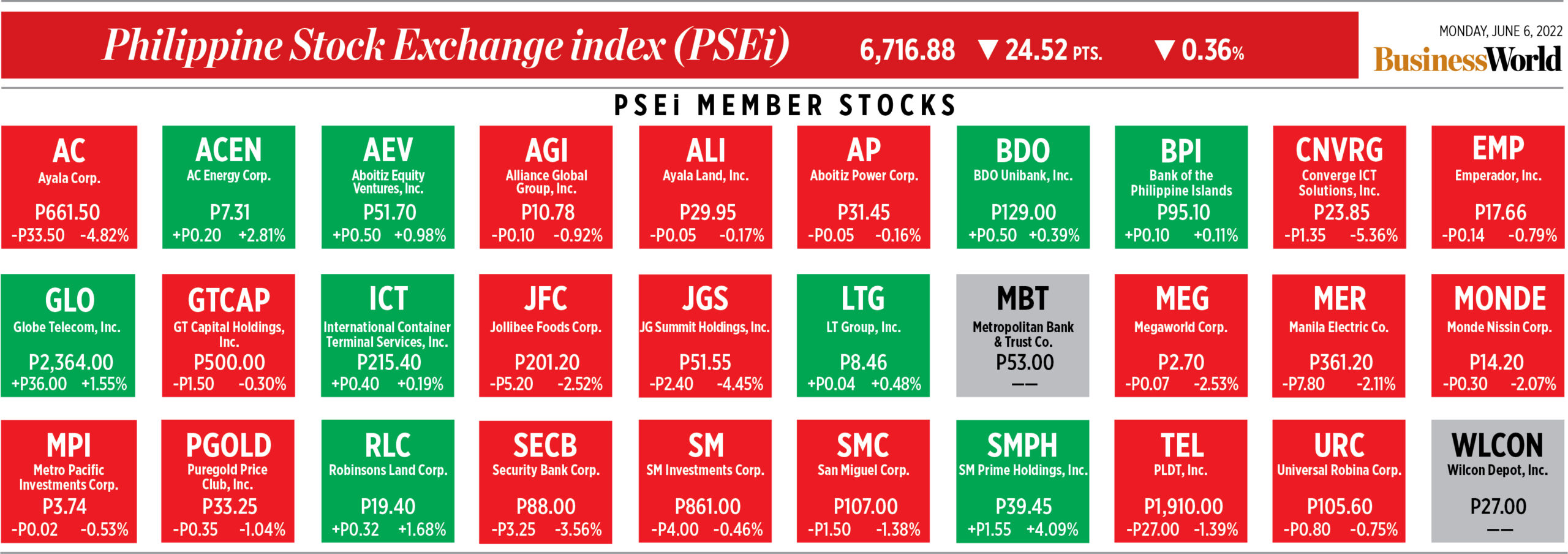
How PSEi member stocks performed — June 6, 2022

Here’s a quick glance at how PSEi stocks fared on Monday, June 6, 2022.


Philippines drops to 57th out of 100 in global startup ecosystem list

The Philippines slipped five places to 57th out of 100 countries in the 2022 edition of research center StartupBlink’s Global Startup Ecosystem Index. The index assessed startup ecosystems across 100 countries based on the total scores on quantity and quality of startups as well as business environment. It also had a separate ranking covering 1,000 cities across the globe. With a total score of 3.302, the Philippines had the seventh-lowest score among its peers in the Asia-Pacific. At the city level, it retained five locations in the rankings. Manila ranked 100th out of 1,000 cities worldwide. Meanwhile, new entrant Naga City (952nd) replaced Baguio City in the latest city rankings.

Philippines drops to 57<sup>th</sup> out of 100 in global startup ecosystem list

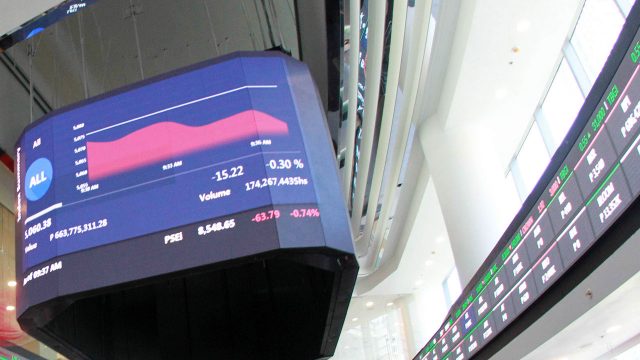
Local shares down on inflation, rate hike fears

STOCKS dropped on Monday amid rising oil prices, which could cause inflation to spike further and cause the US Federal Reserve and the Bangko Sentral ng Pilipinas (BSP) to hike rates further.

The benchmark Philippine Stock Exchange index shed by 24.52 points or 0.36% to close at 6,716.88 on Monday, while the broader all shares index went down by 16.67 points or 0.46% to 3,585.85.

“Philippine shares started the week slipping into the red as investors continued to bet that the Federal Reserve will tighten monetary policy aggressively to combat surging inflation,” Regina Capital Development Corp. Head of Sales Luis A. Limlingan said in a Viber message.

“The local market edged lower this Monday amid the surge in global oil prices and the weakening of the local currency, both of which are seen to pose inflationary risks to our economy,” Philstocks Financial, Inc. Senior Research Analyst Japhet Louis O. Tantiangco said in a Viber message.

Oil prices firmed up after Saudi Arabia raised prices sharply for its crude sales in July, an indicator of how tight supply is even after the Organization of the Petroleum Exporting Countries and other major oil producers or OPEC+ agreed to accelerate output increases over the next two months, Reuters reported.

Brent crude firmed up by 68 cents or 0.6% to $120.40 a barrel at 0640 GMT. US West Texas Intermediate crude futures were up 61 cents or 0.5% at $119.48 a barrel after earlier hitting a three-month high of $120.99.

The US consumer price index  (CPI) for the 12 months through April rose by 8.3%, down from an 8.5% annual rate reported in the prior month. Friday’s inflation report for May is one of the last key pieces of data before the Fed’s June 14-15 meeting, at which the central bank is widely expected to raise rates by another 50 basis points.

In the Philippines, the BSP and analysts expect May headline inflation to have breached 5% amid higher fuel and food prices.

A BusinessWorld poll of 16 analysts held last week yielded a median estimate of 5.4% for May inflation, matching the midpoint of the BSP’s 5% to 5.8% estimate and going beyond the 2-4% goal.

The Philippine Statistics Authority will release the May CPI report on Tuesday, June 7.

The majority of sectoral indices saw losses, except for property, which rose by 64.57 points or 2.08% to 3,165.95.

Meanwhile, mining and oil fell by 267.71 points or 2.14% to 12,198.31; holding firms lost 101.25 points or 1.60% to end at 6,204.36; industrials went down by 93.17 points or 1.01% to 9,119.04; services gave up by 13.27 points or 0.71% to finish at 1,850.26; and financials dropped by 1.81 points or 0.11% to 1,607.87.

Decliners bested advancers, 134 versus 60, while 47 names ended unchanged.

Value turnover increased to P5.94 billion with 1.88 billion shares changing hands from the P4.61 billion with 1.09 billion issues seen on Friday.

Foreigners turned sellers with P287.1 million in net sales versus the P15.21 million in net purchases seen the previous trading day. — L.M.J.C. Jocson with Reuters

Peso ends unchanged vs the dollar

BW FILE PHOTO

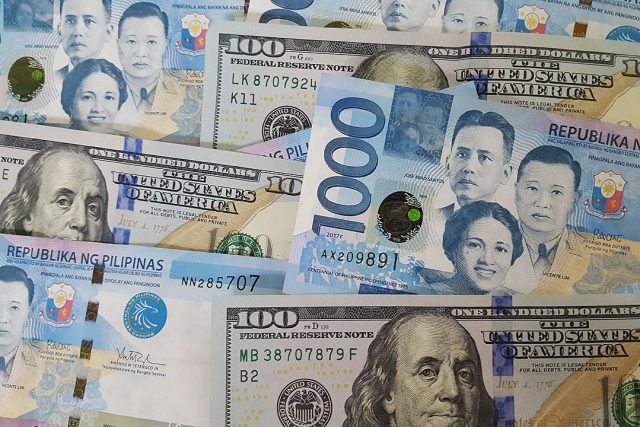
THE PESO ended flat against the dollar on Monday on concerns over further rate hikes here and abroad amid upbeat US employment data and expectations of higher Philippine inflation last month.

The local unit closed at P52.86 on Monday, unchanged from its Friday close.

The peso opened Monday’s session slightly weaker at P52.92 against the dollar. Its weakest showing was at P52.97, while its intraday best was at P52.84 versus the greenback.

Dollars exchanged slipped to $1.079 billion on Monday from $1.128 billion on Friday.

“The peso was unchanged from mixed movements owing to upbeat US employment reports and lingering expectations of a strong BSP (Bangko Sentral ng Pilipinas) rate hike this month,” a trader said in an e-mail.

“The peso exchange rate was slightly weaker today versus the US dollar after generally stronger US jobs/employment data could still support/justify further Fed rate hikes amid continued hawkish signals by most Fed officials…and a day ahead of the latest Philippine inflation data expected to go up to 5% levels,” Rizal Commercial Banking Corp. Chief Economist Michael L. Ricafort said.

US employers hired more workers than expected in May and maintained a fairly strong pace of wage increases, signs of labor market strength that will keep the Fed on an aggressive monetary policy tightening path to cool demand, Reuters reported.

The US Labor department’s closely watched employment report on Friday also showed the unemployment rate holding steady at 3.6% for a third straight month, even as more people entered the labor force.

The Fed has increased rates by 75 basis points (bps) since March. It is expected to hike this by half a percentage point at each of its next meetings this month and in July. 

Meanwhile, in the Philippines, the BSP and analysts expect May headline inflation to have breached 5% amid higher fuel and food prices.

A BusinessWorld poll of 16 analysts held last week yielded a median estimate of 5.4% for May inflation, matching the midpoint of the BSP’s 5% to 5.8% outlook and well above its 2-4% target for the year.

The Philippine Statistics Authority will release the May inflation report on Tuesday, June 7.

BSP Governor Benjamin E. Diokno last month said the central bank is likely to raise key interest rates by another 25 bps at its next policy review on June 23 following a hike of the same magnitude at its May 19 meeting to curb growing inflationary pressures.

For Tuesday, Mr. Ricafort gave a forecast range of P52.80 to P52.95 per dollar, while the trader expects the local unit to move within the P52.75 to P52.95 band. — KBT with Reuters

ADVERTISEMENT
ADVERTISEMENT