Home Blog Page 6270

Globe shares fall amid recession fears

By Abigail Marie P. Yraola, Researcher

AYALA-LED Globe Telecom, Inc.’s share price dipped last week due to a market sell-off prompted by global recession fears and rising interest rates to contain surging inflation.

Data from the Philippine Stock Exchange (PSE) showed 301,005 Globe shares worth P683.67 million changed hands from June 13 to 17, making the stock the 13th most actively traded in the local bourse during the week.

Globe shares finished at P2,220 apiece on Friday, down by 6.1% from a week ago. Year to date, the stock’s price has declined by 32.3%.

“Much of GLO’s movement [last] week was a reflection of the market as a whole rather than something specific to just the company itself,” Regina Capital Development Corp. Equity Analyst Anna Corenne M. Agravio said in an e-mail interview, referring to Globe’s ticker symbol.

“Investors are on edge because of global recession fears, continued spikes in commodity prices, as well as rising interest rates, so prices of index heavyweights like GLO have been very volatile as of late.”

I. B. Gimenez Securities, Inc. Research Head Joylin F. Telagen said in a separate e-mail the mixed trend seen in the telco company’s movement stock price is due to financial markets’ global sell-off this week.

She said the movement was “in anticipation and eventually, unexpected ‘unusually large’ Fed rate hikes by 75 basis points (bps) while expecting another 50 to 75 bps in the next meeting amid inflation concern, which the FOMC (Federal Open Market Committee) participants revised up their projections to 5.20%.”

Last week, the Federal Reserve approved its largest interest rate increase since 1994, raising interest rates by 75 bps to temper soaring inflation in the US, Reuters reported.

In late February, Russia’s invasion of Ukraine sent oil and commodity prices to multi-year highs amid supply concerns.

Last week, Globe announced that its new technology will be used to facilitate fourth-generation (4G) technology acceleration and fifth-generation (5G) technology evolution while boosting energy efficiency by up to 15%.

The telco unit of the Ayala group said it had completed the deployment of a new series of antennas that efficiently enables the acceleration of 4G and the evolution of 5G technology.

Ms. Telagen said this development from Globe would eventually lead to better appropriate the stock’s market price.

“The improving energy efficiency that will sustainably improve or lower Globe’s electricity cost while continuing to improve its technology to 4G and 5G will attract more long-term investors,” she added.

“Significant updates about its operations and ongoing expansion plans will always compel traders to take a look at Globe,” Ms. Agravio said.

She also noted that investors have lately been “very keen” on updates regarding GCash operations of Mynt (Globe Fintech Innovations, Inc.), the fintech alliance of Globe, Ayala Corp., and China’s Alibaba group-affiliate Ant Financial.

“The sustained revenue momentum of GLO’s data-related products/services to add to non-telco revenues robust growing and manageable cost will sustainably provide a better bottom line that will encourage more investors to take a look at the company,” Ms. Telagen said.

Globe’s first-quarter attributable net income nearly doubled to P13.645 billion from P7.307 billion in the same period last year due to an improved top line and the partial sale of its data center business.

Meanwhile, its revenues increased by 1.7% to P43.557 billion from P42.847 billion in the first three months of 2021.

For Ms. Agravio, second-quarter earnings are estimated at P6 billion to P8 billion. By the end of the year, she expects Globe’s bottom line to reach P20 billion to P25 billion.

Similarly, Ms. Telagen sees earnings for the next quarter reaching P6.1 billion, while she expects the company to finish the year with a net income of P22.31 billion.

For this week, Ms. Agravio pegged’s Globe support price level at P2,200 while its resistance price level at P2,400.

Meanwhile, Ms. Telagen placed the support and resistance levels at P2,162 and P2,444, respectively.

Drought threatens northern Italy’s crops

REUTERS

ROME — Northern Italian regions risk losing up to half their agricultural output due to a drought, a farm lobby said on Friday, as lakes and rivers across much of Italy start to run dangerously low, jeopardizing irrigation.

The federation of Italian utility companies, Utilitalia, warned this week that the country’s longest river, the Po, was experiencing its worst drought in 70 years, leaving many sections of the vast, northern waterway completely dried up.

Other rivers stretching into central Italy were also far lower than normal at this time of year, sector authority ANBI said, adding that the current crisis was highlighting “the consequences of climate change on the peninsula.”

Agricultural lobby CIA urged immediate action, calling for emergency irrigation to save crops such as tomatoes and watermelons and the creation of new infrastructure, including basins for rainwater storage.

“The total damage (is) already set to exceed one billion euros,” CIA said in a statement, adding that water shortages could also hit the production of corn and soya, whose supply is already under threat due to the war in Ukraine.

The governors of the northern Piedmont and Lombardy regions — where part of the agricultural output depends on the Po river — said they would ask the national government to declare a drought state of emergency.

In some areas of Turin, Piedmont’s capital, blackouts were reported overnight due to the hot weather stressing underground cables, local media reported. 

Unusually high temperatures are being reported across Europe. Spain recorded its hottest pre-summer heatwave for at least 20 years and temperatures around 40 degrees Celsius were also reached in France. — Reuters

Style (06/20/22)

Ogawa’s Master Drive AI massage chair

Michael Kors debuts Pride 2022 Capsule collection

MICHAEL KORS released a Pride 2022 product capsule collection, including a special-edition Pride tote bag and wristlet to benefit OutRight Action International. The 16-piece Pride 2022 capsule consists of women’s, men’s, and gender-neutral pieces. With rainbow logo charms featured on relaxed apparel, footwear, and accessories, plus a rainbow-faced watch, the capsule celebrates inclusion, diversity and the vibrancy of the community that lies at the heart of Pride. The special-edition canvas tote bag and wristlet feature a rainbow MK charm logo on an optic white background. Both are now available in stores and online, with the Pride tote retailing for $198 and the wristlet for $128. Throughout June in the US, and from June through September in Europe, all profits from the sale of these two accessories will be donated to OutRight Action International, a global human rights organization that does research, documents, defends, and advances human rights for LGBTIQ+ people around the world. In the Philippines, Michael Kors is exclusively distributed by Stores Specialists, Inc., and has stores at Central Square in Bonifacio High Street Central, Greenbelt 5, Newport Mall, Power Plant Mall, Rustan’s Makati, and Shangri-La Plaza Mall and online at Trunc.ph and Rustans.com.

Get an NFT with your Panerai watch

FOR its first foray into the world of NFTs (non-fungible tokens) and digital art, Panerai has partnered with one of the pioneers in the category. Skygolpe, a multidisciplinary Italian artist in the digital sphere, will create the NFT artworks to be delivered to clients as part of their purchase of the Radiomir Eilean Experience Edition watch. Owners will find a one-of-a-kind digital NFT artwork created exclusively to accompany the watch within each wallet. These digital assets are not only examples of visual expression, but also an evolving passport to an array of benefits related to the Radiomir Eilean Experience Edition and beyond. The 50 Genesis NFTs offer exclusive content regarding details of the watch, combined with a sailing journey along the Amalfi Coast aboard the Eilean. The NFT reveals unique aspects of its owner’s specific itinerary as the trip progresses. And the owners of the Genesis NFTs will receive priority access to future initiatives from Panerai, including special services, events, and offerings from the brand. The Radiomir Eilean Experience Edition, a 45mm watch featuring the classic form of the 1930s Radiomir and bronze accents salvaged from the historic yacht Eilean, marks the brand’s adoption of blockchain technology. Panerai watches are sold across the world through an exclusive network of distributors and Panerai boutiques. For more information on Panerai, visit their website and social media accounts: www.panerai.com, www.facebook.com/paneraiofficial, www.twitter.com/paneraiofficial, and www.instagram.com/panerai

Max Mara inspired by film for Spring-Summer 2022

MAX MARA’S Spring-Summer collection takes notes from a film Bonjour Tristesse, written by the French playwright Françoise Sagan. The story’s protagonist, Cécile, gets to enjoy all the hedonistic and glamorous pastimes that Sagan would only dream of living out on a real vacation. Max Mara dissects the sartorial persona of a Cécile de nos jours: the bourgeois rebel. Sagan’s own style, easy beatnik chic, points to workwear classics; the fisherman’s smock, the laborer’s jacket, the mechanic’s overalls and carpenter pants are reimagined with prêt-à-porter finesse. In crisp gabardine, canvas, poplin, and denim, they feature precise contrast top stitching. Tank tops and boyish sandals with chunky crêpe soles complete the bad girl look; chiffon embroidered with wispy feathers is a diaphanous counterpoint. The color palette runs from sand to tan, to navy to black, but there are pops of orange and yellow too.

A massage for Father’s Day

JUST because Father’s Day was yesterday does not mean it is too late to celebrate with a major gift. Ogawa is giving a special offer to those in search of a long-term investment for the man of the house, with exclusive discounts for in-store purchases of its massage chairs available until June 30. Ogawa’s Master Drive AI not only gives an immersive massage experience but also acts as a personal health assistant. It boasts an AI-Powered Automated Analyst feature that uses algorithms to precisely target the body’s concerns. It has voice command control; a smart handle equipped with technology that can measure heart rate to keep track of stress levels and is powered by M.6 GEN Technology, a cutting-edge operating system for faster speed, higher accuracy, and a better, personalized massage every time. An Automatic Fatigue Detection System reacts to fatigue points and responds with the optimum massage strength. The massage chairs feature 4D Thermal rollers, upgraded with Extreme Speed Heating Massage Wheel Technology-4 which uses thermal sensors for a more comfortable and realistic massage experience. Exclusive for in-store purchases until June 30, Master Drive AI Oyster Gray will be available at P320,000 from the original price of P499,000, while Master Drive AI Genuine Leather will be priced at P360,000 from P549,000. Each purchase will come with a free Studio Spin Bike and free delivery within Metro Manila. In this limited-time offer, with 24 months installment at 0% interest on major credit cards (P13,333.33 per month for the Master Drive AI Oyster Gray, and P15,000 per month for the Master Drive AI Genuine Leather). For more information, follow @ogawa_ph on Instagram and Ogawa Philippines on Facebook, or head to www.ogawaworld.net.ph.

Rustan’s celebrates men throughout the month

THIS month, Rustan’s gives homage to the men of the house by offering promos and discounts. The Men’s month promos and discounts are available from June 10 to 30 and include 50% off on polos from Jack Nicklaus, 10% off on hoodies from Champion at 10%. Every purchase of any regular-priced Allen Edmonds pair of shoes comes with a shoe horn or leather lotion. Likewise, Sledgers is giving away a free premium umbrella for every minimum single-receipt purchase worth P4,000. Selected items from Herschel are up to 30% off and select items at American Tourister and Samsonite are up to 20% off. Avail of discounts up to 20% off from Cross, Elago, Harman & Kardon, Innostyle, Iottie, JBL, JLab, LAB.C, Lexon, and Richmond and Finch. Meanwhile, Audiotechnica offers special freebies for every purchase of both its fully manual and automatic belt drive turntable. Choose from Victorinox’s wide selection of handy tools, and get a free Victorinox Rally for a minimum purchase of P3,500. For men who love to cook, get up to 50% off on select items at premium brands like Tefal, Panasonic, Russell Hobbs, LSA International, Maximus, Nachtmann & Schott Zweisel, Nutribullet, Blueair, Conair, Cuisinart, and more. Shoppers can also get up to 12 months 0% installment plan on selected items at Gaggia and Saeco; as well as freebies for purchases at Nespresso, Trusens, and Oceanrich. Get a free Euroo backpack for every purchase of an Euroo cushion massager. Check out items up to 15% off at Denman and Acca Kappa, a P450 markdown on Neal Yard’s Pillow mist and lavandin essential oil duo, and special freebies for purchases at Diptyque, Phyto, and Sisley. Perricone MD also offers buy three, take one on Cold Plasma Plus+ Concentrated Sheet Masks; while shoppers can avail themselves of a Buy Two, Take One Treatment on all Murad spa treatments.

Father’s Day all month long at Ayala Malls

FOR Father’s Day, Ayala Malls encourage patrons to keep supporting dad’s hobbies with a month-long celebration featuring activities and promos this June. Ayala Malls hosts Wheels of Wonder, a series of activities for every kind of motor head. This includes Big Bike Meet Ups at Alabang Town Center, Ayala Malls Circuit, and UP Town Center; RC & Go Kart Racing at Ayala Malls Cloverleaf, Ayala Malls Vertis North, and Alabang Town Center. There are also Automotive and Motorbike Displays at Abreeza Mall, Glorietta, and Ayala Center Cebu, to name a few. This June, Ayala Malls also invites any active dads to test their strength and endurance by joining obstacle race challenges at One Bonifacio High Street. Swing, climb, carry, jump, and sprint for a chance to win Garmin special prizes. Partner gyms are also hosting community fitness classes including Surge at Glorietta, Kinetix at UP Town Center, Get Fit 24/7 at Ayala Malls Market Market, Gold’s Gym at Fairview Terraces & Ayala Malls Feliz, and Anytime Fitness at Ayala Malls Marikina. Timezone adds to the fun with heart-pumping games at Ayala Malls Cloverleaf & Fairview Terraces. Metrobank is also giving away goodies via a raffle: a Fenix 6 Pro Solar watch from Garmin for every P500 single or accumulated receipt using the Metrobank credit or debit card. Purchases can be from any of the following Ayala Malls establishments: Abreeza Mall, Alabang Town Center, Ayala Center Cebu, Ayala Malls Central Bloc, Glorietta, Greenbelt, and TriNoma. Moreover, for a minimum of P1,500 in single receipts, Metrobank debit or credit cardholders will receive one voucher for a free base parking fee for select branches: Alabang Town Center — P40 off, Ayala Center Cebu — P30 off, Glorietta — P50 off, Greenbelt — P50 off, and TriNoma — P50 off. With Ayala Malls and Visa, dads get a chance to win a five days/four nights trip to Qatar for two inclusive of airfare, accommodation, and tickets to the FIFA World Cup by joining the Goal Promo raffle with Visa. Ayala Malls patrons can join the raffle for every P1,000 single or accumulated receipt when they use their locally issued Visa credit, debit, or prepaid card in participating stores: Abreeza Mall, Alabang Town Center, Ayala Center Cebu, Ayala Malls Capitol Central, Ayala Malls Central Bloc, Ayala Malls Circuit, Ayala Malls Feliz, Ayala Malls Manila Bay, Ayala Malls Solenad, Ayala Malls the 30th, Ayala Malls Vertis North, Centrio Mall, Glorietta, Greenbelt, Market! Market!, Marquee Mall, TriNoma, and UP Town Center. Aside from the Grand Prize, participants can also win a PlayStation 5 or an Adidas Al Rihla ball. Drop by the Father’s Day pop-ups to shop for fashion pieces, fitness essentials, accessories, and more. Exclusive offers will be available from June 1 to 30 at Birkenstock, Blade, Brickyard, Collezione, Columbia, Florsheim, Oakley, Olympic Village, The Travel Club, Toby’s Sports, True Value, and more. For more information on ongoing promos, mall events, and safety measures, visit Ayala Malls https://www.facebook.com/AyalaMalls360/ or through IG @iloveayalamalls.


Peso may weaken on BSP’s dovish tone

BW FILE PHOTO

THE PESO may continue to depreciate versus the dollar this week on dovish hints from Bangko Sentral ng Pilipinas (BSP) officials ahead of its review and despite an aggressive rate hike by the US Federal Reserve.

The local unit closed at P53.75 per dollar on Friday, weaker by 28 centavos from its P53.47 finish on Thursday, based on Bankers Association of the Philippines data.

It also shed 75 centavos from its P53-per-dollar close a week earlier.

The peso opened Friday’s session at P53.47 versus the dollar. Its weakest showing was at its close of P53.76, while its intraday best was at P53.43 against the greenback.

Dollars exchanged declined to $962.5 million on Friday from $1.14 billion on Thursday.

The peso weakened as local stocks declined on Friday, Rizal Commercial Banking Corp. Chief Economist Michael L. Ricafort said in an e-mail.

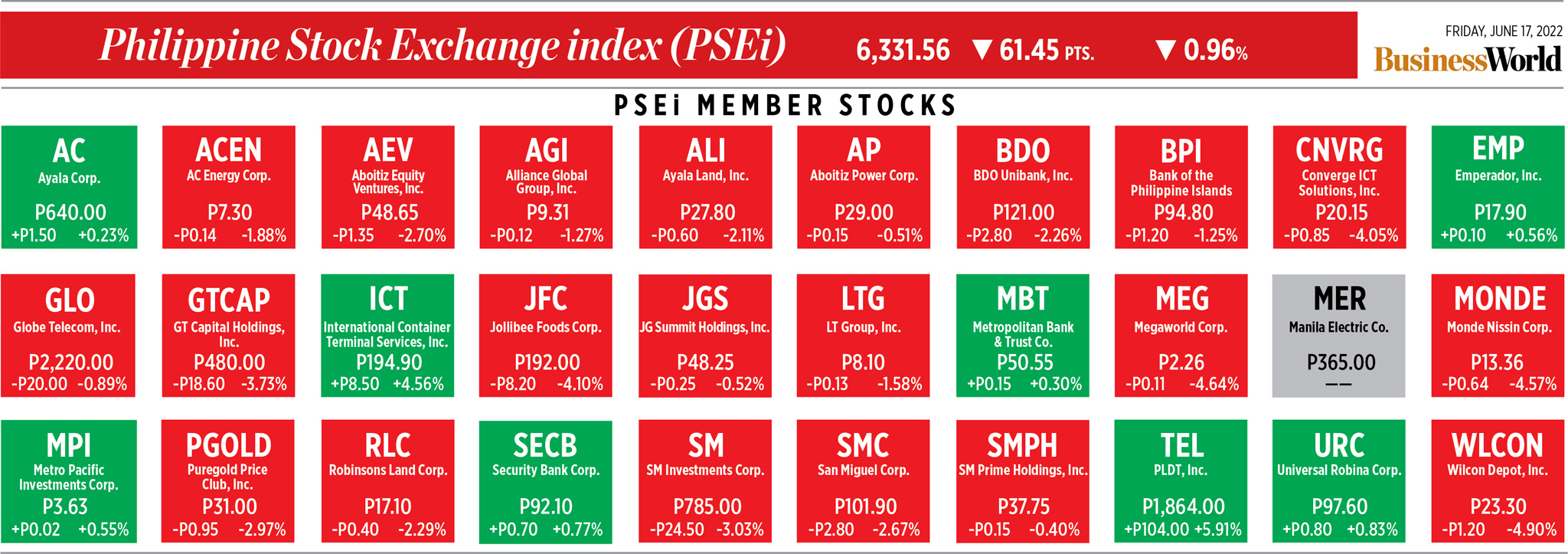
The Philippine Stock Exchange index fell by 61.45 points or 0.96% to close at 6,331.56 on Friday, while broader all shares went down by 40.29 points or 1.17% to 3,394.95. This was in line with the decline in US stock markets amid concerns over the economic impact of aggressive Fed rate hikes, Mr. Ricafort said.

The Fed hiked its benchmark interest rates by 75 basis points (bps) last week. The bigger hike came after US inflation hit a 40-year high in May.

For this week, signals from both the outgoing and incoming BSP chiefs that tightening would be gradual for the rest of the year is expected to give minimal support for the peso, UnionBank of the Philippines, Inc. Chief Economist Ruben Carlo O. Asuncion said in an e-mail.

Outgoing BSP Governor Benjamin E. Diokno and his successor Monetary Board member Felipe M. Medalla last week said a 25-bp hike at their meeting on Thursday is almost a “sure thing.” Both made their comments ahead of the Fed’s decision.

Mr. Medalla said the BSP could raise rates more times this year but ruled out hikes bigger than 25 bps.

He said in a roundtable discussion with BusinessWorld editors last week that the BSP still has the “luxury of time and large reserves.”

“If the markets think we’re behind the curve, they will attack the peso,” he said. “Fortunately, the need to look more hawkish than we should be is not there. Right now, we’re trying to balance to ensure that we don’t miss our inflation targets next year, given the supply shocks.”

Analysts in a BusinessWorld poll were divided on the magnitude of the BSP’s move on Thursday, with nine expecting a 25-bp increase and six betting on a 50-bp hike.

They said they will watch out for guidance from the BSP on its policy path as the Fed and other central banks have become more hawkish in the face of rising inflation.

Oil price movements will also continue to affect the peso-dollar rate, both analysts said.

For this week, Mr. Ricafort gave a forecast range of P53.30 to P53.90 per dollar, while Mr. Asuncion expects a stronger P53.20-P52.70 band. — K.B. Ta-asan

Analysts’ expectations on policy rates (June 23)

THE BANGKO SENTRAL ng Pilipinas (BSP) is widely expected to raise interest rates on Thursday, with several analysts now forecasting a 50-basis-point (bp) increase after the aggressive tightening by the US Federal Reserve last week. Read the full story

Analysts’ expectations on policy rates (June 23)

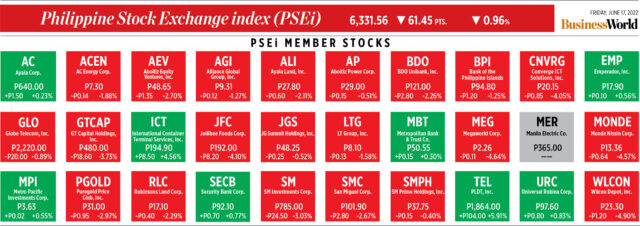
How PSEi member stocks performed — June 17, 2022

Here’s a quick glance at how PSEi stocks fared on Friday, June 17, 2022.


Curbs on plastics output seen needed

BW FILE PHOTO

By Alyssa Nicole O. Tan

LEGISLATION that will hold plastics producers accountable for managing the life cycle of their products will make companies conscious of the possible legal fallout from acting irresponsibly, but curbs on imports and production may ultimately be needed, environmental advocates said.

“If properly and fully implemented the law has significant potential to reduce plastic waste leaking into the environment,” Antonio Gabriel M. La Viña, a lawyer, educator and environmental expert, told BusinessWorld in a Viber message.

“However, there needs to be equal focus on upstream measures to reduce plastics used and put into the market to have a long-term dent on the Philippines’ plastic footprint,” he added. “Right now, the law does not have strong provisions on upstream measures and policies.”

Congress has ratified a consolidated version of a bill seeking to promote sustainability by holding enterprises responsible for the life cycle of their plastic products.

Senator Cynthia A. Villar, primary sponsor of the bill, has said that the reconciled bill focused on “waste reduction, recovery and recycling, and the development of environment-friendly products that advocates the internationally accepted principles on sustainable consumption and production, the circular economy, and producers’ full responsibility throughout the life cycle of their products.”

The act compels large or obliged enterprises to establish or phase in extended producer responsibility (EPR) programs for the plastic packaging of their products to efficiently manage waste and reduce the production, import, supply, or use of plastic packaging deemed low in reusability, recyclability or retrievability; and to achieve plastic neutrality through efficient recovery and diversion schemes.

“Obliged companies need to make sure the processes, methods and schemes they choose, to meet the diversion or collection targets, are environmentally sound and won’t cause equal harm to the environment,” Mr. La Viña said.

“There needs to be investment in facilities and infrastructure which will reuse and recycle as much of the plastic as technologically possible,” he added.

He called it a “good start” to focus on large companies to kick start the initiative, since they have the biggest market share, but said the government must make a clear plan on how to eventually cover micro, small, and medium enterprises as well.

“This will also avoid free-rider issues and inconsistent application of the law,” he added.

EcoWaste Coalition Plastic solutions campaigner Coleen Salamat said that to effectively reduce plastic waste, the government should not only require the retrieval and recycling of plastics but also regulate their production.

“The target of EPR should not solely be on recovery of plastic waste but how much plastics large businesses actually reduce in production,” she told BusinessWorld in an e-mail.

“If there are no plans and guidelines on reducing or phasing out non-environmentally acceptable products and packaging, then this might just be another band-aid solution,” she added.

Ms. Salamat also pointed out an “alarming” provision in the proposed law that includes the establishment of commercial or industrial-scale recycling, composting, thermal treatment, and other waste diversion or disposal facilities for waste products when investment is viable.

“The current trend on the initiatives of consistent top polluters like Nestlé, Procter and Gamble, Unilever, Coca-Cola, still heavily rely on cement kilns, chemical recycling, and other false solutions that burn or melt single-use plastics,” she said.

“These false solutions do not reduce or prevent waste but also contribute to worsening of air pollution and release harmful chemicals that are actually carcinogenic,” she added. “False solutions delay and distract from addressing the root problem of plastics, which is in production at source.”

Since plastics are made with fossil fuels, allowing commercial-scale recycling which includes thermal treatment like waste-to-energy and cement kilns, will only fuel the climate crisis, Ms. Salamat said.

“Obliged enterprises must make sure that they are not doing more harm to the environment,” she added.

Under the bill, obliged enterprises may voluntarily organize themselves into producer responsibility organizations (PRO) to establish viable platforms to implement their EPR program.

Such enterprises must also establish and implement an auditing system to monitor and assess their compliance performance. An independent third-party auditor must certify the veracity of the report using standards established by the department.

Ms. Villar has said the targets for the recovery of plastic products generated are as follows: 20% by the end of 2023; 40% by 2024; 50% by 2025; 60% by 2026; 70% by 2027; and 80% by 2028 and every year thereafter.

Mr. La Viña said this was difficult to achieve considering the current infrastructure available for waste management “but not impossible if industry is pushed with some government support.”

“Industry wanted to start at 10% increments with a longer transition period which they saw as more doable,” he added.

Ms. Salamat also found the goals set to be achievable, noting that the current targets of large enterprises are in line with the EPR targets for recovery.

However, she noted that this legislation, if not fully implemented and enforced, will represent “business as usual.”

She also noted that there is little precedent for large enterprises being held accountable.

“The bill will only impose fines and penalties if obliged enterprises or PROs do not register their EPR programs and if they fail to meet the targets for recovery of plastic product footprint,” she said. “It is very important to note that recovery is not the only problem but (also) the continuous production of single-use plastics.”

“EPR, in its true sense, follows a ‘polluters pay’ principle. Producers have the main responsibility under EPR. Without prohibited acts (regulating) the production, use, distribution, and importation of non-environmentally products and packaging, then it does not really hold polluters accountable,” she added.

Obliged enterprises that fail to comply with the law can be fined at most P20 million and an automatic suspension of their business permits until the law is complied with.

“This law will help make businesses more conscious of their impact on the environment,” Mr. La Viña said.

“Not tackling environmental impacts and being more sustainable in operations will have consequences not just legally but in other aspects such as investments, cost of doing business and even reputation and brand name,” he added.

Government urged to make big green energy push

By Tobias Jared Tomas

THE GOVERNMENT needs to refocus its borrowing to aggressively pursue sustainable energy initiatives, which multilateral institutions are willing to fund on favorable terms, in response to the rising cost of traditional fuels, economists said.

“The ongoing constraints posed by the current global landscape should highlight the importance of alternative sources of energy,” ING Bank N.V. Manila Senior Economist Nicholas Antonio T. Mapa said in an e-mail. “Other nations have decided to accelerate their plans to shift to renewable forms of energy to ensure stable supply chains while simultaneously championing sustainability.”

“Loans from the World Bank (WB) and the Asian Development Bank (ADB) offer very affordable rates and oftentimes target projects that are not just viable, but have a substantial impact on development, equity, and environmental sustainability.” 

Mr. Mapa said that such loan exposure is less vulnerable to swings in global markets.

“Such investments do not bear fruit overnight; thus the government must identify this shift as a priority,” he added. “Currently, the Philippines has made some strides in chasing environmental sustainability with the legislative framework recently passed. Despite these developments, however, the Philippines lags its peers in terms of progress, with the country yet to set a target date for net zero carbon emissions.”

The Philippines has set a goal of cutting its greenhouse gases emissions by 75% by 2030, particularly for agriculture, waste management, industry, transport, and energy.

Leonardo A. Lanzona, who teaches economics at the Ateneo de Manila University, said in a Viber message that “it may appropriate to invest in environment and renewable energy,” but called for “careful analysis of the expected returns” from such projects.

Recent loans that the government recently took on are not cause for concern, but attention should be paid to how productively they are deployed, UnionBank of the Philippines, Inc. Chief Economist Ruben Carlo O. Asuncion said.

“I think that we have a great window in dealing with the nation’s debt and be able to assess debt sustainability,” Mr. Asuncion said in an e-mail. “It is all right to be worried, but it is more productive to hold government accountable for whatever that they will do moving forward.”

The government took out a string of loans over the past few weeks. The Asian Development Bank (ADB) lent $250 million for climate mitigation, $400 million for capital market development and insurance, and $4.3 billion for the South Commuter Railway Project. It also signed a $350-million loan with China for the construction of the Samal-Davao bridge.

“In order to be sustainable, the rate of return coming from these loans needs to be greater than the interest imposed by these loans,” Mr. Lanzona said. “Regardless of the sector where these loans are placed, as long as this condition is satisfied then the loans are properly placed.”

“The concern is not the amount of loans per se, but the returns or the productivity obtained,” he added.

Cybercrime agency plans crackdown on online scams

A man holds a laptop computer as cyber code is projected on him in this illustration picture taken on May 13, 2017. — REUTERS

THE Cybercrime Investigation and Coordinating Center (CICC), which recently opened a cybercrime laboratory in Quezon City, said it will expand its operations to online fraud after initially focusing on addressing online sexual abuse and exploitation of children (OSAEC).

CICC Executive Director Cezar O. Mancao II said at a June 17 briefing that the opening of the facility, known as the Digital Forensics Platform and Laboratory (DFPAL), “will allow the CICC to monitor and coordinate with other law enforcement agencies in conducting thorough digital and forensic investigations and assist them in prosecuting cybercriminals nationwide.”

“We have acquire powerful state-of-the-art technology, which will improve the success rates of investigators and policing operations in the ongoing pursuit to identify, apprehend, and convict individuals and networks associated with online child sexual exploitation,” he added.

Mr. Mancao noted that the agency is taking “one step at a time” in addressing cybercrimes.

“We are also concerned with other cybercrimes that are now rampant. We have… (other) agencies that can best address those kinds of cybercrimes. For the CICC’s part, in a week or in a few days, we will launch our ‘E-Scam Alert PH’ app as well as our hotline and our websites,” he said.

CICC Deputy Executive Director and Assistant Secretary James A. Layug said: “Scams are second (in importance after) online sexual abuse.”

“The e-scam alert… is intended to address (the problem of) scams because they also victimize many of our countrymen.”

CICC is an arm of the Department of Information and Communications Technology.

“OSAEC is a tragic and growing problem in the Philippines, but it does not need to be a permanent one. We will do everything that we can to protect Filipino children. We have to act now and fight against these predators. We need to help each other to protect our netizens,” Mr. Mancao said.

“The opening of this new facility will provide law enforcement agencies with updated data and intelligence that can lead to the arrest and prosecution of these predators,” he added.

The agency said that the pandemic has aggravated the problem of online child exploitation via pornography and other forms of child online sexual abuse, specifically with children from low-income families.

“To support this advocacy, we have child online protection programs and initiatives in partnership with various civil society organizations and many stakeholders,” Mr. Mancao said. — Arjay L. Balinbin

PHL has chance to maximize WTO deal to make vaccines

REUTERS

By Revin Mikhael D. Ochave, Reporter

THE PHILIPPINES should maximize the opportunities on offer from a deal reached at the 12th Ministerial Conference (MC12) of the World Trade Organization (WTO), particularly in the areas of vaccines and fisheries, analysts said.  

George N. Manzano, University of Asia and the Pacific economist and former tariff commissioner, said in a mobile phone interview that the ministerial decision on Trade-Related Aspects of Intellectual Property Rights (TRIPS) waives patent protections on the production of coronavirus disease 2019 (COVID-19) vaccines, providing opportunities for the incoming Marcos administration to boost domestic vaccine output.  

President-elect Ferdinand R. Marcos, Jr., is set to take office on June 30.

“The incoming administration can use the TRIPS waiver to boost local production of vaccines by… invit(ing) foreign partners to set up production facilities in the country. By doing so, the vaccine rollout will be carried out faster,” Mr. Manzano said.

“The partial patent waiver is the right step in forging a collective response to the pandemic. The challenge for the Philippines… is to upgrade the capacity to produce the vaccine. This may involve investment in productive resources. In short, implementation and securing partners are now part of the challenge for which the private sector is a key actor,” he added.  

During the MC12 held in Geneva, which ended on June 17, the 164 WTO members agreed to limit the patent rights on COVID-19 vaccines by allowing the use of patents “without the consent of the right holder to the extent necessary to address the COVID-19 pandemic,” subject to certain conditions.  

The waiver is applicable for five years and may be extended “taking into consideration the exceptional circumstances of the COVID-19 pandemic.”

WTO members will also decide, within six months, on the waiver being expanded to COVID-19 diagnostics and therapeutics, while also blocking the re-export of COVID-19 vaccines produced under the waiver.

Trade ministers at MC12 also reached consensus on restricting harmful subsidies that result in illegal, unreported and unregulated fishing.

Mr. Manzano said that the agreement on fisheries bodies well for fisherfolk.

“The fisheries agreement calls for limiting or ending subsidies to fisheries in the unregulated high seas, particularly beyond the economic zones. This would be good for sustaining the stock of fishery resources, in the light of overfishing. The Philippines can (gain) flexibility in the treatment of aid to poor and artisanal fisheries,” Mr. Manzano said.

Kristine C. Francisco-Alcantara, managing partner of legal trade and technology firm Abad Alcantara and Associates and a Foundation for Economic Freedom fellow, said in a phone interview that the incoming administration could also take advantage of the MC12 agreement not to restrict food exports.

There is scope for “developing similar aggressive policies to improve food security in the Philippines,” Ms. Francisco-Alcantara said, noting that the World Food Programme has won an exemption from export prohibitions or restrictions.

“The focus on food security… as a means to remove barriers to trade is a good start to the WTO’s efforts in dealing with a global trade crisis,” Ms. Francisco-Alcantara said.

“While the provisional extension on the e-commerce tariff moratorium may be seen as advantageous in aiding global digitalization, the WTO needs to start a definitive discussion on trade policies and rules on the digital economy,” she added.

“The TRIPS waiver is also an opportunity to improve the health system (by) enabling a business environment where low cost medicine can be manufactured locally,” she added.

Ms. Francisco-Alcantara said that results of MC12 confirmed the relevance and necessity of the WTO, which demonstrated that multilateral cooperation is possible despite the global crisis.

“The next step is for these discussions to take on a deeper level, not to be reactive in a crisis, but to be proactive,” Ms. Francisco-Alcantara said.

Supreme Court allows PSALM to pay lawyers advising on privatization

THE Supreme Court has overturned a ruling by the Commission on Audit (CoA), paving the way for the Power Sector Assets and Liabilities Management Corp. (PSALM) to pay lawyers who had advised on privatization projects.

In a 31-page decision on Nov. 21 and made public on June 17, the High Court found that CoA had abused its discretion by blocking PSALM’s legal fees after three years.

“CoA has not admitted its fault, much less, provided any real and justifiable reason why after making PSALM wait after over three years, it denied PSALM’s request for concurrence,” according to the ruling, written by Associate Justice Amy C. Lazaro-Javier.

The court ordered the commission to allow payment to the lawyers for services rendered.

It also ruled that the PSALM officers who approved the engagement of lawyers are not liable for the payment of professional fees.

PSALM had hired lawyers to advise on Independent Power Producer contracts of the National Power Corp., the auction of energy generation projects, and other transactions.

The court added that the advisors had rendered satisfactory service under the contract entered into with PSALM for the benefit of the government.

CoA rules require the commission to evaluate a request for concurrence on a retainer contract engaging private lawyers within 60 days.

PSALM had asked CoA to act on the request for concurrence on or before May 30, 2011.  The commission denied the company’s request on Nov. 6, 2014, more than three years since receipt.

“CoA’s unjustified refusal and delay to perform its obligation to review, evaluate, and render its concurrence prevented PSALM from securing the required concurrence,” the court noted. “Thus, there was no fault on the part of PSALM as the fault lies with CoA.”

The tribunal added that CoA’s inaction to the request represented  “evasion of positive duty” and “virtual refusal to discharge a duty enjoined by law.” — John Victor D. Ordoñez

The Metaverse beckons: Is it time to explore?

The Metaverse is the new industrial frontier. Futurists, entrepreneurs, and professionals have defined it in multiple ways, but its meaning continues to mystify the public. Organizations that decide to embrace it are more likely to discover a turning point, similar to the growth of the internet spurring globalization, or the rise of the smartphone that made on-the-go services available. As technologies cause a cultural shift that influence ways of living, they open a plethora of opportunities which businesses may consider for early adoption for their long-term strategy.

DEFINING THE METAVERSE
The word “Meta” in Metaverse is derived from Greek that means “transcending.” Paired with the word “universe,” it implies an area that is beyond the physical. The Metaverse can be defined as a virtual world where a real person can extend themselves and their lives onto digital identities. They can earn, purchase, socialize, learn, and enjoy in this digital space, and the results from these activities can connect and apply to the real world. This is much more immersive than the current ecosystem of social media, online shopping, or gaming communities, because the Metaverse involves key characteristics enabled by key technologies.

When derived from various forums, the key characteristics of the Metaverse include (1) Persistence: where your central digital identity is maintained even as you enter and leave the Metaverse; (2) Ownership: where everything you earn or purchase in the world is certified and attributed to be truly yours; (3) Interoperability: where you can carry what you own and use it in other virtual places, and (4) Decentralization: where there is no central organization that dictates the rules of the space, and is instead defined by the users themselves.

It is these characteristics that make it an overarching realm, as opposed to current platforms or small metaverses (with a lowercase “m”). These metaverses are managed centrally by the company that created them, and users typically are not able to consume or port digital assets across these.

On the other hand, notable technologies that realize the characteristics of the overarching Metaverse are 5G, blockchain, and virtual or augmented reality (VR/AR). Widely rolling out 5G infrastructure provides faster speeds for data consumption of up to potentially 10 GB per second, which is essential for a smooth experience in the virtual world. Blockchain is foundational in what creates the true ownership of certified digital assets or currencies, building a de-centralized autonomous environment enabled by the smart contracting that connects them. Moreover, VR and AR technology, which allows the creation of 3D environments supported by wearables, can make the experience more immersive. There are other layers of technologies involved, such as decentralized applications, but implementing the necessary infrastructure fast tracks the vision.

TAPPING INTO DIGITALLY NATIVE CONSUMERS
Understanding what the Metaverse is helps enable organizations to determine how they can generate new revenue streams or create new business models while positioning themselves early for success in this evolving technology — which can grow exponentially in the future. Leaders must realize that doing so taps into a promising audience: the digital natives. These are the people who grew up in the information age, and who spend a significant amount of their time using laptops, smartphones, and Internet of Things (IoT). Digital natives often prefer to interact online first rather than through traditional face-to-face transactions.

In 2019, CNN Philippines said in an online story that the people of the Philippines are some of the heaviest users of the internet, averaging about 10 hours a day. General information from the Philippine Statistics Authority (PSA) indicates that digital natives likely comprise a third or above of the population. These numbers alone provide ample opportunity for new revenue.

RECOGNIZING THE POTENTIAL OF NFTs
To cite potential application to business, it is also important to understand the concept of non-fungible tokens or NFTs in the Metaverse. NFTs are digital assets that are unique and authenticated through blockchain. This can be anything from digital art, gaming items, or video clips that are owned by people through their digital personas. Their financial value is created through supply and demand within the digital world. Its appeal can be tied to the human psychology that seeks ownership of things, which is why authenticating through blockchain is important to make it “real” and exclusively “mine.” Aside from the advent of cryptocurrency, NFTs have opened possibilities of other forms of virtual ownership, and it drives demand.

In effect, real world brands can use NFTs in various ways, whether for creating brand awareness as people transact through their digital identities to own these NFTs or use the actual ownership itself to unlock a privilege, such as exclusive access or discount to a physical store or location. The applications are almost endless. The experience can be gamified, where online gamers not only play for entertainment, but have their actual efforts translate to acquiring NFTs that have value for trading purposes or even for benefits in the physical world.

According to Navigating the Metaverse, A Guide to Limitless Possibilities in a Web 3.0 World, by Cathy Hackl, Dirk Lueth, and Tommaso Di Bartolo, there are also potential recurring revenue streams from a secondary market for royalties for branded NFTs. This means that aside from earning from the primary purchase, royalties can still be applied as NFTs get traded down the line so that businesses can continue to receive earnings from subsequent trading.

Aside from products with NFTs, services for the Metaverse can also be provided by businesses, according to the EY white paper on the “Metaverse” by Bikram Dasgupta and Aarathi Panikkar. These can range from curating and developing virtual environments, pursuing business integration, running advertising campaigns, implementing smart contracting, and so on. There is a whole ecosystem that needs to support running and maintaining the world itself, which is also an area that can be engaged in for revenue.

THE METAVERSE AS AN INEVITABLE CULTURAL SHIFT
Back in October 2021, the most popular social media platform renamed itself to “Meta.” This clearly demonstrates the explicit commitment of the organization to support the direction of the online environment. Moreover, one of the largest software companies has been acquiring well-known gaming companies, also alluding to how these platforms with their own communities and exchanges will play into the future of the Metaverse. The big players are preparing as early as now to help curate the future experience the Metaverse will be able to offer.

Given the current interest and increasing entry into the Metaverse globally, business leaders should recognize and understand the phenomenon — even if it sounds far-fetched or unreal — and consciously consider this in their periphery or as a direct future strategy for their organization. The Metaverse is looking to inevitably shift the culture, driven by technology, and should be given the requisite attention so that companies are prepared if it becomes a truly global-level disruption.

Similar to how digitization accelerated due to the obvious market of digital natives and even more so with the pandemic requiring seamless virtual work, consumerism, and lifestyles, the time to explore the potential of the Metaverse is now.

This article is for general information only and is not a substitute for professional advice where the facts and circumstances warrant. The views and opinions expressed above are those of the author and do not necessarily represent the views of SGV & Co.


Lee Carlo B. Abadia is a technology consulting principal of SGV & Co.

ADVERTISEMENT
ADVERTISEMENT