OAKLAND, CA —Microsoft Corp. on Tuesday said it would stop selling technology that guesses someone’s emotion based on a facial image and would no longer provide unfettered access to facial recognition technology.
The actions reflect efforts by leading cloud providers to rein in sensitive technologies on their own as lawmakers in the United States and Europe continue to weigh comprehensive legal limits.
Since at least last year, Microsoft has been reviewing whether emotion recognition systems are rooted in science.
“These efforts raised important questions about privacy, the lack of consensus on a definition of ‘emotions,’ and the inability to generalize the linkage between facial expression and emotional state across use cases, regions, and demographics,” Sarah Bird, principal group product manager at Microsoft’s Azure AI unit, said in a blog post.
Existing customers will have one year before losing access to artificial intelligence tools that purport to infer emotion, gender, age, smile, facial hair, hair and makeup.
Alphabet, Inc.’s Google Cloud last year embarked on a similar evaluation, first reported by Reuters. Google blocked 13 planned emotions from its tool for reading emotion and placed under review four existing ones, such as joy and sorrow. It was weighing a new system that would describe movements such as frowning and smiling, without seeking to attach them to an emotion.
Google did not immediately respond to request for comment on Tuesday.
Microsoft also said customers now must obtain approval to use its facial recognition services, which can enable people to log into websites or open locked doors through a face scan.
The company called on clients to avoid situations that infringe on privacy or in which the technology might struggle, such as identifying minors, but did not explicitly ban those uses. — Reuters
BUDGET carrier Cebu Pacific, operated by Cebu Air, Inc., said on Wednesday that it expects its work force to revert to pre-pandemic size early next year, citing the airline industry’s sustained recovery.
“We are calling a lot of our people back. By early next year, we will be back to where we were in 2019 in terms of headcount,” Cebu Pacific President and Chief Executive Officer Lance Y. Gokongwei told reporters.
He expects the airline’s work force size to return to 4,000 next year. The laid-off employees “will be prioritized,” he also said.
The budget carrier cut its work force by 25% in 2020 due to the impact of the global health crisis on its operations. It previously said that it expects to increase the number of its employees this year to 3,678 from 3,046 in 2021.
The company has restored 100% of its pre-pandemic domestic capacity, according to Mr. Gokongwei.
“For international, you can see that a lot of countries, especially in Southeast Asia, are opening up,” he said, adding that there will be opportunities to increase flights to some Asian destinations.
The airline has set a capital-expenditure budget of P32.8 billion for 2022, mainly for fleet replacement.
The company ended 2021 with 74 aircraft, the same as in 2020. It received six new aircraft last year.
Over the next five years, it expects to have 48 deliveries and 35 exits, ending 2026 with 87 aircraft.
The airline saw its attributable net loss for the first three months of the year widen to P7.61 billion from a loss of P7.30 billion in the same period a year earlier.
The company’s revenues for the period reached P6.71 billion, 148% higher than the P2.71 billion generated in the same period in 2021. — A.L. Balinbin with R.M.D. Ochave
Bill Cosby in a publicity shot for The Cosby Show.
Bill Cosby in a publicity shot for The Cosby Show.
SANTA MONICA, Calif. — A California jury in a civil case ruled on Tuesday that Bill Cosby sexually assaulted a woman at the Playboy Mansion in 1975 when she was a teenager and ordered the comedian to pay her $500,000 in damages for emotional distress from the incident.
Judy Huth had testified that the comedian invited her and a friend to the mansion when she was 16, and he was 37, and forced her to perform a sex act.
The verdict came nearly a year after Mr. Cosby was freed from prison when Pennsylvania’s highest court threw out his sexual assault conviction in a different criminal case there.
Ms. Huth’s lawsuit was the first civil case against Mr. Cosby to come to trial.
Ms. Huth, now 64, said she was “elated” by the ruling in the case, which she filed in 2014 after media reports detailed accusations against Mr. Cosby by multiple women. Those reports helped stir up memories of her encounter with Mr. Cosby, Ms. Huth said, and triggered four years of anxiety and other symptoms.
“It’s been so many years, so many tears,” Ms. Huth told reporters outside California Superior Court in Santa Monica. “It’s been a long time coming.”
Ms. Huth told the jury that Mr. Cosby had invited her and the friend to the mansion a few days after they met the then-famous actor and comedian at a public park. After she emerged from a bathroom, Mr. Cosby took her hand and used it to masturbate his penis, she said.
Mr. Cosby, who did not appear in person at the trial, denied Ms. Huth’s allegation. His defense team will appeal the verdict, Cosby spokesman Andrew Wyatt said.
“Mr. Cosby continues to maintain his innocence and will vigorously fight these false accusations, so that he can get back to bringing the pursuit of happiness, joy and laughter to the world,” Wyatt said in a statement.
Mr. Cosby, 84, is best known for his role as the lovable husband and father in the 1980s television comedy series The Cosby Show, earning him the nickname “America’s Dad.” But his family-friendly reputation was shattered after more than 50 women accused him of sexual assaults over nearly five decades.
Ms. Huth brought the case under a California law that allows people who claim they were abused as children to file civil cases years later as adults.
Three other women who have accused Mr. Cosby of abuse attended the trial and told reporters they felt vindicated by the verdict. Lili Bernard, who has a civil lawsuit pending against Mr. Cosby in New Jersey, said the ruling was “important for every sexual assault survivor who has not received justice.”
“We will never give up,” she said.
The jury did not rule entirely in Ms. Huth’s favor. By a 9-3 vote, they said she had not provided “clear and convincing evidence” that Mr. Cosby had acted with “malice, oppression or fraud.”
If jurors had voted yes on that question, they could have provided additional punitive damages to Ms. Huth.
In video of a deposition shown to jurors, Mr. Cosby said he did not remember Ms. Huth. But he said the incident could not have happened because he would not have pursued sexual contact at that time with someone who was under age 18.
Cosby attorney Jennifer Bonjean challenged Ms. Huth’s account throughout the trial, including her revised timeline.
When the lawsuit was filed in December 2014, Ms. Huth said the incident occurred in 1974, when she was 15. She told jurors she recently concluded that she had been mistaken about the year and now believes it happened in 1975. — Reuters
LONDON — Harmonized insurance protection schemes of last resort are needed across the European Union (EU) as consumers increasingly buy policies from outside their country, the bloc’s insurance regulator said on Tuesday.
Petra Hielkema, chair of the European Insurance and Occupational Pensions Authority (EIOPA), said cross-border premiums have been steadily increasing over the past five years compared with domestic premiums.
It also means that consumers are buying policies without knowing who is ultimately responsible if things go wrong, she said.
“Unfortunately we are seeing more cases, with policyholders in one member state receiving less protection and in case of failure less compensation than policyholders in another member state,” Ms. Hielkema told EIOPA’s annual conference.
“That, in my opinion, is unacceptable. It is therefore that EIOPA stresses that minimum harmonization of insurance guarantee schemes is very much needed.”
Insurers are regulated by their home supervisor, with EIOPA and watchdogs in EU states where products are sold by insurers from elsewhere in the bloc having little say over them.
The EU is currently amending its insurance rules and Ms. Hielkema said she was in discussion with the European Parliament on possible new powers, such as issuing a product warning, making binding recommendations to a national regulator, and stopping new sales of poor value products.
“When we talk to EU institutions, they listen, they see the need to support us on this,” she told reporters.
The EU has set up a single banking supervisor, the European Central Bank (ECB), to directly regulate big banks in the euro zone.
Nevertheless, efforts by euro zone finance ministers to go further and create a common bank deposit guarantee system failed again last week as some states fear they will end up helping weaker banks in other countries.
Ms. Hielkema said there was no appetite for a single insurance supervisor like the ECB, but there was a need to better harmonize insurance policy protection and police poor value products more effectively.
“The problem will not go away,” she said. — Reuters
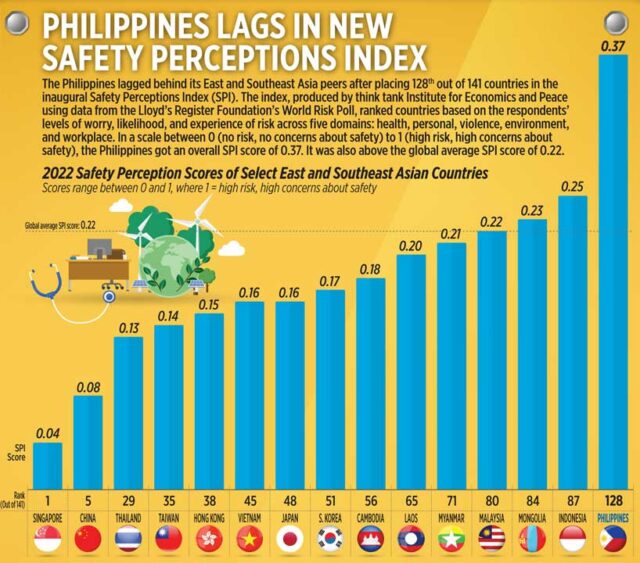
The Philippines lagged behind its East and Southeast Asia peers after placing 128th out of 141 countries in the inaugural Safety Perceptions Index (SPI). The index, produced by think tank Institute for Economics and Peace using data from the Lloyd’s Register Foundation’s World Risk Poll, ranked countries based on the respondents’ levels of worry, likelihood, and experience of risk across five domains: health, personal, violence, environment, and workplace. In a scale between 0 (no risk, no concerns about safety) to 1 (high risk, high concerns about safety), the Philippines got an overall SPI score of 0.37. It was also above the global average SPI score of 0.22.
THE International Swimming Federation (FINA) has validated with finality the entry of the Philippine Swimming, Inc. (PSI) to the 19th FINA World Championships set on June 17 to July 3 in Budapest, Hungary.
“FINA confirms that Mrs. Lailani Velasco, recognized president of the PSI, has completed the sports entries of the swimming delegation of the Philippines according to FINA rules,” FINA sports director Pere Miro told Ms. Velasco in a letter on Saturday.
The Philippine swimming group has fielded in multiple Southeast Asian Games medalist Jasmine Alkhaldi, Miranda Renner, and Jonathan Cook to the world tilt.
Jerald Jacinto, who would have been a replacement to an injured Luke Gebbie, begged off due to medical reasons.
FINA stressed it has denied the PSI’s request to allow Chloe Isleta, the country’s lone Hanoi Southeast Asian Games gold medalist, to be part of the Budapest-bound squad due to gender equality.
“With no swimmers who have achieved the ‘A’ or ‘B’ Standard Entry Time, National Federations may only enter up to four swimmers, two men and two women,” it said.
“With one or two swimmers who has achieved the ‘A’ or ‘B’ Standard Entry Time, National Federations may enter up to four (two men, two women), and with three swimmers who have achieved ‘A’ or ‘B’ Standard Entry Time, one additional swimmer provided that both genders are represented.”
The world swimming body informed PSI chief Ms. Velasco that no exception was possible and “FINA rules must be respected by all national federations.” — Joey Villar
META, MICROSOFT and other tech giants racing to build the emerging metaverse concept have formed a group to foster development of industry standards that would make the companies’ nascent digital worlds compatible with each other.
Participants in the Metaverse Standards Forum include many of the biggest companies working in the space, from chip makers to gaming companies, as well as established standards-setting bodies like the World Wide Web Consortium (W3C), the group said in an statement announcing its creation on Tuesday.
Conspicuously missing from the member list for now however is Apple, which analysts expect to become a dominant player in the metaverse race once it introduces a mixed reality headset this year or next.
Gaming companies Roblox and Niantic also were not included among the forum’s participants, nor were emerging crypto-based metaverse platforms like The Sandbox or Decentraland.
Apple has not yet publicly acknowledged plans for a headset, although it has reportedly given its board a sneak peek of the product, according to Bloomberg. It did not immediately respond to a request for comment about the new metaverse forum.
Introducing such a device would put Apple in direct competition with Meta, which has staked its future on the growth of the metaverse and invested heavily in hardware to make its vision of interconnected virtual worlds a reality.
Meta, known as Facebook until it changed its name as part of its metaverse pivot last year, has disclosed plans for a mixed-reality headset code-named “Cambria” to be released this year.
Apple has been heavily involved in creating web standards such as HTML5 in the past. For three-dimensional content in the metaverse, Apple worked with Pixar on the “USDZ” file format and with Adobe to ensure it supported the format.
Neil Trevett, an executive at chip maker Nvidia who is chairing the Metaverse Standards Forum, said in a statement to Reuters that any company is welcome to join the group, including participants from the crypto world.
The forum aims to facilitate communication between a variety of standards organizations and companies to bring about “real-world interoperability” in the metaverse, he said, without addressing how Apple’s absence would affect that goal. — Reuters
SHARES ended lower on Wednesday amid fears of further tightening by the Federal Reserve, with its chief set to speak to the US Congress overnight, and ahead of the Bangko Sentral ng Pilipinas’ (BSP) policy meeting on Thursday, where it is expected to hike rates anew.
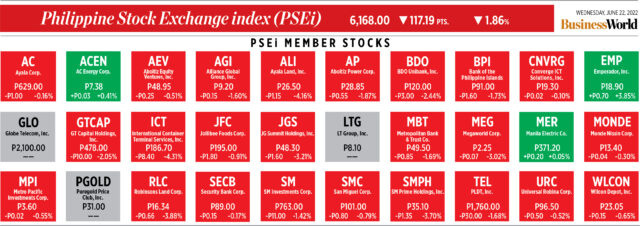
The benchmark Philippine Stock Exchange index (PSEi) plunged by 117.19 points or 1.86% to close at 6,168 on Wednesday, while the broader all shares index gave up 40.32 points or 1.19% to end the session at 3,328.35.
“Philippine shares fell into oversold territory as the market awaits Fed Chair Jerome Powell’s [appearance] before Congress later, kicking off two days of testimony,” Regina Capital Development Corp. Head of Sales Luis A. Limlingan said in a Viber message on Wednesday.
Mr. Limlingan added that the market was also cautious ahead of the BSP’s policy meeting on Thursday, where investors expect a 50-basis-point (bp) hike.
Philstocks Financial, Inc. Senior Research Analyst Japhet Louis O. Tantiangco said in a Viber message that worries over the recovery of the US and the broader global economy amid the Fed’s aggressive tightening path weighed on investor sentiment.
Mr. Powell was set to start his two-day testimony to the US Congress overnight, with investors looking for further clues on whether another 75-bp rate hike is on the table at the Fed’s July meeting.
Economists polled by Reuters expect the Fed will deliver a 75-bp interest rate hike next month, followed by a half-percentage-point rise in September, and won’t scale back to quarter-percentage-point moves until November at the earliest.
The Fed last month raised borrowing costs by 75 bps, the largest since 1994, after data showed inflation hit another 40-month high in May, showing it had yet to peak.
Meanwhile, outgoing BSP Governor Benjamin E. Diokno and his successor Monetary Board member Felipe M. Medalla on Monday affirmed their intent to raise rates gradually, both signaling a 25-bp hike this week despite market expectations of a 50-bp increase.
The BSP began its tightening cycle with a 25-bp hike on May 19 to help stem rising prices as headline inflation already reached 5.4% in May, higher than its 4.6% forecast and 2-4% target for the year. Year to date, inflation has averaged 4.1%.
All sectoral indices ended in the red on Wednesday. Property sank by 103.84 points or 3.57% to 2,800.92; services declined by 33.21 points or 1.98% to 1,643.89; financials lost 23.66 points or 1.53% to end at 1,522.17; holding firms dropped by 72.26 points or 1.25% to 5,705.16; mining and oil fell by 94.22 points or 0.82% to 11,399.17; and industrials retreated by 3.34 points or 0.03% to 8,835.77.
Decliners overwhelmed advancers, 115 versus 68, while 48 names ended unchanged.
Value turnover increased to P4.27 billion with 905.48 million shares changing hands from the P3.97 billion with 885.42 million issues seen on Tuesday.
Net foreign selling grew to P560.32 million from P401.59 million previously. — Luisa Maria Jacinta C. Jocson with Reuters
THE PHILIPPINES’ telecommunication regulator has ordered local internet service providers to block the websites of groups identified with the Maoist movement.
The National Telecommunications Commission (NTC) ordered the “immediate blocking of the reported websites found to be affiliated to and are supporting terrorists and terrorist organizations,” NTC Commissioner Gamaliel A. Cordoba said in the June 8 memo.
The order was issued upon the request of Hermogenes C. Esperon, Jr., the national security adviser of President Rodrigo R. Duterte.
Mr. Esperon on June 6 asked the NTC to order internet service providers to block access to 26 websites “affiliated to and are supporting” the Communist Party of the Philippines (CPP), New People’s Army (NPA) and the National Democratic Front of the Philippines (NDFP).
The Anti-Terrorism Council has labeled them terrorist groups.
The websites of alternative media Bulatlat and Pinoy Weekly, which have been reporting on grassroots situations, were among those listed by Mr. Esperon in his letter.
“Bulatlat and Pinoy Weekly have existed for years and have built a track record of reporting on people’s issues,” the National Union of Journalists said in a statement on Wednesday. “Sometimes, that reporting has been critical of government and its policies, but it is dangerous to equate this with affiliation or support that the government now claims.”
Blocking access to these sites leave a gap in discourse and in the flow of information, it added.
It also said the NTC order showed the threats posed by a 2020 anti-terrorism law to freedom of expression and of the press. “What we feared, and what the government assured would not happen, has happened.”
The list also includes the website of fisherfolk group Pamalakaya and Bagong Alyansang Makabayan, which are among Mr. Duterte’s fiercest critics.
The websites of Pamalakaya, Bulatlat, and Bayan were still inaccessible as of writing.
“If any should feel aggrieved by any perceived improper use or application of any provisions of the Anti-Terrorism ACT, including the provisions on designation, there are remedies under the law,” Justice Undersecretary Adrian F. Sugay told reporters in a Viber message. “Judicial recourse is always available.”
Bulatlat rejected its inclusion in the list released by the NTC and endorsed by Mr. Esperon, calling it a violation of its right to publish and freedom of expression.
“Since June 17, our subscribers using Smart/PLDT as their ISP informed us that they cannot access our website, prompting us to reach out to the IT company to inquire about the incident,” it said in a statement.
PRESS FREEDOM Bulatlat, which considers itself as the longest-running online media outfit and the authority on human rights reporting in the Philippines, asked: “Why are the powers that be so afraid of our truth-telling?”
Bayan called the blocking a “blatant attack” on free speech. “The orders show how arbitrary the use of terrorist-labeling and red-tagging have become,” it said in a statement. “The orders to block certain websites are devoid of any due process and rely merely on guilt by association.”
Bayan said it was not among those designated as “terrorists” by the council. “Even if designated, there is nothing in the law that says you can block access to websites.”
It added that no specific offense or evidence had been cited to justify the blocking the websites. “This again highlights the dangers of the anti-Terror Law.”
Bayan, which vowed to question the order before the courts, urged telecommunication companies to reject it.
It urged Clarita A. Carlos, the next national security adviser, to “revoke these illegal orders and to cease attacks on free speech and freedom of association.”
“We call on the media, free speech advocates and opponents of the ‘terror law’ to stand together and push back against this latest attack.”
Meanwhile, international group Human Rights Watch urged the oversight committees of the Philippine Congress to take another look at the way the 2020 law on terror was being misused.
“The NTC should refuse this attempt by the National Security Council to use it for political ends,” it said in a statement. “The NTC should make sure that press freedom and freedom of expression online is upheld and respected.”
The global rights watchdog also called on civil society and the international community, including United Nations agencies and donor governments like the European Union, to “publicly condemn this latest attempt to suppress freedom of expression in the Philippines.”
The Anti-Terrorism bill was signed into law on July 3, 2020, and took effect after 15 days.
The Supreme Court, which heard four-dozen petitions seeking to void the law, scrapped two clauses — one that would have criminalized protests deemed by authorities as harmful and another that would have allowed the Anti-Terrorism Council to adopt bans by supranational authorities.
INCOMING tax bureau chief Lilia C. Guillermo on Wednesday said she would enforce the collection of the unpaid estate tax of the late dictator Ferdinand E. Marcos, as ordered by the courts.
“I have not seen any documents about it,” she told the ABS-CBN News Channel. “If that’s final and executory, then it is our mandate to collect.”
The unpaid estate tax was worth P23 billion in 1997 and had ballooned to more than P200 billion due to interests and other fees, according to former Supreme Court Justice Antonio T. Carpio.
Ferdinand R. Marcos, Jr., the son of the late dictator, won the May 9 presidential election by a landslide and will start his single six-year term on June 30.
In December, the tax agency sent a written demand to the Marcos family to settle the tax.
The court-approved heirs of Mr. Marcos are his widow Imelda and his only son, Marcos Jr. who is popularly known as “Bongbong.”
Ms. Guillermo said she had not discussed the matter with Mr. Marcos, who tapped her to head of the Bureau of Internal Revenue (BIR). The Marcoses have remained mum on the issue.
“I don’t know if that’s really P200 billion, and maybe if that’s really the amount, imagine it will really help collections of BIR,” Ms. Guillermo said.
Estate tax is a tax “on the right of the deceased person to transmit his/her estate to his/her lawful heirs and beneficiaries at the time of death and on certain transfers,” according to the BIR. “It is not a tax on property.”
The incoming BIR chief said the Marcoses would become “role models” if their unpaid estate tax was settled.
“In the event I have to collect or BIR has to collect, I will say this is the amount,” she said. “‘Can you be a role model?’”
“But I should have the correct data, I should know what really is in that decision,” she added. “I will explain it to him.”
Ms. Guillermo, who had served at the BIR for decades, heads the Philippine central bank’s technology and digital innovation office.
She vowed to push the digitalization of the BIR to improve collection. She noted that 97% of tax collections come from voluntary payments, while only 3% are paid after investigations.
“We will make it easy for taxpayers,” said Ms. Guillermo, who promised to hire big data scientists and make her decisions data-driven.
She also said she would ensure that social media influencers pay the right taxes. — Kyle Aristophere T. Atienza
THE PHILIPPINES on Wednesday said it had detected 32 more infections involving the highly contagious Omicron subvariant BA.5, bringing the total to 43.
Of the 32 patients, 16 have recovered and 14 were still under quarantine, Health Undersecretary Maria Rosario S. Vergeire told a virtual news briefing. “The outcomes of the rest are still being verified.”
Twenty-one patients came from Western Visayas, four each from Calabarzon and Metro Manila, and three from Central Luzon. “At the moment, the exposure of individuals is still unknown and travel histories are being verified.”
Ms. Vergeire said 30 of the patients have been fully vaccinated, one was partially vaccinated, while the vaccination status of the remaining patient was still being verified.
She said further studies were needed to determine if the BA.5 subvariant was now spreading at the community level.
“We cannot say that for now,” she said. “We need scientific evidence for us to say there is community transmission happening. We still need a further review of all these cases so we can determine what type of transmission is already happening.”
While there has been a “notable increase” in infections in the Philippines, the country’s healthcare use rate remained at low-risk, Ms. Vergeire said.
She said 3,198 infections were logged from June 14 to 20, close to the number of cases reported in the third week of February, when the country was experiencing a coronavirus surge believed to have been driven by the Omicron variant.
The health official said the national positivity rate had increased to 3.1%, which is “similar to rates in the first half of March this year.”
Still, the country’s average daily attack rate remained at low risk, Ms. Vergeire said.
Metro Manila recorded a “sharp rise” in new COVID-19 cases, while the rest of Luzon and the Visayas have also shown an increase, Ms. Vergeire said.
Mindanao remained on a “low plateau” despite reporting an increase of fewer than 40 infections daily, she added.
Meanwhile, Health Secretary Francisco T. Duque III said infections in the National Capital Region could hit 2,000 by the middle or end of July.
Cases in Metro Manila “may reach 800 to 1,200 a day by the end of June or the first week of July,” he told DZBB radio, third-party projections. “That could peak at 1,500 to 2,000 some time maybe by mid-July or end of July. But after that peak, it may plateau at 800 to 1,200 cases per day.”
Ms. Vergeire said severe and critical cases in the capital region remained low despite increasing infections.
The Philippines posted 3,051 infections from June 13 to 19, 82% higher than a week earlier, health authorities said on Monday. Of the total, fewer than 1% or 15 were critical.
Ms. Vergeire on Monday noted that only the National Capital Region (NCR) had experienced a significant rise in infections.
The average daily infections in the capital region had risen to 255 from about 100, while the positivity rate increased to 4.4%, she said.
About 70 million Filipinos had been fully vaccinated against the coronavirus as of June 19, while 14.85 million people have received booster shots.
Coronavirus infections were unlikely to decline significantly anytime soon, OCTA Research Group fellow Fredegusto P. David told a televised news briefing on Tuesday.
The new infection peak in the capital region could happen in the first or second week of July, he added. The average daily attack rate in Metro Manila might increase to 1.7 from 1.6.
Metro Manila, an economic powerhouse that is home to more than 13 million people, is under the first level in a five-tier alert system, which is being updated every 15 days. — Kyle Aristophere T. Atienza