Home Blog Page 6248

NCR building materials price growth in March fastest in over 10 years

RETAIL price growth of construction materials in Metro Manila accelerated to its fastest pace in more than a decade, the Philippine Statistics Authority (PSA) reported on Friday.

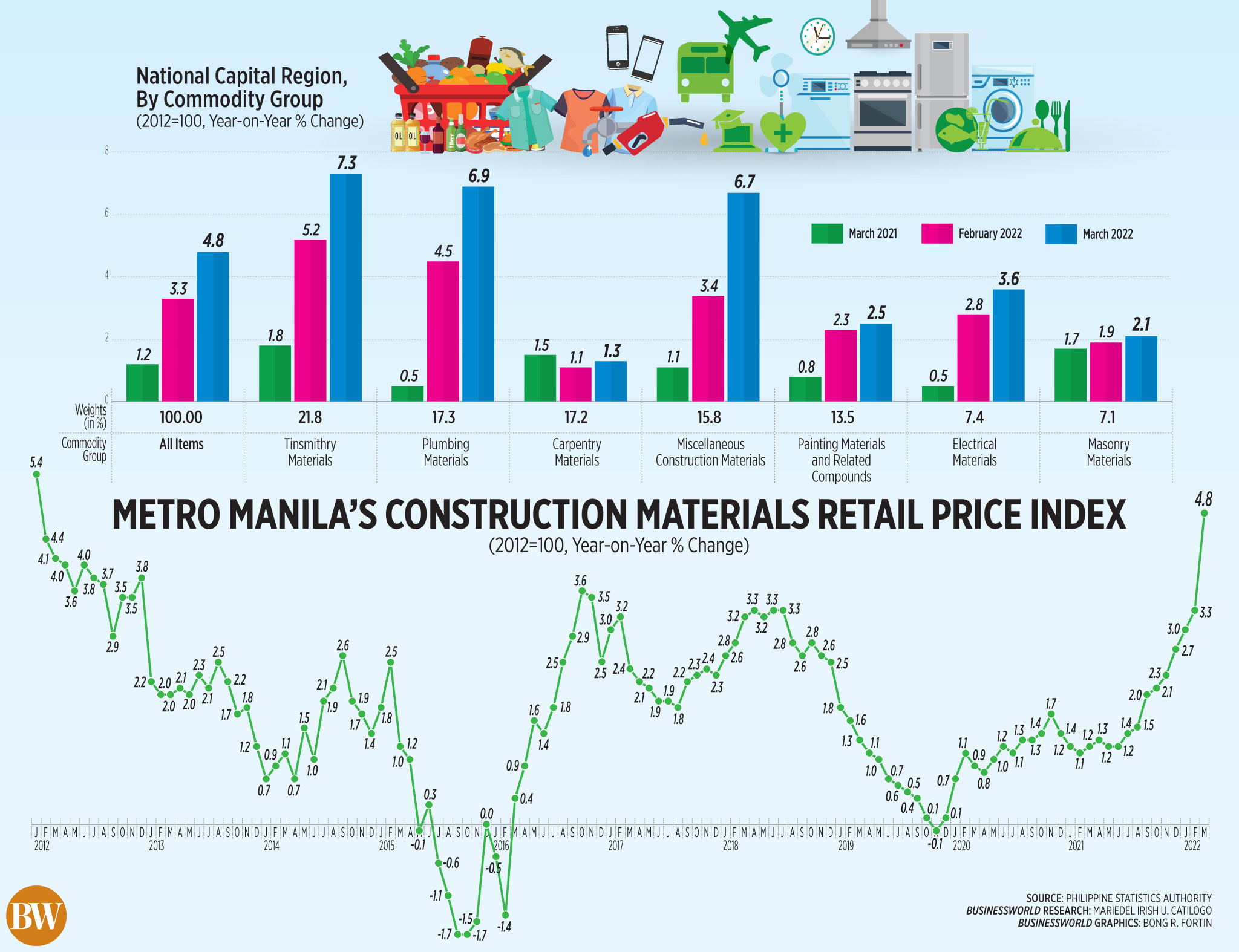
Preliminary data from the PSA showed that retail price growth of building materials in the National Capital Region (NCR) rose by 4.8% year on year in March, higher than the 3.3% seen in February and 1.2% in March last year.

This was the quickest pace in more than 10 years, since the 5.4% in January 2012.

Metro Manila's construction materials retail price index

This brought the NCR’s construction materials retail price index (CMRPI) average in the first quarter to 3.7%, higher than the 1.2% in January–March last year.

Prices for all commodity groups recorded increases that month, led by tinsmithry materials (7.3% in March from 5.2% in February).

Plumbing materials likewise grew by 6.9% year on year in March from 4.5% in February; miscellaneous construction materials (6.7% from 3.4%); electrical materials (3.6% from 2.8%); painting materials and related compounds (2.5% from 2.3%); masonry materials (2.1% from 1.9%); and carpentry materials (1.3% from 1.1%).

The retail construction prices reflect demand from small-scale building projects, such as small contractors. — Abigail Marie P. Yraola


Tax agencies should keep up with global trend toward flexible work — ADB

Cognitive jobs that require data interpretation, analysis, and creative thinking — characteristics that are prevalent among higher educated and more skilled workers — can be done from home, said an Asian Development Bank economist. 

“What we see globally is that enterprises and workers in information-related occupations are shifting towards hybrid and even remote work arrangements,” Sameer Khatiwada, ADB Southeast Asia’s social sector specialist, told BusinessWorld in an e-mail. 

Despite the global trend of hybrid or remote work, business process outsourcing companies (BPOs) in the Philippines that operate in economic zones will be required to operate on location by September 2022, when the extension of the work-from-home set-up approved by the Fiscal and Incentives Review Board ends. 

Instead of requiring onsite work to allow the effective monitoring of fiscal incentives, Mr. Khatiwada said that “tax agencies will need to create innovative ways to strengthen tax surveillance and compliance in hybrid or remote work arrangements.” 

Cognitive jobs that can be done remotely include product design, software development, and call center operations. Back-office operations can also be done from home, although these are at risk of automation, according to Mr. Khatiwada

In a May 17 ADB blog, he differentiated cognitive jobs from manual jobs that cannot be done from home, such as driving a truck or waiting tables at a café. 

According to a 2012 study in the Philippine Review of Economics that examined 427 occupations, only 8%–10% have all tasks classified as remote; 35%–37% cannot be done remotely. The rest are a combination of onsite and remote tasks. 

The pandemic hit some occupations harder than others. Service sectors such as those in food and transportation were casualties of the lockdown and physical distancing measures. So were those in manufacturing and construction who had to cope with these disruptions. 

SOCIAL PROTECTION 

Self-employed workers were likewise harder hit than their salaried counterparts, per ADB’s December 2021 research on the Southeast Asian labor market. The study noted that this segment tends to be in the informal sector, and that those who were lower-skilled were less likely to shift to teleworking.  

As such, they face a higher risk of unemployment and income loss during times of crisis. 

Freelancers can make their incomes more crisis-proof if they can diversify their clients, including by expanding their skillsets to related areas, Mr. Khatiwada said.  

“The pandemic has also highlighted that — given the non-standard form of employment contracts of freelancers — many were ineligible for government support and the safety nets put in place during the pandemic,” he added. “There is a need to rethink and build more comprehensive, inclusive, and sustainable employment or income insurance schemes moving forward.” 

Either an expanded social unemployment insurance or an income protection scheme can be enacted by the government to support all workers’ transition to the “future of work,” according to Kelly Bird, Philippines country director for ADB. 

“Two alternative models that could be applicable to the Philippines is the Malaysian employment insurance scheme and the Chilean unemployment insurance scheme, [the latter of which] comprises of individual savings accounts and a government Solidarity Fund,” he told BusinessWorld in an e-mail. “The second intervention is enterprise-based skills development schemes that allow workers access to lifelong skills training.” 

ADB, Mr. Bird added, is collaborating with the trade and industry, labor and employment, and tourism departments to pilot SkillsUpNet Philippines. 

“This will provide grant funding to networks of enterprises in priority sectors to skill up or reskill workers and job seekers,” he said.  

With these, “networks can incorporate digital skills training, which [in turn] can support hybrid work arrangements.” 

Added Mr. Khatiwada: “Remote work is not possible without connectivity, so governments need to prioritize investments in infrastructure that allow workers to be productive in a hybrid setting.” said Mr. 

Nine of 10 employees prefer a hybrid or remote work setup, based on a survey of 8,184 workers by Sprout Solutions in January. — PBM

Shanghai’s fashion stores struggle to clear lockdown stock hangover

IFC Mall in Shanghai. -- Stefan Wagener/Flickr/CC BY 2.0

SHANGHAI — Almost a month since Shanghai lifted its strict coronavirus disease 2019 (COVID-19) lockdowns, fashion retailers are stuck with piles of unsold stock as cautious consumers stay away from the commercial hub’s glitzy shopping districts.

Curbs to stop the virus in Shanghai, China’s fashion capital, ground the city of 25 million to a halt in April and May, leaving clothing and beauty product displays in stores untouched and containers of imported apparel stranded at port.

The city’s re-opening this month saw a flood of goods ship from warehouses to store shelves already laden with merchandise unsold during two months of lockdown. Normally around a fifth of all imported goods coming into China pass through Shanghai’s port.

Days after COVID-19 curbs eased, large “sales” signs went up across Shanghai, with retailers from Lululemon to Victoria’s Secret offering discounts to lure shoppers.

Even online retailers have struggled to clear a glut caused by lockdowns and supply interruptions.

“This affected us a lot,” said Josh Gardner, founder and chief executive of China market e-commerce partner Kung Fu Data, which manages online stores for 10 fashion brands, including G-Star Raw.

“In April, May on (China’s major e-commerce) platforms, there wasn’t a T-shirt to be found, we were sold out of summer stock and so was everyone else, there was just no product,” he said. “Now, everyone’s just bleeding and stuck with a lot of inventory they can’t move.”

China is a major market for personal luxury goods companies with sales reaching $74.4 billion in 2021, according to Bain.

One consultancy estimated that sales during “618” — a major shopping event in China from May 31 to June 20 — across the main e-commerce sites, such as Tmall and JD.com, were flat year-on-year.

In the event’s opening week, data from Tmall showed men’s wear sales had dropped 22% and women’s wear was down 4%, although activewear sales rose 26%, possibly due to an increased focus on fitness during the lockdown.

For now, some retailers are warehousing inventory and ordering less for the fourth quarter when they will try to clear existing stock through November’s Singles’ Day.

“For the apparel category, due to the epidemic and sluggish consumption, there is a high level of inventory backlog of spring collections,” JD.com chief executive Lei Xu said following the online retailer’s first quarter earnings. “As a result, many factories are considering skipping their … summer collections.”

Flash sales specialists OnTheList, which sells luxury products for brands including Versace, Jimmy Choo, and Lanvin at discounts of 70% or more, re-opened its physical Shanghai showroom last weekend with a sale from Salvatore Ferragamo.

The high-end Italian fashion brand and almost all other retailers in Shanghai closed stores throughout April and May. Salvatore Ferragamo declined to comment.

Jean Liang, OnTheList’s China managing director, said luxury brands are now more open to online sales, as well as offline sales, while cosmetics brands are pro-actively looking to hold sales to clear excess inventory.

“Before it was always us pitching asking them about their plans and now they approach us, which means they have inventory they need to clean out to have a healthy stock situation,” she said. OnTheList’s calendar of flash sales, which run every few days, is already booked through to September.

Sending products abroad to be distributed in Europe or America is another solution but is currently complicated by surging shipping and air transport costs, said Benny Wong, supply chain director at online wholesale marketplace, Peeba.

“Now the main hurdle is transportation … that creates a big problem for the inventory owner,” he said. “Inventory can kill (and) some product categories have huge inventory to move.”

CONSUMERS WARY

Weeks after re-opening, retail sentiment is downbeat with Shanghai’s consumers yet to return to malls in significant numbers and footfall around half its usual levels in major downtown malls, according to retail staff.

People in Shanghai are reluctant to return to indoor public areas largely out of fear of being locked down again, as China’s dogged zero-COVID policies demand each time new infections emerge.

A continued ban on in-restaurant dining also means malls remain without their usual food and beverage attractions.

Across China, retail sales slipped 6.7% in May from a year earlier, extending the previous month’s 11.1% decline, as a slowdown in the world’s second-largest economy discouraged consumer spending.

“In terms of inventory clearance there’s not really a good solution in China,” Kung Fu Data’s Mr. Gardner said. “I mean, what are you going to do that’s not going to destroy your brand?” — Casey Hall/Reuters

US vows more high-level engagement with Pacific islands amid China push

REUTERS

WASHINGTON — White House Indo-Pacific coordinator Kurt Campbell said on Thursday he expects more high-level US officials to visit Pacific island countries as Washington steps up its engagement to counter China in the strategically important region.

Mr. Campbell said the United States needed more diplomatic facilities across the region, and more contact with Pacific island countries that at times “receive lesser attention.”

“You will see more cabinet-level, more senior officials, going to the Pacific … recognizing that nothing replaces, really, diplomatic boots on the ground,” he told Washington’s Center for Strategic and International Studies.

The Biden administration has vowed to commit more resources to the Indo-Pacific as China seeks to boost economic, military and police links with Pacific island nations hungry for foreign investment.

Beijing’s growing influence was highlighted by its security pact with the Solomon Islands this year, a move that fanned concerns in Australia, New Zealand, and the United States.

“Sovereignty is central in terms of how we see the Pacific overall. Any initiative that compromises or calls into question that sovereignty, I think we would have concerns with,” Mr. Campbell said, without referring to China.

Washington has said it will expedite the opening of an embassy in the Solomon Islands, announced earlier this year when Secretary of State Antony Blinken visited Fiji, the first trip there by America’s top diplomat in four decades.

Mr. Campbell said he envisioned Fiji would be one of the United States’ “hubs” of engagement.

“Our mantra will be nothing in the Pacific without the Pacific … we do not take these bonds for granted,” he said, acknowledging perceptions that Washington had not always sufficiently taken the needs of islanders into account.

Monica Medina, responsible for Oceans and International Environmental and Scientific Affairs at the US State Department, said areas where Pacific islands particularly needed help included coping with climate change and countering illegal fishing.

“We know we have much, much, much more work to do,” she said.

Fiji’s UN ambassador, Satyendra Prasad, told the CSIS event the islands needed “great predictability” and no “stop-start” in ties with Washington.

“Pacific people and their governments would welcome an enduring partnership with the US that is there for the long-term,” he said.

Samoa’s UN envoy said there was a need to see whether a US treaty with the Pacific covering tuna could be expanded into a wider trade agreement.

“I think that is already under consideration,” Fatumanava-o-Upolu III Pa’olelei Luteru said. “That’s something that would be very helpful.”

Washington could also help by supporting the UN-driven Multi-Dimensional Vulnerability Index to help island nations access concessional financing.

In apparent reference to China’s attraction, Mr. Luteru said politicians had a responsibility to their people.

“If … you ask a particular country and they are not able to help you, you then have a choice to say no, we’re not going to provide that service to the people; or you go to another country that perhaps is not the traditional partner, and you say to them, can you help us?” he said. — Michael Martina and David Brunnstrom/Reuters

PHINMA Corp. to conduct annual stockholders’ meeting through remote communication on July 14


Spotlight is BusinessWorld’s sponsored section that allows advertisers to amplify their brand and connect with BusinessWorld’s audience by enabling them to publish their stories directly on the BusinessWorld Web site. For more information, send an email to online@bworldonline.com.

Join us on Viber to get more updates from BusinessWorld: https://bit.ly/3hv6bLA.

Monkeypox case count rises to more than 3,200 globally — WHO

A SECTION of skin tissue, harvested from a lesion on the skin of a monkey, that had been infected with monkeypox virus. — CENTERS FOR DISEASE CONTROL AND PREVENTION

More than 3,200 confirmed monkeypox cases and one death were reported to the World Health Organization as part of the current outbreak. 

There is need for intensified surveillance in the broader community, WHO Director-General Tedros Adhanom Ghebreyesus said on Thursday, adding that cases in non-endemic countries were still predominantly among men who have sex with men. 

“Person-to-person transmission is ongoing and is likely underestimated,” Mr. Tedros said at a meeting of the International Health Regulations (2005) Emergency Committee. 

The meeting of experts was convened by the WHO to decide whether to declare monkeypox a global health emergency. 

A “public health emergency of international concern” is WHO’s highest level of alert. Forty-eight countries have reported cases in the current outbreak, which began in May. 

There had been almost 1,500 suspected cases of monkeypox this year in Central Africa and 70 deaths, Mr. Tedros said. 

The WHO head called on member states to share information on the virus as it would help the agency in its goal to support countries to contain transmission. — Reuters

US recession fears darken outlook for global growth

China Daily via REUTERS

WASHINGTON/LONDON/TOKYO — Manufacturing growth is slowing worldwide as China’s coronavirus disease 2019 (COVID-19) curbs and Russia’s invasion of Ukraine disrupt supply chains and keep inflation at the highest in years, while the growing risk of a US recession poses a new threat to the global economy. 

Gauges of factory activity released Thursday in Japan, Britain, the euro zone, and United States all softened in June, with US producers reporting the first outright drop in new orders in two years in the face of slumping consumer and business confidence. 

S&P Global’s flash US Composite PMI Output Index, which tracks the manufacturing and services sectors, dropped to 51.2 this month from a final reading of 53.6 in May and the slowest growth pace in five months. The manufacturing component dropped to 52.4, the lowest in nearly two years, from 57 in May and was notably weaker than the estimate of 56 in a Reuters poll of economists. 

“Business confidence is now at a level which would typically herald an economic downturn, adding to the risk of recession,” said Chris Williamson, chief business economist at S&P Global Market Intelligence. 

Meanwhile, high prices in the euro zone meant demand for manufactured goods fell in June at the fastest rate since May 2020 when the coronavirus pandemic was taking hold, with S&P Global’s headline factory Purchasing Managers’ Index falling to a near two-year low. 

“June’s euro zone PMI surveys showed a further slowdown in the services sector, while output in the manufacturing sector now seems to be falling outright,” said Jack Allen-Reynolds at Capital Economics. 

“With the price indices remaining extremely strong, the euro zone appears to have entered a period of stagflation.” 

There is a roughly one-in-three chance of a recession in the bloc within 12 months, economists in a Reuters poll published earlier on Thursday predicted. They also said inflation — which hit a record high of 8.1% last month — was yet to peak. 

Jerome Powell, chair of the Federal Reserve, said on Wednesday the central bank was not trying to engineer a recession in the United States to stop inflation but was fully committed to bringing prices under control even if doing so risks an economic downturn. 

He acknowledged a recession was “certainly a possibility.” 

Inflation continues to run at least three times higher than the Fed’s targeted level of 2% and it is expected to deliver another 75 basis point interest rate hike next month, according to economists polled by Reuters. 

Despite Mr. Powell’s comments a few primary dealers have either started predicting a recession as early as this year or have brought forward their recession calls. 

US investment firm PIMCO warned on Wednesday that central banks tightening monetary policy to fight persistently high inflation raised the recessionary risk. 

There is a 40% chance of a US recession over the next two years, with a 25% chance of that happening in the coming year, a Reuters poll found earlier this month. 

“Stagflation, which is characterized by persistent high inflation, high unemployment and weak demand, has become the dominant risk theme since late 1Q22 and a plausible potential risk scenario,” said Fitch Ratings in a report released this week. 

A string of recent data globally showed policymakers are walking a tight rope as they try to defuse inflation pressures without tipping their economies into a steep downturn. 

US retail sales unexpectedly fell in May and existing home sales tumbled to a two-year low, a sign high inflation and rising borrowing costs were starting to hurt demand. 

Britain’s economy unexpectedly shrank in April, adding to fears of a sharp slowdown as companies complain of rising production costs. Its PMI also showed signs the economy was stalling as high inflation hit new orders and businesses reported levels of concern that normally signal a recession. 

There is a 35% chance of a British recession within 12 months, another Reuters poll showed. 

In Asia, South Korea’s exports for the first 10 days of June shrank almost 13% year-on-year, underscoring the heightening risk to the region’s export-driven economies. 

While Chinese exporters enjoyed solid sales in May, helped by easing domestic COVID-19 curbs, many analysts expect a more challenging outlook for the world’s second-biggest economy due to the Ukraine war and rising raw material costs. 

The au Jibun Bank flash Japan Manufacturing PMI marked its slowest expansion since February. — Lucia Mutikani, Jonathan Cable, and Leika Kihara/Reuters

Cisco, Nike quit Russia, as pace of Western firms leaving speeds up

WU YI-UNSPLASH

US companies Cisco Systems and Nike plan to fully exit Russia, the two firms told Reuters on Thursday, as the pace of Western firms departing accelerated.

Telecoms equipment maker Cisco will wind down its business in Russia and Belarus, the company said. Nike is making a full exit from Russia three months after suspending its operations there, the sportswear maker said.

Foreign companies seeking to exit Russia over the war in Ukraine face the prospect of a new law being passed in the coming weeks allowing Moscow to seize assets and impose criminal penalties. That has encouraged some businesses to accelerate their departure.

“What was a trickle is becoming a torrent,” said Paul Musgrave, a political science professor at the University of Massachusetts, commenting on the latest round of companies announcing they would leave.

Cisco suspended business operations, including sales and services, in Russia in March.

“We have now made the decision to begin an orderly wind-down of our business in Russia and Belarus,” it said in an emailed statement on Thursday.

Earlier this month, Cisco’s rival International Business Machines Corp began winding down its business in Russia and Microsoft said it was making substantial cuts to its Russian business.

The withdrawal of top technology firms such as Cisco, IBM and Microsoft limits access to critical equipment for Russian businesses and households. They may now have to depend on older equipment and domestic alternatives.

Cisco has offered relocation options to its few hundred employees in those countries, it said. The company did not disclose which countries the employees were offered as alternative locations.

RIVALS MAY BENEFIT

Companies heading for the exit may struggle to return, said Mr. Musgrave. “This presents opportunities for domestic firms in some markets but even more for brands from China and elsewhere to make inroads,” he said.

Nike said on March 3 it would temporarily suspend operations at all its Nike-owned and operated stores in Russia. It has now decided to leave entirely, it said Thursday.

Cisco and Nike join the likes of McDonald’s and Renault in making complete exits from Russia. More companies are expected to leave in the coming weeks ahead of the new law.

The law, which could be in place within weeks, allows Russia to appoint administrators over companies owned by foreigners in “unfriendly” countries, who want to quit Russia as the conflict with Ukraine drags down its economy.

Nike’s rival Adidas said in March it was shutting its Russian stores and pausing online sales.

Adidas currently has no plans to resume business in Russia, the German sportswear company told Reuters on Thursday.

“The operation of Adidas’ stores and Adidas’ online retail in Russia continues to be suspended until further notice, this also applies to the delivery of goods to Russia,” it said in an emailed statement. — Praveen Paramasivam, Supantha Mukherjee, and Mimosa Spencer/Reuters

Billie Eilish performing live in Manila

crommelincklars/CC BY 2.0/Wikimedia Commons

After her first scheduled performance in the Philippines was stymied by the coronavirus disease 2019 (COVID-19) pandemic, seven-time Grammy Award-winning American singer-songwriter Billie Eilish takes her Happier Than Ever, The World Tour to Manila. The concert will be on Aug. 13 at the SM Mall of Asia Arena in Paranaque.

Ms. Eilish was scheduled to perform in Manila in September 2020 as part of the Where Do We Go? World Tour which was canceled due to the coronavirus pandemic.

Born Billie Eilish Pirate Baird O’Connell, the singer-songwriter first gained recognition in 2015 for the song “Ocean Eyes.” In 2020, her album When We All Fall Asleep, Where Do We Go? won the Grammy Album of the Year award, making her the youngest artist to win the award at the age of 18. In 2022, Ms. Eilish won an Academy Award for Best Original Song for “No Time to Die” — the theme song of the James Bond film of the same title.

Her concert at the Mall of Asia Arena will have a standing section open to adults and minors 13 to 17 years old accompanied by a guardian. The seated section will be open to patrons aged 10 and above. Only fully vaccinated patrons will be allowed at the venue.

Ticket prices range from P3,081 to P14,93.

Tickets are available for Fan Club pre-sale on June 24, Live Nation Philippines pre-sale on June 25 (10 a.m.) and public sale on June 27 (10 a.m.), via smtickets.com and its outlets. — MAPS


Duterte signs memo to boost financial inclusion

LANDBANK

Philippine President Rodrigo R. Duterte’s office on Friday released a memorandum circular directing government bodies to support the implementation of a national strategy boosting access to financial services, which are mostly offered by the private sector.

The memorandum directs all departments, agencies, and instrumentalities of the Philippine government to adopt initiatives under the National Strategy for Financial Inclusion (NSFI), launched in 2015 and updated earlier this year to cope with the changing technological landscape.

“All regional development councils (RDCs) and equivalent bodies are enjoined to adopt financial inclusion as a development agenda,” the memorandum, signed by Executive Secretary Salvador C. Medialdea on June 23, read.

“All local government units (LGUs) are likewise encouraged to promote financial inclusion within their respective jurisdictions,” it added.

The NSFI provided strategic objectives and guiding principles that would promote financial inclusion.

To implement the circular effectively, the Financial Inclusion Steering Committee (FISC), chaired by central bank governor Benjamin E. Diokno, is tasked to coordinate with and provide technical assistance to RDCs and LGUs.

“The FISC shall also conduct information, education and communication activities towards building public understanding on the NSFI,” it added.

Funds necessary for the implementation of the circular will be charged against the appropriations of concerned government agencies with respect to their NSFI-related projects and activities, “subject to the usual accounting and auditing requirements, rules and regulations.”

“As a shared blueprint that aspires to achieve financial inclusion towards broad-based financial resilience, the adoption and implementation of the National Strategy for Financial Inclusion demands cooperation and support from the whole-of-government,” the circular read.

The proportion of Filipino adults with bank accounts reached 53% in the first quarter of 2021 from 29% in 2019. These comprised basic deposit and e-money accounts.

Data from the Philippine central bank showed that bank deposit accounts rose by 19% to 7.9 million in the last quarter of 2021, from 6.6 million in the same period a year earlier.

The Philippine government considers financial inclusion as a key driver of economic recovery towards a post-pandemic world.

The central bank is aiming to transform 50% of the total volume of retail payments into digital and bring 70% of Filipino adults into the banked population by 2023 under its Digital Payments Transformation Roadmap. — Kyle Aristophere T. Atienza

Duterte orders dissolution of NDC-owned Cavite industrial estate

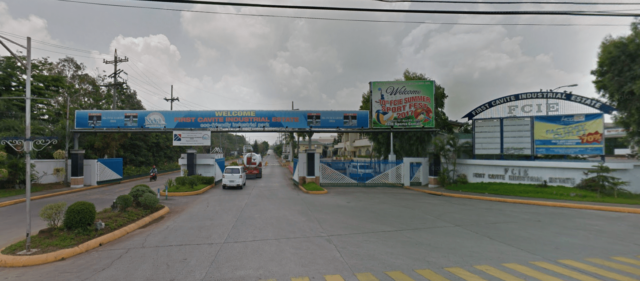
PRESIDENT Rodrigo R. Duterte has ordered the dissolution of an industrial estate in Cavite after a follow-on project to be developed by the estate operator failed to materialize.

The dissolution order was contained in a memorandum signed by Executive Secretary Salvador C. Medialdea on June 23, ending the corporate life of First Cavite Industrial Estate, Inc., (FCIEI), which was registered with the Securities and Exchange Commission in 1990.

The estate was originally a joint venture of the National Development Co. (NDC) and partners. NDC became the sole owner in 1999.

“After completion of the development of the NDC property, which served as the FCIEI’s sole industrial estate project, the Board of Directors of the NDC deferred the dissolution of FCIEI considering that it may be used to develop another property of the NDC,” according to the memorandum.

The abolition of the company was recommended given that the intention for the FCIEI to undertake another development project did not materialize, the memorandum read. “[It] was approved in principle in 2015, with the condition that the FCIEI’s liabilities, particularly to the Philippine Economic Zone Authority (PEZA), are settled.”

It said that through a Memorandum of Agreement dated March 7, 2016, the FCIEI and PEZA agreed on the partial settlement of the former’s obligations to the latter.

The Governance Commission for Government-Owned or -Controlled Corporations (GCG) recommended the abolition of the FCIEI after determining that “its original purpose is no longer relevant to the State and it is no longer achieving the objectives and purposes for which it was originally designed and implemented,” according to the memorandum.

The GCG added that the FCIEI was not cost efficient and is involved in an activity “best carried out by the private sector.”

“The assets of the FCIEI shall be liquidated to settle the outstanding liabilities of the corporation,” according to the memorandum. “The remaining assets and/or liabilities of the FCIEI shall be assumed by its parent company, the NDC.”

In the memorandum, Mr. Duterte ordered the creation of a technical working group to oversee the settling of liabilities, liquidate of its assets, and assist in the winding-up of its corporate affairs. — Kyle Aristophere T. Atienza

Home Credit releases 2021 Sustainability Report

The Report outlines Home Credit’s strong progress in delivering digital-led financial inclusion benefits, building on company’s history of responsible operations, with highlights of its Philippine ESG performance

Home Credit released its Sustainability Report last June 15 detailing Home Credit’s progress in delivering against Environmental, Social and Governance (ESG) principles – a framework used globally, to measure non-financial factors anchored on sustainability and ethical impact of a company or business.

The report aligns with the United Nations’ Sustainable Development Goals and covers all the company’s markets across the globe.
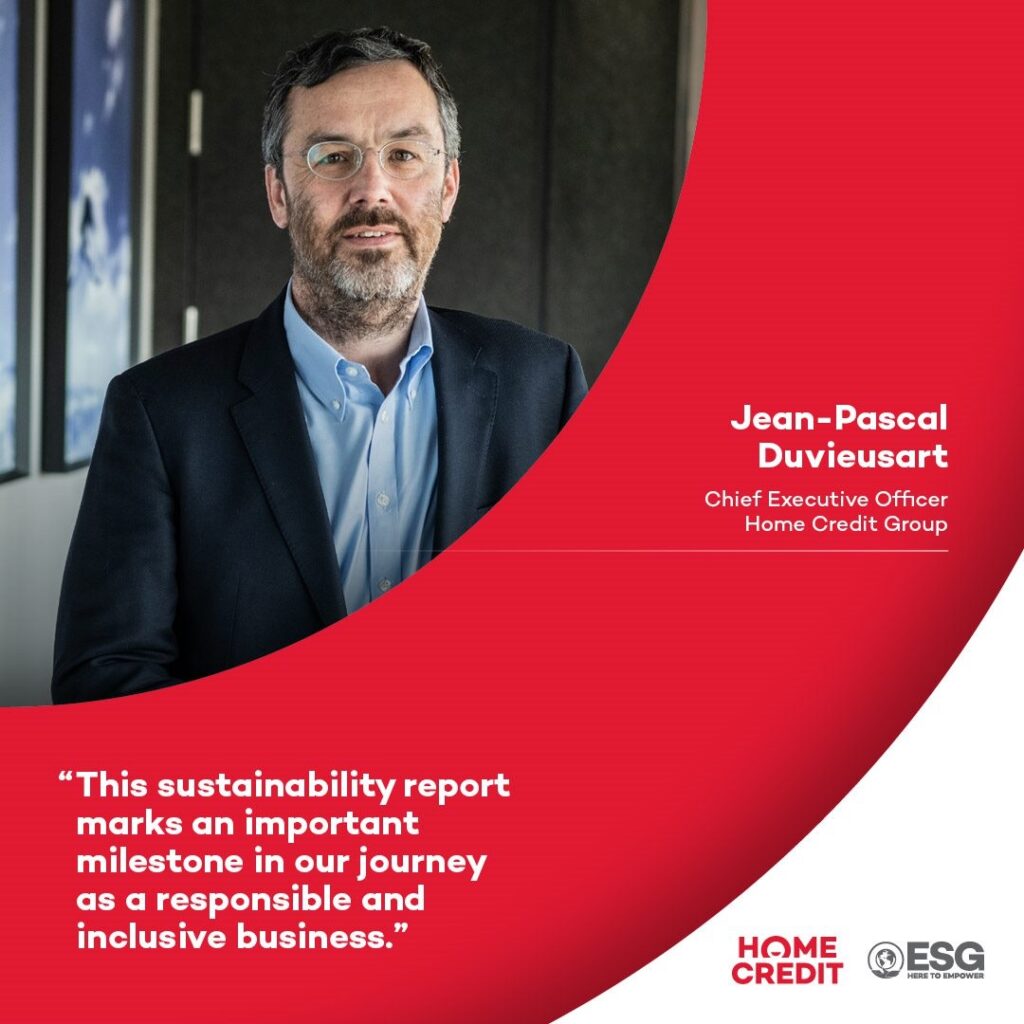
“This sustainability report marks an important milestone in our journey as a responsible, inclusive business, that has ESG principles firmly embedded in its values and DNA,” said Jean-Pascal Duvieusart, Chief Executive Officer, Home Credit Group.

Home Credit has been working to support customers and communities in 2021 as they navigated the continued challenging global environment.

The report highlights key themes and trends that impact the business, based on a materiality assessment.
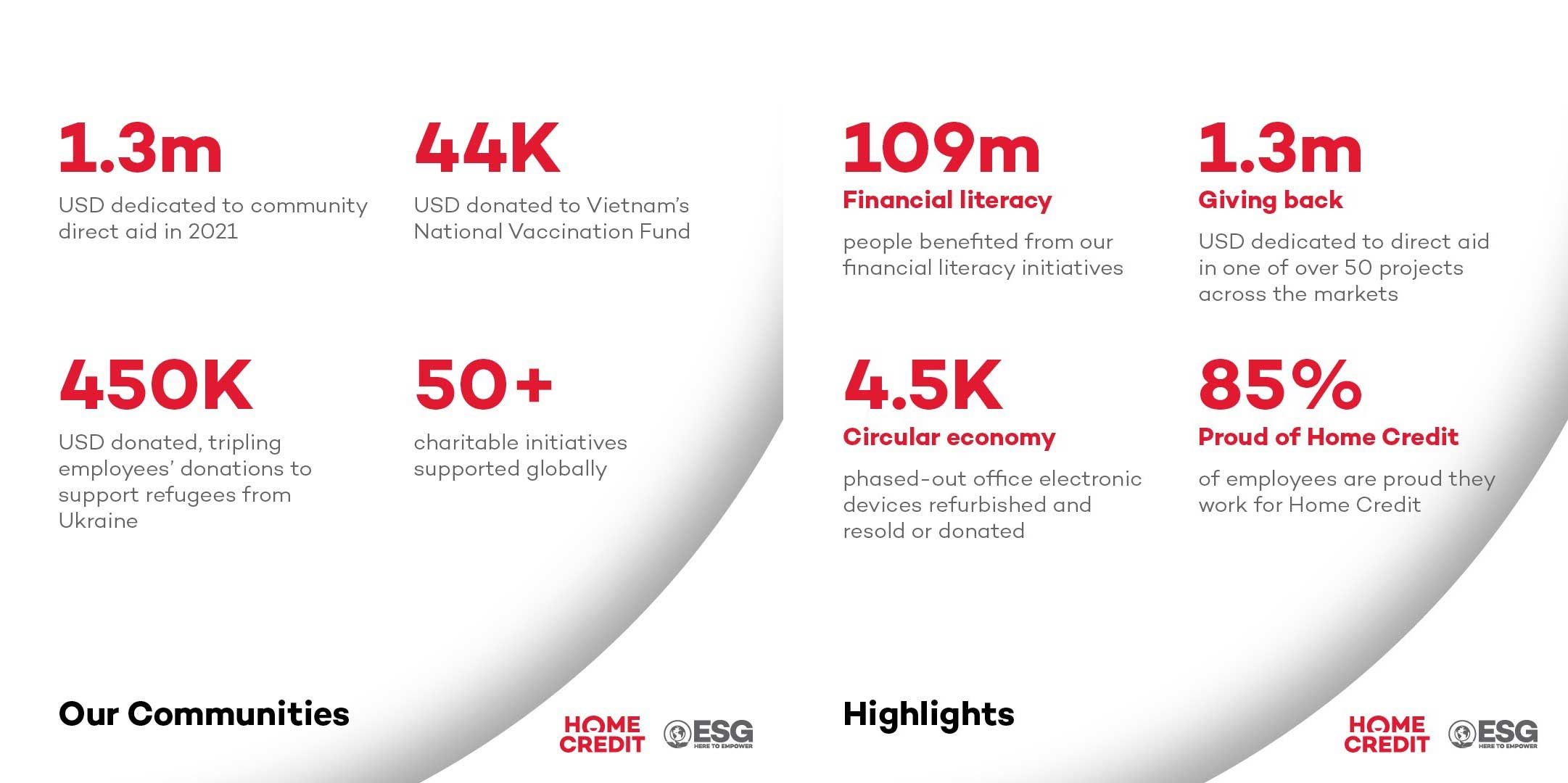
Key 2021 report highlights at a glance:

  • Serving the underserved

23% of Home Credit customers were first-time borrowers

  • Financial literacy

109 million people benefited from Home Credit financial literacy initiatives in 2021

  • Equitable lending

43% of Home Credit customers are women

  • Zero interest

44% of our consumer loans have 0% interest, thanks to partnerships with retailers and manufacturers

  • Payment holidays

2.2 million customers were given the option of payment holidays and deferred payments to help them better cope with the pandemic in 2021

  • Giving back to communities

USD1.3 million dedicated to community direct aid in one of over 50 projects across the markets

  • Carbon footprint

12k tCO2 equivalent in scope 1 & 2

  • Circular economy

4.5k phased out office devices refurbished and resold or donated

The materiality assessment sets out the most significant themes for Home Credit. It was compiled with reference to industry leading benchmarks such as the Standards and Practices for Responsible Inclusive Finance by the Social Performance Task Force (SPTF), Principles for Responsible Banking by the United Nations Environment Programme Finance Initiative (UNEPFI) and Materiality Finder by the Sustainable Accounting Standards Board (SASB).

In addition, the Home Credit Sustainability Report was prepared with reference to the Global Reporting Initiative (GRI) Standards.

Spotlight on the Philippines

In the Philippines, Home Credit has been the pioneer of financial inclusion since 2013, providing access to useful, affordable and responsible financial products and services to over 8 million Filipinos.

“Our mission at Home Credit is to empower every Filipino to be financially capable. Our robust network of over 10,000 POS locations and expanding online presence presents us whenever and wherever our customers need us. With our strong brand partnerships and community across the country, we have become a one-stop ally for every Filipino,” said David Minol, Home Credit Philippines’ Chief Executive Officer. “We have provided over 178 billion pesos in loans to our customers over the past 8 years, those loans have become a lifeline for most Filipinos, especially for those without access to bank or credit.”

Home Credit Philippines has been at the forefront of financial inclusion and innovation. Its Home Credit Marketplace app has evolved into a vibrant hub where customers can browse products, compare prices, and buy from local retailer. As part of our efforts to further to provide options for our customers, we have also expanded our partnerships from major retailers to specialist and medium to small brick and mortar stores- majority of which are based in smaller, underserved cities. By end of 2021, our marketplace now feature products from over 70 merchants across the Philippines expanding availability of products beyond consumer electronics and gadgets to furniture, home appliance, and even sports and lifestyle equipment.

At the height of the global pandemic, HCPH also partnered with BPI/MS Insurance Corporation, one of the Philippines major insurance providers to address the growing demand for insurance services in the country and provide value-added services to Home Credit’s customers, to help become more financially resilient despite the uncertainties.

Building on the learnings of the pandemic, Home Credit has also created its enhanced Safe Lender Toolkit, which aims to help customers resolve unexpected financial difficulties. The toolkit provides a range of support options from short-term through deferred payments and collection exclusion to long-term with debt resolution support, dynamic repayments and settlements.
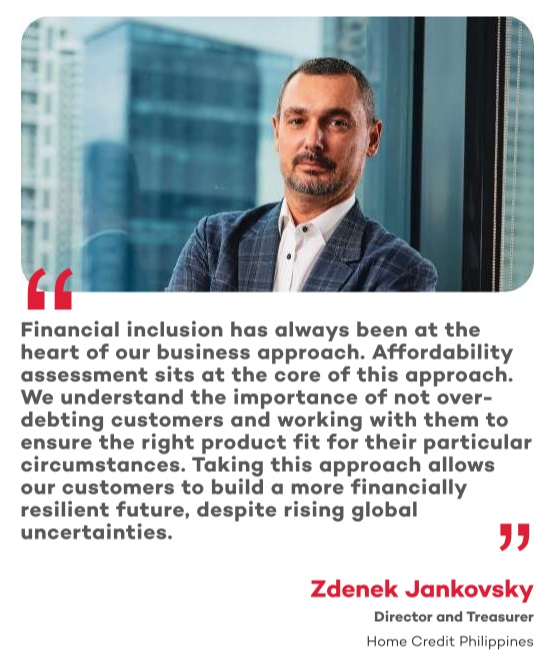
“Financial inclusion has always been at the heart of our business approach. Affordability assessment sits at the core of this approach. We understand the importance of not over-debting customers and working with them to ensure the right product fit for their particular circumstances,” said Zdenek Jankovsky, Home Credit Philippine’s Director and Treasurer. “Taking this approach allows our customers to build a more financially resilient future, despite rising global uncertainties.” he added.

ESG principles have long driven Home Credit’s portfolio development- whether it’s a 0% interest product that helps someone buy their first smartphone, a revolving loan that provides more resilient cash flow or a payment holiday that helps a customer whose financial circumstances have suddenly changed.

Linked to this solid ESG performance are ESG-linked loans that have been granted to Home Credit Philippines to further its mission.

In December 2021, HCPH closed it first ESG-linked credit facility with Deutsche Bank noted as a groundbreaking transaction with focus on expanding credit access to underserved communities in the Philippines, including female and first-time borrowers, and increased provision of financial literacy programs in the country

As of June 20, Home Credit Philippines in partnership with Praxis, and the Manila Broadcasting Corporation has launched a financial literacy radio segment named “Payo para sa Life: Pera Wais Tips” aired daily across DZRH radio stations nationwide, to expand HCPH’s flagship “Wais sa Home” financial literacy program.

In May 2022, HCPH and Citi pioneered a Php 420 social finance facility with a first of its kind support for mobile device purchases for Filipinos. Half of the loan is devoted for women to aid purchase of basic digital devices to empower them to connect to the internet, access essential services such as digital banking, financial literacy, and for running their own online businesses or avail of online education.

“With more ESG-linked loans, we’re even better placed to continue to deliver equitable and transparent access to financial services for our communities,” said Jean Lafontaine, Home Credit Group’s Head of Funding and Investor Relations.


Spotlight is BusinessWorld’s sponsored section that allows advertisers to amplify their brand and connect with BusinessWorld’s audience by enabling them to publish their stories directly on the BusinessWorld Web site. For more information, send an email to online@bworldonline.com.

Join us on Viber to get more updates from BusinessWorld: https://bit.ly/3hv6bLA.

ADVERTISEMENT
ADVERTISEMENT