Home Blog Page 6234

Palace supports filing of charges vs those linked to agri smuggling 

BUREAU OF CUSTOMS

THE PRESIDENTIAL Palace on Tuesday said charges should be filed against the 22 officials and personalities allegedly involved in the smuggling of agriculture products into the country. 

A report by the Senate Committee of the Whole indicated that around P667.5 million worth of agri-fishery products were technically smuggledinto the country from 2019 to 2022.  

We are one with the Senate in fighting corruption in the bureaucracy,Palace Spokesman Jose Ruperto Martin M. Andanar said in a statement.    

File the necessary charges before the Office of the Ombudsman so officials and persons mentioned in the Senate report could be afforded due process, face their accusers, and have their day in court,he added.  

The 63-page committee report, filed on June 1, revealed a list of agriculture smugglers and protectors,” naming officials from the Agriculture department, Customs bureau, and local governments as well as private individuals.   

Senator Aquilino KokoL. Pimentel III, one of the 17 senators who signed the report, said in a statement on Tuesday: By signing, I am not confirming that I have personal knowledge. Its just us acknowledging that intelligence has reached the senate president,”  

The list of names provided is not yet comprehensive,he added, so it would be a good idea to continue the probe in the next Congress.  

Senator-elect Robinhood Ferdinand RobinC. Padilla said it would not be enough to just remove the accused officials from their position.  

If those in government positions lack accountability, they cant stop at apologies,he told reporters in Filipino in a press conference.  

Some of the officials cited in the report have denied the accusations and expressed readiness to face allegations in court.  

Senate President Vicente C. Sotto III, who led the investigation, has said that a copy of the list has been personally given to President-elect Ferdinand BongbongR. Marcos, Jr., who will concurrently serve as Agriculture secretary.  

Smuggling is really one of our biggest problems today,Mr. Pimentel said.  

The report cited weaknesses in the prosecution of smuggling cases, failure to digitalize inspection processes, and lack of first border inspection. Alyssa Nicole O. Tan 

Over 600,000 tricycle drivers to receive fuel subsidy  

ZAMBOANGA CIO

THE DEPARTMENT of the Interior and Local Government (DILG) on Tuesday announced that 617,806 tricycle drivers nationwide will be receiving fuel cash subsidy under the agency’s program to address rising fuel prices. 

In a statement, DILG Secretary Eduardo M. Año said the cash assistance will be distributed by the Land Transportation Franchising and Regulatory Board (LTFRB) through e-wallet platforms, state-owned Land Bank of the Philippines (LANDBANK), and other off-site payout sites of local government units.  

“We hope this fuel subsidy will help those tricycle drivers who are suffering because of the constant rise in oil prices,” he said in Filipino. “We hope this would give relief to these drivers.”  

In March, the LTFRB started releasing fuel subsidy for other public transport operators and drivers, and said it was waiting for the beneficiary list of tricycle and delivery drivers from the DILG.  

Mr. Año noted the subsidy will be distributed in three batches.  

The first batch will be for the 539,395 tricycle drivers who will receive the cash aid through their e-wallet accounts; the second batch will be for the 73,233 who will avail of LANDBANK’S over-the-counter services; and the third will cover 5,178 drivers who will use on-site payout sites of local governments.   

“All those included in the master list of qualified tricycle drivers will receive a fuel subsidy,” he said. “Let us just wait for additional details from the LTFRB.”  

The DILG said about 766,590 tricycle drivers submitted their names for the master list, but 148,784 were disqualified due to lack of requirements and failing to meet the deadline.  

Mr. Año also urged city and municipal mayors to establish help desks for the beneficiaries.  

Oil companies imposed another round of price hike on Tuesday. From the start of the year to June 14, pump prices of diesel, gasoline, and kerosene have gone up by P41.15, P28.70, and P37.95, respectively. John Victor D. Ordoñez 

Samar coastal road partially opened 

DPWH

THE ₱1.126-billion Samar Pacific Coastal Road project in central Philippines is now partially open, the Department of Public Works and Highways (DPWH) announced on Tuesday.  

An initial eight-kilometer stretch of the 11.6-km coastal road in Northern Samar province and its Simora Bridge component, part of the government’s Build Build Build infrastructure program, were inaugurated Monday.    

DPWH Undersecretary Emil K. Sadain said the past four years of construction proved to be challengingwith about 29 typhoons and pandemic restrictions affecting the project. 

The partial opening of the Samar Pacific Coastal Road is a huge step toprovide comfortable and improved interconnectivity that will support sustainable agricultural development, and contribute to food self-sufficiency program and in sustaining peace and development efforts in Northern Samar,he said.

Northern Samar Governor Edwin C. Ongchuan noted that without the coastal road, travel to and from several remote towns required multiple boat rides.

The project, with funding assistance from the Republic of Korea through the Export-Import Bank of Korea (KEXIM), forms part of the Samar Island circumferential road, according to Mr. Sadain. 

Construction of the remaining three-kilometer, two-lane road with two more bridges are ongoing with the bridges at an average completion rate of about 50%, DPWH said.  

The road traverses the coastal municipalities of Palapag, Laoang and Catubig where residents are mainly engaged in coconut and rice farming. MSJ

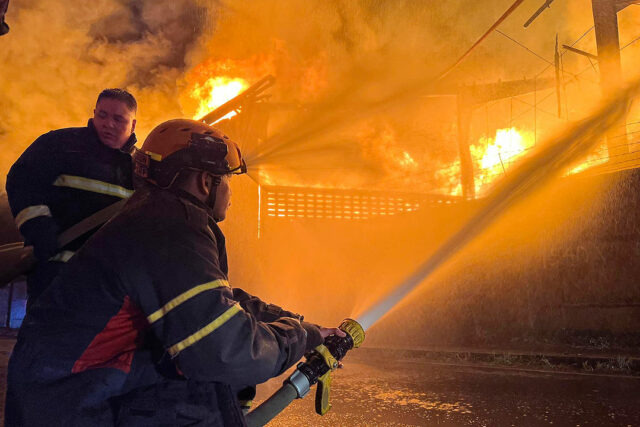
Coconut processing plant in Zamboanga City gutted by fire 

MAYOR BENG CLIMACO FACEBOOK PAGE

FIREFIGHTERS in Zamboanga City on Tuesday morning were still working to put out a fire that broke out late Monday at a coconut processing plant located along the citys coastal area.  

As of Monday noon, the Bureau of Fire Protection had yet to declare the fire under control, according to the Zamboanga City government.  

There were no reported casualties or injuries, it said.   

Outgoing Mayor Maria Isabelle Climaco-Salazar said the origin of the fire that started at around 11 p.m. at the Philippine International Development, Inc. (PHIDCO) compound was still undetermined.  

Fire fighting activities continue up to this time, as traffic rerouting is in effect,she said in a Facebook post on Tuesday morning.   

PHIDCO, established in 1959, is a coconut processing and export firm according to the company website.   

Its export products include crude coconut oil, refined bleached deodorized (rbd) coconut oil, cochin coconut oil, and copra expeller cake. It also produces the Washington brand of cooking oil, Datu laundry bars, and Viva detergent bars for the local market. 

Aside from its manufacturing activities, it leases out commercial as well as warehouse spaces,it said. MSJ 

Ukraine digs for survivors in rubble of Russian missile hit

KREMENCHUK, Ukraine — Firefighters and soldiers searched for survivors in the rubble of a shopping mall in central Ukraine on Tuesday after a Russian missile strike killed at least 16 people in an attack condemned by the United Nations and the West.

Family members of the missing lined up at a hotel across the street where rescue workers had set up a base after Monday’s strike on the busy mall in Kremenchuk, southeast of Kyiv.

More than 1,000 people were inside when two Russian missiles slammed into the mall, Ukrainian President Volodymyr Zelensky said. At least 16 people were killed and 59 injured, Ukraine’s emergency services said.

“This is not an accidental hit, this is a calculated Russian strike exactly onto this shopping center,” Mr. Zelensky said in an evening video address. He said the death count could rise.

More than 40 people had been reported missing, Ukraine’s prosecutor general’s office said.

A survivor receiving treatment at Kremenchuk’s public hospital, Ludmyla Mykhailets, 43, said she was shopping with her husband when the blast threw her into the air.

“I flew head first and splinters hit my body. The whole place was collapsing,” she said.

“It was hell,” added her husband, Mykola, 45, blood seeping through a bandage wrapped around his head.

Russia has not commented on the strike but its deputy ambassador to the United Nations, Dmitry Polyanskiy, accused Ukraine of using the incident to gain sympathy ahead of a June 28-30 summit of the NATO military alliance.

“One should wait for what our Ministry of Defense will say, but there are too many striking discrepancies already,” Mr. Polyanskiy wrote on Twitter.

The United Nations Security Council will meet Tuesday at Ukraine’s request following the attack. UN spokesperson Stephane Dujarric said the missile strike was “deplorable.”

Leaders of the Group of Seven (G7) major democracies, at a summit in Germany, said the attack was “abominable.”

“Russian President Putin and those responsible will be held to account,” they wrote in a joint statement tweeted by the German government spokesperson.

BATTLE FOR LYSYCHANSK
Elsewhere on the battlefield, Ukraine endured another difficult day following the loss of the now-ruined city of Sievierodonetsk after weeks of bombardment and street fighting.

Russian artillery pounded Lysychansk, Sievierodonetsk’s twin city across the Siverskyi Donets River.

Lysychansk is the last big city still held by Ukraine in eastern Luhansk province, a main target for the Kremlin after Russian troops failed to take the capital Kyiv early in the war.

A Russian missile strike killed eight and wounded 21 others in Lysychansk on Monday, the area’s regional governor Serhiy Gaidai said. There was no immediate Russian comment.

Ukraine’s military said Russia’s forces were trying to cut off Lysychansk from the south.

Rodion Miroshnik, ambassador to Moscow of the Luhansk People’s Republic, said Russian troops and their Luhansk Republic allies were advancing westward into Lysychansk and street battles had erupted around the city’s stadium.

Fighting was on in several villages around the city, and Russian and allied troops had entered the Lysychansk oil refinery where Ukrainian troops were concentrated, Miroshnik said on his Telegram channel.

Reuters could not confirm Russian reports that Moscow’s troops had already entered the city.

Russia also shelled the city of Kharkiv in northeast Ukraine on Monday, hitting apartment buildings and a primary school, the regional governor said.

The shelling killed five people and wounded 22. There were children among those wounded, the governor said.

‘AS LONG AS IT TAKES’
Moscow denies targeting civilians in what it calls a “special military operation” in Ukraine, but Kyiv and the West have accused Russian forces of war crimes.

The war has killed thousands, sent millions fleeing, and triggered spikes in global food and energy prices.

During their summit in Germany, G7 leaders, including US President Joseph R. Biden, said they would keep sanctions on Russia for as long as necessary and intensify pressure on President Vladimir Putin’s government and its ally Belarus.

The United States also said it was finalizing another weapon package for Ukraine that would include long-range air-defense systems.

Mr. Zelensky asked for more arms in a video address to the G7 leaders, US and European officials said. He requested help to export grain from Ukraine and for more sanctions on Russia.

The G7 nations promised to squeeze Russia’s finances further — including a cap on the price of Russian oil that a US official said was “close” — and pledged up to $29.5 billion more for Ukraine.

The White House said Russia had defaulted on its external debt for the first time in more than a century as sanctions have effectively cut the country off from global finance.

Russia rejected the claims, telling investors to go to Western financial agents for the cash which was sent but bondholders did not receive. — Reuters

US Supreme Court abortion ruling ignites legal battles over state bans

BATTLES over abortion shifted to state courts on Monday after the US Supreme Court overturned the constitutional right to the procedure nationwide, as judges blocked statewide bans in Louisiana and Utah and clinics in Idaho, Kentucky, Mississippi and Texas sued seeking similar relief.

The six are among the 13 states with “trigger laws” designed to ban or severely restrict abortions once the Supreme Court overturned the landmark 1973 Roe v. Wade ruling that recognized a right to the procedure, as it did on Friday.

In Louisiana, abortion services that had been halted since Friday began resuming after Orleans Parish Civil District Court Judge Robin Giarrusso on Monday issued a temporary restraining order blocking the state from carrying out its ban.

The order came shortly after Hope Medical Group for Women in Shreveport — one of Louisiana’s three abortion clinics — sued, arguing Louisiana’s trigger laws “lack constitutionally required safeguards to prevent arbitrary enforcement.”

Later on Monday in Utah, 3rd District Court Judge Andrew Stone, at the request of a Planned Parenthood affiliate, issued a temporary restraining order that would allow abortion services to resume in the state after a 2020 ban took effect on Friday.

“Today is a win, but it is only the first step in what will undoubtedly be a long and difficult fight,” Karrie Galloway, president and CEO of Planned Parenthood Association of Utah, said in a statement.

Republican Louisiana Attorney General Jeff Landry said his office was “fully prepared to defend these laws in our state courts, just as we have in our federal courts.” Republican Utah Attorney General Sean Reyes did not respond to requests for comment.

The rulings came as a flurry of lawsuits were filed nationally challenging Republican-backed abortion laws under state constitutions after Friday’s ruling by the conservative-dominated US Supreme Court.

In Republican-led Texas, where a ban on abortions after six weeks of pregnancy went into effect last year, a judge in Harris County will hear arguments on Tuesday on whether to block officials from enforcing pre-Roe v. Wade abortion prohibitions.

Republican Attorney General Ken Paxton had said in a Friday advisory that while the state’s 2021 trigger ban would not take effect for 30 days after the Supreme Court’s ruling, prosecutors could immediately pursue cases based on pre-1973 laws.

In Idaho, a Planned Parenthood affiliate asked the state’s Highest Court to block enforcement of a “trigger” law banning abortion that the Republican-controled state legislature passed in 2020 due to take effect Aug. 19.

Similar lawsuits were filed by abortion providers asking state courts to block enforcement of “trigger” bans in Kentucky and Mississippi.

“To be clear, there is no right to abortion contained in the Commonwealth’s Constitution — and we will stand up against any baseless claim to the contrary,” Kentucky Attorney General Daniel Cameron said in a statement.

Abortion rights advocates plan to challenge an Ohio ban on abortions after six weeks that took effect on Friday, and in Florida, a group of abortion providers went before a judge on Monday to argue a challenge to that state’s ban on abortions after 15 weeks of pregnancy.

In states where federal court orders were blocking abortion restrictions based on the Roe precedent, those orders are now being lifted. South Carolina’s ban on abortions after a fetal heartbeat is detected is now in effect, Attorney General Alan Wilson said on Monday, after a federal judge put on hold an injunction that had prevented its implementation. — Reuters

G7 to stand by Ukraine ‘for as long as it takes’

SCHLOSS ELMAU, Germany — The Group of Seven (G7) club of wealthy nations on Monday vowed to stand with Ukraine “for as long as it takes,” promising to tighten the squeeze on Russia’s finances with new sanctions that include a proposal to cap the price of Russian oil.

The announcement came after Ukraine’s President Volodymyr Zelensky, addressing G7 leaders at their summit in the Bavarian Alps via a video link, asked for weapons and air defenses to gain the upper hand in the war against Russia within months.

But efforts to rally the Global South to the Ukrainian cause were less successful, with five developing countries invited to partner with the rich country club signing up only to a mildly worded statement hailing democracy’s “courageous defenders” without referring explicitly to Russia’s invasion of Ukraine.

The G7 leaders’ own statement aimed to signal that its members were ready to back Ukraine for the long haul, at a time when soaring inflation and energy shortages — fueled by Russia’s invasion — have tested the West’s sanction resolve.

“We will continue to provide financial, humanitarian, military and diplomatic support and stand with Ukraine for as long as it takes,” according to the statement.

After missiles rained down on Kyiv on Sunday, US national security adviser Jake Sullivan said the United States was readying a new weapon package for Ukraine that included long-range air defenses and ammunition.

In reference to Mr. Zelensky’s address, Mr. Sullivan told reporters: “At the top of his mind was the set of missile strikes that took place in Kyiv and other cities across Ukraine and his desire to get additional air defense capabilities that could shoot down Russian missiles out of the sky.”

The G7 countries said they were ready to provide security commitments in a post-war settlement while stressing, after Ukraine had earlier voiced misgivings, that it was up to Kyiv to decide a future peace deal with Russia.

The G7 countries said they had also pledged or were ready to grant up to $29.5 billion for Ukraine.

PUTIN’S REVENUES
The White House said on Monday Russia had defaulted on its foreign sovereign bonds for the first time in a century — an assertion Moscow rejected.

G7 nations, which generate nearly half the world’s economic output, want to crank up pressure on Russia without stoking already soaring inflation that is causing strains at home and savaging the Global South.

The expanded sanctions would also target Russia’s revenue stream from gold exports, Moscow’s military production and officials installed by Moscow in areas of Ukraine occupied by Russian forces.

Imposing the oil price cap aims to hit Russian President Vladimir Putin’s war chest while actually lowering energy prices.

“The dual objectives of G7 leaders have been to take direct aim at Putin’s revenues, particularly through energy, but also to minimize the spillovers and the impact on the G7 economies and the rest of the world,” a US official said on the sidelines of the G7 summit.

Western sanctions have hit Russia’s economy hard and the new measures are aimed at further depriving the Kremlin of oil revenues. G7 countries would work with others — including India — to limit the revenues that Mr. Putin can continue to generate, the US official said.

India has refrained from criticizing Russia and provided a market for Russian oil, gas and coal as it sought to balance longstanding ties with Moscow and relations with the West.

While hosting the Indonesian president at the G7 summit, German Chancellor Olaf Scholz did not rule out boycotting the Group of Twenty summit in Indonesia in November if Mr. Putin attended.

India’s Prime Minister Narendra Modi is one of the five leaders of guest nations joining the G7 for talks on climate change, energy, health, food security and gender equality on the second day of the summit.

“It is good, important and necessary that we talk to each other,” Mr. Scholz said of the guest nations, which also included Argentina, Indonesia, Senegal and South Africa, hailing them as “democracies of the future.”

MORE SANCTIONS
A US official said news that Russia had defaulted on its foreign sovereign bonds for the first time since the Bolshevik revolution in 1917 showed how effective Western sanctions had been.

The Kremlin, which has the funds to make payments thanks to rich energy revenues, swiftly rejected the US statement, accusing the West of driving it into an artificial default.

The United States said it would also implement sanctions on hundreds of individuals and entities adding to the more than 1,000 already sanctioned, target companies in several countries, and impose tariffs on hundreds of Russian products. The agencies involved would release details on Tuesday to minimize any flight risk, a second senior administration official said.

The Ukraine crisis has detracted attention from another crisis — that of climate change — originally set to dominate the summit. Activists fear Western nations are watering down their climate ambitions as they scramble to find alternatives to Russian gas imports and rely more heavily on coal, a dirtier fossil fuel, instead.

Japan is also pushing to remove a target for zero-emission vehicles from a G7 communique expected this week, according to a proposed draft seen by Reuters. — Reuters

Biden signs memo versus illegal and unregulated fishing in swipe of China

WASHINGTON — US President Joseph R. Biden on Monday signed a national security memorandum to fight illegal fishing, part of pledged efforts to help countries combat alleged violations by fishing fleets, including those of China.

The White House said in a statement that it would also launch an alliance with Canada and the United Kingdom to “take urgent action” to improve monitoring, control and surveillance in the fight against illegal, unreported and unregulated (IUU) fishing.

US officials have vowed to introduce policies to better battle illegal fishing, particularly in the Indo-Pacific, as part of stepped up engagement with the region to counter China’s growing influence.

Some countries in the region chafe at China’s vast fishing fleet, arguing its vessels often violate their 200-nautical-mile exclusive economic zones (EEZ) and cause environmental damage and economic losses.

Senior US administration officials told reporters at a briefing that the memorandum directs agencies to work toward “ending human trafficking, including forced labor… while promoting safe, sustainable use of the ocean.”

The Department of Labor, the Department of Defense, the US Coast Guard and other enforcement agencies would engage with private and foreign partners to “investigate fishing vessels and operators expected to be harvesting seafood with forced labor,” the official said.

The effort was not targeted at any specific country, but the official said China was one of the largest violators.

“The PRC (People’s Republic of China) is a leading contributor to illegal, unreported and unregulated fishing worldwide, and has impeded progress on the development of measures to combat IUU fishing and overfishing in international organizations,” the official said.

“The PRC has a responsibility to uphold these commitments as a flag state and actively monitor and correct… fishing fleet activities in other countries’ waters,” she said.

China says it is a responsible fishing country that has been cooperating internationally to clamp down on illegal fishing, and that it fishes in relevant EEZs according to bilateral agreements.

“The US accusation is completely untrue and does nothing to protect the marine environment and promote international cooperation in sustainable fishery,” Liu Pengyu, spokesman for China’s embassy in Washington, said in a statement.

Earlier in June, the Philippines accused China of illegal fishing in its EEZ, a complaint backed by the US State Department

The US Coast Guard has said illegal fishing has outpaced piracy as the top global maritime security threat, and risks heightening tensions among countries vying for overexploited fishing stocks.

US Indo-Pacific policy coordinator Kurt Campbell said in May countries in the region were cooperating to step up patrolling and training efforts, as well as sharing technologies to track vessels engaged in illegal fishing that turn off electronic transponders. — Reuters

More than 40 migrants die in truck in Texas

SAN ANTONIO, TEXAS — Authorities found 46 migrants dead inside a tractor-trailer on Monday in San Antonio, Texas, the city’s fire department said, in what appears to be one of the most deadly recent incidents of human smuggling along the US-Mexico border.

The San Antonio Fire Department said 16 other people found inside the trailer were transported to the hospital for heat stroke and exhaustion, including four minors. Officials also said three people were in custody following the incident.

The truck was found next to railroad tracks in a remote area on the city’s southern outskirts.

Mexico’s Foreign Minister Marcelo Ebrard called the suffocation of the migrants in the truck the “tragedy in Texas” on Twitter and said the local consulate was en route to the scene, though the nationalities of the victims had not been confirmed.

There have been a record number of migrant crossings at the US-Mexico border in recent months, which has sparked criticisms of the immigration policies of US President Joseph R. Biden, a Democrat.

Temperatures in San Antonio, which is about 160 miles (250 km) from the Mexican border, swelled to a high of 103 degrees Fahrenheit (39.4 degrees Celsius) on Monday with high humidity.

In July 2017, 10 migrants died after being transported in a tractor-trailer that was discovered by San Antonio police at a Wal-Mart parking lot. The driver, James Matthew Bradley, Jr., was sentenced the following year to life in prison for his role in the smuggling operation. — Reuters

Don’t delay Cancer Assistance Fund guidelines

ANGIOLA HARRY-UNSPLASH

In the past six months, my 67-year-old father-in-law has been experiencing drastic weight loss, weakness, continuous coughing and breathing difficulty. After a series of medical tests, we learned that the manifestations were caused by a tumor in his right lung. He has lung cancer.

The family is hoping that National Integrated Cancer Control Act (NICCA), which was signed into law in 2019, would help my father-in-law ease his out-of-pocket expenses as he seeks proper care to address and improve his medical condition.

Despite the shift in health priorities in the past couple of years due to the COVID-19 pandemic, there have been milestones attained in relation to the law. The government, through its lead agency, the Department of Health (DoH), has worked together with several stakeholders to implement the provisions of the law and bridge the gaps to bring quality healthcare to cancer patients.

For instance, the NICCA Council was officially created early last year. It is envisioned as a policymaking, planning, and coordinating body that would ensure the judicious use of available resources as mandated in the law. Cancer patients, persons living with cancer, and cancer survivors are now considered as persons with disabilities (PWDs) by virtue of Administrative Order (AO) No. 2013-0005-B issued in October 2021.

Moreover, cancer access sites are steadily expanding, with 31 sites nationwide as of February 2022, compared to the initial 14 sites prior to the 2019 passage of the law.

The access sites aim to establish a continuum of care at least for the eight priority cancer types, namely, 1.) breast cancer, 2.) childhood cancers, 3.) gynecologic cancers, 4.) liver cancers, including colorectal and other digestive tract cancers, 5.) adult blood cancers, 6.) head and neck cancers, including thyroid, 7.) lung cancer, and 8.) prostate, renal and urinary bladder cancer.

And then, last June 8, 2022, the DoH released AO No. 2022-0013. This order pertains to the Guidelines for the Implementation of the Cancer and Supportive-Palliative Medicines Access Program (CSPMAP), which will also be known as “Ayuda sa Kanser” (translated as “Aid for Cancer”) or simply as “Ayus Ka.” The CSPMAP is a sub-program component of the NICC Program and refers to the mechanism in providing access to free medicines that are not yet covered by PhilHealth to minimize or eliminate out-of-pocket expenditures.

According to the same AO, the funding for the CSPMAP will be sourced from the annual Cancer Control Program (CCP) and Cancer Assistance Fund (CAF) budget line items. For the past two years, the CCP and CAF have been given allocations in the approved national budget or General Appropriations Act (GAA), FY 2022. Both allocations, P786.956 million for CCP and P529.200 million for CAF, were specified in the special provisions of the DoH budget.

As specifically stated in the GAA’s special provisions, the CCP “shall be used to cover the cost of cancer treatment and care… and will be exclusively for the procurement of cancer, supportive care and palliative care medicines covering the eight treatable cancer types.” The CAF “shall be used to fund the cost of cancer treatment and its cancer-related components, including the needed diagnostics and laboratories for the eight cancer types subject to the implementing guideline has been issued by the DoH and Department of Budget and Management (DBM).”

According to the recent information from the DoH, the said implementing guideline for the CAF will be issued as a Joint Memorandum Circular with the DoF. Upon learning this, the non-ex officio members of the NICCA Council immediately sent their formal letters to the offices of the President and of the Health Secretary, appealing for the urgent issuance of the Memorandum Circular to be able to facilitate the utilization of the allocated CAF budget which has been idle since the GAA was signed early this year.

The P529.2 million CAF allocation will protect and deliver the promise of the NICCA by providing help for more patients of the needed diagnosis or active treatments. If not issued before the end of this administration on June 30, the circular will be passed on to the new administration and may result in further delays. New officials taking over these agencies will likely take time to get familiar with operations and review these implementing guidelines before making any decisions.

Apparently, as of this writing, the said Joint Memorandum Circular has not yet been issued.

Meanwhile, my father-in-law, together with perhaps thousands of cancer patients, is scheduled to undergo therapy beginning next month in one of the cancer access sites. They were assured that the cost of their treatments would be covered.

We are praying that with the immediate issuance of the implementing guidelines of the Cancer Assistance Fund, this promise of the National Integrated Cancer will happen.


Alvin Manalansan is the Health and Nutrition fellow of Stratbase ADR Institute and is a co-convenor of UHC Watch.

Guidebook for the next administration

PHILIPPINE STAR/EDD GUMBAN

(Part 1)

The very first book I wrote as an economics educator at the start of the 1970s was entitled A Guide to Economics for Filipinos. Over the next four decades or so, hundreds of thousands of copies of the book were printed in eight successive editions to try to educate high school and even college students all over the country on the very imperfect science of economics. The first seven editions were published by Sinag-tala Publishers, Inc. The latest one (that has been retitled simply Economics for Filipinos) was published in 2020 by Vibal Publishing.

Modesty aside, I think have contributed in a small way to the economics education of at least two generations of the Filipino youth. I still meet people in their forties and fifties who tell me that they used my textbook in their high school years. As long as I retain my mental capacities, I will not stop being an economics educator, especially through columns like this that I write weekly for BusinessWorld. As I always did in the many editions of Guide to Economics for Filipinos, I made sure that I explained economic theories and practices in the context of integral human development. As is indicated by the title of this very column I write for BusinessWorld, I never neglect the “human” side of economics.

One of the many benefits to me of the lockdowns (beside my being able to avoid infection by COVID-19) was the time it gave me to write a book that I am now presenting to the Administration of President Ferdinand R. Marcos, Jr. as a “guide to how he and his economic team can do much to lead our country to First World status in the next 10 to 20 years.” I am convinced that his being able to carry out his “continuity” pledge will further solidify the strong foundations built by previous economic teams so that the road to First World status by 2040 to 2050 will be irreversible. Another six years of an annual 6% to 7% GDP — with a possibility of an upside of 8% to 10% given a significant improvement in good governance (as the President asked the public to pray for on the night he was proclaimed the winner of the presidential election) — almost guarantee our being able to attain our Ambisyon Natin 2040 goal as enunciated by NEDA (National Economic and Development Authority).

The title of the book I have written, The Philippine Economy Towards First World Status, is unapologetically ambitious. Yes, I am strongly convinced that those who are in their twenties and early thirties today (the so-called millennials and centennials) will live to see the Philippines become a First World country.

As mentioned in the Foreword written by banker Francis Sebastian (who led the group that financed the publication of the book), one generation from now — the decade spanning 2040 to 2050 — the Philippines will attain an annual per capita income of more than $12,000 in today’s prices which will bring its economy to the high-income level from the upper-middle-income status in which we will find ourselves in 2024, as recently announced by the Secretary of Economic Planning, Arsenio Balicasan. More importantly, because of the enlightened economic policies that I expect our future leaders (starting with the one that will be inaugurated on June 30) will implement, this level of per capita income will make it possible for all Filipinos to enjoy “a strongly rooted, comfortable and secure life,” as stated in the vision statement of NEDA in its “Ambisyon Natin 2040” declaration.

In my opinion, a high-income level of an annual $12,000 per capita in 2022 prices is sufficient for a country to be considered First World as long as all of us can “enjoy a stable and comfortable lifestyle, secure in the knowledge that we have enough for our daily needs and unexpected expenses, that we can plan and prepare for our own and our children’s future. Our family live together in a place of our own, and we have the freedom to go where we desire, protected and enabled by a clean, efficient and fair government” (Ambisyon Natin 2040). We need not have the astronomical levels of income of today’s so-called First World countries such as Japan ($40,113 in 2019) or the US ($65,280 in 2019). As the articles in the first chapter of the book will illustrate, there are many other human and spiritual values in life that are more important than GDP per capita.

With all due respect to the US, its very high income per capita does not prevent the all too frequent mass shootings of innocent children and adults by trigger-happy malcontents nor the killing of innocent and completely defenseless babies in the wombs of their mothers. I attribute many of these aberrant behaviors to the deterioration of family values in American society. Unfortunately, many families in the US and other advanced economies have forgotten that the family is the very foundation of every strong, peaceful, and happy society.

That is why, although the book is mainly on economics, the first chapter is replete with articles about fundamental philosophical, moral, and theological truths in which should be rooted authentic integral human development. As we increase the amounts of goods and services available to every individual or society, we must also grow in truth, justice, peace, charity, respect for life and the family, etc. That is why we began the book by reviewing certain social and moral principles which are the very foundation of a progressive economy that purports to be “First World.” Having a high per capita income is a necessary but not sufficient condition to deserve being called a “developed economy.”

Chapter 1 can be considered the equivalent of the “Declaration of Principles and State Policies” contained in the Philippine Constitution of 1987. Especially highlighted are the principles of distributive justice and equity in the distribution of income and wealth, the preferential option for the poor, the limits of the free market economy, the duties of the State to address the imperfections of liberal capitalism, the priority of labor over capital, the social responsibility of business, and the great value to a nation of a growing and young population in the midst of a developed world that is greatly suffering economically from rapid ageing and demographic decline, of which China is the most recent victim because of an aggressive population control program in the last century.

As an economist, I am very glad that the training I received at Harvard University in the early 1960s preceded the unhealthy obsession with econometrics and highfalutin quantitative analysis. Without neglecting the quantitative tools of economic theorizing and research, equal emphasis was given to Economic History. We were steeped in the works of the great economic historian Joseph A. Schumpeter, who taught in the faculty of economics of Harvard until his demise just a few years before I started my doctoral studies there. That is why I made sure before I dared to project the state of the Philippine economy one generation from now that I would heed the advice of George Santayana, another famous professor who taught at Harvard. Santayana gave the world the following advice: “Those who cannot remember the past are condemned to repeat it.”

In the second chapter of the book, I made sure that those who are enthusing about the so-called Industrial Revolution 4.0 have a clear understanding of the first three industrial revolutions, which the Philippine economy still has to complete before becoming First World. I also made sure that our leaders in the coming generation will not “reinvent the wheel” by learning important lessons from our neighboring countries in the Indo-Pacific region who preceded us in the road to attaining First World status: Japan, Singapore, Hong Kong, Taiwan, South Korea, and, more recently, China.

It is also in Chapter 2 that I reviewed more recent Philippine economic history by examining the roots of our failures as well as successes, especially in the last 30 years. Our economic failure was dramatically summarized in our having been called for at least two decades “the sick man of Asia.” Whereas we were touted as next only to Japan in facing a bright economic future during the 1950s and 1960s, we fell to the bottom of the list in GDP per capita among our peers in East Asia by the end of the last century. As we compare ourselves to our more successful neighbors, the causes of this failure were not difficult to identify: failed economic policies of inward-looking, import-substitution industrialization that spawned a host of industries that remained “infants” forever; an almost criminal neglect of agricultural and rural development by the State; poor governance; and rampant corruption. Especially debilitating was the “Filipino First” mentality that delivered the Philippine economy to a monopolistic or oligopolistic elite and prevented the flow of much-needed Foreign Direct Investments.

Not everything was bleak, however, in our recent economic history.

Ever since 1986, despite varying qualities of political leadership, we always had the best and the brightest running our various government economic agencies (the Central Bank, the Department of Finance, the National Economic and Development Authority, Department of Trade and Industry, the Department of Public Works and Highways, etc.). Slowly but surely, these honest and competent technocrats were building stronger institutions and crafting and implementing more enlightened policies so that by the second decade of the present century, our GDP consistently grew at 6% to 7% annually, a rate that can be sustained over the next 20 years.

During these last 30 years, as the world experienced three serious global crises (the East Asian Financial Crisis of 1997 to 2000, the Great Recession of 2008 to 2012, and the more recent global economic crisis precipitated by the COVID-19 pandemic and further aggravated by the Russian invasion of Ukraine, the Philippine economy was among the most resilient in the world. Given the incoming Administration of President Ferdinand R. Marcos, Jr.’s choices for his economic team of very competent and experienced technocrats, one can expect a continuation of the yearly GDP growth rate of at least 6% to 7%. There is an upside if the next Administration can manage to significantly improve governance and minimize corruption: the growth rate can even accelerate to 8% to 10%.

(To be continued.)

Those who are interested in purchasing copies of the book (that will be available by mid-July 2022) may contact Rio Quiza at rioangela.quiza@uap.asia or Henry Siy of Totus Book Store at totusbookstore@gmail.com or FB Page: https://facebook.com/totusbookstore or FB messenger: m.me/totusbookstore. For comments, my e-mail address is bernardo.villegas@uap.asia


Bernardo M. Villegas has a Ph.D. in Economics from Harvard, is professor emeritus at the University of Asia and the Pacific, and a visiting professor at the IESE Business School in Barcelona, Spain. He was a member of the 1986 Constitutional Commission.

bernardo.villegas@uap.asia

The lights are going out for crypto’s laser-eyed grifters

KAT J-UNSPLASH/CITYPNG

THERE aren’t many silver linings to be found in the cryptocurrency crash. People have lost money, often those who could least afford it. But one welcome casualty is the army of laser-eyed social media “influencers,” toxic promoters in what must surely rank as the one of the most egregious product-placement manias in financial history. What comes next should be a healthier focus on consumer protection in an age of digital investing.

The simple identifier of a pair of laser eyes — a badge of optimism that Bitcoin was headed for $100,000 and beyond — at its peak adorned the avatars of congresswomen, billionaires, sports stars and, of course, hordes of rank-and-file crypto enthusiasts.

The lasers aren’t shining so brightly after the latest rout in cryptoland, with some going completely dark, presumably in an effort at reputational damage control. The Winklevoss twins are now busy promoting their next act as musicians in covers band called Mars Junction; Elon Musk is insisting he never told anyone to buy. And celebrities who once flaunted their non-fungible tokens have now taken them down.

The real changes will come lower down the speculative food chain, as the fuel runs out for viral economic narratives promoting crypto trading among young and impressionable consumers eager to get rich quicker than the rest of society.

The business model of influencers is to take real dollars in exchange for promoting virtual cash. At one point, YouTubers were being offered $30,000 to promote crypto-linked investments. But those dollars are drying up as trading on exchanges diminishes and startup funding disappears. Even Coinbase Global, Inc., with a market capitalization of more than $12 billion, has slashed affiliate marketing fees, according to Business Insider. Influencers who just months ago were making $40 for each new sign-up to the platform are now being offered $2 to $3.

Celebrities such as Matt Damon and Larry David deserve the mudslinging for promoting ads, but at least their affiliations were clear. Not all social media personalities are scammers. But those with less transparent ties to the products they were promoting — such as YouTuber Logan Paul, a cheerleader to his 23 million followers for collapsed token Dink Doink, a project that he told the New York Times in May went “absurdly wrong” — are clearly eroding the trust of followers in general.

And as the obvious ignorance of some crypto shills filters through to their fans — who will surely tire of the constant claims that crypto is an “inflation hedge” when it’s anything but — more regulatory intervention as well as voluntary crackdowns by TikTok and other social media platforms are likely not far behind. Some reality TV stars’ accounts have been shuttered, with Snapchat suspending Jazz and Laurent Correia last year.

This isn’t about censorship, but transparency. Jackson Palmer, Dogecoin’s co-creator, has an umbrella term to describe our world: Griftonomics. Applying it to crypto, he says, reveals a network of “bought influencers.” One study by the Dutch financial markets regulator of 150 influencers covering more than 1 million followers found that only a tiny fraction — around 1% — weren’t making money from affiliated projects, many of which weren’t disclosed.

The authorities obviously have a role to play in cleaning up the worst excesses. Advertising overseers in the UK and France have done a decent job in halting misleading ad campaigns. Kim Kardashian and Floyd Mayweather were both sued in January, accused of hyping a digital currency called EthereumMax to investors. Mayweather had already been fined by the US Securities and Exchange Commission in 2018 for touting coins without disclosing a financial interest, while last year Kardashian was admonished by the UK Financial Conduct Authority for using her fanbase to promote “a speculative digital token created a month before by unknown developers.”

But there’s an urgent need for more financial and digital literacy, too. Young people are saddled with debts at an increasingly early age and feel the pressure acutely. There’s also a feeling that wealth is accumulated through being lucky — born in the right generation or to the right family, or by backing the right token — rather than due to merit. That helps explain why Buy-Now-Pay-Later loans have flourished among those who struggle to repay them, and why a high percentage of people follow and listen to influencers.

There’s a role here for parents and educators, and maybe even specific apps with guardrails to allow for experimental spending with small amounts of cash. And it should also be possible for regulators to fight fire with fire: misleading economic narratives about inflation hedges could be countered by qualified influencers, as with other forms of misinformation.

But for now, people with laser eyes on their profile photos have unwittingly slapped an obvious health warning on their content. If you see those two red dots, steer clear.

BLOOMBERG OPINION

ADVERTISEMENT
ADVERTISEMENT