Home Blog Page 620

Gov’t hikes award of T-bills on strong demand

BW FILE PHOTO

THE GOVERNMENT hiked the volume of Treasury bills (T-bills) it awarded on Monday as the offer was met with robust demand and all tenors fetched average yields below prevailing secondary market levels, as the market expects below-target November inflation that could cement prospects of another rate cut from the Bangko Sentral ng Pilipinas (BSP) next week.

The Bureau of the Treasury (BTr) raised P25 billion via the T-bills it auctioned off, higher than the P22-billion plan, as the offer was almost four times oversubscribed, with total tenders reaching P85.26 billion. This was also slightly higher than the P84.87 billion in bids recorded last week.

The Auction Committee made a full award as the papers were quoted at yields that were all lower than secondary market rates, the Treasury said in a statement.

Broken down, the government raised P7 billion as planned from the 91-day T-bills as the tenor was met with demand worth P29.815 billion. The three-month paper fetched an average rate of 4.812%, down by 3.7 basis points (bps) from 4.849% in the previous auction. Yields accepted were from 4.770% to 4.844%.

Meanwhile, the Treasury increased its award of 182-day debt to P10.5 billion from the P7.5-billion program as bids reached P29.75 billion. The strong appetite caused the BTr to double its acceptance of noncompetitive bids for the tenor to P6 billion, it said.

The average rate of the six-month T-bill went down by 4 bps to 4.93% from 4.97% last week. Tenders awarded carried yields from 4.89% to 4.965%.

Lastly, the BTr sold the programmed P7.5 billion in 364-day securities as bids for the tenor hit P25.695 billion. The one-year T-bill’s average yield was at 5.011%, inching up by 0.8 bp from 5.003% the previous week. Accepted rates were from 4.998% to 5.027%.

At the secondary market before Monday’s auction, the 91-, 182-, and 364-day T-bills were quoted at 4.882%, 5%, and 5.071%, respectively, based on PHP Bloomberg Valuation Service Reference Rates data provided by the Treasury.

The government fully awarded its T-bill offer as rates mostly moved sideways and saw “decent” demand, a trader said in a Viber message.

“Treasury bill average auction yields were again mostly slightly lower, as seen for most weeks over the past five months, ahead of the upcoming local inflation data on Dec. 5 that is expected to remain benign and even slightly slower versus 1.7% in October,” Rizal Commercial Banking Corp. Chief Economist Michael L. Ricafort said in a Viber message.

He said this would bolster expectations of another rate cut from the BSP next week, as signaled by monetary authorities recently.

A BusinessWorld poll of 15 analysts yielded a median estimate of 1.6% for November inflation, within the BSP’s 1.1% to 1.9% forecast for the month.

If realized, this would ease from the 1.7% clip in October and the 2.5% seen in November 2024. It would also be the slowest clip in three months or since the 1.5% in August and mark the ninth straight month that inflation fell below the central bank’s 2-4% annual target.

BSP Governor Eli M. Remolona, Jr. has said that another cut is possible at the Monetary Board’s Dec. 11 meeting, with further reductions until next year also on the table as they want to support the economy amid softening growth prospects.

The central bank has lowered benchmark borrowing costs by a total of 175 bps since it began its easing cycle in August 2024, with the policy rate now at an over three-year low of 4.75%.

Mr. Ricafort said that S&P Global Ratings’ move to affirm the Philippines’ investment-grade “BBB+” rating and its positive outlook last week has also provided a boost to market sentiment.

He added that increasing bets on a US Federal Reserve cut this month also helped bring yields down.

Markets widely expect a second straight reduction at the Fed’s Dec. 9-10 meeting, but the policy outlook for next year as the state of the world’s largest economy remains a mixed bag.

On Tuesday, the government will sell P35 billion in dual-tenor Treasury bonds (T-bonds), or P20 billion in reissued seven-year papers with a remaining life of two years and four months, and P15 billion in reissued 10-year debt with a remaining life of nine years and four months. This will be the BTr’s last bond auction this year.

The Treasury wants to raise P101 billion from the domestic market this month, or P66 billion through T-bills and P35 billion via T-bonds.

The government borrows from local and foreign sources to help fund its budget deficit, which is capped at P1.56 trillion or 5.5% of gross domestic product this year. — Katherine K. Chan

CPG says P1.6-B Barbados Tower nearly fully taken up

CENTURY-PROPERTIES.COM

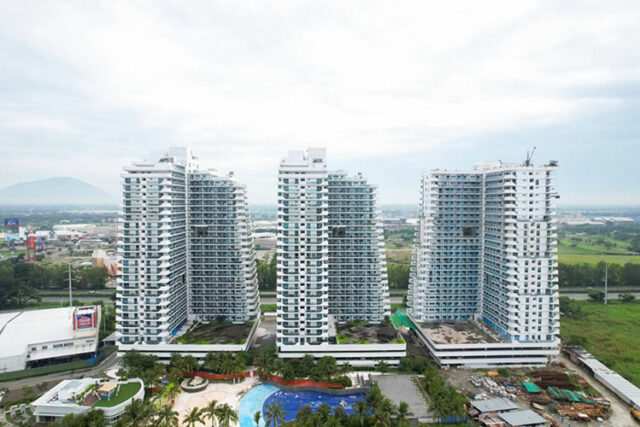
LISTED Century Properties Group, Inc. (CPG) said it has sold 99% of its units in its P1.6-billion Barbados Tower, its third high-rise building within the Azure North Estate in San Fernando, Pampanga, highlighting market demand for family-friendly residential enclaves.

The 820-unit tower, CPG’s third high-rise in the residential resort estate, brings Azure North’s total inventory to 2,426 units, the company told the stock exchange on Monday.

The developer also sold all 49 units in its Azure North Townvillas, CPG’s premium house-and-lot project within the estate. The project offers three- to four-storey houses with lot areas ranging from 69 square meters (sq.m.) to 133 sq.m.

Azure North Townvillas is expected to generate about P1.3 billion in revenues, with construction to be finished by 2028.

Also within the estate is the P1.2-billion Mykonos Tower, which has about 300 units and is expected to be completed by the end of 2027.

The mid-rise residential tower features studio units ranging from 26.34 sq.m. to 28.15 sq.m., and one-bedroom units sized 44 sq.m., with unit sizes larger than CPG’s Metro Manila condominiums.

The residential resort estate also includes a man-made beach lagoon, wave pool, and exclusive clubhouse.

The developer added that it is investing P215 million in the Azure North Waterpark, which will be completed by 2028.

Guests can enjoy water slides, a basketball court, children’s playground, and a pet park.

The 7.8-hectare Azure North Estate has attracted investors, particularly Filipinos working abroad.

“Our focus extends beyond construction — we’re building the foundation for a lasting community where families can flourish,” CPG President and Chief Executive Officer Jose Marco R. Antonio said.

He noted that CPG’s strategy is to “build communities that offer family-friendly environments with recreational opportunities for kids while also providing opportunities to generate rental revenue.”

CPG posted a 17% increase in its nine-month net income, reaching P2.1 billion from P1.8 billion last year.

Shares of CPG last closed on Nov. 28 at P0.64 per share. — Beatriz Marie D. Cruz

Siargao beyond the surf

MAGPUPUNGKO Rock Pools — BRONTË H. LACSAMANA

By Brontë H. Lacsamana, Reporter

WHEN people think of Siargao Island, they visualize foreigners flocking to the waves to surf in the day, then crowding the bars, mingling with locals and fellow travelers in the night.

While this image of Siargao is real, there’s actually more to the island than surfing and nightlife.

My first visit to Siargao, as part of sea travel company 2GO’s launch of the Manila-Siargao ferry route, showcased unforgettable natural wonders. From vast forest cover and seaside rock pools to unspoiled rivers and picturesque beaches, the trip only proved that there’s a serene, homey side to tourist destinations like Siargao that glam travelogue snippets on social media fail to capture.

At the port of General Luna, the coastal town that hosts Siargao’s hotspots ranging from beaches to surf to nightlife, we spoke with councilor Bingle Silvosa about the tourists on the island.

“We are recovering from [Typhoon] Odette back in 2021 and the series of typhoons we’ve been through. The entire Philippines is experiencing a slight downturn in tourist arrivals, but I hope by next year we come back stronger and better — not only Siargao, but the rest of the Philippines’ tourist destinations,” he told BusinessWorld.

Mr. Silvosa noted that the island is faring much better than it was three months ago, with more tourists coming from Europe. About 90% of tourist arrivals in Siargao ultimately stay in the municipality of General Luna.

He added that to maintain the island’s natural beauty, the local government is working hard to enforce its rules, such as the strict prohibition of single-use plastics.

“I think we are ready for the influx of tourists,” he said. “Of course we have safety nets in terms of environmental protection.”

ISLAND HOPPING
The mornings of our comfortable, two-night stay at the Rucksack Inn were interrupted by phone alarms indicating that we had to get up early to make the most of the sights. (If there’s a good, non-work-related reason to get up early, this was it!)

Our first stop was Guyam Island, a white-sand islet just a 10-minute motorboat ride from the main port. The crystal-clear waters are nice to wade in, but the real joy of this spot is the bucolic atmosphere. Because it’s so tiny, the only places where you can hang out are a few huts, a quaint bar, and a makeshift basketball court. The best way to while away the time here is to lounge under the shade of the verdant palm trees.

Our next stop, 15 minutes away on boat, was Naked Island, a 200-meter-long sandbar containing zero vegetation, hence the name. Because it’s just a strip of sand in the middle of the ocean, it attracts photographers and people who want to swim in the cool, aquamarine waters.

Our final stop, another 15 minutes away, was Dako Island, the biggest of the three destinations (the word dako means large). This was also where a lunch of grilled seafood was served on banana leaves, also known as a boodle fight. This island was the most scenic of the three, with white-sand beaches and green palm trees, and rock formations at one end with strategically placed huts overlooking the sea for photo opportunities.

With motorboats docked a few steps from the shores of these magnificent beaches, ferrying happy tourists to and from one island to the other, it’s easy to see why Siargao locals are protective of its natural beauty. If there’s one thing to note, the tour guides and boatmen were always alert about keeping trash away from the environment.

COCONUT VIEW DECK
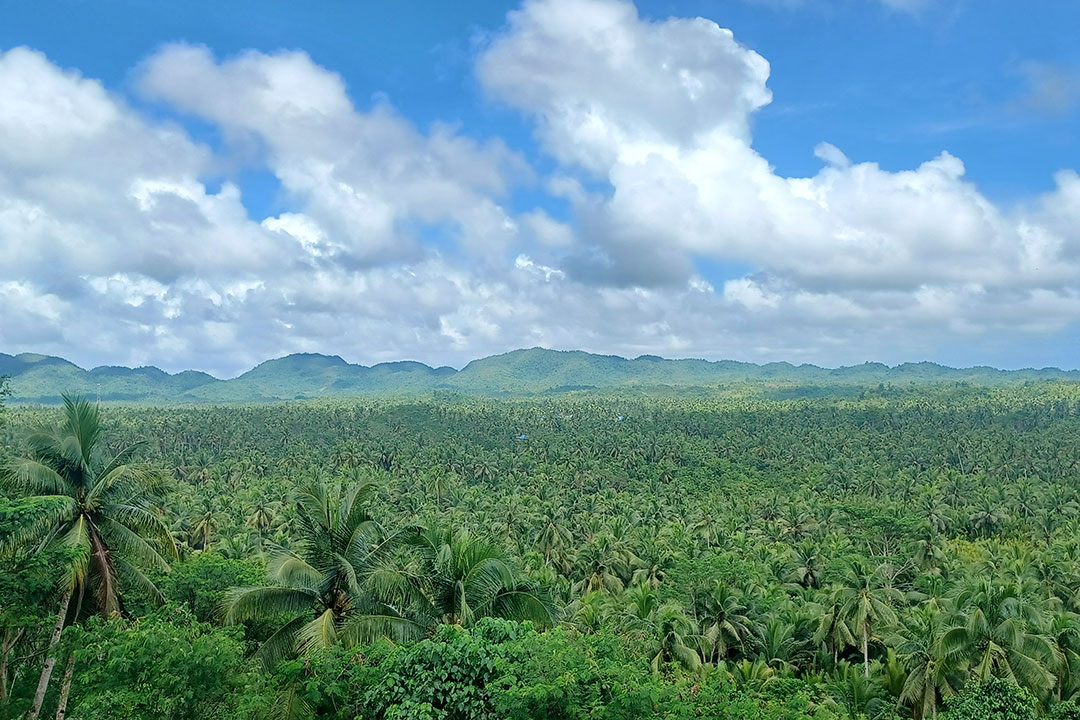
About 17 kilometers (or 25 to 30 minutes) away from General Luna is the Coconut View Deck, or Coconut Plantation View Point. It’s not actually a deck per se, but an elevated roadside stretch overlooking a seemingly endless sea of palm trees.

Because of its location in the middle of Siargao Island, it is an easy stop since the cliffside road connects the popular coastal area and the northern part of the island. Locals say that it offers a lovely view of the sunset, the trees backed by a colorful sky as the sun dips towards the mountains, but we found that the view is just as lovely in the morning.

Here, you can find local photographers who offer a “human drone” service, which is done by asking the tourists to pose with the tree view as a backdrop and then the photographers run back and forth to mimic the aerial movements of a drone. The result is a lively panoramic shot that does kind of look like it was filmed by a drone camera.

MAGPUPUNGKO ROCK POOLS
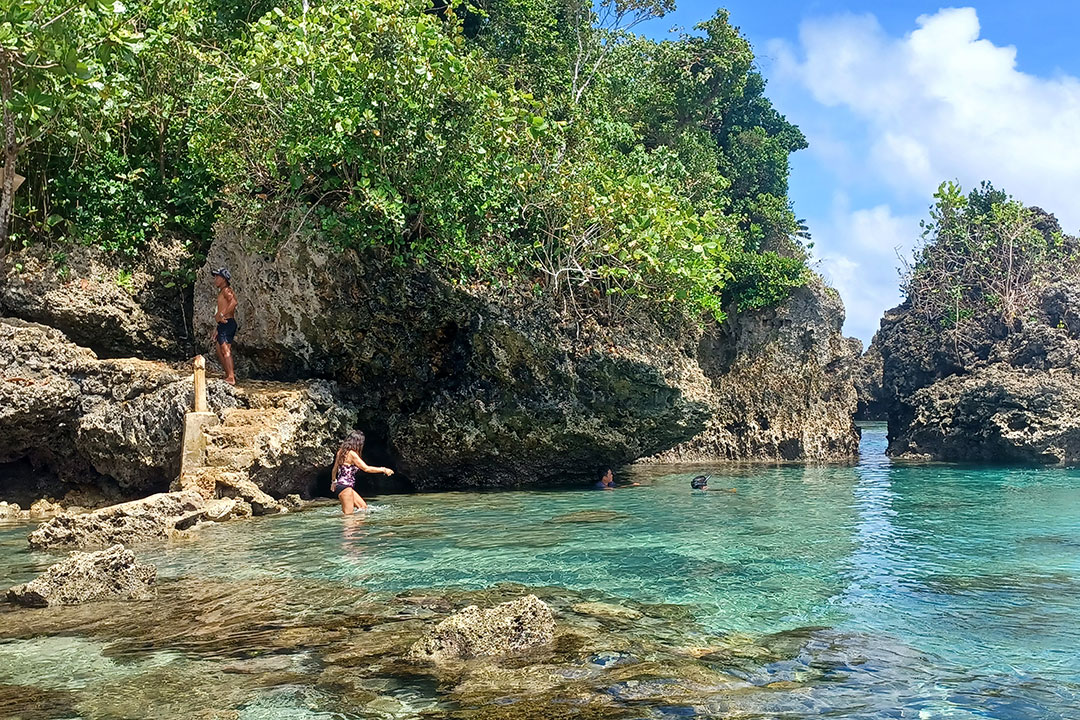
Located on the eastern coast of Siargao, around an hour from town, the Magpupungko Rock Pools are a series of natural pools that emerge during low tide. The biggest tidal pool, just a short walk away from the main beach, has a massive rock that serves as a cliff-diving spot.

For those who want to lounge around in cool waters, this is the perfect place to do so. Some of the natural pools are shallow enough for kids, while others go down five feet, exactly for adults. The one with the large rock where people dive from goes as deep as 12 feet.

Because the beach is rocky and characterized by reefs and rock formations, it’s best to wear aqua shoes or water shoes to protect your feet, though many visitors simply walk to the area in slippers or sandals and take them off once in the pool.

With clear, aquamarine waters and sun-warmed rocks, this spot is both great for pictures and a relaxing place to unwind. Just don’t come during high tide, because the waves become too large to fully enjoy the spot.

SURF SPOTS
Though our trip was focused more on natural wonders beyond surfing, we were able to glimpse the untamed waves that made Siargao a hit among surfers from all over the world.

Cloud 9, just three minutes or a kilometer away from our hostel, is the heart of the surf scene. The waves attract a lot of surfers, but so does the wooden boardwalk that stretches out over the water for great sunset views and photo opportunities. Cafés and establishments with the fun island vibe make this a popular hangout spot, even for non-surfers.

Pacifico Beach, closer to the northeastern part of the island, is less well known with a more lowkey, chill atmosphere. It’s not as crowded, and the surf is supposedly friendlier for beginners, with vendors selling coconuts across the beach for people who want to lounge and watch the surfers do their thing.

MAASIN RIVER
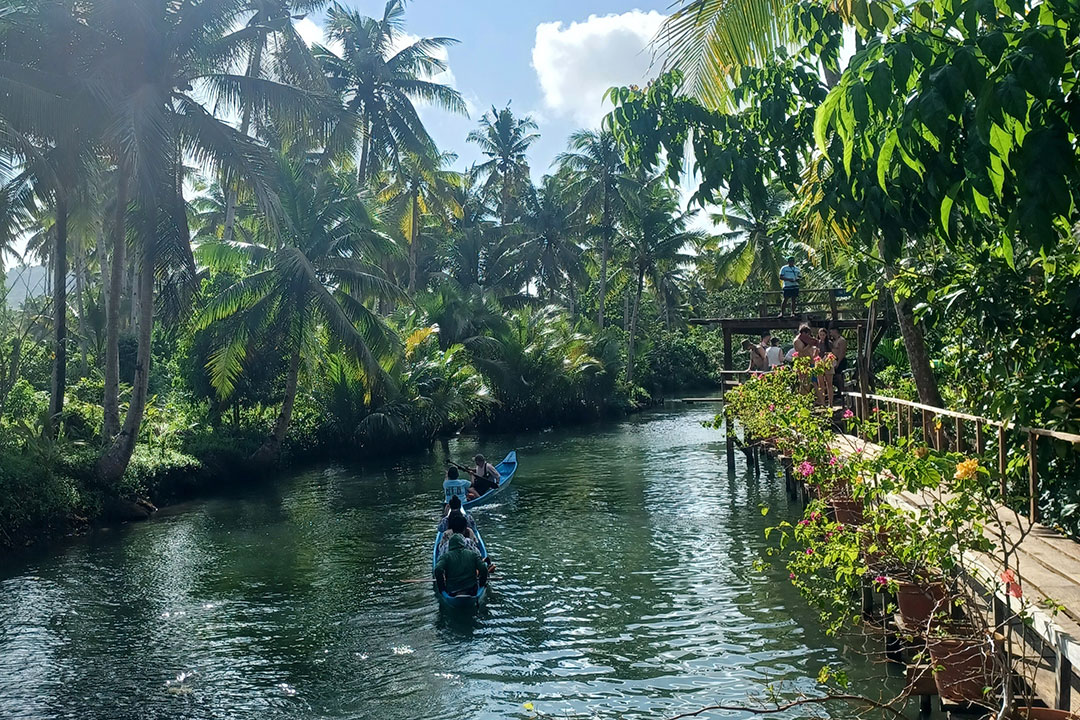
You wouldn’t think that a random bridge on the roadside with a smattering of souvenir stalls across it would have a small path leading down to a serene riverside. Once there, the surroundings are surprisingly beautiful — lush mangroves lining a clean, calm river, with tourists ferried up and down on its gentle currents.

Maasin River offers a peaceful, 10-to-15-minute boat ride, with only the occasional dog barking or cock crowing interrupting the silence. Usually, only the boatman’s oars dipping into the water can be heard (unless you’re unlucky enough to be there with other groups of tourists shrieking and chattering away in other boats).

The endpoint of the ride is a quaint spring with a few stalls on the embankments. We didn’t get off here and instead rowed all the way back to the starting point, to fully bask in the quiet of a somewhat remote environment.

COCONUT COMBUT
Our final stop in the two-day tour was Coconut Combut, known as Siargao’s first paintball and gel blaster arena. It’s a brand-new attraction, hidden amongst the coconut trees that we glimpsed from the view deck earlier that morning.

Here, visitors can group together and engage in friendly matches in the outdoor arena. Afterwards, they can cool off at the café, which offers coffee and tea lattes and smoothies.

One of the co-owners is a laidback German named Milo, who first came to Siargao a few years back and has since fallen in love with the place.

“We built this for the locals, for people who might be looking for something new to do outside of the usual,” he told the visiting media. “It’s a difficult place to maintain, but it’s really our way of giving back to the community.”

He also runs the Latin American restaurant Cabrones, situated in Rucksack Inn where we were staying. The place hosts events almost nightly, like bingo nights and beer pong.

Rommel Tan-Abing, owner of Rucksack Inn Siargao, told BusinessWorld that it’s part of “the magic of the island” that people are helpful with each other’s businesses, endeavors, and journeys.

“All of us are on the same boat, so we go through the same challenges,” he explained. “For example, things like the fluctuation of electricity and limited internet connectivity are difficulties we all face.”

Throughout the trip, we experienced one power outage, during check-in. Meanwhile, stable internet seemed confined to the hotel or certain spots on the island. Some establishments, like Coconut Combut, offer Starlink internet.

As someone who had been visiting Siargao since 2018 and moved there in 2021, Mr. Tan-Abing said that the island has come a long way, but that its private sector and local government still have a lot to do to maintain responsible tourism growth.

“It’s not just about keeping tourist sites pristine, but also training our guides and workers. We should equip them with skills so that they can share the stories and history of this island,” he said.

Sea travel company 2GO launched its Manila-Siargao route in November. With a total travel time of 29 hours, the weekly service leaves Manila every Monday at 6:30 p.m. and arrives in Siargao at 11:30 p.m. on Tuesday. The ship then proceeds to Butuan and Ozamiz as per its usual route. The return trip departs Siargao every Wednesday at 2:30 a.m. and arrives in Manila at 7:30 a.m. on Friday.

DBP to ask for dividend, regulatory relief as it seeks to rebuild its capital

BW FILE PHOTO

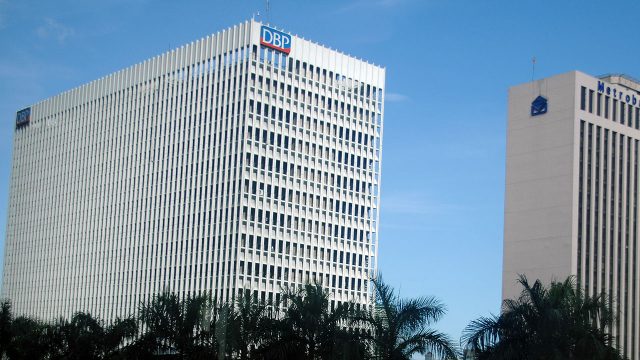
THE DEVELOPMENT Bank of the Philippines (DBP) is planning to seek dividend and regulatory relief again from the central bank to rebuild its capital, its top official said.

DBP President and Chief Executive Officer Michael O. de Jesus said the bank wants to recoup the seed capital it provided for Maharlika Investment Corp. (MIC).

“Our goal is to build up our capital,” he told reporters on the sidelines of an event on Thursday. “We’ve had dividend relief for the past maybe seven years.”

In 2019, DBP was exempted from remitting its dividend to the government for its 2017 earnings after its dividend rate was slashed to 0% from 50%.

It was likewise granted dividend relief for its 2022 income after President Ferdinand R. Marcos, Jr. signed an executive order as compensation for its contribution to the MIC.

Republic Act No. 7656 or the Dividends Law mandates government-owned and -controlled corporations to remit dividends equivalent to at least 50% of their earnings to the National Government.

“We need to build up as a bank. That’s why we’re asking (for) dividend relief, especially so we can recover,” he added. “Remember, the bank lost P25 billion to Maharlika. So, we need to build up our capital base.”

In September 2023, DBP injected P25 billion into the MIC for the sovereign wealth fund’s initial seed capital, while Land Bank of the Philippines (LANDBANK) contributed P50 billion.

According to Mr. De Jesus, DBP has about P97 billion in total equity, up from the around P80 billion it had three years ago.

The DBP chief said they are bullish about the MIC despite the slow progress of its investments.

“They have a long pipeline of investments. No investment yet. They took time to set it up and all that,” he said. “But they have good people in Maharlika. We’re confident it will do well.”

Mr. De Jesus said DBP will again request for dividend relief for the next five to seven years, including this year, as well as regulatory relief for 2025.

He added that they target to exit regulatory relief in two years.

In an earlier report, the International Monetary Fund called for the restoration of capital for DBP and LANDBANK after their contributions to the MIC.

The IMF noted the importance of capital restoration and exiting regulatory relief “as soon as possible.”

The Finance department has pushed for the amendments to DBP’s decades-old charter to strengthen its financial position and give it easier access to the capital markets.

Mr. De Jesus earlier said they could push for the passage of a new DBP charter in this Congress after the previous proposal approved by the 19th Congress was vetoed by Mr. Marcos in May.

The proposed charter amendments include provisions that would increase its capital stock to P300 billion from P35 billion to help finance its priority sectors, such as social infrastructure and small businesses, and allow it to offer up to 30% of its shares to the public, with the National Government mandated to own 70% of its capital stock at all times.

Several measures are now pending at the committee level at both the House and the Senate.

Fitch Ratings said in January that the charter changes could help support the state-run lender’s capital restoration following its contribution to the country’s sovereign wealth fund and boost its credit profile.

DBP’s net income fell by 51.77% year on year to P2.257 billion in the first nine months of 2025.

Mr. De Jesus said the bank’s net income might be cut by P1 billion to P2 billion by yearend due to higher provisioning and as the ongoing graft scandal has slowed down contractors’ repayments. Still, he sees DBP recovering by the first quarter of 2026. — Katherine K. Chan

FLI pumps P1.86B into residential and retail growth

FILINVESTLEGACY.COM

GOTIANUN-LED property developer Filinvest Land, Inc. (FLI) has reinvested P1.86 billion in its residential and retail projects, with a focus on regional properties.

In a disclosure to the stock exchange on Monday, FLI said the reinvestment covers 10 key projects across Metro Manila, Luzon, and Mindanao.

This includes P309.4 million for the Mimosa Lifestyle Mall and Filinvest Shoppes Mimosa in Pampanga, P270 million for its mid-rise residential property Futura Monte Naga in Camarines Sur, and P206.6 million for its mid-rise tower Futura Bay Gensan in General Santos City.

FLI also allocated funds for Futura One Fora Dagupan in Pangasinan (P137 million), Futura Vinta Zamboanga (P84.7 million), and 8 Spatial Davao (P107.1 million).

In Metro Manila, P267 million was allocated to Studio N and P161.7 million to Futura Centro.

The funds come from the P1.86 billion raised from the buyback of FLI shares last year, following the conversion of 597.12 million common shares of Filinvest REIT Corp. (FILRT).

“These investments reflect our strategy to bring quality developments closer to emerging urban centers while driving inclusive growth,” FLI Executive Vice-President and Chief Financial Officer Ana Venus A. Mejia said.

“By focusing on key regional hubs, we aim to create vibrant communities that support economic activity and improve quality of life,” she added.

The total amount forms part of the P1.86 billion raised from the share buyback last year, excluding taxes and transaction costs.

FLI, the real estate arm of the Filinvest group, has housing projects across the socialized, affordable, middle-income, and high-end segments.

The company posted a 5% increase in its nine-month net income to P3.64 billion, while revenues grew 9% to P20.08 billion amid strong residential demand and stable leasing.

At the local bourse on Monday, FLI shares rose 1.32%, or one centavo, to close at 77 centavos each. — Beatriz Marie D. Cruz

Bang & Olufsen launches centennial collection

NOW that it has turned 100, Danish luxury audio brand Bang & Olufsen (B&O) has unveiled its Centennial Collection to mark a century of making quality audio equipment.

At B&O’s celebration in the Philippines, held at Gallery by Chele in Bonifacio Global City, Taguig, on Nov. 27, B&O Brand Manager Vince Miclat showed off the new products launched for the centenary.

The Danish audio brand updated three of its existing designs for the new collection: the Beoplay H100 headphones, now in Century Brown; the Beosound A5 portable speaker, now in Century Weave (a blend of beige and chestnut brown); and the large Beosound A9 5th Gen speaker, now in Century Blue.

They all share brushed aluminum details plus the founders’ motto: “A never failing will to create only the best.” The founders, Peter Bang and Svend Olufsen, started B&O in Struer, Denmark, in 1925, with the mission to bring better radios into people’s homes.

Mr. Miclat told the media that the Centennial Collection “not only commemorates the past, but also invites people to bring artistry and sound into their homes.

“The main reason behind it is looking back to the designs of the past while injecting the designs of the future,” he said. “Longevity-wise, you can enjoy them for the next five to 10 years because, if there’s anything that needs to be upgraded in the software, you will always get the updates in the app.”

The Beoplay H100 headphones in Century Brown deliver the same rich, detailed sound as the original version, with titanium drivers, Dolby Atmos tuning, and advanced noise cancellation. What sets it apart is that it’s finished in brown leather ear cushions, its glass disc rendered in natural silver tone. It is priced at P168,000.

“The market for this product is people who are design-driven but also very particular with sound,” Mr. Miclat explained. “People who enjoy authentic sound, that’s our market.”

He added that one of B&O’s most popular products in the Philippines, the Beosound A5, is also elevated with its centennial version.

Now clad in a Century Weave that evokes old-time geometric radio grills, the portable speaker still looks like a picnic basket but with more detail in its color. It offers B&O’s signature RoomSense technology that adapts playback based on the acoustics of the space it’s in, able to blend visually and sonically both indoors and outdoors.

The centennial edition is framed in aluminum with a red leather handle and priced at P140,000.

With designs that mix the past and the future, B&O aims to “honor the craftsmanship that has shaped generations while looking forward to inspiring new ones,” according to Ferdinand Ong, owner of B&O’s official Philippine distributor, Living Innovations.

This is most evident in the third item in the collection, the Beosound A9 in Century Blue, a favorite of interior designers. Combining art and acoustics in one sculptural statement piece, its circular silhouette and tripod legs recall mid-century furniture.

The updates for the centenary are the circular fabric in dark blue and legs in solid aluminum instead of wood. Behind the design are seven powerful drivers that fill any space with immersive sound. It is priced at P420,000.

“This brand has always given us magic. It really is beautiful but also sounds wonderful,” Mr. Ong said. “It’s been a long journey of working with B&O in the Philippines, more than a decade, and we’re sure there will be many more years of creating experiences that will stand the test of time.”

Mr. Miclat added that B&O’s speakers are different because they don’t exaggerate specific audio elements like bass.

“The inspiration always is that, whenever you hear music or a movie, it has to sound like how the artist or filmmaker wanted it to sound,” he said. “That’s what you can expect from B&O.”

The limited-edition Centennial Collection is available at Bang & Olufsen’s stores in Power Plant Mall, Makati City, and Shangri-La Plaza Mall, Mandaluyong City. For more information, visit their official pages on Facebook and Instagram. — Brontë H. Lacsamana

The SM Journey: Why values and ESG+R matter

RECYCLED water from the malls’ sewage treatment plants helps sustain greenery and serves other operational needs. — SMPRIME.COM

(This is the author’s acceptance speech as the “MAP Management Person of the Year 2025” Awardee which he gave on Nov. 24.)

SM was once condemned for cutting down trees in Baguio City. Today, I want to tell you why that was the right decision, and what it taught me about leadership.

Across SM Baguio is the University of the Cordilleras, the oldest post-war university in the region. It sits on a hillside and serves thousands of students.

In 2012, I noticed signs of potential soil erosion on the slope above the campus, where our mall stands. Each rainfall risked sending soil toward the classrooms below. I could not sleep knowing the danger it posed to the school.

The only way to keep the campus safe was to build a retaining wall and reinforce the ground. That required the removal and relocation of several trees in the SM Baguio property.

As someone who has long cared about the environment, it was a very hard decision to make. Unfortunately, many saw the act but not the intent.

Despite our efforts to explain the situation, many accused SM of betraying the environment for financial gain. The reactions were harsh. A foreign artist even canceled a concert at our arena in protest.

We finished the work anyway. The hillside held, and the school remains safe. That choice — of doing what is right, even when unpopular — sharpened my understanding of leadership.

The incident also led to a truly unexpected blessing. I had a meaningful exchange with the head of the United Nations Office for Disaster Risk Reduction (UN DRR).

One conversation led to another, and soon after, I was invited to serve as the first Filipino private sector representative to the UN DRR.

Through ARISE Global, I am able to share what SM has quietly practiced since the late 1980s: forward thinking and resilience.

I now work across sectors to help communities prepare and recover faster from calamities.

The Philippines sits in the Pacific Ring of Fire and the typhoon belt. We deal with earthquakes, volcanic eruptions, and storms on a regular basis.

For 21 consecutive years, our country has been named the world’s most disaster-prone nation. Our geography has made our reality tougher than most countries. To some, that might be reason enough to leave the Philippines. But my family and I — we chose to stay.

I am 70 years old now. And I still hold only one passport, a Philippine passport. That is both a fact and a statement of faith. Despite the risks, the noise, and the many uncertainties, I have never doubted our country’s promise or the strength of the Filipino spirit.

Our nation is not perfect. Our people are not perfect. Yet many of us remain here and keep going, because we believe that hope is stronger than hardship. That life in the Philippines, no matter how difficult, is worth the struggle. And that in time, things do get better.

It is hard to imagine now, but SM was built on hardship and hope. My grandfather got my father to dream big, not just to lift himself from poverty, but to earn more than enough to help others. So, from a single shoe store in downtown Manila, SM now has an ecosystem that includes real estate, banks, retail, schools, and more. Our scale has allowed us to turn growth into service, generating jobs, building infrastructure, and supporting scholars and livelihoods nationwide.

The SM journey has not been linear.

We have been tested by political unrest, economic challenges, and natural disasters. A pandemic even closed our malls. After each test, we came out stronger. Not because we were spared, but because we learned, adapted, and dreamt bigger.

We were able to navigate those moments because two constants guided our choices: our values and our sustainability framework.

In our family, we live by three core values: integrity, hard work, and humility. These are the same values we teach our people. Let me go through each one.

We have a very simple definition of integrity. My father would always say, “Whatever decision we make, we should be able to eat and sleep well.” That belief guided SM’s response to the pandemic.

Three days after the lockdown was announced, we decided to waive rent for our mall tenants nationwide. We did not wait for a government directive. We just knew that it was the right thing to do. By the end of 2020, we had extended over P23 billion in rental concessions. Our income fell, but thousands of small businesses survived and jobs were protected.

The financial risk we faced was real. But we made that call because that is how we were raised. Working hard is second nature to our family. We were raised to believe that there is dignity in every kind of work.

My siblings and I still follow that rule today. We are in the office or on-site six days a week. But I would not really call it work. It is what we love to do.

We enjoy meeting people, listening to customers, and learning from our employees. Each visit reminds us that there is always something to improve, and be grateful for.

I would also like to think that this is why none of us look our age.

Humility — and the simplicity that comes with it — has guided our family for three generations.

When they were young, my children brought packed lunches to school. They had no allowance until they were old enough to understand the value of money. I remember my eldest son, Chico, once telling me that his P5 weekly allowance in Grade 5 was not enough to buy soft drinks at the canteen. I told him, “You can, if you save your allowance for two weeks.” It was a brief conversation, but the lesson stayed with him to this day.

At SM Prime, our sustainability framework is simple yet grounded in decades of experience. We call it ESG+R, or Environmental Stewardship, Social Inclusion, Good Governance, plus Resilience.

In 2006, a documentary changed the way I viewed the environment. Watching Al Gore’s An Inconvenient Truth made me realize that we could no longer just talk about climate change. We had to do more. So we did.

We began recycling water as early as the 1990s at SM Megamall. It was the more costly choice back then. But as climate risks grew, we kept expanding our efforts. Today, water stewardship is practiced across our malls. We manage stormwater through large rainwater tanks, and use smart fixtures and waterless urinals to conserve water. We elevated our properties to reduce flooding and strengthened our roofs to withstand stronger typhoons. That allowed us to turn our rooftops into solar fields. Last Nov. 8, we reached 100-megawatt peak capacity. And we intend to keep going.

Our commitment to social inclusion began in 2004, when a 15-year-old boy on the autism spectrum got lost in one of our malls. The noise, crowds and unfamiliar setting overwhelmed him, causing anxiety and an outburst. One security personnel mistook this for unruly behavior and waved him off. Thankfully, other guards helped his family find him. That event transformed the way we served our customers. It taught us that inclusion begins with awareness, but only matters when it leads to action.

Since then, we have worked to make our people and spaces more compassionate. Our teams undergo continuous sensitivity training to better assist persons with autism, Down Syndrome, and other disabilities. Our malls have golf carts, resting areas, accessible paths, and family-friendly spaces so everyone — regardless of age and ability — can move around with ease.

Inclusion also extends to how we run our companies.

At SM, family members and professional managers work together with a shared commitment to good governance. It guides how we make decisions and how we choose our leaders. Our company presidents are non-relatives chosen for their expertise and integrity, whether they grew within the organization or joined from outside. We also have independent directors who are leaders in their fields, and respected in both business and public service. Their common denominator is a deep sense of malasakit and accountability, grounded in the values that have shaped SM from the beginning.

Last in the equation is resilience, which began not as a concept but as an experience.

In 1988, a fire raged for four days and gutted SM Makati. It was one of the hardest moments of my life. I will never forget it because it happened on my mother’s birthday. My father asked me to oversee the rebuilding of the store. When I went to the site during clearing operations, the heat was intense. The air was thick with smoke and ashes, and nothing could be salvaged. I told myself that no one should ever have to go through that. From then on, safety became a personal mission.

In every SM property, we installed sprinkler systems, even before it was a requirement. We improved our design and planning by using both data and experience. We learned from every incident, no matter how small. That fire, while scary and traumatic, taught me the importance of prevention and preparedness.

The events of the past few weeks remind us why values and ESG+R matter. They also show how losing integrity — at a time when we are building climate resilience — can have serious consequences.

Like everyone here, I am affected by what is happening. It is painful to see our country suffer because of the faults of a few. But when the road gets rough, you do not stop and turn back. You keep your hands on the wheel and stay the course.

We in the private sector have a responsibility to create value, opportunity, and stability. That duty does not disappear when times are difficult. This is when it matters most.

In the 1970s, when capital was leaving the country, my father chose a different path. He kept his money in the Philippines and invested in the expansion of SM Makati. It was a bold choice, but it was the right one.

We are making the same choice today. Despite the weak sentiment and perceived risks, the SM Group continues to invest and believe in the Philippines. Nation-building is hard work. But if we do what is right, even when it is difficult or unpopular, we can build a future where Filipinos live with dignity and hope.

Receiving this award is both an honor and a responsibility. It is a reminder to do more for our country. With this in mind, I will devote more time and resources to help strengthen the Philippines. I will focus on the areas where I can make a meaningful difference.

First, education. At the National University, we will continue expanding access to affordable, quality learning. Our goal is to reach 100,000 students by 2027, by opening more campuses and offering more courses.

Second, resilience. Through ARISE Philippines, we will keep working with LGUs to strengthen disaster preparedness and climate adaptation. We cannot stop natural calamities, but we can prevent them from causing greater harm.

Third, community rebuilding. The Cebu earthquake damaged homes in SM Cares Village. After relocating the affected families and listening to the residents, we chose not to rebuild. Instead, we will build a church for the community.

And finally, the future. We will keep investing in developments that reflect what Filipinos truly deserve: smart cities, sustainable communities, modern infrastructure, and green spaces that promote progress, inclusivity, and well-being.

With these efforts, I hope to honor the privilege I have been given, and the legacy of my father.

As I close, I want to thank the people who made this recognition possible. The MAP Board of Governors led by President Al Panlilio, as well as the members of the Search and Judging committees. My wife and children for their unconditional love, support, and understanding. My siblings, who have given so much of themselves to realize our father’s dreams, and who have stood by our family through every challenge. Our employees and professional managers for their hard work, discipline, and commitment to delivering the SM magic to our customers every day. Our customers, tenants, suppliers, and stakeholders, for allowing SM to be part of their daily lives and success.

Most of all, to my father who taught me everything I know and my mother who raised me to be the person I am today.


Hans T. Sy is Management Association of the Philippines’ Management Person of the Year 2025 Awardee. He is the chairman of the Executive Committee of SM Prime Holdings, Inc.

map@map.org.ph

info@smprime.com

Peso climbs to over one-month high as dollar drops on Fed concerns

BW FILE PHOTO

THE PESO rose to an over one-month high on Monday as the dollar was dragged lower by concerns over the impending change in leadership at the US Federal Reserve.

The local unit climbed by 15.5 centavos to close at P58.49 versus the greenback from its P58.645 finish on Friday, Bankers Association of the Philippines data showed.

This was the peso’s best close in over a month or since it ended at P58.41 on Oct. 22.

The local unit opened Monday’s session slightly stronger at P58.63 per dollar. Its weakest showing was at P58.68, while its intraday best was its closing level.

“The peso appreciated today after reports surfaced that the current director of the US National Economic Council Kevin Hassett is rumored to be appointed as the next Fed chief by President Donald J. Trump,” a trader said in a Viber message.

Michael L. Ricafort, chief economist at Rizal Commercial Banking Corp., said in a Viber message that growing bets of a Fed cut at their Dec. 9-10 meeting also caused the dollar to weaken.

The dollar began December on the back foot as investors braced for a pivotal month that could bring the Federal Reserve’s final rate cut of the year and the confirmation of a dovish successor to Chair Jerome H. Powell, Reuters reported.

Traders are now pricing in an 87% chance the Fed will cut by 25 basis points when it meets next week, according to the CME FedWatch tool.

What is less clear cut is what happens after December. Money markets right now show very little chance of another cut much before the spring and some analysts believe December might even yield a “hawkish cut” — trader-speak for a cut accompanied by indications from policymakers that another near-term fall in borrowing costs may not be forthcoming.

Either way, with investors assuming a December cut is close to a done deal, alongside a report that White House economic adviser Mr. Hassett could be the next Fed chair, the dollar is struggling, having clocked its worst weekly performance against a basket of major currencies in four months last week.

US Treasury Secretary Scott Bessent said there was a good chance Mr. Trump would announce his pick before Christmas.

The peso also rose amid the anticipated seasonal increase in remittances for the holidays, Mr. Ricafort added.

For Tuesday, the trader sees the peso moving between P58.35 and P58.60 per dollar, while Mr. Ricafort expects it to range from P58.35 to P58.65. — ARAI with Reuters

Legal row over Midas Hotel could influence DigiPlus outlook — analysts

DIGIPLUS.COM.PH

By Alexandria Grace C. Magno

THE ONGOING legal dispute between DigiPlus Interactive Corp. and former Party-list Rep. Elizaldy S. Co involving the Midas Hotel and Casino could weigh on operations and investor sentiment, though the financial impact on the company is expected to be limited, analysts said.

“Because the dispute concerns ownership or management of Midas Hotel and Casino, operations may face uncertainty as long as the appeal in court remains unresolved,” Regina Capital Development Corp. Head of Sales Luis A. Limlingan said in a Viber message.

“For investors, a still-pending court appeal may introduce risk and uncertainty. In the long run, if the dispute drags on, it could compromise the value or use of Midas Hotel, limiting PLUS’ ability to leverage that asset, which could result in the company shifting its focus on alternative assets like New Coast or its digital platforms. However, if the dispute resolves cleanly, this could strengthen the company’s resolve and credibility, potentially helping PLUS when negotiating future partnerships or investments in Philippine tourism and gaming, as the broader hospitality industry in the Philippines is seeing large-scale hotel developments and growing demand,” he added.

AP Securities, Inc. Equity Research Analyst Shawn Ray R. Atienza said the issue may create “a slight hit on investor confidence on PLUS near-term, but boost reputation long term as the company’s exposé of Zaldy Co’s parasitical practices as a business partner shows their boldness to call out malpractices by peers.”

Law firm Villaraza & Angangco confirmed that the case between former Ako Bicol Representative Mr. Co and DigiPlus, formerly Leisure & Resorts World Corp. (LRWC), is still ongoing.

DigiPlus previously won an arbitration case on the valuation of the Midas Hotel and Casino, but Mr. Co’s firm, Eco Leisure and Hospitality Holding Co., has challenged the decision before the Pasig Regional Trial Court, where the appeal remains pending.

DigiPlus issued its statement after social media posts on Friday claimed that the Anti-Money Laundering Council’s freeze order on the former lawmaker’s bank accounts could benefit the online gaming company.

In a 2020 disclosure, LRWC said it entered into an investment agreement on Nov. 11, 2012 with Eco Leisure and Hotel Enterprises of the Philippines, Inc. (HEPI) to acquire 51% of HEPI, which operates the Midas Hotel and Casino. LRWC invested P750 million in cash for the transaction. Some reports have stated that LRWC signed a preliminary agreement with Eco Leisure and Hospitality Holding Co. to acquire 50% of HEPI for about P800 million.

Mr. Atienza said the freeze order on Mr. Co’s assets could affect Midas operations and investor sentiment in the short term. However, he noted that the financial exposure is relatively small.

“We assume that the freeze order imposed on Zaldy Co’s assets presents chances of a disruption, or even a complete halt in Midas’ operations [but] an operational halt only has minimal material impact on [Digiplus’] financials as their net JV (with HEPI) only accounts for 4.6% of their book value (based on FY24 FS), so their growth prospects from international expansion remain unchallenged by this news,” he said.

DigiPlus shares fell by 0.82% or 20 centavos to close at P24.30 on Monday.

Disney’s Zootopia 2 fuels box office frenzy with $556 million worldwide

Zootopia 2 (2025)

LOS ANGELES — Walt Disney’s animated Zootopia 2 racked up an estimated $556 million in global ticket sales over the US Thanksgiving weekend, providing a strong kickoff to Hollywood’s crucial holiday moviegoing season.

Nearly half of the film’s box office receipts from Wednesday through Sunday came from China, bucking a trend of Hollywood movies finishing behind locally made films.

The $272-million tally made Zootopia 2 Hollywood’s highest-grossing animated movie in China, surpassing a record set by the first Zootopia in 2016.

Also in theaters, Universal Pictures’ movie musical Wicked: For Good claimed $92.2 million worldwide in its second weekend, bringing its total to $393.3 million after 10 days.

The fervor for the two films provided welcome news for movie theater owners who hope audiences will pack cinemas through Christmas, the second-busiest time of the year for moviegoing. Annual box office sales have yet to recover to the pre-pandemic levels seen in 2019.

Zootopia 2 collected $156 million of its worldwide total in the United States and Canada, making it the leader on domestic box office charts. The movie, set in a city of animals, tells the story of a bunny police officer, voiced by Ginnifer Goodwin, and her fox partner, voiced by Jason Bateman.

“It’s a proud moment for Disney Animation and all of us at Disney, not to mention a great way to start the holiday season,” Disney Entertainment Co-Chairman Alan Bergman said in a statement.

Year-to-date domestic ticket sales reached $7.8 billion, up 1.2% from a year ago but 23% shy of 2019, according to data from Comscore.

Thanksgiving weekend sales are expected to rank among the top five of all time in the United States and Canada when final numbers come in on Monday, said Paul Dergarabedian, Comscore’s head of marketplace trends. Coming releases include James Cameron’s third Avatar film just before Christmas.

“Think about how many people were in theaters over the past week being exposed to theater marketing and trailers,” Mr. Dergarabedian said. “Hopefully that creates the momentum that can give us a really solid home stretch of the year.” — Reuters

Lackluster GDP to impede property’s recovery

IN Q3 2025, the Philippine economy expanded by 4%, the slowest since the 3.8% contraction in Q3 2011. — ALEXES GERARD-UNSPLASH

The third quarter gross domestic product (GDP) growth of the Philippines was a disappointing 4% — due mainly to tempered household consumption as well as constricted government infrastructure spending. The third quarter (Q3) 2025 GDP growth was the weakest quarterly economic expansion recorded since the third quarter of 2011, a period that also saw slower spending due to corruption allegations involving public projects. While Q3 is historically a slow quarter, the sharp slowdown was worse than what economists projected. Average GDP growth for 9M 2025 is now at 5%, even lower than the 5.5% to 6.5% estimate of the country’s economic managers. Hence, it is no longer surprising to see credit rating agencies and multilateral aid agencies also downgrading their growth forecast for the Philippines for 2025.

Colliers Philippines is still hoping for a strong finish for the property sector. Fourth quarter is traditionally a strong period for retail spending due to higher remittances and disbursement of holiday bonuses for public and private sector employees. Greater purchasing power supported by attractive ready for occupancy (RFO) promos should also help lift demand for residential units, especially mid-income (P3.6 million to P12 million a unit) condominiums primarily targeted by developers’ “renter to owner” schemes. The office market has so far surpassed initial projections for 2025, but stakeholders are on the lookout for anti-outsourcing measures that might impede the Philippine business process outsourcing (BPO) sector’s growth beyond 2025.

SLOWEST QUARTERLY GROWTH SINCE Q3 2011
In Q3 2025, the Philippine economy expanded by 4%, the slowest since the 3.8% contraction in Q3 2011. As of 9M 2025, average GDP reached 5%, lower than the government’s full year target of between 5.5% and 6.5%. The country remains one of the fastest growing economies in Southeast Asia in 9M 2025, next to Vietnam’s 7.7%.

Steady GDP expansion is essential for the country to generate decent jobs and ensure growth in individual incomes. Improving workers’ purchasing power is crucial in fueling residential demand.

CENTRAL BANK EASES RATES FURTHER, INFLATION HOLDS STEADY
The Bangko Sentral ng Pilipinas (BSP) or central bank cut its policy rate for the fourth straight meeting, reducing the benchmark rate by another 25-basis points (bps) to 4.75% in October, the lowest since September 2022. The central bank noted that inflation outlook remains within the target range of 2% to 4% but highlighted the weaker economic outlook and the decline in business confidence as key reasons for further rate cuts. Since August 2024, the central bank has cut a total of 175 bps.

Inflation reached 1.7% in October 2025, an easing from 2.3% a year ago. As of 10M 2025, average inflation reached 1.7%, below the government’s 2%-4% target range.

SHIFTING GEARS BEYOND 2025
The office and residential markets are now starting to move sideways in the property cycle. With substantial correction in office rents at the height of the pandemic, Colliers is hopeful that recent tailwinds in the office market will result in gradual recovery in lease rates within and outside Metro Manila. It appears that property developers have finally accepted what needs to be done to revive the Metro Manila vertical market, especially the mid-income segment which is now the focal point of developers’ RFO promos. The retail segment continues its aggressive recovery post-covid, with strong absorption and limited new retail space resulting in drop in vacancy and rise in rents.

The Q3 results point to a need for massive pump-priming from the government. Continued slowdown in government’s infrastructure program will likely result in a Philippine economy grinding to a halt — so it is crucial that private personal consumption expenditures in Q4 are supported by ramped up public sector spending. With the current market dynamics, it’s obvious that the Philippine economy and property are still moving, but not sprinting. Until we see sweeping governance reforms and an eventual return of private investor confidence, we’re bound to see property opportunities not exactly shouting, but whispering.


Joey Roi Bondoc is the director and head of Research of Colliers Philippines.

joey.bondoc@colliers.com

The Executive Secretary and PhilHealth’s woes

PHILSTAR FILE PHOTO

President Ferdinand Marcos, Jr. appointed House of Representatives Deputy Speaker Ralph Recto the Secretary of Finance in January 2024, replacing Benjamin Diokno.

Mr. Recto was chosen for the position because of his experience and ability to build consensus and to communicate effectively with Congress, valuable assets that ensure the smooth passage and implementation of the administration’s economic agenda. He served three terms as a Senator, including as Senate President Pro Tempore and Minority Leader and multiple terms as a Representative of the 3rd District of Batangas.

He also had previous executive experience, having served as the Socioeconomic Planning Secretary and Director-General of the National Economic and Development Authority (NEDA) during the presidency of Gloria Macapagal Arroyo. He holds a bachelor’s degree in Commerce majoring in Business Management from De La Salle University, and earned masteral units in Business Economics from the University of Asia and the Pacific, and in Public Administration from the University of the Philippines.

As if to live up to his reputation for which he was chosen as the new Secretary of Finance, Mr. Recto approved in May 2024 the transfer of P89.9 billion in excess Philippine Health Insurance Corp. (PhilHealth) funds to the national treasury. The transfer was made pursuant to a provision in the 2024 General Appropriations Act, which authorized the use of “excess” funds from Government-Owned and -Controlled Corporations (GOCCs) to finance the National Government’s unprogrammed appropriations.

The funds were transferred in tranches throughout 2024:

• P20 billion on May 10, 2024.

• P10 billion on Aug. 21, 2024.

• P30 billion on Oct. 16, 2024.

The remaining balance was scheduled for transfer on November 2024, but a Supreme Court Temporary Restraining Order (TRO) was issued, halting the transfer of the last P29.9 billion.

PhilHealth’s P89.9 billion has been invariably referred to as a government subsidy, excess funds, unspent funds, and a reserve fund. If it is a subsidy, it is not a direct subsidy of the government for PhilHealth but a subsidy for more than 38 million Filipinos — indigents, senior citizens, people with disabilities, and others. The subsidy represents the aggregate premium payment for the mass enrollment of the informal sector of the population in PhilHealth.

Withdrawing the P89.9 billion from PhilHealth is tantamount to cancelling the premium payment of the informal sector, consequently cancelling their enrollment in PhilHealth. That would be in violation of RA 11223, An Act Instituting Universal Health Care for All Filipinos.

It matters to PhilHealth, being an insurance company, if the P89.9 billion are excess funds, unspent funds, or a reserve fund. In the context of insurance, a reserve fund is the amount of money set aside by an insurance company to assure the payment of future claims. It will not remain unspent or idle for long. A substantial part of it, or even the entire amount, may be spent within the year.

Anyway, Retired Supreme Court Senior Associate Justice Antonio Carpio, a lead petitioner in a case before the Supreme Court challenging the transfer, had stated in October that Secretary Recto’s approval of the transfer of PhilHealth’s “excess” funds to the national treasury is unconstitutional and potentially constitutes technical malversation or plunder. He said the special funds can only be used for their intended purpose, which is for universal healthcare.

Key points of Carpio’s comments:

Unconstitutional Transfer: He pointed out that the Constitution specifies that the power to transfer appropriations belongs exclusively to the President.

• Special Funds: The funds, sourced from member contributions and “sin” tax proceeds, are considered special funds and cannot be used for any other government purpose, such as unprogrammed infrastructure projects.

• Personal Liability: He warned that if the Supreme Court deems the transfer unconstitutional, Recto would be personally liable to return the full amount transferred, which was already P60 billion before a TRO was issued.

In response, Secretary Recto argued before the Supreme Court on July 17 that the move was legal, moral, and economically sound, as it was done in compliance with a mandate from Congress in the General Appropriations Act (GAA) of 2024 to utilize idle funds from GOCCs.

According to him, the majority of the remitted funds were allocated under the unprogrammed appropriations of the 2024 General Appropriations Act (GAA) to fund various government priorities, including the financing of critical health-related and social service projects, and emergency allowances for health workers and medical assistance for indigent patients.

The breakdown of how the P60 billion remitted by PhilHealth as of December 2024 was used is as follows:

• P27.45 billion: Paid for the Public Health Emergency Benefits and Allowances for healthcare workers during the COVID-19 pandemic.

• P10 billion: Provided Medical Assistance to Indigent and Financially Incapacitated Patients (MAIPP).

• P4.10 billion: Used for the procurement of various medical equipment for the Department of Health (DoH) and local government unit hospitals and Primary Care Facilities.

• P3.37 billion: Funded the construction of three new DoH health facilities.

• P1.69 billion: Allocated to the Health Facilities Enhancement Program (HFEP).

• The remaining P13 billion: Used as government counterpart financing for foreign-assisted infrastructure and social development projects, which included general infrastructure projects intended to accelerate healthcare service delivery in remote areas and enhance food security. These infrastructure projects were part of the general infrastructure and social development initiatives.

Those would be valid justifications if there was no Republic Act No. 11223, or An Act Instituting Universal Health Care for All Filipinos. “An Act Instituting Universal Health Care (UHC)” is a misnomer. RA 11223 did not really institute universal health care, which means free or affordable healthcare services. This is only feasible if the government owned a sufficient number of hospitals and primary care clinics staffed by healthcare professionals employed by the government.

UHC was meant for people whose lives can be saved or whose good health can be maintained if they receive timely medical attention without ruining them financially. Complications of the leading diseases in the Philippines like bronchitis, influenza, chicken pox, diarrhea, and respiratory tract infection can be prevented if the patient receives preventive, curative, rehabilitative, and palliative health services.

To achieve the goal of UHC, the country must have a strong, efficient, well-run health system that meets priority health needs, access to essential medicines and technologies to diagnose and treat medical problems, a large corps of trained, motivated health workers to provide the services patients need.

While the Philippine government owns hospitals and employs healthcare workers, their numbers fall way short of those required to provide the health services needed by the more than 100 million Filipinos. Many patients are forced to seek medical services in private hospitals.

The World Health Organization (WHO) had advised our legislators to implement universal healthcare fully in 2030 when the country’s health delivery system would be capable of servicing UHC. But some of them rushed the enactment of RA 11223 into law so that they could present UHC in the elections of 2019 as their gift to the Filipino people. Among the authors of the law were Senators JV Ejercito, Sonny Angara, Nancy Binay, and Cynthia Villar, who were all running for re-election.

RA 11223 automatically enrolled all Filipino citizens in PhilHealth, supposedly to defray the cost of medical care. However, according to the findings of the Philippine Institute of Development Studies, PhilHealth pays only 40% of their hospital bills.

That is because PhilHealth is not configured to run a complex and far-flung operation. First, not one of the members of the board of directors had substantive experience in the insurance business, much less in health insurance, to be able to formulate and promulgate policies for the sound administration of the program.

Health Secretary Dr. Ted Herbosa, Chairman of PhilHealth’s board of directors, has made statements that reflect total ignorance of the operating system of PhilHealth and its management. He chided the management of PhilHealth for keeping or investing its money instead of spending it on the people’s health needs.

PhilHealth members pay their membership fees or premiums in advance. The investment manager places the money in the money market to make it grow. The problem is PhilHealth does not have a competent investment manager.

Dr. Herbosa has also referred to wards as charity wards. Most hospitals have three sections: wards, semi-private rooms, and private rooms. What is commonly referred to as a ward is a hall where 10 or more beds for inpatients are located, much like the emergency room of a large hospital. The inpatient pays for every night he occupies the bed. A charity ward is for indigent inpatients.

Also, PhilHealth does not have the personnel required by a health insurance company with more than 100 million enrollees, the majority of whom are vulnerable to diseases due to their harsh circumstances. It does not have the specialists that are key to the viability of the organization: foremost of whom is a formally trained health insurance actuary. The other is the aforementioned investment manager.

During the third round of oral arguments on the petition challenging the transfer of PhilHealth’s “excess” funds, Supreme Court Associate Justice Antonio Kho told DoH Assistant Secretary Albert Domingo, “Probably, it’s time to overhaul PhilHealth and change the board for not complying with what the law requires.”

Finance Secretary Recto and the members of the PhilHealth board did not benefit personally from the transfer of PhilHealth funds to the national treasury, unlike the senators and congressmen involved in the flood control scandal. Still, they violated the law. The appropriate punishment should be applied to them. The saying “No one is above the law” is often invoked nowadays. But Ralph Recto is now the Executive Secretary.


Oscar P. Lagman, Jr. has been a keen observer of Philippine politics since the 1950s.

ADVERTISEMENT
ADVERTISEMENT