Home Blog Page 62

South Korea’s Lee expresses regret to North Korea over drone incursion

SOUTH KOREA’S President Lee Jae-myung delivers a speech after taking his oath during his inauguration ceremony at the National Assembly in Seoul on June 4, 2025. — REUTERS

SEOUL — South Korean President Lee Jae Myung on Monday expressed regret to North Korea over a drone incursion that he said was carried out by a South Korean individual without government approval, stressing Seoul’s commitment to preventing future incidents.

“Although it was not our government’s intention, we express our regret to the North over the fact that unnecessary military tensions were caused by the irresponsible and reckless actions of some individuals,” Mr. Lee said in a cabinet meeting.

Mr. Lee said an investigation by South Korean authorities found a National Intelligence Service (NIS) employee and an active-duty military official were involved in the case, adding that the constitution forbade individual acts of provocation against North Korea.

Pyongyang said in January that drones sent from the South had violated its airspace, accusing Seoul of a serious provocation and saying it had shot them down.

South Korea denied any military involvement and launched a joint military-police probe, which led prosecutors to indict a South Korean man in his 30s on charges including violating aviation and national security laws over the unauthorized drone flights, according to authorities.

North Korea in recent months has declared South Korea as its most hostile state and rebuffed outreach efforts by Mr. Lee’s administration. — Reuters

Iran, US receive plan to end hostilities, immediate ceasefire; source says

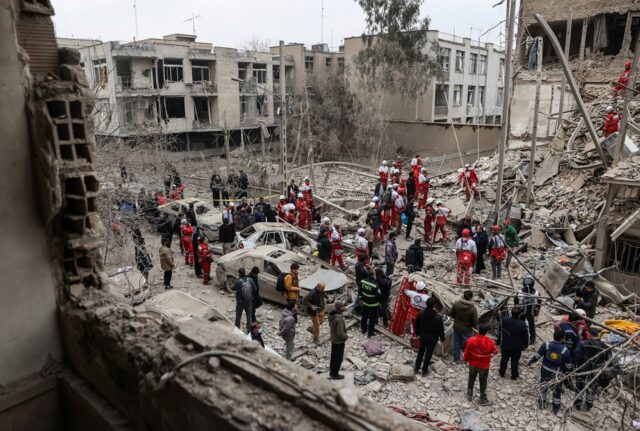
Emergency personnel work at the site of a strike on a residential building, amid the US-Israeli conflict with Iran, in Tehran, Iran, Mar. 16, 2026.—via REUTERS/MAJID ASGARIPOU

IRAN and the United States have received a plan to end hostilities that could come into effect on Monday and reopen the Strait of Hormuz, a source aware of the proposals said on Monday.

A framework to end hostilities has been put together by Pakistan and exchanged with Iran and the US overnight, the source said, outlining a two-tier approach with an immediate ceasefire followed by a comprehensive agreement.

“All elements need to be agreed today,” the source said, adding the initial understanding would be structured as a memorandum of understanding finalized electronically through Pakistan, the sole communication channel in the talks.

Axios first reported on Sunday that the United States, Iran, and regional mediators were discussing a potential 45-day ceasefire as part of a two-phase deal that could lead to a permanent end to the war, citing US, Israeli, and regional sources.

The source told Reuters Pakistan’s army chief, Field Marshal Asim Munir, has been in contact “all night long” with US Vice President JD Vance, special envoy Steve Witkoff, and Iranian Foreign Minister Abbas Aragchi.

Under the proposal, a ceasefire would take effect immediately, reopening the Strait of Hormuz, with 15–20 days to finalize a broader settlement. The deal, tentatively dubbed the “Islamabad Accord,” would include a regional framework for the strait, with final in-person talks in Islamabad.

There was no immediate response from US and Iranian officials. Pakistan’s foreign office spokesperson Tahir Andrabi declined comment.

Iranian officials have previously told Reuters that Tehran was seeking a permanent ceasefire with guarantees they will not be attacked again by the US and Israel. They have said Iran has received messages from mediators including Pakistan, Turkey, and Egypt.

The final agreement is expected to include Iranian commitments not to pursue nuclear weapons in exchange for sanctions relief and the release of frozen assets, the source said.

Two Pakistani sources said Iran has yet to commit despite intensified civilian and military outreach.

“Iran has not responded yet,” one source said, adding proposals backed by Pakistan, China and the United States for a temporary ceasefire have drawn no commitment so far.

There was no immediate response from Chinese officials to requests for comment.

The latest diplomatic push comes amid escalating hostilities that have raised concerns over disruption to shipping through the Strait of Hormuz, a critical artery for global oil supplies.

US President Donald Trump has in recent days publicly pressed for a rapid end to the conflict, warning of consequences if a ceasefire is not reached within a short timeframe.

The conflict has heightened volatility in energy markets, with traders closely watching any developments that could affect flows through the strait. — Reuters

Pag-IBIG Fund approves benefits package for repatriated OFWs under PBBM directive

In adherence to the directive of President Ferdinand R. Marcos, Jr. to provide timely and meaningful assistance to overseas Filipino workers (OFWs) affected by the conflict in the Middle East, Department of Human Settlements and Urban Development Secretary Jose Ramon P. Aliling, who also chairs the 11-member Pag-IBIG Fund Board of Trustees, announced the approval of a special Pag-IBIG Fund benefits package for repatriated OFWs, allowing them to access their savings and receive temporary relief on housing loan payments as they recover and rebuild their lives back home.

Under the approved benefits package, qualified OFW members may apply to withdraw up to 100% of their Pag-IBIG Regular Savings, including their employee share, employer share, and dividends earned, even before its 20-year maturity; withdraw up to 100% of their Modified Pag-IBIG II or MP2 Savings, inclusive of returns earned, even before its 5-year maturity; or avail of a 3-month moratorium on Pag-IBIG Housing Loan payments, free from interest and penalties, with the loan term extended by three months.

The package forms part of Pag-IBIG Fund’s response to the directive of the President to provide timely and meaningful assistance to OFWs affected by the conflict in the Middle East.

“In adherence to the directive of President Ferdinand R. Marcos, Jr., Pag-IBIG Fund stands ready to extend practical and immediate assistance to our OFWs affected by the situation in the Middle East,” Mr. Aliling said. “Through this benefits package, qualified members may access their Pag-IBIG savings and receive temporary relief on housing loan payments, giving them more room to provide for their families and meet urgent needs during this difficult time.”

As of February 2026, Pag-IBIG Fund has 891,427 registered OFW members in the Middle East, including 86,234 MP2 savers and 40,024 housing loan borrowers, with the largest numbers in Saudi Arabia, Qatar, the United Arab Emirates, and Kuwait. These approved relief measures are intended to help affected members meet urgent family and household expenses through early access to their savings, while also giving qualified housing loan borrowers breathing room from monthly payments as they recover and begin rebuilding their lives in the Philippines.

Meanwhile, Pag-IBIG Fund Chief Executive Officer Marilene C. Acosta said Pag-IBIG Fund is ready to deliver the approved financial assistance package in a manner that is prompt, accessible, and responsive to the needs of affected OFW members, in support of the government’s broader assistance and reintegration efforts for them.

“We recognize that for this assistance to be truly responsive, it must be made available to qualified members in a manner that is fast, clear, and accessible,” Ms. Acosta said. “That is why we will make applications for these benefits available online through Virtual Pag-IBIG, while also ensuring that our more than 200 branches, OFW Centers, and service offices are ready to assist members and their families. In doing so, Pag-IBIG Fund also supports the assistance and reintegration efforts being carried out by the Department of Migrant Workers and the Overseas Workers Welfare Administration for affected OFWs. Our goal is to make sure that qualified OFW members can turn to Pag-IBIG Fund for immediate and practical support as they recover.”

Pag-IBIG Fund said members may access its services from Monday to Friday in office-based branches and from Tuesday to Saturday in mall-based branches, as well as through its digital service channel, Virtual Pag-IBIG, even as it supports the government’s energy conservation measures.


Spotlight is BusinessWorld’s sponsored section that allows advertisers to amplify their brand and connect with BusinessWorld’s audience by publishing their stories on the BusinessWorld Web site. For more information, send an email to online@bworldonline.com.

Join us on Viber at https://bit.ly/3hv6bLA to get more updates and subscribe to BusinessWorld’s titles and get exclusive content through www.bworld-x.com.

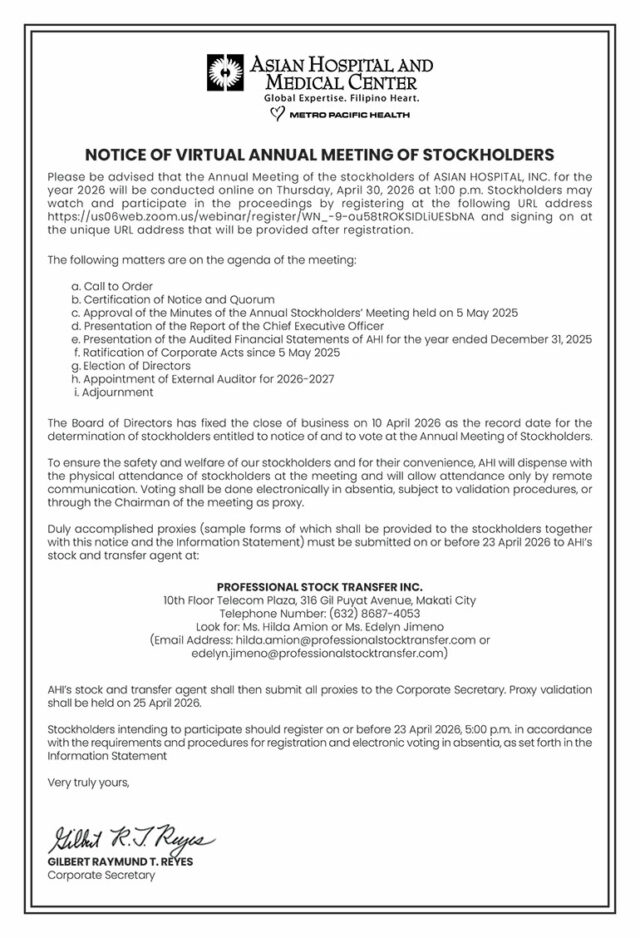
Asian Hospital, Inc. discloses virtual Annual Stockholders’ Meeting on April 30


Spotlight is BusinessWorld’s sponsored section that allows advertisers to amplify their brand and connect with BusinessWorld’s audience by publishing their stories on the BusinessWorld Web site. For more information, send an email to online@bworldonline.com.

Join us on Viber at https://bit.ly/3hv6bLA to get more updates and subscribe to BusinessWorld’s titles and get exclusive content through www.bworld-x.com.

DigiPlus levels up user engagement with ArenaPlus’ P1B Prediction Giveaway

DigiPlus Interactive Corp., the country’s pioneer and leader in digital entertainment, through its flagship sportsbook platform ArenaPlus, formally launched its P1 Billion Prediction Giveaway last Saturday, March 21, heralding a major step-up in its customer acquisition and retention strategy.

This initiative is anchored by a high-stakes prediction challenge designed to invite new users onto ArenaPlus, while also deepening player participation and reinforcing brand leadership in the Philippine online sportsbook space. Central to this campaign is the introduction of a localized tournament bracket game — a staple in American sports culture that ArenaPlus is pioneering for the local market.

“We want to bring some excitement for the Filipino basketball fans, especially since we know that the NBA is the most popular sport here. The bracket game is actually very common in the US. It’s been running there constantly for years, but the Philippines has never had that experience. We want to bring that here,” said ArenaPlus Head Erick Su.

By offering the P1 Billion Prediction Giveaway as a free-to-play initiative, DigiPlus enables fans to engage in the tournament without any monetary commitment. Su emphasized that the campaign is designed to provide a safe, entertainment-led experience, with the bracket format sustaining interest from the opening round of the Playoffs through the Finals, where one team ultimately prevails.

“I think the excitement will be from beginning to the end. Because the bracket game covers the whole stage of the Playoffs, fans can expand their predictions and go along with the whole process and expect that they can win,” Mr. Su said. “So that’s going to bring a lot of excitement. And this is completely free and very safe as we want to entertain Filipinos.”

Amplifying the campaign that launched at Mall of Asia Sky Deck Amphitheater in Pasay City was premier host and actor Luis “Lucky” Manzano, who was also introduced as ArenaPlus’ latest brand ambassador. Joining Mr. Manzano were fellow endorsers Gilas Pilipinas naturalized player Justin Brownlee, multi-time champion assistant coach Bong Ravena, and his son, international pro Thirdy, who are effectively raising ArenaPlus’ visibility while also broadening the brand’s demographic reach.

“At ArenaPlus, we are relentless with our commitment to elevate our players’ experience, making sports more fulfilling, more immersive, and more rewarding for every Filipino,” said ArenaPlus Marketing Head Hannah Bagui as ArenaPlus continues to differentiate itself by pioneering accessible digital sports entertainment.

While the campaign is designed to drive wide participation, ArenaPlus emphasized that it intends to maintain strict platform integrity through its rigorous eKYC (electronic Know Your Customer) process. Such a guardrail bolsters an already rich suite of responsible gaming tools built into ArenaPlus, such as options to set daily gaming durations, customize specific gaming schedules, and establish daily loss limits. This ensures that while the campaign achieves great reach, it does so within a secure, transparent, and compliant environment that builds trust.

Through these strategic customer activations and continuous platform innovation, DigiPlus Interactive Corp. continues to solidify its legacy as the definitive pioneer of the Philippine digital entertainment industry, driving growth while also redefining user engagement.


Spotlight is BusinessWorld’s sponsored section that allows advertisers to amplify their brand and connect with BusinessWorld’s audience by publishing their stories on the BusinessWorld Web site. For more information, send an email to online@bworldonline.com.

Join us on Viber at https://bit.ly/3hv6bLA to get more updates and subscribe to BusinessWorld’s titles and get exclusive content through www.bworld-x.com.

Philippines still likely to be ASEAN’s second-fastest growing economy despite oil shocks

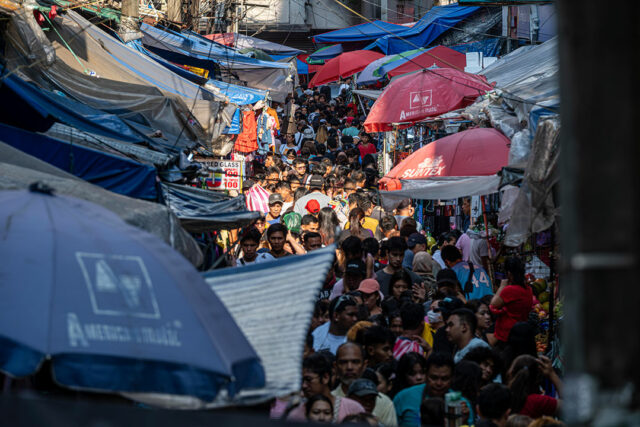
Shoppers flock to Divisoria, Manila. — PHILIPPINE STAR/RYAN BALDEMOR

By Katherine K. Chan, Reporter

The Middle East conflict threatens the Philippines’ growth prospects but a rebound in private spending and robust exports could still position the country as the second fastest growing economy in the region, the ASEAN+3 Macroeconomic Research Office (AMRO) said.

AMRO Chief Economist Dong He said they see the Philippine gross domestic product (GDP) expanding by 5.3% this year, unchanged from their forecast in January, and by 5.8% in 2027.

“This makes the Philippines one of the faster-growing economies in the region – above the ASEAN average of 4.6% and the ASEAN+3 average of 4%,” Mr. He told BusinessWorld in an e-mail interview. “The acceleration reflects an expected recovery in private consumption and stronger exports.”

If both projections hold true, the economy will surpass its 4.4% growth last year or when the flood control graft scandal slowed government spending, household consumption and investments in the country.

Household spending, which accounts for over 70% of the country’s GDP, grew by 3.8% in the fourth quarter, the weakest pace seen since the -4.8% in the first quarter of 2021. Full-year household spending growth eased to 4.6% in 2025 from 4.9% in 2024.

On the other hand, the country’s goods exports grew by 15.2% to $84.41 billion last year, exceeding the Bangko Sentral ng Pilipinas’ (BSP) projected 9% growth to $60 billion.

For this year, the BSP expects goods exports to rise modestly by 3% to $65.3 billion amid reduced front loading and elevated trade costs, before picking up by 4% to $67.9 billion in 2027.

Still, Mr. He said the Philippines will likely remain resilient against tariff and trade disruptions.

“The Philippines has been relatively less affected by tariff and trade disruptions, reflecting its more domestically driven growth and lower reliance on goods exports,” he said.

“However, vulnerabilities remain in electronics and semiconductor exports. To mitigate risks, the country should further diversify export markets, improve trade facilitation and logistics, and attract firms looking for supply chain relocation to strengthen external resilience,” he added.

The information technology and business process management (IT-BPM) and finance sectors may also help drive the country’s growth this year, Mr. He said.

However, he noted that the IT-BPM industry needs policies to support its shift toward knowledge-process outsourcing (KPO) and global capability centers (GCCs) activities.

“For the Philippines, the high value-added knowledge-based services, such as the IT-BPM and finance would continue to be the key sources of value-added creation,” Mr. He said. “However, with AI (artificial intelligence) becoming increasingly prevalent, a concerted shift is required toward higher-value segments, namely KPO, GCCs and digital trade services.”

While the country may be well positioned this year, Mr. He also noted that global trade uncertainties, financial market volatility and energy shocks amid the ongoing conflict in the Middle East could weigh on its economic growth.

“The conflict in the Middle East and the resulting disruption to the Strait of Hormuz pose the most immediate risk to the outlook – a protracted disruption to global energy supply could push inflation higher and weigh materially on growth,” he said.

“Other key risks include unpredictable US trade policy shifts, the uncertain trajectory of technology demand, and volatile global financial markets,” he added.

ENERGY RISKS
Oil trade disruptions have led to energy price shocks globally, with the Philippines facing oil price surges and looming fuel shortages as the war drags on.

For Mr. He, the oil crisis could mean faster inflation for the Philippines as its heavy reliance on imported oil from the Middle East makes it vulnerable to price and supply shocks.

“The Philippines is one of the more affected countries in the region,” he said. “As a net oil and gas importer, with 98% of its oil imports sourced from the Middle East, the Philippines is exposed to higher oil prices and potential supply disruptions.”

AMRO now sees Philippine inflation quickening to 3.9% this year if oil prices hold around $80-$90 per barrel. This is faster than its earlier projection of 3.2%.

However, Mr. He said inflation can further accelerate if price increases and supply disruptions last longer.

“Given heightened uncertainty, the authorities should remain vigilant and stand ready to recalibrate policy parameters to mitigate the impact of external shocks,” he added. “Specifically, amid rapidly evolving geopolitical tensions, volatile energy prices, and weaker growth momentum, the BSP should remain cautious in making monetary policy adjustments.”

Last month, the BSP kept its benchmark rate unchanged at 4.25% in an off-cycle meeting to calm markets worried over uncertainties arising from the US-Iran war.

BSP Governor Eli M. Remolona, Jr. said the Monetary Board arrived at the decision after noting that the current price pressures are supply-driven, and hiking rates immediately risk derailing the country’s economic recovery.

He added that future monetary policy decisions will consider second-round price effects, particularly a potential uptick in transport fares, food and fertilizer prices, electricity rates and wages.

AMRO’s Mr. He said the central bank must “respond decisively” once such second-round effects materialize.

“Meanwhile, enhanced coordination between fiscal and monetary authorities is required to cushion the impact of supply-driven inflation and prevent adverse effects on growth,” he added. “In this regard, the government could consider timely administrative measures, such as targeted subsidies to highly exposed sectors and reducing tariffs on energy imports.”

Amid current economic shocks, Mr. He said the Philippines has a “sharper mandate than usual” in tightening regional cooperation and addressing shared economic challenges as it takes the helm in the Association of Southeast Asian Nations (ASEAN) this year.

“The current moment – where trade disruptions and an energy shock are testing the region simultaneously – gives the chairmanship a sharper mandate than usual,” AMRO’s chief economist said.

Mr. He said the National Government must pursue local reforms alongside regional development efforts, especially by drawing in private investments, enhancing infrastructure delivery and strengthening capital markets.

“The current external environment raises the cost of delaying these reforms,” he added.

This year, the Philippines assumed chairship of the 11-member regional bloc, composed of Brunei, Cambodia, Indonesia, Laos, Malaysia, Myanmar, the Philippines, Singapore, Thailand, Vietnam and Timor-Leste.


China ready to cooperate with Russia to ease Middle East tension, foreign minister says

United States Ambassador to the United Nations Mike Waltz addresses a Security Council meeting to discuss 'ongoing US aggression' against Venezuela at the UN headquarters in New York City, US, Dec. 23, 2025. — REUTERS

BEIJING — China is willing to continue to cooperate with Russia at the UN Security Council and make efforts to cool down the Middle East situation, Foreign Minister Wang Yi told his Russian counterpart Sergei Lavrov in a phone call on Sunday.

Mr. Wang said the fundamental way to resolve navigation issues in the Strait of Hormuz is to achieve a ceasefire as soon as possible, adding that China has always advocated political settlement of hotspot issues through dialogue and negotiation.

The foreign ministers’ call came ahead of a UN Security Council vote next week on a Bahraini resolution to protect commercial shipping in and around the Strait of Hormuz.

As permanent UNSC members, China and Russia should “adopt an objective and balanced approach and seek to win greater understanding and support from the international community,” Mr. Wang told Mr. Lavrov, according to a statement from his ministry.

A Russian Foreign Ministry statement said the ministers discussed ways to achieve a rapid ceasefire and “launch a political-diplomatic dialogue.”

“Satisfaction was expressed at the coincidence in Russia’s and China’s approaches on most issues on the global agenda, including the situation around Iran, related to the unprovoked aggression of the US and Israel against that country,” it said.

China has repeatedly called for a ceasefire in the Gulf region and Middle East, urging an end to the fighting that has run for more than a month and largely closed the Strait of Hormuz, a critical shipping artery for oil and gas. — Reuters

US rescues airman, vows ‘hell’ for Iran if Strait stays shut

REUTERS

WASHINGTON/CAIRO — US special forces rescued an airman in a high-risk mission deep inside Iran while President Donald Trump threatened to rain “hell” on Tehran if it did not reopen the Strait of Hormuz by Tuesday for oil flows vital to the world economy.

Mr. Trump announced the rescue in the early hours of Sunday in a social media post that described the operation in a mountainous area as “one of the most daring” such missions in US history.

The airman, the weapons officer of an F-15 jet shot down on Friday, was wounded but “will be just fine”, Mr. Trump said in a message on X. The jet’s pilot was rescued later that day.

In another post laden with expletives, Mr. Trump told Iran to open the Hormuz waterway, the conduit for around a fifth of the world’s oil and natural gas supply that has been largely shut down since the war began five weeks ago.

“Tuesday will be Power Plant Day, and Bridge Day, all wrapped up in one, in Iran,” he said on his Truth Social platform, threatening strikes on energy and transport infrastructure that critics say would violate international law.

“There will be nothing like it!!! Open the Fuckin’ Strait, you crazy bastards, or you’ll be living in Hell – JUST WATCH! Praise be to Allah. President DONALD J. TRUMP”

Adding to the pressure, Washington’s ally in the war, Israel – which attacked a major petrochemicals facility in Iran on Saturday – was preparing to attack energy facilities next week and was awaiting US approval, a senior Israeli defense official said.

In the kind of mixed messaging that has baffled supporters, foes and financial markets alike, Mr. Trump told Fox News on Sunday that Iran was negotiating, with a deal possible by Monday.

After reports of explosions across Iran’s capital Tehran on Monday morning, a US-Israeli strike on a residential building killed at least five people and left several people buried under rubble in Qom, south of the city, a deputy governor told the semi-official SNN news agency.

IRAN CONDEMNS ‘RECKLESS’ US, HITS GULF
Tehran is demanding an end to hostilities and its parliamentary speaker Mohammad Baqer ‌Qalibaf condemned Mr. Trump’s threats, saying he was being misled by Israeli Prime Minister Benjamin Netanyahu.

“Your reckless moves are dragging the United States into a living HELL for every single family, and our whole region is going to burn because you insist on following Netanyahu’s commands,” he posted on X.

Showing it still had fight despite the US-Israeli pounding, Iran expanded attacks on Gulf energy infrastructure, launching drone and missile strikes on petrochemical facilities in Kuwait, Bahrain and the United Arab Emirates.

The Revolutionary Guards also said they hit an Israeli‑linked vessel at Dubai’s Jebel Ali port.

In Kuwait, drones sparked fires and caused “severe material damage” at petrochemical plants operated by affiliates of state oil firm Kuwait Petroleum Corporation, the company said.

The strikes underscored Iran’s ability to sustain cross‑border attacks and disrupt infrastructure across multiple Gulf states, exposing vulnerabilities in energy and maritime hubs.

In Israel too, media showed search-and-rescue teams combing debris in the northern city of Haifa after an Iranian missile hit a residential building. Israeli paramedics said nine people were being treated.

HOSTAGE CRISIS AVERTED
With the impact from the strait’s closure on the global economy deepening by the day, the rescue of the US airman removed the risk for Mr. Trump of a hostage crisis further souring the mood of an American public already sceptical of the war.

Under cover of darkness, US commandos slipped deep into Iran, undetected, scaled a 7,000‑foot (2,100-meter) ridge and took the ​stranded American weapons specialist to safety, moving the airman toward a secret rendezvous point before dawn on Sunday.

Two MC-130 aircraft that had ferried some of the roughly 100 special ‌operations forces into rugged terrain south of Tehran suffered a mechanical failure and could not take off, a US official told Reuters.

Their commanders made a high-risk decision, ordering additional aircraft to fly into Iran to extract the group in waves — a decision that left the elite commandos waiting for a couple of tense hours.

The rescue force was pulled out in stages, ​and US troops destroyed the disabled MC‑130s and four additional helicopters inside Iran rather than risk leaving sensitive equipment behind.

Iran said several US aircraft were destroyed during the operation, including two military transport planes and two Black Hawk helicopters. Footage posted on social media showed burned-out aircraft wreckage, which Reuters verified was in the area.

PEACE EFFORTS FRUITLESS
The war, which opened with US and Israeli air strikes across Iran on February 28, has spread to Lebanon, where Israel has resumed its campaign against the Iranian-backed Hezbollah.

Thousands have died, mainly in Iran and Lebanon, where Israeli airstrikes killed another 11 people on Sunday, according to Lebanon’s health ministry.

Efforts brokered by Pakistan to bring the two sides to an agreement have so far failed.

“What we care about are the terms of a conclusive and lasting END to the illegal war that is imposed on us,” Iran’s Foreign Minister Abbas Araqchi said on X.

Iran’s chokehold over the narrow Strait of Hormuz shipping lane off its southern coast has sent crude prices soaring, squeezing consumers and businesses worldwide. — Reuters

Oil prices rise as US-Israeli war with Iran continues to disrupt supply

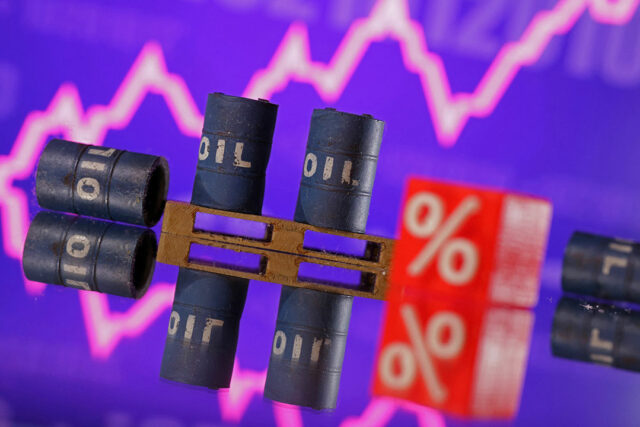
Miniatures of oil barrels and a rising stock graph are seen in this illustration. — REUTERS/DADO RUVIC/ILLUSTRATION

OIL PRICES climbed on Monday on continuing fears of supply losses because of shipping disruptions in the key Middle East producing region from the US-Israeli war with Iran.

Brent crude futures rose $1.71, or 1.6%, to $110.74 a barrel by 0057 GMT. US West Texas Intermediate crude futures gained $0.71, or 0.6%, to trade at $112.25 per barrel.

On Thursday, the last trading day before the Good Friday holiday break, WTI settled up more than 11% and Brent soared nearly 8% in volatile trading, recording their biggest absolute price increase since 2020, as US President Donald Trump promised to continue attacks on Iran.

The Strait of Hormuz, which carries oil and petroleum products from Iraq, Saudi Arabia, Qatar, Kuwait, and the United Arab Emirates, remains largely closed by Iranian attacks on shipping after the war began on February 28.

Because of the Middle East supply disruptions, refiners are seeking alternative sources for crude, particularly for physical cargoes in the US and the UK North Sea.

“Global buyers are bidding aggressively for (US) Gulf Coast barrels and Brent is rallying even faster,” the Schork Group said in a client note on Monday.

On Sunday, Mr. Trump ratcheted up pressure on Tehran, threatening in an expletive-laden Easter Sunday social media post to target Iran’s power plants and bridges on Tuesday if the strategic Strait of Hormuz is not reopened.

Still, some vessels, including an Omani-operated tanker, a French-owned container ship and a Japanese-owned gas carrier, crossed the Strait of Hormuz since Thursday, shipping data showed, reflecting Iran’s policy to allow passage for vessels from countries it deems friendly.

The war threatens to linger on as Iran has officially told mediators it is not prepared to meet with US officials in the Pakistani capital Islamabad in coming days and efforts to produce a ceasefire have reached a dead end, the Wall Street Journal reported on Friday.

On Sunday, OPEC+, consisting of some members of the Organization of the Petroleum Exporting Countries and allies such as Russia, agreedto a modest rise of 206,000 barrels per day for May.

However, that decision will largely exist on paper as several of the group’s key producers are unable to raise output due to the war.

Russian supply has been disrupted recently by Ukrainian drone attacks on its Baltic Sea export terminal. Media reports on Sunday said its Ust-Luga terminal resumed loadings on Saturday after days of disruptions. — Reuters

Puregold highlights sari-sari stores’ role in driving grassroots commerce and MSME growth

With Puregold Channel’s Sari-Sari Stories, the company honors the enduring impact of sari-sari stores as drivers of commerce and MSME growth.

In its final installment of the Sari-Sari Stories, Puregold releases “Pangalan,” a moving tribute to the sari-sari stores that continue to power daily life, grassroots enterprise, and community connection across the Philippines.

Following “Ways,” “The Sign,” and “The Witness,” Puregold broadens the conversation from nostalgia to economic relevance, highlighting how sari-sari stores continue to serve as accessible retail touchpoints, community anchors, and entry-level enterprises that support household livelihoods in the country.

The short film, “Pangalan,” showcases the resilience and relevance of sari-sari stores amid the changing retail landscape.

Sari-sari stores go beyond informal neighborhood retail. They function as last-mile commerce points that respond to everyday consumer needs with proximity, familiarity, and flexible purchasing options. Their resilience has allowed them to remain relevant even as the retail landscape continues to evolve.

That economic role is matched by social relevance. At the heart of Pangalan is the idea that sari-sari stores are more than neighborhood shops: they are trusted spaces that people turn to not only for essentials, but for connection and reliability. The film captures this dual role in distinctly Filipino terms: the store as tanungan, tambayan, and takbuhan.

The narrative is reinforced by appearances of OPM artists Jhoanna Robles of BINI, Stell Ajero of SB19, and Skusta Clee, whose personal recollections reflect the deep familiarity of sari-sari stores in Filipino life. Their participation adds cultural relevance to a message ultimately anchored in enterprise, accessibility, and community-based retail.

Through the short film series, Puregold hopes to reinforce its commitment to MSMEs by spotlighting the role that grassroots enterprises play for Filipino neighborhoods.

Puregold’s focus on this segment remains rooted in mass-market demand and the practical realities of everyday consumption. By spotlighting community-based retail, the company reinforces its relevance at the grassroots level while drawing attention to the vital contribution of MSMEs to the domestic economy.

In “Pangalan,” Puregold mentions the upcoming Tindahan Ni Aling Puring Convention, another effort to support sari-sari store owners and entrepreneurs nationwide.

The timing is equally strategic, with MSMEs already looking ahead at the upcoming Puregold Tindahan Ni Aling Puring Sari-Sari Store Convention in May. The annual event has become a key platform for sari-sari store owners, entrepreneurs, and partner suppliers, underscoring Puregold’s enduring commitment to small business development and ecosystem growth.

Watch the full video here:

Stay in the loop. Subscribe to the Puregold Channel on YouTube, like @puregold.shopping on Facebook, and follow @puregold_ph on Instagram and X, and @puregoldph on TikTok for updates and behind-the-scenes content.


Spotlight is BusinessWorld’s sponsored section that allows advertisers to amplify their brand and connect with BusinessWorld’s audience by publishing their stories on the BusinessWorld Web site. For more information, send an email to online@bworldonline.com.

Join us on Viber at https://bit.ly/3hv6bLA to get more updates and subscribe to BusinessWorld’s titles and get exclusive content through www.bworld-x.com.

Poll: Inflation likely hit 20-month high in March

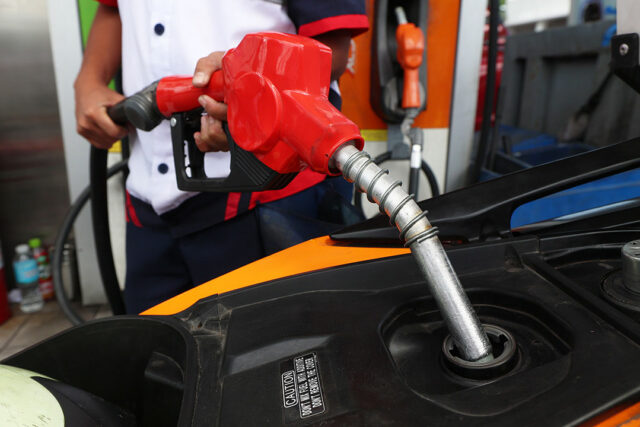
AN ATTENDANT fills a tank at a gasoline station in Quezon City, March 20, 2026. — PHILIPPINE STAR/MIGUEL DE GUZMAN

By Katherine K. Chan, Reporter

SHARP OIL PRICE increases driven by supply disruptions from the Middle East war, along with pricier rice, may have pushed Philippine inflation to its fastest pace in nearly two years, analysts said.   

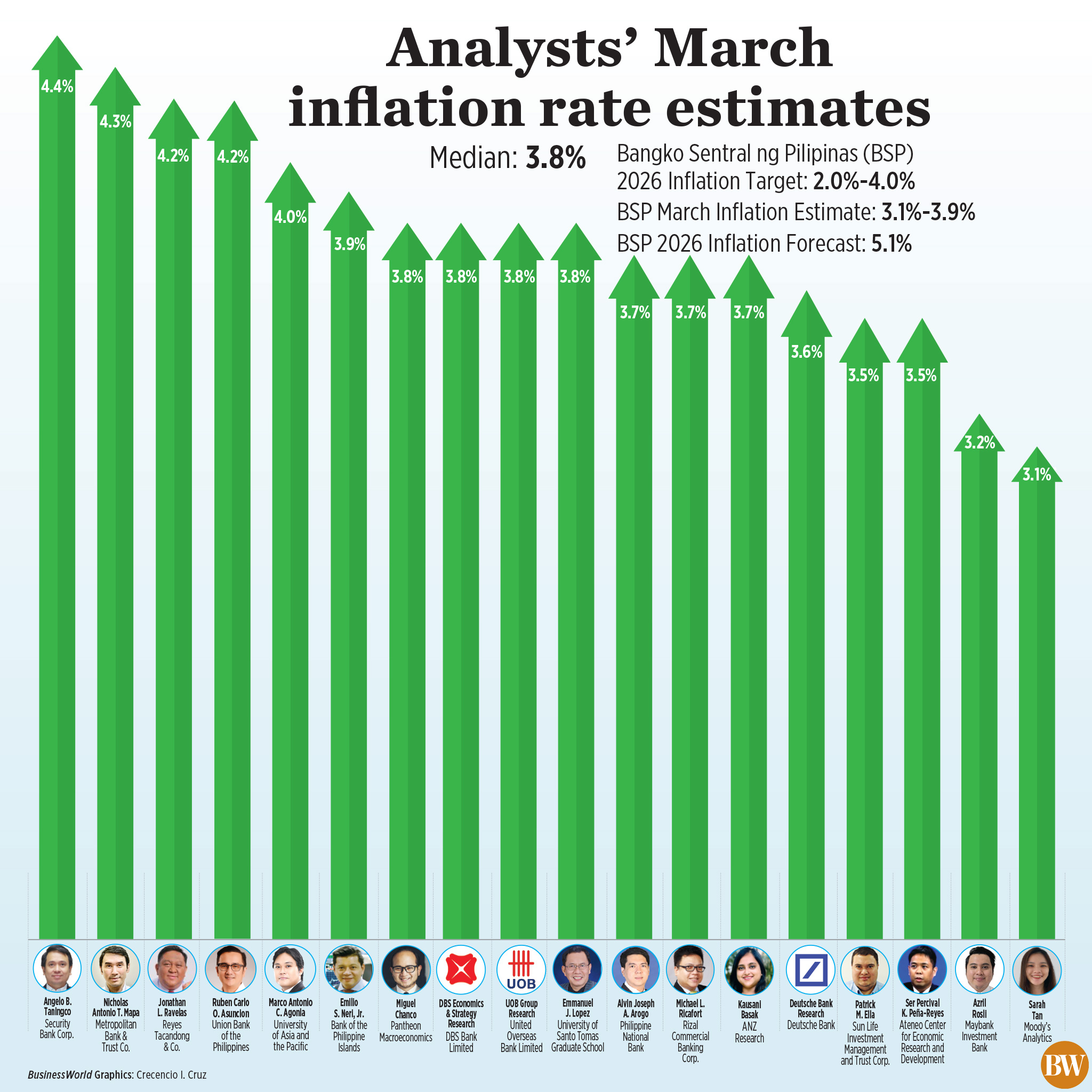
A BusinessWorld poll of 18 analysts yielded a median estimate of 3.8% for the consumer price index in March, accelerating from the 2.4% in February and 1.8% a year ago.

This is near the upper end of the Bangko Sentral ng Pilipinas’ (BSP) 3.1%-3.9% forecast for the month.

If realized, the headline print would be the fastest in 20 months or since 4.4% seen in July 2024.

This would also mark the third straight month that inflation settled within the central bank’s target.

The Philippine Statistics Authority (PSA) will release the March inflation data on Tuesday, April 7.

“I’m looking at 3.8% for the March inflation print, with most of the acceleration from 2.4% in February coming from transport deflation coming swiftly to an end on the back of the major fuel price hikes seen in recent weeks,” Miguel Chanco, chief Emerging Asia economist at Pantheon Macroeconomics, said in an e-mail.

He said transport inflation likely quickened to 8.5% last month from -0.3% in February.

“On top of this, we’re expecting a further rise in food inflation where low base effects are still doing a lot of heavy lifting,” Mr. Chanco added.

In March, local fuel retailers raised pump prices by double digits as the US-Iran war sent crude oil prices soaring. Pump price adjustments stood at a net increase of up to P43.50 a liter for gasoline, P67.35 per liter for diesel and P70.90 per liter for kerosene last month.

The Philippines is a net importer of crude oil and sources most of its crude oil as well as liquefied petroleum gas supply from the Middle East. This makes the country extremely vulnerable to global crude price swings.

Analysts also attributed the faster headline clip to higher rice prices and electricity rates during the month.

“In addition, higher rice and power prices, coupled with the continued depreciation of the peso, likely amplified imported inflation pressures, especially for fuel, food, and other essential goods,” Maybank Investment Bank economist Azril Rosli said in an e-mail.

“Some offset may have come from softer prices for vegetables, fish, and meat, but overall price pressures appear to have been dominated by energy-led cost increases and second-round effects in services and utilities,” he added.

Based on PSA data, the average cost of local regular milled rice climbed by 5.8% to P48.69 a kilo in the second half of the month from P46.02 a year earlier. The price of well-milled rice went up by 8.02% year on year to P56.68 a kilo, while the price of special rice rose by an annual 3.79% to P64.07 a kilo.

Manila Electric Co. hiked electricity rates by 64.27 centavos per kilowatt-hour (kWh) to P13.8161 per kWh for its customers in the greater Metro Manila area. This meant households consuming 200 kWh monthly paid about P129 more in their electricity bill for March.

TARGET BREACH?
Meanwhile, several analysts see inflation potentially breaching the BSP’s target in March, as base effects and elevated prices of rice and other staple foods add to the inflationary impact of oil shocks.

“We forecast March inflation at 4.2% year on year, up from 2.4% in February, mainly reflecting unfavorable base effects and higher food prices, particularly rice and other key staples, amid tighter domestic supply conditions and lingering import‑related cost pressures,” Union Bank of the Philippines Chief Economist Ruben Carlo O. Asuncion said in an e-mail.

“Transport and utility costs also likely contributed following recent movements in global oil prices, while core inflation remains relatively stable for now,” he added.

Emerging supply-side pressures could also drive second-round price effects on transport fares, electricity rates and wage-related adjustments, Mr. Asuncion noted.

The BSP wants to keep inflation within the 2%-4% range, with 3% as their point target.

However, the central bank is now expecting the headline print to overshoot the band amid price pressures from elevated oil costs and second-round inflation effects.

If the BusinessWorld poll’s median forecast materializes, headline inflation would average 2.7% as of March, still below the BSP’s revised inflation estimate of 5.1% for the entire year.

Meanwhile, Security Bank Chief Economist Angelo B. Taningco projects inflation to accelerate to 4.4% in March, citing the peso’s slump as one of the drivers.

The peso touched back-to-back record lows last month as uncertainties over the Middle East war took a toll on the local currency.

On Tuesday, the peso closed at a fresh low of P60.748 against the dollar, down 5.8 centavos from its previous record finish of P60.69 on Monday, Bankers Association of the Philippines data showed.

PAUSE OR HIKE?
Still, most analysts polled by BusinessWorld said the current macroeconomic backdrop calls for a pause at the BSP’s upcoming meeting later this month.

“Easing would risk fueling inflation expectations, while aggressive tightening would weaken growth without addressing the root cause of the shock,” Moody’s Analytics Assistant Director and Economist Sarah Tan said in an e-mail.

“In this context, we expect the BSP to adopt a wait-and-see approach, assessing whether the increase in oil prices proves temporary or sustained. For now, a prolonged pause appears the most realistic path, and we expect the BSP to hold fire at the April meeting,” she added.

However, Security Bank’s Mr. Taningco sees the BSP tightening in a move to temper inflationary pressures.

“We still expect the BSP to raise the policy rate by 25 basis points (bps) to 4.5% at its April 23 meeting,” he said via e-mail. “This is largely in response to March inflation topping the 4% upper bound of the BSP’s target range.”

On March 26, the central bank maintained the key rate at 4.25% in an off-cycle meeting as it sought to soothe markets amid uncertainties arising from the Middle East war.

The BSP last reduced its benchmark rate by 25 bps for a sixth straight meeting in February, extending its easing cycle to a year and a half. It has cut a total of 225 bps since August 2024.

BSP Governor Eli M. Remolona, Jr. said they opted to hold steady as policy adjustments will have little impact on taming supply-driven inflation pressures, adding that tightening may delay economic recovery.

Still, the central bank chief said the Monetary Board will monitor second-round price effects to guide their upcoming policy decisions, with a rate hike likely if the price of crude oil reaches $200 per barrel.

The Monetary Board will hold its second policy review this year on April 23.

Middle East war darkens outlook for Philippine economy — BMI

A clear view of the setting sun is seen above the skyline of Taguig, March 13, 2026. — PHILIPPINE STAR/RYAN BALDEMOR

THE PHILIPPINE ECONOMY is likely to expand by 4.7% this year, amid sluggish government spending and oil supply disruptions arising from the ongoing war in the Middle East, Fitch Solutions unit BMI said.

In a report dated March 31, BMI said Philippine gross domestic product (GDP) growth may have recovered in the first quarter, expanding by 3.6% due to strong exports and factory activity.

If realized, this would be faster than the post-pandemic low of 3% in the fourth quarter of 2025, but much slower than 5.4% in the first quarter of 2025.

At the same time, BMI said it cut its full-year Philippine GDP growth projection to 4.7% from 5.1%, reflecting its shift to a scenario where oil prices remain higher for longer.

“Subdued government capex (capital expenditures) continued to weigh on overall activity. Furthermore, the US-Iran conflict darkens our outlook for the rest of the year,” BMI said.

Latest data from the Bureau of the Treasury showed that government spending fell year on year for a sixth straight month in January. State spending slumped by 23.9% to P303.5 billion from the P398.8 billion logged in the same month last year.

The Fitch unit also noted that elevated energy prices amid the war will likely weaken consumers’ purchasing power, eventually taking a toll on the consumption-driven economy.

“Already, this has fed through to higher domestic energy prices, with diesel and gasoline prices rising by around 80% and 50% respectively, compared with pre-conflict levels,” BMI said.

“Higher fuel costs will erode household purchasing power and weigh on growth, while government measures to curb energy consumption — including a four-day workweek for public sector workers — will add further to this drag,” it added.

The month-long Middle East conflict sent oil prices soaring after the closure of the Strait of Hormuz disrupted crude oil shipments.

The Philippines, a net importer of oil, sources most of its supply from the Middle East, making the country vulnerable to swings in global oil prices.

Last month, President Ferdinand R. Marcos, Jr. placed the Philippines under a state of national energy emergency for a year amid concerns over the country’s energy supply.

Mr. Marcos also signed into law a measure temporarily authorizing the Executive department to suspend or reduce the excise tax on petroleum products.

Since the US and Israel began its war on Iran in late February, local pump prices have jumped up by P43.50 a liter for gasoline, P67.35 per liter for diesel and P70.90 per liter for kerosene.

However, the Department of Foreign Affairs said last week that it has secured a deal with Iran, allowing Philippine-flagged vessels shipments and seafarers safe passage through the Strait of Hormuz.

BMI sees consumer prices soaring in the coming months, raising its full-year inflation forecast to 3.6% from 3.2% previously.

“Even so, we are revising up our inflation forecast by 0.4 (percentage point) to 3.6%, with implications for monetary policy,” it said.

This also came after the Bangko Sentral ng Pilipinas (BSP) stood pat in an off-cycle meeting last month as it noted that inflation may breach its 2%-4% target at 5.1% this year.

The central bank’s benchmark rate currently stands at an over three-year low of 4.25%, following 225 basis points (bps) in total cuts since August 2024.

For BMI, the BSP’s easing cycle has now hit a dead end, with no room for any further reductions at least until yearend.

“This decision suggests that the BSP is willing to look past short-term supply-shock inflation spikes and signals the bar for a rate hike remains high,” it said. “Taken together, this meeting reinforces our revised call for no additional easing in 2026.”

The Monetary Board is scheduled to hold a policy meeting on April 23. — Katherine K. Chan