Home Blog Page 6159

Insurance to be reshaped towards purposeful growth

Globally, the insurance industry is seen to be on the verge of a “dynamic and purpose-driven moment” this year, as multinational professional services firm Ernst & Young (EY) noted in its latest “Global Insurance Outlook.”

“We believe the industry is poised for a period of purposeful growth, despite daunting macroeconomic and structural challenges, fierce competition and ongoing tech-driven disruptions,” the outlook’s authors wrote in the report.

Driving that dynamic moment are three trends that are expected to reshape the insurance market, as well as open opportunities for insurers to make more meaningful decisions for their clients and workforces.

“The decisions and actions leaders take today can meaningfully influence the future of the industry — and the lives and livelihoods of billions of people around the globe,” EY’s Global Insurance leadership team wrote in a message in the outlook.

Recognizing the rise of open finance and the ecosystems of financial solutions it enables, EY sees an emergence of open insurance, where insurance-related data and other types of personal information are shared among different organizations through application programming interfaces (APIs) that connect disparate systems.

Like how open finance can transform the delivery of financial services, open insurance makes it possible for insurers to tailor-fit policies or packages for customers.

“Across all lines of business, there is increased demand for more affordable, transparent and customized insurance that better suits evolving conditions and can be easily adjusted as the needs change,” EY’s outlook read. “Customers are increasingly willing to buy that insurance from other companies (e.g., retailers, other financial institutions, tech platforms) that offer intuitive personalized experiences.”

In addition, global professional services company Accenture recognized that technology, as it is integrated within traditional insurance products, will enable the personalization of solutions.

“Wearables and Internet of Things (IoT) sensors are creating new ways to track, price and promote health, home safety and security and auto insurance solutions,” Accenture wrote in its recent analysis of the insurance revenue landscape in the future. “Technology allows for increased personalization of products, services and rates, but insurers need to be prepared to operate on the right platforms and with the right partners to enable that personalization.”

Whereas before technology and automation is considered to cause job reductions in the insurance industry, at present the industry is set to have a more nuanced and interdependent human-tech dynamic — the second trend EY spotted.

“The consensus among forward-looking executives is that human talent is every bit as important to future success as AI, machine learning and modernized processing platforms, the firm’s outlook read. “Yet the scarcity of key skills and “the Great Resignation” mean that insurers must address the traditional view of the industry as slow-moving and dull if they are to become employers of choice.”

In attracting talent, EY recommends insurers to take stronger positions on social issues that matter most to rising generations of workers (e.g., diversity and inclusion, sustainability); provide meaningful work; and enhance their benefits, performance recognition and compensation models.

“Younger workers are also looking for more purposeful work, which gives an advantage to insurers that can articulate a clear story about how their products and services benefit society as a whole,” EY added.

Also, Accenture observed that the coronavirus pandemic and “the Great Resignation” are creating the pressures and shifts that will force insurers to disrupt long-standing apprenticeship models for skilling in essential functions like claims and underwriting. These forces are also pressing the need to attract and retain talent that are critical in roles critical to insurance workforce transformation like technology, analytics, and actuarial.

“Insurers will always need humans. But with fewer workers, they increasingly need humans enabled by machines, transforming how work gets done regardless of who’s doing it or where,” Kenneth Saldanha, senior managing director – Global Insurance lead at Accenture, wrote on the company’s website.

As insurers are seen to be seriously considering the impact of their actions to the environment and society around them, sustainability, the third trend, brings “a historical opportunity” for the industry to purposefully lead, innovate, and grow.

“Previous discussions about sustainability were largely theoretical and centered on making public pledges of support. Today, however, leading insurers are taking tangible steps and adopting hard metrics to address the full range of environmental, social and governance (ESG) issues and opportunities,” EY’s outlook added.

For most insurers, the outlook continued, the focus is squarely on the “E” in ESG, as climate change is expected to have the biggest and most immediate impact on the industry’s financial performance.

Accenture even recognizes climate change to drive innovation in the insurance industry, in spite of the growing volatility of environmental catastrophes and damage linked to climate change being a complex risk to insure.

“Technology can help shape and improve that response with more sophisticated risk modeling, enabled by digital technology such as AI and analytics. Insurers can improve pre- and post-incident handling around climate-related disasters,” Accenture’s analysis read.

Social issues, nevertheless, are also needing urgent responses, and so insurers must lay out their strategy with specific targets and quantifiable performance metrics, EY advised.

“Within a broader ESG strategy, insurers must identify priority focus areas, clarify why they are allocating resources to them, and determine what benefits they expect to achieve,” the outlook’s authors wrote. — Adrian Paul B. Conoza


Merging insurance with technology

The insurance industry has also been disrupted by the COVID-19 pandemic. Like almost all industries adapting to the new normal, the sector was also urged to innovate.

For one, to maintain their connection with consumers amid the lockdown restrictions and safety concerns, insurance companies were pushed to shift to the digital space. Hence, the number of consumers who moved online to connect with their agents increase from 25% prior to the pandemic to 57% since the beginning of the pandemic, according to professional services firm EY Philippines.

“One key insight here is that insurance companies have the opportunity to re-examine and adjust their digital distribution and communication offerings to address shifting consumer preferences,” SGV (EY Philippines) Consulting Partner Charisse Rossielin Cruz noted in an article published on the firm’s website.

Given the urge for innovation in the sector during and much likely beyond the pandemic, what does this mean for insurtech?

According to management consulting firm Boston Consulting Group, as the need for digital transformation in insurance sped up amid the pandemic, global insurtech funding rose to $7.5 billion in 2020, increasing 21% from the year prior.

“The record-breaking amount of equity funding invested in the space, as well as the large number of M&A deals, IPOs, and strategic reinsurer contributions, show that technology plays a key role in the evolution of the industry,” the firm said. “It is now time for incumbent insurers to accelerate their digital transformations and acknowledge the strategic role that insurtechs can play in helping them rapidly adapt to, and survive in, a post-COVID-19 world.”

Merging insurance with technology, insurtech refers to the utilization of innovations or technologies that could support in enhancing business operations and efficiency  as well as the customer experience in the insurance sector.

In the Philippines, where access to some financial services is a challenge for many Filipinos, it was thought that insurtech could support in improving insurance penetration. BusinessWorld reported last month that some financial technology (fintech) firms were looking to offer microinsurance products via online channels or insurtech to help raise the insurance penetration in the country.

“Interestingly enough, the Philippines scored very low on insurance penetration, but higher on microinsurance penetration. Our job is to really enhance and further penetrate the microinsurance level of the Philippines,” Mario Berta, country manager at insurtech firm Igloo, was quoted as saying.

For Mr. Berta, the insurtech market must be developed, which could help increase the insurance penetration in the Philippines. — Chelsey Keith P. Ignacio

Get up to 65% off at Tefal’s first ever Lazada Super Brand Day

Exclusive deals are up for grabs this July 20!

Get ready to add to cart as Tefal celebrates its first-ever Lazada Super Brand Day sale this July 20!

Score amazing finds with Tefal’s lowest prices ever at up to 65% off in this one-day only sale. You can also avail of exclusive offers, free shipping, plus freebies to enjoy on July 20. 

Don’t miss these terrific deals at the Piso Sale, where you can get a Tefal Mini Rice Cooker worth PHP 2,695 and a Tefal Cook N’ Clean 24 cm. fry pan worth PHP 1,599 for only one peso!

Buy 1, Take 1 promos are also up for grabs with Tefal’s Blendeo Uno blender, Cook n Clean Frypan 24 cm. and Essential Steam Iron.

Fantastic promos and big discounts await so catch Tefal’s first-ever Lazada Super Brand Day on July 20. Head on over to Lazada, Add to Cart, check out then get cooking!

Tefal enthusiasts may also look out for the upcoming Impossible Challenge starting July 11! Get the chance to win P 10,000 worth of exclusive Tefal Lazada Vouchers in this exciting activity. Watch out for the full mechanics to be posted on our Facebook pages.

Check out the great deals for wonderful home appliances at http://bit.ly/TefalLazadaMall plus other exciting cooking products at https://www.lazada.com.ph/shop/tefal-cookware/. Homemakers can know more about Tefal’s appliances at https://bit.ly/TefalAppliancePHFBPage and Foodies can also find out more about their kitchen products at https://www.facebook.com/tefalph.


Spotlight is BusinessWorld’s sponsored section that allows advertisers to amplify their brand and connect with BusinessWorld’s audience by enabling them to publish their stories directly on the BusinessWorld Web site. For more information, send an email to online@bworldonline.com.

Join us on Viber to get more updates from BusinessWorld: https://bit.ly/3hv6bLA.

BSP delivers its biggest rate hike ever

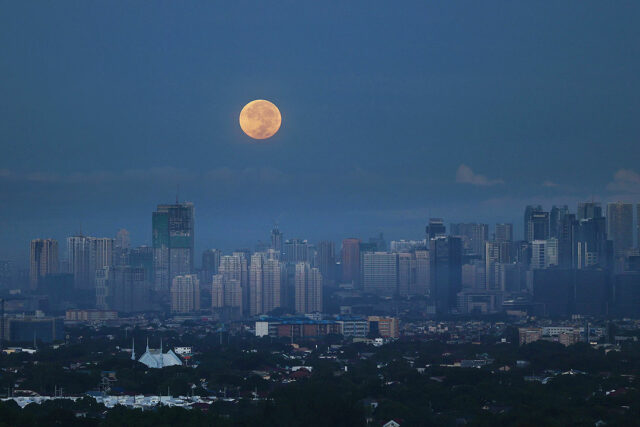
A bright July supermoon is seen over Metro Manila, July 14. — PHILIPPINE STAR/ MIGUEL DE GUZMAN

By Keisha B. Ta-asan

THE BANGKO SENTRAL ng Pilipinas (BSP) unexpectedly raised its benchmark interest rates by 75 basis points (bps) on Thursday, but left the door open for further tightening as it seeks to tame the fastest inflation in nearly four years.

BSP Governor Felipe M. Medalla said the Monetary Board raised its key rate to 3.25%, effective immediately, which brought back the rate to the March 2020 level. This latest move is the BSP’s biggest rate hike ever.

Rates on the overnight deposit and lending facilities were also hiked by 75 bps to 2.75% and 3.75%, respectively. 

“In raising the policy interest rate anew, the Monetary Board recognized that a significant further tightening of monetary policy was warranted by signs of sustained and broadening price pressures amid the ongoing normalization of monetary policy settings,” Mr. Medalla said in a Facebook Live on Thursday morning.

The BSP’s surprise move came ahead of its regular policy meeting scheduled on Aug. 18, and follows two 25-bp rate hikes each in May and June. The Monetary Board has raised benchmark interest rates by a total of 125 bps so far this year.

This was also the central bank’s first off-cycle move since April 16, 2020, when it cut rates by 50 bps to 2.75% to support the pandemic-hit economy.

“By taking urgent action, the Monetary Board aims to anchor inflation expectations further and temper mounting risks to the inflation outlook. In particular, policy action is intended to help manage spillovers from other countries that could potentially disanchor inflation expectations,” Mr. Medalla said.

The BSP is ready “to take further necessary actions to steer inflation towards a target-consistent path over the medium term,” he added.

Mr. Medalla said the BSP will still hold a policy meeting on Aug. 18.

Inflation rose by 6.1% year on year in June, the fastest in nearly four years and exceeded the central bank’s 2-4% target band for a third straight month. The average inflation rate in the first six months is 4.4%, still below the BSP’s full-year forecast of 5%.

BSP Deputy Governor Francisco G. Dakila, Jr. said any revisions on inflation targets will be done in the Aug. 18 meeting.

“It is because, again, we would want to incorporate the latest data… the updated numbers on inflation, as well as inflation expectations and on GDP (gross domestic product) growth,” he said.

The Philippine Statistics Authority (PSA) is scheduled to release July inflation data on Aug. 5, and second-quarter GDP data on Aug. 9.

Mr. Dakila said the initial results of the BSP’s partial survey of private sector economists showed higher mean inflation forecasts for this year (5.4% from 4.9% previously) and 2023 (4.4% from 3.9% previously).

The policy move should help temper the risks to the inflation outlook, he said.

Also, the BSP intends to cut the reserve requirement ratio (RRR) to single digits.

“The adjustments in the reserve requirements are meant to be not indicative of any change in the monetary policy stance but it will be an operational adjustment,” Mr. Dakila said.

Cutting the RRR would give banks more money to lend and reduce the cash holdings that they keep in their vaults as standby funds that do not generate returns.

ECONOMIC OUTLOOK
Mr. Medalla also said the favorable growth conditions this year “suggests that the domestic economy can accommodate a further tightening of monetary policy.”

In a separate statement, Finance Secretary Benjamin E. Diokno said the Philippine economy is robust enough to absorb the policy rate hike.

“The growth outlook is seen to be supported by the maintenance of loosened quarantine restrictions as well as the positive impact of structural reforms… The National Government will continue to adopt a gradual and calibrated path of fiscal consolidation to help preserve the strong growth momentum,” Mr. Diokno, a former BSP governor, said.

The economy expanded by a faster-than-expected 8.3% in the first quarter. The Development Budget Coordination Committee (DBCC) is targeting 6.5-7.5% GDP growth this year.

BSP’s Mr. Dakila said the GDP targets for this year are achievable, adding that second-quarter growth is “very likely to be strong or may even be stronger than the first-quarter numbers.”

While GDP may slow down a bit due to higher interest rates, Bank of the Philippine Islands (BPI) Lead Economist Emilio S. Neri, Jr. said “it might be worse if inflation goes up further.”

“The economy managed to grow by 6.3% and 6.1% in 2018 and 2019 even if the policy rate was above 4%. A prolonged period of high inflation will eventually hurt consumers, which will likely affect the economy more severely compared to higher interest rates,” Mr. Neri said in a statement.

Former BSP Deputy Governor Diwa C. Guinigundo said he was not surprised that the central bank came out “appropriately aggressive in an off-cycle meeting.”

“It’s timely for the BSP to focus on stabilizing inflation and the exchange rate because both would also affect market rates. Uncertainty as to the direction of policy when inflation is hitting historic highs and the peso is performing poorly could also push interest rates and consequently debt servicing costs,” he said in a Viber message.

MORE RATE HIKES
The central bank may increase policy rates further this year as it continues its fight against inflation, ING Bank N.V. Manila Senior Economist Nicholas Antonio T. Mapa said in an e-mail note.

“BSP Governor Medalla will need to sustain the recent hawkish rhetoric to re-anchor inflation expectations and establish the bank’s commitment to fighting inflation,” Mr. Mapa said.

“We expect BSP to hike again at least one more time in 3Q with the possibility of further tightening should inflation continue to remain stubbornly high. The peso will get an immediate reprieve in the short term but chronic trade deficits could mean that any rally in the currency may be capped,” he added.   

Makoto Tsuchiya, assistant economist at Oxford Economics, said the BSP may raise rates by 50 bps at the August meeting to end the year at 3.75%. Inflation is expected to peak above 8% in the fourth quarter, averaging 5.9% for the year, he added.

“But if the (Philippine peso) were to depreciate sharply from here or inflation surprised on the upside, this would justify further tightening this year. For now, we expect that with global trade set to slow and a negative output gap, the BSP will be conscious to not stifle the recovery in domestic demand,” he said in a note.

PESO RECOVERS
The Philippine peso, which had hit a record low early this week versus the US dollar, recovered some lost ground.

The local unit closed at P56.15 per dollar on Thursday, gaining 11 centavos from its P56.26 finish on Wednesday, based on Bankers Association of the Philippines data.

Year to date, the local unit has weakened by 10.09% or by P5.15 from its close of P51 versus the dollar on Dec. 31, 2021.

The peso is the worst-performing currency in Southeast Asia this year as the greenback continues to strengthen on expectations for faster Federal Reserve policy tightening.

The Fed is seen stepping up its tightening campaign with a supersized 100-basis-point rate hike this month after a report showed inflation racing at four-decade highs.

The BSP’s move was meant to support or at least stabilize the peso exchange rate, said Michael L. Ricafort, chief economist at Rizal Commercial Banking Corp. in Manila.

A weak peso adds further pressure on inflation, threatening to derail recovery of the consumption-driven domestic economy.

“More rate hikes are still possible, if needed, as a function of any further Fed rate hikes to bring down elevated inflation,” Mr. Ricafort said. — with Reuters

Debt-to-GDP ratio still manageable — DoF

BW FILE PHOTO

By Diego Gabriel C. Robles

AMID CONCERNS over the Philippines’ ballooning debt, Finance Secretary Benjamin E. Diokno said the debt-to-gross domestic product (GDP) ratio is “not the sole criterion that matters” in assessing the economy’s health.

Mr. Diokno told reporters that the country’s debt-to-GDP ratio, which stood at 63.5% as of end-March, is still manageable.

He made the statement after sharing Bloomberg’s Sovereign Debt Vulnerability Ranking, which included countries with debt-to-GDP ratios lower than the Philippines such as Nigeria (37.4%), Turkey (43.7%) and Mexico (58.4%).

The Philippines was not on the list of 25 countries with the highest default risk this year.

The Department of Finance (DoF) chief said macroeconomic fundamentals, demographic profile, resiliency, and quality of political institutions should also be considered in assessing an economy’s health.

“The fiscal and monetary authorities are in control. The debt-to-GDP ratio is manageable. The banking system is sound and more than adequately capitalized; [nonperforming loans], which [are] low, continues to fall. The banking industry has [built] in enough buffers,” Mr. Diokno said.

Economic managers are aiming to bring down the debt-to-GDP ratio to 61.8% by yearend. The debt-to-GDP ratio is expected to steadily drop to 61.3% by next year all the way to 52.5% by 2028.

Mr. Diokno also noted the country’s economic prospects are “bright” and external sector remains robust.

“[Our] gross international reserves [are] more than enough and there is a steady structural inflow of foreign exchange [from] OFW remittances, BPO receipts, [and] rising exports,” he added.

Preliminary data from the BSP showed the country’s gross international reserves stood at $101.983 billion at end-June, falling 3.5% from the record $105.762-billion level seen in June 2021.

Overseas Filipino workers’ (OFWs) remittances jumped by 3.9% in April to $2.395 billion.

Meanwhile, exports rose by 6.2% year on year to $6.310 billion in May but were offset by imports that grew by 31.4% annually to $11.989 billion.

The Development Budget Coordination Committee (DBCC) retained this year’s export growth target to 7%, but increased import growth goal to 18% from 15% previously.

The economy is expected to grow by 6.5-7.5% this year, and by 6.5-8% annually from 2023 to 2028.

DEBT LEVELS
The national debt can return to pre-pandemic levels if there is faster growth, favorable interest rate conditions, and a longer time horizon, a researcher from the Philippine Institute for Development Studies (PIDS) said.

“If we assume that GDP growth, real interest rate, and the exchange rate are fixed and constant, then the only major variable that the government has a handle on is the primary balance,” said John Paul Corpus, PIDS supervising research specialist, on a PIDS webinar on Thursday.

Primary balance is the difference between a government’s revenue and its non-interest expenditure.

“The government must improve its primary balance, either by cutting primary spending or raising more revenues, or doing a combination of both,” he said.

Nonetheless, quickly returning would be challenging as “fiscal policy might need to continue to be conducive to supporting the country’s economic recovery, especially given the difficult global economic environment,” Mr. Corpus added.

Mr. Diokno said last week that it is not “crucial” to return to the 39.6% debt-to-GDP ratio seen as of end-2019, considering the country’s experience at the height of the coronavirus pandemic.

“We have to prioritize growth first rather than going back to that number,” he said.

OUTGROWING DEBT
The National Government’s outstanding debt slipped by 2.1% to P12.5 trillion as of end-May.

“It may not be something to worry about for some but it is something to worry about for ordinary people who directly feel its impact. We can outgrow debt only if all sectors and stakeholders will cooperate and coordinate,” John Paolo R. Rivera, an economist from the Asian Institute of Management, said.

Analysts agreed that outgrowing the debt would require at least 6% annual GDP growth in the next six years.

“Debt is expected to remain elevated with the borrowing and spending that the government will need to do to support recovery amid inflation headwinds. As such, sustained growth will give it some room to do this while balancing fiscal prudence,” said Robert Dan J. Roces, chief economist at Security Bank Corp.

Leonardo A. Lanzona, director of the Ateneo Center for Economic Research and Development, said the government should still prioritize investing in human capital over debt repayment.

“These should mean significant investments in education, housing, and nutrition, which are investments needed to place the economy back [on] its feet… Ignoring these in favor of short-term maturing investments for economic recovery and debt repayments can force the economy to drift away further from the initial human capital stocks before the pandemic, placing us in a much more difficult position in the long term,” he said.

Rizal Commercial Banking Corp. Chief Economist Michael L. Ricafort said fiscal discipline is needed to cut the debt-to-GDP ratio, which includes rationalizing government spending.

“These were done by the economic teams of the previous three administrations and were successful in reducing the debt-to-GDP ratio and even led to credit rating upgrades,” Mr. Ricafort said.

For Senior Economist Nicholas Antonio T. Mapa of ING Bank N.V. Manila Branch, “the longer we have a [debt-to-GDP] ratio above 60%, the more we will be susceptible to ratings action.”

“Fitch [Ratings] noted in its recent report that they had concerns about the uncertainty [of] medium-term growth prospects as well as possible challenges in unwinding the policy response to the health crisis and bringing government debt on a firm downward path,” he said via e-mail.

Fitch Ratings in February kept the country’s investment grade “BBB” rating, but kept the “negative” outlook as it flagged uncertainties in the country’s medium-term growth and hurdles to bringing down debt. A negative outlook means a downgrade is possible within the next 12 to 18 months.

S&P Global Ratings last affirmed the country’s “BBB+” rating with a stable outlook in May 2021. Meanwhile, Moody’s last affirmed its “Baa2” credit rating with a stable outlook for the Philippines in July 2020.

PHL vehicle sales accelerate in June

PHILIPPINE STAR/EDD GUMBAN

VEHICLE SALES in the Philippines accelerated by 27% in June, driven by increased demand for commercial vehicles.

A joint report from the Chamber of Automotive Manufacturers of the Philippines, Inc. (CAMPI) and Truck Manufacturers Association, Inc. (TMA) showed total vehicle sales reached 28,601 units in June, up by 26.8% from 22,550 units sold in the same month last year.

Month on month, total vehicle sales increased by 8.5% from May’s 26,370 units.

Auto salesCommercial vehicle sales surged by 39.4% to 21,144 units in June, from 15,168 a year ago. This was driven by a 55% rise in sales of Asian utility vehicles and a 38% jump in sales of light commercial vehicles.

Passenger vehicle sales remained sluggish, inching up by 1% to 7,457 units in June from 7,382 a year ago.

“The automotive industry recovery is progressing as new motor vehicle sales reached an upward growth trajectory in June driven by the pent-up demand from consumers amid the less-than-ideal economic conditions recorded in the same period,” CAMPI President Rommel R. Gutierrez said in a statement.   

For the first six months, the industry sold 154,874 units, up by 16.7% from 132,767 units sold in the same period last year.   

Sales of commercial vehicles rose by 28.2% to 115,871 units in the first six months, offsetting the 8% decline in passenger car sales to 39,003.

The CAMPI-TMA report showed that Toyota Motor Philippines Corp. had the highest market share for the January to June period with 51.71% after selling 80,090 units.   

Mitsubishi Motors Philippines Corp. had the second-highest market share at 13.39% with 20,734 units sold.

It was followed by Nissan Philippines, Inc.  (7.22% or 11,188 sold units); Suzuki Phils., Inc. (6.36% or 9,851 sold units); and Ford Motor Co. Phils. Inc. (5.78% or 8,956 units sold).   

Mr. Gutierrez is hopeful that vehicle sales momentum will be sustained in the next few months.

“The industry is optimistic of sustaining motor vehicle sales in its current pre-pandemic trendline in the coming months, albeit challenging amid the ongoing headwinds to the economic recovery, which continue to affect consumer confidence and overall employment,” Mr. Gutierrez said.   

CAMPI previously announced that it is targeting to sell 336,000 units in 2022, 17% higher than the 268,488 units sold in 2021. — Revin Mikhael D. Ochave

Netflix premieres new spy thriller

RYAN GOSLING stars in the film The Gray Man. — ABELL/NETFLIX

ACTORS Ryan Gosling and Ana de Armas had to undergo fight training and more for their roles in Netflix movie The Gray Man, adapted from American novelist Mark Greaney’s book series. The film opens in theaters today and will stream on Netflix on July 22.

Mr. Gosling stars as CIA operative Court Gentry, who is plucked from a federal penitentiary and recruited by his handler Donald Fitzroy (played by Billy Bob Thornton). Once a highly skilled agent, Mr. Gentry is now is hunted across the globe by Lloyd Hansen (Chris Evans), a former cohort and maniacal CIA contractor. He finds an ally in Agent Dani Miranda (Ana de Armas).

The film is directed by Anthony and Joe Russo (also known as The Russo Brothers) who have directed Marvel titles such as Captain America: The Winter Soldier (2014), Captain America: Civil War (2016), Avengers: Infinity War (2018) and Avengers: Endgame (2019).

During an online press conference with international media on July 14, the film’s directors said that the spy thriller’s story is modern and relevant to current issues.

“This film is connected in a lot of ways to some issues that are going on in the world right now. The character is extremely exceedingly existential, and quite funny. We just find that it fits our sense of humor. It’s the kind of film that, we feel, would work well with today’s audiences,” Anthony Russo said.

For the movie, lead actor Mr. Gosling trained with a former Delta Force member who also helped the actors with fight sequences and self-defense moves.

“There was an amazing stunt team. At first, they went through all these different styles of martial arts and sort of tried to curate it for the character,” Mr. Gosling said.

Cuban-Spanish actress Ana de Armas had to prepare physically with activities such as shooting, doing weights, and carrying weapons.

“I started running like a chicken at the beginning with [a] vest around me. I didn’t know how to move or squat or do anything, and I really enjoyed the process… because I could see myself improving,” Ms. De Armas said.

The actress added that she also had to prepare for the psychological aspect of the role.

“…You’re the one calling the shots. You’re the one who has to make the decision to solve the problem in the moment…,” Ms. De Armas said. “At the end of the day, it’s all about doing the right thing.”

Meanwhile, actor Chris Evans, who has previously worked with the Russo brothers in superhero movies, takes on the role of the villain.

“Playing a villain is always a little more fun. You have a little bit more freedom. You get a lot more jokes… Working with the Russos is what gives that sense of trust and freedom,” Mr. Evans said. “When you trust the filmmakers, you’re more willing to take risks.”

THE ACTION SEQUENCES
The co-directing brothers highlighted the action sequence in Prague, Czech Republic as the most challenging during production.

“In the Prague sequence, we needed a large section of the city in order to pull that off. That sequence starts in a major city square, and it continues through a chase throughout the city,” Anthony Russo said.

“There’s a tram that the Gray Man gets on, Ana [de Armas]’s character is sort of chasing the car…,” Mr. Russo said. “In order to shoot that sequence, we were using trams in Prague. We built a bus that was designed to look exactly like a tram but ran on wheels, because sometimes we needed to run the tram faster than the tram could actually go…” he said. “And then, we also had a tram… that was stationary.”

“There is a lot of running. I would go back to pre-movie me and tell him to work on his cardio. I didn’t expect all the [Prague] running,” Mr. Gosling said of the sequence’s shoot.

After this movie, the directors are hopeful that more The Gray Man stories will follow.

“Part of our motivation to assemble a cast like this who can embody so many interesting characters was the hope of creating a universe that you wanted to follow all of them,” Mr. Anthony Russo said. “So, yes, hopefully, there’ll be more stories to tell.” — Michelle Anne P. Soliman

IMF warns it will cut global growth forecast again with ‘darkened’ outlook

THE International Monetary Fund (IMF) warned it will again cut the forecast for global economic growth as impacts reverberate from Russia’s invasion of Ukraine, pandemic-related shutdowns in China and higher inflation.    

The outlook for this year and next will be downgraded later this month when the IMF releases its World Economic Outlook Update, Managing Director Kristalina Georgieva wrote in a blog post published on Wednesday, without providing specific figures.  

“The outlook remains extremely uncertain,” she wrote. “It is going to be a tough 2022 — and possibly an even tougher 2023, with increased risk of recession.”  

The global recovery from the pandemic has been compromised by surging commodities prices on the back of the Ukraine war and a slowdown in China amid sustained coronavirus disease 2019 (COVID-19) restrictions. Stronger inflation is also forcing policy makers to raise interest rates, moves aimed at cooling price growth but that risk tipping economies into recessions.   

The IMF’s warning follows its April downgrade for global expansion this year to 3.6%, from 4.4% seen before the war in Ukraine. It also comes ahead of a meeting later this week of finance ministers and central bankers from the Group of 20.   

“The global economic outlook has darkened considerably, while inflation remains high,” the IMF said in a related note, adding that recent indicators point to a “very weak” second quarter.    

Ms. Georgieva’s comments on gross domestic product come a day after she raised the alarm on a global debt crisis in the making as central banks raise interest rates to curb inflation, increasing debt-servicing costs for vulnerable nations.  

Separately on Tuesday, the IMF downgraded its forecast for US gross domestic product this year and next, warning that a surge in inflation poses “systemic risks” to both the country and the global economy. — Bloomberg

Gilas Pilipinas shifts focus with must-win matchup with India

GILAS Pilipinas battles India on Friday for a shot at quarterfinal slot. — FIBA

LIKE Thirdy Ravena who got cut and bruised off a nasty fall in the 95-80 loss to Lebanon, Gilas Pilipinas is ready to pick itself up and continue the fight in the International Basketball Federation (FIBA) Asia Cup.

The Nationals shift their focus to Friday’s must-win Group D matchup with fellow opening-day loser India at the Istora Senayan, which could well give them a shot at a targeted quarterfinal ticket.

Per tournament rules, the group winner earns an outright Last-8 ticket while the second and third-ranked teams go into the qualification phase to dispute a quarters seat versus Group C’s No. 3 and No. 2, respectively.

A win virtually secures the Philippines’ positioning for at least No. 3 ahead of its last group game against old tormentor New Zealand on Sunday.

New Zealand, which opened with a 100-47 rout of India, and Lebanon are tipped to battle for Group D supremacy, leaving the third spot a contest between Gilas and the Indians.

“It was a tough game for us against Lebanon but most importantly, we have another chance to bounce back and now, the ‘championship game’ is our next game against India,” said Philippine skipper Kiefer Ravena.

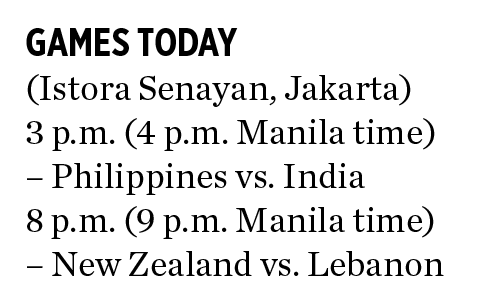
The Filipinos go into the 3 p.m. game (4 p.m. Manila time) with the psychological edge, having previously swept the Indians in their two matches in the FIBA World Cup Asian Qualifiers, 104-69 and 79-63. Still, that’s no reason for Gilas to lower its guards.

“We played India before but I think it’s a different team they sent here in the FIBA Asia Cup, so we have to be physically and mentally prepared going to the game,” said Mr. Ravena.

Gilas coach Chot Reyes picked up some positives from the tough opening game on Wednesday night, where his charges unleashed a mighty 16-4 blast to cut what was once a 21-point lead by the Cedars to a manageable nine in the fourth before the Cedars shut the door for good.

“I thought we made a great run. We never quit even when we were down by 20,” said Mr. Reyes.

The no-quit spirit was epitomized by Thirdy, who slammed his head on the floor on a bad landing off a block attempt with 1:15 left in the second period. After some anxious moments, the younger Mr. Ravena was wheeled out of the court but by the half time warm-ups, he was already doing shoot-around and eventually reported back in.

Overall, Mr. Reyes said the Lebanon gig presented valuable lessons for his youthful crew.

“For us, it’s a great learning experience. We have a very young team here and for them to be able to experience a very high level competition, I think it’s the most important thing,” he said. — Olmin Leyba

Paolo Ballesteros to host Drag Race Philippines

PAOLO BALLESTEROS has been named as the main host of Drag Race Philippines. — PHOTO FROM FACEBOOK.COM/DRAGRACEPHL

KNOWN for impersonating male and female celebrities through his makeup transformations, television host, actor, and makeup artist Paolo Ballesteros has been named as the main host of Drag Race Philippines, the show’s official Instagram account announced on July 12.

Drag Race Philippines is the Filipino version of the Drag Race franchise which aim to find the next “Drag Superstar.” It is based on the original American competition series RuPaul’s Drag Race.

Paolo Elito Macapagal Ballesteros IV is currently a co-host of the Philippines’ longest running noontime show, Eat Bulaga!

He has also starred in films, most notably Die Beautiful where he played Trisha, a trans pageant queen whose last wish was to have different celebrity transformations at his wake. The role earned him the Best Actor award at the 29th Tokyo International Film Festival. In 2019, he starred in the hit comedy film The Panti Sisters alongside Martin del Rosario and Christian Bables.

Mr. Ballesteros will join former Drag Race contestant Jiggly Caliente, who is a judge in the show.

Drag Race Philippines will premiere worldwide on Aug. 17 at WOW Presents Plus, the online streaming service of World of Wonder, the producer of RuPaul’s Drag Race. It will also stream on Discovery+ in the Philippines. — MAPS

Emperador lists in Singapore, targets expansion

EMPERADOR, Inc., a global whisky and brandy conglomerate headquartered in the Philippines, on Thursday became the first PSE-primary listed company to conduct a secondary listing on the Main Board of the Singapore Exchange Securities Trading Limited (SGX-ST). Leading the historic milestone for Emperador, Inc. were (left to right): George Schulze, Dalmore whisky expert in Asia for Emperador; Bryan Donaghey, head of whisky business for Emperador and CEO of Whyte and Mackay; Loh Boon Chye, CEO of SGX; Dr. Andrew L. Tan, chairman of Emperador; Gerard Ho, Singapore Ambassador to the Philippines; and Kevin L. Tan, CEO of Alliance Global Group, Inc., the holding company of Emperador, Inc.

By Victor V. Saulon, Sub-Editor

SINGAPORE — Emperador, Inc. on Thursday started trading on the Singapore stock exchange after holding its secondary listing in the global financial hub to mark the Filipino spirits company’s move to boost its international presence.

“This moment is truly a milestone for Emperador,” Andrew L. Tan, the company’s chairman, told reporters after the listing, adding that the move “reinforced the globalization” of the Philippine-listed firm.

Emperador, whose primary listing is maintained on the Philippine Stock Exchange, is trading under the stock code EMI in both bourses.

Bryan Donaghey, head of Emperador’s whisky business and chief executive officer of Whyte and Mackay Group Ltd., a company acquired in 2014, said the listing sets the “the next chapter” in the Tan-led group’s growth.

In an interview with BusinessWorld, he said the proportion of sales contributed by the international business “is probably 35% and 40%,” with the Philippine business accounting for the biggest share.

“We’d see that move up to more like 50% as we grew the international business,” he said, adding that the source of foreign sales is “widespread.” He said the target is expected to be reached by 2025.

At present, about 30% of the company’s branded whisky business is in the Asia-Pacific region, around 15% in the United States, Canada, and Europe, and about 30% in the United Kingdom.

“So, the international [part] of it is quietly spread across the continents that’s why we can grow because we’re represented in those markets already. So, it’s about getting bigger in the markets we’re already in for the whisky side,” Mr. Donaghey said.

“And brandy is also a good opportunity to get into more markets,” he added.

He said the brandy business grew from 17 to 65 countries, and that growth is expected to continue. Emperador, a manufacturer, bottler and distributor of alcoholic drinks, has presence in more than 100 countries.

Emperador’s portfolio includes best-selling Spanish brandies Fundador, Terry Centenario, Presidente and Emperador. Its single malt whisky brands include The Dalmore, Jura, Fettercairn, and Tamnavulin.

In the statement distributed during the listing, it said its fast-growing international business is led by the Scotch whisky segment after the integration of Whyte & Mackay.

Mr. Donaghey said the secondary listing leverages the Singapore stock market’s stature and “will ensure we are well-positioned to broaden our access to the international investment community in the future.”

“We’re already in China, we’re already in the US, it’s about growing the business that we’ve got there,” he said. “Our Asia-Pacific business has increased over tenfold over the last five or six years. A lot of that is in China.”

Kevin Andrew L. Tan, one of the company’s directors, described the listing as “putting a very strong Filipino company in the global map.”

“Emperador is effectively a Filipino company. We are an Asian company with global aspirations,” the younger Mr. Tan told reporters, adding that the listing “cements” the group’s international ambition.

“We hope that it also opens the doors for any other companies to also do the same thing. The Singapore stock exchange is truly a global exchange. It’s a very diversified exchange,” he said.

Pol de Win, the Singapore exchange’s senior managing director, head of global sales and origination, said in a briefing after the listing that Emperador’s move to build a global portfolio steps up its growth strategy in both mature and emerging markets.

He said the listing in Singapore “provides an excellent springboard for Emperador to further raise its profile and capture new growth opportunities.”

On Thursday, shares in the company closed higher by 3.9% or P0.68 to close at P18.10 apiece at the Philippine bourse.

SSC-R battles JRU for chance to fight for NCAA finals seat

‘We dedicate everything to the JRU community’ — Tioseco — SYNERGY/GMA NETWORK, INC.

SAN Sebastian College – Recoletos (SSC-R) and José Rizal University (JRU) eye a chance to fight for a finals seat as they battle each other on Friday in a do-or-die showdown in the National Collegiate Athletic Association (NCAA) Season 97 volleyball at the Filoil Flying V Arena.

The Lady Stags wound up the No. 3 seed after finishing with a 5-3 record while the Lady Bombers survived the Lyceum of the Philippines University (LPU) Lady Pirates, 25-11, 16-25, 17-25, 25-21, 17-15, on Tuesday and then edged the Mapua Lady Cardinals via quotient to claim the fourth and last spot in the stepladder semis.

The winner of the 2 p.m. showdown will battle No. 2 Arellano University in another knockout duel for the right to face College of St. Benilde, which swept the elimination round in nine games to seal the first slot to the best-of-three finale.

SSC-R coach Roger Gorayeb vows to give it all to gain another chance of adding another trophy to their 23 they have in their massive cabinet of hardware back in campus in Legarda, Manila.

“We’re going all out for that win,” said SSC-R coach Roger Gorayeb, owner of all but two of the proud school’s 23 women’s titles.

Mr. Gorayeb is hoping it could minimize committing errors that cost them their last elimination round game at the hands of LPU, 25-27, 25-22, 16-25, 25-18, 15-13, a week ago.

“We hope to have less errors, if possible,” said Mr. Gorayeb.

JRU, for its part, is expected to ride high on the school’s second semifinal appearance.

“We dedicate everything to the JRU community, this is for them,” said JRU mentor Mia Tioseco. — Joey Villar

ADVERTISEMENT
ADVERTISEMENT