Home Blog Page 6124

Pag-IBIG Fund finances 8,471 homes for low-wage earners in H1 2022

Pag-IBIG Fund financed 8,471 socialized homes for minimum-wage and low-income members amounting to P3.67 billion in the first half of 2022, its top officials said Wednesday (July 20).

Socialized home loans make up 19% of the total number of housing loans financed by the agency from January to June this year. The amount, meanwhile, represents 7% of the total housing loans released by the agency for the said period. Pag-IBIG Fund posted record-highs of 47,184 in housing units financed and P51.96 billion in home loans released during the first half of the year.

“We at Pag-IBIG Fund remain committed in pursuing our mandate to provide a home for every Filipino worker. With our Affordable Housing Program, achieving the dream of homeownership is made possible especially for minimum-wage workers. The program’s lowest rates and longest payment term allow our members from the low-income sector to buy or build a home of their own,” said Pag-IBIG Fund Chief Executive Officer Acmad Rizaldy P. Moti.

Pag-IBIG Fund’s Affordable Housing Program (AHP) is a special home financing program specifically designed for minimum-wage and low-income members from the National Capital Region (NCR) who earn up to P15,000 a month, and from outside the NCR who earn up to P12,000 per month. Under the AHP, eligible borrowers enjoy a special subsidized rate of only 3% per annum for home loans of up to P580,000 for socialized subdivision projects.

Pag-IBIG Fund Deputy Chief Executive Officer for Home Lending Operations Marilene C. Acosta, meanwhile, said that the AHP’s 3% rate translates to a monthly amortization of as low as P2,445.30 for a socialized home loan amounting to P580,000, making homeownership within reach of low-income earners.

“We first offered the AHP’s subsidized 3% rate in May 2017 to help more members, particularly those from the minimum-wage sector, realize their dreams of owning a home. With our very low rates, our members are able to enjoy a monthly amortization on their home loans that is lower than the cost of rent. And, since qualified borrowers do not need to put out cash for equity under the program, payments are even more within budget of low-income members. Makakaasa ang aming mga miyembro na patuloy nila kaming katuwang sa pag-abot ng kanilang pangarap na magkaroon ng sariling tahanan,” Acosta added.


Spotlight is BusinessWorld’s sponsored section that allows advertisers to amplify their brand and connect with BusinessWorld’s audience by enabling them to publish their stories directly on the BusinessWorld Web site. For more information, send an email to online@bworldonline.com.

Join us on Viber to get more updates from BusinessWorld: https://bit.ly/3hv6bLA.

Australia gov’t to double foreign investment fees, penalties

PEXELS

SYDNEY — Australia will double the fees for foreign investors looking to buy assets in the country, Treasurer Jim Chalmers said on Friday, as he grapples with protracted budget deficits and seeks to boost government revenue. 

The increase in fees and penalties for purchases of property, farms and businesses in Australia is expected to generate an additional $315 million in revenue over the next four years, Mr. Chalmers said. 

Mr. Chalmers said he continued to back foreign investment in Australia but he had to make the decision due to “the state of the budget we have inherited from our predecessors.”

“Foreign investment fees will continue to make up only a small proportion of total foreign direct investment,” he said in a statement. The new measures will take effect from July 29. 

Mr. Chalmers earlier this week warned the country’s economic picture would be “confronting” as the government prepares to release updated economic forecasts to parliament on July 28 to account for faster inflation and rising interest rates. 

The recently elected Labor Government, having promised during the election campaign not to raise taxes, has also warned that spending will have to be trimmed to restrain government debt. — Reuters

Japan warns of rising security threats in annual defense report

REUTERS

TOKYO — Japan warned on Friday of escalating national security threats, including repercussions from Russia’s war with Ukraine, Chinese intimidation of Taiwan, and vulnerable technology supply chains, in its annual defense white paper.

The report sets out the government’s security concerns as it prepares the defense ministry budget request due next month, aiming to build public support for an unprecedented hike in military funding that the ruling party aims to double over the next decade or so.

It also sets the stage for a year-end national security review expected to call for the acquisition of longer-range strike missiles, strengthened space and cyber capabilities, and tighter controls over access to technology.

“The political, economic and military rivalries between nations is clear, and the challenge posed to the international order is a global issue,” the white paper said.

It describes Moscow’s attack on Ukraine as a “serious violation of international law” and raises concerns that Russia’s use of force to resolve a dispute established a precedent that threatens the security of neighboring Taiwan, which Beijing views as its own territory.

Chinese military planes are increasingly probing Taiwan’s air defenses, with fighter jets this month crossing the Taiwan Strait’s median line, the unofficial buffer between China and Taiwan. Taipei criticized that maneuver as a “provocation.”

Beijing says it has sovereign rights and jurisdiction over the waterway.

The defense white paper approved by Prime Minister Fumio Kishida’s government identifies China, Russia, and North Korea as its main security concerns. Mr. Kishida’s defense minister, Nobuo Kishi, last month had described Japan as being on a front line surrounded by nuclear-armed actors.

Most Japanese appear to share government concerns over Japan’s deteriorating security environment, with recent opinion polls putting support for higher defense spending at more than 50%.

Mr. Kishida’s ruling Liberal Democratic Party, which has pledged to double military spending to 2% of GDP, gained seats in national elections for upper house lawmakers this month.

A 2% target would bring Tokyo in line with a minimum commitment set by North Atlantic Treaty Organization (NATO) members, and given the size of its economy, would make the pacifist nation the world’s No.3 in total defense spending after the United States and China.

The white paper cited comparative OECD estimates of defense spending for Japan and eight other countries, showing Japan at 0.95% of GDP, the United States at 3.12%, South Korea at 2.57%, nearby China at 1.2%, and neighboring Russia at 2.73%.

Japan’s spending as a percentage of GDP is lower than all other Group of Seven nations, as well as Australia and South Korea, it said.

“Spending per capita in South Korea, Britain, France, and Germany is two to three times as much,” the document said. — Tim Kelly/Reuters

Biden says he is ‘doing well,’ working after testing positive for COVID

PRESIDENT JOE BIDEN/FACEBOOK

WASHINGTON — Joseph R. Biden, Jr., the oldest person ever to serve as president of the United States, has tested positive for coronavirus disease 2019 (COVID-19). He is experiencing mild symptoms and will continue working but in isolation, the White House said on Thursday.

Mr. Biden, 79, has a runny nose, fatigue and an occasional dry cough, symptoms which he began to experience late on Wednesday, White House physician Kevin O’Connor said in a note released on Thursday. Mr. Biden has begun taking the antiviral treatment Paxlovid, Mr. O’Connor said.

Fully vaccinated and twice boosted, Mr. Biden said he was “doing well” in a video posted on his Twitter account. In the 21-second clip, he also said he was “getting a lot of work done” and would continue with his duties.

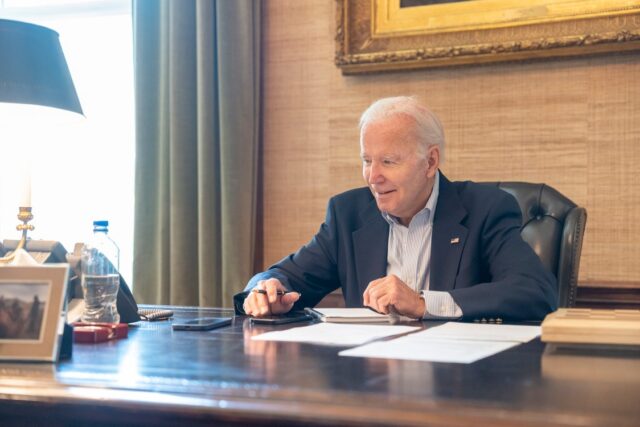
A photograph on his Twitter account showed him smiling, wearing a blazer and sitting at a desk with papers.

White House COVID coordinator, Dr. Ashish Jha, said Mr. Biden’s oxygen levels were normal and the president would isolate for five days and return to public events once he had a negative COVID test.

Mr. Biden became ill at a time when his administration is grappling with soaring inflation, global supply challenges, mass shootings and Russia’s land assault on Ukraine.

His illness forced cancellation of a trip to Pennsylvania where Biden intended to lay out plans to ask Congress for $37 billion for crime prevention programs.

The White House provided an unusually detailed account of the president’s morning activities, including a series of phone calls to political allies, and said people who had come into close contact with Biden were being told of his illness.

Vice President Kamala Harris was in close contact with Mr. Biden on Tuesday, a White House official said. Mr. Biden’s chief of staff, Ron Klain, told MSNBC he was as well, but he said that so far no one linked to the president’s case had tested positive.

PAXLOVID 

The Pfizer Inc. antiviral drug Paxlovid that Mr. Biden is taking has been shown to reduce the risk of severe disease by nearly 90% in high-risk patients if given within the first five days of infection.

But Paxlovid has in some cases been associated with rebound infections, in which patients improve quickly and test negative after a five-day course of the drug, with symptoms returning days later.

Dr. Bruce Farber, chief of infectious diseases at Northwell Health in New York, who is not treating the president, said Paxlovid is likely the only treatment Mr. Biden will get, unless his symptoms worsen.

“Elderly people are more at risk for developing complications from COVID,” Mr. Farber said. “It dramatically is lower if you’ve been vaccinated and doubly boosted, which he has been, so I anticipate he will do very well.”

At Mr. Biden’s last physical in November 2021, doctors reported that the president has atrial fibrillation, a common irregular heartbeat for which he takes Eliquis, a drug designed to prevent blood clots and reduce the risk of heart attacks and stroke.

Mr. Jha said Biden will stop taking Eliquis and the statin Crestor while on his Paxlovid treatment to avoid a negative interaction between the drugs.

Yale University cardiologist Dr. Harlan Krumholz, said doctors had to balance risks in medicine.

“Sometimes the choice to mitigate one thing may elevate risk for something else. I am hopeful that the president will get through COVID, be helped by Paxlovid, and soon get back on the medication that reduces his risk from atrial fibrillation,” he said.

OFFICIAL WASHINGTON NOT IMMUNE 

Multiple members of Biden’s administration and other senior figures in Washington have tested positive for the coronavirus in recent months, including Harris and House of Representatives Speaker Nancy Pelosi, both of whom have since tested negative and resumed working.

While many Americans have moved on from the strict precautions of the pandemic’s early months, returning to offices and schools and resuming summer travel, the virus has been spreading rapidly.

US cases are up more than 25% in the last month, according to data from the Centers for Disease Control and Prevention (CDC), with the BA.5 subvariant taking hold.

Evading the immune protection afforded either by vaccination or prior infection, BA.5 has been the dominant subvariant in the United States since at least early July and has driven a surge of new infections globally.

More than 1 million people have died from COVID in the United States. Most of those deaths, some 600,000, happened after Mr. Biden took office in January 2021 at the peak of a major wave of the disease.

‘GET VACCINATED NOW’ 

Mr. Biden set up strict COVID-19 safety protocols at the White House, urged Americans to take the virus seriously and campaigned for everyone to get fully vaccinated.

He is tested regularly for the disease and anyone who meets with him or travels with him is tested beforehand, the White House has said. Mr. Biden had last tested negative on Tuesday.

He has stopped wearing a mask at public events in recent months, and the White House dropped its mask requirement ahead of his March 1 State of the Union address.

Asked by Reuters on Wednesday what the country should do with COVID cases on the rise, Mr. Biden encouraged vaccination for those who had yet to get the vaccine.

“It’s not in their interest or the public’s interest not to get vaccinated,” Mr. Biden told reporters at Joint Base Andrews. “We have the capacity to control it. They should get vaccinated now.”

Mr. Biden joins a roster of world leaders who have contracted COVID since the pandemic started in early 2020.

A month before he lost the 2020 presidential election to Mr. Biden, Donald Trump contracted the virus. He, his wife Melania and other White House staff contracted it after an event for Supreme Court Justice Amy Coney Barrett in September 2020.

Mr. Trump, then 74, was hospitalized on Oct. 2, 2020, and underwent aggressive treatment at Walter Reed National Military Medical Center in a suburb of Washington. His low oxygen levels alarmed his medical team.

Dr. Jeremy Faust, an emergency medicine specialist at Brigham and Women’s Hospital, wrote on Twitter: “Biden isn’t remotely in the same risk category as Trump was. He’s had 4 doses of vaccine, Paxlovid, and possibly a variant which tends to cause less severe disease. He also doesn’t have obesity.” — Trevor Hunnicutt, Steve Holland and Jeff Mason/Reuters

US carriers’ cost struggle overshadows travel demand surge

AMERICAN AIRLINES

CHICAGO — US carriers are struggling to offset higher costs even as booming travel demand has given them strong pricing power, raising questions about their ability to shield profit once consumer demand softens.

Those worries are battering airline shares, taking the focus away from what is shaping up to be the industry’s strongest earnings season in three years.

Shares of American Airlines Group Inc and United Airlines fell more than 9% on Thursday even after both carriers posted their first quarterly profit without US government aid since the coronavirus disease 2019 (COVID-19) pandemic began.

Airlines expect travel demand to hold up even in the second half of the year as there is little evidence of higher fares, persistently high inflation and rising interest rates curbing consumer spending.

But staffing gaps and aircraft shortages have made it tougher to ramp up capacity and fully tap booming demand. In fact, carriers have been forced to cut flights and make costly staffing adjustments to avoid cancellations and delays, driving up operating costs.

American, United, and Delta Air Lines see no let up in cost pressure this year as capacity constraints are not allowing them to operate as many flights as they did before the pandemic.

Delta doesn’t plan to add more flights for the rest of the year. Similarly, United intends to keep its capacity below the pre-pandemic level in the current and fourth quarters.

To ensure adequate staffing, they are being forced to spend more. Delta, for example, expects to spend over $700 million this year in overtime and premium pay, 50% higher than in 2019.

Carriers are also hamstrung by construction projects at airports and staffing gaps among air-traffic controllers. United said it will cut 200 flights a day in Newark in September as a result of runway construction.

United Chief Executive Scott Kirby said the company will prioritize operational reliability by overstaffing until the entire aviation infrastructure returns to normal.

“It means that there will be cost pressures,” Mr. Kirby told investors on an earnings call.

Labor unions and some analysts blame the industry’s decision to let go thousands of workers at the height of the coronavirus pandemic in 2020 for its staffing challenges. Carriers have been aggressively hiring, but training backlogs have left them still short-staffed.

Meanwhile, a rush to staff up is driving up labor costs.

American has offered its pilots a base pay increase of about 17% after United agreed to a double-digit pay hike for its pilots. To attract and retain talent, the Texas-based carrier has also announced hefty pay increases for pilots at its regional carriers.

“As an industry, pilot wages are going to increase,” said American Chief Executive Robert Isom. “And that’s something that the industry as a whole is going to have to digest.”

Airlines are also facing higher fuel costs, but a decline in global prices is expected to offer some relief. Yet, United warned that higher fuel prices would be the new normal for the industry. It expects its fuel bill this year to be $9 billion higher than in 2019.

Strong consumer demand, thus far, has allowed carriers to mitigate inflationary pressure with higher fares. Analysts, however, are not sure they will have the same pricing power in the fall when leisure travel bookings tend to slow down.

Christopher Raite, senior analyst at Third Bridge, said business travel spending will have to pick up the slack.

But the industry’s struggle to get operations back on a smoother track as well as a worsening economy have cast a shadow on business travel demand. Many companies have already started tightening their purse strings.

“The airline industry is fundamentally less profitable than it was pre-pandemic,” Mr. Raite said. “If we are to see corporations cut back, that would be a bad sign for airlines.” — Rajesh Kumar Singh/Reuters

ECB hikes rates, throws lifeline to indebted countries

FRANKFURT — The European Central Bank (ECB) raised interest rates by more than expected on Thursday as concerns about runaway inflation trumped worries about growth, even while the euro zone economy is suffering from the impact of Russia’s war in Ukraine.

The ECB raised its benchmark deposit rate by 50 basis points to zero percent, breaking its own guidance for a 25-basis-point move as it joined global peers in jacking up borrowing costs. It was the ECB’s first rate increase in 11 years.

Policymakers also agreed to provide extra help for the euro zone’s big debtor nations — Italy among them — with a new bond purchase scheme. Sources told Reuters they did not expect to use it imminently despite a selloff in Italian bonds.

Ending an eight-year experiment with negative interest rates, the ECB also lifted its main refinancing rate to 0.50%, and promised another hike, possibly as soon as its Sept. 8 meeting, with more to follow later.

ECB President Christine Lagarde said a clear deterioration of the inflation outlook and unanimous backing for the anti-fragmentation instrument justified the bigger move.

“Price pressure is spreading across more and more sectors,” Ms. Lagarde said. “We expect inflation to remain undesirably high for some time.” She listed driving factors including higher food and energy costs and wage rises.

“We decided on balance that it was appropriate to take a larger step towards exiting from negative interest rates.”

But even if the ECB is now moving more quickly, Ms. Lagarde said the terminal rate — or level where hikes end — has not changed.

The ECB did not provide guidance for its expected rate hike in September, saying only that further increases will be as appropriate and decisions will be made meeting-by-meeting.

The ECB had for weeks guided markets to expect a 25-basis-point increase on Thursday, but sources close to the discussion told Reuters early this week that 50 basis points had come into play as part of a deal including help for indebted countries.

With inflation across the 19 countries that use the euro already approaching double-digit territory, it is at risk of getting entrenched well above the ECB’s 2% target. Any gas shortage over the coming winter is likely to push prices even higher, perpetuating rapid price growth.

Ms. Lagarde warned that risks to the inflation outlook were on the upside and have intensified, particularly as the war is likely to drag on, keeping energy prices high for longer.

Economists polled by Reuters had predicted a 25-basis-point increase but most favored a 50-basis-point hike, lifting the ECB’s record-low minus 0.5% deposit rate to zero.

The euro climbed as much as 0.8% to $1.0261, having traded at $1.0198 just before the statement but turned negative on the day as Ms. Lagarde spoke.

The euro climbed to as high as $1.0278 after the rate hike before easing back to $1.0183, flat on the day. Markets are now pricing in a 50-basis-point rate hike in September and see a combined 127 basis points of rises over the rest of the year.

GOING BIG?

The new bond purchase scheme, called the Transmission Protection Instrument (TPI), is intended to stop any excessive rise in borrowing costs for governments across the currency bloc as policy tightens.

Recent increases have been larger for indebted countries like Italy, Spain and Portugal but sources told Reuters the ECB was not seeing the need to activate the new scheme in any country at present.

Activating the instrument will be entirely at the discretion of the ECB and the bank will target public sector bonds with maturities between one and 10 years.

“The ECB is capable of going big for that,” Ms. Lagarde said.

Countries will be eligible if they comply with European Union fiscal rules and do not face “severe macroeconomic imbalances.” Compliance with commitments under the EU’s Recovery and Resilience Facility will be needed, as will an assessment of debt sustainability.

All euro zone countries currently comply with those conditions, sources told Reuters.

The ECB’s commitment on Thursday comes as a political crisis in Italy is weighing on markets following the resignation of Prime Minister Mario Draghi, who was Lagarde’s predecessor at the ECB.

The yield spread between Italian and German 10-year bonds widened during Lagarde’s news conference to near the 250-basis-point level that triggered an emergency ECB policy meeting last month.

The ECB’s 50-basis-point hike still leaves it lagging its global peers, particularly the US Federal Reserve, which lifted rates by 75 basis points last month and is likely to move by a similar margin in July.

But the euro zone is more exposed to the war in Ukraine and a threatened cut off in gas supplies from Russia could tip the bloc into recession, leaving policymakers with a dilemma of balancing growth and inflation considerations. — Balazs Koranyi and Francesco Canepa/Reuters

Philippine DoJ asked to junk kidnapping complaint vs Okada

Lawyers of Japanese billionaire Kazuo Okada have asked government prosecutors in the Philippines to dismiss the kidnapping complaint against him for lack of evidence, according to a statement sent by his camp on Friday. 

His lawyers submitted a counter-affidavit that sought to dismiss the complaint for kidnapping and illegal detention during a preliminary investigation at the Department of Justice (DoJ) on Thursday, it said. 

Board members of Tiger Resort Leisure and Entertainment, Inc. including Hajime Tokuda last month filed the complaint, accusing Mr. Okada’s representatives of storming Okada Manila on May 31 and using brute force to compel officers of the resort to yield. 

In its statement, the Okada camp said Mr. Tokuda had “willingly surrendered his company ID, voluntarily agreeing to be taken home.” “A copy of CCTV footages showed Tokuda peacefully leaving the hotel’s premises and being escorted by security personnel.”  

“Tokuda was never under duress,” it said. “His personal phone was not taken from him and was not prevented by the security personnel that accompanied him from using the same.” 

During the preliminary investigation, the lawyers told prosecutors Mr. Okada would submit an affidavit joining the defense of the other respondents.  

The DoJ preliminary probe came on the heels of the Japanese billionaire’s “recent legal victories,” including an order by the Philippine Supreme Court to keep the status quo, allowing his reinstatement as chairman of Okada Manila, according to the statement. 

It also cited the dismissal by the Court of Appeals of the estafa charges against Mr. Okada. 

Mr. Okada was removed from Tiger Resorts as a shareholder, director and company chairman in 2017 by Universal Entertainment Corp. and Tiger Resort Asia Ltd. for alleged mismanagement. — Norman P. Aquino, John Victor D. Ordoñez and Revin Mikhael D. Ochave

Philippine growth forecast upgraded

Buildings are seen along EDSA in Quezon City, July 3. — PHILIPPINE STAR/ MIGUEL DE GUZMAN

THE ASIAN Development Bank (ADB) on Thursday said it had raised its growth forecast for the Philippines this year, but warned that a slowdown in global growth and a spike in commodity prices could threaten recovery.

In its Asian Development Outlook 2022 Supplement, the multilateral lender said the country’s gross domestic product (GDP) is now projected to expand by at least 6.5% this year, higher than its 6% forecast made in April.

The latest estimate is at the low end of the government’s recently revised 6.5-7.5% target for 2022.

ADB raises 2022 Philippine GDP growth forecast to 6.5%, inflation to 4.9%

“The growth forecast for the Philippines is raised from 6% to 6.5% for 2022 on a stronger-than-expected Q1 performance, underpinned by rebounds in investment and household consumption,” the ADB said.

The latest GDP projection for the Philippines tied with Vietnam as the highest in Southeast Asia. It is also above the ADB’s 5% growth forecast for Southeast Asia, which was raised from 4.9%.

“The Philippine economy’s growth momentum has accelerated close to its ideal growth path. Strong domestic demand supported by a pickup in employment and remittance inflows, private investment expansion, and large public infrastructure projects will underpin the country’s recovery from the economic impact of the pandemic,” ADB Philippines Country Director Kelly Bird said in a statement.

The government further reopened the economy this year amid wider coronavirus disease 2019 (COVID-19) vaccination coverage and the “relatively mild” impact of the Omicron variant. In the first quarter, GDP grew by a better-than-expected 8.1%.

The ADB said mobility data showed work and recreation are now at pre-pandemic levels, while private sector indicators such as manufacturing, industrial production and imports also continued to expand.

However, the Philippine economy faces several risks to growth in the second half, such as “sharper-than-expected slowdowns in major industrial economies, possible sustained elevated global commodity prices, and tighter financial conditions,” the ADB said.

The government is poised to continue ramping up infrastructure spending, particularly on priority projects under the “Build, Build, Build” program. These include ADB-funded projects such as the Malolos Clark Railway, South Commuter Railway, EDSA Greenways Project, and Metro Manila Bridges.

Meanwhile, the ADB retained its Philippine GDP forecast at 6.3% for 2023, “as financial tightening and a broader pass-through of price pressures weigh on demand.”

This is below the government’s 6.5-8% target for 2023, but the second-highest in Southeast Asia, after Vietnam’s 6.7% GDP projection for 2023.

The multilateral lender also raised its average inflation forecast for the Philippines this year to 4.9% from the 4.2% estimate in April.

This is below the Bangko Sentral ng Pilipinas’ 5% average inflation forecast for the year.

Inflation accelerated to a near four-year high of 6.1% in June, bringing the six-month average to 4.4%.

For 2023, ADB hiked its Philippine inflation forecast to 4.3%, from 3.5% in April.

WAR, INFLATION
Meanwhile, the ADB cut its growth forecast for developing Asia this year and 2023, as the economic outlook darkened due to the protracted war in Ukraine, aggressive tightening by central banks, and a slowdown in China.

Reflecting the dimmer global outlook, the ADB downgraded its 2022 growth forecast for developing Asia to 4.6%, slower than the 5.2% projection in April.

Developing Asia is projected to grow by 5.2% in 2023, slightly lower than the previous 5.3% forecast.

“Risks to developing Asia’s economic outlook remain elevated and mainly associated with external factors. A substantial slowdown in global growth could hurt exports, manufacturing activity, and employment prospects, and cause turbulence in financial markets,” the lender said.

The ADB noted that aggressive monetary tightening by central banks, including the US Federal Reserve, might hurt growth and rattle financial markets. The Russia-Ukraine war may continue to drive up prices in energy and commodities, which will affect the region’s growth.

“Rising food prices and shortages, in particular, could threaten food security and heighten social tensions in some economies. From within the region, downside risks could arise from the potentially lingering effects on supply chains from (China’s) latest round of lockdowns and the country’s growth slowdown, which could hinder developing Asia’s growth momentum,” it added.

The ADB also raised the inflation forecast for this year to 4.2% from 3.7% and next year to 3.5% from 3.1% due to higher fuel and food prices.

“Inflation pressures in the region are, however, less than elsewhere in the world,” it said. — D.G.C. Robles

Country’s debt-to-GDP ratio rose the most in 2 years, says think tank

PHILSTAR FILE PHOTO

THE PHILIPPINES and Thailand saw the biggest rise in government debt-to-gross domestic product (GDP) ratios in the world from end-2019 to end-2021, Moody’s Analytics said in a report on Thursday.

In a commentary “Global Debt: Asia’s High Debt-to-GDP,” Moody’s Analytics said debt-to-GDP ratios in the Asia-Pacific region are still above pre-pandemic levels.

“Thailand and the Philippines experienced the largest government debt-to-GDP increase across Southeast Asia and across the globe between the end of 2019 and the end of 2021,” it said.

The Philippines’ debt-to-GDP ratio stood at 60.5% at the end of 2021, beyond the 60% threshold prescribed by multilateral lenders for developing economies. It was also much higher than the 39.6% at the end of 2019 or before the pandemic.

“Both countries were the slowest-growing economies in the region last year and required substantial expansionary fiscal policy to support economic recovery,” Moody’s Analytics said.

The Philippine economy contracted by 9.6% in 2020, but bounced back with a 5.7% GDP growth in 2021.

Despite the increase, Moody’s Analytics said the Philippines and Thailand still have “rather low” debt-to-GDP ratios.

At the end of the first quarter of 2022, the Philippines’ debt-to-GDP ratio stood at 63.5%, the highest since 65.7% in 2005.

The country’s outstanding debt stood at P12.5 trillion at the end of May.

Moody’s Analytics noted other Southeast Asian countries such as Singapore, Malaysia, and Indonesia have seen a decline in debt-to-GDP ratios in 2021, bringing the region’s average lower than in 2020.

“On the other hand, Thailand, Vietnam and the Philippines had trouble containing total debt in 2021 due to tightened COVID-19-related restrictions through much of the year,” Moody’s Analytics said.

The Philippines incurred about P3.2 trillion in additional debt to fund the government’s pandemic response.

“During the pandemic, Southeast Asian governments raised debt ceilings to accommodate higher borrowing and spending to support the economy. Post-pandemic, fiscal consolidation is expected to begin in 2023 as countries move toward endemic-COVID-19 policies, including an easing of social distancing measures,” the think tank said.

Finance Secretary Benjamin E. Diokno this month said the government seeks to bring down the debt-to-GDP ratio to 61.8% by end-2022. It is expected to steadily drop to 61.3% by next year all the way to 52.5% by 2028.

“This kind of debt structure is nothing to worry about. This is one of the lowest among emerging markets… The way out of this is by growing at a faster rate. We simply outgrow our debt,” Mr. Diokno has said.

He added that it is not “crucial” to return to the pre-pandemic debt-to-GDP ratio.

“We have to prioritize growth first rather than going back to that number,” he said. — D.G.C.Robles

Long-term plan for fertilizer industry needed

PHILIPPINE STAR/ WALTER BOLLOZOS

By Kyle Aristophere T. Atienza, Reporter

PRESIDENT Ferdinand R. Marcos, Jr.’s plan to secure cheaper fertilizer from other countries would help lower agricultural production costs, but the government should come up with a long-term plan to help boost the competitiveness of the domestic fertilizer industry, experts said.

“The main advantage of cheaper fertilizer from bilateral deals is potentially moderating production costs and saving on foreign exchange,” Sonny A. Africa, executive director of research group Ibon Foundation, said in a Facebook Messenger chat.

“This should just be a short-term lifeline though and the long-term approach should be to develop a domestic fertilizer industry, especially in organic fertilizers, as part of an overall plan for food self-sufficiency,” he added.

Earlier this week, Mr. Marcos said he would reach out to China, Russia, Indonesia, Malaysia and the United Arab Emirates to secure cheaper fertilizer through government-to-government deals.

The state’s move is in response to insufficient local fertilizer supply, said Leonardo A. Lanzona, who teaches economics at the Ateneo de Manila University.

“The issue is that the fertilizer industry here is not efficient enough to supply the fertilizer demand in the country,” he said in a Messenger chat.

Allowing the government to import more fertilizer through bilateral deals would force local fertilizer producers to boost the quality of their products, he said.

“By raising the level of efficiency from these imports, the fertilizer industry here should learn to be more competitive,” he added.

Raul Q. Montemayor, national manager of the Federation of Free Farmers Cooperatives, Inc. said the move “should have been done much earlier by the previous administration.”   

“A little bit late now for the current crop because farmers have already started planting,” he said in a Viber message. “But if they can bring in the fertilizer in a few months, it can be used for late planting or for the next crop that will be harvested early next year.”

Russia is the largest global exporter of fertilizer. Western sanctions on Russia over its invasion of Ukraine have affected shipments of fertilizer around the world.

“We expect a tight fertilizer supply until next year,” Mr. Montemayor said.

Worried about how the government will “fund and handle” the supply from other countries, Mr. Montemayor said the government should consider partnerships with the private sector.

“They may have to link up with the private sector which can provide the needed logistics,” he said.

Mr. Montemayor noted that the only fertilizer the Philippines “used to produce” was ammonium sulfate. This was produced at Philippine Phosphate Fertilizer Corp.’s plant in Leyte.

“However, I think the plant stopped its operations after it was hit by Yolanda,” he said, referring to the supertyphoon that hit the Philippines in 2013. “Even then, I think we were importing most of the sulfate that was used in the plant.”

“For oil-based fertilizer, we have no capacity to produce our own, so we have to import,” he added.

Unstable fertilizer prices due to global shocks should nudge the government and the agriculture sector to pursue alternative ways to boost crops, said Arnold Padilla, a program coordinator at the Pesticide Action Network – Asia Pacific.

“When global fertilizer prices have been skyrocketing, the more we need to look for ways that veer away from too much dependence on imported inputs, even if they are done through bilateral government deals,” he said in a Messenger chat. 

“We should look for ways to improve local production in a more sustainable way such as through agroecology and less dependence on chemical, much less, imported inputs.” 

Mr. Padilla said the transition to agroecology would not be easy and could “take time.”  “But it should be the general direction. At the minimum, while in transition, the necessary step is to lessen dependence on imports.”

Mr. Montemayor, who represents a group of farmers, said the government should expand the country’s production of substitutes that can improve soil quality, such as organic fertilizer, organic soil ameliorants, fermented extracts and plant nutrients. 

“This will take some time because the Department of Agriculture has always been promoting the use of inorganic inputs,” he said. “We should complement these with proper soil testing, so that we know what types and quantities of fertilizer are needed in specific areas. There are also technologies that help rejuvenate the soil.”

Business groups list 24 priority bills for 19th Congress

PHILSTAR

LOCAL BUSINESS GROUPS and foreign chambers urged the 19th Congress to prioritize the passage of 24 measures, which include the liberalization of foreign equity restrictions, two tax reform packages, and amendments to a law that would allow hybrid work arrangements of economic zone locators.

Twelve groups, including the American and European chambers of commerce, Management Association of the Philippines and Makati Business Club, sent a letter with a list of the proposed legislative reforms to President Ferdinand R. Marcos, Jr. on July 20.

A copy of the letter was also sent to the incoming House speaker, Senate president and key Cabinet officials.

Mr. Marcos is set to have his first State of the Nation Address (SONA) before Congress on July 25. The 19th Congress will also open its first session on the same day.

“We look forward to working closely with the Marcos-Duterte administration and the 19th Congress to pursue the advocated reforms and others that will generate substantial impact in achieving inclusive growth through job generation, increased investment, poverty reduction, and improved global competitiveness,” the groups said.

The list includes seven bills that reached “advanced stages” of approval in the last Congress — liberalization of foreign equity restrictions in the 1987 Constitution, open access in data transmission; ease of paying taxes, promotion of digital payments, creation of the Department of Resilience, and the last two tax reform packages of the Duterte administration.

Finance Secretary Benjamin E. Diokno earlier said he would push the passage of the remaining tax reform packages on improving real property valuation and simplifying financial taxation. The proposed property valuation and assessment reform seeks to broaden the tax base, while the capital income and financial taxes reform, seeks to simplify the taxation of passive income, financial services and transactions.

The Ease of Paying Taxes bill seeks to simplify the process of filing and paying taxes by removing venue restrictions, while the Open Access in Data Transmission bill aims for increased competition in the digital service industry by easing the requirements to enter the telecommunication sector.

The business groups’ list also includes amendments to the Corporate Recovery and Tax Incentives for Enterprises (CREATE) Act and Philippine Economic Zone Authority (PEZA) Act to allow hybrid and flexible work arrangements for economic zone locators.

Also included in the list is the proposed Freedom of Information Act, as well as amendments to the Secrecy of Bank Deposits Law, E-Commerce Act, Intellectual Property Code, Build-Operate-Transfer Law and Philippine Ports Authority (PPA) charter.

Other measures include national unemployment insurance, the proposed Pandemic Protection Act, Holiday Rationalization Act, creation of the Philippine Airports Authority, Philippine pension system portability, Apprenticeship program reform, International Maritime Trade Competitiveness Act, and Satellite-based Technologies Promotion Act.

The business groups also identified as priorities a measure easing ownership of agricultural lands and the repeal of the Commonwealth Act 138 (Flag Act). — R.M.D.Ochave

Isuzu Philippines optimistic of hitting 2022 sales target  

ISUZU Philippines Corp. is optimistic about reaching its sales target for 2022, a company official said, citing signs of economic recovery and purchases of commercial vehicles.

“So far, our target for this year [is] around 16,000 units and we are optimistic that we can hit that. Despite of all the challenges in the industry, we are still optimistic that this year will still be favorable for the industry, especially for Isuzu,” said Robert D. Carlos, Isuzu Philippines assistant division head for sales, on the sidelines of the car manufacturer’s 25th inaugural anniversary in Pasay City.

The models that are driving growth for Isuzu Philippines is its lightweight truck Traviz and pickup truck D-Max, he said.

Mr. Carlos said economic activity “is slowly going back and we can see the purchase of vehicles, especially for our commercial vehicles, particularly the Traviz, which is ideal for logistics delivery.”

He cited online shopping as the reason for the popularity of vehicles for package delivery as well as “fleet customers that are purchasing trucks as they go back to their projects and businesses.”

He said Isuzu Philippines would continue to supply its vehicle brands despite supply chain issues.

“Our push models are the Traviz and the D-Max,” Mr. Carlos said. “I think almost all of the brands are experiencing supply problems. But we are still really trying to cope up. We will supply everything that we have.”

Meanwhile, Mr. Carlos said that Isuzu Philippines plans to establish 50 dealerships across the country by the first quarter of 2023.

“So far, we have 48 dealerships and counting. We plan to hit 50 dealerships hopefully until next year. Because of the coronavirus disease 2019 (COVID-19) pandemic, some are getting [delayed]. But hopefully next year, we can hit that and even more,” Mr. Carlos said.

“We’re targeting [the new dealerships in the] first quarter of next year. We have one [planned] in [the] Visayas and one [planned] in Luzon,” he added.

In 2021, Isuzu Philippines ranked sixth among car manufacturers in the country as it sold 14,424 units, equivalent to a 5.37% market share, based on a joint report from the Chamber of Automotive Manufacturers of the Philippines, Inc. and Truck Manufacturers Association, Inc.

For the first six months of 2022, data from the carmaker groups showed that Isuzu Philippines sold 7,936 units, translating to a 5.12% market share or sixth place among car firms in the country. — Revin Mikhael D. Ochave

ADVERTISEMENT
ADVERTISEMENT