Home Blog Page 6114

PPA awards multiple port dredging contracts

PHILIPPINE PORTS AUTHORITY

THE Philippine Ports Authority (PPA) recently awarded dredging projects at various ports, including those in Manila, Ilocos Norte, Negros Occidental, Misamis Oriental, and Camiguin.

The agency issued on March 21 the notice of award for the dredging of the Pasig River at South Harbor in Manila to Khan Kon Chi Construction and Development Corp., which is based in Davao City.

The project cost is P253.35 million, according to a copy of the document released by the agency.

The agency said a post-qualification assessment was conducted on March 9 and 10 to verify the eligibility, technical and financial requirements submitted by the company. 

A notice of award was also issued on March 21 to the KXBG Construction & Development Corp. and Kenzai Builders Corp. Joint Venture, which is also based in Davao City, for the dredging of Currimao Port in Currimao, Ilocos Norte. The project cost is P114.88 million.

The post-qualification assessment was conducted on March 9, according to the agency.

Bemkar Construction, which is based in Camarines Norte, was issued the notice of award for the P252.98-million dredging of ports of Banago, San Carlos and Danao, Escalante in Negros Occidental.

The PPA said it conducted the post-qualification assessment on March 15 and 18.

The Goldridge Const. & Dev’t. Corp. and J.C. Piñon Joint Venture, which is based in Bulacan, was awarded the P945.64-million dredging of the Manila International Container Terminal entrance channel, Port Area, Manila.

The agency said the joint venture was declared as the lowest calculated and responsive bidder on March 21. Post-qualification assessment was conducted on March 10 and 11.

Ormoc City-based JFAP Construction was awarded a P90.58-million dredging of the ports of Cagayan de Oro, Opol and Balingogan, in Misamis Oriental; and the ports of Benoni, Balbagon, and Guinsiliban, in Camiguin.

The agency said the post-qualification assessment was conducted on March 10 and 15. — Arjay L. Balinbin

Corporate dissolution made easy

The Philippines, it’s often easier to incorporate a new entity than to dissolve an existing corporation. Investors face the tedious and long process of closing their businesses, which requires the cancellation of various registrations with regulators, including the Securities and Exchange Commission (SEC) and the Bureau of Internal Revenue (BIR). The difficulties of dissolution — and eventual liquidation — are one of the factors that affected the country’s ranking in the World Bank’s ease of doing business report in recent years.

To address the challenges of corporations contemplating dissolving and eventually, liquidating, the SEC recently issued the guidelines on corporate dissolution consistent with the provisions of Republic Act 11232 or the Revised Corporation Code (RCC).

DIFFERENT TYPES OF CORPORATE DISSOLUTION
SEC Memorandum Circular No. 5, Series of 2022 prescribes the procedures and requirements for the different types of corporate dissolution, namely voluntary dissolution with or without creditors affected under Secs. 134 and 135 of the RCC, respectively; involuntary dissolution pursuant to Sec. 138; and dissolution by shortening of corporate term provided in Sec. 136.

Of the three types, dissolution by corporate life shortening is by far the most common, with a corporation determining at the outset the end of its existence. This is done through the filing of an application for amendment of the Articles of Incorporation (AoI) with the SEC indicating the shortened term or the last day that it operates as a juridical entity.

An entity can propose an expiration date of less than one year from the SEC approval or one year or more from such approval. The chosen timing also has a significant impact on the corporation. If the dissolution period is less than a year, the applicant has to submit, among others, a tax clearance certificate from the BIR. On the other hand, if the shortened term is a date that is more than one year from the Commission’s green light, the BIR tax clearance will not be required.

While the procedure and process are essentially the same for both options — with the same applications lodged with the same government agencies — the difference is in the sequencing.

Under the first option, the company will file and process the application for BIR tax clearance and undergo a rigorous tax audit process prior to filing an application for AoI amendment.

The second option allows for the filing and processing by the SEC of the application for shortening of the corporate term without waiting for the BIR tax clearance. After the SEC approves the application, the company continues to operate as a juridical entity until the expiration of the corporate term. The corporation is not yet dissolved until after the last day of its shortened term.

Until the release of SEC MC 5, these options were not officially provided in any SEC rulebook, although they were applied in practice. Numerous registered companies have taken advantage of the alternate route, effectively steering clear of the need to first secure the BIR tax clearance prior to the processing of the dissolution application. However, getting the clearance is still required for a corporation to officially close its business operations in the Philippines. In this regard, the BIR will still conduct the mandatory closure audit, which is a condition precedent to the grant of the tax clearance.

Under the old rules, the SEC may approve the dissolution provided the end of the corporate term must be at least one year from the filing of the application. In the recently promulgated issuance, it is clear that the end of the corporate existence must be at least one year from the actual approval of the SEC.

SEC MC 5 specifically provides that the application must contemplate a future date, and not a date that had already lapsed at the time of the filing of the application.

TIMELINE AND COSTS
A regular BIR tax audit covering a fiscal or taxable year may take at least one year to close, or longer depending on the complexity of the issues raised by the examiners. In a mandatory closure investigation that will cover the last two to three taxable years, the audit may be completed in approximately two years.

Given that the completion of the BIR tax audit may be difficult to estimate, the timeline for the dissolution under option 1 is indefinite and will largely depend on the pace and workload of the assigned BIR examiners.

Meanwhile, the timeline under option 2 is definite as to when the corporation is deemed legally dissolved. Upon the expiration of the shortened term, as stated in the approved amended AoI, the corporation is considered dissolved for SEC purposes without any further proceedings. Thus, dissolution automatically takes effect on the day following the last day of the corporate term, without the need for the SEC to issue a certificate of dissolution.

The costs for both options are relatively the same, including the filing fees, regulatory fees, and deficiency taxes that may be assessed and paid at the close of the BIR tax audit. However, the simplified dissolution process will result in lower overall costs and time as there is no need to comply with certain requirements, such as filing of audited financial statements, which will save the corporation on professional fees. There will also be fewer personnel expected to be retained on the payroll, particularly those who will be in charge of the BIR tax audit and the related liquidation process. Likewise, the corporation is not required to maintain the office lease.

Under Sec. 139 of the RCC, a dissolved corporation will continue to exist for three years after the effective date of dissolution to generally wind up its affairs, including the disposal of its properties and distribution of its assets.

Notably, given the expected time lag between the SEC approval and the BIR tax clearance, corporations in the process of liquidation often opt to maintain a bank account for the settlement of any deficiency tax assessment by the BIR.

As the SEC has clarified the two available options in the shortening of the corporate term, registered entities have the opportunity to carefully weigh the method that will better address their needs, taking into consideration the processing period, available administrative resources, and the targeted timeline for the dissolution.

This article is for general information only and is not a substitute for professional advice where the facts and circumstances warrant. The views and opinions expressed above are those of the author and do not necessarily represent the views of EY or SGV & Co.


Cecille S. Visto is a tax senior director and lead manager for the Entity Compliance and Governance Services of SGV & Co.

Russia moves war goalposts as it gets bogged down in Ukraine

LONDON — Russia has reframed its war goals in Ukraine in a way that may make it easier for President Vladimir Putin to claim a face-saving victory despite a woeful campaign in which his army has suffered humiliating setbacks, military analysts say.

Russia attacked its neighbor by land, air and sea on Feb. 24 and pushed as far as the capital Kyiv — where its forces have been stalled for weeks — in what Ukraine and the West said was a bid to topple the democratic government of President Volodymyr Zelensky.

On Friday, however, a senior military official said the real objective was to “liberate” the Donbass region of eastern Ukraine, where Russian-backed separatists have been fighting the Ukrainian army for the past eight years.

“The main objectives of the first stage of the operation have generally been accomplished,” said Sergei Rudskoi, head of the Russian General Staff’s Main Operational Directorate.

“The combat potential of the Armed Forces of Ukraine has been considerably reduced, which… makes it possible to focus our core efforts on achieving the main goal, the liberation of Donbass.”

Donbass, where Mr. Putin has accused Ukraine without evidence of waging “genocide” against ethnic Russians, has long occupied a prominent place in Moscow’s litany of grievances against Ukraine.

But if capturing the whole of Donbass had been the objective from the start, Moscow could have mounted a much more limited offensive and spared itself the effort and losses involved in invading Ukraine from the north, east and south.

“Obviously they have completely failed in everything they’ve set out to do and so now they are redefining what the purpose is so they can declare victory,” said Ben Hodges, a former commander of US army forces in Europe who now works for the Center for European Policy Analysis.

“Clearly they do not have the ability to continue sustained large-scale offensive operations… Their logistics problems have been apparent to everybody, they’ve got serious manpower issues and the resistance has been way beyond anything they could have possibly imagined.”

HIGH COSTS
The costs of Russia’s “special military operation” have been steep. Rudskoi, the General Staff official, on Friday acknowledged 1,351 deaths among Russian soldiers. Ukraine claims the real figure is more than 10 times as high.

Oryx, a Dutch military blog that records both sides’ equipment losses based on verifiable photos and video, says Russia has lost 1,864 pieces of hardware including 295 tanks, 16 planes, 35 helicopters, three ships and two fuel trains. It has verified Ukrainian losses of 540 items, including 77 tanks.

Each side makes regular claims of the amount of enemy equipment it is destroying, but neither confirms its own losses.

Thwarted in its offensive, Russia has resorted to pounding cities to rubble with rockets and artillery.

“The advance is stalled or at best very slow at this stage,” said Nick Reynolds, a land warfare analyst at the RUSI think-tank in London.

“Its original strategy is now completely unachievable. Its original strategy was to decapitate the Ukrainian government or cause it to collapse by just moving the military into the country… Obviously that didn’t happen; quite the opposite.”

Russia has more work ahead to achieve even the more modest goal of driving Ukraine’s forces out of the east. Of the two regions that make up the Donbass, its defense ministry says Russian-backed forces control 93% of Luhansk but only 54% of Donetsk.

Meanwhile Ukraine is sounding increasingly confident.

Deputy Chief of Staff of Ground Forces Oleksandr Gruzevich said on Friday that Russia would need three to five times more forces to take Kyiv, and was being blocked in its efforts to establish a land corridor across the south coast to link up annexed Crimea with Donbass.

Hodges, the retired US general, said the question now was whether the West would be bold enough to overcome its fears of a Russian escalation using chemical or nuclear weapons — which he said would offer no tactical advantage to Moscow — and step up support to Ukraine even further.

He said more equipment such as long-range rockets, artillery and drones, coupled with provision of Western intelligence, could enable Kyiv to move from defense to attack.

“We’re only parceling out support to Ukraine instead of flooding them,” he said. “It feels like we want to keep them from being defeated but we’re not willing to let them win.” — Reuters

Fire erupts as Saudi Aramco oil site hit by Houthis

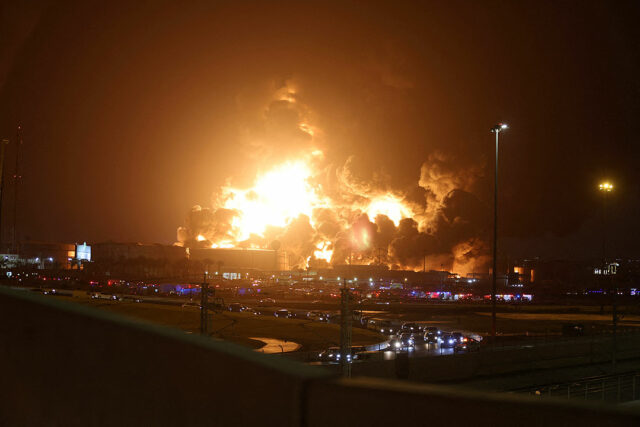
A VIEW of a fire at Saudi Aramco’s petroleum storage facility in Jeddah, Saudi Arabia on March 25. — REUTERS

RIYADH — Yemen’s Houthis said they launched attacks on Saudi energy facilities on Friday and the Saudi-led coalition said oil giant Aramco’s petroleum products distribution station in Jeddah was hit, causing a fire in two storage tanks but no casualties.

A huge plume of black smoke could be seen rising over the Red Sea city where the Saudi Arabian Grand Prix was taking place at the weekend, an eyewitness said.

The Iran-aligned Houthis have escalated attacks on the kingdom’s oil facilities in recent weeks and ahead of a temporary truce for the Muslim holy month of Ramadan.

The coalition has repeatedly said it is exercising self-restraint in the face of the attacks, but launched a military operation in Yemen early on Saturday saying it aimed to protect global energy sources and ensure supply chains.

A coalition statement on state media on Friday said the fire had been brought under control. Flames could still be seen in live footage aired by Saudi-owned Ekhbariya television channel.

The Saudi energy ministry said the kingdom strongly condemned the “sabotage attacks,” reiterating that it would not bear responsibility for any global oil supply disruptions resulting from such attacks, state news agency SPA reported, citing an official in the ministry.

The ministry blamed Iran for continuing to arm the Houthis with ballistic missiles and advanced drones, stressing that the attacks “would lead to impacting the Kingdom’s production capacity and its ability to fulfil its obligations to global markets.” Teheran denies arming the Houthis.

There was no immediate comment from Aramco.

The coalition said its Saturday airstrikes targeted “sources of threat” in the Houthi-controlled capital Sanaa and the Red Sea port city of Hodeidah.

The attacks came as Jeddah was hosting the Formula One Saudi Arabian Grand Prix. The dense black smoke could be seen from the race circuit, a Reuters witness said.

Formula One CEO Stefano Domenicali told drivers and team bosses that the Grand Prix would go ahead as planned, according to a source familiar with the matter.

‘VITAL FACILITIES’
Houthi military spokesman Yahya Sarea said the group launched missiles on Friday at Aramco’s facilities in Jeddah and drones at the Ras Tanura and Rabigh refineries, and said it had also targeted “vital facilities” in Riyadh, the capital.

Saudi state media earlier said the coalition had foiled a string of Houthi drone and rocket attacks. Saudi air defenses also destroyed a ballistic missile launched towards Jizan, which caused a “limited” fire at an electricity distribution plant.

The Houthi escalation comes as the United Nations special envoy tries to secure a temporary truce for the Muslim holy month of Ramadan that starts in April, and ahead of Riyadh’s hosting Yemeni parties for consultations later this month.

US Secretary of State Antony Blinken condemned the attacks on ally Saudi Arabia, and said the United States would continue to work with Riyadh to strengthen its defenses while working for a durable resolution to the conflict in Yemen.

“At a time when the parties should be focused on de-escalation and bringing needed life-saving relief to the Yemeni people ahead of the holy month of Ramadan, the Houthis continue their destructive behavior and reckless terrorist attacks striking civilian infrastructure,” Mr. Blinken said.

Last weekend a Houthi assault on the kingdom caused a temporary drop in output at a refinery and a fire at a petroleum products distribution terminal. On March 11, the group targeted a refinery in Riyadh, causing a small fire.

The coalition intervened in Yemen in March 2015 after the Houthis ousted the Saudi-backed government from the capital, Sanaa, in late 2014.

The conflict, widely seen as a proxy war between Saudi Arabia and Iran, has killed tens of thousands of people and pushed Yemen to the brink of famine. The Houthis say they are fighting a corrupt system and foreign aggression. — Reuters

North Korea says new ICBM will curb ‘dangerous’ US; Washington seeks new sanctions

SEOUL/UNITED NATIONS — North Korea said on Friday its launch of a big new intercontinental ballistic missile was designed to demonstrate the might of its nuclear force and deter any US military moves.

The United States responded by saying it would push the UN Security Council to “update and strengthen” sanctions on North Korea over its “increasingly dangerous provocations,” a move Pyongyang’s allies China and Russia are likely to oppose.

Thursday’s launch was the first full ICBM test by nuclear-armed North Korea since 2017. Flight data indicated the missile flew higher and for a longer period than any of North Korea’s previous tests before crashing into the sea west of Japan.

What North Korea calls the Hwasong-17 would be the largest liquid-fuelled missile ever launched by any country from a road-mobile launcher, analysts say.

Its range and size suggest North Korea plans to tip it with multiple warheads that could hit several targets or with decoys to confuse missile defenses, they say.

The leaders of the Group of Seven (G7) industrialized nations and the European Union condemned the test as a “reckless” threat to peace and security and a danger to international civil aviation and maritime navigation. They said it demanded a united response.

North Korea’s return to testing weapons experts believe are capable of striking the United States is an unwelcome additional challenge to President Joseph R. Biden as he responds to Russia’s invasion of Ukraine.

North Korea’s last ICBM launches and nuclear tests in 2017 prompted U.N. Security Council sanctions, but the United States and its allies are at odds with Russia and China over the Ukraine war, making such a response more difficult.

US Ambassador to the United Nations Linda Thomas-Greenfield nevertheless announced a new sanctions push at a meeting of the 15-member Security Council on Friday.

North Korea’s nuclear tests and ballistic missile launches have long been banned by the Security Council and subjected to sanctions that have been strengthened over the years.

However, while they backed sanctions in 2017, China and Russia have since pushed for their easing to encourage North Korea to return to denuclearization talks with the United States and others.

“Now is not the time to end our sanctions, now is the time to enforce them,” Ms. Thomas-Greenfield said.

“Offering sanctions relief, without substantive diplomatic progress, would only funnel more revenue to the regime and accelerate the realization of its WMD (weapons of mass destruction) and ballistic-weapons goals.”

China’s UN Ambassador Zhang Jun told the council “no party should take any action that would lead to greater tensions” and added, referring to North Korea by the initials of its official name: “The US must not continue to brush aside the DPRK’s justified demands. It should offer an attractive proposal to pave the way for early resumed dialogue.”

Russia’s RIA news agency earlier quoted the Russian foreign ministry as saying that Russia and China had agreed to coordinate closely on the Korean situation.

“Concern was expressed over the latest developments in the sub-region” at a meeting between Russian Deputy Foreign Minister Igor Morgulov and China’s representative for the Korean Peninsula, it said, adding that they emphasised the need to step up efforts towards fair political and diplomatic solutions.

North Korean state media said leader Kim Jong Un ordered the test because of “daily-escalating military tension in and around the Korean peninsula” and the “inevitability of the long-standing confrontation with the US imperialists accompanied by the danger of a nuclear war.”

“The strategic forces… are fully ready to thoroughly curb and contain any dangerous military attempts of the US imperialists,” Kim said while overseeing the launch.

It came after the election of a new, conservative South Korean administration that has pledged a more muscular military strategy towards North Korea. 

In a call with Chinese President Xi Jinping after the launch, South Korean President-elect Yoon Suk-yeol called for close coordination on North Korea’s complete denuclearization, his office said. Mr. Xi said Beijing and Seoul should bolster mutual political trust, Chinese state media said.

China urged restraint on “all sides” after the test.

‘STRIKING DEMONSTRATION’
Washington announced its own sanctions on Thursday on two Russian companies, a Russian and a North Korean individual, and North Korea’s Second Academy of Natural Science Foreign Affairs Bureau for transferring sensitive items to North Korea’s missile program.

Mr. Kim said the test would help convince the world of the power of his strategic forces.

“Any forces should be made to be well aware of the fact that they will have to pay a very dear price before daring to attempt to infringe upon the security of our country,” he said.

North Korean state media showed a massive missile, painted black with a white nosecone, rising on a column of flame from a launch vehicle.

It said the Hwasong-17 flew for 1,090 km (680 miles) to an altitude of 6,248.5 km (3,905 miles) and hit a target in the sea. Similar numbers were reported by Japan and South Korea.

Seoul-based website NK Pro said discrepancies in the imagery and video on state media suggested it may have been shot on different dates, raising the possibility that North Korea was hiding details.

Pyongyang never acknowledged what South Korea said was a failed launch from the same airport last week, and on Thursday South Korea’s Yonhap news agency cited unnamed officials who said they were examining whether the latest test may have been a smaller Hwasong-15 ICBM, which was test fired in Nov. 2017.

Officials in Seoul and Washington previously said launches on Feb. 27 and March 5 involved parts of the Hwasong-17 ICBM system, likely in preparation for a full test.

North Korea called Thursday’s test a “striking demonstration of great military muscle”.

Kim, shown in video at the launch site dressed in a leather jacket and sunglasses, called it a “miraculous” and “priceless” victory for the Korean people. — Reuters

Reset and restart towards better tourism

FREEPIK

After two years in flux, Tourism Secretary Berna Romulo-Puyat announced that the country will be opening its borders to international tourism. Starting April 1, the Philippines will be accepting business and leisure travelers from all countries regardless of whether they enter with a visa or visa-free. The only requirement is a vaccination certificate and a negative COVID RT-PCR test result taken 48 hours prior to arrival.

It will be recalled that in 2019, the tourism industry was growing at a galloping pace. We ended that year attracting 8.2 million foreign visitors and 110 million local travelers. Unfortunately, the momentum was broken and all this came to a halt when the pandemic struck. The good news is that the time under lockdown was not squandered. Under Secretary Berna’s baton, the Department of Tourism (DoT) worked to strengthen the value proposition of the Philippines while achieving greater sustainability of our tourist sites.

Health and safety is the top concern of tourists today, not only against COVID-19 but against all types of infectious pathogens. As early as May 2020, the DoT put together a handbook of health protocols with which tourism establishments were made to conform with. As of last month, 98% of all tourism workers are fully vaccinated and 247 hotels, resorts, restaurants, and spas were granted safety seals according to the strict health standards of the World Travel & Tourism Council (WTTC). Hundreds more are working towards WTTC certification.

In terms of tourism products, each region was made to develop “tourism circuits” composed of new sites, attractions, activities, and experiences. Camiguin, for instance, has added gastronomy, nature photography, and historical tours to its usual offering of beach, diving, and eco-tourism products. Other regions have added pilgrimages (religious tours), sports and adventure, rural and farms, and wellness tours to their offerings. New products under development include Habi (woven fabrics), Hilom (wellness), and Halal tours. All these are meant to add more dimensions to our regional tourism menu.

Training of tourism professionals has intensified in the last two years. A new generation of tour guides has been developed, each with their own field of specialty. Some are experts in history, others in flora and fauna, others in gastronomy, and so forth. The DoT is also training tour guides in various foreign languages.

The DoT aspires to elevate Filipino service and efficiency standards to a level that exceeds ASEAN standards. With that in mind, tour guides and service providers are now required to undergo training programs based on newly crafted modules. Certification is granted only after passing an examination.

Tourism-related businesses have been among the most adversely affected by the pandemic, many of whom faced the specter of bankruptcy. The DoT is working on overdrive to help tourism establishments recoup their losses. It all begins with bringing tourists back.

Awareness is key. During the height of the pandemic, the DoT embarked on an advertising campaign called “Wake up to the Philippines,” the goal of which was to keep the Philippines in the consciousness of potential visitors. Now that our borders have opened, several new advertising campaigns have been rolled out. Among them are “More Fun Awaits,” “Welcome Back,” and “It’s More Fun with You.” These campaigns are now playing in key tourism markets via print ads and below-the-line marketing.

Digital advertising is what propels tourism promotions today. The DoT, through the Tourism Promotions Board, has channeled the lion’s share of its advertising budget on digital platforms. Sleek and well produced ads are presently airing on Facebook, Instagram, TikTok and YouTube. All these are complimented by a new app called Travel Philippines. There, potential visitors can go on virtual tours (there are 16 virtual tours presently available), create their itineraries, and make bookings.

The Tourism Promotions Board, headed by Anthonette Velasco-Allones, is on an all-out campaign to attain our tourism numbers of 2019. Familiarization tours of travel influencers have resumed, as have public relations campaigns, participation in travel expositions, and promotion of sporting events and MICE. In fact, the Philippines will host the Global Summit of the World Travel & Tourism Council next month. In September, the Philippines will host the Travel Exchange Exposition.

So as not to be too dependent on traditional markets like the US, Japan, Korea, and China, new markets are being developed in the Middle East as well as Nordic and Mediterranean countries.

Ms. Allones estimates that the Philippines will attain the 2019 arrival figures by 2023. However, this can be accelerated if more direct flights to and from key destinations are arranged. Direct flights are the secret to the success of Bali and Phuket and the Philippines is in a position to do the same, what with numerous new airports built or rehabilitated in our islands. It’s a shame, however, that San Miguel has not yet made good its promised world-class airport in Caticlan. Cebu’s airport, however, is the best in the country today.

The drive towards sustainability continues. Sustainability is largely an infrastructure play and the DoT has been working closely with the Department of Environment and Natural Resources and the Department of Public Works and Highways to increase the carrying capacity of our tourism sites. Wastewater treatment plants, solid waste systems, and roads connecting ports to tourist destinations are the priority. The DoT has also been in close coordination with local government units to ensure that our natural and heritage sites are not overrun. So effective are the DoT’s sustainability programs that Thailand looks at it as a model.

After two painful years, tourism is finally open for business. We are happy that the DoT used the time under lockdown to strengthen the foundations of the industry. Thanks to the leadership of Secretary Romulo-Puyat, we can look forward to a fundamentally stronger industry as we move forward.


Andrew J. Masigan is an economist

andrew_rs6@yahoo.com

Facebook@AndrewJ. Masigan

Twitter @aj_masigan

Putin isn’t crazy enough to use nukes. Or is he?

MACROVECTOR-FREEPIK
MACROVECTOR-FREEPIK

IN RECENT WEEKS, we have seen a curious dichotomy in Russian President Vladimir Putin’s military approach to his war in Ukraine. With one hand, he is reaching for modern weapons of war: hypersonic missiles, cyberattacks, and precision-guided munitions.

With the other hand, he is turning to the dictates of medieval warfare in encircling large cities and threatening to reduce them to rubble. He has in effect said to the heroic defenders of Mariupol, “Lay down your arms, and I will spare your homes and your spouses and children.” Predictably, the Ukrainians, who enjoy not only the moral advantage but increasingly the tactical one, have spurned his offer. So his cannons boom, his cruise missiles fly and the tally of his war crimes rises by the day.

What can we learn about modern warfare, and how to foil Putin’s approach to it, from events in Ukraine?

The top concern is probably the Russian president’s unsubtle saber rattling about nuclear weapons, including putting his nuclear forces into “special combat readiness” and the ominous statement from his spokesman, Dmitry Peskov, “You know about the famous black suitcase and the red button.”

Putin surely doesn’t want things to reach an apocalyptic level — he, too, has children and a country he deeply loves. But would he risk a relatively low-yield tactical nuclear weapon — perhaps to knock apart a city from which most civilians have fled — in hopes of avoiding Western retribution in kind?

Maybe, but doing so would raise him to the top of the pantheon of history’s war criminals. I suspect it is a line even he is reluctant to cross, although he will continue to threaten it.

More likely would be the use of a chemical weapon, something he previewed when he falsely accused the Ukrainians of harboring their own arsenal. The North Atlantic Treaty Organization (NATO) is taking the threat seriously. “I expect allies will agree to provide additional support,” said Secretary General Jens Stoltenberg on Thursday, including “equipment to help Ukraine protect against chemical, biological, radiological, and nuclear threats.”

A chemical or biological attack would terrorize the population — a key objective in Putin’s Plan B strategy now that Plan A, a blitzkrieg decapitation of Ukraine’s government, has failed. It would also help him conserve his inventory of cruise missiles and bombs, which is shrinking rapidly. Few things would empty a city faster than a cloud of nerve gas.

As President Joe Biden meets with the European allies in Brussels, they should be crafting specific plans for each scenario. Putin’s use of weapons of mass destruction would probably need to be met by what NATO has henceforth avoided: a no-fly zone, at least above western Ukraine, to maintain the flow of weapons from Poland into Ukrainian hands. A Russian chemical attack might also demand a NATO ground force to protect the western city of Lviv, to which the Ukrainian government of President Volodymyr Zelenskyy may need to relocate to prepare for mounting a nationwide resistance.

Another modern weapon Putin has rolled out is hypersonic missiles. While not confirmed by the Pentagon, the Russians say they launched one at a precisely demarcated target late last week. There is much confusion about hypersonic weapons. In a nutshell, they move at more than five times the speed of sound, have maneuverability in flight (and thus are hard to knock down), and can be either self-powered like a cruise missile or glide to their target after being launched from an aircraft or rocket. (Strictly speaking, hypersonics fly at low altitudes like traditional cruise missiles, although in the media the term is commonly used to describe some ballistic missiles and space-launched weapons.)

The significance of the Russian launch has little to do with defeating Ukraine and much to do with signaling to the West. Putin is warning the US and NATO that not only does he have nuclear weapons, but that he could deploy one on a platform against which there is little to no defense.

We should take the point: The US needs to build its own hypersonic missiles to create a deterrent regime, and explore defenses against them, probably using lasers (ultimately the only system fast enough to engage them). The military is already on both these paths, but feasibility is years away. Thus NATO should take seriously Putin’s signal, but not overreact to it. The West has plenty of other escalation options — cyberwarfare, conventional strikes, maritime responses — if necessary.

Finally, the bear that hasn’t growled is cyberwarfare. Biden rightfully has highlighted both the nuclear and chemical weapons possibilities, but Putin will may well ramp up on cyber against (in probably this order) US consumers (gas pipelines and food distribution networks); transportation grids; financial institutions; the US government itself.

As we reach the one-month mark in this war, Putin is primarily using the strategies of ancient warfare: destroying cities and terrorizing populations. But in the background loom the most modern tools of combat: cyberattacks, hypersonic missiles — and perhaps chemical weapons and or even tactical nukes. The US and its allies need to plan now how they will react to any or all of them.

BLOOMBERG OPINION

Grave threats with failed nuclear power plants

UPKLYAK-FREEPIK

Russian forces captured the USSR-built Chernobyl nuclear power plant, the site of the world’s worst nuclear disaster, after a fierce battle on the first days of Russia’s invasion of Ukraine. Russian troops took over the power plant while Ukrainian forces battled them on three sides after Moscow mounted an assault by land, sea, and air in the biggest attack on a European state since World War Two (Reuters, Feb. 24, 2022). Why was Chernobyl targeted and captured?

“Our defenders are giving their lives so that the tragedy of 1986 will not be repeated,” Ukrainian President Volodymyr Zelenskyy said shortly before the power plant was captured. “This is a declaration of war against the whole of Europe.”

Zelenskyy knew this was Russia’s undisguised threat hurled at Europe and the NATO countries sympathetic to Ukraine not to interfere militarily. “If as a result of the occupiers’ artillery strikes the nuclear waste storage facility is destroyed, the radioactive dust may cover the territories of Ukraine, Belarus, and the EU countries,” he said. The Chernobyl disaster in the then-Soviet Ukraine sent clouds of nuclear material across much of Europe in 1986 after a botched safety test in the fourth reactor of the atomic plant (Ibid.). The plant, which lies 130 kilometers north of the capital, Kyiv, has been decommissioned, and the reactor that exploded has been covered by a $2-billion protective “sarcophagus” (funded by 40 friendly nations) to prevent radiation from leaking further. Nuclear clean-up was scheduled for completion in 2065. What a horror if the plant were now bombed!

Viktor Sushko, deputy director general of the National Research Center for Radiation Medicine (NRCRM) based in Kyiv describes the 1986 Chernobyl disaster as the “largest anthropogenic disaster in the history of humankind” (bbc.com July 26, 2019). The NRCRM estimate around five million citizens of the former USSR, including three million in Ukraine, have suffered as a result of Chernobyl, while in Belarus around 800,000 people were registered as being affected by radiation following the disaster.

How totally sinister for Russia to threaten its “brother” Ukraine and most of the world with exploding the iconic Chernobyl sarcophagus — 328 feet high, 541 feet long, and 30,000 tons in weight — that separates the destroyed reactor from the environment for at least the next 100 years! It would be genocide more massive than infamous German dictator Adolf Hitler’s Holocaust of the European Jews during World War II.

What brazen evil in threatening such genocide with a flint held to a failed nuclear power plant!

But wait — didn’t the Russian Ambassador to the Philippines, Igor Khovaev, once so solicitously say at a CNN Philippines interview about the planned re-commissioning of the “mothballed” Bataan Nuclear Power Plant (BNPP): “The safety standards, [the] international standards are much, much higher than the standards on which the Bataan Nuclear Power Plant was built. So I think it’s not possible at all,” he said, referring to the planned plant opening (CNN Philippines, April 4, 2018). The Russian friend would not recommend gambling with a dangerous failed nuclear power plant, knowing what harm it can do to life, health, and the environment.

Since the start of his term in 2016, President Rodrigo Duterte has purposely developed a close friendship with Russian President Vladimir Putin (and Chinese President Xi Jinping), openly expressing preference for military arms and training (and other aid) from the communist countries rather than from the “West” (the US and its allies). In October 2017 Russia donated military equipment to the Philippines — particularly 5,000 AK-74M Kalashnikov assault rifles with 1 million rounds of ammunition. And so it was Russia’s State Atomic Energy Corp. (Rosatom) that conducted an assessment of the BNPP facility to determine if it was fit for commissioning. Rosatom also announced it would look into the possibility of land-based and floating nuclear power plants in the country, knowing that the BNPP could not be activated because it is built on the earthquake fault line connected to the active volcano Mt. Natib in nearby Morong, to Mt. Pinatubo, and to Mariveles volcano, all in the Bataan Volcanic Arc, all in an extremely dangerous earthquake zone which could trigger an explosion of the BNPP.

Why then, three months before he steps down from office, did President Duterte sign Executive Order (EO) No. 164, dated Feb. 28, 2022, allowing the country to tap nuclear power as an alternative energy source, and directing the Nuclear Energy Program Inter-Agency Committee (NEP-IAC) to study reopening the mothballed BNPP?

A 2017 Stanford University study describes the technical lapses that prevented activation and viable operational sustainability (specially the siting error) as well as the graft and corruption in government that bloated the financial requirements of the BNPP.

“One of the biggest controversies was the Marcos connection with Westinghouse. First, Marcos requested that National Power Co. (the government-owned electric utility) negotiate a deal to buy two nuclear reactors. Westinghouse used connections to Marcos to strike the deal. Already known to be more expensive than other options, the Westinghouse contract jumped from $650 million for only one reactor to $2.2 billion. Later, evidence of large sums of money going to President Marcos himself was found. Westinghouse denied corruption accusations.

“Another controversy was how Westinghouse was able to gain the contract over General Electric. It is documented that National Power was negotiating with General Electric before Westinghouse came into the picture. However, once the connections between Westinghouse and the Marcos regime were established by Herminio Disini, a friend of the president himself, General Electric appeared to be strung along, as though they were still in contention even though they actually were not. There is documentation that contract negotiations began before General Electric could pitch its proposal to the government” (from B. Dumaine, “The $2.2 Billion Nuclear Fiasco,” Fortune, Sept. 1, 1986).

The Sandiganbayan First Division ordered businessman Herminio Disini, crony of the late dictator Ferdinand Marcos, to surrender $50.6 million in commissions that he received for helping two foreign firms obtain the contract to build the mothballed BNPP in 1974 (Philippine Daily Inquirer, April 13, 2012). The Supreme Court ordered Disini to pay P1.01 billion in damages to the government over the BNPP project that was tainted with corruption (GMA News, June 15, 2021).

The Office of the Solicitor General (OSG) filed a motion for partial reconsideration with the Sandiganbayan for the antigraft court to also order Marcos to return the ill-gotten commissions that he, in conspiracy with Disini, had allegedly obtained through the anomalous contract. The OSG said the government was entitled to actual or compensatory damages as well as to the return of the P22.2 billion that the government spent in total to build the plant. But though it found Marcos to have had a “personal financial interest” in the transaction, the Sandiganbayan said the government failed to present evidence to show that the dictator or his wife, Imelda, received any part of the commissions from the BNPP deal (Philippine Daily Inquirer, May 11, 2012).

Fast-forward to today: Ferdinand Marcos, Jr., the dictator Ferdinand Marcos, Sr.’s only son and namesake, is running for President at the coming May 9 national elections, in tandem with Sara Duterte, President Duterte’s daughter, who is running for Vice-President. Marcos Jr. praised President Duterte’s EO 164 and precisely called for the rehabilitation of the BNPP, which he said should have solved the country’s energy deficit problem during the time of former President Ferdinand Marcos, Sr. (mb.com.ph March 9, 2022).

“The Duterte administration is about to leave a tarred legacy and is setting us up for another horror story like Chernobyl and Fukushima,” Greenpeace campaigner Khevin Yu said, referring to the world’s worst nuclear disasters (Reuters, March 2, 2022).

What have the Filipino people done to be threatened, like the hapless Ukrainians and neighbors, with grave danger to life, health and the environment?


Amelia H. C. Ylagan is a doctor of Business Administration from the University of the Philippines.

ahcylagan@yahoo.com

The Marcoses and the Ilocano tobacco farmers

BW FILE PHOTO

The effects of the COVID-19 pandemic and natural disasters have left Filipino farmers reeling. Philippine Statistics Authority (PSA) data show that agricultural output dropped by 1.7% in 2021.

Transport and logistical breakdowns, travel restrictions, a decrease in demand, and low volume of exports due to the pandemic have bled our farmers dry. Fuel price hikes arising from the Russia-Ukraine conflict will lead to higher transport and production costs, only worsening the agricultural sector’s conditions.

It is thus crucial to ask: Will our next President defend farmers’ interests and decisively implement interventions to address the many issues they face? More importantly, does our next chief executive have a track record of prioritizing the development of our agricultural sector?

In this piece, I will detail the Marcos family’s history with the agricultural sector, particularly the tobacco industry and tobacco farmers in Ilocos Norte.

The latest surveys have Ferdinand “Bongbong” Marcos, Jr. as the current presidential frontrunner. Bongbong promises to restore the so-called “agricultural golden age” during the regime of his father, Ferdinand Marcos, Sr.

However, one does not have to dig deep to find the ways in which Bongbong Marcos and his family have failed to champion the interests of farmers in their own bailiwick, the Ilocos Region or the “solid North.”

The economy of Ilocos Norte, which has had a Marcos or close Marcos relative as its governor since 1971 (with the exception of Rodolfo Fariñas, who was governor from 1988-1998), is anchored on its agricultural sector and it is a major tobacco-producing province.

During the Senate interpellations of sin tax laws passed in the past decade, both Bongbong Marcos and his sister Imee Marcos staunchly opposed tobacco taxes, claiming to defend tobacco farmers and the tobacco industry in doing so.

This is how Marcos Jr. explained his opposition to the sin tax law on his website: “During his tenure as Senator, BBM was known to constantly defend the interests of tobacco farmers against the unreasonable and disproportionate increase in excise taxes on tobacco products. According to him, the imposition of unreasonable excise taxes would destroy the livelihood of tobacco farmers and the tobacco industry as a whole.”

However, since the implementation of Republic Act 10351 or the Sin Tax Law of 2012, local tobacco production increased even with substantial increases in excise taxes on cigarettes from 2013 to 2017. From 2013-2017, the average volume of tobacco production was 55,769 metric tons; this is 15,000 metric tons higher than the average volume of tobacco production from 2008-2012, which was only 40,479 metric tons.

Furthermore, Ilocos Norte’s tobacco farmers should actually benefit from the sin tax law, as the local government receives allocations from tobacco excise tax revenues, as mandated in Republic Act (RA) 10351. The law stipulates that 15% of the revenues from tobacco excise taxes must be split among major tobacco-producing provinces and allocated towards support for tobacco farmers. This includes financial support for displaced tobacco farmers, infrastructure projects like farm-to-market roads, and alternative livelihood programs.

The onus is on the local government units to use tobacco tax funds for the welfare of tobacco farmers. Sadly, while the Marcoses opposed the sin tax law in the guise of protecting the farmers, when the law was implemented, Imee Marcos was implicated in a controversy regarding the use of excise tax funds that were meant to go towards the farmers’ livelihood.

Ilocos Norte is the site of the 2018 tobacco excise tax funds controversy. To quote a Philippine Star story written by Audrey Morallo dated July 6, 2018:

“Ilocos Norte Gov. Imee Marcos and other officials of the province should be slapped with graft charges over their alleged involvement in the misuse of their share of tobacco excise taxes, a House committee recommended in its report.

“The House Committee on Good Government and Public Accountability said that Marcos and officials of the provincial government of Ilocos Norte should be held liable for the ‘highly irregular and illegal’ purchase of 110 units of Foton minicabs.

“‘With all premises considered, the committee has determined that the purchase of the subject vehicles by the PGIN was highly irregular and illegal,’ the committee said.”

According to the committee report, the purchases were allegedly made without public bidding, violating the Government Procurement Act, and were purchased from a direct contractor, Mark Chua. They were allegedly overpriced by P195,000 per unit, resulting in a total of P21.4 million in overpayment. (http://bit.ly/HR00882)

During the congressional probe on the matter, Ms. Marcos argued that these vehicles were used by tobacco farmers to transport products and thereby increase productivity. However, at the hearing, Representative Rodolfo Fariñas pointed out that one of the beneficiaries of the vehicles was the barangay captain of Barangay Tres in Laoag City, where tobacco farms are absent.

Farmers from other provinces in the Ilocos region also continue to suffer from issues that the local government could address through the proper utilization of tobacco tax revenues. A focus group discussion (FGD) held by Action for Economic Reforms (AER) and Social Watch Philippines in Ilocos Sur in 2018 showed that tobacco farmers desire support in the form of cash subsidies and loans to address their lack of initial capital for farming. Tobacco farmers are also vulnerable to health hazards due to exposure to uncured tobacco, are constantly in debt to tobacco manufacturers, and have difficulty switching to other crops because of the lack of a market for vegetables.

These concerns were echoed in a December 2021 focus group discussion by AER in Bacnotan, La Union, a province in the Ilocos region. Tobacco farmers in the area voiced a need for more support from the government. Notably, the group lamented the absence of a farm-to-market road. This forces farmers to carry tobacco by the side of the road, which adds to their fatigue and takes a toll on their health. Tobacco is a very difficult crop to farm, they said, comparing it to a child that needs to be nurtured, from planting to harvesting.

Farmers have no choice but to plant tobacco in La Union, they said. The lack of access to water in the province makes it difficult for them to fully switch to planting rice. And ever since the COVID-19 lockdowns, farmers have been restricted from directly selling to tobacco companies. They are kept in the dark regarding prices and unable to negotiate the prices of their product, which the farmers believe are too low. “Resibo na lang dinadala sa amin. Hindi namin alam kung paano ’yung grading ng tobacco namin (They just bring us a receipt. We do not know how they are grading our tobacco),” the farmers said.

When asked about their preferred presidential candidate, Bongbong Marcos won unanimously among the Ilocano farmers. “’Yung sinasabi nila na si Marcos daw ay tutulungan niya ’yung mga magsasaka. ’Yun ang gusto namin (What they say is that Marcos will help the farmers. That is what we want),” the farmers said.

When asked about what the Marcos family had done to help them, they were mostly silent, with some of them bringing up Ferdinand Sr.’s achievements.

We hope that if he is elected President, Marcos Jr. would live up to his promises of championing the rights of Filipino farmers. But the Marcos family has worked actively to block a crucial measure that has provided billions of pesos in subsidies for the welfare of tobacco farmers, has proven to lower smoking prevalence among Filipinos (from 31% in 2008 to 20.7% in 2018), and has generated enough revenue to triple the budget of the Department of Health.

We fear that a Marcos presidency would only enable regressive measures affecting health, revenues, and the economy, thus hurting the marginalized, including our farmers.


Pia Rodrigo is the strategic communication officer of Action for Economic Reforms (AER). AER is one of the civil society members of the Sin Tax Coalition, a network of advocates who supported the passage of the Sin Tax Reform Act in 2012.


Local tourism bullish this year but a word of caution

The local tourism industry is excited as government eased inbound travel restrictions for foreigners and returning Filipinos.

And foreign travelers have in fact started flying in.

According to the UN World Tourism Organization’s (UNWTO) World Tourism Barometer January 2022 report, 61 percent of tourism professionals are optimistic that international tourism could see a 30 to 70-percent growth, although still below the pre-pandemic levels.

The UNWTO report also stated that domestic travel would continue to propel tourism as travelers seek less crowded and nature-based attractions and activities.

The Philippines felt the uptick in early February as the Department of Tourism (DOT) reported 21,974 registered tourists on the One Health Pass platform, or 11,900 foreigners, and 10,074 balikbayans.

Tourism touchpoints such as hotels and resorts have installed health and safety protocols and fully-vaccinated personnel to assure tourists’ safety.

Despite these efforts, there is still a risk of contracting the virus while on vacation. Although a traveler may have taken all the necessary precautions in planning their trip, we are still in the midst of a pandemic.

For additional protection, travelers are advised to secure travel insurance to cover their medical expenses should they fall ill with the virus while on their trip.

A travel policy like Malayan Insurance Co. Inc.’s Travel Master with COVID-19 Cover conveniently guarantees peace of mind and financial security should vacationers become sick, injured, or encounter travel inconveniences. This affordable non-life insurance policy is offered to those going overseas, traveling inbound to the Philippines, or touring within the country.

“There is no such thing as taking too many safety precautions, especially when going out-of-town. Comprehensive travel insurance like Malayan’s Travel Master with COVID-19 Coverage is necessary for all travelers during the pandemic. It frees tourists from undue worries that could steal their enjoyment while on vacation and provides comfort to family members if travelers fall ill at any time,” Paolo Y. Abaya, president and chief executive officer of Malayan Insurance, said.

For as low as P910 for a four-day domestic trip or P1,090 for an international journey (non-Asian), Travel Master policyholders are assured of emergency medical treatment and hospitalization due to COVID-19 plus daily hospital allowance if they contract the virus while they’re away.

Policyholders may choose insurance limits from P1.5-million (USD29,000), P2.5-million (US$50,000) or P5-million ($100,000), which is very well within Philippine Inter-Agency Task Force’s requirement of at least $35,000 worth of travel insurance coverage.

Aside from the extensive Covid-19 coverage, Travel Master policyholders are protected from the financial burden of personal accidents, unprovoked assault, murder, terrorism, and personal liability for property damage and bodily injury. They will also receive benefits for travel inconveniences like delayed flights and baggage and lost travel documents, cash, bags, and laptops.

1 UN World Tourism Organization, January 2022, “World Tourism Barometer,” Volume 20, Issue 1, https://webunwto.s3.eu-west-1.amazonaws.com/s3fs-public/2022-01/UNWTO_Barom22_01_January_Excerpt.pdf?lXWPdwSpA0FBYClC_xMHrLYarzBnARrV

Department of Tourism, February 21, 2022. “DOT bares higher tourist influx since reopening,” https://beta.tourism.gov.ph/news/dot-bares-higher-tourist-influx-reopening

Rocamora, Joyce Anne, Philippine News Agency, February 4, 2020, “Prepare requirements for seamless PH travel, int’l tourists told,”
https://www.pna.gov.ph/articles/1167070


Spotlight is BusinessWorld’s sponsored section that allows advertisers to amplify their brand and connect with BusinessWorld’s audience by enabling them to publish their stories directly on the BusinessWorld Web site. For more information, send an email to online@bworldonline.com.

Join us on Viber to get more updates from BusinessWorld: https://bit.ly/3hv6bLA.

TikTok is propagandists’ new tool to win elections in Southeast Asia

REUTERS

By Nuurrianti Jalli

Scholars and political observers have raised concerns over public opinion maneuvering on social media in Southeast Asia as three countries in the region — the Philippines, Malaysia, and Indonesia — are gearing up for elections.

Propagandists’ strategic maneuvering of public opinion on social media remains a dangerous threat to democracy in Southeast Asia. Over the years, strategic use of cybertroopers in Southeast Asian countries has been prominent, especially during the election periods.

Political actors have attempted to sway public opinion via Facebook, Twitter, and YouTube to push for a political narrative to garner more supporters in the region.

Now, TikTok, as the most downloaded app in Southeast Asia, would serve as a new strategic tool for propagandists to push for political narrative during the electoral period.

TikTok provides unique features enabling propaganda to reach a greater public, as its content-sharing model is novel compared to its predecessors, where it does not rely on the number of followers but instead focuses on the content itself.

This means anybody who could create “interesting-enough” content can land on the “for you page,” opening doors of opportunities for political opportunists to push for political narrative by creating engaging audio-visual content.

With its recommended system, radical propaganda could result in extremism among fanatical followers as TikTok would push for similar content to users. This model could create an information bubble that would feed users with certain narratives and influence their worldview.

Unlike its predecessors, TikTok is relatively new in the global-fame-game after a sudden burst of new downloads worldwide at the beginning of the COVID-19 pandemic.

While tech companies like Facebook, Twitter, and Google have taken serious steps to combat the misuse of their platforms by propagandists, TikTok does not have as rigorous policies.

TikTok has been heavily criticized by scholars and media for allowing extremism to be on its platform, which led the tech company to rebut with improved policies through their community guidelines.

Relying mostly on in-house and AI monitoring framework and community flagging system, as an audio-visual platform, TikTok seems to struggle to oversee content its users produce on its platform.

TikTok has established its latest community guidelines to avoid individuals’ misuse of the platform.

However, political propaganda is still rampant on the platform, for example on the “live” section of the platform.

The “live” feature on TikTok has been misused to spread political narrative in several countries, including the US and Russia.

Unlike the uploaded audio-visual content, the live feature posed a distinctive challenge due to its synchronous real time-streaming nature, which makes AI monitoring less effective compared to humans in content moderation.

But, relying on 24/7 human monitoring of live videos is unrealistic as it is impossible and economically impractical to hire enough workforce to monitor millions of content uploaded on TikTok daily.

Therefore the next best way is to harness community engagement by developing a community flagging system to help identify content in violation of its policy.

As general elections in the Philippines, Malaysia, and Indonesia are looming, we should not disregard TikTok as a space for political information warfare amid elections in the region.

Seeing how Russian influencers were paid to disseminate pro-Kremlin propaganda on TikTok, my prediction, similar trends highly likely will happen in the Southeast Asian countries.

Digital propaganda strategies for disinformation campaigns that we have seen on other social media platforms include coordinated use of paid influencers, cybertroopers, bots, deepfakes.

These could be replicated on TikTok during the Southeast Asian elections considering the platform gained popularity in the region in the past three years.

As information disorders ahead of the election are to be expected, one of the ways to mitigate information disorders is through media and information literacy efforts.

While fact-checkers can only do so much, citizens should also be well equipped with the right skills to check information for themselves.

In Southeast Asia, media and information literacy education are still behind compared to other parts of the world, despite the current climate of information pollution. While information disorders will never go away, equipping citizens with the right skills would help in mitigating its spread. — The Conversation via Reuters

Nuurrianti Jalli is assistant professor of Communication Studies at the College of Arts and Sciences Department of Languages, Literature, and Communication Studies at Northern State University in South Dakota, USA.

PHL remains ‘favored destination’ for outsourcing

PIXABAY

By Patricia B. Mirasol, Reporter

Heads of global outsourcing firms agreed that the Philippines remains a “favored destination” as they outlined the pandemic’s positive outcomes at the 2022 Asia CEO Forum.

“There’s plenty of growth opportunity,” said Nick Sinclair, founder of TOA Global, an Australia-headquartered company that supplies offshore professionals, including from the Philippines, to over 600 accounting firms worldwide.

“I think for everyone in this industry — particularly if you’re an accountant — the future is very bright,” he said at the March 24 event, noting that a lot of accounting firms are not run as effectively as they could be. “Technology is going to allow us a more human connection and have a bigger impact to small businesses globally.”

TOA Global, which has more than 2,000 team members in the Philippines, has a 10-year vision of increasing that number to 20,000. It plans to launch a foundation this year to educate and upskill the underprivileged.

“We’ve seen how brilliant accountants are in the Philippines,” added Mr. Sinclair. “We want to amplify that in the global stage.”

The country’s reputation as a tried-and-tested customer experience delivery point has been strengthened these past two years, according to Rommel M. Regino, head of global operations and sales of Inspiro, a Philippine-headquartered company offering business process outsourcing and call center services worldwide.

“The Philippines is consistently among the top three most favored offshore destinations, making us an integral part of any customer experience outsourcing delivery portfolio,” he said. “We should work together for the Philippines to remain as a favored destination.”

Like all industries, he added, global outsourcing had to undergo massive changes in technology adoption, business processes, and people management as a result of coronavirus disease 2019 (COVID-19).

According to a 2021 forecast by the International Data Corporation, the digital transformation of business practices, products, and organizations is expected to reach $2.8 trillion in 2025, more than double the amount allocated in 2020.

Customer experience is expected to get a large chunk of these investments, said Mr. Regino. “We believe that a positive agent experience translates to an exceptional customer experience. We’ve seen clients invest in technology for customer experience. Shouldn’t we do the same for our agents?”

Inspiro invested in learning simulators for new hires, which resulted in a 45% skills improvement and a 95% increase in sales conversion. The company also equipped its workforce with cybersecurity protection — such as two-factor authentication and data encryption — when they had to work from home during the various lockdowns.

Mr. Regino said that, although a majority of its staff is “quite excited” to now be back on-site, remote work has been proven to be a boon from a talent availability standpoint.

The COVID-19 pandemic accelerated the ability to employ someone not in one’s town or country, Mr. Sinclair acknowledged at the Asia CEO Forum. That said, TOA Global’s founder noted the company is still “a big believer in offices” because of their potential for collaboration and growth.

“They will not die…but we want to build offices and extend to a hub-and-spoke network, so [our staff only need to] travel 15–20 minutes to work,” he added.