Home Blog Page 6068

Celebrity-favorite beauty brand opens Greenbelt store

KIM KARDASHIAN, Nicole Kidman, Kate Winslet, Chrissy Teigen, Kate Moss. All celebrities, all users of Clé De Peau Beauté (at least, according to social media accounts, makeup artists, magazine articles, and beauty blogs). The brand, owned by Japanese beauty giant Shiseido, opened its doors in the Philippines late last month in Greenbelt 5 in Makati.

Clé De Peau Beauté, roughly translated as “key to beautiful skin” in French, used a giant clear key to open its store in Greenbelt, and socialites walked to the store accompanied by a violinist and a ballerina.

Its flagship product, simply called La Crème (“The Cream”) claims to be able to fight skin aging, and smoothens and firms the skin. First launched in 1982, it has received many reformulations (a lucky eight as of this writing) for it to continuously improve. Its ingredients include a “skin-empowering illuminator” made with platinum golden silk (derived from a kind of silk cocoon), a renewing Ceraferment extract, Retinol ACE, an ingredient called 4MSK that prevents the appearance of dark spots, hyaluronic acid, and squalane (among others —  the ingredient list numbers to about 60). There’s even a special way to apply it at night: using a spatula (part of its chic crystalline packaging), one should get a pearl-sized amount, and smooth the product all over the face, and massage it gently from the chin to the temples.

The ingredients, the ritual, and the celebrities who swear by it puts the product at a premium: the website lists La Crème at $550 — that’s P30,553.05 at a P55.55 per dollar exchange rate for a 30 ml jar. The 50 ml jar sells on the website for $795 (P44,163.04 at the same exchange rate).

Michael Goh, Managing Director of Shiseido Philippines Corp., told BusinessWorld during the launch about its celebrity clientele. “They really love that level of sophistication. At the same time, I think the efficacy of the product does work. With all the science and technology, the product really delivers.”

Speaking about why the Japanese have such a scientific approach to beauty, he says, “We do have very good scientists, and I think that’s an enormous investment; getting into innovations, as well as research in terms of the products. That’s why we are able to come up with great products like this.”

For more information, visit www.cledepeau-beaute.com/ph/ or follow @cledepeaubeautephilippines on Facebook. — JLG

Rates of T-bills, bonds to climb

BW FILE PHOTO

RATES of government securities (GS) on offer this week are expected to rise as the Philippine central bank is seen to be aggressive in its next policy meeting as inflation remains elevated.

The Bureau of the Treasury (BTr) will offer P15 billion in Treasury bills (T-bills) on Monday, made up of P5 billion each in 91-, 182-, and 364-day debt papers.

On Tuesday, the BTr will auction off P35 billion in reissued 10-year Treasury bonds (T-bonds) with a remaining life of six years and five months.

Traders expect yields to move higher at this week’s T-bill and T-bond auctions.

The first trader sees T-bill rates moving sideways or higher by 10 basis points (bps) and the reissued 10-year bonds fetching yields ranging from 6.25% to 5.75%.

The first trader said faster July inflation could give the Bangko Sentral ng Pilipinas (BSP) a reason to hike rates by 50 bps instead of just 25 bps.

The second trader sees T-bill rates rising by 10-15 bps from those seen at the previous auction and T-bond yields to range at 5.75% to 5.90%.

“With the release of inflation data, which printed faster than expected, the BSP is expected to continue to be aggressive in its tightening ways, therefore putting pressure on short end of the GS curve,” the second trader said.

The third trader expects the reissued 10-year papers to be priced at around 5.60% to 5.875%, in line with secondary market levels.

“As with the previous weeks’ auctions, we should see continued demand and we expect tenders to be over 2x the offer. Even with CPI (consumer price index) at 6.4%, I think market is comfortable with current levels given that the BSP has sounded off that they are prepared to take all needed actions vs. CPI.  This, together with their statement of a sure 25-bp or 50-bp hike [next week], will keep levels at bay,” the third trader said.

Meanwhile, Rizal Commercial Banking Corp. Chief Economist Michael L. Ricafort said that yields of government securities on offer this week could ease to track the slight week-on-week declines in rates short-term tenors and larger declines of 20-30 bps in long-term ones at the secondary market.

Headline inflation quickened to 6.4% year on year in July, its fastest pace since October 2018, mainly due to soaring prices of food and higher transport costs.

The reading was faster than the 6.1% in June and 3.7% a year ago. It also settled at the high end of the BSP’s 5.6-6.4% forecast range for the month.

For the first seven months, inflation averaged 4.7%, lower than the 4% seen in the same period a year ago and the central bank’s 5% inflation forecast, but higher than its 2-4% target for the year.

BSP Governor Felipe M. Medalla last week said the central bank still has room to hike borrowing costs without sacrificing the economy’s recovery as real interest rates remain negative.

He said their planned hike of 25 bps or 50 bps at their Aug. 18 meeting is still supportive of growth. Mr. Medalla added that it is too early to tell if the August increase will be the last for now amid lingering uncertainties at home and abroad.

The Monetary Board last month raised the benchmark interest rates by 75 bps in an off-cycle move, as it sought to contain inflationary pressures exacerbated by the peso’s weakening versus the dollar amid the Fed’s aggressive stance. It has raised rates by 125 bps so far since May.

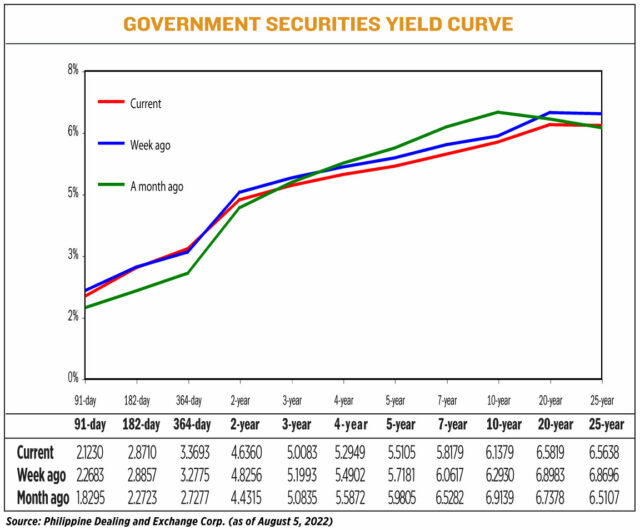
At the secondary market on Friday, the 91-, 182-, and 364-day T-bills were quoted at 2.123%, 2.871%, and 3.3693%, respectively, based on the PHP Bloomberg Valuation Reference Rates published on the Philippine Dealing System’s website.

Meanwhile, the 10-year bond fetched a yield of 6.1379%. The seven-year tenor, the closest tenor to the remaining life of the papers to be offered on Tuesday, was quoted at 5.8179%.

Last week, the Treasury raised P15 billion as planned from its auction of T-bills, with bids reaching P43.31 billion.

Broken down, the BTr made a full P5-billion award of 91-day securities as the tenor attracted P24.07 billion in bids. The average rate of the tenor went down by 18.3 bps to 2.09%. Accepted rates ranged from 2.08% to 2.1%.

The government also borrowed P5 billion as planned via the 182-day securities as tenders reached P12.94 billion. The average rate of the tenor rose by 4.6 bps to 3.188%. Accepted rates ranged from 3.125% to 3.225%.

Lastly, the Treasury raised P5 billion from the 364-day debt papers as programmed, with demand for the tenor reaching P6.29 billion. The tenor’s average rate rose by 12.4 bps to 3.48%, with the government accepting offers ranging from 3.35% to 3.7%.

Meanwhile, the reissued 10-year papers to be offered on Tuesday were last auctioned off on Feb. 18, 2020, where the BTr made a full award of the reissued papers worth P30 billion at an average rate of 4.409%.

The BTr wants to raise P215 billion from the domestic market this month, or P75 billion through T-bills and P140 billion via T-bonds.

The government borrows from local and external sources to help fund a budget deficit capped at 7.6% of gross domestic product this year. — Diego Gabriel C. Robles

Peugeot PHL rolls out easy-own program

PHOTO FROM PEUGEOT PHILIPPINES

PEUGEOT PHILIPPINES makes it easier for car browsers to acquire any of its vehicles through its newly launched Peugeot Easy-Own Financing Program. Included are the 5008, 3008, and 2008 SUVs; and the Traveller Premium van.

The new Peugeot 5008 SUV is positioned as a premium seven-seater SUV, boasting the immersive driving character afforded by the brand’s i-Cockpit. It also offers a comprehensive set of features in its advanced driver assistance system (ADAS) — including blind spot detection, lane-keeping assistance, and driver attention alert.

The 3008 is a stylish five-seater SUV, while the 2008 is a compact five-seater SUV, the “ultra-modern interpretation of an instinctive and versatile driving experience.” The SUVs are all assembled at the Stellantis factory in Gurun, Malaysia, and undergo specific endurance and quality testing for “best-in-class performance to meet the needs of customers in Southeast Asia.”

Lastly, the Traveller Premium heralds comfort, elegance, and style — interpreted in a spacious cabin and in its enhanced driving experience. This vehicle, directly imported from France, features passenger amenities and a host of safety and security measures.

Valid for a limited time, the Peugeot Easy-Own Financing Program is offered in partnership with Security Bank, and is available at all Peugeot showrooms and satellite dealerships nationwide. For more information, visit www.peugeot.ph.

‘Living Sculpture’ Daniel Lismore brings wearable art to London

BRITISH multidisciplinary artist Daniel Lismore wears one of his sculptural artwork creations next to other mannequins which form part of the ‘Fashion in Motion: Daniel Lismore’ exhibition at the Victoria and Albert Museum in London, Britain, Aug. 5. — REUTERS/TOBY MELVILLE

LONDON —  British artist Daniel Lismore’s monumental pieces of “wearable art” featuring everything from rubbish to elaborate headgear studded with jewels took center stage at London’s Victoria and Albert Museum on Friday.

Guests were invited to closely inspect the nearly two-meter (6-foot, 4-inch) tall pieces, one of which was worn by Mr. Lismore, who calls himself “a living sculpture.”

“I’m not a performance artist or a drag queen, I just live as art,” he said in an interview.

The pieces — featuring brightly colored fabrics and metallic embellishments — took between two hours to eight months to put together and were inspired by people and objects from around the world, said Mr. Lismore.

“There’s hundreds of stories in each piece,” he said.

“There’s an honorary i-D magazine cover. There’s a piece that I wore to Buckingham Palace for the Queen’s Platinum Party. There’s pieces from everywhere you can imagine, things I find on the floor, rubbish, pieces from Bulgari, pieces from all over.”

The piece he wore on Friday was among his heaviest, he said, and featured items of personal significance.

“I wanted to put all my memories of over the years, from when I was a teen, when I was bullied and all these things that meant something to me throughout my life,” Mr. Lismore said.

“And it had mirrors, it was to kind of reflect on whoever was looking at me so they could see themselves in me somehow.”

The artist, who made his London debut with the show, presented 12 pieces from his travelling exhibitionBe Yourself, Everybody Else is Taken” which opened in Atlanta in 2016. — Reuters

Imports of fish feed materials from ASF-hit countries cleared

THE Department of Agriculture (DA) said it is authorizing imports of processed animal proteins (PAPs) used in fish feed from countries affected by African Swine Fever (ASF).

“Aquaculture is one of the biggest contributors to the Philippine economy with more than two million registered fisherfolk nationwide and that to sustain the local aquaculture industry, adequate supply of feed products such as PAPs, used as raw material in aquaculture feed manufacture, is crucial,” the DA said in a memorandum order.

In March, the department banned imports of processed porcine or pork meal for animal feed use from countries affected with ASF.

According to an import risk assessment conducted by the Bureau of Animal Industry (BAI), the risk of the virus entering via PAP shipments from ASF-affected countries is deemed to be medium, while the risk of exposure is estimated to be low.

The order also cited the World Organisation for Animal Health code, which indicates that the ASF virus is inactivated when meat is subjected to heat for at least 30 minutes at a minimum temperature of 70°C.

“Therefore, the risk of transmission of ASF virus through the inclusion of PAPs in aquatic feed diets is low, given that the feed ingredient is subjected to several manufacturing processes with a temperature sufficient to inactivate the ASF virus,” according to the order.

“To prevent further serious impact on the aquaculture sector, President Ferdinand R. Marcos, Jr. authorized the BAI to prescribe the guidelines on the importation of porcine PAPs from countries affected with ASF, as alternative source of this commodity solely for aquatic feed use,” it added. — Luisa Maria Jacinta C. Jocson

Solar Philippines’ solar-battery project gets original proponent status

SOLAR Philippines Batangas Baseload Corp. (SPBBC) has secured original proponent status (OPS) to supply power to Manila Electric Co. (Meralco) from its solar-battery baseload project.

“We are grateful for this opportunity to show that solar with batteries can deliver cost-competitive baseload. We thank Meralco for leading the market in the adoption of renewable energy, and look forward to see this project realized for the benefit of consumers,” said Leandro L. Leviste, founder of Solar Philippines Power Project Holdings, Inc., in a press release over the weekend.

SPBBC proposed to supply Meralco with up to 200 megawatts (MW) of baseload power from 1,800 MW of solar and 1,800 MWh of battery storage that it is developing in Batangas towns Nasugbu, Tuy, and Balayan.

The company claims that the project would be the world’s first gigawatt-scale solar-battery baseload project.

OPS projects are subject to a competitive challenge, with the proponent given the right to match comparative proposals.

The proponent is offering electricity at a fixed price of P4.65 per kilowatt-hour for 20 years, inclusive of value-added tax and other charges. Its offer is said to be 20-40% cheaper than the cost of fossil-fueled power generation in the Philippines.

SPBCC added that its project would be able to operate on a 24-hour basis, and can replace the need for a 200-MW coal power plant. The company said it could supply reliable power in all weather conditions.

“With a plant designed to produce the contracted energy even during cloudy days, and with excess during sunny days able to be sold into the wholesale electricity spot market,” SPBCC said.

The company also said it might source backup power from a portfolio of other plants to maximize the availability of supply.

SPBBC is a subsidiary of Solar Philippines. It is set to be added to the portfolio of publicly listed Solar Philippines Nueva Ecija Corp. as part of an approved asset-for-share swap. — Ashley Erika O. Jose

Prada navigates tricky COVID curbs to hold Beijing show

BEIJING/SHANGHAI — Prada on Friday became the first major luxury house to host a show in China this year, navigating strict COVID curbs to send models down a catwalk in a historic Beijing mansion hotel, a move aimed at underscoring its commitment to the market.

Livestreamed on multiple online platforms including Weibo, more than 400 celebrities and customers attended the event held by the Italian group in the Prince Jun’s Mansion Hotel, where it showcased its men and women’s fall and winter collections.

Shows in Chinese cities by global luxury giants, from Prada to LVMH’s Louis Vuitton and Christian Dior, used to be a familiar sight and continued even in 2020 and 2021 after China curbed the spread of the virus relatively quickly thanks to tough border curbs.

But much has changed in 2022 with China’s continued insistence on a “dynamic zero COVID” policy that uses harsh measures to cut any virus transmission chain, even as the rest of the world opens up in the face of infectious Omicron variants.

Since the start of the year, several cities including China’s commercial capital of Shanghai have undergone draconian lockdowns and much of the country’s population is now required to undergo regular coronavirus disease 2019 (COVID-19) testing. These measures have bred uncertainty that has hit both the economy and consumer confidence.

In order to attend Prada’s event, guests had to show proof of a negative COVID-19 test taken within 48 hours and masks were mandatory for all attendees indoors except the models stomping along the catwalk.

Those flying in from other Chinese cities also had to comply with Beijing’s testing requirements for domestic travelers.

“[This event] is a key statement for the brand, especially in this moment where first mover advantage will be seen as more powerful and significant than before,” said Kim Leitzes, APAC managing director of data provider Launchmetrics.

Prada declined requests to be interviewed for this story.

The brand has seen significant improvement in its China business in recent years, reducing its reliance on wholesale and driving more sales through its own stores and website, where items are more likely to be sold at full price.

It has also attracted a new generation of Chinese consumers with the appointment of superstar Cai Xukun as a celebrity ambassador in 2019.

“I’m very excited to be here tonight,” said one of the Friday show attendees, Chen Zaozao, who works at an auction house in Beijing. “I used to have many opportunities to attend fashion events before but it has become rare these days.” — Reuters

Priority access to government land proposed for aquaculture as industry calls for limits on seafood imports

By Luisa Maria Jacinta C. Jocson, Reporter

THE fisheries industry has proposed that the government expand tenure for public land used in aquaculture, and called for limits on fish imports that compete with domestic products.

“I think the government should further support the increase of production of the fisheries sector by enacting support policies that will encourage the private sector to produce more. There should be a more secure tenure for cage operators, not the annual permits that are currently being given,” Asis G. Perez, co-convenor of the food advocacy group Tugon Kabuhayan, said in a text message.

“Priority should be given to cage operators in lease of government land for use as nurseries for fish which will be stocked in the cages,” he added.

Mr. Perez said that the government should also avoid unnecessary imports of fisheries products to ensure the aquaculture industry is sufficiently confident in investing in expansion.

“The government should facilitate and not unnecessarily prevent the entry of equipment and feed ingredients needed to produce finished products,” he added.

Pangingisda Natin Gawing Tama Network Representative Dennis F. Calvan said that to address the rising prices of fish, the government should provide support to increase the output of the domestic fishery and aquaculture industry. He proposed government purchases from the industry at reasonable prices for eventual sale to the market.

“The DA should continue its fuel support in order to help municipal fisherfolk continue their fishing activities,” he added in a Viber message.

In July, headline inflation rose 6.4% year on year with prices of food and beverages accelerating by 6.9% month on month. Price growth in fish and other seafood was 9.2%, against 6.7% the previous month.

“The bulk of our aquaculture commodities consist of bangus (milkfish) and tilapia. The combined volume of these two primary commodities is roughly between 85 to 90% of our total production. Prices of these two main items are very stable and reasonable compared with other fish items,” Mr. Perez said.

“If prices of various commodities continue to increase, we can rely on these two commodities to provide the volume and stable prices,” he added.

The DA has said it is working to increase and stabilize the production of food and bring down prices. It also recently launched the Comprehensive National Fisheries Industry Development Plan, a five-year plan to expand fisheries output.

Between 2021 and 2025, the DA targets a 10% reduction in post-harvest losses and an 80% compliance rate with hygiene and sanitation standards for all fish processing establishments.

It also set growth targets by the end of the five-year period as follows: mangrove crab production 500%, shellfish 250%, bangus 6%, municipal fishing 5%, and commercial fishing 4%.

Estate planning now more urgent amid new rules, increasing prices

THE URGENCY of estate planning has been magnified by the recent changes in the country’s estate tax laws, as well as the rising prices of goods and services, AIA Philippines said.

“Zonal values were actually being brought up aggressively depending on the location. So essentially, if it’s 6%, when the zonal value has increased 10 times, then it becomes 60% relative to the original 20% that you were actually budgeting,” AIA IM Philippines Chief Executive Officer Angel Marie L. Pacis said in a virtual interview. AIA IM is the investment management arm of AIA Philippines.

“Real property valuation has actually tripled over the past years because of the non-stop real estate developments throughout the country and, of course, because of the Congressional mandate to the BIR (Bureau of Internal Revenue) to re-assess real estate valuation every three years,” AIA Philippines Assistant Vice-President and Legal Counsel Jenny Anne T. Dones said.

In 2018, the estate tax rate was set at 6% of the net estate under the Tax Reform for Acceleration and Inclusion (TRAIN) law from a graduated rate that ranged between 5-20% previously.

While having a single rate simplified the estate tax system, the valuation base was adjusted upwards, resulting in higher tax assessments.

Ms. Pacis added that zonal values were also affected by Russia’s invasion of Ukraine as it disrupted global supply chains and inflated the prices of commodities. This can lead to a revaluation of assets and possibly higher tax obligations, she said.

“Over time, values tend to go up, tax rates tend to go up, and if you don’t distribute today and you opt to distribute in the future, then chances are taxes will be higher,” Ms. Pacis said.

She said estate planning is an underdeveloped industry in the country as it is perceived to be immediately and solely focused on the payment of estate tax.

Most people are not aware that estate planning involves the need for an inventory of assets, negotiating the terms of distribution with the beneficiaries, and securing a clearance from the BIR, Ms. Pacis said.

“A family is likely to face problems at each of these steps, and therefore estate planning should allow you to hurdle each step as smoothly as possible. What it does is preempt any potential problems that could erupt at every step of the legacy planning process,” she said.

A persistent problem in the industry is conflict among the beneficiaries and the lack of action towards conflict minimization or prevention.

“I would actually recommend making sure that potential conflict when you’re gone is minimized because, if you do that, then that’s actually a good way of indirectly minimizing the expenses. Remember, if they fight, on top of the BIR fees, they’re going to pay the lawyers,” Ms. Pacis said. 

Ms. Dones added that estate planning can be designed around ensuring the financial viability of benefactors, or even estate preservation or expansion, when the benefactor is no longer around.

Estate planning can help in minimizing wealth leakages like tax, medical expenses, and litigation expenses, as well as ensure liquidity in moments of need, she added.

“Not paying more than is necessary is definitely an important goal, but sometimes estate planning is really a trade-off… It’s like a zero-sum game — it could actually prevent conflict but it could actually increase the tax rate, or sometimes minimizing that tax rate actually forces you to let go of the control,” Ms. Pacis said.

“I actually caution clients from designing their legacy planning around tax minimization because, while that is an important goal, by walking through their vision, their issues, their needs, the specific considerations, the factors that are actually present now, they may realize that sometimes paying a little bit more taxes provides a better fit for the overall objectives of the benefactor,” she added.

TAX REFORMS
Meanwhile, under the TRAIN law, large taxpayers were also mandated to declare major purchases and sales data through e-receipts or e-invoices within the next five years of the law’s implementation. This was meant to address issues on compliance and business transactions transparency.

“It is just a matter of time for the BIR to develop its data analytics capability and understand the purchasing capabilities of its tax subjects. Digital developments are seen to boost BIR’s tax collection efficiency,” Ms. Dones said.

At the same time, the exchange of financial information between borders was eased under the Automatic Exchange of Information and its reporting mechanism called the Common Reporting Standards (CRS). It is designed to allow a signatory country to access the financial information of other signatory countries without the need for the former to request access.

The Philippines has yet to fully commit to the CRS but AIA expressed its intent to comply with it once it does.

“It is more difficult to hide your money from the BIR or any taxing authority for that matter because countries would have the ability now to look at your financial activities wherever you may be in the world,” Ms. Dones said.

She also expects the passage of Real Property Valuation Reform and the Ease of Paying Taxes, both of which were tagged as priority bills by the Marcos administration.

“Reforms to property valuation system in the country and shielding it from political influence will improve revenue collection for the LGUs (local government units) without increasing the existing tax rates or imposing new taxes,” said Ms. Dones. — Diego Gabriel C. Robles


Grab PHL says MOVE IT acquisition compliant with rules

GRAB Philippines is confident that its acquisition of MOVE IT, which allows it to enter the market for motorcycle taxis, is compliant with existing rules, its public affairs director said.

“Legally, based on the pilot guidelines issued by the DoTr (Department of Transportation), we feel that we are covered,” Grab Philippines Public Affairs Director Sherielysse R. Bonifacio told BusinessWorld during a gathering on Thursday last week.

“For us, it’s a good response to the situation we have now. Transport is in short supply and given the rising cost of fuel, we really believe that motorcycle taxis are a good response,” she added.

Grab Philippines aims to expand MOVE IT’s existing motorcycle taxi fleet and improve the efficiency of its platform to service more commuters and onboard at least 6,000 driver-partners within three months.

Ms. Bonifacio said that Grab Philippines already operates MOVE IT, noting that there is no “prohibition” to doing so under the current guidelines for the operation of motorcycle ride-hailing firms, which include Angkas and JoyRide.

“We’ve informed the officials of the Land Transportation Franchising and Regulatory Board of the current administration. We’ve told them in a face-to-face meeting plus we wrote a letter to tell them about it,” she said.

“It seems that the reception was neutral, and we will find out if there are further instructions,” she added.

According to Grab Philippines, MOVE IT will be independently operated using the existing technology and application.

“It will continue to comply with the standards set by the DoTr’s motorcycle taxi pilot program,” the company said in a statement.

Grab Philippines Country Head Grace T. Vera Cruz said the company is “doubling down on our commitment to outserving the needs of the Filipino people, and we are optimistic that through MOVE IT, we will create more livelihood opportunities, spur greater economic activities, and help improve every Filipino’s daily commute.”

“If there is a question of law, we shall be prepared to respond,” Ms. Bonifacio said.

Grab Philippines and MOVE IT signed a partnership deal last year to expand the latter’s market access and availability of its motorcycle taxi services. However, the technical working group tasked with overseeing the operations of motorcycle taxis issued an order suspending the partnership’s implementation pending further study. — Arjay L. Balinbin

Yields on gov’t debt drop on faster July inflation

YIELDS on government securities (GS) traded in the secondary market declined last week following the result of the 3.5-year bond auction and as July headline inflation hit a near four-year high.

Bond yields, which move opposite to prices, fell by an average of 17.03 basis points (bps) week on week, according to the PHP Bloomberg Valuation Service Reference Rates as of Aug. 5 published on the Philippine Dealing System’s website.

Rates on all tenors across the curve fell week on week at the end of trading last Friday except for the 364-day Treasury bills (T-bills), which increased by 9.18 bps to fetch 3.3693%.

Yields on the 91- and 182-day T-bills declined by 14.53 bps and 1.47 bps, respectively, to 2.123% and 2.871%.

At the belly, the two-, three-, four-, five-, and seven-year Treasury bonds (T-bonds) saw their rates drop by 18.96 bps (to 4.636%), 19.1 bps (5.0083%), 19.53 bps (5.2949%), 20.76 bps (5.5105%), and 24.38 bps (5.8179%), respectively.

Similarly, yields on the 10-, 20-, and 25-year papers decreased by 15.51 bps, 31.64 bps, and 30.58 bps, respectively, to fetch 6.1379%, 6.5819%, and 6.5638%.

“In the early part of the week, we saw buying interest from end-users, pushing yields down. Especially after the well-received auction last [Tuesday]. However, profit-taking ensued ahead of the CPI (consumer price index) report (and after),” bond trader said in a Viber message.

“GS market rallied as markets reassessed the US Federal Reserve’s dot plot. More hawkish rhetoric from Bangko Sentral ng Pilipinas (BSP) also gave traders hope that inflation would eventually slow,” Senior Economist Nicholas Antonio T. Mapa of ING Bank N.V. Manila said in an e-mail.

The Bureau of the Treasury (BTr) raised P35 billion on Tuesday as planned from its sale of fresh 3.5-year T-bonds maturing on Feb. 4, 2026, with total bids for the tenor reaching P106.32 billion or more than thrice the amount on the auction block.

The debt papers were awarded at a coupon of 5.25%, 11.3 bps lower than the 5.363% recorded for the seven-year bonds maturing on Feb. 14, 2026 but 23.9 bps below 5.489% seen for the four-year tenor in the secondary market before the auction on Tuesday.

Accepted yields hovered between 5% and 5.25%, with an average rate of 5.153%.

Meanwhile, the Fed has raised its key rates by 225 bps this year to tame rising inflation in the world’s largest economy. Fed officials have also signaled another aggressive hike at their Sept. 20-21 policy meeting.

Back home, preliminary data from the Philippine Statistics Authority on Friday showed the CPI surged by 6.4% year on year in July due to faster increases in food and transport costs.

July’s headline inflation print was the fastest in nearly four years or since the 6.9% in October 2018.

Year to date, inflation averaged 4.7%, lower than the 4% seen in the same period last year. This was also lower than the 5% forecast of the central bank but already above its 2-4% target range for the year.

BSP Governor Felipe M. Medalla last week said the BSP has room to raise interest rates further while continuing to support the economy’s recovery. He has signaled an increase of 25 bps or 50 bps in their Aug. 18 meeting and said further increases would be data dependent.

The Monetary Board has hiked benchmark rates by a total of 125 bps so far this year, including the massive 75-bp increase in an off-cycle move last month, to temper rising inflation expectations.

Analysts see the upward pressure on GS yields this week.

“Given higher CPI, the 50 bps hike on Aug. 18 is almost a certainty. This expectation may put upward pressure on yields,” the trader said.

“We also have the GDP (gross domestic product) data coming up, which will probably give more reasons for BSP to hike aggressively,” the trader added.

A BusinessWorld poll of 18 economists last week yielded a median estimate of 7.5% for second quarter GDP growth. If realized, this would be slower than the 8.3% expansion in the first quarter and the 12.1% in the April to June period last year.

“We could see a correction [this] week after latest inflation print and expectation that inflation has not yet peaked. BTr borrowing also to drive direction after recent debt numbers showed government has limited fiscal space,” Mr. Mapa said.

Preliminary data from the Treasury showed the National Government’s outstanding debt hit a record high of P12.79 trillion as of end-June. — L.O. Pilar

A gaming screen that’s fast and furious

The Porsche Design AOC AGON Gaming Monitor features a 27-inch QHD panel and sturdy silver-colored stand. — PHOTO FROM PORSCHE DESIGN PHILIPPINES

EXCLUSIVE LIFESTYLE brand Porsche Design and gaming monitor market leader AOC have collaborated to develop and release the first-ever Porsche Design AOC AGON Gaming Monitor. Now available in the Philippines, the 27-inch (68.58-cm) PD27 is said to provide high performance analogous to a race car. It boasts a 27-inch QHD panel, 240Hz refresh rate, and 0.5ms MPRT, and a sleek, eye-catching, racing-influenced design and a wide range of functionalities to be utilized both on a daily basis and during long gaming sessions. Even before the official launch, the unique design of this new monitor was honored with the Red Dot Award 2020.

Gamers of all skill levels agree that a key factor in success is high-performance PC equipment. Esports players must react quickly and make decisions in milliseconds, with the performance of each piece of equipment able to easily dictate the outcome of a competition. Porsche Design tapped into its motorsports DNA and teamed up with AOC to create a high-performance monitor — specifically for those gamers who are in it to win it.

“With its linear and purist design that blends form and function, the Porsche Design AOC AGON PD27 is a perfect embodiment of the brand’s DNA and overarching design philosophy. Combined with AOC AGON’s innovative and cutting-edge technologies, the new monitor is developed for gamers seeking optimal performance that doesn’t compromise on style,” said Porsche Design Chief Design Officer Roland Heiler.

Added AOC Europe Marketing and Business Management Director Stefan Sommer, “We’re proud and elated to announce the first result of our new partnership with Porsche Design: The Porsche Design AOC AGON PD27 gaming monitor. AOC’s proven expertise in display technologies is a great match with Porsche Design’s exceptional approach to design. Gamers around the world will be thrilled to experience this great product, both in design and outstanding gaming performance.”

The monitor is affixed to a silver-colored stand, shaped like the roll cage of a race car. Just as it does in an actual sports car, this frame provides the user the stability and durability. The PD27 can project logos on the table in different colors, and light up the back of the display to elevate the gaming environment.

The PD27 is also certified with VESA’s DisplayHDR 400, providing vivid, lifelike colors and a wide dynamic range that allows users to immerse themselves in the simulated world. Additionally, a very tight curvature of 1000R (one-meter radius) surrounds and encapsulates the user — a particularly great feature for the sim-racing community. The 240Hz refresh rate reduces the perceivable motion blur, while the 1ms GtG and 0.5ms MPRT pixel response times guarantee a clear, ghosting-free gaming experience. With Adaptive sync (AMD’s FreeSync Premium Pro), users experience smooth gameplay, free of tearing. The VA panel’s high brightness of 550 nits ensures undisturbed gameplay at any lighting conditions.

The PD27 comes with a wireless (IR) keypad, shaped like a center console, to quickly access monitor settings or gaming presets, plus 5W stereo speakers with DTS sound. For everyday functionality, the monitor also comes with a four-port USB 3.2 hub, 2x HDMI 2.0 and 2x DisplayPort 1.4 inputs. The Porsche Design AOC AGON PD27 is available in select Porsche Design Manila stores for P42,240. For more information, visit www.porsche-design.com.