Home Blog Page 606

Small entrepreneurs urged to shun loan sharks

IMAGE GENERATED USING AMD’S AMUSE V3.1 WITH STABLEDIFFUSION 3.0.

By Edg Adrian A. Eva, Reporter

FILIPINO small entrepreneurs should not be afraid to borrow from banks for their business capital needs because they offer more reasonable interest rates and safer payment terms compared with unregulated lenders, according to UnionDigital Bank’s chief executive officer.

Many micro, small and medium enterprises (MSME) continue to rely on informal lenders, known locally as “five-six,” because of misconceptions that bank loans are difficult to access, said Danila “Bong” J. Mojica, president and CEO at the country’s first digital lender.

“Where do they go? To five-six lenders who are unregulated,” he told BusinessWorld in Filipino on the sidelines of the launch of its financial products on Saturday. “The interest rates are no joke — 20% a month. I even know one that charges 180% per annum. But many entrepreneurs still borrow because they have no choice.”

He said UnionDigital, the digital banking arm of Union Bank of the Philippines, Inc., aims to offer alternatives by providing loans of as much as P50,000, which can be paid in terms ranging from one to 12 months.

These loans carry a one-time processing fee of no more than 10%, which is deducted from the loan amount upon disbursement, according to the digital bank’s website.

A July report by the Boston Consulting Group found that 55% of 3,000 surveyed MSMEs in the Philippines had never applied for a loan, citing fear of debt and perceived high interest rates.

As a result, most small enterprises continue to rely on personal savings to fund their operations, even though formal MSME loans typically carry interest rates of only 1% to 5%, it said.

Mr. Mojica said UnionDigital follows a strict approval process to ensure that loans are extended only to borrowers with the capacity to pay. This safeguards both the bank and the entrepreneurs, he added.

Addressing concerns about collection practices, he stressed that they don’t resort to harassment or threats.

“We anticipate that there are people who won’t pay, so we put provisions in place,” he said. “But in our current system, nonperforming loans have been drastically reduced because of the discipline we’re putting in.”

UnionDigital’s “Kaya Mo” (You Can) campaign is part of a broader effort to bridge financial services to unbanked Filipinos, particularly small entrepreneurs.

At the launch event, Lincoln “Cong TV” Velasquez — a popular content creator, business owner and UnionDigital’s brand ambassador — urged MSMEs to practice financial discipline when borrowing.

“It’s okay to be afraid,” he said. “But always calculate the risk in the things you get into. Before you borrow money, make sure you know how you’re going to pay it back.”

Tracing the widening arc from work permits to world wanderers: Key updates in Philippine immigration law

FREEPIK/THIS RESOURCE WAS GENERATED WITH AI.

As work is no longer tethered to place, the law is compelled to keep pace. Philippine immigration law is now evolving to reflect the realities of a borderless and digitized world, recognizing the diverse ways by which individuals move, work, and establish connections across borders. Recent measures highlight this shift, including the institutionalization of the Digital Nomad Visa (DNV), the Department of Labor and Employment’s (DoLE) supplemental rules on Alien Employment Permits (AEP), and the recalibrated rules on the entry of Indian nationals.

DIGITAL NOMAD VISA
The Philippines has joined a growing number of jurisdictions offering visas for remote professionals through Executive Order No. 86. This measure authorizes the Department of Foreign Affairs (DFA) to issue DNVs to non-immigrant foreign nationals who wish to enter and/or stay temporarily in the country for the purpose of performing remote work, by means of digital technologies, for clients or employers situated abroad. The DNV is valid for a period of one year, extendible upon renewal.

To qualify, applicants must satisfy and continuously comply with the following conditions during the validity of their DNVs:

a. Must be at least 18 years of age;

b. Must show proof of remote work using digital technology;

c. Must show proof of sufficient income generated outside the Philippines;

d. Must show proof of no criminal record;

e. Must have health insurance valid for the period of the DNV;

f. Must be a national of a country that offers DNVs to Filipinos and where the Philippines has a Foreign Service Post (FSP); otherwise, the application may be filed in the nearest country where a Philippine FSP is available;

g. Must not pose threat to the internal or external security of the Philippines; and,

h. Must not be employed in the Philippines.

As of this writing, the DFA, in coordination with the relevant government agencies, has yet to issue the implementing rules and regulations (IRR) governing the DNV, including procedures for its issuance, renewal, and revocation. Until the IRR is released, qualified foreign nationals will have to wait before they can apply for this new visa category.

SUPPLEMENTAL AEP GUIDELINES
The DoLE has also issued Department Order No. 248-A, series of 2025, or the “Supplemental Guidelines Clarifying and Amending the Provisions of DoLE Department Order No. 248,” which sets forth revisions and clarifications to the filing of AEP applications.

Among the notable changes introduced is that employers are now only required to publish job vacancy advertisements in a newspaper of general circulation, which remain valid for 45 days. Publication through PhilJobNet and the Public Employment Service Office (PESO) or Job Placement Office (JPO) is no longer mandatory, though still encouraged.

The Supplemental AEP Guidelines also expressly enumerates the industries covered by the requirement to submit an Understudy Training Program (UTP) or Skills Development Program (SDP), namely: a) establishments registered under the Foreign Investment Act that enjoy fiscal incentives; b) those engaged in the operation of public utilities or critical infrastructure under the Public Service Act; and, c) those identified as strategic investments, such as enterprises in key sectors outlined in the Strategic Investment Priority Plan or an equivalent national development framework.

Meanwhile, it also specifies the categories of foreign nationals who are exempt from the UTP/SDP requirement. These include: a) foreign nationals excluded or exempted from the AEP; b) equity holders, shareholders, or foreign nationals who are owners or investors with equity participation duly reflected and reported with the Securities and Exchange Commission; and, c) foreign nationals holding positions that the Technical Working Group may later determine to qualify for exemption, in accordance with established guidelines and criteria.

Foreign applicants may now also submit an Affidavit of Undertaking pending the submission of the UTP/SDP, or while awaiting the completion of the newspaper publication, when filing for the renewal of an AEP or for additional positions, provided that the pending requirements are satisfied within 60 days from filing. Compliance with these requirements is a precondition for the release of the AEP Card, and failure to comply may constitute grounds for its revocation.

Building on these parameters, the Supplemental AEP Guidelines continue to require employers with approved UTPs/SDPs to submit progress reports. The timelines for submission have also been clarified as semi-annually for AEPs valid for one year, and annually for those valid for two or three years.

The Supplemental AEP Guidelines takes effect on Aug. 28.

ENTRY OF INDIAN NATIONALS
The Philippines has also eased the rules on entry of Indian nationals, signaling closer cooperation between the two countries. The DFA issued Foreign Service Circular (FSC) Nos. 2025-019 and 2025-020, which respectively provide for 14-day and 30-day visa-free entry for Indian nationals. These measures reflect the government’s policy to encourage stronger tourism engagement with India.

Under FSC No. 2025-019, Indian nationals may enter the Philippines visa-free for a maximum period of 14 days, provided they present a passport valid for at least six months beyond the intended stay, confirmed hotel accommodations or bookings, proof of financial capacity, and a return or onward ticket. Transit passengers holding visas to a destination beyond the Philippines must still obtain a Philippine transit visa.

Meanwhile, FSC No. 2025-020 permits Indian nationals holding a valid visa or permanent residence from the United States, Japan, Australia, Canada, the Schengen countries, Singapore, or the United Kingdom (AJACSSUK) to enter and stay in the Philippines visa-free for up to 30 days, subject to the presentation of the applicable visa or residence document, along with the same supporting documents as above.

Both types of visa-free entry privileges are strictly for tourism purposes and are non-extendible and non-convertible to other Philippine visa categories. Applicants must also have no derogatory records with the Bureau of Immigration. For stays beyond the allowed period, or for visits not exclusively for tourism purposes, Indian nationals must apply for a regular 9(a) Temporary Visitor Visa from a Philippine Embassy or Consulate abroad.

Taken together, these measures show the Philippines’ commitment to modernizing its immigration framework. With the introduction of digital nomad visas, the refinement of rules on foreign work authorization, and the expanded entry options for Indian nationals, the Philippines is building a more responsive and forward-looking approach to immigration. As a whole, these reforms ensure that Philippine immigration law remains attuned to the realities of an interconnected world.

The views and opinions expressed in this article are those of the author. This article is for general informational and educational purposes only and not offered as and does not constitute legal advice or legal opinion.


Jewel M. Culala is an associate of the Immigration department of the Angara Abello Concepcion Regala & Cruz Law Offices (ACCRALAW).

jmculala@accralaw.com

(632) 8830-8000

KPop Demon Hunters movie holds its own atop music and movie charts

A scene from KPop Demon Hunters.

LOS ANGELES — From K-pop trainee to songwriter and now a leading singer in KPop Demon Hunters, South Korean artist EJAE poured everything she knew about popular Korean music into the Netflix project.

The animated film that has become a cultural phenomenon includes the chart-topping hit “Golden,” which EJAE performs.

“I just love how ‘Golden’ is a very hopeful song, so not just America, but globally, everyone’s resonating with it,” the singer told Reuters.

“It feels like we’re all like connecting together,” she added.

The 33-year-old was signed by South Korea’s SM Entertainment when she was in her teens as a trainee, learning singing, dancing, and performing in anticipation of launching a career as a K-pop artist.

Instead of singing, she initially became a songwriter and producer who worked with popular groups such as Aespa, Twice, Red Velvet, Nmixx and others to capture the authentic sound of the genre.

KPop Demon Hunters debuted on the streaming platform on June 20, quickly garnering global praise from critics and audiences.

The story follows a trio of demon hunters that perform K-pop music to both impress fans and combat demons.

A sing-along version of KPop Demon Hunters topped the North American box office over the weekend, in what appears to be a historic first for streaming giant Netflix.

The movie brought in an estimated $18 million from US and Canada box offices, according to IMDb’s Box Office Mojo, surpassing the $15.6 million for horror movie Weapons.

KPop Demon Hunters centers on Rumi, the lead singer of the group, with musical vocals provided by EJAE and a speaking voice from Arden Cho.

Rumi struggles with her identity and fears that her two best friends, Mira, voiced by May Hong, and Zoey, voiced by Ji-young Yoo, won’t accept her for who she really is.

The film was produced by Sony Pictures Animation.

While the fictional K-pop girl group called HUNTR/X has achieved enormous real-life success, Ms. Cho has been surprised by some of the audience reactions to the movie’s music.

“Someone was saying that HUNTR/X voices were AI (artificial intelligence) because it’s so good,” Ms. Cho said. “It’s so good that they were like, ‘Oh, those singers must be AI.’ No, we’re real. We’re here,” she added.

The movie’s soundtrack has dominated the charts this summer, boasting over 3 billion global streams to date, with breakout hit “Golden” hitting #1 on the Billboard Hot 100 chart, Netflix reports.

The action-packed movie is also the highest-charting soundtrack of 2025 so far with songs “How It’s Done,” “What It Sounds Like,” and “Free” also ranking with “Golden” in the top 10 most streamed songs for the week ending on Aug. 14, according to Luminate.

To create “Golden,” which is getting Grammy Award buzz, EJAE had to hit some high notes.

“Whenever Rumi sings, you know, they (the directors) really wanted her to belt, show off her vocals because that’s her role, right?” EJAE said.

“So, yes, I put as many high notes as possible. And like, I honestly found my range while singing ‘Golden,’” she added. — Reuters

Mastercard to have new head for Asia-Pacific starting January

RICHARD WORMALD

MASTERCARD has appointed Richard Wormald as its president for Asia-Pacific effective Jan. 1, 2026.

Mr. Wormald, who is currently Mastercard’s division president for Australasia, will take over the role from Ari Sarker.

“I’m honored to step into this role and build on the strong foundation Ari has created. Asia-Pacific is a dynamic and diverse region, and I look forward to working with our teams and partners to keep growing and delivering meaningful impact,” he said in a statement.

“It’s been an incredible journey leading Mastercard in Asia-Pacific. I’m proud of what we’ve built together and grateful to the teams, partners, and customers who’ve made it all possible. Rich is a trusted colleague and a thoughtful leader — I’m confident he’ll continue to move the business forward with purpose and care,” Mr. Sarker added.

Mr. Sarker will take an advisory position at the company after he steps down at the end of the year.

Meanwhile, Mr. Wormald’s current post will be filled by Paul Monnington, who was head of Woolworths’ Wpay business and also held other senior roles at Woolworths Group and National Australia Bank.

Mr. Monnington will oversee markets including Australia, New Zealand and the Pacific Islands and report to Mr. Wormald as part of the Mastercard Asia-Pacific leadership team.

“This transition reflects Mastercard’s continued investment in strong, values-driven leadership and its commitment to shaping the future of commerce in Asia-Pacific. With a bench of experienced leaders and a clear vision for what’s next, Mastercard is well-positioned to accelerate innovation, deepen partnerships, and unlock new opportunities across one of the world’s most dynamic and diverse regions,” the company said. — AMCS

Veteran banker Stephen CuUnjieng joins Maharlika board

THE MAHARLIKA Investment Corp. (MIC) has appointed investment banker Stephen Anthony T. CuUnjieng as an independent director.

MIC President and Chief Executive Officer (CEO) Rafael D. Consing, Jr. on Tuesday said the appointment of Mr. CuUnjieng as chair of the investment committee took effect on July 1.

“The Maharlika Investment Fund operates on a different timeline than most investment vehicles; its primary duty is to cultivate long-term, intergenerational wealth for the Philippines. Mr. CuUnjieng’s appointment is a testament to our commitment to that prudent, long-view approach,” he said in a Viber message.

Mr. Consing said the appointee brings the “sophisticated judgment” needed to navigate market cycles and identify assets that offer sustainable value.

Mr. CuUnjieng has more than 35 years of leadership experience in investment banking, private equity, and corporate governance, holding senior roles in global financial institutions across Asia, the US, and Europe.

He previously served as chairman and chief executive officer of Evercore Asia and held leadership positions at Macquarie Capital, Merrill Lynch, and Salomon Brothers.

He has also served on the boards of Century Pacific Food, First Philippine Holdings Corp., and the New York Philharmonic.

The MIC board is chaired by Finance Secretary Ralph G. Recto, with Mr. Consing as vice chairperson.

Members include Land Bank of the Philippines President and CEO Ma. Lynette V. Ortiz and Development Bank of the Philippines President and CEO Michael O. de Jesus.

Mr. CuUnjieng joins German Q. Lichauco II and Roman Felipe S. Reyes as independent directors.

Among major investments of the MIC is its acquisition of a 20% stake in Synergy Grid & Development Phils., Inc., giving it a “foothold” in the National Grid Corp. of the Philippines.

The sovereign wealth fund also signed an agreement with Saudi Arabian energy company ACWA Power to develop renewable energy projects for off-grid locations in the Philippines. — Aubrey Rose A. Inosante

Philippines surpasses global average in Internet Connectivity Index

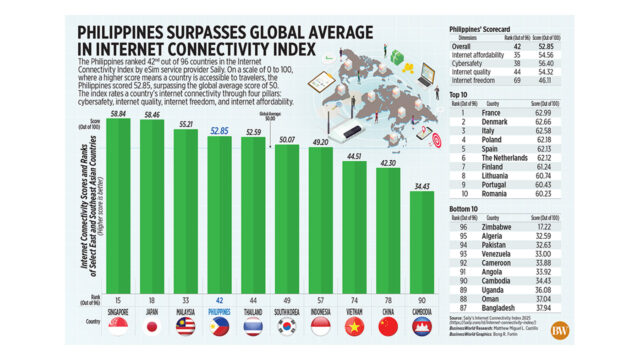
The Philippines ranked 42nd out of 96 countries in the Internet Connectivity Index by eSim service provider Saily. On a scale of 0 to 100, where a higher score means a country is accessible to travelers, the Philippines scored 52.85, surpassing the global average score of 50. The index rates a country’s internet connectivity through four pillars: cybersafety, internet quality, internet freedom, and internet affordability.

Philippines surpasses global average in Internet Connectivity Index

How PSEi member stocks performed — August 26, 2025

Here’s a quick glance at how PSEi stocks fared on Tuesday, August 26, 2025.


PSEi tumbles to four-month low on tariff threats

REUTERS

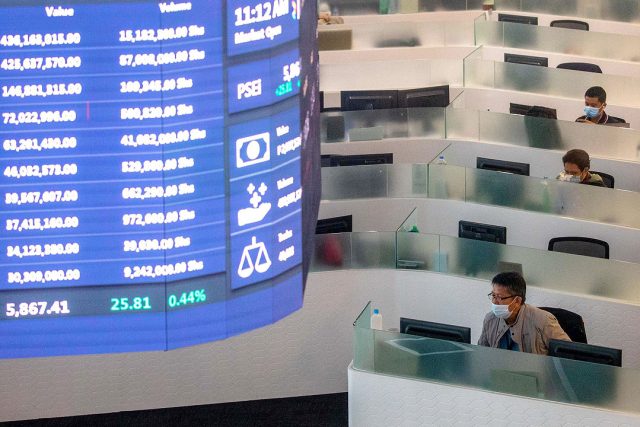
PHILIPPINE SHARES plummeted on Tuesday, with the benchmark index falling to the 6,100 level and hitting a four-month low, following US President Donald J. Trump’s latest tariff threats. 

The bellwether Philippine Stock Exchange index (PSEi) fell by 2.17% or 136.34 points to close at 6,145.24, while the broader all shares index dropped by 1.41% or 53.03 points to end at 3,684.55.

This was the PSEi’s worst close in over four months or since it finished at 6,138 on April 21.

“The local market started the week on a negative tone as the US’ latest tariff threats weighed on sentiment. US President Donald Trump warned of significant tariffs against China if the country would not export rare earth magnets to the US,” Philstocks Financial Inc. Research Manager Japhet Louis O. Tantiangco said in a Viber message.

“The US President also warned of additional tariffs to countries that would not remove taxes and other measures on digital services,” he added.

On Monday, Mr. Trump said China had to give the United States rare earth magnets or “we have to charge them 200% tariff or something,” Reuters reported.

Senior Chinese trade negotiator Li Chenggang is expected to travel to Washington this week to meet US officials, a United States government spokesperson said, with the two superpowers looking to chart a path beyond their current truce.

Mr. Trump also threatened countries that have digital taxes with “subsequent additional tariffs” on their goods if those nations do not remove such legislation.

“The market saw a decline today as most stocks were weighed down by heavy selling pressure,” Regina Capital Development Corp. Head of Sales Luis A. Limlingan said in a Viber message.

“Investors are positioning ahead of the Bangko Sentral ng Pilipinas’ (BSP) policy rate decision this week, with all eyes on how the stock market will react once the central bank’s move is confirmed,” he added. The BSP is widely expected to deliver a third straight 25-basis-point cut at the Monetary Board’s policy meeting on Thursday.

Almost all sectoral indices closed lower on Tuesday. Services fell by 5.46% or 124.49 points to 2,151.69; financials sank by 3.02% or 64.05 points to 2,052.40; holding firms went down by 0.41% or 21.67 points to 5,183.79; property declined by 0.26% or 6.43 points to 2,438.03; and industrials retreated by 0.1% or 9.75 points to 9,103.17. 

Meanwhile, mining and oil rose by 1.04% or 99.50 points to 9,588.74. 

“Ayala Land, Inc. was the top index gainer for the day, jumping 5.17% to P28.50. BDO Unibank, Inc. was the worst index performer, plunging 7.99% to P131.20,” Mr. Tantiangco said.

Value turnover jumped to P14.32 billion on Tuesday with 1.55 billion shares traded from the P6.44 billion with 803.64 million shares exchanged on Friday.

Decliners outnumbered advancers, 112 versus 81, while 64 names were unchanged.

Net foreign selling swelled to P2.04 billion on Tuesday from P721.91 million on Friday. — Revin Mikhael D. Ochave with Reuters

Business chambers welcome Konektadong Pinoy enactment

PHILSTAR FILE PHOTO

BUSINESS CHAMBERS said on Tuesday that the Konektadong Pinoy Act will improve the economy’s competitiveness and hasten the Philippines’ digital transition.

The Joint Foreign Chambers, the EU-ASEAN Business Council, the IT and Business Process Association of the Philippines, and the US-ASEAN Business Council welcomed the new measure in a joint statement.

“We see this as a landmark achievement that will significantly improve internet access, boost the Philippines’ economic competitiveness, and strengthen its digital ecosystem as ASEAN develops its regional Digital Economy Framework Agreement (DEFA),” the groups said.

However, they said the “law’s success will be dependent on the development of implementing rules and regulations (IRR) that protect the free and seamless flow of data across borders.”

In particular, they said that the IRR needs to ensure that businesses are able to innovate and scale to fully harness the potential of the digital economy.

“We remain committed to supporting the Philippines’ digital transformation and look forward to the full and immediate implementation of this law,” they added.

The Konektadong Pinoy bill, which lapsed into law on Sunday, relaxes the entry requirements for investing in the data transmission industry, thereby increasing internet access and the development of digital infrastructure.

Opponents of the law cited the risks it poses to national security, with incumbents threatening to mount legal challenges.

One of the sticking points is a provision in the law allowing new data transmission entrants to operate without obtaining a legislative franchise or a certificate of public convenience and necessity.

The Department of Information and Communications Technology said it is currently working on the draft IRR which will be presented in a public consultation. The final IRR is due to be released within 60 days. — Justine Irish D. Tabile

Rice-importing powers pushed for FTI, Planters

THE Department of Agriculture (DA) proposed to legislators that Food Terminal, Inc. (FTI)  and Planters Products, Inc. be granted the power to import rice on behalf of the government.

The proposal follows efforts to amend the Rice Tariffication Law, which had stripped the National Food Authority (NFA) of its import powers and opened up the import trade to private traders.

In a statement, the DA cited the need to exert regulatory power over rice imports to prevent oversupply, which it said has “depressed” farmgate prices earned by domestic farmers.

“We must regain control,” Agriculture Secretary Francisco P. Tiu Laurel, Jr. said. “Rice is a commodity imbued with too much public interest to leave entirely to the private sector.”

At present, the NFA is required to build up its rice reserves by procuring domestic rice, but it can only purchase about 5% of the palay (unmilled rice) harvest “due to limited warehousing and drying capacity,” the DA noted.

It added that the NFA’s impact on the market is limited to releasing rice during calamities.

The DA said if needed, government corporations under its umbrella like FTI and the Planters Products “could import on behalf of the government.”

“The proposed changes aim to strike a balance between ensuring affordable rice for consumers and protecting the livelihoods of Filipino rice farmers,” it said.

The DA, however, clarified that the rice import function will remain largely with the private sector.

Mr. Laurel has told the Senate that private importers should be required to share the responsibility of maintaining the country’s rice reserves.

“If we aim to have a 20-day rice buffer stock, we’re thinking of a 50-50 split between the NFA and the private sector,” he said.

Under the proposed setup, rice imports will follow the sugar import model, under which the Sugar Regulatory Administration  issues import allocations only to qualified importers. 

Rice importers will also be required to maintain their reserves by procuring palay from domestic farmers at fair prices.

A private sector role in maintaining the buffer stock, sourced from local rice farmers, will also reduce the cost to the government of maintaining its rice reserve, Mr. Laurel said. — Kyle Aristophere T. Atienza

La Niña could bring more typhoons by September

PHILIPPINE STAR/MIGUEL DE GUZMAN

A POTENTIAL La Niña could start influencing weather patterns as early as September, mainly in the form of more typhoons, the government weather service, known as PAGASA (Philippine Atmospheric, Geophysical and Astronomical Services Administration), said.

In a statement, PAGASA said the prevailing weather pattern in the tropical Pacific, known as the El Niño Southern Oscillation (ENSO)-neutral, is most likely to persist until October.

However, climate models indicate an increasing probability of a brief La Niña episode emerging between September and December.

La Niña, the cool phase of ENSO, is characterized by unusually cool sea surface temperatures in the central and eastern equatorial Pacific.

PAGASA said a La Niña Watch is issued when conditions are favorable for the development of La Niña within the next six months, and the probability rises to above 55%.

It said La Niña typically result in an above-average number of tropical cyclones towards the end of the year and above-normal rainfall in most of the Philippines, possibly bringing floods and landslides to vulnerable areas, it added.

PAGASA said it will continue to “closely monitor the ongoing El Niño, its effect on the local climate, and the possibility of La Niña.” — Kyle Aristophere T. Atienza

Vehicles procured via e-portal valued at nearly P290 million

DBM

VARIOUS agencies have taken possession of nearly P290 million worth of motor vehicles (MVs) procured via the e-Marketplace platform, the Department of Budget and Management (DBM) said on Tuesday.

The DBM’s Procurement Service (PS) reported that 153 vehicles have been delivered to 50 government agencies as of Aug. 26.  The vehicles were acquired for a combined P289.936 million.

The DBM also reported that 30 more agencies are awaiting the delivery of 56 vehicles, valued at P115.72 million.

“When compared to the Authority to Purchase Motor Vehicle — a documentary requirement for procuring entities to procure MVs which indicates the budget ceiling for purchase — the savings shoot up to P27.43 million,” the DBM said via Viber.

The e-Marketplace is an official electronic commerce platform where agencies can directly procure supplies and equipment from vetted suppliers.

The PS said only motor vehicles are currently available on the e-Marketplace but expects to add airline tickets, cloud computing services, and software and licenses soon.

The e-Marketplace currently lists 83 vehicle models available for procurement, including multi-purpose vehicles, passenger vans, utility vans, sport utility vehicles, sedans, buses, mini buses, and pick-up trucks. 

The e-Marketplace had been projected to process at least P320 million in transactions this year.

The e-Marketplace is a feature of the New Government Procurement Act, which was signed into law by President Ferdinand R. Marcos, Jr. in July 2024. — Aubrey Rose A. Inosante