Home Blog Page 607

BYD seeks to shift mass market image with souped-up racetrack

BW FILE PHOTO

THE NAME BYD Co. is mainly associated with mass market electric vehicles (EV). A manufacturing behemoth that churns out more electric cars than anyone else on the planet, it’s a brand built on volume and affordability.

BYD cars have become a common sight on China’s roads and a favorite among city taxi and ride-hailing drivers. It’s given rise to a popular joke — while BYD officially stands for “Build Your Dreams,” many quip it’s short for “Be Your Driver.”

Now, BYD is trying to rewrite that narrative, launching luxury models priced over $200,000. Its latest effort to shed its utilitarian skin has involved building an entire automotive racing and testing playground to bring potential customers from the street to the track.

The Shenzhen-based automaker opened the “all-terrain circuit” in Zhengzhou, a city with over 10 million people in central China, earlier this month. It’s part of a plan to invest 5-billion-yuan ($700 million) to set up tracks that are open to the public and designed specifically for new energy vehicles.

For an entry fee of 599 yuan, rev heads can get an hour-long taste of the action, including test driving a popular volume model and a track ride in the 1-million-yuan Yangwang U9.

The Gymkhana-style drills kind of feel like a paid sales promotion, however for a few dollars more, aspiring racers can pay for access to a wider range of BYD’s premium lineup and that’s when things get interesting. Drivers can experience flooring it on a 550 meter-long straightway and try out standard slalom, a graceful, repetitive zigzag maneuver, or moose testing, a more aggressive, single emergency swerve designed to test a car’s stability and agility.

There’s even a dune built with over six thousand tons of sand that offers a steep incline of almost 30 meters, plus a pool, where Yangwang EVs can be put through their paces in water.

BYD opening all this up to the general public is a departure of sorts, considering legacy carmakers tend to keep tracks private for R&D purposes. Some luxury brands, like BMW AG and Porsche, offer track tests for buyers of their high-performance cars, but generally the focus is on a single experience.

BYD isn’t the only Chinese automaker tapping into motor sports. Zhejiang Geely Holding Group Co. has built several tracks, including the Ningbo International Circuit, and founder and Chairman, Li Shufu, has even proposed to the government that racetracks meeting international standards be supported with land and tax benefits.

Xiaomi Corp.’s SU7 Ultra prototype meanwhile broke the lap record at the world famous Nurburgring track in Germany’s Eifel mountains, and the tech giant has a club for certified Xiaomi racers.

For racing purists, BYD’s concept will present a paradox. The very essence of motor sports has long been tied to the visceral experience: the roar of the engines, the vibration of a car’s body and the raw, unfiltered feedback from the road.

EVs, by contrast, are defined by their near-silent operation and instantaneous, linear acceleration. An old-school racer, accustomed to the tactile feel of a manual gear shift, might see the quiet hum of an electric motor as a betrayal of the sport’s spirit.

The growing number of intelligent and automated features could be even more frustrating.

In traditional racing, the driver’s skill — the precise maneuvering of the clutch, brake and throttle — is what pushes the car to its limits. But racing an EV with driver-assisted functions can feel as though the car, rather than the driver, is making most of the adjustments.

“It really depends on your personal definition of ‘driving pleasure,’” said Sean Zhou, a Shanghai-based F1 commentator and automotive influencer. “There’s no doubt it’s fast, but whether you’ll enjoy it is a completely subjective matter.”

Probably BYD is not trying to convert die-hard gear-heads but rather build a new driving culture without alienating its core customer base. As well as race drills and circuits, the Zhengzhou track allows for more mundane things like intelligent all-wheel drive and automated parking practice.

BYD isn’t stopping at one. Other cities including Hefei and Shaoxing, both a few hours’ drive from Shanghai, are on the list for their own ultra experience tracks.

Having captured the mass market, a carmaker like BYD only has two options to climb the brand ladder, according to Zhou. “Either it gets super luxurious, like a Rolls-Royce, or it gets super sporty, like a Ferrari. Ultimately, a brand’s pricing power is determined by the emotional value it offers, and that value can only be delivered in a few key ways.” Bloomberg News

Vietnam island building in Spratlys may soon surpass China’s — report

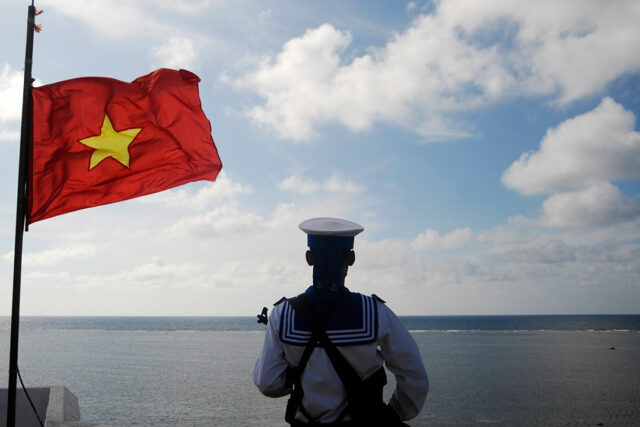
A VIETNAMESE naval soldier stands guard at Thuyen Chai island in the Spratly archipelago, Jan. 17, 2013. — REUTERS

WASHINGTON — Vietnam has significantly expanded island building work in areas it claims in the Spratly Islands chain of the disputed South China Sea and will match and likely surpass the scale of such activity there by China, a US think tank reported on Friday.

Recent satellite imagery showed that since the start of this year, Vietnam has expanded island-building to eight features previously untouched by a round of reclamation that began in 2021, the report from Washington’s Center for Strategic and International Studies (CSIS) said.

The report from CSIS’ Asia Maritime Transparency Initiative, said the imagery showed Vietnam has undertaken dredging and landfill work at Alison Reef, Collins Reef, East Reef, Landsdowne Reef and Petley Reefs.

The work meant that all 21 Vietnamese-occupied rocks and low-tide elevations in the Spratly Islands chain have now been expanded to include artificial land, when four years ago a majority hosted only isolated pillbox structures.

The report said new expansion had also begun at three features that already hosted medium-sized artificial islands created in earlier rounds of dredging: Amboyna Cay, Grierson Reef, and West Reef.

“As of March 2025, Vietnam had created about 70% as much artificial land in the Spratlys as China had,” it said. “Reclamation at these eight new features all but ensures that Vietnam will match — and likely surpass — the scale of Beijing’s island-building.”

China claims almost the entire South China Sea, despite overlapping claims by Brunei, Malaysia, the Philippines and Vietnam. Beijing has conducted extensive island-building work there opposed by the United States and its allies and partners.

The CSIS report said the images showed infrastructure, including munitions storage containers, was beginning to appear on Vietnamese claimed reefs where dredging work was approaching completion, such as Barque Canada Reef, Discovery Great Reef, Ladd Reef, Namyit Island, Pearson Reef, Sand Cay, and Tennent Reef.

It said the location of new structures and munitions depots seemed to preclude the possibility of full-length runways on some of the longer features and said a runway at Barque Canada was likely the only one being constructed to join Vietnam’s sole existing airstrip at Spratly Island. China and Vietnam’s Washington embassies did not immediately respond to requests for comment on the CSIS report.

In February, China said it opposes Vietnam’s construction activities on Barque Canada Reef, saying it was Chinese territory.

In 2016, the Permanent Court of Arbitration in the Hague ruled that China’s South China Sea claims were not supported by international law, a decision Beijing rejects. — Reuters

US confirms nation’s first travel-associated human screwworm case linked to Central American outbreak

CDC.GOV

BUENOS AIRES/CHICAGO/WASHINGTON — The US Department of Health and Human Services (HHS) on Sunday reported the first human case in the United States of travel-associated New World screwworm, a flesh-eating parasite, from an outbreak-affected country.

The case, investigated by the Maryland Department of Health and the US Centers for Disease Control and Prevention (CDC), was confirmed by the CDC as New World screwworm on Aug. 4, and involved a patient who returned from travel to El Salvador, HHS spokesman Andrew G. Nixon said in an e-mail to Reuters.

Earlier, Reuters reported that beef industry sources said last week that the CDC had confirmed a case of New World screwworm in a person in Maryland who had traveled to the United States from Guatemala.

Mr. Nixon did not address the discrepancy on the source of the human case.

“The risk to public health in the United States from this introduction is very low,” he said.

The US government has not confirmed any cases in animals this year.

The differing accounts from the US government and industry sources on the human case are likely to further rattle an industry of cattle ranchers, beef producers and livestock traders already on high alert for potential US infestations as screwworm has moved northward from Central America and southern Mexico.

The government’s confirmation of a screwworm case comes just over a week after US Department of Agriculture (USDA) Secretary Brooke Rollins traveled to Texas to announce plans to build a sterile fly facility there as part of efforts to combat the pest.

The USDA has estimated a screwworm outbreak could cost the economy in Texas, the biggest US cattle-producing state, about $1.8 billion in livestock deaths, labor costs and medication expenses.

An executive of the industry group Beef Alliance sent e-mails last week to about two dozen people in the livestock and beef sectors, informing them that the CDC had confirmed a human case of screwworm in Maryland in a person who had traveled to the US from Guatemala, according to a source, who asked not to be identified, and who shared the contents of the e-mails with Reuters.

Beth Thompson, South Dakota’s state veterinarian, told Reuters on Sunday that she was notified of a human case in Maryland within the last week by a person with direct knowledge of it. CDC deferred questions to Maryland on a call with state animal health officials, Ms. Thompson said.

“We found out via other routes and then had to go to CDC to tell us what was going on,” she said. “They weren’t forthcoming at all. They turned it back over to the state to confirm anything that had happened or what had been found in this traveler.”

Another source said that state veterinarians had learned about a human case in Maryland during a call last week with the CDC. A Maryland state government official also confirmed a case.

A spokesperson for the Maryland Department of Health did not immediately respond to requests for comment.

WHAT ARE SCREWWORMS?
Screwworms are parasitic flies whose females lay eggs in wounds on any warm-blooded animal. Once the eggs hatch, hundreds of screwworm larvae use their sharp mouths to burrow through living flesh, eventually killing their host if left untreated.

The maggots’ feeding is similar to a screw being driven into wood, giving the pests their name.

Screwworms can be devastating in cattle and wildlife, and rarely infest humans, though an infestation in either an animal or a person can be fatal.

Treatment is onerous, and involves removing hundreds of larvae and thoroughly disinfecting wounds. But infestations are typically survivable if treated early enough.

The e-mails from the Beef Alliance executive said that due to patient privacy laws, there were no other details available about the positive human case of screwworm. The person was treated and prevention measures were implemented in the state, the e-mail said.

A livestock economist at Texas A&M University was asked to prepare a report for Rollins on the impacts to industry of the border closure to Mexican cattle, according to the e-mails, a measure that has largely been in effect since November to prevent the arrival of screwworm to the United States.

The CDC was required to report the positive New World screwworm case to both Maryland health officials and the Maryland state veterinarian, one of the e-mails said, adding that the CDC also notified other agriculture stakeholders.

“We remain hopeful that, since awareness is currently limited to industry representatives and state veterinarians, the likelihood of a positive case being leaked is low, minimizing market impact,” the beef industry executive wrote.

A representative for the Beef Alliance did not respond to requests for comment.

IMPACT ON BEEF AND CATTLE FUTURES
Livestock traders and beef producers have been on edge about the potential for cases in cattle as prices have already hit record highs because the US cattle herd is at its smallest size in seven decades.

A human case and the lack of transparency around it could present a political challenge for Rollins. The USDA has set traps and sent mounted officers along the border, but it has faced criticism from some cattle producers and market analysts for not acting faster to pursue increased fly production.

Rollins first announced plans for a sterile fly facility at Moore Air Force Base in Edinburg, Texas — near where a production facility to combat screwworm operated during the last major outbreak 50 years ago — in June, saying that the facility would take two to three years to come online.

A spokesperson for the USDA did not immediately respond to a request for comment.

Mexico has also taken efforts to limit the spread of the pest, which can kill livestock within weeks if not treated. The Mexican government said in July that it started to build a $51-million sterile fly production facility in the country’s south.

The sole operating plant is in Panama City and can produce a maximum of 100 million sterile screwworm flies each week. The USDA has estimated that 500 million flies would need to be released weekly to push the fly back to the Darien Gap, the stretch of rainforest between Panama and Colombia.

Screwworms have been traveling north through Mexico from Central America since 2023. They are endemic in Cuba, Haiti, the Dominican Republic and countries in South America, according to the USDA.

Mexico reported a new case about 370 miles (595 kilometers) south of the US border in Ixhuatlan de Madero, Veracruz, in July. The USDA immediately ordered the closure of livestock trade through southern ports of entry, after previously halting imports in November and May.

The US typically imports over a million cattle from Mexico a year to fatten in feedlots and process into beef.

Screwworms were eradicated from the United States in the 1960s when researchers began releasing massive numbers of sterilized male screwworm flies that mate with wild female screwworms to produce infertile eggs. — Reuters

South Korea tells China it wants to normalize ties, upgrade economic relations

STOCK PHOTO | Image by Vitamin from Pixabay

SEOUL — South Korea hopes to normalize relations with China that have been strained in recent years, a special envoy from Seoul told Chinese Foreign Minister Wang Yi on Sunday, and agreed to boost economic cooperation, Seoul’s foreign ministry said.

South Korean President Lee Jae Myung sent a special delegation led by former parliament speaker Park Byeong-seug to his country’s main trading partner as he travels to Washington to meet US President Donald J. Trump.

Mr. Lee arrived in Washington early on Monday.

Mr. Park told Mr. Wang he hoped the countries would work together to “open the door to normalizing South Korea-China relations, which have been strained in recent years,” according to his comments relayed by South Korean TV.

Mr. Park handed Mr. Wang a letter from Mr. Lee to Chinese President Xi Jinping and invited Mr. Xi to the summit of the Asia-Pacific Economic Cooperation (APEC) grouping in October, South Korea’s foreign ministry said in a statement on Monday.

Mr. Wang welcomed the delegation’s visit and appreciated the message of developing ties between the countries, the ministry said.

“(South Korea’s) new government will pursue a mature development of South Korea-China strategic cooperation partnership based on national interest while continuing to develop the South Korea-US alliance,” Mr. Park said.

The two sides agreed to work towards substantive progress on economic and supply chain cooperation, the ministry said.

In a readout from the Chinese foreign ministry, Mr. Wang said that development of both countries’ ties has shown that good neighborliness, seeking common ground while reserving differences and expanding cooperation are the “right choices.”

Mr. Wang added that China’s policy is to maintain stability and continuity with South Korea and he urged both sides to “improve national sentiment and manage sensitivities properly” to move bilateral relations forward steadily.

Diplomatic ties between the countries have improved since a 2017 dispute over South Korea’s deployment of a US missile defense system, which Beijing opposed.

But they exchanged harsh words in 2023 about critical comments on Beijing by South Korea’s last president, Yoon Suk Yeol. — Reuters

China’s new mega-dam triggers fears of water war in India

This photo shows a hydroelectric dam near Shannan, Tibet Autonomous Region, China taken on March 30, 2025. — REUTERS/GO NAKAMURA

PARONG, India — India fears a planned Chinese mega-dam in Tibet will reduce water flows on a major river by up to 85% during the dry season, according to four sources familiar with the matter and a government analysis seen by Reuters, prompting Delhi to fast-track plans for its own dam to mitigate the effects.

The Indian government has been considering projects since the early 2000s to control the flow of water from Tibet’s Angsi Glacier, which sustains more than 100 million people downstream in China, India and Bangladesh. But the plans have been hindered by fierce and occasionally violent resistance from residents of the border state of Arunachal Pradesh, who fear their villages will be submerged and way of life destroyed by any dam.

Then in December, China announced that it would build the world’s largest hydropower dam in a border county just before the Yarlung Zangbo river crosses into India. That triggered fears in New Delhi that its long-time strategic rival — which has some territorial claims in Arunachal Pradesh — could weaponize its control of the river, which originates in the Angsi Glacier and is known as the Siang and Brahmaputra in India.

India’s largest hydropower company in May moved survey materials under armed police protection near a prospective site of the Upper Siang Multipurpose Storage Dam, which would be the country’s biggest dam, if completed. Senior Indian officials have also been holding meetings about accelerating construction this year, including one organized in July by Prime Minister Narendra Modi’s office, according to two of the sources, who spoke on condition of anonymity to discuss sensitive government matters.

Delhi’s concerns were described in the undated Indian government analysis of the Chinese dam’s impact, the specifics of which Reuters corroborated with four sources and is reporting for the first time.

Beijing hasn’t released detailed plans about the dam’s construction, but the analysis drew on past work conducted by Indian government-affiliated institutions like the Central Water Commission and accounted for the expected size of the Chinese project, which broke ground in July and will cost nearly $170 billion.

Delhi estimates the Chinese dam will allow Beijing to divert as much as 40 billion cubic meters (BCM) of water, or just over a third of what is received annually at a key border point, according to the sources and the document. The impact would be especially acute in the non-monsoon months, when temperatures rise and lands become barren across swathes of India.

The Upper Siang project would alleviate that with its projected 14 BCM of storage capacity, allowing India to release water during the dry season. That could mean the major regional city of Guwahati, which is dependent on water-intensive industry and farming, would see a reduction in supply of 11%, according to the sources and the document, as opposed to 25% if the Indian dam isn’t built.

The project could also mitigate any move by Beijing to release devastating torrents of water downstream, the sources said.

If the dam is at its minimum drawdown level — where water is stored at less than 50% of its height — it would be able to fully absorb any excess water released from a breach in Chinese infrastructure, according to the document and the sources. India is considering a proposal to keep 30% of its dam empty at any time in order to account for unexpected surges, two of the sources said.

A spokesperson for China’s foreign ministry said in response to Reuters’ questions that the hydropower projects “have undergone rigorous scientific research on safety and environmental protection, and will not adversely impact the water resources, ecology, or geology of downstream countries.”

“China has always maintained a responsible attitude toward the development and utilization of transboundary rivers, and has maintained long-term communication and cooperation with downstream countries such as India and Bangladesh,” the spokesperson added.

Mr. Modi’s office and the Indian ministries responsible for water and external affairs did not respond to Reuters’ questions. State-owned hydropower major National Hydroelectric Power Corporation (NHPC) also did not return a request for comment.

India’s foreign ministry has said that top diplomat S. Jaishankar raised concerns about the dam during a meeting with his Chinese counterpart on Aug. 18. A Jaishankar deputy also told lawmakers in August that the government was implementing measures to safeguard the lives and livelihoods of citizens in downstream areas, including building the dam.

India has itself been accused by Pakistan, a Chinese ally that it briefly clashed with in May, of weaponizing water. Delhi this year suspended its participation in a 1960 water-sharing treaty with Islamabad and is considering diverting flows from another crucial river away from its downstream neighbor.

An international tribunal has ruled that India must adhere to the agreement but Delhi says the panel lacks jurisdiction.

DEVELOPMENT OR DESTRUCTION?
When NHPC workers moved surveying materials near the village of Parong in May, angry locals damaged their machinery, destroyed a nearby bridge and looted the tents of police sent to guard the operation.

Many of them are members of Arunachal’s Adi community, who live off paddy, orange and sweet lime farms in the mist-shrouded hills and valleys nourished by the Siang.

The villagers have set up makeshift watch posts on regional roads to deny access to NHPC workers. That has forced security personnel to trek miles, often under cover of night, to reach a prospective site of the dam.

At least 16 Adi villages are likely to be lost to the storage area of the dam, directly affecting an estimated 10,000 people, according to two of the sources. Community leaders say more than 100,000 people will be impacted overall.

“The cardamom, paddy, jackfruit and pear we grow on this land help educate our children and support our family,” said Odoni Palo Pabin, an Adi grocer and mother of two. “We will fight the dam to death.”

The dam has the support of Arunachal’s chief minister, who is a member of Mr. Modi’s party and has called the Chinese project an existential threat.

The project will “ensure water security and provide flood moderation to counter any potential water surges,” the state government said in a statement, adding that it decided in June to engage in detailed compensation discussions with families that could be affected by the dam.

Lawmaker Alo Libang, an Adi who represents an area that would be submerged by the Indian project, said he believed locals could be convinced to move if they received generous compensation.

NHPC has plans to spend more than $3 million on education and emergency infrastructure to incentivize the villagers to move elsewhere, three of the sources said, citing instructions from Mr. Modi’s office.

In one sign of progress, three villages in the area recently agreed to let NHPC officials carry out dam-related work, according to the Arunachal government and dozens of locals.

India has a history of activist movements against large dams, which have sometimes slowed these projects by years or forced them to scale down.

Even if the Upper Siang dam gets the go-ahead, it could take a decade to build after breaking ground, according to four of the sources. That means the project would likely be completed after China’s project, which Beijing expects to start generating power by the early-to-mid 2030s.

The delay means an Indian project would be vulnerable during construction if Beijing suddenly releases water during the monsoon season, triggering a surge that could wash away temporary dams, two of the sources said.

International experts and Adi activists have also warned that building large dams in seismically active Tibet and Arunachal could heighten risks for downstream communities.

The Chinese “dam is being built in a zone of high seismicity and in a zone that experiences extreme weather events,” said Sayanangshu Modak, an expert on the India-China water relationship at the University of Arizona.

“These kinds of extreme weather events trigger landslides, mudslides, glacial lake outburst flooding,” he said. “So that raises concerns about dam safety… it’s a very legitimate concern and India should engage with China.” — Reuters

Alex Eala advances at Flushing Meadows in major first for Philippines

ALEX EALA — JIMMIE48/WTA

NEW YORK — Alexandra Eala became the first Filipino player to win a main draw match at a Grand Slam in the professional era, as she beat 14th seed Clara Tauson in an opening round upset at the US Open on Sunday.

Eala burst into tears amid raucous support from the Grandstand crowd as she produced a stunning comeback from 5-1 down in the third set to beat the Dane 6-3 2-6 7-6 (11) after Tauson had twice served for the match.

“It means a lot, I think you could see by my reaction,” Eala told reporters.

“Everything just made it so special – from who I was playing to the crowd, it was amazing. I’m so blessed to be the first to do this. I take so much pride in representing my country.

“I’m so blessed to be the first to do this. It makes what I do bigger than myself, and it ads meaning to what I do.”

The 20-year-old is no stranger to big moments at Flushing Meadows, having made history in 2022 as the first Filipino to win a junior Grand Slam singles title.

The historic day for Southeast Asia was sweetened by Janice Tjen, who became the first Indonesian in 22 years to win a match at a major. Tjen beat 24th seed Veronika Kudermetova 6-4 4-6 6-4 and will face Britain’s Emma Raducanu in the second round.

“I feel proud to be able to do this for my country,” Tjen said. “Hopefully like this, by me making appearance here, will inspire more tennis players, like, younger kids to play tennis and also believing that they can be here too.”

Eala said that succeeding alongside Tjen made her achievement even more meaningful.

“I’m so happy to see the progress of tennis in Southeast Asia in general,” she said. “I’ve known (Tjen) for a long time, so I’m happy for her. I’m happy that players from this region are coming up and starting to be successful.”

Eala will aim to carry her momentum into Wednesday’s second-round match against either Spain’s Cristina Bucsa or American qualifier Claire Liu.

“I think the key for my upcoming match is just to come in with the same mentality, same fight,” she added.

“Right now I’m just focused on recovering. That was a very tough match, but I think this will help long-term.” — Reuters

DigiPlus pioneers 24/7 CX operational powerhouse

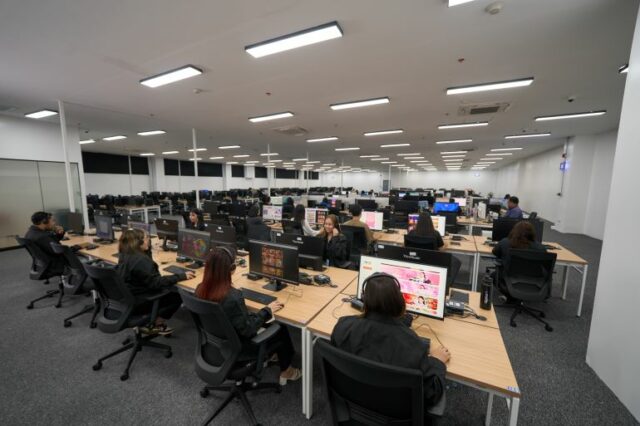
CX representatives at the DigiPlus Merville studio assist players with their needs and questions across all gaming platforms: BingoPlus, ArenaPlus, and GameZone.

DigiPlus Interactive Corp., the driving force behind the brands BingoPlus, ArenaPlus, and GameZone, continues to enhance its customer experience (CX) by offering round-the-clock player support, setting a new standard in the industry. With over 40 million registered users, DigiPlus is steadily expanding its customer service operations to ensure timely assistance across account management, transaction support, technical troubleshooting, and fraud prevention.

Since its transition to digital operations during the pandemic, DigiPlus has fostered a vibrant and growing online community through its e-games and entertainment offerings. By bringing the excitement of gaming into the home, the company has made play more convenient, engaging, and accessible — anytime, anywhere.

As DigiPlus continues to scale its business, its customer support team has grown to over 300 dedicated members, with plans to reach 450 by yearend. This expansion underscores the company’s commitment to delivering high-quality assistance at every player interaction. By implementing a well-structured support system covering both primary and premium tiers, DigiPlus has built a customer experience framework that not only resolves issues efficiently but also drives greater player satisfaction across all touchpoints.

“The strengthening of our customer service operations plays a vital role in making certain that every player’s concern is addressed swiftly and effectively. Our goal is to elevate the level of service and guarantee timely resolution of all player issues reinforcing our unwavering commitment to player satisfaction,” said Customer Service Director Carlos Pio Feliciano.

A CX representative happily assisting a player over the phone with a withdrawal request — a concern that is the top reason players call.

Serving a diverse user base across generations, DigiPlus provides support through various channels, including email, chat, and calls. On average, the customer service team handles nearly million transactions per month. The most common concerns involve withdrawals, KYC (Know Your Customer) processes, game fairness, deposits, and account registration.

Representatives undergo advanced communication training covering essential areas such as product knowledge, communication techniques, conflict resolution, and technical troubleshooting. Their top priority is maintaining transparency with players, keeping them informed throughout the resolution process.

“Our commitment to excellence doesn’t stop after initial training,” added Feliciano. “We provide continuous learning modules to ensure our CX representatives stay up-to-date with the latest platform updates, tools, and industry trends. This guarantees they remain equipped to address new challenges as they arise.”

By investing in cutting-edge technology, ongoing training, and innovative digital solutions, DigiPlus is actively cultivating a customer-first culture rooted in trust, satisfaction, and brand loyalty. This 24/7 CX operational powerhouse reflects the company’s commitment to outstanding service and its position at the forefront of digital entertainment.

For players who seek support and assistance, you may contact the following lines 24/7:
BingoPlus — bingoplus.ph | cs@bingoplus.vip | (02) 8539-0282
ArenaPlus — arenaplus.ph | cs@arenaplus.vip | (02) 8539-0285
GameZone — gzone.ph | cs@gamefun.pro | (02) 8539-0286


Spotlight is BusinessWorld’s sponsored section that allows advertisers to amplify their brand and connect with BusinessWorld’s audience by publishing their stories on the BusinessWorld Web site. For more information, send an email to online@bworldonline.com.

Join us on Viber at https://bit.ly/3hv6bLA to get more updates and subscribe to BusinessWorld’s titles and get exclusive content through www.bworld-x.com.

World’s central bankers fear being caught in Fed’s storm

REUTERS/KEVIN LAMARQUE/FILE PHOTO

JACKSON HOLE, Wyoming — Global central bankers gathered at a US mountain resort over the weekend are starting to fear that the political storm surrounding the Federal Reserve may eUSngulf them too.

US President Donald Trump’s efforts to reshape the Fed to his liking and pressure it into interest rate cuts have raised questions about whether the US central bank can preserve its independence and inflation-fighting credentials.

Trump, frustrated by the legal protections given to the Fed’s leadership and the long terms for Board of Governors members meant to outlast any given president, has put intense pressure on Chair Jerome Powell to resign and is pushing to oust another board member, Governor Lisa Cook.

If the world’s most powerful central bank were to yield to that pressure, or Trump finds a playbook for removing its members, a dangerous precedent would be set from Europe to Japan, where established norms for the independence of monetary policy may then come under new attack from local politicians.

“The politically motivated attacks on the Fed have a spiritual spillover to the rest of the world, including Europe,” European Central Bank policymaker Olli Rehn, from Finland, said on the sidelines of the Fed’s annual symposium in Jackson Hole, Wyoming.

That’s why Rehn and colleagues were enthusiastically backing Powell to stand his ground, even after he signaled a possible rate cut in September. Powell was met by a standing ovation when he took the podium at the conference.

‘NOT BE TAKEN FOR GRANTED’
Conversations with a dozen central bankers from across the world on the sidelines of the Fed’s getaway in the shadows of the Grand Teton Mountains revealed that a scenario in which the Fed sees its ability to counter inflation jeopardized by a loss of independence was taken as a direct threat to their own standing and to economic stability more broadly.

It would likely entail major turmoil in financial markets, they said, with investors demanding a greater premium to own US bonds and reassessing the status of Treasury securities as the lifeblood of the global financial system.

Central banks around the world have already started preparing for the fallout, telling lenders on their watch to watch their exposure to the US currency.

More fundamentally, a Fed capitulation would end a regime that has brought relative price stability and has lasted at least since late Chair Paul Volcker vanquished high inflation 40 years ago.

Since then, more and more central banks followed the Fed’s model of political independence and a single-minded focus on their mandate – for most, keeping inflation near 2%.

“It’s a reminder that independence should not be taken for granted,” Bundesbank President Joachim Nagel, also a member of the ECB’s Governing Council, said. “We have to deliver on our mandate and make clear that independence is the conditio sine qua non for price stability.”

POLITICAL FOOTBALL
Markets so far have not registered deep concerns about the Fed’s independence. US equity markets are roaring, and there hasn’t been the sort of jump in Treasury yields or inflation expectations that would be emblematic of the Fed’s credibility being seen at risk.

While Trump can name a new chair when Powell’s term as the chief policymaker ends in May, he needs more departures among the Fed’s seven-member board for his appointees to gain majority control. The Fed’s network of 12 regional reserve banks, whose leaders take turns voting on interest rate policy, is a further counterweight, hired by local boards of directors as a way to distance them from Washington’s influence.

Yet Trump’s soured relationship with the Fed, set in a country perceived to have strong institutional and legal traditions, has made other central bankers all too aware of how fragile their independence may be.

Even the ECB, whose autonomy from the 20 governments of the euro zone is sanctioned by European Union treaties, has had to fight hard to prove it.

It was accused of bankrolling governments when it launched its massive bond-buying scheme a decade ago with the aim of staving off deflation, and survived multiple court challenges seeking to block those purchases.

Right- and left-wing parties in countries such as Italy, Germany and France have also periodically criticised the central bank.

Other countries have turned the appointment of their national governor into a political football.

Latvian central bank governor Martins Kazaks was criticised by national politicians for not catering to the government’s wishes during his fractious reappointment process. Slovenia hasn’t had a governor since January amid party bickering.

In Japan, the late Prime Minister Shinzo Abe blasted then central bank governor Masaaki Shirakawa for doing too little to beat deflation, and hand-picked Haruhiko Kuroda in 2013 to take the helm when Shirakawa stepped down weeks before his term ended.

Kuroda then deployed a massive asset-buying programme, which helped weaken the yen and reflate growth, but raised eyebrows among conventional central bankers for making the BOJ the main creditor of its own government.

SETTING A BAD EXAMPLE
Trump has said the end of Powell’s term next May could not “come fast enough” and very publicly started the process of choosing a successor.

“It’s as if Trump learned from Abe,” said one source familiar with the BOJ’s thinking who declined to be named due to the sensitivity of the matter.

In turn, Trump’s moves could embolden governments around the world, particularly those with populist inclinations, to assert control over their central banks.

That could set the stage for globally higher inflation rates and more volatile markets.

“Taking over the Fed is one development that would set a very bad example for other governments,” said Maury Obstfeld, a senior fellow at the Peterson Institute for International Economics and former chief economist at the International Monetary Fund.

“How do you look at this happening in the United States, which was thought to be the bastion of institutional checks and balances and the rule of law, and not conclude that other countries are easier targets?” — Reuters

South Korea’s Lee faces pivotal test at first summit with Trump

STOCK PHOTO | Image by Vitamin from Pixabay

WASHINGTON/SEOUL — South Korea’s new president, Lee Jae Myung, will face a pivotal moment on Monday when he meets U.S. President Donald Trump in Washington for their first summit, as the countries’ decades-old alliance strains to confront rapid geopolitical changes.

Much is riding on the meeting for Mr. Lee, who took office in June after a snap election called after his conservative predecessor – feted in Washington for his hard line on North Korea – was removed for attempting to impose martial law.

South Korea’s economy relies heavily on the U.S., Washington underwrites the country’s security with troops and nuclear deterrence, and Lee hopes to chart a balanced path of cooperating with the United States while not antagonizing top trade partner China.

South Korea has long come under targeted criticism from Mr. Trump, who has called it a “money machine” that takes advantage of American military protection.

Mr. Lee will seek to make a good impression, connect personally with Mr. Trump, and above all, avoid any unpleasant surprises, analysts said.

“For Lee, a no-news summit I think would be good,” said Victor Cha of the Center for Strategic and International Studies.

However, Mr. Cha said what Mr. Trump’s aides produce for him to talk about at the meeting may be completely different from what President Trump wants to talk about.

Under heavy pressure from Mr. Trump’s administration, South Korean negotiators secured a last-minute deal last month to avoid the harshest of tariffs but must still hammer out details of billions of dollars in promised investments.

South Korean officials say they hope such working-level trade negotiations will largely be left for other meetings.

“There are many major topics in the security field,” Mr. Lee’s top policy aide, Kim Yong-beom, said on Wednesday. “Our position is that trade was already finalized last time. We hope that specific implementation plans for trade won’t be included in the summit at all, or at least should be kept simple if discussed.”

Several top officials, including the foreign minister, rushed to Washington over the weekend to try to iron out final details.

Mr. Lee, who arrived in Washington on Sunday, will highlight some of South Korea’s expected investments when he visits a shipyard in Philadelphia owned by the country’s Hanwha Group after the summit. Cooperation to help the ailing U.S. shipbuilding sector is part of the broad tariff agreement reached between the countries.

Mr. Trump is expected to pressure Lee to commit to more spending on defense, including potentially billions of dollars more toward the upkeep of 28,500 American troops stationed in South Korea.

Wi Sung-lac, Mr. Lee’s top security adviser, said South Korea was in talks with Washington on Seoul’s higher defense spending, taking as a reference NATO’s agreement on a big new defense spending target. Wi added that the government was also looking into a plan for the purchase of American weapons.

Duyeon Kim, from the Center for a New American Security, said to avoid any public splits, the leaders should focus on reaffirming long-standing alliance principles and broadly agreeing to expand cooperation in all areas.

While focusing on increasing military spending, Mr. Lee will likely seek to avoid conversations about a potential reduction of U.S. troops or using them for a wider range of operations, or details on modernizing the alliance, she said.

“They should leave those topics for working-level officials to hash out,” Mr. Kim said. “Ambition could backfire.”

Mr. Lee said it is difficult for Seoul to accept the demand by the United States to adopt “flexibility” of operating the U.S. military now stationed in South Korea, Yonhap news agency reported on Monday.

Trump and Lee may also discuss efforts to persuade North Korea to freeze and eventually abandon its nuclear weapons program. Both leaders support engaging Pyongyang, and Lee has called for a phased approach to denuclearization.

But North Korea has rejected both American and South Korean overtures so far, and said it will never give up its nuclear arsenal. Leader Kim Jong Un has said the U.S. and South Korea remain hostile to his country and he supervised test firing of new air defense systems over the weekend.

Before Mr. Lee meets Mr. Trump, the South Korean leader travelled to Tokyo to meet Japanese Prime Minister Shigeru Ishiba on Saturday to underscore the importance of cooperation between South Korea, Japan and the U.S.

Mr. Lee and Mr. Ishiba discussed relations with Washington and U.S. tariff issues and the Japanese leader shared his experience with Mr. Trump, which for Seoul was useful information before Mr. Lee’s first meeting with Mr. Trump, said Mr. Wi, the South Korean security adviser. — Reuters

SpaceX postpones Starship test flight over ground system issue

REUTERS

Elon Musk’s SpaceX on Sunday called off the launch of Starship’s tenth mission from Texas over an issue at its launch site, delaying an attempt to achieve several long-sought development milestones missed due to past tests ending in early failures.

The 232-foot(70.7-meter)-tall Super Heavy booster and its 171-foot(52-meter)-tall Starship upper half sat stacked on a launch mount at SpaceX’s Starbase rocket facilities as it was being filled with propellant ahead of a liftoff time of 7:35 p.m. ET (2335 GMT).

But roughly 30 minutes from liftoff, SpaceX said on X it was “standing down from today’s tenth flight of Starship to allow time to troubleshoot an issue with ground systems.”

Mr. Musk had been poised to provide an update on Starship’s development progress prior to the rocket’s launch on Sunday, but a placeholder live stream indicated it had been cancelled.

SpaceX did not say when it would make another launch attempt. Similar scrubs in the past have been resolved in a matter of days.

Development of SpaceX’s next-generation rocket, the center of the company’s powerful launch business future and Mr. Musk’s Mars ambitions, has faced repeated hiccups this year as NASA hopes to use the rocket as soon as 2027 for its first crewed moon landing since the Apollo program.

This year, two Starship testing failures early in flight, another failure in space on its ninth flight, and a massive test stand explosion in June that sent debris flying into nearby Mexican territory have tested SpaceX’s test-to-failure development approach. Still, the company has continued to swiftly produce new Starships for test flights at its sprawling Starbase production facilities.

Those setbacks underscore the technical complexities of Starship’s latest iteration, packed with far more capabilities such as increased thrust, a potentially more resilient heat shield and stronger steering flaps crucial to nailing its atmospheric reentry – key traits for Starship’s rapid reusability that Mr. Musk has long pushed for.

The stacked system had been expected to blast off from Texas around sunset on Sunday before its Starship upper stage separated from the Super Heavy booster dozens of miles in altitude. Super Heavy, which has returned for a landing at its launch pad in giant mechanical arms in past tests, would have instead targeted the Gulf of Mexico for a soft water landing in order to test a backup engine configuration.

Starship was to briefly ignite its own engines to blast further into space, where it would have attempted to release its first batch of mock Starlink satellites and reignite an engine while on a suborbital path around the planet.

After that phase, the ship targets an atmospheric reentry over the Indian Ocean, a crucial flight phase that tests a variety of prototypical heat shield tiles and engine flaps designed to endure a barrage of blazing heat that has largely shredded the rocket’s exterior during past flights.

“Starship’s reentry profile is designed to intentionally stress the structural limits of the upper stage’s rear flaps while at the point of maximum entry dynamic pressure,” SpaceX said on its website. — Reuters

Russia and Ukraine stage new prisoner exchange after UAE mediation

Army soldier figurines are displayed in front of the Ukrainian and Russian flag colors background in this illustration taken, Feb. 13, 2022. — REUTERS/DADO RUVIC/ILLUSTRATION

MOSCOW — Russia and Ukraine exchanged 146 prisoners of war from each side on Sunday after mediation by the United Arab Emirates, the Russian defense ministry and the Ukrainian president said.

The Russian ministry said all of the freed Russians were in Belarus receiving psychological and medical assistance.

Ukraine also returned to Moscow eight Russian citizens, residents of the Kursk region, the ministry said.

Ukrainian President Volodymyr Zelenskiy, writing on the Telegram messaging app, announced that the exchange had taken place, but gave no figures.

The president posted pictures of smiling returnees, saying most of them had been in captivity since 2022, when Russia invaded its smaller neighbor. He said a journalist taken prisoner a month after the invasion was among them.

Mr. Zelenskiy thanked the United Arab Emirates for its role in overseeing the swap.

“The exchanges are continuing. Perhaps that is possible because of our soldiers, who are increasing the exchange fund for Ukraine,” the president wrote, referring to the capture of Russian servicemen.

The Ukrainian military issued a statement confirming that a total of 146 prisoners from each side had been swapped.

Vladimir Medinsky, who has led the Russian side in three rounds of talks on a settlement in Turkey since May, said Ukraine was being slow in returning civilians to Kursk, a Russian region where Kyiv’s forces staged a mass incursion a year ago.

He said more than 20 residents were waiting to go home.

“Three months have passed and residents of Kursk region are not being returned, but are being exchanged in small groups for some people needed by Ukraine,” he wrote on Telegram. “Russia is engaged in painful bargaining to get civilians returned.” — Reuters

Germany should look for new trade partners, Chancellor Merz says

Christian Democratic Union (CDU) party leader Friedrich Merz speaks at the party headquarters, after the exit poll results are announced for the 2025 general election, in Berlin, Germany, Feb. 23, 2025. — REUTERS

BERLIN – Germany should look beyond a trade deal between the United States and the European Union that slaps 15% tariffs on EU goods by finding new trade partners in coming years, Chancellor Friedrich Merz said on Sunday.

“How do we handle world trade if for example the Americans are no longer prepared to play by the rules of the World Trade Organization? “ Merz said at a government Open Day, an event where people can visit Berlin institutions and participate in discussions.

“We should search for partners in the world that share our thinking,” added Mr. Merz , leader of the conservative CDU party whose approval rating stands at 25% – level with Alternative fur Deutschland (AfD) – according to an INSA poll published by newspaper Bild this weekend.

The July 28 framework trade deal was brokered between U.S. President Donald Trump and EU Commission President Ursula von der Leyen.

“We need good economic relations with the U.S., and we may have got off lightly,” said Mr. Merz, noting that trade possibilities might open up in South America, Asia and Africa, and should be of mutual benefit.

“We must consistently go down that road,” he said.

Mr. Merz also said basic questions regarding social security systems needed to be addressed by the end of the year, arguing that the government must rein in welfare spending on employment, pension and health benefits.

“We have to make our social security systems fit for the future,” he said. — Reuters