Home Blog Page 606

Trump puts his own name on US Institute of Peace ahead of Rwanda-Congo peace deal

U.S. President Donald Trump delivers remarks at the Roosevelt room at White House in Washington, US, Jan. 21, 2025. — REUTERS

WASHINGTON — President Donald Trump’s name has been affixed to the United States Institute of Peace building in Washington, DC, nearly nine months after his Department of Government Efficiency seized the nonprofit organization and all but closed it.

The change came ahead of Mr. Trump hosting the presidents of Rwanda and the Democratic Republic of Congo inside the building on Thursday for the signing of a US-brokered peace deal.

Mr. Trump’s State Department said it renamed the building, adding Mr. Trump’s name above US Institute of Peace on the exterior, “to reflect the greatest dealmaker in our nation’s history,” according to a post on the department’s X account on Wednesday.

“Thank you for putting a certain name on that building,” Mr. Trump told Secretary of State Marco Rubio at the signing event, adding that it was a “great honor.”

The name change builds on the president’s earlier efforts to remake the institute. DOGE fired the nonprofit’s employees in March and installed its own leadership. A federal judge later declared the move unlawful, calling the effort a “gross usurpation of power.”

But most of the staff left the building and lost their jobs again a few weeks later, after an appeals court paused the earlier ruling, said Liz Callihan, a former institute staffer. The building has been largely empty since mid-summer, except for roughly a dozen facilities and operations employees, she said.

The institute’s Wikipedia page was edited on Thursday to say it is “an American institute that supports the Executive Branch,” according to website records viewed by Reuters. The institute is not a federal agency, however, as Congress set it up in 1984 as an independent nonprofit. Whether the president and his staff have the authority to fire institute employees is part of the lawsuit being considered by the appeals court.

When asked about the decision to emblazon the building with the president’s name, White House spokeswoman Anna Kelly on Wednesday said the institute had been renamed for the president.

“Now, the Donald J. Trump Institute of Peace, which is both beautifully and aptly named after a president who ended eight wars in less than a year, will stand as a powerful reminder of what strong leadership can accomplish for global stability. Congratulations, world!” she said.

The claim that Mr. Trump has ended eight wars this year is widely disputed. Much work remains before most of the conflicts the president claims to have ended can actually be considered resolved. — Reuters

Exhibitors report high-quality engagement as SMEs seek solutions at the 17th PHILSME Entrepreneur and Franchise Edition

Executives from Toyota Motor Philippines, GCash for Business, Taho Story, USA Poultry & Egg Export Council, Benchmark, and Canva join PHILSME CEO Trixie Esguerra-Abrenilla in kicking off the 17th edition.

The 17th Philippine SME Business Expo and Conference (PHILSME) Entrepreneur and Franchise Edition, held Nov. 28-29 at the World Trade Center Metro Manila, drew 10,000 visitors, connecting small and medium enterprises (SMEs) with 180 brands offering business tools, technologies, franchise models, and growth solutions.

PHILSME CEO and Managing Director Trixie Esguerra-Abrenilla led the event and shared: “PHILSME is built for SMEs — to help them find solutions, partners, and opportunities that move them forward. The quality of engagement at the 17th edition reflects how intentional entrepreneurs have become in choosing the right tools for growth.”

Delivering the keynote address, DTI Assistant Secretary Grace Baluyan highlighted the scale of the enterprise sector: “MSMEs constitute nearly all business establishments in the country, with over 99% of registered enterprises belonging to the micro, small, and medium-enterprise category.”

SME owners engage with exhibitors offering business solutions and technologies among the 180 brands featured at PHILSME.

A strong lineup of business mentors and industry practitioners led learning sessions throughout the event, including Francis Kong, Dean Pax Lapid, Jonathan Yabut, Myrna ‘Mommy Negosyo’ Natividad, Reymond ‘Boss RDR’ Delos Reyes, Kimberly ‘Kimilu’ Lu, and Kween Yasmin. Corporate leaders also shared essential perspectives, including Norman Cloyd B. Sebastian, Vice President, Sales Distribution Department — Marketing Division, Toyota Motor Philippines, who discussed SME mobility and operational scaling, and Joseph Jerome Francia, First Vice President and Head of Operations, GMA International, who headed the GMA Pinoy TV panel “From Overseas to Own Business: Empowering OFWs to Become Entrepreneurs,” providing practical views on transitioning from overseas employment into business ownership.

Two PHILSME community events also took place during the expo: the PHILSME Business Network New Members Awarding Ceremony and a focused Networking Night attended by PHILSME Network members, exhibitors, and sponsors.

Entrepreneurs and SMEs attend high-value learning sessions led by business mentors and industry experts at the PHILSME Conference.

Exhibitors reported that the 17th edition delivered exceptionally deep engagement, with SMEs taking time to analyze solution fit, explore implementation steps, and initiate early-stage partnership discussions. Many described this expo as one of the strongest PHILSME editions in terms of visitor preparedness and seriousness.

Supported by 19 sponsors including Toyota Motor Philippines as Diamond Sponsor and Platinum Sponsors GCash for Business, Taho Story, USA Poultry & Egg Export Council, Benchmark, and Canva, the expo registered strong business activity across sectors.

Momentum from the 17th edition has led many exhibitors to begin reserving their space for the 18th PHILSME on May 22-23, 2026 at the SMX Convention Center, Pasay City. Companies looking to tap into this demand and meet their revenue targets can secure exhibition slots at philsme.com/exhibit. To explore partnership and sponsorship opportunities, visit philsme.com.


Spotlight is BusinessWorld’s sponsored section that allows advertisers to amplify their brand and connect with BusinessWorld’s audience by publishing their stories on the BusinessWorld Web site. For more information, send an email to online@bworldonline.com.

Join us on Viber at https://bit.ly/3hv6bLA to get more updates and subscribe to BusinessWorld’s titles and get exclusive content through www.bworld-x.com.

Senate OKs budget on 2nd reading

PHILIPPINE STAR/EDD GUMBAN

By Adrian H. Halili, Reporter

THE PHILIPPINE SENATE on Thursday approved on second reading the P6.793-trillion budget for 2026, slashing funds for the Public Works department and cutting deeply into unprogrammed appropriations as lawmakers confront intensifying public anger over corruption allegations in the government’s spending process.

The chamber’s move represents one of its most forceful responses yet to weeks of public criticism over opaque budget items associated with a widening scandal involving lawmakers and officials accused of siphoning billions from flood control funds.

“The complete details, including the line-by-line amendments and all pertinent attachments, will be made available on Saturday, Dec. 6, prior to the approval on third reading of the fiscal year 2026 General Appropriation Bill,” Senator Sherwin T. Gatchalian, who heads the Committee on Finance, told senators on the floor.

The record spending plan was approved after 46 days of committee and plenary debates, held under the shadow of a corruption controversy that has gripped Congress since whistleblowers alleged large-scale diversion of infrastructure funds.

Senators Alan Peter S. Cayetano and Emmanuel Joel J. Villanueva voted against the measure. Mr. Cayetano said the proposal failed to support rural development and retained questionable allocations.

“This is such a great opportunity for a game-changer budget, yet it does not really promote rural development, and the unprogrammed funds are still there,” he said, adding that the minority bloc would continue to work with the majority in the bicameral conference committee.

The 2026 spending plan is 7.4% higher than this year’s P6.352-trillion budget and is equivalent to 22% of economic ouput. The economy grew 4% in the third quarter, a pace that makes it unlikely for the government to hit its full-year growth target of 5.5% to 6.5%.

A large portion of the Senate’s adjustments fell on unprogrammed appropriations, where lawmakers carved out P68.5 billion, reducing the total to P174.5 billion from the House of Representatives-endorsed P243 billion.

Retained components include P97 billion for foreign-assisted projects, P35 billion for their government counterpart funding and P30 billion for the Armed Forces’ modernization program.

The Senate Committee on Finance earlier pledged to eliminate problematic insertions after the 2025 budget faced scrutiny for bloated unprogrammed allocations. The 2026 proposal originally included P250 billion in such items, most of which were pre-planned initiatives rather than emergency or contingency funds.

Lawmakers also imposed a significant cut on the Department of Public Works and Highways — the agency at the center of the alleged fund diversion — slashing its budget by P55.91 billion to P568.56 billion from the House-proposed P624.48 billion.

On the other hand, the Senate increased funding for key social services. The Department of Education’s budget was raised to P992.66 billion, or P78.5 billion above the House’s P914.14-billion proposal, largely to accelerate classroom construction.

State universities and colleges received an P8.6-billion increase to P140.29 billion. The Department of the Interior and Local Government’s budget was also increased by P22.6 billion to P308.24 billion.

But several agencies faced cuts: the Department of Health was reduced by P19.96 billion to P263.22 billion; the Department of Social Welfare and Development lost P31.28 billion, bringing its allocation down to P230.02 billion; and the Department of Agriculture was trimmed by P21.06 billion to P159.23 billion.

‘SMARTER SPENDING’
Governance experts said the Senate’s adjustments should be paired with strategic reallocations to expand public services.

Joy G. Aceron, convenor-director of transparency group G-Watch, said the Senate should channel more funds to health, education and anti-poverty initiatives.

“The increase should come with more effective service delivery mechanisms coupled with transparency, participation and accountability,” she said in a Facebook Messenger chat. She added that shortages in classrooms, textbooks, teachers and basic facilities should be addressed, while programs like the 4Ps should be guided by clear development goals.

Ederson DT. Tapia, a political science professor at the University of Makati, said the Senate should redirect funds toward “high-impact, high-accountability sectors” such as food security, disaster resilience, health, education and digital governance.

“In tight fiscal environments, cuts only make sense if they are paired with smarter spending,” he said, noting that every peso should produce measurable gains for households.

Mr. Tapia also warned that transparency must improve.

“When the public can see the budget, agencies tend to choose projects with clear and immediate results,” he said. “The challenge is to avoid neglecting long-term reforms such as digital systems and capacity building.”

Public pressure for accountability has intensified following reports of anomalous flood control allocations and congressional insertions.

In response, the Senate earlier required all 2026 budget documents, including transcripts and hearings, to be posted online. Malacañang also said the bicameral conference committee meetings would be livestreamed.

The Senate aims to approve the budget on third reading by Dec. 9, with bicameral meetings set for Dec. 11 to 13.

Philippines cuts export targets as global risks deepen

BW FILE PHOTO

THE PHILIPPINES has sharply lowered its export targets for this year until 2028 amid geopolitical tensions, renewed trade barriers, and persistent disruptions in major shipping routes that continue to squeeze global supply chains and dampen demand.

Under the revised Philippine Export Development Plan (PEDP), exports are now expected to reach $110.8 billion to $113.4 billion this year, $116.1 billion to $120.2 billion in 2026, $123.3 billion to $127.4 billion in 2027, and $132.8 billion to $135.1 billion in 2028, the Export Development Council (EDC) said on Thursday.

These are all substantially below the earlier projections of $163.6 billion, $186.7 billion, $212.1 billion, and $240.5 billion for those respective years. For 2025, the EDC now forecasts export growth of about 3.55% from the original 14.1%.

“The rate of growth has decelerated in the last two years, so we have to adjust,” EDC Executive Director Bianca Pearl R. Sykimte said at the National Export Congress. She cited mounting global headwinds — rising political tensions, uncertainty surrounding US tariff policies and bottlenecks along key shipping routes — as the main reasons for the reset.

Merchandise and services exports reached $107 billion in 2024 and $103.7 billion in 2023, both falling short of the plan’s earlier path. Data from the Philippine Statistics Authority show merchandise exports in the first 10 months at $70.43 billion, higher than $61.9 billion a year ago.

Gains were driven largely by electronics and semiconductors, though the EDC noted that the improvement remained uneven across sectors.

Ms. Sykimte said the revised figures also reflect weaker global demand, which has weighed on key Philippine export categories even as electronics, automotive components and several agro-based shipments posted modest recovery.

“Our frontliners have been navigating a global economy that is volatile in its pace of change, uncertain in its directions, complex in its interdependencies and ambiguous in outcomes,” she added.

Even with the adjustments, sectoral performance suggests the country will continue to trail regional peers.

The Philippines ranked 49th globally in merchandise exports in 2024 and sixth in the Association of Southeast Asian Nations, behind Thailand, Vietnam, Malaysia, Indonesia and Singapore.

“Even if we triple our exports, it is not enough to catch up with our nearest competitor, Indonesia,” Ms. Sykimte said, noting that larger economies have benefited from stronger inflows of export-driven investments.

The EDC flagged the country’s heavy reliance on a small set of markets. Ten destinations — the US, Japan, Hong Kong, China, South Korea, Thailand, Singapore, the Netherlands, Taiwan and Germany — account for about 80% of total exports.

While Philippine goods reach about 200 markets, only 32 absorb more than $100 million annually, and only 14 exceed $1 billion. Just two markets take in more than $10 billion worth of Philippine shipments.

Ms. Sykimte said this concentration exposes the country to external shocks and foreign policy changes in a few major economies.

Diversification, she said, would be central to the PEDP’s revised approach. The government aims to secure more preferential trade arrangements through bilateral and regional agreements while easing market access barriers in existing destinations.

The revised PEDP retains a three-pillar strategy: expanding market access through trade policy, building sectoral capabilities and strengthening trade promotion to link exporters with buyers overseas.

The plan also seeks to attract more export-oriented foreign investment, which Ms. Sykimte said has helped scale up export ecosystems in other countries.

Still, Ms. Sykimte said the country will post positive export growth this year, supported in part by the stronger performance seen in recent months. Average monthly goods exports reached $7.2 billion in the past five months, up from the typical $5 billion to $6 billion range in previous years.

Electronics and semiconductors are expected to remain the main drivers, though she noted that October’s gains were broad-based across about 28 sectors.

Even so, she stressed that the Philippines needs sustained reforms to regain competitiveness.

“Given the size of our competitors in the region and globally, it is harder for the Philippines to be seen as a supplier in the global market,” she said. The country needs to broaden its capabilities and strengthen its position if it wants to keep pace, she added. — JIDT

Growth slump may drag until 2027 — Deutsche Bank

Photo from Philippine Ports Authority

By Katherine K. Chan

THE PHILIPPINES’ economic slowdown may extend through 2027, raising the odds of deeper monetary easing by the Bangko Sentral ng Pilipinas (BSP), according to Deutsche Bank Research.

In a report, it said the widening corruption scandal in the Department of Public Works and Highways — involving alleged fund diversion and irregularities in flood control projects — is likely to weigh on public and private investment for several years. It warned that the fallout could suppress growth and push the central bank to cut policy rates more aggressively.

“The public works corruption scandal is likely to be a drag on growth, as it reduces public and private capex (capital expenditure),” Deutsche Bank economists Vaninder Singh and Joey Chung said in the report released on Thursday. “BSP is likely to cut twice more, with risks of an even deeper easing cycle.”

The BSP has lowered borrowing rates by 175 basis points (bps) since August 2024, including a fourth straight 25-bp cut in October that brought the benchmark rate to a three-year low of 4.75%.

BSP Governor Eli M. Remolona, Jr. this week signaled that a fifth cut is possible at the Monetary Board’s December meeting, citing expectations that full-year growth will fall well below target. “Baby steps” of 25 bps remain the most likely pace, he added, ruling out larger cuts.

Mr. Remolona has said the economy might expand by only 4-5% this year, compared with the government’s 5.5-6.5% goal — a target he acknowledged is now out of reach.

The economy grew 4% in the third quarter as consumer and investor sentiment weakened amid the budget scandal, pulling the nine-month average to 5%.

Deutsche Bank expects growth to remain subdued next year, projecting a 5.1% expansion in 2026, well below the government’s 6-7% goal. It sees a modest improvement to 6% in 2027 as investment conditions stabilize.

Its baseline view is for 50 bps of additional easing, bringing the policy rate to a terminal 4.25% by mid-2026.

“DB Economics expects two further rate cuts in response to a deeper negative output gap that will last longer, likely well into 2027,” according to the report. “The risk is, if anything, for an even deeper easing cycle.”

Meanwhile, ING Think also sees room for more easing next year, anchored on its expectation that inflation across major Asian economies including the Philippines will stay within target in 2026.

“In 2026, inflation is unlikely to rise above the central bank targets in any of the Asian economies under our coverage, and we still expect rate cuts in… the Philippines,” it said in a separate report.

Philippine inflation averaged 1.7% in the first 10 months of the year, matching the BSP’s full-year forecast. The central bank expects inflation to settle at 3.1% in 2026 and 2.8% in 2027.

Deutsche Bank also flagged risks to the peso, warning that the currency could temporarily weaken past P60 a dollar next year if corporate sentiment deteriorates further.

It expects a recovery later in the year as import demand eases and the current account deficit narrows.

“Poor corporate sentiment is showing through not just in potential capex decisions but also in views on the currency,” it said, citing conversations with onshore clients.

“We suspect this will play out in phases over the course of 2026 — a possible peso weakness first, followed by some recovery as the current account deficit shrinks due to the infrastructure and capex factors,” it added.

It also noted that while stretched short-peso positions could push the currency beyond P60, the exchange rate should eventually return to P57-P58 or firmer if the dollar softens.

The peso fell to P59.17 a dollar on Nov. 12, its weakest on record.

ECCP: Trade, investment to rise in next 4 years

PHILIPPINE STAR/ MICHAEL VARCAS

By Aubrey Rose A. Inosante, Reporter

ABOUT EIGHT of 10 European companies operating in the Philippines expect trade and investment activity to increase over the next four years, the European Chamber of Commerce of the Philippines (ECCP) said, even as a corruption scandal involving flood control projects continues to weigh on investor sentiment.

The findings were part of the ECCP’s 2025 Business Sentiment Survey Report released on Thursday that gathered 172 responses from member companies from October to early November.

The chamber said 78.5% of respondents anticipate higher trade and investment activity in the next two to four years, while 20.3% expect conditions to remain steady — reflecting what it described as a “sustained commitment to the market even in the absence of expansion.”

Only 1.2% foresee weaker trade and investment in the medium term.

In the near term, sentiment is similarly upbeat. Over the next 12 months, 70.3% expect business activity to rise, while 26.7% foresee no change. Just 2.9% anticipate a decline.

The relatively positive outlook comes amid what economic managers have described as a temporary drag caused by revelations of widespread graft in public works, particularly flood control infrastructure.

The scandal has slowed government spending, disrupted project pipelines and contributed to weaker investor and consumer confidence.

Asian Development Bank Country Director for the Philippines Andrew Jeffries said several tailwinds could support a rebound next year, including monetary easing and strength in services, which account for 60% of employment.

“Macroeconomic fundamentals remain broadly sound. Nonperforming loans have actually decreased,” he said. But he added that the sharp fall in public infrastructure spending is the biggest drag on growth this year. “The number one driver for next year is getting infrastructure spending back on track.”

RECOVERY EXPECTATIONS
ECCP members cited expectations of economic recovery as a major factor behind their expansion. About 51.7% of the respondents pointed to Philippine growth prospects as a key driver of future business activity, while 42.4% expect these opportunities to become significant in the next two to three years.

The outlook comes after a weaker-than-expected 4% economic growth in the third quarter, bringing year-to-date growth to 5%, as household consumption and government spending slowed due to the corruption controversy.

Only 5.8% said economic recovery would not factor into their expansion considerations.

Political and policy conditions were also central to investor sentiment. About 45.4% of companies said stability in government and politics underpins their expansion plans, while 48.8% expect it to become an increasingly significant factor. A small group — 5.8% — said it is not a key consideration.

“Political and policy stability is a critical driver for foreign investment, as it reduces risks and provides predictability for long-term planning,” the chamber said.

European companies reported a more nuanced view of the Philippines’ overall investment environment. The report found that 59% said the country had become more attractive in the past two years compared with other markets in the region, while 40.1% cited improvements specifically tied to their investment decisions. More than a quarter said conditions were unchanged, and 29.1% reported diminished appeal.

As a supplier market, the country fared weaker: 36% noted gains, 40.7% saw no change, and 18.6% reported deterioration. The Philippines performed relatively better as a sales market, with 46.5% citing improved attractiveness, 35.5% noting stability and 13.4% signaling a decline.

“The data suggest that while the Philippines is increasingly recognized as a promising market — particularly for sales and overall business opportunities — perceptions of its investment and supplier potential remain more mixed,” ECCP said.

Companies may be prioritizing market access and revenue growth while exercising caution on long-term commitments and supply-chain integration.

Despite generally optimistic sentiment, 90.1% of companies said significant barriers continue to hinder trade, investment or business operations in the Philippines. Only 9.9% reported no major obstacles.

The top challenges cited include lack of harmonized standards, complex taxation processes — such as value-added tax refunds, audits and other Bureau of Internal Revenue procedures — and cumbersome Customs rules. These issues highlight “regulatory and procedural inefficiencies,” ECCP said.

Other obstacles include unfair competition, geopolitical risks, rising protectionist measures, limited liberalization in services and gaps in green supply chains.

Among companies engaged in trade, only 18% described Customs procedures as speedy and efficient; 48% said they were acceptable but need improvement, while 34% found them burdensome.

ECCP, a multilateral chamber promoting European-Philippine business ties, represents more than 900 member companies.

TV5 cites payment issues in ending ABS-CBN content deal

BW FILE PHOTO

By Ashley Erika O. Jose, Reporter

TV5 NETWORK, Inc. said ABS-CBN Corp.’s failure to meet its financial obligations under their content supply agreement has become a burden, prompting the company to terminate the deal.

“TV5 recognizes the value of ABS-CBN’s well-loved programs to our viewers. However, their failure to meet their financial commitments to us has made it very difficult for us to compensate our own employees, talents, and partners who help deliver these programs to your homes,” TV5 Network said in a statement on Thursday.

ABS-CBN confirmed that it received the termination notice issued by TV5 for their five-year content supply agreement signed in 2023. The company said it remains committed to resolving the dispute.

“We have sought additional time to resolve this matter and are working urgently within the 30-day period we have been given. While this timeline is challenging given our current circumstances, we are committed to finding a way to fulfill our obligations — not only to TV5 but to all our partners and stakeholders,” ABS-CBN said.

The company also denied that it deliberately withheld payments, saying such claims do not reflect its current financial situation.

“Should this partnership be terminated, we will find ways to reach you, our audiences. Just as we overcame the initial difficulties after losing our franchise, we will not abandon our Kapamilya and will find ways to continue serving you,” it added.

TV5 said the agreement required ABS-CBN to remit its share of advertising revenues on time.

“These amounts collected, our share being held by ABS-CBN for TV5, has reached such material value as to severely affect TV5’s ability to settle its own obligations,” the statement said.

TV5 noted that despite repeated appeals, ABS-CBN has not paid what is due or indicated its intention to do so.

“To be clear, we value the partnership with ABS-CBN and, as part of the same industry, understand ABS-CBN’s financial difficulties. But TV5 is also faced with its own challenges. We need the funds owed to us to continue serving you, our viewers. Our leniency, as well as forbearance, must now yield to the realities of this business,” TV5 said.

ABS-CBN said the financial challenges stem from the loss of its broadcast franchise, which “significantly reduced” revenues and caused ongoing losses.

“We deeply regret that this action has been taken at this critical juncture in our recovery, particularly as we continue to navigate the unprecedented challenges arising from our franchise loss,” ABS-CBN said.

For the third quarter, ABS-CBN’s net loss widened to P1.28 billion from P389.87 million a year earlier. Combined revenues rose 19.63% to P3.48 billion, while total expenses fell 7.85% to P4.58 billion.

Globalinks Securities and Stocks, Inc. Head of Sales Trading Toby Allan C. Arce said TV5’s termination is a major setback for ABS-CBN’s collaborative broadcast strategy and financial growth.

“[It] highlights deep operational and financial tensions between the two networks,” Mr. Arce said. “In the near term, the collapse of the deal could weigh on ABS-CBN’s expected revenue growth for 2026, as free-to-air partnerships have been critical in expanding audience reach and monetization after the loss of its own broadcast franchise.”

He added that the dispute could affect future partnerships, noting that termination may make potential partners more cautious.

“Escrow arrangements, and stricter payment terms likely to become standard in future content-sharing or block time agreements,” Mr. Arce said.

ABS-CBN said its transformation into a storytelling company has shown “steady performance improvement.”

In June, it projected a return to profitability within 18 months, citing higher advertising revenue and contributions from digital, film, and music operations.

For the nine months to September, ABS-CBN reduced its net loss to P2 billion from P2.41 billion despite lower revenues. Gross revenue fell 3.05% to P11.75 billion, while expenses dropped 10.99% to P13.52 billion. Advertising revenue rose 14.68% to P5.47 billion, while consumer revenue expanded 13.31% to P3.66 billion.

On Thursday, ABS-CBN shares fell by seven centavos, or 2.03%, to close at P3.38 apiece.

TV5 Network is part of MediaQuest Holdings, Inc., whose unit Hastings Holdings, Inc. — under the PLDT Beneficial Trust Fund — holds a majority stake in BusinessWorld through the Philippine Star Group.

Meralco unit explores offtake for 1,200-MW coal plant in Quezon

TOLEDO POWER CO.

MERALCO POWERGEN Corp. (MGEN), the power generation arm of Manila Electric Co. (Meralco), is exploring options to secure offtake for the capacity of its planned 1,200-megawatt (MW) coal-fired power project in Quezon province as early as next year.

Speaking to reporters last week, MGEN President and Chief Executive Officer Emmanuel V. Rubio said the company has begun preparing to participate either in a competitive selection process (CSP) or in a baseload capacity auction.

“We’re coordinating with the DoE (Department of Energy) the best way to actually get this capacity,” Mr. Rubio said.

Under current rules, power suppliers offer capacity through CSPs conducted by distribution utilities via a transparent, least-cost procurement mechanism.

Auctions, meanwhile, are market-based processes designed to secure offtake agreements for power supply.

MGEN, through its subsidiary Atimonan One Energy, Inc., plans to develop a 1,200-MW ultra-supercritical pulverized coal-fired power plant in Quezon.

The Philippine government in 2020 stopped accepting new proposals for coal-fired power projects to improve energy sustainability, reliability, and flexibility.

The Atimonan project, however, obtained a certification confirming that it remains outside the coverage of the moratorium, allowing it to continue securing the remaining permits.

MGEN intends to build the facility using high-efficiency, low-emission (HELE) technology, which operates at higher temperatures and pressures to maximize energy output while reducing fuel consumption.

Once completed, the plant is expected to generate sufficient electricity to supply at least five million households.

“We’re expecting that the delivery of this unit is February 2030,” Mr. Rubio said.

As of July, MGEN’s total net saleable capacity stood at 5,068 MW, which the company expects to double over the next five years through ongoing growth projects, including Atimonan.

Meralco’s controlling stakeholder, Beacon Electric Asset Holdings, Inc., is partly owned by PLDT Inc. Hastings Holdings, Inc., a unit of PLDT Beneficial Trust Fund subsidiary MediaQuest Holdings, Inc., holds an interest in BusinessWorld through the Philippine Star Group, which it controls. — Sheldeen Joy Talavera

Have a spot of tea with Bantay and Muning

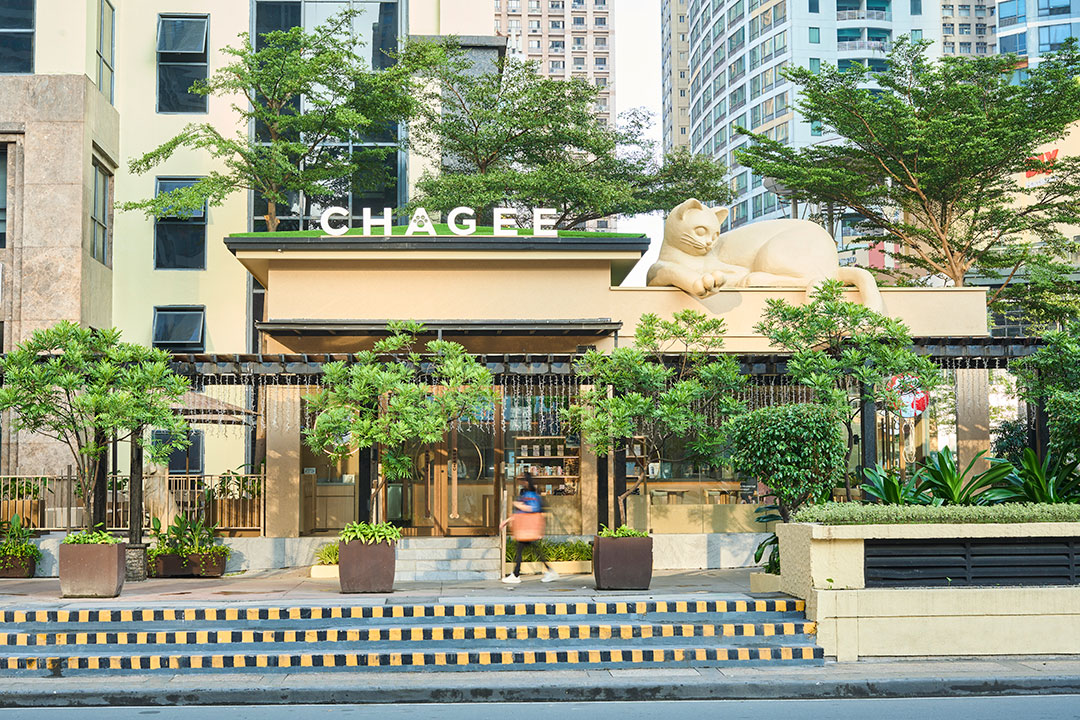
CHAGEE’S first-ever pet-friendly store in Quezon City, Philippines

Chagee opens first pet-friendly store

CHINESE MILK TEA brand Chagee, which brought the premium tea bar experience to the Philippines, has introduced a concept store that is inclusive not just to humans. It has opened its first-ever pet-friendly store in Southeast Asia — in Quezon City, Philippines.

“Chagee has become welcoming space where tea culture meets pet companionship. It’s a community hub where people can connect with their loved ones,” said Christopher Tiong, Chagee country general manager, at the media preview on Dec. 2 in Eastwood, where the concept tea bar is located.

“This store carries that same spirit of thoughtful design, so that fur parents and fur babies alike can enjoy the space,” he added.

Fueled by growing pet ownership among Filipinos, Chagee’s mission “to craft moments of connection through high-quality tea” has expanded to include pets, not just their humans.

PET-FRIENDLY FEATURES
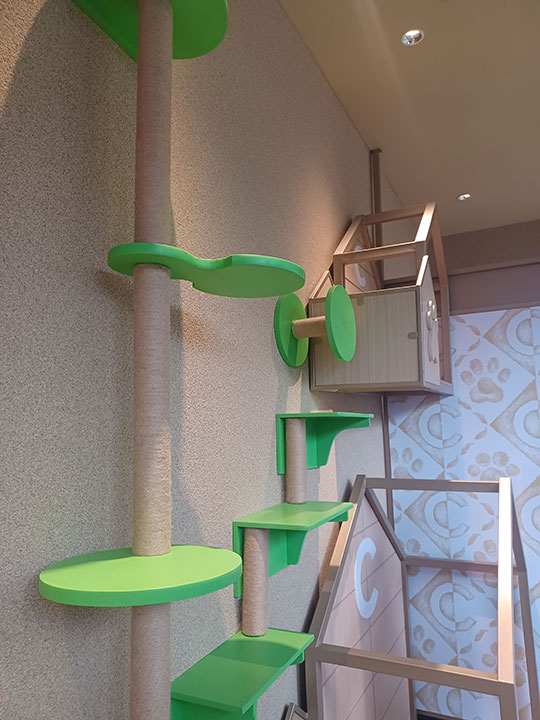
Chagee showed the press the pet-friendly features that can be found at the store. From the outside, a playful giant cat installation adorning the rooftop greets those who enter, while the al fresco dining area is guarded by a dog sculpture.

The safety, hygiene, and comfort of both humans and animals are taken into consideration, with non-slip and durable flooring and air purifiers strategically situated around the store. Chagee also offers free water served in specially designed bowls for pets.

A novelty in this store that the other three branches don’t have is an enclosed tea bar counter with glass panels, keeping drinks visible yet protected from pet fur or dander.

Oliver Rabatan, Chagee deputy general manager, told the press that the enclosed area protects the integrity of the drinks.

“We want it to be hygienic and we want to maintain cleanliness,” he said.

Mr. Rabatan also pointed out the dedicated cleaning station equipped with wet wipes, lint rollers, and trash bags. The indoor handwash station next to it also helps the customers themselves stay clean and fresh.

“Every detail in this pet-friendly store is intentionally designed with both our guests and our pets in mind, while also preserving the premium and relaxing atmosphere of every Chagee store,” he explained.

There is also a playpen that can also serve as a photowall for cats. It contains a mini house, tiered ledges, and scratch poles for them to explore and let off steam.

Mr. Tiong told BusinessWorld that they chose Eastwood as the location for their pet-friendly concept because it’s accessible (it is an outdoor branch and not in a mall) and offered the proper space for the vision to come to fruition.

“It’s a location that really is mindful of the needs of the fur parents and the fur babies,” he said. “It serves a community that is known for being pet-friendly. Eastwood has been doing that for decades.”

Aside from the store design itself, Chagee’s Eastwood tea bar uses cups exclusive to the branch, depicting cartoon dogs and cats on the cups.

ANIMAL WELFARE
Malou Perez, founder of the nonprofit organization Pawssion Project, talked about how the space can leave a positive impact on animal welfare.

“Seeing all of these things could change the perspective of people and make them understand that we can actually coexist with animals. Requesting the pound to catch strays is never the solution,” she explained.

Pawssion Project, which has rescued over 3,000 stray animals and rehomed more than 2,000 since 2018, is Chagee’s partner for the store. For the opening weekend of Dec. 5 to 7, all proceeds from Chagee’s pet merchandise available at the store will be donated to the Pawssion Project.

For Ms. Perez, creating more pet-friendly spaces will create a kinder world for animals, which is our responsibility “as their stewards.”

She noted that pet-friendly spaces shouldn’t bear the full burden of dealing with the animals, as it should also depend on responsible pet owners.

“The reason a lot of spaces are hesitant to open their doors to pets is because of irresponsible pet parents. There are malls, hotels, accommodations, and restaurants who start as a pet-friendly establishment and then later on take that away because of pet parents who allow their dog to make a mess,” Ms. Perez explained.

“All of these problems that eventually affect animals are the fault of irresponsible pet owners,” she said. “It serves as a reminder to all of the pet parents that our pets are our responsibility.”

Mr. Tiong said that they will display photos of Pawssion Project’s rescues in the store to boost adoption and raise awareness about the state of stray animals in the Philippines.

“Pawssion Project’s advocacy fits so naturally with our goal of building kinder, more connected communities. With this partnership, we hope to give customers an easy, meaningful way to help more animals find loving homes,” he explained.

As for whether it will have more branches like this, Chagee has said that its focus for now will be on the Eastwood store, though they are “open to new opportunities.”

“Right now, we’re focused on the stores we have. We want to really connect with the communities that we serve,” he said.

GRAND OPENING
From Dec. 5 to 7, the store will offer guests a variety of photo opportunities in the area, like a Chagee giant cup, a “pawtrait” photo booth, and even a “paw-shion” show, which will be open to walk-ins.

Participants who will complete two activities at the pop-up event can take home prizes, such as a free drink voucher. Pet parents who purchase any of the pet store merchandise will get a free family “paw-trait” while pet parents who post their “paw-trait” and tag Chagee’s social media can get a chance to win big in a giveaway.

To ensure the safety of the pets and owners, all pets joining the activities must present both the original and a photocopy of their updated vaccination records.

Chagee is also bringing back its popular Tear and Win promo, along with pet merchandise, exclusively for the grand opening weekend. Customers who purchase any large Chagee fresh milk tea from Dec. 5 to 7 will automatically get upgraded to a Tear and Win cup, with prizes including a Fendi dog collar and leash, an exclusive pet spa session, pet pins, thermal cups with a strap, and pet foldable tents.

Chagee is also offering special bundle deals, where customers can enjoy two large BO·YA Jasmine Green Milk Teas for P165 or one large BO·YA Jasmine Green Milk Tea and one large Da Hong Pao Milk Tea for P169. Both bundles are eligible for the Tear and Win promo. — Brontë H. Lacsamana


SEC proposes tiered public ownership rules for IPO listings

SEC.GOV.PH

THE Securities and Exchange Commission (SEC) has released for public comment a draft memorandum circular proposing a tiered minimum public ownership framework for companies seeking to list shares on the stock exchange.

The draft circular, issued on Dec. 3, is open for comments until Dec. 23. It seeks to establish a tiered approach to public ownership requirements based on the size of the issuer, balancing factors such as market liquidity, investor protection, capital formation, and market competitiveness.

“A tiered minimum public ownership framework provides a proportionate and market-aligned approach that preserves the long-term benefits of adequate public float while addressing potential constraints in demand absorption for large issuances, thereby supporting capital formation and encouraging more companies to pursue listing in the Philippines,” the circular said.

In earlier statements, SEC Chairperson Francisco Ed. Lim said the plan to implement a tiered minimum public float requirement was prompted by the limitations of the current 20% rule, which he described as a “one-size-fits-all” approach that does not account for differences in company market capitalization.

Under the draft rules, companies planning to list on an exchange will be assigned to one of five tiers based on their expected market value at listing.

Tier I companies with a market value of up to P500 million must maintain a minimum initial public float of 33%. Tier II companies valued between P500 million and P1 billion must have at least 25% public float, but not less than P165 million in shares.

Tier III companies with a market value from P1 billion to P50 billion are required to maintain at least 20% public float worth a minimum of P250 million. Tier IV companies valued between P50 billion and P150 billion must have at least 15% public float, valued at no less than P10 billion, while Tier V companies with market value above P150 billion must maintain at least 12% public float worth at least P22.5 billion.

After listing, companies are required to maintain a fixed minimum level of public ownership corresponding to their initial public offering (IPO) tier.

Tiers I, II, and III must maintain at least 20% public ownership, Tier IV at least 15%, and Tier V at least 12%.

The commission said that if public ownership falls below the required level, the company must report the shortfall to the SEC by the next business day, submit a business plan within 10 days, and has up to 12 months to restore the minimum float.

The draft also requires companies to implement internal policies and procedures to monitor minimum public ownership and provide regular reports to the SEC.

Companies must submit a public ownership report and updates on progress within 15 days after each month-end until the public float meets the required minimum.

“Companies who made their IPOs before the effectivity of these rules shall be subject to the maintenance requirement of 20% provided under SEC Memorandum Circular No. 13, series of 2017,” the draft memorandum read.

Last month, Mr. Lim told reporters he hopes the draft will be approved in time for January next year.

“Maybe in Q1 or even earlier, but I probably won’t be able to accomplish everything this year. At least we can start fresh next year since everything is already in place, right?” he said. — Alexandria Grace C. Magno

Ben&Ben, Maki to headline 12th Himala sa Buhangin Festival in Ilocos Norte

THE iconic sand dunes of Paoay, Ilocos Norte serve as the backdrop for the 12th Himala sa Buhangin Festival where Ben&Ben (inset) is set to perform. — ARTEMIO A. DUMLAO

PAOAY, Ilocos Norte — The Paoay Sand Dunes are set to come alive again as the Himala sa Buhangin Arts and Music Festival returns for its 12th edition on Dec. 5 and 6.

Known as the country’s “only sand dunes festival,” it celebrates Ilokano creativity and culture, drawing thousands to one of Ilocos Norte’s most iconic landscapes.

Kicking off the two-day event is Ben&Ben, one of the Philippines’ most popular bands, known for its heartfelt lyrics and genre-defying sound.

On the festival’s second day, rising pop singer Maki will take the stage, joined by chart-topping rapper Hev Abi, promising a high-energy performance in the middle of the dunes.

The festival’s music lineup also features other well-known acts such as Indio I and Brownman Revival, alongside homegrown Ilokano talents Lvndrs, Magrus, Vintage Core, and Tape Monkeys.

After dark, the celebration continues with DJ sets from Gunna Lex, Nasty, Eric Manalo, and MC Travis, who will keep things going until dawn.

Beyond music, the festival showcases Ilokano artistry through immersive installations. Bamboo structures inspired by bawang (garlic), sea-themed displays, and traditional fishing instruments called alat highlight the province’s coastal heritage, everyday life, and enduring connection between the people and the sea.

Festivalgoers can also enjoy a variety of activities, including obstacle courses, 4×4 test drives and races, cultural dance performances, and fire and belly dancing shows.

The festivities conclude with a sunset screening of the film The Fisher on the second day, offering a reflective moment amid the area’s dunes.

Conceived by former Governor Imee Marcos to promote the Paoay Sand Dunes as a cultural and tourism landmark, Himala sa Buhangin has grown into a major attraction.

Having drawn over 50,000 festivalgoers in 2024, organizers expect an even larger crowd this year, as the dunes — immortalized in films like Himala and Ang Panday — once again provide a dramatic backdrop for a festival that blends heritage, creativity, and modern entertainment. — Artemio A. Dumlao

Globe’s ¥20-B loan positions company for 5G growth, BMI says

PHILSTAR FILE PHOTO

GLOBE Telecom, Inc.’s ¥20-billion loan signals the telecommunications company’s improved debt servicing capacity and positions it to capture growth in 5G, according to a study by BMI, a unit of Fitch Solutions.

“The loan provides liquidity to manage debt maturities while maintaining financial flexibility during this operational transition,” BMI said in a report dated Dec. 3.

Last month, Globe announced that it had signed a ¥20-billion (around P7.6 billion) term loan facility with Mizuho Bank, Ltd., a major Japanese commercial bank, to partially finance its capital expenditures (capex), debt refinancing, and other corporate requirements for the year.

BMI said Globe is well-positioned to capture the expected growth in 5G adoption in the Philippines, noting that the company’s loan with Mizuho Bank reflects its transition from infrastructure deployment to revenue generation after its investments in 5G technology.

For the three months ending September 2025, Globe reported a 12.79% drop in attributable net income to P5.25 billion from P6.02 billion a year ago, on slightly lower revenues of P44.36 billion, down 1.68% from P45.12 billion.

For the January-to-September period, attributable net income fell 14.04% to P17.69 billion, while revenues declined 2.34% to P131.59 billion.

Globe said it had invested about P31.4 billion in capital expenditure for the first nine months of 2025, down 23% from P41 billion in the same period last year.

The company expects full-year 2025 capex to fall below $1 billion, reflecting a strategic shift toward targeted investments and reinvestment of proceeds from tower sales for the remainder of the year.

Earlier this year, Globe also signed P20 billion in loan facilities with local banks BDO Unibank, Inc. and Metropolitan Bank & Trust Co. to fund its 2025 capex and reduce debt.

“As the company monetizes infrastructure assets including towers and potentially fiber networks, debt financing becomes less critical for core operations,” BMI said.

The study also highlighted Globe’s initiatives to diversify into financial technology and digital services through its e-wallet platform GCash, noting that this positions the company to grow average revenue per user (ARPU) through revenue streams beyond traditional connectivity.

BMI added that Globe could benefit from the Konektadong Pinoy Act, leveraging its mobile network infrastructure, spectrum holdings, and integrated mobile-fixed offerings to provide services in urban consumer markets.

“The primary risks are enterprise segment pricing pressure and potential rural broadband market share loss, where Globe’s infrastructure deployment remains limited compared to urban coverage,” BMI said.

At the stock exchange on Thursday, shares in Globe fell by P9, or 0.56%, to close at P1,600 apiece. — Ashley Erika O. Jose

ADVERTISEMENT
ADVERTISEMENT