Home Blog Page 6035

Japan expects launch of U.S. Indo-Pacific economic plan during Biden visit

President Joe Biden‘s visit to Japan this month is expected to coincide with the formal launch of a new U.S. economic strategy for the IndoPacific, even as China seeks “very aggressively” to fill a void since Washington quit a regional trade pact, Tokyo’s ambassador to the United States said on Monday.

Ambassador Koji Tomita told an event hosted by Washington’s Center for Strategic and International Studies that Japan and the United States had been working on the details of the IndoPacific Economic Framework (IPEF), which, he said, needed to strike a balance between inclusivity and high standards.

Asian countries are keen to boost ties with the United States, but have been frustrated by its delay in detailing plans for economic engagement with the region since former President Donald Trump quit a regional trade pact in 2017. Read full story

Mr. Biden, who is to visit South Korea and Japan from May 20 to May 24, announced the plan for IPEF last year. In announcing its strategy for the IndoPacific region in February, the administration said the plan was to launch IPEF in early 2022.

Mr. Tomita said Mr. Biden‘s visit would send a powerful signal that Washington remains focused on the IndoPacific in spite of the war in Ukraine.

“But this is not just a message. I think the visit will establish in very strong terms that Japan and the United States jointly are ready to play a leadership role in the economic and social development of the broader IndoPacific region,” he said.

Mr. Tomita noted that Mr. Biden‘s visit would include a summit meeting of the Quad grouping of the United States, Japan, Australia and India, an important vehicle for that purpose.

“Also, I’m expecting the visit will also coincide with the formal launch of the IndoPacific Economic Framework initiative by the United States. And we are now trying to flesh out the ideas to be contained in this initiative,” he said.

Mr. Biden is due to host Southeast Asian leaders at a special summit in Washington on Thursday and Friday, but an Asian diplomat said IPEF was not on the formal agenda as most ASEAN economies would not be among the initial signatories. Read full story

The diplomat said at least six countries were likely to sign up initially with the United States to negotiate agreements on a range of common standards. These were Australia, Japan, New Zealand, South Korea and ASEAN members the Philippines and Singapore.

Analysts say Washington was particularly keen to get Vietnam and Indonesia aboard too, but they have had issues about agreeing to U.S. standards on cross-border data flows.

Mr. Tomita said the U.S. withdrawal from what is now known as the Comprehensive and Progressive Agreement for Trans-Pacific Partnership was a setback and China was “very aggressively seeking to fill this void.”

“Whenever you do any form of regional economic forum there is a trade-off between inclusiveness and high standards,” he said, referring to IPEF. “Of course, we need both, but we have to strike the right balance between these two requirements.”

The Biden administration has ignored calls for a return to CPTPP because of concerns about the effect this could have on U.S. jobs and has frustrated smaller Asian countries by its unwillingness to offer greater market access they seek via IPEF.

The U.S. ambassador to Japan, Rahm Emanuel, told the same forum IPEF needed to be inclusive, but also have high enough standards that it would not be “a race to the bottom economically.” – Reuters

Philippine stocks fall as traders weigh Marcos win, global rout

REUTERS

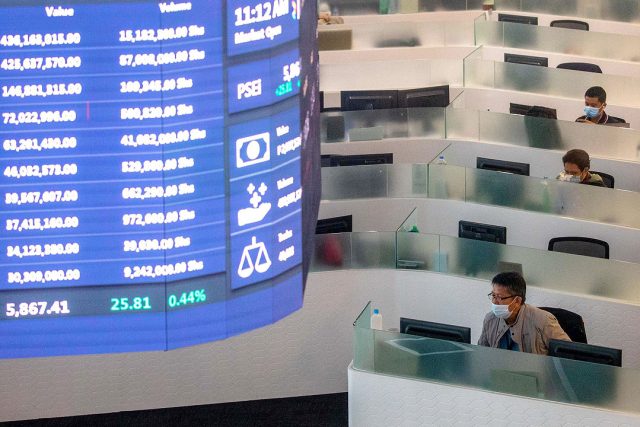
The benchmark Philippine stock index slid amid a global selloff, as investors awaited Ferdinand Marcos Jr.’s economic policies following his landslide win in the presidential election.

The Philippine Stock Exchange Index declined as much as 3.1% before paring declines. Most of the 30 components of the benchmark fell with Aboitiz Power Corp., AC Energy Corp. and LT Group Inc. leading the losses.

Equities are unlikely to rebound until Marcos lays out a plan to spur growth, tame inflation and address the nation’s ballooning debt, according to analysts. The drop in the benchmark gauge also reflects losses in regional shares as rising U.S. interest rates and slowing Chinese growth hurt sentiment.

“Many investors are likely to be in a wait-and-see mode,” Robert Ramos, who helps manage P140 billion ($2.7 billion) as head of the trust and investments group at Rizal Commercial Banking Corp., said before the start of trading. “They will wait for the new government to discuss its plan for the economy and how we get out from the impact of the pandemic.”

The Philippine Stock Exchange Index has declined about 8% this year, outperforming an 18% drop for the MSCI AC Asia Pacific Index. — Bloomberg

Philippines election win returns Marcos to power, and polarization

Presidential candidate Ferdinand "Bongbong" Marcos Jr. is seen at the miting de avance in Paranaque City, May 7. — PHILIPPINE STAR/KRIZ JOHN ROSALES

MANILA – The Philippines woke to a new but familiar political dawn on Tuesday, after an election triumph by Ferdinand Marcos Jr paved the way for a once unimaginable return to the country’s highest office for its most notorious political dynasty.

Marcos, better known as “Bongbong”, trounced bitter rival Leni Robredo to become the first candidate in recent history to win a Philippines presidential election majority, marking a stunning comeback by the son and namesake of an ousted dictator that has been decades in the making.

Marcos fled into exile in Hawaii with his family during a 1986 “people power” uprising that ended his father’s autocratic 20-year rule, and has served in congress and the senate since his return to the Philippines in 1991.

Marcos’s runaway victory in Monday’s election looked certain when early results of an unofficial vote poured in and with 95% of the eligible ballots counted, he had more than 30 million votes, double that of Robredo.

An official result is expected around the end of the month.

Marcos refused to celebrate, offering instead what he called a statement of gratitude.

“There are thousands of you out there, volunteers, parallel groups, political leaders that have cast their lot with us because of our belief in our message of unity,” he said, standing beside a national flag, in remarks streamed on Facebook.

“Any endeavour as large as this does not involve one person, it involves very, very many people working in very, very many different ways.”

Though Marcos, 64, campaigned on a platform of unity, political analysts say his presidency is unlikely to foster that, despite the huge margin of victory.

Many among the millions of Robredo voters are angered by what they see as a brazen attempt by the disgraced former first family to use its mastery of social media to reinvent historical narratives of its time in power.

Thousands of opponents of Marcos senior suffered persecution during a brutal 1972-1981 era of martial law, and the family name became synonymous with plunder, cronyism and extravagant living, with billions of dollars of state wealth disappearing.

The Marcos family has denied wrongdoing and many of its supporters, bloggers and social media influencers say historical accounts are distorted.

‘DETESTABLE IMAGE’

Human rights group Karapatan called on Filipinos to reject the new Marcos presidency, which it said was built on lies and disinformation “to deodorize the Marcoses’ detestable image”.

“Marcos Jr has not publicly acknowledged the crimes of his father and his family’s role, as direct beneficiaries,” it said in a statement.

“Marcos Jr continues to spit on the graves and sufferings endured by all the Marcos martial law victims by feigning ignorance on the numerous documented atrocities.”

Marcos, who shied away from debates and interviews during the campaign, recently praised his father as a genius and a statesman but has also been irked by questions about the martial law era.

As the vote count showed the extent of the Marcos win, Robredo told her supporters to continue their fight for truth until the next election.

“It took time to build the structures of lies. We have time and opportunity to fight and dismantle these,” she said.

Marcos gave few clues on the campaign trail of what his policy agenda would look like, but is widely expected to closely follow outgoing President Rodrigo Duterte, who targeted big infrastructure works, close ties with China and strong growth. Duterte’s tough leadership style won him big support.

Aries Arugay, a political science professor, said Marcos has much to do to prove he is sincere about unity.

“This polarization will happen regardless,” he said.

“Under a Marcos presidency, perhaps it will become more pernicious because I don’t think the unity slogan will be implemented, meaning reaching out to the other side.”

“It will be a tough sell because it is not credible.” — Reuters

Inflation a ‘headache’ for next leader

PHILIPPINE STAR/EDD GUMBAN

THE PHILIPPINES’ next president needs to immediately address rising inflation and fiscal issues, as the economy recovers from a coronavirus pandemic and the Russia-Ukraine war, analysts said. 

Filipinos on Monday voted in an election that was generally peaceful but marred by malfunctioning vote-counting machines and long lines. (Related story on S1/10

“The incoming president will need to treat inflation as a top economic priority… The prolonged pandemic has widened income disparity in the Philippines and increased unemployment,” Sonia Zhu, an analyst at Moody’s Analytics, said in a note titled “Inflation will be a big headache for the new Philippine president.”

She noted that leading presidential candidates former Senator Ferdinand R. Marcos, Jr. and Vice-President Maria Leonor G. Robredo have both floated fiscal support, with Mr. Marcos suggesting fuel subsidies and Ms. Robredo proposing targeted social aid for the poor.   

“Inflation management has become a key policy point. Since early 2022, household discretionary income has come under threat from higher prices for staples,” Ms. Zhu said.

Headline inflation sizzled to a three-year high of 4.9% in April, driven by soaring food and energy prices amid the Russia-Ukraine war. This was beyond the central bank’s 2-4% target, and the 4.3% forecast for 2022. 

Commodity prices are expected to edge higher in the next months amid supply chain disruptions, China lockdowns and concerns over oil supply.   

In a separate note released on Monday, Pantheon Chief Emerging Asia Economist Miguel Chanco said the next president should prioritize reviving the Philippine economy, whose recovery has “easily been the most lackluster in emerging Asia.” 

“We’d even go so far as to say that it doesn’t really matter who takes the helm at Malacañan Palace, as any future administration will be preoccupied with repairing the economic damage caused by the pandemic since 2020, with economic reforms likely to take a backseat,” he said.   

The Philippines’ gross domestic product (GDP) grew by 5.7% in 2021, after a record 9.6% contraction in 2020. The government is targeting 7-9% growth this year, although multilateral agencies are forecasting below-target growth due to the Russia-Ukraine war.

“Based on our current forecasts, real GDP will remain some 15% below the pre-COVID trend by the end of this year,” Mr. Chanco said.

The next administration also has to address the weak labor market, he said. The unemployment rate fell to 5.8% in March.   

“Consumption, the economy’s mainstay, is likely to stay under pressure, with the sluggish job market, the rebuilding of savings lost since 2020 and, more recently, fast-rising inflation, weighing heavily on spending decisions,” Mr. Chanco said.

Think tank IBON Foundation Executive Director Sonny A. Africa said the new president should deal with the “considerable economic scarring” from the strict lockdowns during the early part of the pandemic. 

“(The) current economic managers downplay the National Government debt burden it has substantially bloated, which will weigh heavily on public spending on social and economic services,” he said in a Facebook Messenger chat.    

Outstanding National Government debt hit a record P12.68 trillion at end-March. The debt-to-GDP ratio hit a 16-year high of 60.5% in 2021, which is slightly above the 60% threshold considered manageable by multilateral lenders for developing economies.

While presidential candidates have presented possible ways to help bring down prices, analysts said the next administration would face fiscal constraints when implementing its programs.     

“The Philippines might not have the financial capacity to provide such fiscal cushioning. The limited fiscal room has the new administration’s hands tied when it comes to navigating price hikes,” Ms. Zhu said, adding that it may be up to the central bank to do the heavy lifting to cool inflation.

“A first-quarter GDP growth reading above 6% year on year will increase the odds of a rate hike in June to 60%,” she added. First-quarter GDP data will be released on May 12.

Mr. Chanco said the country continues to face fiscal constraints. “The country suffered one of the biggest budget blowouts at the height of the COVID crisis, and progress in closing the budget gap has essentially stalled,” he said.

The budget deficit shrank by 1.44% year on year to P316.8 billion in the first quarter.

Meanwhile, Mr. Chanco said a victory by Mr. Marcos, who has led opinion polls, is “unlikely to translate directly to a bad day for markets.”

“What arguably matters more is that election day proceeds smoothly and that the transition in government takes place without a hitch,” he said.

However, Mr. Chanco said a possible worst-case scenario is political and government gridlock, if the runner-up challenges the results of the elections.   

Tom Rafferty, The Economist Intelligence Unit regional director for Asia, said Mr. Marcos would likely continue the “broadly pro-market” policy agenda set by President Rodrigo R. Duterte such as the infrastructure push, tax incentives for businesses and removal of barriers to investments.

In a note released on Monday, Mr. Rafferty said the biggest risk to Mr. Marcos’s presidency will be the execution of his policy agenda.

“Failure to navigate the oft-fractious parliament and adequately deliver progress on major business-friendly reform and infrastructure upgrade amid an ongoing pandemic, which will require consummate political and communication skills, could jeopardize the country’s hitherto impressive recent growth trajectory and trigger a sudden reversal of fortune and ensuing political volatility in 2023,” he said.

University of Asia and the Pacific economist Cid L. Terosa said in an e-mail that the winner of the presidential elections would matter to markets in the short run “but the business and market environments that the next president will weave matter more in the long run.”

“While we can argue that a (Marcos) presidency will be met by markets and investors with more intense apprehension than a Robredo presidency, (Marcos’s) possible ascent to the presidency will give him the opportunity to either dispel doubts or magnify qualms. Since investors and markets are generally forward-looking, (Marcos) must exert effort to give them a good future. If he can do this, the past won’t matter to investors and markets,” Mr. Terosa said.

The next administration will inherit an economy whose growth momentum is challenged by inflation and fiscal issues, he added.

“Will his administration accelerate or decelerate the growth momentum? It will all depend on the economic decisions (Marcos) will make in the first three to six months of his presidency,” Mr. Terosa said. — Luz Wendy T. Noble with inputs from Tobias Jared Tomas

MUFG sees PHL economy growing by 6.5% this year

PHILIPPINE STAR/ MICHAEL VARCAS

By Luz Wendy T. Noble, Reporter

THE PHILIPPINE ECONOMY is likely to grow faster than expected this year, although China’s slowdown could be a downside risk to the country’s economic expansion, MUFG Bank said.

In a note released on Monday, MUFG said it now expects Philippine gross domestic product (GDP) to expand by 6.5% this year, from its previous forecast of 6%.

This is still below the 7-9% target set by economic managers.

MUFG Bank analyst Sophia Ng said they would be reviewing their growth outlook for the Philippines in view of the economic slowdown in China due to its zero-COVID policy and strict lockdowns.

This could have a direct impact on the Philippines because China is the country’s biggest trading partner.

“A reduction in demand from China will have a negative impact on the Philippines’ overall export growth, and the supply crunch will also raise import prices of goods in general, resulting in wider trade deficits in the coming months,” Ms. Ng said in an e-mail.

For the first quarter, MUFG said Philippine economic output likely expanded by 6.8%.

If realized, this would be slower than the 7.8% growth in the October to December period, but would still mark the fourth consecutive quarter of growth for the economy.

It also compares with a BusinessWorld poll of 17 analysts that yielded a median estimate of 6.7% GDP growth for the first three months.

First-quarter GDP data will be released on May 12.

Ms. Ng said their first-quarter GDP estimate took into account the slower rise in consumption as mobility restrictions were tightened during the Omicron surge in January.

Metro Manila and some provinces were placed under Alert Level 3 to contain rising infections.

Restrictions were eased to Alert Level 2 by February, and to the most relaxed Alert Level 1 by March.

Ms. Ng said another factor that likely eased growth in January to March was the large drop in net exports due to a bigger trade deficit.

The trade gap widened to $13.892 billion in the first quarter from the $8.345-billion deficit a year earlier, the Philippine Statistics Authority reported on Friday.

The Philippine economy grew by 5.7% in 2021, after a record 9.6% contraction in 2020.

Investors may sour on future PPP projects in PHL, analysts say

PHILIPPINE STAR/EDD GUMBAN
PEOPLE ride the Light Rail Transit Line 1 in this file photo dated Oct. 19, 2020. — PHILIPPINE STAR/ EDD GUMBAN

By Arjay L. Balinbin, Senior Reporter

THE GOVERNMENT faces another international arbitration claim, this time stemming from the delayed implementation of fare adjustments for the Light Rail Transit Line 1 (LRT-1).

Analysts said investors might sour on public-private partnership (PPP) projects in the Philippines after seeing the government fail to implement the automatic fare adjustment under the contract entered into by Light Rail Manila Corp. (LRMC).

This shows that the government “doesn’t play fairly,” transport expert Rene S. Santiago said in a phone message.

“Message to investors is don’t get enmeshed with PPP (projects) of the Philippines,” he said.

Terry L. Ridon, convenor of public policy think tank Infrawatch PH, said in a separate phone message that automatic fare adjustment was one of the features of PPP projects under the Aquino administration.

“While this has been met with resistance by the public, it has been included as a PPP feature to entice the private sector to invest in public services.”

“While this may entice the private sector into joining PPPs, investors had failed to see that government still wields ultimate control on whether automatic increases can in fact be implemented,” he said. “As a result, the private sector is forced to undertake arbitration proceedings to implement the automatic fare adjustment provisions.”

Mr. Ridon also noted that while this favors  the public, it affects the PPP entity’s financial projections since investments in public services were under the premise that they can implement fare increases.

“As a result, it will take longer for the PPP entity to recover its original investment, and certainly, it will discourage investors from further entering into PPPs with government in the future.”

LRMC, the private operator of LRT-1, seeks to recover P2.67 billion in compensation claims and costs resulting from delays in the fare adjustments for 2016, 2018, and 2020, Metro Pacific Investments Corp. (MPIC) said in a May 6 disclosure to the stock exchange.

LRMC is composed of MPIC that leads the consortium with a 55% stake, Ayala group’s AC Infrastructure Holdings Corp. with a 35% stake, and Macquarie Infrastructure Holdings (Philippines), Inc. with a 10% stake.

Mr. Ridon said the government should “renegotiate automatic fare increase provisions with its PPP partners, and determine whether it is a provision that can truly implement instead of subjecting contracts to arbitration, in order to guide the private sector on how to proceed with PPPs in the future.”

“But we nonetheless maintain that there should be no automatic fare increases in public services and utilities, and all increases should be subject to public consultation and government approvals.”

In a phone interview, Philippine Exporters Confederation, Inc. Chairman George T. Barcelon said an arbitration case is a “normal course of business if there are things that need to be clarified.”

“But what we want to project, especially with the [amended] Public Service Act, for us to attract more investments, is that when there are issues that arise, there are proper courts or there are proper agencies to expeditiously and judiciously look into it and render decision,” he said.

“The rule of law must be there. And again, we’ve always been stressing that the ease of doing business is very crucial,” he added.

Sonny A. Africa, executive director of think tank Ibon Foundation, said in a Messenger chat that arbitration cases are an intrinsic risk whenever the government privatizes public utilities and goes into big-ticket partnerships with private investors.

“The Philippine government shouldn’t have to be forced to deal with arbitration proceedings that, win or lose, sees citizens footing the bill. The government should not have to worry about whether it will be sued or not when deciding whether to put the public good before profit,” he said.

The alternative to PPP, Mr. Africa said, is public financing through government bonds and “progressive taxation,” which is “cheaper than relying on private financing for for-profit operations.”

He also pointed out that Ayala’s expression of its intention to divest is “unfortunate and an example of how the government is forced into negotiating with private firms over how much profit they are willing to take just to keep operating.”

A representative of the LRTA said in a phone message: “LRTA cannot yet issue a statement on the matter, as it still has not received a copy of the request for arbitration; and after which, LRTA shall confer with DoTr and the Office of the Government Corporate Counsel.”

NLEX Corp. and CAVITEX Infrastructure Corp., toll road subsidiaries of MPIC, had also filed arbitration cases with the Permanent Court of Arbitration against the government through the Toll Regulatory Board (TRB). Both involve petitions for toll rate adjustments.

The tribunal ruled last year the TRB was not accountable for “unreasonable delay” on petitions for toll rate adjustments filed by MPIC’s tollway unit NLEX Corp. in 2012 and 2014, while it terminated CAVITEX’s arbitration case after the company withdrew its claims for compensation arising from nonapproval of their petitions for rate adjustment filed in 2011 and 2014.

MPIC is one of three Philippine subsidiaries of Hong Kong’s First Pacific Co. Ltd., the others being PLDT, Inc. and Philex Mining Corp.

Hastings Holdings, Inc., a unit of PLDT Beneficial Trust Fund subsidiary MediaQuest Holdings, Inc., maintains an interest in BusinessWorld through the Philippine Star Group, which it controls.

U2’s Bono gives ‘freedom’ concert in Kyiv metro

BONO and The Edge sing during a performance for Ukrainian people inside a subway station, as Russia’s attack on Ukraine continues, in Kyiv, Ukraine, May 8. — REUTERS/VALENTYN OGIRENKO

KYIV —  Irish rock group U2’s frontman Bono and his bandmate The Edge performed a 40-minute concert in a metro station in the Ukrainian capital of Kyiv on Sunday and praised Ukrainians fighting for their freedom from Russia.

“Your president leads the world in the cause of freedom right now … The people of Ukraine are not just fighting for your own freedom, you’re fighting for all of us who love freedom,” Bono told a crowd of up to 100 gathered inside the Khreshchatyk metro station. He was referring to Ukrainian President Volodymyr Zelensky.

Russia invaded Ukraine on Feb. 24, pressing towards Kyiv before withdrawing its forces from near the capital at the end of March to concentrate its firepower on eastern Ukraine.

Russia, which calls its action in Ukraine a “special military operation,” continues to carry out missile strikes across Ukraine. However, some life has returned to Kyiv even though air raid sirens sound regularly.

Bono rallied the crowd between songs during his performance.

“This evening, 8th of May, shots will ring out in the Ukraine sky, but you’ll be free at last. They can take your lives, but they can never take your pride,” he said. — Reuters

KathNiel love team makes a comeback with a new series

CINEMA love team and real-life couple Kathryn Bernardo and Daniel Padilla celebrate their 10th anniversary as a love team with a new series, 2 Good 2 Be True, which will be shown on Netflix and on the Kapamilya channels.

Ms. Bernardo and Mr. Padilla first appeared in a Sunday youth-oriented show called Growing Up (2011) and subsequently starred in the romantic drama Princess and I (2012). In the following years, they starred as on-screen partners in various television dramas such as Got to Believe (2013), Pangako Sa ‘Yo (the 2015 remake), La Luna Sangre (2017), as well as blockbusters like Pagpag (2013), She’s Dating the Gangster (2014), and The Hows of Us (2018).

In their new series, 2 Good 2 Be True (which is the love team’ first project together since 2017), Mr. Padilla and Ms. Bernardo take on the roles of Eloy and Ali, two people who are scarred by tragedy and love. Eloy is a young mechanic and a law student who vows to free his jailed father as he slowly moves after his mother’s death. Meanwhile, Ali works as a nurse with dreams to someday become a doctor.

“Growing up, marami siyang nakitang heartbreaks sa nanay niya. Kaya nagkaroon siya ng trust issues when it comes to boys (Growing up, she has witnessed her mother’s many heartbreaks, that is why she has trust issues when it comes to boys),” Ms. Bernardo said about her character during a press conference on May 6.

Mr. Padilla said that his character is focused on fighting for justice for his father, played by Romnick Sarmenta.

The two first meet during a hotel robbery, then they meet again after Ali becomes the private nurse of the wealthy Hugo Agcaoili (Ronaldo Valdez) who has Alzheimer’s. At the same time, Eloy starts work as the wealthy businessman’s mechanic.

The series’ co-directors, Mae Cruz Alviar and Paco Sta. Maria, said that the show highlights the importance of family, friends, relationships, and giving people second chances.

Having previously worked with the love team, Ms. Alviar said the actors “have given their performances depth. When we say maturity, we do not always equate it to skin, or physicality. It’s depth and wisdom. You can see that in how they attack the scenes. Even behind the scenes, you can tell the experience and depth and the wisdom of these two.”

According to the couple, the secret to their longevity as an onscreen love team is respect and teamwork.

“Teamwork is very important, and that you do not see yourselves as competition,” Ms. Bernardo said.

Ms. Bernardo thanked the fans for their continued support and patience after the love team’s long absence from the screen. “I want to thank the fans for standing by our side,” she said. “Dahil kahit maraming nangyari, they waited para mabigyan sila ng ganitong proyekto (Even though a lot has happened, they waited to be given this project),” she added.

“I want to thank our bosses in ABS-CBN and to our supporters for their loyalty,” Mr. Padilla said in English and Filipino.

Produced by RGE Unit, the series’ cast includes Gloria Diaz, Irma Adlawan, Gelli de Belen, Cris Villanueva, Smokey Manaloto, Matt Evans, Jenny Miller, Yves Flores, Gillian Vicencio, Bianca de Vera, Pamu Pamorada, Hyubs Azarcon, Via Antonio, and Alyssa Muhlach.

The series will stream on Netflix Philippines following a partnership deal between ABS-CBN and Netflix.

“We are grateful for the opportunity to open doors, not just for us, but also for the company and content creators from the Philippines,” Ms. Alviar said.

Netflix Philippines’ subscribers will be able to watch the series starting May 13 (72 hours ahead of 2 Good 2 Be True’s television broadcast). Meanwhile, iWantTFC users can watch the show on the iWantTFC app and iwanttfc.com 48 hours before each episode’s television premiere. The series will air on the Kapamilya Channel, Kapamilya Online Live, A2Z, and TV5 beginning May 16. — Michelle Anne P. Soliman

The multiverse is huge in pop culture right now — but what is it, and does it really exist?

WHETHER you need a new villain or an old Spider-Man, your sci-fi movie will sound more scientifically respectable if you use the word “multiverse.” The Marvel multiverse puts different versions of our universe “out there,” somewhere. In these films, with the right blend of technology, magic, and imagination, travel between these universes is possible.

For example (spoilers!), in Spider-Man: No Way Home, we discover there are other universes and other Earths, some of which have their own local Spider-Man. In the universe of the movie, magic is possible.

This magic, thanks to a misfiring spell from superhero Dr. Strange, causes some of the other Spider-Men to be transported into our universe, along with a few supervillains.

In Doctor Strange in the Multiverse of Madness (in cinemas), the universe-on-universe buffoonery threatens a “desecration of reality.”

So, which of these ideas has Marvel borrowed from science, and which ones are pure fiction?

Could there be other Earths? Could there be other people out there, who look a lot like us, on a planet that looks like ours? Scientifically, it’s possible, because we don’t know how big our universe actually is.

We can see billions of light years into space, but we don’t know how much more space is out there, beyond what we can see.

If there is more space out there, full of galaxies, stars, and planets, then there are more and more chances for Another-Earth to exist. Somewhere. With enough space and enough planets, any possibility becomes likely.

The fiction of the Marvel multiverse stems from the ability to travel between these other earths. There’s a good reason why Dr. Strange needs to use magic for this.

According to Albert Einstein, we can’t travel through space faster than light. And while more exotic ways to travel around the universe are scientifically possible — wormholes, for example — we don’t know how to make them, the universe doesn’t seem to make them naturally, and there is no reason to think they’d connect us to Another-Earth rather than some random part of empty space.

So, almost certainly, if Another-Earth is out there somewhere, it’s unimaginably far away, even for an astronomer.

The Marvel multiverse might seem wild, but from a scientific perspective it’s actually too tame. Too normal. Too familiar. Here’s why.

The basic building blocks of our universe — protons and neutrons (and their quarks), electrons, light, etc. — are able to make amazing things, such as human life. Your body is astounding: energy-gathering, information-processing, mini-machine building, self-repairing.

Physicists have discovered that the ability of our universe’s building blocks to make life forms is extremely rare. Just any old blocks won’t do.

If electrons had been too heavy, or the force that holds atomic nuclei together had been too weak, the stuff of the universe wouldn’t even stick together, let alone make something as marvelous as a living cell. Or, indeed, anything that could be called alive.

How did our universe get the right mix of ingredients? Perhaps we won the cosmic lottery. Perhaps, on scales much bigger than what our telescopes can see, other parts of the universe have different building blocks.

Our universe is just one of the options — a particularly fortunate one — among a multiverse of universes with losing tickets.

This is the scientific multiverse: not simply more of our universe, but universes with different fundamental ingredients. Most are dead, but very very rarely, the right combination for life-forms comes up.

The Marvel multiverse, by contrast, merely rearranges the familiar atoms and forces of our universe (plus a bit of magic). That’s not enough.

What was our universe like in the past? The evidence suggests that the universe was hotter, denser, and smoother. This is called the Big Bang Theory.

But was there a Big Bang? Was there a moment when the universe was infinitely hot, infinitely dense, and contained in a single point? Well, maybe. But we’re not sure, so scientists have explored a bunch of other options.

One idea, called cosmic inflation, says that in the first fraction of a second of the universe, it expanded extremely quickly. If true, it would explain a few things about why our universe expands in just the way it does.

But, how do you make a universe expand so rapidly? The answer is a new type of energy field. It has control of the first moments of the universe, causes a rapid expansion, and then hands the reins to the more familiar forms of matter and energy: protons, neutrons, electrons, light, etc.

Cosmic inflation might make a multiverse. Here’s how. According to this idea, most of space is expanding, inflating, doubling in size, moment to moment. Spontaneously and randomly, in small islands, the new energy field converts its energy into ordinary matter with enormously high energies, releasing what we now see as a Big Bang.

If these high energies scramble and reset the basic properties of matter, then each island can be thought of as a new universe with different properties. We’ve made a multiverse.

In the cycle of the scientific method, the multiverse is in an exploratory phase. We’ve got an idea that might explain a few things, if it was true. That makes it worthy of our attention, but it’s not quite science yet. We need to find evidence that is more direct, more decisive.

Something left over from the aftermath of the multiverse generator might help. A multiverse idea could also predict the winning numbers on our lottery ticket.

However, as Dr. Strange explains, “The multiverse is a concept about which we know frighteningly little.”

Luke Barnes is a lecturer in Physics at the Western Sydney University

PLDT nears capacity limits, eyes more data centers

PLDT, Inc. will be building more data centers in the Philippines, including one in Davao City, as the group is now approaching capacity limits, its chairman said.

“We have given effectively license to the enterprise side of PLDT to go ahead, because, actually, we are approaching capacity limits of our data centers. We have to build more. In today’s board, we told them to go ahead and expand,” PLDT Chairman Manuel V. Pangilinan said in an ambush interview on May 5.

“Build and it will come. That was the mantra this morning to them. Go ahead and build. [We need] several more,” he added.

The company recently broke ground for its 11th data center project in Sta. Rosa, Laguna, with the goal of positioning the Philippines as Asia-Pacific’s next digital hub and destination.

Through its existing data centers, PLDT has been serving the requirements of some global technology companies.

Data analytics and consulting company GlobalData has said that global hyperscalers, or the massive international companies that dominate the cloud service sector, may need facilities in the country because “local hosting” is a “key requirement” to address the “strong demand” for cloud services.

More Philippine businesses plan to transfer workloads to the cloud, boosting the country’s cloud market to $2.8 billion by 2025 from $1.8 billion in 2020, it said in a statement.

To support its updated requirements for residential broadband and data center businesses, the company has upped its capital expenditure (capex) guidance for the year to P85 billion from P76-80 billion.

PLDT Chief Finance Officer Anabelle L. Chua said at a press briefing last week that the capex will also support upgrades of the towers and their passive infrastructure assets.

The company saw its first-quarter attributable net income increase by 56% to P9.1 billion from P5.8 billion in the same period a year ago.

Hastings Holdings, Inc., a unit of PLDT Beneficial Trust Fund subsidiary MediaQuest Holdings, Inc., has a majority stake in BusinessWorld through the Philippine Star Group, which it controls. — Arjay L. Balinbin

Doctor Strange 2 debuts to heroic $185 Million

Benedict Cumberbatch in a scene from Doctor Strange in the Multiverse of Madness

LOS ANGELES — Doctor Strange and his questionably effective book of spells has summoned a blockbuster $185 million at North American movie theaters over the weekend, reaffirming the box office dominance of Disney’s Marvel Cinematic Universe after a shakier, pandemic-battered year for the franchise.

The timeline-bending Doctor Strange in the Multiverse of Madness represents a return to form for Disney’s MCU after COVID-era releases Black Widow ($80 million debut, plus $60 million on Disney Plus), Shang-Chi and the Legend of the Ten Rings ($75 million debut), and Eternals ($71 million debut). Due to the pandemic and other extenuating circumstances, those installments failed to live up to their franchise predecessors in terms of ticket sales.

Those box office returns mark the 11th biggest opening weekend in history. Given the anomaly of reaching those box office heights, Doctor Strange 2 easily delivered the biggest opening weekend of 2022, as well as the second-biggest debut in COVID-19 times. Prior to this weekend, The Batman stood as the year’s biggest opening weekend with $134 million. Spider-Man: No Way Home still ranks as the pandemic’s biggest opening weekend (and the second-biggest ever) with $260 million.

Overseas, the film earned $265 million from 49 territories, taking the global total to $450 million. Since Doctor Strange 2 is not likely to play in China, Russia, or Ukraine, the film will rely on repeat viewings from audiences around the globe to push ticket sales past the coveted $1 billion mark. Only Spider-Man: No Way Home has been able to cross that threshold since COVID took hold.

At the domestic box office, the Doctor Strange follow-up outgrossed its predecessor’s entire opening weekend tally in a single day. Doctor Strange 2 raked in $90 million on Friday alone, while the 2016 adventure Doctor Strange brought in $85 million between Friday and Sunday. Marvel and other major franchise films tend to be front-loaded in terms of ticket sales because fans want to be among the first to see the movie — lest spoilers appear online and ruin the fun. Still, the sequel will quickly blow past the final box office tally of the original Doctor Strange, which ended its theatrical run with $232 million domestically and $677 million globally.

Doctor Strange 2 is benefitting as the follow-up film to Sony’s box office behemoth Spider-Man: No Way Home, which became a must-see movie event and grossed $1.89 billion worldwide. With Peter Parker’s tantalizing adventures as a precursor, plus Disney’s marketing machine heavily teasing some big surprise cameos, Doctor Strange landed in rarified air —  even for a Marvel movie.

Imax, 3D, and other premium format screens also contributed to higher grosses for Doctor Strange 2, which cost $200 million to produce, not including hefty marketing fees. According to Disney, 36% of overall box office ticket sales came from premium formats. With $33 million from Imax alone, Doctor Strange ranks among the company’s top 10 global opening weekends.

“This is another sensational Marvel opening, by Marvel’s own dominant standard,” says David A. Gross, who runs the movie consulting firm Franchise Entertainment Research. “Doctor Strange is growing its audience with a stronger follow-up release.”

Sam Raimi, the mastermind behind the original Spider-Man trilogy, directed Doctor Strange in the Multiverse of Madness. The film picks up as the eponymous neurosurgeon-turned-Avenger, played by Benedict Cumberbatch, casts a dangerous spell that forces him to travel into the multiverse to face a mysterious new adversary and alternate versions of himself. Along with Cumberbatch, the cast includes Chiwetel Ejiofor as Karl Mordo, Elizabeth Olsen as Wanda Maximoff a.k.a. Scarlet Witch, Benedict Wong as Wong, and Xochitl Gomez as America Chavez, a teen who can travel between dimensions.

Doctor Strange 2 kicks off the summer blockbuster season with a bang. In the coming months, Top Gun: Maverick, Jurassic World Dominion, and Thor: Love and Thunder should keep theaters bustling with foot traffic. — Reuters

Philjets bullish on rise in helicopter deliveries this year

PHILJETS Aero Services, Inc., a Philippine-based aerospace company, is hoping to surpass last year’s helicopter deliveries as “strong demand” continues.

“As a company, Bell delivered 156 helicopters globally last year and our aim is to do more than that for this year,” the company said in an e-mailed statement in response to a BusinessWorld query.

Philjets is the independent representative of American aerospace manufacturer Bell Textron, Inc. in the Philippines.

“We continue to see strong demand and order activity for Bell helicopters in the corporate segment for the Philippines, which is similar trend to what we are seeing across Asia Pacific,” it added.

Bell helicopters are used by businesses and individuals to meet their business and personal objectives, mainly to travel safely and efficiently.

The company has said the Bell 429, a light helicopter, continues to gain appeal among corporate customers in the Philippines.

The Bell 429 is considered capable of completing a range of missions including search and rescue, medical evacuations, natural disaster relief, national security, and military training.

Asked if the company is in talks with the Philippine military about supplying new units, Philjets said: “The Armed Forces of the Philippines and especially the Philippine Air Force have been operating Bell helicopters for decades.”

“They understand the value that Bell aircraft can bring to their missions and most importantly they value the support we have shown them to keep their helicopters flying. As a company, we are always speaking with the Armed Forces of the Philippines to show how our Bell helicopters can help them fulfill their requirements in a safe, reliable and efficient manner,” it added.

It said the competition in the Philippine helicopter market has become “intense,” as in other countries with a robust helicopter industry.

“We are confident that the safety and reliability and track record of providing good customer service will help us to stand out in a highly competitive industry,” Philjets noted.

The company announced last week the appointment of Reginald J. Arguelles as its general manager.

“Mr. Arguelles brings his extensive experience and international expertise to the role. Before joining Philjets, he was a technical instructor at the prestigious Lufthansa Technical Training Philippines,” it said in a statement.

He spent five years with PAL Express as engineering services and production control manager, then as senior manager and assistant vice-president, the company noted.

Mr. Arguelles said: “The Philippines has a wealth of talent and manpower is customer-centric. I plan to help them harness and reach their full potential towards excellent and consistent maintenance service.” — Arjay L. Balinbin