Home Blog Page 5989

NEA orders fuel oil-dependent power co-ops to source more renewable energy

PHILSTAR FILE PHOTO

THE National Electrification Administration (NEA) has directed electric cooperatives to tap more renewable energy if they are currently drawing power from diesel or bunker-fired power plants.

“We have directed cooperatives to procure renewable energy for the hybridization of their diesel or bunker-fired power suppliers that they are (currently) engaged with,” NEA Administrator Emmanuel P. Juaneza told Businessworld by phone.

Energy Secretary Raphael P.M. Lotilla said at a Senate energy committee hearing on Aug. 10 that his department is looking to end off-grid areas’ dependence on imported fuel.

Mr. Juaneza said that NEA, together with the National Power Corp., started the “hybridization” process of off-grid power in 2019.

Mr. Juaneza said electric cooperatives are required to comply with the renewable portfolio standards (RPS) requirement.

Under RPS, power distribution utilities, electric cooperatives, and retail electricity suppliers are required to source an agreed portion of their energy supply from renewable energy (RE) facilities.

He said solar is the most likely renewable source that cooperatives will turn to because of falling costs.

“The only drawback with solar energy is that it is not baseload, it’s variable,” he said.

Mr. Juaneza said the main obstacle to 100% household electrification is the lack of funds.

Mr. Juaneza said that to energize one sitio with 10 households, P1.5 million is needed.

According to a NEA statement issued last week, Mr. Lotilla said he is “counting on NEA to be our committed partner in realizing the government’s vision of total electrification of the country.” — Ashley Erika O. Jose

Workplace safety measures present at over 98% of offices before pandemic

FREEPIK

OCCUPATIONAL HEALTH, safety and productivity measures were in place in over 98% of establishments in 2019, the last full year before the pandemic, the Philippine Statistics Authority (PSA) said, citing the results of a survey.

The Integrated Survey on Labor and Employment: Module on Occupational Safety and Health Practices found that 98.6% of the 38,305 establishments with 20 or more employees had in place preventative and control measures to safeguard workers, up from 98.1% in 2017.

The wholesale and retail trade; repair of motor vehicles and motorcycles was the top category of business in terms of preventative measures in place, with 24.8% of the segment having such measures in place (from 24.1% in 2017). This was followed by manufacturing at 16.8% (from 18.4%), accommodation and food service activities at 12.5% (from 13.1%), education at 10.9% (from 11.1%), and administrative support and service activities at 7.2% (from 5.9%).

The most common safety measures or activities listed by PSA were: posted safety signage or warnings (89.7% of all establishments), disseminated information materials on safety and health (83.9%), and regularly inspected and conducted maintenance of equipment, mechanical and electrical facilities (83.2%).

Meanwhile, about 95.8% or 36,694 of all establishments implemented policies or programs for workers health and safety.

The most common such policies and programs were smoke-free workplace (85.3%), fire prevention and control programs (83.6%), sexual harassment prevention policies (77.7%), emergency and preparedness response programs (74.0%), and work accident prevention programs (72.3%).

About 85.8% of all establishments in 2019 said they conducted various OSH-related training and seminars that prepared employees on issues regarding safety, health and environmental hazards.

The most common forms of training involved first aid (61.5%), fire safety (60.9%), 40-hour basic OSH courses (44.9%), emergency preparedness (32.2%), and drug-free workplace seminars (27.4%).

In a separate module on Productivity Improvement Programs (PIP) and Gainsharing Practices, only 15,234 (or 39.8%) of tall establishments in 2019 were found to have carried out workplace programs to improve worker and enterprise productivity.

The electricity, gas, steam, and air conditioning supply industries posted a 57.1% share of establishments with PIP training, or 172 of the 301 establishments surveyed.

This was followed by human health and social work activities except public health activities at 49.9% (of 1,447 establishments); manufacturing at 48.9% (of 6,406); arts, entertainment, and recreation at 48.6% (of 313); and education except public education at 38.8% (of 4,156).

About 25.8% or 3,926 of establishments cited lack of funds for not conducting PIP sessions. The second most common reason cited was lack of manpower or support from the employees at 13.0%.

By the time the pandemic set in, the survey estimated that 72.5% of business operations were disrupted by community quarantines and strict lockdowns as of June 2020.

About 64.1% of firms reported that sales were down from a year earlier, while 48.3% resorted to reduced operating hours.

The report found that the pandemic resulted in reduced cost of production cost inputs (45.4% of establishments surveyed); implementation of work-from-home arrangements (36.6%); temporarily layoffs (16.9%), shuttered operations with continued compensation for workers (16.1%); and shuttered operations with no compensation for workers (13.9%).

Some 44.5% of establishments said that they tapped other sources of funding during the slowdown. The top source of such funds, cited by 45.7% of those surveyed, was delayed payments to suppliers, followed by early payments from customers, resorted to by 33.1%. Some 24.5% took on bank loans. — Ana Olivia A. Tirona

Back to school: A refresher on the taxation of educational institutions

Yesterday marked the end of beach days for students as they officially start a new academic year. While summer 2022 might seem brief, the young may very well be looking forward to face-to-face classes. Zoom classes can be set aside for the meantime while students flock back to schools for their first-ever in-person classes since the pandemic.

At the onset of the pandemic, a plunge was seen in the number of enrollees especially in academic year 2020-2021, mainly due to pandemic-driven economic and social factors and a reluctance to transition to alternative modes of learning. Private schools took a hit as students transferred to the public-school system or dropped school altogether. It is hoped that academic year 2022-2023 will see an increase in enrollees; initial numbers from the Department of Education (DepEd) appear to be positive.

This optimism for increased enrolment, however, does come with tax implications. Along with the increase in enrollees and subsequently, tuition, educational institutions are still subject to some form of tax. So, to all educators and school administrators, grab your pen and paper (or your tablet, as the kids might say), it’s time to take a refresher course on the taxation of educational institutions.

LESSON 1: WHAT’S THE INCOME TAX RATE FOR EDUCATIONAL INSTITUTIONS AGAIN?
Before we discuss taxing school income, it is important to determine the corporate structure of the school, which will be used to classify it either as a proprietary education institution (PEI), a non-stock, non-profit educational institution (NSNP-EI), or a government educational institution (GEI).

PEIs, commonly known as “private schools,” are managed and administered by private individuals, groups, or stockholders. PEIs may be registered as domestic corporations, partnerships, or other recognized entities under the law, provided that they are registered and adhere to the rules and regulations of either the DepEd, Commission on Higher Education (CHED), or the Technical Educations and Skills Development Authority (TESDA).

PEIs registered as domestic corporations are subject to a preferential income tax rate of 10% based on net taxable income. The Corporate Recovery and Tax Incentives for Enterprises (CREATE) Act, however, granted a reprieve to PEIs by lowering the tax rate to 1% of net taxable income between July 1, 2020 and June 30, 2023. The preferential tax rate is given to PEIs, provided that incomes received from unrelated business or other activities do not exceed 50% of the total revenue for the taxable year; otherwise, PEIs may be subject to the regular corporate income tax on the entire amount of taxable income. PEIs other than domestic corporations are still subject to the regular income tax rates depending on their structure. As such, a PEI owned by a sole proprietorship may still be subject to the regular income tax.

NSNP-EIs are also considered private schools, as these are managed by private groups of individuals, better known under corporate law as “trustees” or “members.” NSNP-EIs do not issue shares of stock or dividends. Further, no income shall inure to the benefit of any trustee, member, director, or officer of NSNP-EIs. These institutions are required to register and adhere to the rules of DepEd, CHED, and TESDA as well.

As expressly provided in the Constitution, and further reiterated under Section 30(H) of the Tax Code, NSNP-EIs are exempt from income tax on their revenue and assets, provided that the revenue and assets are actually, directly, and exclusively for educational purposes. Unrelated income, however, may still be subject to the appropriate income taxes.

To ensure that the income from NSNP-EIs is actually, directly and exclusively used for education purposes, NSNP-EIs are required to secure a one-time tax exemption certification from the Bureau of Internal Revenue (BIR) through the submission of applicable documents as required under Revenue Memorandum Order No. 44-2016. Such certification may be revoked by the BIR for any violation of any existing tax rule, or if there are material changes in the character, purpose or method of operation by the NSNP-EI.

GEIs are schools that are supported, either fully or partially, by the government. These institutions are commonly formed by express provision of law and their tax exemptions are usually stated in their charter. Generally, GEIs are exempt from income tax under Section 29(I) of the Tax Code.

LESSON 2: IS MY SCHOOL SUBJECT TO VAT ON INCOME OR REVENUE RECEIVED?
Section 109(H) of the Tax Code states that educational services rendered by private educational institutions and GEIs duly accredited with either the DepEd, CHED, or TESDA are exempt from VAT. However, the exemption does not extend to the input VAT on purchases made by the schools. In connection with this, input VAT on purchases made by private schools may be claimed as a cost or expense.

It must be noted, however, that the VAT exemption of private schools only extends to receipts from educational services such as tuition. In several BIR VAT rulings and tax appeals cases, gross receipts from other activities such as the disposal of school vehicles and equipment for operational use and rentals received by PEIs or NSNP-EIs from canteen concessionaires may still be subject to VAT. Thus, while the private school may be exempt from VAT on its tuition, it may still be subject to VAT on other areas.

Revenue received from non-educational activities has been the subject of various administrative and judicial cases involving educational institutions — this is one to watch.

LESSON 3: DOES MY SCHOOL NEED TO WITHHOLD TAXES FROM PURCHASES? Taxpayers such as NSNP-EIs or GEIs, who are exempt from payment of income tax, are generally exempt from withholding tax on income receipts as well. However, this does not absolve the school from withholding taxes on its purchases.

Common expenses such as rent, payments to professionals, management, and technical consultants are all subject to certain withholding taxes under Revenue Regulation (RR) No. 02-1998, as amended by RR No. 11-2018. This means that on every payment made to suppliers, the school must withhold a certain percentage therefrom net of VAT.

Last, schools that are considered as top withholding agents are required to withhold 1% on every purchase of goods or 2% on every purchase of service from regular suppliers.

Blessed with preferential tax rates and exceptions, schools must also invest in a robust regulatory compliance team aside from having a strong roster of faculty members. Of equal importance is regulatory compliance of educational institutions as part of our collective aim of enriching the country’s youth and improving our educational and tax system.

Any questions? There being none, class dismissed!

Let’s Talk Tax is a weekly newspaper column of P&A Grant Thornton that aims to keep the public informed of various developments in taxation. This article is not intended to be a substitute for competent professional advice.


Joen Jacob G. Ramas is a senior in charge of Tax Advisory & Compliance division at the Cebu office of P&A Grant Thornton, the Philippine member firm of Grant Thornton International Ltd.

pagrantthornton@ph.gt.com

Traffic woes, overcrowding mar first school day

PARENTS crowd the entrance and fence of Concepcion Elementary school during the first day of face to face class monday Aug 22. — PHILIPPINE STAR/ WALTER BOLLOZOS

By Kyle Aristophere T. Atienza, Reporter

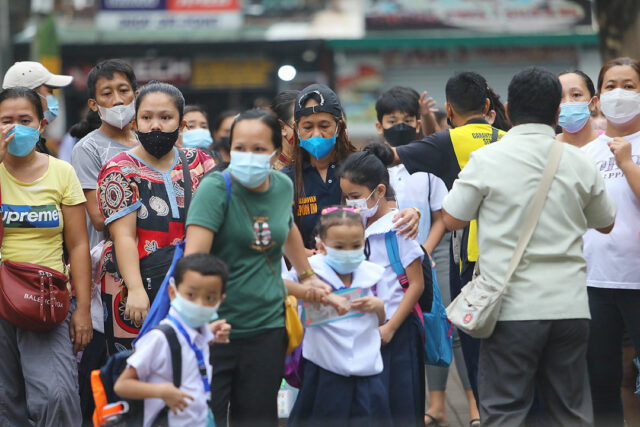
THE GOVERNMENT on Monday said the coronavirus pandemic would no longer be an excuse to suspend face-to-face classes, as Filipino students endured heavy traffic on their way to cramped classrooms on the first day of school.

“We can no longer keep COVID-19 as an excuse to keep our children from schools,” Vice-President and Education Secretary Sara Duterte-Carpio said at an event marking the new school year. “Our commitment to basic education must never falter.”

“There were calls to suspend the opening of classes and move it to September or October,” she said. “But we are talking about the future of Filipino youth.”

President Ferdinand R. Marcos, Jr. has said learning would be much more effective inside classrooms, where students can fully interact with their teachers and classmates. “I welcome the return of our children to full face-to-face classes after two years of online learning due to the pandemic,” he said in a statement.

“Since the threat of COVID-19 is still in our midst, it is important that our teachers and students continue to observe the minimum health protocols to ensure that they remain healthy while learning new things.”

Students and teachers were greeted by overcrowded classrooms and heavy traffic on the first day of school.

“When we asked our students to return to classes amid the pandemic, all systems should have been in place to ensure that public utility vehicles are available, traffic flow is manned efficiently and health protocols are observed,” Senator Mary Grace S. Poe-Llamanzares said in a statement.

Ms. Poe, a former pre-school teacher, said students should be sitting in chairs, not on the floor.

“Our students deserve a safe and comfortable experience as they brave going back to school amid the lingering pandemic,” Ms. Poe said.

“We hope concerned agencies will make up for the hitches encountered on Day One of face-to-face classes and make the coming days pleasant for our learners.”

Media reports showed traffic congestion across the country, especially in Manila, the capital and nearby cities.

John Paul S. Tanyag, a commuter, worries that the situation will worsen as more schools enforce five days of face-to-face classes in the coming weeks.

It took him one-and-a-half hours to get to his office in Taguig from his house in Muntinlupa City — triple the usual travel time in smooth traffic.

“It will get worse for sure,” he said in a Facebook Messenger chat. “There were missed opportunities to plan ahead while we were on lockdown.”

“The traffic situation that we have seen needs special attention,” Ariel E. Inton, a former board member of the Land Transportation Franchising and Regulatory Board (LTFRB), said by telephone. “The government has to do something about this as soon as possible.”

Mr. Inton, a lawyer advocating commuter safety, urged the government to hold meetings with various sectors and other agencies, including the Interior and Local Government and Education departments.

“Right now, we are not yet implementing full face-to-face classes,” he said. “The problem will be bigger once the full implementation is seen in November. We have to prepare the concerned agencies.”

ACT Teachers Party-list Rep. France L. Castro noted that as many as 50 students were cramped in one classroom in Quezon City, which she said poses health risks.

The Education department should limit students per classroom to avoid transmission of the coronavirus, she told the ABS-CBN News Channel.

Polen Austria, a parent, worries that coronavirus infections could surge as health protocols are ignored in her child’s public school.

“I’m quite confident because my child is already fully vaccinated,” she said by telephone. “But others might get infected and the disease could spread.”

Some teachers held a protest rally near the presidential palace before going to school, hitting the government’s unpreparedness. They also decried their meager salaries.

“Instead of being able to focus on teaching, they have to address classes that don’t have classrooms, or students that don’t have chairs and books or modules,” Vladimer Quetua, chairman of the Alliance of Concerned Teachers (ACT), said at the rally.

Teachers should not carry the burden of solving the gaps in Philippine education, he said. “This is the responsibility of the government, which continues to deny adequate support for education.”

Meanwhile, the Kabataan Party-list group denounced the confiscation by police of donations during a relief drive at an elementary school in Quezon City.

“The Kabataan Party-list condemns this act of police brutality that did not only deprive young students of safety equipment and other necessities on their first day but also inflicted trauma on children who witnessed such violence,” it said in a statement.

A video of police officers forcefully confiscating school materials and other goods in front of President Corazon C. Aquino Elementary School in Quezon City went viral on social media.

In a Facebook post, the Salinlahi Alliance for Children’s Concerns, which started the relief drive, called the police move despicable.

Police officers said the group did not have a permit to distribute the goods.

Kabataan urged the Philippine National Police to pull out policemen in schools to prevent violent incidents in front of children.

In a statement, the PNP reported a smooth implementation of security and minimum and public health protocols during the opening of the school year.

A total of 23,653 police officers were deployed across the country to maintain order, national police chief Rodolfo S. Azurin said.

Kabataan said the number of cops deployed for the reopening of schools was excessive.

COVID CASES
The Department of Health (DoH) posted 23,883 coronavirus infections in the past week, with the daily average falling by 15% to 3,412 cases from a week earlier.

In a bulletin, the agency said it had verified 321 more deaths, 90 of which occurred from Aug. 8 to 21. Of the new cases, 101 were severe and critical cases.

DoH said 699 of 2,586 intensive care unit (ICU) beds in the country had been used as of Aug. 21, while 6,677 of 22,076 non-ICU beds were occupied. There were 811 severe and critical admissions, it added.

The government has fully vaccinated 72.31 million Filipinos DoH said. It added that 17.42 million people have received booster shots.

Meanwhile, key coronavirus disease 2019 (COVID-19) indicators in the capital region continue to drop, the OCTA Research Group said.

The virus reproduction number in Metro Manila had fallen to 1.03 as of Aug. 18, from 1.11 a week earlier, OCTA fellow Fredegusto P. David tweeted. The capital region’s positivity rate had fallen to 14.6% as of Aug. 20 from 16.3% a week earlier, he added.

Mr. David said the region’s healthcare use rate for COVID-19 was 37%. “The National Capital Region remains at moderate risk at this time.” — with John Victor D. Ordoñez


Philippines detects 4th monkeypox case

AN ELECTRON MICROSCOPIC image shows mature, oval-shaped monkeypox virus particles as well as crescents and spherical particles of immature virions, obtained from a clinical human skin sample associated with the 2003 prairie dog outbreak in this undated image obtained by Reuters on May 18, 2022. — CYNTHIA S. GOLDSMITH, RUSSELL REGNERY/CDC/HANDOUT VIA REUTERS

THE PHILIPPINES has detected its fourth monkeypox case.

The 25-year-old patient, a Filipino with no travel history to or from a country with no monkeypox cases, has been isolated, the Department of Health (DoH) said in a statement on Monday evening.  

Fourteen close contacts have been identified, one of whom was taking care of the patient, it said. 

All four confirmed monkeypox cases in the Philippines are unrelated to each other, DoH said.  

The first patient has recovered and was discharged on Aug. 6. The second and third patients were still in home isolation and in stable condition. 

No new contacts of these patients have been identified. — Kyle Aristophere T. Atienza 

Philippine agents seize smuggled rice, sugar 

BUREAU OF CUSTOMS FACEBOOK PAGE

PHILIPPINE authorities on Monday seized hundreds of bags of smuggled rice and sugar in a warehouse near Manila, the capital, according to the presidential palace, amid rising sugar prices and tight supply.  

Customs agents also seized machines in the Caloocan City warehouse that were being used to repack imported rice and sugar to make it appear that these were locally bought, Press Secretary Trixie Cruz-Angeles said in a statement on Monday night.  

The agents forcibly opened the warehouse after the owners and caretaker refused to cooperate, she said.  

The government has intensified its crackdown on smuggling and hoarding amid rising food prices. 

“The huge volume of sugar discovered by Customs agents in the various warehouses in Luzon has led Malacañang to conclude that the sugar shortage is artificial, brought about by the hoarding of sugar traders who wanted to rake in huge profits from the sudden spike in sugar prices,” Ms. Angeles said. — Kyle Aristophere T. Atienza 

Local govt’s told to help DSWD give out cash aid

The Department of the Interior and Local Government (DILG) has ordered local governments to help the Social Welfare department distribute cash aid to poor students after chaos marred the latter’s program at the weekend.

“We call on our local government units to respond proactively to the appeal of Social Welfare Secretary Erwin T. Tulfo,” DILG Secretary Benjamin C. Abalos said in a statement on Monday. “Let us step up and extend all the help that we can provide for the success of the distribution of financial aid to our students.”

Tens of thousands of students and parents trooped to offices of the Department of Social Welfare and Development (DSWD) nationwide at the weekend to claim their cash aid. Many of them went home with nothing, while at least one stampede was reported in Zamboanga in the country’s south.

The agency on Thursday said it would give P500 million in student cash aid — P1,000 each to elementary students from poor families, P2,000 to high school students, P3,000 to senior high school students and P4,000 to college students.

The aid is limited to three students per family, which can get the financial assistance on Saturdays from Aug. 20 to Sept. 24.

The Social Welfare department admitted failing to coordinate with local governments for the cash aid distribution. Social Welfare Secretary Erwin T. Tulfo apologized for the mess at the weekend, saying he wanted his agency to directly give the money and avoid selective aid.

Mr. Abalos said cities should set up several distribution centers to avoid overcrowding. He also ordered police to keep peace and enforce minimum public health protocols during the distribution of financial aid.

“In this massive undertaking, we look to our LGUs to assist us to be able to send out the financial assistance to the students who need them the most,” he added.

In Manila and nearby areas, authorities had to use riot police to prevent people from storming the offices of the DSWD.

Political analysts have said the chaos showed the government has not learned from its experiences during the coronavirus pandemic.

Mayors in several cities have suggested alternative procedures in the release of the cash aid.

Iloilo City Mayor Jerry P. Treñas said DSWD should consider a school-based distribution system. “If the reason of DSWD is to avoid going through the LGUs, the financial assistance can be coursed through the schools. It will be easier and more convenient,” he posted on Facebook on Saturday.

Earlier in the day, the mayor scolded the DSWD regional head over what he called a “terribly planned event” at the Iloilo Sports Complex.

In Dagupan City, Mayor Belen T. Fernandez offered to provide the local government’s list of poor households. She also offered the city’s plaza for the distribution.

In Zamboanga City, about 5,000 people showed up in front of a school where the aid was distributed, causing a stampede that hurt 29 people.

The victims, aged 16 to 58 years, had been waiting in line for a chance to receive the aid since Friday evening, the Zamboanga City Medical Center’s Public Affairs Unit posted on Facebook.

Zamboanga City Mayor John M. Dalipe in a statement said they were “ready and willing to support and provide necessary resources to ensure the well-being of the beneficiaries.” — John Victor D. Ordoñez

1st day of classes suspended in typhoon-affected areas as ‘Florita’ intensifies

CAGAYAN PIO

CLASSES in some northern parts of the country were suspended Monday, the first day of school reopening for in-person learning, as typhoon Florita intensified and tropical cyclone wind signals were raised by the state weather agency.   

Work in both public and private establishments were also canceled in some towns and cities effective Monday afternoon, based on social media announcements by local governments, including in the provinces of Cagayan and Isabela where tropical storm Florita could possibly make landfall by Tuesday afternoon.     

Florita was located 155 kilometers (km) east of Casiguran, Aurora as of Monday afternoon, based on the 5 p.m. bulletin of the Philippine Atmospheric, Geophysical, and Astronomical Services Administration (PAGASA). 

It was moving in a west-southwest direction with maximum sustained winds of 75 km per hour (km/h) near the center and gustiness of up to 90 km/h. 

The tropical storm is also being enhanced by the southwest monsoon, according to PAGASA. 

There is a potential for slight weakening as Florita crosses the northern portion of northern Luzon due to frictional effects of the rugged terrain, but the tropical cyclone will likely remain a tropical storm throughout the passage over land,it said. 

The weather agency also warned against flooding and landslides.   

Some of the areas in the storms path are those affected by the magnitude 7 earthquake that struck northern Luzon on July 27, which triggered landslides.   

Regional and provincial disaster management teams have been placed on high alert for preemptive evacuation and emergency response operations.   

Leon DG Rafael, Jr., disaster risk reduction and management council director for Cagayan Valley, also called on local governments not affected by the typhoon to organize teams who could assist in response operations.   

As of 5 p.m. PAGASA raised signal #2 in the following areas: Cagayan, Isabela, Quirino, eastern portion of Nueva Vizcaya, Apayao, eastern portion of Abra, Kalinga, Mountain Province, Ifugao, and the northern and central portions of Aurora.  

A signal #2 alert means heavy winds of more than 61 km/h to 120 km/h are likely.   

Winds may reach gale-force in strength in any of the areas where wind signal no. 2 is hoisted throughout the passage of tropical storm Florita,the weather agency said.   

A weaker signal #1 was up in Babuyan Islands, the rest of Nueva Vizcaya, the rest of Abra, Benguet, Ilocos Norte, Ilocos Sur, La Union, eastern portion of Pangasinan, eastern portion of Tarlac, Nueva Ecija, the rest of Aurora, eastern portions of Pampanga and Bulacan, northeastern portion of Rizal, the northern portion of Quezon including Polillo Islands, northern portion of Laguna, and Camarines Norte.  

Florita could make a second landfall in Babuyan Islands off northern Luzon before exiting the Philippine area on Wednesday evening or Thursday morning, PAGASA Weather Specialist Aldczar D. Aurelio said in a streamed briefing Monday. MSJ 

House bill filed to legalize importation, sale of used clothing 

PHILIPPINE STAR/EDD GUMBAN

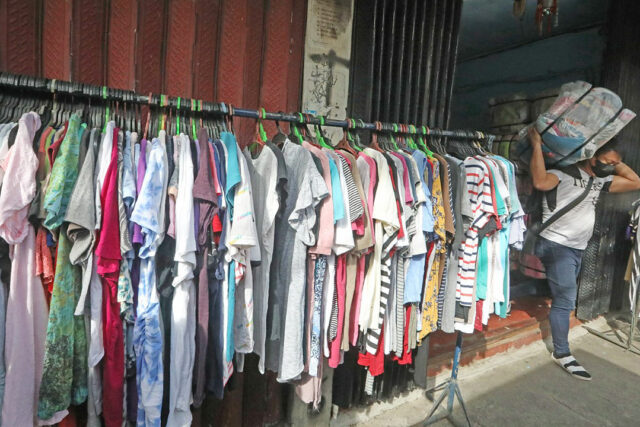
A BILL seeking to legalize the commercial importation and sale of used clothing, popularly referred to as ukay-ukay, was filed at the House of Representatives on Monday.    

House Bill No. 3845 seeks to repeal the more than 50-year-old Republic Act No. 4653, which bans the entry of secondhand clothing into the country to safeguard public health and the nations dignity.  

The measure, filed by Albay Rep. Jose Ma. Clemente S. Salceda, mandates the Department of Health (DoH) to set guidelines for importation of used textiles.    

It also tasks the Bureau of Customs, Tariff Commission, and the Department of Social Welfare and Development to issue rules and regulations necessary for implementation.    

Mr. Salceda said in the bill’s explanatory note that the measure “will decriminalize (importation of used garments) allowing them to become formally part of the economy.”

At the Senate last week, Senator Rafael T. Tulfo raised the possibility of legalizing secondhand garments during a Ways and Means Committee hearing.  

I would rather that we place DoH standards and allow (secondhand clothing) businesses to finally register, instead of having such a large underground sector that we just choose to ignore, because its big enough to provide jobs, but illegal,Mr. Salceda, who chairs the House Ways and Means Committee, said in a statement last week. 

Ukay-ukay has been legal in all but the law itselfIts time for the law to recognize what is real and legal to the ordinary Filipino anyway,he added. Matthew Carl L. Montecillo

Senate bill proposes interest-free loans, emergency fund for MSMEs 

PHILIPPINE STAR/ MICHAEL VARCAS

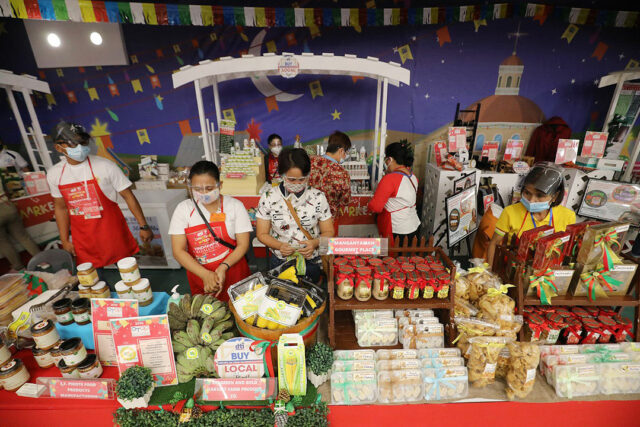
A BILL filed at the Senate seeks to provide additional support to micro, small and medium enterprises (MSMEs), including interest-free loans from state-owned banks and an emergency fund for disaster recovery.  

Senator Emmanuel Joel J. Villanueva, author of Senate Bill 138 or the MSME Stimulus Act, said the proposed law is intended to boost and popularize local products in domestic and international markets.  

Theres a unique sense of pride that something that delicious can be made in your hometown by your people, and shared throughout the country and the whole world,the senator said in a mix of English and Filipino in a statement on Monday.   

The measure will create the MSME Growth Stimulus Program to extend assistance, strengthen, and facilitate the growth and development of MSMEs to create and sustain jobs across the regions.   

Under the bill, interest-free loan windows will be opened through the Land Bank of the Philippines (LANDBANK) and the Development Bank of the Philippines.   

An MSME Stimulus Contingency Fund will also be maintained and used to assist MSMEs affected by disasters, public health emergencies, armed conflict, and other disruptions.  

The Department of Finance will also be mandated to provide wage subsidies to disaster-hit MSMEs.  

The bill will help MSMEs become resilient and disaster-proof,the senator said.  

Most of our MSMEs took massive losses during the (coronavirus) pandemic, leading to their closures and laying off employees,Mr. Villanueva said.  

Now that the economy is opening up, our MSMEs need booster shots of government aid to keep local goods and services afloat and help MSMEs keep their employees,he added. 

Data from the Department of Trade and Industry show MSMEs comprise 99.5% of all businesses in the country, generating 62.66% of the countrys employment in 2020. Alyssa Nicole O. Tan 

PHL, India to enhance defense and security partnership 

DFA.GOV.PH

THE PHILIPPINES and India have agreed to enhance their defense and security partnership, including increased maritime coordination, the Philippine Department of Foreign Affairs said on Monday. 

The two countries made the commitment during the 4th Philippines-India Strategic Dialogue held August 18 in Manila.  

The talks were led by Philippine Foreign Affairs Undersecretary for Bilateral Relations and ASEAN (Association of Southeast Asian Nations) Affairs Ma. Theresa P. Lazaro and Indian Ministry of Foreign Affairs Secretary Saurabh.  

The diplomatic leaders discussed counter-terrorism, disaster risk reduction and management, transnational crime, intelligence exchange and procurement of defense equipment, as well as regional and global developments.  

Both sides shared concerns on maritime security and the marine economy, and agreed to fast-track preparations for a bilateral maritime dialogue.  

A day before the strategic dialogue, the delegations convened the 13th Philippines-India Policy Consultations where new areas of partnership were discussed, including financial technology, space cooperation, development cooperation, and renewable energy.  

Both nations also vowed to enhance cooperation in agriculture, pharmaceuticals, science and technology, culture, education, and tourism.    

Policy Consultations between the foreign ministries began on an ad hoc basis in 1994 and was institutionalized in 2000 with the signing of the Memorandum of Understanding on Policy Consultation Talks.  

Last weeks event was the first physical meeting between Philippine and Indian delegations since 2017. Alyssa Nicole O. Tan

Grab’s MOVE IT offers free rides to public school teachers in 4 Metro Manila areas 

MOVE IT, a subsidiary of Grab Philippines, announced on Monday that it is offering free motorcycle taxi rides to teachers and other personnel of public schools in Makati, Taguig, Pateros, and Pasay.

The free rides will initially run from 22 August until 30 September, during school days,MOVE IT said in a statement.

The company said it aims to ease the daily commute challenges of public school teachers and administrative workers, especially during the first few days of the resumption of face-to-face classes. 

The free rides can be availed using a promo code through the MOVE IT application.

Grab Philippines recently acquired MOVE IT, allowing it to enter the market for motorcycle taxis. 

Grab Philippines aims to expand MOVE ITs existing motorcycle taxi fleet and improve the efficiency of its platform to service more commuters and onboard at least 6,000 driver-partners within three months. 

The two companies signed a partnership deal last year to expand the latters market access and availability of its motorcycle taxi services. However, the technical working group tasked with overseeing the operations of motorcycle taxis issued an order suspending the partnerships implementation pending further study.   

Grab Philippines said it is confident that its acquisition of MOVE IT is compliant with existing rules. Arjay L. Balinbin 

ADVERTISEMENT
ADVERTISEMENT