
How PSEi member stocks performed — June 6, 2022

Here’s a quick glance at how PSEi stocks fared on Monday, June 6, 2022.
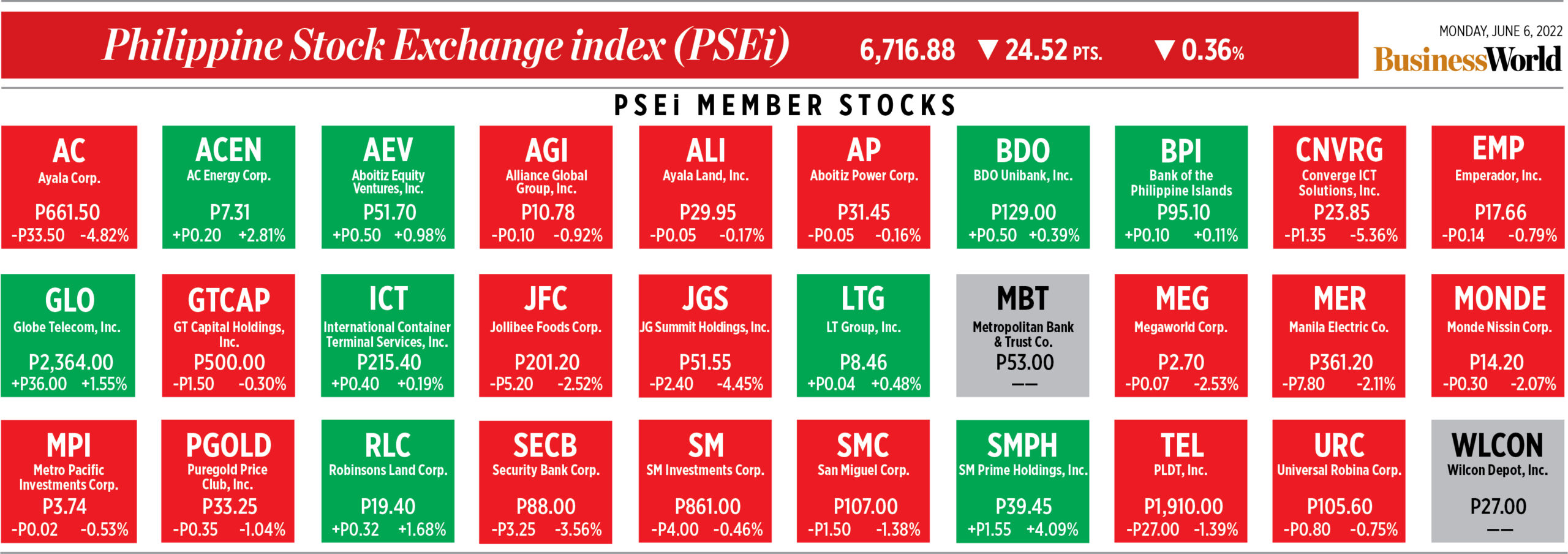

Here’s a quick glance at how PSEi stocks fared on Monday, June 6, 2022.

The Philippines slipped five places to 57th out of 100 countries in the 2022 edition of research center StartupBlink’s Global Startup Ecosystem Index. The index assessed startup ecosystems across 100 countries based on the total scores on quantity and quality of startups as well as business environment. It also had a separate ranking covering 1,000 cities across the globe. With a total score of 3.302, the Philippines had the seventh-lowest score among its peers in the Asia-Pacific. At the city level, it retained five locations in the rankings. Manila ranked 100th out of 1,000 cities worldwide. Meanwhile, new entrant Naga City (952nd) replaced Baguio City in the latest city rankings.

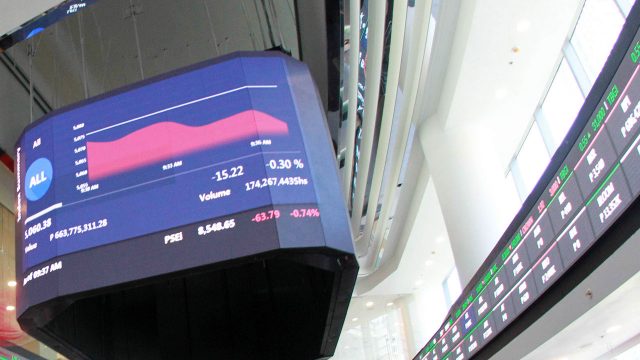
STOCKS dropped on Monday amid rising oil prices, which could cause inflation to spike further and cause the US Federal Reserve and the Bangko Sentral ng Pilipinas (BSP) to hike rates further.
The benchmark Philippine Stock Exchange index shed by 24.52 points or 0.36% to close at 6,716.88 on Monday, while the broader all shares index went down by 16.67 points or 0.46% to 3,585.85.
“Philippine shares started the week slipping into the red as investors continued to bet that the Federal Reserve will tighten monetary policy aggressively to combat surging inflation,” Regina Capital Development Corp. Head of Sales Luis A. Limlingan said in a Viber message.
“The local market edged lower this Monday amid the surge in global oil prices and the weakening of the local currency, both of which are seen to pose inflationary risks to our economy,” Philstocks Financial, Inc. Senior Research Analyst Japhet Louis O. Tantiangco said in a Viber message.
Oil prices firmed up after Saudi Arabia raised prices sharply for its crude sales in July, an indicator of how tight supply is even after the Organization of the Petroleum Exporting Countries and other major oil producers or OPEC+ agreed to accelerate output increases over the next two months, Reuters reported.
Brent crude firmed up by 68 cents or 0.6% to $120.40 a barrel at 0640 GMT. US West Texas Intermediate crude futures were up 61 cents or 0.5% at $119.48 a barrel after earlier hitting a three-month high of $120.99.
The US consumer price index (CPI) for the 12 months through April rose by 8.3%, down from an 8.5% annual rate reported in the prior month. Friday’s inflation report for May is one of the last key pieces of data before the Fed’s June 14-15 meeting, at which the central bank is widely expected to raise rates by another 50 basis points.
In the Philippines, the BSP and analysts expect May headline inflation to have breached 5% amid higher fuel and food prices.
A BusinessWorld poll of 16 analysts held last week yielded a median estimate of 5.4% for May inflation, matching the midpoint of the BSP’s 5% to 5.8% estimate and going beyond the 2-4% goal.
The Philippine Statistics Authority will release the May CPI report on Tuesday, June 7.
The majority of sectoral indices saw losses, except for property, which rose by 64.57 points or 2.08% to 3,165.95.
Meanwhile, mining and oil fell by 267.71 points or 2.14% to 12,198.31; holding firms lost 101.25 points or 1.60% to end at 6,204.36; industrials went down by 93.17 points or 1.01% to 9,119.04; services gave up by 13.27 points or 0.71% to finish at 1,850.26; and financials dropped by 1.81 points or 0.11% to 1,607.87.
Decliners bested advancers, 134 versus 60, while 47 names ended unchanged.
Value turnover increased to P5.94 billion with 1.88 billion shares changing hands from the P4.61 billion with 1.09 billion issues seen on Friday.
Foreigners turned sellers with P287.1 million in net sales versus the P15.21 million in net purchases seen the previous trading day. — L.M.J.C. Jocson with Reuters
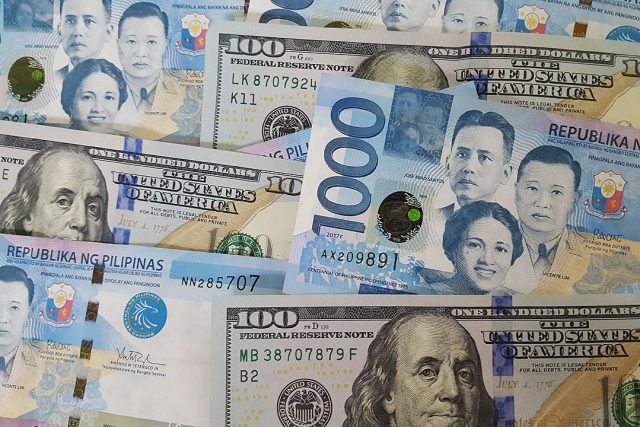
THE PESO ended flat against the dollar on Monday on concerns over further rate hikes here and abroad amid upbeat US employment data and expectations of higher Philippine inflation last month.
The local unit closed at P52.86 on Monday, unchanged from its Friday close.
The peso opened Monday’s session slightly weaker at P52.92 against the dollar. Its weakest showing was at P52.97, while its intraday best was at P52.84 versus the greenback.
Dollars exchanged slipped to $1.079 billion on Monday from $1.128 billion on Friday.
“The peso was unchanged from mixed movements owing to upbeat US employment reports and lingering expectations of a strong BSP (Bangko Sentral ng Pilipinas) rate hike this month,” a trader said in an e-mail.
“The peso exchange rate was slightly weaker today versus the US dollar after generally stronger US jobs/employment data could still support/justify further Fed rate hikes amid continued hawkish signals by most Fed officials…and a day ahead of the latest Philippine inflation data expected to go up to 5% levels,” Rizal Commercial Banking Corp. Chief Economist Michael L. Ricafort said.
US employers hired more workers than expected in May and maintained a fairly strong pace of wage increases, signs of labor market strength that will keep the Fed on an aggressive monetary policy tightening path to cool demand, Reuters reported.
The US Labor department’s closely watched employment report on Friday also showed the unemployment rate holding steady at 3.6% for a third straight month, even as more people entered the labor force.
The Fed has increased rates by 75 basis points (bps) since March. It is expected to hike this by half a percentage point at each of its next meetings this month and in July.
Meanwhile, in the Philippines, the BSP and analysts expect May headline inflation to have breached 5% amid higher fuel and food prices.
A BusinessWorld poll of 16 analysts held last week yielded a median estimate of 5.4% for May inflation, matching the midpoint of the BSP’s 5% to 5.8% outlook and well above its 2-4% target for the year.
The Philippine Statistics Authority will release the May inflation report on Tuesday, June 7.
BSP Governor Benjamin E. Diokno last month said the central bank is likely to raise key interest rates by another 25 bps at its next policy review on June 23 following a hike of the same magnitude at its May 19 meeting to curb growing inflationary pressures.
For Tuesday, Mr. Ricafort gave a forecast range of P52.80 to P52.95 per dollar, while the trader expects the local unit to move within the P52.75 to P52.95 band. — KBT with Reuters
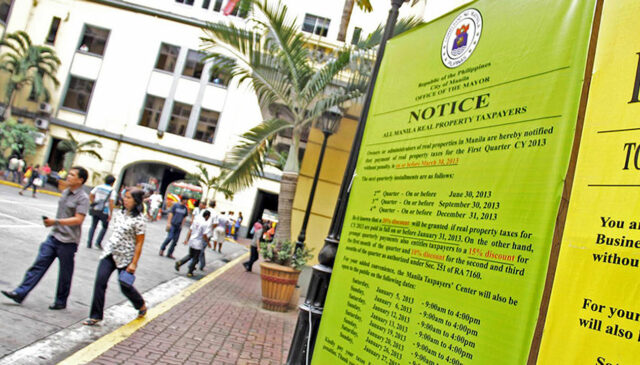
PROPERTY TAXES should be a key area of focus for developing economies in Southeast Asia seeking to raise government revenue after the pandemic, the Asian Development Bank (ADB) said.
During a webinar on Monday, ADB Economic Research and Regional Cooperation Department Advisor Donghyun Park said the collection of property taxes is hampered by issues like valuation.
“I think an important source of tax revenue, for local governments and subnational governments, is in fact, property taxes,” Mr. Park said. “What is limiting property taxes which are very much underutilized in the region is proper market valuation.”
“I think governance reform, especially at the subnational government level, is very important for mobilizing tax revenue at the subnational and local level.”
“Of course, you have to try to raise more from the mainstays such as value-added tax (VAT), but also venturing to new areas, such as property tax, personal income tax, digital economy tax, environmental tax, and so forth,” he added. “It has to be a balance. I do think it has to be a medium-term strategy and priority for most governments in the region.”
The Department of Finance (DoF) has said that current land valuations are outdated. In April, it said commercial areas in San Lorenzo, Makati are valued at P40,000 per square meter, when the actual value is between P400,000 to P900,000.
“So we are losing tens of billions of pesos because that kind of wealth is not being taxed correctly,” Finance Secretary Carlos G. Dominguez III said.
In May, the DoF also urged the incoming administration to pass pending tax legislation, including the proposed Real Property Valuation and Assessment Reform Act, a component of the Comprehensive Tax Reform Program. It is currently with the House Committees on Ways and Means, Local Government, and Finance.
Hannelore Niestan, a consultant and international taxation expert at the ADB, also sees room for further improvement in collecting VAT, a likely platform for taxing the digital economy.
She said “tax revenue in the Asia Pacific is low” due to issues with collecting property and personal income taxes and sees seeing room for strengthening environmental taxes.
Ms. Niestan also backed a greater focus on tax administration, with tax compliance a key area for improvement “especially for multinational companies.”
Mr. Park also warned that Information and Communication Technology (ICT) should not be the sole driver for tax collection.
“ICT can do a lot to help improve the quality of tax administration, but at the same time, we cannot assume it is a panacea for tax administration. It is just a complement,” Mr. Park said. “Without good governance, technology can only do so much for tax administration.” — Tobias Jared Tomas

THE Trade Union Congress of the Philippines (TUCP) said on Monday that the impact of recent hikes in the minimum wage has been offset by higher fuel prices, keeping workers below the poverty line.
The TUCP, the Philippines’ largest labor federation, said in a statement that the rising prices of basic goods that stem from the surge in fuel prices make it more difficult for workers to live on poverty wages.
“The buying power of the current wage adjustments is being dissipated by the series of previous and present extraordinary increases in the prices of basic commodities and cost of services and have no impact in lifting the lives of workers from worsening poverty caused by the pandemic crisis,” TUCP President Raymond C. Mendoza said.
“Because of extraordinary inflation, the series of wage increase orders issued by the wage boards failed to restore the purchasing power of wages and (they) didn’t uplift workers’ purchasing power above poverty threshold wage level,” he added.
The Labor department on Sunday announced that new minimum wages will be implemented in 14 regions this month, after regional boards approved wage hikes of between P30 and P110.
Seaoil Philippines and Phoenix Petroleum Philippines announced in separate advisories on Monday fuel price hikes of P2.70 per liter of gasoline and P6.55 per liter of diesel, which will take effect on Tuesday.
“Prices can flexibly go up and down but government wage orders are inflexible,” Bienvenido S. Oplas, Jr., founder of free-market think thank Minimal Government Thinkers, said in a Viber message when asked to comment. “Soon a combination of oil and intermediate goods price hikes plus wage hikes will force companies to reduce workers and (will be) a worse outcome for labor.”
“This phenomenon directly hit the lives of workers and their families already bearing the brunt of the pandemic, in particular, the informal workers, the daily paid and the minimum waged workers who are mostly contractual and short-term, end-of-contract employees,” Mr. Mendoza said.
The new minimum wage in Metro Manila increased by P33 on June 4 to P570 for non-agricultural workers, and P533 for agricultural workers.
Central Luzon will see a P40 increase to P414-460.
The new daily wage in Calabarzon is P390-P470 for nonagricultural workers; P350-P429 for agricultural workers; and P350 for retail and service establishments with not more than 10 workers.
The Department of Energy estimates that gasoline, diesel, and kerosene prices have increased by P23.85 per liter, P30.30, and P27.65, respectively in the year to date as of May 31. — John Victor D. Ordoñez

PLASTIC WASTE generated by electronic commerce (e-commerce) transactions is beyond the capacity of local governments to deal with the additional solid waste, EcoWaste Coalition said.
The environmental advocacy said in a statement on Monday that the plastic waste from e-commerce packaging imposes an “additional and unnecessary burden” on communities, particularly after the pandemic forced consumers to order more goods online.
“Lazada and Shopee will again hold a mid-year grand sale starting June 6 which will add to more packaging and plastic waste being burned or dumped into our environment. We urge these companies to implement a genuine plastic use reduction scheme and to support their sellers and logistics providers in implementing similar measures,” EcoWaste Coalition Plastic Solutions Campaigner Coleen Salamat said.
EcoWaste coalition said the e-commerce industry is currently valued at P1.2 trillion, equivalent to 5.5% of the economy in 2022, according to data from the Department of Trade and Industry.
“Lazada and Shopee should… support global efforts to save our climate and environment. Cutting back on their plastic waste should be a very simple step for these companies. Let us stop sacrificing our environment for profit,” Ms. Salamat said. — Revin Mikhael D. Ochave

TAXES collected from fuel marking amounted to P439.40 billion as of late May, counting back to when the program started in September 2019, the Department of Finance said.
The total includes P409.58 billion generated by customs duties as of May 26, and P29.81 billion worth of excise taxes collected as of Oct. 28, 2021.
The volume of marked fuel was 42.10 billion liters as of May 27, Finance Secretary Carlos G. Dominguez III said in a Viber message on Monday.
Luzon accounted for over 73% of marked fuel, or 31 billion liters, while 8.7 and 2.3 billion liters were marked in Mindanao and the Visayas, respectively.
Diesel accounted for 60.70% of the marked fuel, while gasoline consisted of 38.92%, and kerosene 0.51%.
There are currently 28 oil firms participating in the fuel marking program.
Petron Corp. had the largest volume of fuel marked at 10.26 billion liters, or 24.37% of the total, followed by Pilipinas Shell Petroleum Corp. at 7.48 billion liters or 17.76%.
Unioil Petroleum Philippines, Inc. had 4.31 billion liters marked, while Insular Oil Corp. and Seaoil Philippines, Inc. accounted for 3.65 billion and 3.48 billion, respectively.
The fuel marking program was launched on Sept. 4, 2019. Fuel marked with a special dye signifies tax compliance, while the absence of the dye is considered an indication that the fuel may be smuggled. The program is authorized by Republic Act 10963, or the Tax Reform for Acceleration and Inclusion (TRAIN) law.
Last year, P158.44 billion was collected via duties. In 2022 so far, collections have totaled P154.40 billion, while the volume of marked fuel for the period was 12.97 billion liters.
Mr. Dominguez has said that the government expects to collect P147.1 billion in fuel excise tax and VAT in 2022. — Tobias Jared Tomas

THE Securities and Exchange Commission (SEC) said its investigation into a company offering unlicensed investment products revealed that the company promised daily returns of 3-5% on investments of at least P1,000.
The SEC said it is now issuing an order to revoke the registration of Intime Import and Export (LLC) Corp. for its unlicensed investment-taking activities.
According to the SEC website, the agency first warned the public against placing investments with the company on April 6.
The investment scheme offered by Intime “has the characteristics of an ‘investment contract’ which must first be registered with the commission before it may be offered and sold or distributed to the public,” the SEC said in an advisory.
The SEC said the company is not registered to offer securities to the public and its officers do not hold licenses as capital market professionals.
On May 2, the SEC issued a show-cause order to Intime to explain why its Certificate of Incorporation should not be revoked. The agency said it received no response.
“Likewise, the investment scheme of respondents Intime Import and Export promising a return of 3-5% per day has the characteristics of a Ponzi scheme,” the commission added.
A Ponzi scheme offers impossibly high returns to early investors paid out of the capital contributed by later investors.
“The investment scheme of Intime Import and Export also operates to defraud investors as it deceives the investing public by making it appear that it has the authority to deal in securities. This also amounts to serious misrepresentation as to what they can do or are doing to the damage and prejudice of the investing public,” it added. — Luisa Maria Jacinta C. Jocson

The term “task force” may be familiar to everyone because of the Inter-Agency Task Force (IATF) that dealt with the pandemic. It was composed of representatives from various executive departments, apparently to ensure that the members took a collaborative approach to combating COVID-19.
The task force approach lends itself readily to the tax enforcement mandate of the Bureau of Internal Revenue (BIR). While there are no recent administrative issuances serving as guidelines for the creation of task forces or special audit teams, previous task forces were formed to focus on audits of specific industries.
For example, the BIR recently created a task force to inspect registered business enterprises (RBEs) in the information technology-business process management (IT-BPM) industry, to ensure that RBEs comply with conditions for the continuous availment of incentives under the CREATE Law. Last year, a special task force was also created to monitor compliance of online merchants and influencers, possibly due to the rise of online transactions during the pandemic.
Previous task forces were likewise created to address matters of public concern. One created by the BIR’s Legal Inspection Group looked into a former President to assess whether bribes and kickbacks resulted in a deficiency income tax situation.
In the absence of guidance on the scope of action a task force may carry out, what should a taxpayer do upon receipt of a notice that his business is going to be audited by a task force? Should he worry, considering that task forces are usually related to matters of public concern?
LETTER OF AUTHORITY (LoA)
Medicard Philippines, Inc. vs. Commissioner of Internal Revenue (CIR) defines a Letter of Authority (LoA) as the “authority given to the appropriate revenue officer assigned to perform assessment functions.” It empowers or enables the revenue officer to examine the books of account and other accounting records of a taxpayer for the purpose of collecting the correct amount of tax. If a revenue officer is not authorized by the CIR or by his duly authorized representative through an LoA, the assessment is deemed invalid as it violates the taxpayer’s right to due process.
Jurisprudence shows that despite the creation of a task force, special auditors should still be authorized pursuant to a valid LoA. RDAO No. 08-03 also clearly states that no special task force may be created without the approval of the Commissioner. Thus, it cannot be said that the mere creation of the task force is equivalent to a LoA.
Hence, the task force cannot ripen into assessment. An assessment must always originate from a LoA; otherwise, the assessment is void.
HOW ARE THE TASK FORCE’S FINDINGS ENFORCED?
After the issuance of the LoA, if the taxpayer is found liable for deficiency tax during an investigation conducted by a Revenue Examiner, the taxpayer must be informed through a Notice of Discrepancy (NoD), a Preliminary Assessment Notice (PAN), a Final Letter of Demand (FLD) or Final Assessment Notice (FAN), and finally, a Final Decision on Disputed Assessment (FDDA).
A review of the cases that involved a task force would show that the findings of a task force are also followed through in a similar manner to that of an ordinary audit. In the case of Sps. Estrada vs. BIR, the required notices such as the PAN, FLD, and FDDA were served to the taxpayers. The Court of Tax Appeals decision also states that the taxpayers were given sufficient opportunity to be heard, having been able to effectively protest the PAN and FAN.
Thus, the process of enforcement is the same for both types of tax audit.
WHAT DUE PROCESS IS ACCORDED TO THE TAXPAYER?
While replete with case law and issuances explaining the procedures applicable to a task force, it is evident in jurisprudence that there is no difference in due process afforded to taxpayers, whether subjected to a regular audit, or that of a task force. As stated previously, taxpayers are still afforded due process with the service of the notices mandated under the law and are able to submit and file their protests to address the findings of the task force.
To note, the taxpayer has 30 days to reply to the NoD, 15 days to file a reply to the PAN, 30 days to file a protest to the FAN, and 30 days to appeal to the FDDA. These timelines should similarly apply to the audit conducted by a task force.
SUSPENSION OF TASK FORCES
It is thus easy to point out where the confusion and concern come from since there is not much difference between a task force’s proceedings and a regular tax audit. These concerns were raised by the Department of Finance (DoF) in May when it called for the suspension of the BIR’s special audit task forces, noting that task forces caused confusion for some taxpayers and that the creation of such task forces duplicated functions within the bureau.
While not addressing the remarks of the DoF on redundancy, the BIR issued Revenue Memorandum Circular (RMC) No. 76-2022 which suspended audit and other field operations under the authority of task forces created through Revenue Special Orders, Operations Memoranda, and other similar orders/directives. On the same day, the BIR issued RMC No. 77-2022 clarifying the earlier RMC stating that despite the suspension, service of assessment notices, warrants, and seizure notices would still be given effect. Similarly, taxpayers need not secure authority from revenue officials if they are to voluntarily pay their known deficiency taxes.
Task forces are created mainly to focus on a specific objective. However, if these units perform the same functions as that of officers assigned to perform a regular audit, it calls into question whether the creation of a task force is truly necessary or merely causes anxiety and confusion for taxpayers. Sure enough, taxpayers are still recovering from the stress and trauma brought about by the pandemic. As such, the BIR should ease off on taxpayers and not add to the burden of their recovery.
Let’s Talk Tax is a weekly newspaper column of P&A Grant Thornton that aims to keep the public informed of various developments in taxation. This article is not intended to be a substitute for competent professional advice.
Anna Gabrielle L. Sunga is an associate of Tax Advisory & Compliance division of P&A Grant Thornton, the Philippine member firm of Grant Thornton International Ltd.

PARIS — Rafael Nadal regained his aura of invincibility on clay on Sunday by brutally crushing Casper Ruud to lift the French Open trophy for an incredible 14th time and widen the gap at the top of the men’s all-time list of Grand Slam winners.
Norwegian Ruud became the latest victim in a long line of challengers who have unsuccessfully tried to defeat the Spaniard in the Roland Garros final since Nadal won his maiden title on the red clay in 2005.
There was a sense of déjà vu as the Spaniard, who turned 36 on Friday, completed a 6-3, 6-3, 6-0 thrashing on a balmy afternoon in Paris to maintain his 100% success rate in the championship round at the claycourt major.
In the past 12 months, Nadal contemplated retirement due to his battle with a chronic foot problem, was forced to spend six weeks on the sidelines after suffering a stress fracture on a rib in March and was unsure if he would be able to compete in Paris after struggling with his foot in Rome.
Rumors that the “king of clay” was making his final appearance at Roland Garros kept circulating during the past fortnight.
“I don’t know what can happen in the future but I am going to keep fighting to try and keep going,” Nadal said in his victory speech on Court Philippe Chatrier, getting the afternoon’s biggest round of applause from the stands.
Despite all the trials and tribulations he suffered in the buildup, no one could prevent Nadal from lifting the Musketeers’ Cup for a record-extending 14th time. The win means Nadal is now halfway through the calendar Grand Slam for the first time in his career after also winning the year’s opening major at the Australian Open.
OLDEST CHAMPION
Nadal passed fellow Spaniard Andres Gimeno as the oldest Roland Garros men’s singles champion. The result once again demonstrated that even when he is less than 100% fit, he is still a mountain too steep to conquer on the red clay of Roland Garros.
The win also gave Nadal a record-extending 22nd Grand Slam title and put him two clear of world number one Novak Djokovic of Serbia and Swiss Roger Federer in the men’s race for the most major titles.
He got a standing ovation as he walked onto the center court under overcast skies as a raucous crowd livened up the atmosphere with drums and trumpets.
The Spaniard, who has a statue erected in his honor at the claycourt arena in western Paris, kickstarted the party early for his fans.
The duo had never played a competitive match before Sunday, but they have hit together plenty of times at the Spaniard’s academy in Mallorca and Ruud earlier said he has never won a practice set against his idol.
That record remained unchanged on Sunday.
BLISTERING START
Nadal, who is 13 years older than the Norwegian, made a blistering start as he raced to a 2-0 lead with a superb forehand passing shot securing him the first break of the match. But despite all his experience, there were still nerves for the Spaniard as he frittered away his early advantage with two unforced errors off his forehand and two double faults.
Nadal’s vicious top-spin forehand, however, soon found its range and he started applying pressure to Ruud’s backhand to secure a break and canter to a 4-1 lead before securing the opening set.
Ruud raised his level at the start of the second, saving three break points to hold serve in the opening game and earned praise from his opponent when he charged down the length of the court to reach a drop shot and turned it into a winner.
The Norwegian soon broke Nadal to love to take a lead for the first time in the match.
The break seemed to galvanize Nadal. The Spanish fifth seed wiped out his advantage in the next game and from a 3-1 lead in the second set, Ruud did not win another game.
Nadal was now fully in the mood to put on a show and he put Ruud out of his misery on his second championship point with a backhand winner down the line, ending the contest in two hours and 18 minutes. — Reuters

STEPHEN Curry scored 29 points and made five 3-pointers in three quarters of action and the Golden State (GS) Warriors evened the National Basketball Association (NBA) Finals at one game apiece with a convincing 107-88 victory over the Boston Celtics on Sunday night in San Francisco.
Jordan Poole added 17 points and Kevon Looney tallied 12 for the Warriors. Klay Thompson and Andrew Wiggins had 11 apiece for Golden State, which travels to Boston for Game 3 on Wednesday.
Jayson Tatum made six 3-pointers while scoring 28 points for the Celtics, who won the first game of the series but were outscored 55-38 in the second half on Sunday.
Jaylen Brown added 17 points for Boston but was just 5-of-17 shooting. Derrick White scored 12 points off the Celtics’ bench.
Golden State shot 45.3% from the field, while Boston made 37.5% of its shots. Both teams were 15 of 37 from behind the arc.
Celtics Game 1 hero Al Horford (26 points) had just two points on 1-of-4 shooting in this one.
Boston committed 19 turnovers while Golden State racked up 15 steals. Curry, Looney and Otto Porter, Jr. had three apiece.
Curry scored 14 points in the third quarter to help the Warriors turn a 52-50 half time lead into a 23-point cushion. Golden State outscored Boston 35-14 in the period.
Curry scored eight points during a 16-4 burst that saw Golden State open up a 68-56 lead with 6:47 left in the third quarter.
Grant Williams and Tatum hit consecutive 3-pointers to cut Boston’s deficit in half, but the Warriors responded with 11 straight points. Porter started the surge with a trey and Curry drained two straight from behind the arc to make it 79-62 with 2:13 remaining in the quarter.
Poole ended the quarter with two 3-pointers in the final 30 seconds. He launched the second from just inside the half-court line and it swished through just as time expired to give Golden State an 87-64 lead entering the final stanza.
The Warriors scored the first six points in the fourth quarter to increase the margin to 29 and cruised to the finish.
Curry scored 15 first-half points as the Warriors led by two at the break. Tatum made five 3-pointers while scoring 21 in the half for Boston, while Brown added 15. — Reuters
