Home Blog Page 5914

PSE may allow more shares for local small investors

BW FILE PHOTO

THE Philippine Stock Exchange (PSE) has been authorized to increase the maximum subscription amount for each local small investor to more than P100,000 on a case-to-case basis to correspond with the size of the share offering.

In a circular, the exchange announced that the Securities and Exchange Commission had approved the amendments to the rules for local small investors (LSIs), or those who are willing to subscribe to a minimum board lot and whose subscription does not exceed P100,000.

The authority given to the PSE to increase the maximum subscription amount is aimed at “facilitating and achieving maximum participation and subscription to the LSI allocation.”

The PSE said the allocation to LSIs will be at least 10% of the entire initial public offering (IPO), which will be offered only after the effectivity of the registration statement and during the formal offering period.

“In the event of an over or under subscription in the 10% offer, a ‘clawback’ or a ‘clawforward’ mechanism shall be implemented,” the PSE said, referring to a provision relating to the reallocation of the offer shares.

In a separate circular, the exchange also released amendments to listing rules for real estate investment trusts (REITs) relating to lock-up exemptions for REIT sponsors, as well as regarding the shareholder equity requirement.

“To enable a secondary offering of REIT shares during the IPO, even in cases where the actual issuance of REIT shares to the sponsors or promoters in exchange for their contributed properties at a price lower than the IPO price may take place within the 180-day period before the IPO due to pending regulatory approvals, such shares issued to sponsors or promoters shall be exempted from the application of the lock-up rule,” the PSE said.

An amendment was also introduced that states that a newly formed REIT is not prohibited from undertaking a secondary offering of shares during an IPO, among others.

In another circular, the PSE also announced amendments to the lock-up rule section for the main board and the small and medium enterprises (SME) board.

“The amended lock-up rule allows alternative investment funds (AIFs) or their investment vehicle with demonstrated track record in private equity investments to sell during the IPO the shares that they acquired within 180 days prior to the IPO at a price lower than the IPO price, subject to the conditions set out in the rules,” the exchange said.

An alternative investment fund is an investment vehicle established for the purpose of raising capital from different investors and investing the pooled funds in alternative investments such as private equity, venture capital, and real estate.

The circular also detailed specific guidelines for listings on the main board and the SME board, among other amendments. — Luisa Maria Jacinta C. Jocson

VistaREIT shares remain unchanged on market debut

(FROM LEFT) VREIT President and CEO Manuel Paolo A. Villar and PSE President and CEO Ramon S. Monzon; VREIT Chairperson Jerylle Luz C. Quismundo, Vista Land and Lifescapes, Inc. Chairman, Former Senate President Manuel B. Villar, Jr., PSE Chairman Jose T. Pardo and PSE COO Atty. Roel A. Refran; China Bank Capital Corporation President Ryan Martin L. Tapia, VREIT CFO Melissa Camille Z. Domingo, Securities Clearing Corporation of the Philippines COO Renee D. Rubio and PSE Issuer Regulation Division Head Atty. Marigel B. Garcia

By Luisa Maria Jacinta C. Jocson, Reporter

VISTAREIT, Inc. (VREIT), the commercial real estate investment trust of integrated property developer Vista Land & Lifescapes, Inc., saw its share price finish unchanged on its debut on the Philippine Stock Exchange (PSE) on Wednesday.

The REIT shares closed at their initial public offering (IPO) price of P1.75 apiece. The stock will trade under the ticker VREIT.

“We are truly excited to bring VistaREIT to the public. What we offer is an elevated mall experience coming from our high-quality and world-class tenants. We believe that Filipinos deserve an experience that is at par with the best of the world and this IPO helps us to do just that,” Vista Land Chairman Manuel B. Villar, Jr. said in a statement.

The firm said it is anchoring its solid expansion program on the “robust, geographically-diverse pipeline of the profitable assets of Vista Land.”

VistaREIT President and Chief Executive Manuel Paolo A. Villar said the company is aiming to be among the leading diversified commercial REITs in the Philippines in terms of portfolio, profitability, growth, sustainability and dividend yield.

“We are optimistic about the prospect of a reinvigorated economy due to the easing of the restrictions, VistaREIT sees a robust foundation, its synergies with Villar-group retail ecosystem,” he added.

Analysts said that VistaREIT’s performance was mainly affected by dampened investor sentiment amid rising inflation and the ongoing Russia-Ukraine crisis, among other catalysts.

“VistaREIT had a lukewarm reception during its listing and would have finished much higher if not weighed by market sentiment as a whole, with the PSE index already drifting towards oversold territory,” Regina Capital Development Corp. Head of Sales Luis A. Limlingan said in a Viber message.

Diversified Securities, Inc. Equity Trader Aniceto K. Pangan said that rising inflation rates might trigger further interest rate hikes that could affect demand for REITs as the yield’s attractiveness goes down when lending rates move up.

“Aside from this, economic activity slows down when [a] rate hike is implemented to contain inflation but as long as yields are higher than [the] inflation rate, the demand remains attractive,” Mr. Pangan added in a text message.

Rizal Commercial Banking Corp. Chief Economist Michael L. Ricafort also noted that while the VistaREIT stock closed unchanged, it defied its intraday low of P1.59.

VistaREIT is the flagship mall and office REIT of Vista Land. The company has a portfolio of 10 community malls and two PEZA-registered office buildings with an aggregate gross leasable area of 256,404 square meters.

The malls are located in the cities of Las Piñas, Bacoor, General Trias, Imus, Antipolo, San Jose Del Monte, San Fernando, and Talisay as well as the municipality of Tanza in Cavite. The office buildings are located in Taguig City and Bacoor City.

Discovery World unit plans P7-B project in Davao City

ONE Davao Townships Corp., a wholly owned subsidiary of Discovery World Corp., announced it is developing an 11-hectare modern community project in Davao City as part of its township expansion plans.

The development is expected to generate up to P7 billion in real estate sales in various phases.

“The planned township will be the first luxury real estate project of its kind as One Davao pushes the region’s potential by integrating residential lots and mixed-use spaces,” Discovery World said in a disclosure on Wednesday.

The project will feature two areas: the West Village and the East Village.

“The West Village boasts of generous land cuts in a spacious yet private area. About 42% of the village will be dedicated to open spaces and amenities for upscale living. Nature-friendly features with a lush, green environment will reward residents with the benefits of outdoor living,” the firm said.

Meanwhile, the East Village will have mixed-use and commercial spaces and will serve as a “leisure hub with all desirable necessities within arms’ reach.”

“Discovery World is coming in strong in Mindanao and will explore more townships and regional developments in the years ahead,” the firm added.

Discovery World is engaged in the hotel and resort business through brands Discovery Shores Boracay, Club Paradise Palawan, and the cruise business through Discovery Fleet. It is a subsidiary of JTKC Equities, Inc., a holding company investing in real estate companies, predominantly in the leisure and hospitality sector.

Apart from One Davao Townships, Discovery World’s subsidiaries include Euro-Pacific Resorts, Inc., Palawan Cove Corp., Discovery Fleet Corp., Cay Islands Corp., Sonoran Corp., Long Beach Property Holdings, Inc., Lucky Cloud 9 Resort, Inc., Balay Holdings, Inc., and Discovery Hospitality Corp.

Discovery World shares dropped by 4.22% or seven centavos to close at P1.59 on Wednesday. — Luisa Maria Jacinta C. Jocson

Celebrating the local

A PLATE of seafood kare-kare, piyanggang pork belly, and adlai on the side at “Flavors of the Philippines” at Brasserie on 3. — PHOTO BY JOSEPH L. GARCIA

Conrad’s Brasserie on 3 gives even international dishes a Filipino touch

ALLERGIES and other health issues aside, it’s hard to repel the spell of a paella-filled lechon and a seafood kare-kare. These and more are exactly what Conrad Manila is serving for the whole month of June at the “Flavors of the Philippines” food festival at its restaurant, Brasserie on 3.

Brasserie on 3 went all out during a launch last week, serving a Sinuglaw — grilled meats and kinilaw (raw fish in citrus and other acids) —  as an appetizer. This was a little bit different, made with crispy chicken skin, pork belly, a seafood ceviche, and tuna inasal (barbecue) skewers. Due to health protocols, guests at the launch were served their food plated, though under normal circumstances, one can get up and get food at the buffet.

Next came a nourishing Balbacua (a slow-cooked beef stew rich in collagen, from it being made with skin and other parts). Finally, the main course arrived: a luxurious spread of Pork Belly Lechon (this one stuffed with paella; the pig itself is double-fried, according to Executive Sous Chef Patricia Mesina), Piyanggang Manok (a chicken dish from Mindanao that uses blackened coconut), and Seafood Kare-Kare. This seafood kare-kare (a peanut-based stew) was very indulgent: no expense was spared, so this one had scallops, lobster, and crab.

“We focused on all the regions of the Philippines, so that’s Luzon, Visayas, and Mindanao,” said Ms. Mesina during a group interview. “Our thrust is local and sustainable. A majority of our ingredients are local.”

The thrust for the local goes beyond the food festival, designed to celebrate Independence Day on June 12. “It’s an international buffet, but we have sections for the Filipino (food),” said Ms. Mesina. She points out that some sushi selections, available year-round for example, have Filipino elements in them, such as in an adobo inari. “As much as possible, we try to infuse local flavors to even international dishes.”

Conrad Manila’s General Manager, Linda Pecoraro agrees, saying “Where possible, we go local.” This goes beyond the food itself, with Ms. Pecoraro citing the exhibits of local artists at the hotel’s galleries. “It’s about being inspiring… during these times, it’s about celebrating the culture, and celebrating the food, and the produce that the Philippines supplies.”

Ms. Pecoraro also talked about how the hotel is doing, after two years of the waning COVID-19 pandemic. “With the MICE (meetings, incentives, conferences and exhibitions) business slowly coming back, and our social business also coming back; [things are] very positive.” Last year, Conrad Manila bagged the award for Philippines’ Best MICE Hotel for 2021 at the World MICE Awards.

Ms. Pecoraro said, “We’re getting there, and business is coming back; I’m pleased to say.”

“Flavors of the Philippines” is available daily for buffet lunch and dinner until June 30, with prices starting at P2,450 net per person. For reservations, call 8833-9999. —  Joseph L. Garcia

PLDT tapped for rollout of 220 public WiFi sites

PHOTO FROM JGSUMMIT.COM.PH

THE PLDT group announced on Wednesday that it was tapped by the United Nations Development Programme (UNDP) and the Department of Information and Communications Technology (DICT) for the rollout of public WiFi in 220 state universities and colleges in the country.

The flagship project aims to “further boost the online and blended learning programs of the education sector,” PLDT said in an e-mailed statement.

The project was launched at the Bulacan Polytechnic College in San Jose del Monte, Bulacan with a simultaneous online screening at Nueva Vizcaya State University on June 7.

The free WiFi project is DICT’s digital empowerment initiative aimed at connecting Filipinos nationwide in accordance with Republic Act No. 10929 or the Free Internet Access in Public Places Act.

Under the law, the project should cover all government hospitals and health centers; national and local government offices; public libraries; public parks, plazas, and other open areas; public schools; state universities and colleges along with TESDA (Technical Education and Skills Development Authority) institutions; and transport terminals.

“Among the key objectives of the Free WiFi project is to contribute to the progress of several SDGs (sustainable development goals). It’s strategic that we partnered with UNDP because it’s clear to them, which of the goals we are targeting,” DICT Acting Secretary Emmanuel Rey R. Caintic said.

UNDP Resident Representative Selva Ramachandra said that part of the organization’s mission is to promote inclusive quality education and to bridge the digital divide, especially in the academic sector.

“This initiative strives to enable public higher education institutions and their students to access and participate in opportunities for economic development.”

Hastings Holdings, Inc., a unit of PLDT Beneficial Trust Fund subsidiary MediaQuest Holdings, Inc., has a majority stake in BusinessWorld through the Philippine Star Group, which it controls. — Arjay L. Balinbin

High-flying Blue Eagles out to sustain flight vs Lady Spikers

NO. 4 SEED Ateneo Blue Eagles celebrate their victory over the Golden Tigresses. — THE UAAP

By John Bryan Ulanday

AMIDST another anticipated turbulence, high-flying Ateneo is out to sustain its flight against no less than its fierce rival La Salle to keep its title retention bid alive in the second phase of the University Athletic Association of the Philippines (UAAP) women’s volleyball tournament stepladder playoffs at the Mall of Asia Arena.

Dragged into an unchartered territory as the lower-ranked squad, the reigning champion but fourth-seeded Blue Eagles defied odds in three straight elimination matches with hopes of extending it anew against the Lady Spikers.

La Salle, as the No. 2 seed, sports a twice-to-beat advantage in the 5 p.m. duel, making it a tougher adversity to overcome for Ateneo.

But the Blue Eagles are ready in a bid to stay afloat with unbeaten National University (NU) that is already in the finals as their ultimate target.

“We will live for another day. We will just do it one game at a time, one day at a time. Hopefully, we will win at the right time and we will win when it matters,” said coach Oliver Almadro after a stunning sweep of No. 3 Santo Tomas.

Buoyed by massive wins against University of the Philippines to gain a tie at fourth and against Adamson in a playoff match to qualify in the stepladder, the streaking Ateneo rolled past Santo Tomas with 25-23, 25-23, 25-20 victory the other night to climb the ladder.

Back in 2014, the Alyssa Valdez-led Blue Eagles also took on a similar path by scaling the stepladder semifinals — against Adamson, twice-to-beat NU and unbeaten La Salle in the finals — as the No. 3 seed for their first-ever UAAP volleyball championship.

It’s far from being replicated as of now, but Mr. Almadro is hoping for his wards to get motivation from that dream run.

“It’s an honor for our team kung maikukumpara sa kanila. What is important is if we can duplicate what they did, we will be thankful to the Lord, and of course, we will be thankful for them for being our inspiration. Sana ma-manifest,” he added.

Banking on a week-long break, La Salle for its part is keen on stopping its rival’s run for good in just one match to arrange a best-of-three titular showdown with NU.

Attaboy tops list of North America’s 50 best bars

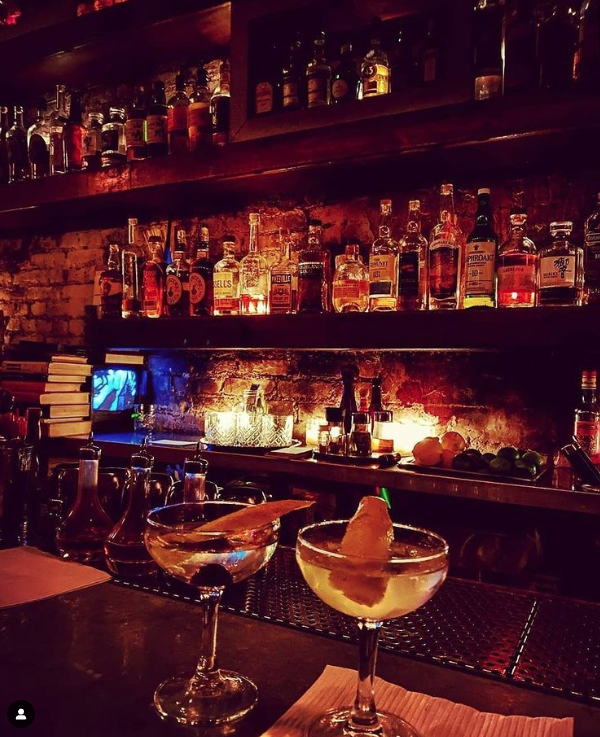
PHOTO FROM INSTAGRAM.COM/ATTABOY134/

NEW YORK’s Attaboy takes the top spot at the inaugural list of North America’s 50 Best Bars.

Attaboy has already earned its place among other lists by William Reed Business Media: last year, it was No. 34 on the World’s 50 Best Bars list. It has been around for about 10 years, a sort of a spinoff of Milk & Honey in New York. That bar, which opened in 1999, was credited with making speakeasies fashionable again. That bar has since closed; its founder, mixology pioneer Sasha Petraske passed away in 2015. Attaboy’s founders, Mr. Petraske, Sam Ross, and Michael McIlroy, themselves proteges of Mr. Petraske, opened Attaboy in 2012 at Milk & Honey’s former location at 143 Eldridge St., in the city’s Lower East Side.

The list’s notes about Attaboy describes its selection as “perfectly balanced variations of Prohibition-era cocktails.” While the list gives suggestions of various drinks on offer — there’s Ross’ Penicillin (scotch, lemon juice, ginger-honey syrup) and the Greenpoint (rye, green herbal liqueur, vermouth) —  its entry on North America’s 50 Best says, “Of course, none of these drinks can be found on the menu. In fact, there is no menu. Rather, each drink is custom tailored for the guest after a brief conversation.”

During a press conference streamed on the YouTube channel of 50 Best Bars last week, Attaboy General Manager Haley Traub said, “I still don’t believe it.”

“I think what’s most exciting about this is that we can show up and we can do the day-to-day and we can provide the best possible experiences to our guests, and then we can still clock out at the end of the night and you know, be silly bartenders, and have a wonderful time,” she said. “At the end of the day, we know that we’re providing the best possible experiences to our guests and to the people that come through our doors, is honestly all


North America’s 50 Best Bars

1. Attaboy, New York
2. Handshake Speakeasy, Mexico City
3. Licorería Limantour, Mexico City
4. Katana Kitten, New York
5. Kumiko, Chicago
6. Café La Trova, Miami
7. Baltra Bar, Mexico City
8. Dante, New York
9. Thunderbolt, Los Angeles
10. Civil Liberties, Toronto
11. Zapote Bar, Playa del Carmen
12. La Factoría, San Juan
13. Kaito del Valle, Mexico City
14. Sweet Liberty, Miami
15. Café de Nadie, Mexico City
16. Hanky Panky, Mexico City
17. Double Chicken Please, New York
18. Service Bar, Washington, DC
19. Raised by Wolves, San Diego
20. Sabina Sabe, Oaxaca
21. El Gallo Altanero, Guadalajara
22. Selva, Oaxaca
23. Amor y Amargo, New York
24. Jewel of the South, New Orleans
25. The Keefer Bar, Vancouver
26. Dear Irving, New York
27. Overstory, New York
28. Herbs & Rye, Las Vegas
29. El Pequeño Bar, Montreal
30. Employees Only, New York
31. The Dead Rabbit, New York
32. Broken Shaker, Miami
33. Friends and Family, Oakland
34. Death & Co (Los Angeles), Los Angeles
35. Mace, New York
36. Death & Co (Denver), Denver
37. Arca, Tulum
38. Mother, Toronto
39. ABV, San Francisco
40. El Floridita, Havana
41. Bar Raval, Toronto
42. Bar Leather Apron, Honolulu
43. Clover Club, New York
44. Bitter & Twisted, Phoenix
45. Cloakroom Bar, Montreal
46. Julep, Houston
47. Bar Mordecai, Toronto
48. Teardrop Lounge, Portland
49. Bar Kismet, Halifax
50. Genever, Los Angeles

Amber Kinetics to produce more energy storage systems

ENERGY storage firm Amber Kinetics, Inc. expects to more than double the production capacity of its manufacturing facility in Sto. Tomas, Batangas with the completion of its second plant by yearend.

“Our current capacity is something like 600-700 flywheels per year. By the time it (new plant) is fully operational, that should be something like 1,800 to about 2,000 flywheels per annum,” Roberto S. Kanapi, the company’s director of business development, said in a virtual media briefing on Wednesday.

Flywheels are the company’s modular kinetic energy storage system with a power capacity of 8 kilowatts and a discharge duration of four hours. They use recyclable steel materials.

Each of Amber Kinetics’ flywheels does not contain nor emit hazardous materials over its design life of 30 years. The company described its flywheel to be a “promising energy solution that does not compromise environment and safety.”

Mr. Kanapi said that the capacity of the second plant is also a function of the number of operating shifts, currently at one to two shifts a day. The facility can accommodate a third shift if needed.

Based in Silicon Valley, Amber Kinetics was founded in 2009 with the aim of helping hasten a transition to a clean energy future through what it claims to be the world’s first and only long-duration kinetic energy storage system.

In 2018, it opened a manufacturing site in the Philippines and has so far invested about $150-$160 million in the country.

With the second plant, the company expects to export its flywheels to other countries that need energy storage systems. Up to 70-80% of the current plant’s output is for the local market, Mr. Kanapi said, adding that a flywheel weighs about 2.5 tons.

“The two countries that we are looking at now, aside from Japan, of course, are Australia and the Philippines,” he said. “Australia is a huge market for energy storage. We were also completely surprised by the potential.”

Locally, Amber Kinetics has established partnerships with the Development Bank of the Philippines and the Department of Science and Technology. Both institutions are exploring emerging energy innovations, providing support to the country’s energy interests, it said.

The company has also set up its Flywheel Innovation Hub, a demonstration facility for flywheel technology at the De La Salle University’s Laguna campus.

Amber Kinetics said its storage system had been installed and commissioned in Australia, China, Hawaii, the Philippines, and the United States. More recently, flywheel units have been deployed and installed in Japan.

“Amber Kinetics provides accessible technology to support the Philippines’ growing renewable energy demands,” the company’s media release said. — Victor V. Saulon

Obiena tests positive for Covid-19, sits out two events

EJ OBIENA — REUTERS FILE PHOTO

CONTRARY to what some would like to believe, the menace that is the coronavirus disease 2019 (COVID-19) pandemic hasn’t fully vanished just yet. In fact, it caught an unwilling victim in Asian pole-vault record-holder Ernest John “EJ” Obiena.

The 26-year-old Mr. Obiena recently tested positive for the global health malady that will cost him two events — the Oslo Bislett Games in Norway and the Meeting de Paris in France this weekend.

“I hate to say it, but I would unfortunately miss these events due to health reasons. To be specific, I contracted COVID-19 a few days ago and I’m quarantining at home right now here in Formia (Italy) at home,” said Mr. Obiena on his Facebook story post on Tuesday.

Mr. Obiena though vowed to come back stronger as he is scheduled to see action in the Taby Stavhoppgala on June 28 and the Bahaus Galan on June 30 in Stockholm also in Sweden.

“Looking forward to see you all in Stockholm,” he said.

Mr. Obiena was coming off a gold medal-winning, record-breaking performance in last month’s Hanoi Southeast Asian Games where he vaulted to 5.46 meters and a triumph at the L’Aquila leg of the European City of Sports meet in Italy where he recorded a 5.85m — his best in this year’s outdoor season.

The World No. 5 would have been on pace in eclipsing his personal best 5.93m had he not contracted the virus. — Joey Villar

Virtual wine tasting: does it work?

Virtual wine tasting — PHOTO BY SHERWIN LAO

I was out with my family one recent Saturday evening to watch the day’s last screening of Top Gun: Maverick, a rare occasion in the last few years that saw us out late at night. What we all observed were the sheer number of people outside, the high volume of cars, the heavy traffic, and the bustling commerce in bars and restaurants —  all indications showing that Metro Manila’s nightlife is back to a pre-pandemic level. Restaurants are busy again even if take-out and delivery are readily available because there are also premiums consumers put on ambiance, presentation, service, and, of course, food served hot and fresh. This could be said in fact more so with wines.

Winery.ph, Boozeshop.ph, Manila-wine.com, Flasked.ph are just some of the most popular online liquor websites that sell a lot of wine, especially during the quarantine and movement-restriction periods. Yet there is a sense that some things are really best experienced in situ. I just feel that wine consumers want to see, and even touch, their wines when they go to their favorite supermarkets or liquor shops.

THE BORDEAUX EN-PRIMEUR EXPERIMENT: POSSIBLY THE BIRTH OF VIRTUAL TASTING
The En-Primeur is the most important business event in the city of Bordeaux. It lasts between eight to 10 weeks. En-primeur, which literally means “in first,” is the practice of purchasing wines in advance of its commercial release. It is also known as “wine futures” and is the same in principle as investing in commodity futures and hedging on price movements of assets.

In this annual event, the Chateaux get advance payments for their wines (18 months minimum in advance), while the buyers, mostly traders, get their wines from this vintage at pre-release prices which are supposedly lower than when the same wines are commercially released.

Other than the wine industry, the whole city is also bustling and directly benefits from the thousands of wine professionals visiting from all over the world and spending euros on hospitality enterprises including hotels, restaurants, and transportation. So, when this COVID-19 curse came upon Bordeaux and France in general, the Bordelais had to do something to salvage this financially critical En-Primeur tradition. Virtual wine tasting, while totally unheard of before, was now a reality.

With a lockdown in place, the only way for the chateaux to get interested buyers to purchase en-primeur wines was to send samples and do what is now commonly known as virtual tastings. Even the Union des Grands Crus de Bordeaux, a powerful group composed of over 130 top-tiered member chateaux from Bordeaux’s top appellations, had members that sent barrel samples to wine traders and critics. Instead of face-to-face barrel tasting and talking with winemakers and chateaux owners, it was replaced by real-time virtual Zoom meetings and distant tastings of samples sent.

The experiment may have worked as the 2020 and 2021 En-Primeur did its job for both the 2019 vintage (primarily because of a price reprieve from growing prices in the past few years) and 2020, another well-priced vintage. But there were also gripes and concerns about the virtual tastings experiment. Aside from suspicions that barrel samples were not the same as the blend of the final wine, which means the tastings done remotely were actually different from the finished product, there were also issues on volatility and noticeable flaws from the samples.

As of this writing, the 2022 En-Primeur for the 2021 Bordeaux vintage had returned to its successful face-to-face pre-pandemic setting and is winding down — and, as I learned from my good friend and resource person Yann Schyler, there is no official start and end to En-Primeur.

I can already sense that the return to a real En-Primeur will be beneficial to the chateaux, with a rather underwhelming 2021 vintage expected to do much better than expected. The mere revival of real and live interactions and tastings between buyers, critics, and the chateaux owners, after two “virtual tasting years” may have a huge influence on the positive reception of the wine trade to this 2021 vintage.

IS VIRTUAL WINE TASTINGS HERE TO STAY?
During the lockdown years of 2020 and 2021, virtual wine tastings were the buzzword among wine companies. In wine-producing countries, from Australia to the US, wine tastings in the cellar doors or winery stores were replaced with virtual wine tastings where customers were sent select bottles of wines in advance of the tasting schedule and were then guided through each bottle by a winery representative through Zoom or Google Meet as scheduled.

For us here in Metro Manila, in lieu of wine dinners, courageous wine companies have offered wine and food sets for scheduled virtual tastings. I believed there were not a lot of successful virtual wine dinners that happened in both 2020 and 2021. Virtual wine tastings are just temporary solutions, but their novelty may end sooner than we think. And let me explain why.

1. No Personal Touch — Virtual tastings are a bit impersonal. You are looking at a screen while you taste wine along with the person on the opposite side of the screen. Wine is and will always be a social drink. Wine needs company, and wine events need people rubbing elbows with each other to be successful. Laughter, smart comments, the sound of clinking glass, and even simple gestures can be missed on virtual platforms when these small things add to the magic of a wine event.

2. Pacing Issue — With scheduled virtual tastings, the pacing is important, and getting every participant in different households, or even from one household, on the same page or pace will always be a challenge. In real-live tastings, there are no distractions as everyone is properly seated and waiting for the host to guide them through each of the wines in the line-up. In a virtual set-up, people can be tinkering with their phones, watching TV, or doing other things since those activities are just second nature when you are in the comfort of your home.

3. Less Selection — With virtual tastings, only select wines are featured and delivered because you cannot overprice a virtual wine tasting event by sending more than three bottles. With more than three wines, the price for a wine package for virtual tasting events may become out-of-reach. Whereas in real live wine events, several wines can be featured, from cocktails prior to the formal dinner, to each wine served with the four or five courses in the meal. With a virtual tasting, it could be just one white, one red, and one sparkling or dessert-type wine.

4. Wastage or Forced Consumption — Since the majority of these virtual wine tastings will deliver full-size bottles, wastage or forced consumption (especially for households of three people or less) is the natural aftermath. In real live wine events, wines are portioned, and it is even hard to get seconds as no extra bottles are normally opened. Unlike spirits which, with their higher ABVs, can be left unconsumed for days, weeks, or months, sadly for opened wines, they need to be consumed in their entirety within the next few hours. Unless, of course, you have some wine preservation gadgets like the expensive Coravin or some inert gas canister to preserve the wine properly. Contrary to popular belief, a screwcap cannot preserve the wine once it has been opened as air would have gotten in already after the opening.

Virtual wine tastings for eager learners are indeed much better than drinking cluelessly. However, this phase should be over once the country opens up and normalcy returns. There is simply no substitute for real live wine events. I want to see up close the rosy cheeks of my fellow wine drinkers and hear the clinking sounds of wine glasses — that is how it should be.

The author is the only Filipino member of the UK-based Circle of Wine Writers (CWW). For comments, inquiries, wine event coverage, wine consultancy, and other wine-related concerns, e-mail the author at wineprotege@gmail.com, or check his wine training website https://thewinetrainingcamp.wordpress.com/services/.


Figaro on track to hit 150 store target by yearend

FIGARO COFFEE FACEBOOK PAGE

FIGARO Coffee Group, Inc. in a disclosure on Wednesday said that it will reach its target of having 150 branches open nationwide by the end of 2022.

“The gradual reopening of the economy gave us the confidence to aggressively expand our presence in more areas in the country. We at Figaro want to be able to cater to new markets that have high demand for quality food products at affordable prices,” Figaro Chairman Justin T. Liu said.

The firm said it is in the process of building 30 outlets in Bulacan, Cavite, Cebu and Laguna, and in more areas in the National Capital Region.

Figaro currently has 120 outlets across the country, which comprise of its brands Angel’s Pizza, Figaro Coffee and Tien Ma’s Taiwanese Cuisine, among others.

“There is a lot of demand in Metro Manila, but we also see a huge potential and a growing area outside the city center. The Philippines is a market that is primed up for growth and we are excited to bring value to a wider audience in our nation,” Figaro Chief Operations Officer Michael T. Barret said.

The company said it is also building more commissaries across the country to support its stores. Its Cebu commissary and main Metro Manila hub are set to be completed in the third quarter of this year.

“Aside from expanding its footprint in the country, Figaro is looking to further grow its suite of products, lining up partnerships with retail giants for 2022,” the firm said.

Figaro has an upcoming collaboration with Waltermart involving two of its brands, Figaro Coffee and Tien Ma’s Taiwanese Cuisine through a dual concept store.

Angel’s Pizza is also set to open more kiosks and branches across Metro Manila.

“People want something new, people want something fun, something affordable. Our main goal really is basically to delight our customers. We do that by ensuring that we deliver high-quality products with good customer service. We understand that by continuing this strategy we will maintain long-term viability,” Mr. Liu added.

At the stock exchange on Wednesday, Figaro shares rose by 1.92% or one centavo to close at P0.53. — Luisa Maria Jacinta C. Jocson

PHL Azkals miss cut in AFC Asian Cup qualifiers

THE Philippine Azkals kissed their Asian Football Confederation (AFC) Asian Cup aspirations goodbye after missing the cutline for the last five tickets at stake in the final round of the qualifiers in Mongolia.

Undone by their 4-0 setback to Palestine on Tuesday night, the Azkals finished with four points in Group B and hoped to still make it as one of the five best second-placers across the six groups.

However, the rest of the No. 2 teams tallied a superior six-point card apiece and nosed out the Azkals for the remaining seats to next year’s Continental showpiece.

Kyrgyz Republic (Group F), Indonesia (Group A), Malaysia (Group E), Thailand (Group C), and Hong Kong (Group D) progressed, leaving the six-ranked Philippines out of it all.

In the fringes with three points entering the last day of pool play, Indonesia and Malaysia came through with crucial victories on Tuesday night over Nepal (7-0) and Bangladesh (4-1) to zoom past the erstwhile fourth-running Azkals and ensure their respective march.

Jordan, Palestine, Uzbekistan, India, Bahrain and Tajikistan earlier clinched the six berths for the group topnotchers.

The 11 qualifiers joined 2015 champions Australia, China, three-time winner Iran, Iraq, two-time victor Japan, Korea, Lebanon, Oman, reigning holder Qatar, three-time ruler Saudi Arabia, Syria, the United Arab Emirates and Vietnam in the main competition.

It’s back to the drawing boards for the Filipino booters, who missed the bus four years after making their historic debut in the Asian Cup.

INDONESIA BOOKS LAST SPOT
Indonesia humbled Nepal 7-0 and Jordan beat former champions Kuwait 3-0 to round out the field for next year’s expanded 24-team Asian Cup finals in the final night of qualifying action on Tuesday.

The final matches of the round in Kuwait City saw Jordan advance as Group A winners on the back of three second-half goals and Indonesia edges out the Philippines as the last of the five best second-placed teams.

Winger Witan Sulaeman scored twice as Indonesia clinched the final qualifying spot against Nepal, who was reduced to 10 men after little more than half an hour when Suman Aryal was sent off for a second yellow card.

Already 1-0 ahead, Indonesia doubled their lead before half time and poured on five more goals after the break to ensure their presence at the continental championships for the first time since they co-hosted in 2007.

Malaysia, who also co-hosted in 2007, had not progressed from qualifying since 1980 but a 4-1 thrashing of Bangladesh in Kuala Lumpur got them in behind Group E winner Bahrain, who sealed top spot with a 1-0 win over Turkmenistan.

The first 24-team Asian Cup will be played in a yet-to-be determined venue after China withdrew from hosting the event due to the coronavirus disease 2019 (COVID-19) pandemic.

Bahrain and Malaysia joined Group B winner Palestine as well as Uzbekistan, Thailand, India, Hong Kong, Tajikistan and Kyrgyzstan in advancing to the finals.

Reigning champion Qatar, Japan, Saudi Arabia, South Korea, Syria, Australia, Iran, Iraq, the United Arab Emirates, China, Oman, Vietnam and Lebanon had already booked their spots.

India took top spot in Group D with a 4-0 win over Hong Kong, who also advanced as second-place finishers.

Anwar Ali gave Igor Stimac’s India side the lead inside the first minute as he fired into the roof of the net before Sunil Chhetri scored his 84th international goal in first half added time.

Late goals from substitutes Manvir Singh and Ishan Pandita completed the rout.

Palestine secured first place in Group B earlier on Tuesday with a 4-0 thumping of the Philippines, while Uzbekistan ensured they would finish top of Group C with a 2-0 win over second-placed Thailand.

Tajikistan finished first in Group F and advanced alongside Kyrgyzstan after the pair shared a 0-0 draw in Bishkek. — Olmin Leyba with reports from Reuters