Home Blog Page 5894

Stock trading via GCash set for 2023 nationwide

INSTAGRAM.COM/GCASHOFFICIAL

THE PHILIPPINE Stock Exchange (PSE) together with GCash and brokerage firm AB Capital Securities, Inc. on Tuesday launched a triad partnership that aims to allow stock market trading nationwide through the e-payment firm next year.

“We are targeting a soft launch by November and hopefully if things go well in the soft launch the nationwide launch will be in the beginning next year,” PSE President and Chief Executive Officer Ramon S. Monzon said in the partnership launch on Tuesday.

PSE has provided the technology for the trading, GCash will be hosting the trading in its application, and AB Capital will serve as the brokerage for the partnership.

Martha M. Sazon, GCash president and chief executive officer, said that the launch will be just like how the company previously launched its other services.

“The way we launch new services normally, we do beta launch or we do soft launch,” she added.

She said that through the soft launch, GCash will identify the room for improvements as it studies how it performed with the beta-testers.

“We show it to the market, we see how they react and we adjust our products and services and then launch nationwide,” Ms. Sazon said.

“Hopefully by early next year or by January we’ll have our nationwide launch,” Ms. Sazon added.

The partnership, which will be called GStocks, aims to democratize financial services for Filipinos.

Ang tinatarget I guess dito ay ‘yong mga hindi pa nag-i-invest sa stock kasi it’s a mystery to them, mahirap magbukas ng account sa broker eh, ito ngayon may ‘GCash ako subukan ko nga mag-invest sa stocks’,” Mr. Monzon said on the sidelines of the partnership launch.

“The target market of this partnership are GCash subscribers who haven’t invested in stocks yet for it is still a mystery to them since it is hard to open an account with a broker but now they can invest by just having a GCash account.

Mr. Monzon said that the PSE is hoping that this endeavor “will really give Filipino[s] access to the capital markets.”

“At GCash we pursue a vision of ‘finance for all.’ We work for a Philippines where everyone has access to financial services,” Ms. Sazon said.

“Democratization of financial services is very important to us and we think that this is one step closer to that,” she added.

She said that for GCash, democratization comes through affordability and accessibility.

“With this partnership what we are providing is access,” Ms. Sazon added.

“We truly believe that this initiative is going to promote inclusive growth,” AB Capital Group Chairman and Chief Executive Officer Antonio Jose U. Periquet said.

He added that the wealth gap between those who have access to financial services and those who have not tends to widen.

“The aggregate growth in assets is not inclusive, so to speak,” Mr. Periquet said. “Ownership is not widespread and the growth of aggregate wealth in the nation’s companies is not inclusive.”

“[This initiative] is going to widen share ownership hopefully beyond what we would’ve imagined is possible,” he added.

Aside from the partnership, the PSE official also talked about the firm’s project in the fourth quarter, which is the release of its “data analytics factory” as well as its preparations for the said initiative.

“Our data analytics factory… we will be launching that in the fourth quarter. Tamang tama eh dahil kailangan ng mga GCash subscribers to learn about stocks (The timing is perfect since GCash subscribers need to learn about stocks),” Mr. Monzon said on the sidelines. — Justine Irish D. Tabile


Global Ferronickel says affiliate firm completes first ore export to China

GLOBAL Ferronickel Holdings, Inc. affiliate Ipilan Nickel Corp. has completed its maiden shipment of nickel ore for export to China, the listed holding firm said on Tuesday.

Ipilan Nickel exported 54,700 wet metric tons (WMT) of medium-grade nickel ore to Guangdong Century Tsingshan Nickel Industry Co., Ltd. in China (GCTN) from its mine site in Brooke’s Point, Palawan.

“After years of careful planning and regulatory compliance, this inaugural shipment is a remarkable milestone for our group and bodes well for the country’s economic and social governance goals at this critical time,” Global Ferronickel Chairman Joseph C. Sy said in a press release.

Ipilan Nickel’s target for the year is 500,000 WMT amid increased production with the start of year-round operations, according to Mr. Sy.

Under its mineral production sharing agreement with the government, the mining company is authorized to engage in the exploration, development and utilization for commercial purposes of nickel and other mineral deposits in Palawan with an area of 2,835 hectares.

The estimated mine life is at least 10 years with an annual production rate of 1.5 million WMT of medium-to-high-grade nickel ores.

“We are proud of this development because it sets the tone for the optimal pursuit of our social development and environmental protection objectives,” Mr. Sy said, adding that the affiliate “can now roll up the score in community engagement with various socio-civic initiatives in place from the beginning of our operations.”

Ipilan Nickel said it is also planning to implement projects that will support education, wellness, and livelihood development. It has also identified infrastructure as its primary focus “with the establishment of a mini-hydro power plant and farm-to-market roads.”

Global Ferronickel is a holding company with principal business interests in mineral resource exploration, mining, and exporting of nickel ore.

In the second quarter, the company’s net income dropped by 16.2% to P615.58 million from P734.56 million in the previous year.

Revenues from contracts with customers likewise declined by 12.5% to P2.17 billion from P2.48 billion.

Ipilan Nickel is owned by Southeast Palawan Nickel Ventures, Inc., an associate of Global Ferronickel.

On Tuesday, Global Ferronickel shares ended higher by 2.55% or six centavos to close at P2.41 apiece. — Luisa Maria Jacinta C. Jocson

PLDT rolls out digital solution for customer concerns

PLDT, Inc. said it now has a digital support solution that allows customers to report service issues without having to call the hotline, queue in physical stores, or await a response on social media.

This is “in line with our commitment to enhancing our customer experience,” the company said in an e-mailed statement on Tuesday.

PLDT’s home business added more than 401,000 net fiber subscribers in the first half of the year, increasing the overall number of fixed broadband subscribers to 3.2 million.

“With just a few clicks, customers can easily inquire about their bills, request for after-sales support, file complaints, or report service issues through this easy-to-understand feature of PLDT Home’s Support website,” the company said.

Customers also receive a confirmation e-mail and regular status updates.

The goal is to provide customers with “faster, easier, and more convenient ways to get help for their concerns,” according to the company.

“This is part of our commitment to elevate the quality of service that we deliver to our customers through technology and innovation,” it added.

Customers may visit https://pldthome.com/support for their concerns.

PLDT said home broadband use remained robust in the first half of the year with customers sustaining the hybrid model of work and study-from-home setups.

“Fiber-only service revenues grew 62% or P8.9 billion to P23.2 billion for the first half of 2022, driving total home service revenues to P28.1 billion, up 24% or P5.4 billion year on year for the first half of the year,” the company said in a statement.

Fiber-only revenues accounted for 82% of total home revenues, up from 63% a year earlier.

Hastings Holdings, Inc., a unit of PLDT Beneficial Trust Fund subsidiary MediaQuest Holdings, Inc., has a majority stake in BusinessWorld through the Philippine Star Group, which it controls. — Arjay L. Balinbin

As AI-generated art takes off — who really owns it?

ARTIST Jason Allen won the top prize at the Colorado State Fair in the United States with his AI-generated artwork Théâtre D’opéra Spatial. — COMMONS.WIKIMEDIA

Artists say it could lead to job losses in certain sectors

EDINBURGH — At first glance, the series of warped clown faces in a collision of primary colors appears to be the work of a painter — with oily brushstrokes and smudged backgrounds the typical hallmarks.

Yet the images displayed by Scotland-based artist Perry Jonsson on his tablet were in fact created through artificial intelligence (AI) — reflecting a growing trend in the art world.

He used a machine learning program, whereby algorithms take a text prompt and analyze data to produce thousands of images, before selecting and refining his favorite ones.

“They’re a bit creepy,” the 31-year-old told the Thomson Reuters Foundation one August morning in an Edinburgh cafe not far the bustle of the world’s largest arts festival.

“But what I loved was the humanity that shone through, and that’s what I was looking for something that felt like an actual artist might paint,” he said, adding that AI allows him to stretch himself creatively despite his lack of drawing ability.

A filmmaker by trade, Mr. Jonsson began dabbling in AI-generated artworks this year, and is one of a growing number of people in the creative sector experimenting with software that has sparked debate about the future of art and role of man versus machine.

What began in the 1970s as artists tinkering with the possibilities of computer programming has become a burgeoning business — with AI-generated pieces winning digital arts competitions and fetching huge sums at auction in recent years.

The most famous example, Edmond de Belamy, a portrait depicting a blurry image of a man in black shirt and white collar sold at auction for $432,000 in 2018 — despite having carried a presale estimate of $7,000 – $10,000.

However, advances in AI have fueled concerns over the ethical and legal implications of co-creating art with machines.

“It’s very much a wild west,” Mr. Jonsson said, adding that he tried to “stay above board” when it comes to using copyrighted works. Yet he said it was difficult to know whether the data used by AI programs to create his artwork is rights-free.

Some AI art generation tools trawl images and mimic styles by using rights-protected works to create a new piece of art, raising fears among artists of digital theft.

Copyright laws in the United States and the European Union (EU), for example, do not explicitly cover AI-generated art, leaving some artists to ask whether AI will help or hinder creativity.

The growing use of AI to produce magazine covers, posters or creating logos, for example, also throws up the thorny question of whether AI can — or will — eventually replace artists.

Award-winning 3D graphics artist and film maker David OReilly, who writes on the issue, warned that, “everyone who contributes to AI accelerates their own automation.”

HUMAN TOUCH
A 2020 World Economic Forum (WEF) study estimated that AI would destroy 85 million jobs by 2025, but also that the tech would create 97 million new ones in various industries.

From mechanical waiters and humanoid healthcare robots to digitally resurrecting dead celebrities, the growing use of AI has thrown up complex issues of ethics, copyrights and privacy.

Art is the latest sector to test the limits of law.

Stephen Thaler, the founder and CEO of Missouri-based technology company Imagination Engines, Inc., had a copyright claim for a computer-generated artwork rejected by the US Copyright Review Board in February.

The board said his work, which depicts an empty railway track tunneling through a wall of violet flowers, “lacks the human authorship necessary to support a copyright claim.”

Bernt Hugenholtz, a professor of copyright law at Amsterdam University, said that future lawsuits will hinge on whether a person makes creative choices, which is a “very abstract test.”

If someone simply presses one or two buttons to produce art, or gives a general text prompt like “create a picture of a monkey wearing a silly hat,” that is not a creative act and the person could not be the author under EU copyright law, he said.

However, if someone uses a very specific prompt, generates many images, selects from those images, and carries out further edits, then it could justify authorship, Mr. Hugenholtz added.

COPYCAT BOTS
Mr. Hugenholtz said he also saw potential for legal clashes when it comes to infringement of art styles and derivative works.

For a work to be considered copyrightable, the new creation must be sufficiently original.

Popular image-generating programs such as San Francisco-based OpenAI’s DALL-E have faced recent criticism on this front.

Such tools are trained using machine learning on huge datasets, with millions of images already created by human artists fed into the system to refine its outputs. —

Some artists question if AI firms are honest about or even aware of whether copyrighted images are being used to this end.

When OpenAI in July allowed DALL-E users to use its generative art for commercial purposes, and moved to a paid subscription service, the artist Mr. OReilly criticized the move.

He called it a “scam” in an Instagram post, saying that OpenAI was profiting from “vast amounts of human creativity.”

OpenAI said that the hundreds of millions of images in DALL-E’s training data were either licensed by the company, or came from publicly available sources.

Furthermore, the company argues that the images it creates should be copyrightable, and a spokesperson said that it makes “unique, original images that have never existed before.”

However, Mr. OReilly said that tech companies are exploiting the legal uncertainty over copyright.

To ensure artists profit from their work, the data used to improve algorithms should be publicly audited and artists given the choice of whether or not to contribute their art, he added.

AIDING OR OUSTING?
This month, artist Jason Allen sparked controversy by winning the top prize at the Colorado State Fair in the United States with his AI-generated artwork Théâtre D’opéra Spatial, which depicts three humans silhouetted by a gilded window.

Several artists have expressed anger on social media over the prize, with some fearing for their livelihoods.

Mr. Jonsson said he believes that certain artistic roles — such as storyboarding to make videos — will become automated.

“It’s only a matter of time,” he added.

However, fellow Edinburgh-based artist Alex Harwood said he was not threatened by AI tools. While he has experimented with them, the illustrator stressed that they could not replicate his work — or convey the emotion involved in the creative process.

“I think it’s a point in history when you have to decide whether you reject it (AI) and live on this side of the line, or accept it (as) how it’s going to be from now on,” Mr. Harwood added. — Thomson Reuters Foundation

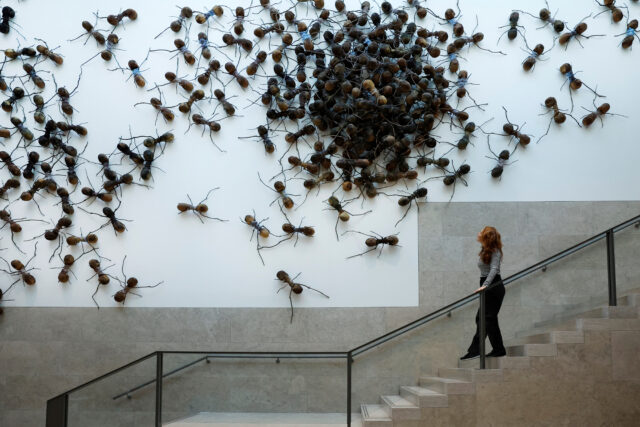
Amsterdam’s Rijksmuseum crawling with giant ants

THE EXHIBITION entitled ‘Casa Tomada’ of artist Rafael Gomezbarros is displayed at Rijksmuseum in Amsterdam, Netherlands, Sept. 16. — REUTERS/PIROSCHKA VAN DE WOUW

AMSTERDAM — Amsterdam’s Rijksmuseum, home to Dutch masterpieces like Rembrandt’s Nightwatch, will temporarily have its walls and windows overrun by 700 giant ants, as part of a new exhibit.

By breaking artwork conventions, “House Taken,” by Colombian artist Rafael Gomezbarros, wants to draw attention to migration and forced displacement.

Inspired by the Colombian conflict between the government and guerrilla groups which started in 1964 and forced millions of Colombian citizens to leave their homes, the bodies of Mr. Gomezbarros’ ants are made from two casts of human skulls, representing both victims and perpetrators, Mr. Gomezbarros told Reuters.

The ants’ legs are sticks from Jasmine trees, used during the conflict to cover the bodies of victims to mask the smell of death.

The meaning of “House Taken,” which has previously shown in Colombia, Bolivia, the United States and Sweden, changes over time depending on its audience, he said.

People migrate for different reasons, Mr. Gomezbarros added, such as “a country in bankruptcy, war or lack of opportunities.”

“The ants symbolize the industriousness, resilience and cooperative spirit of people,” Rijksmuseum curator Julia Kantelberg explained, adding that letting people make their own associations is part of the artwork’s goal.

Casa Tomada is part of a larger exhibition, “Crawly Creatures,” which will start Sept. 30 and run up until Jan. 15, 2023. It focuses on the ever-changing perceptions of crawly creatures, such as ants but also toads, snakes and spiders, in the arts and sciences. —  Reuters

Converge issues human rights policy to protect customers, stakeholders

LISTED fiber internet provider Converge ICT Solutions, Inc. said it has crafted a human rights policy aimed at protecting and upholding the rights of its customers and stakeholders.

“We recognize our role as an enterprise by taking steps to make sure that Converge is not complicit in any form of human rights violations, where everyone is treated based on the principles of fairness, dignity, and respect,” Converge Chief Executive and Co-Founder Dennis Anthony H. Uy said in an e-mailed statement.

The policy touches on specific human rights topics relevant to an internet service provider, such as freedom of expression, access to information, data privacy, online sexual abuse and exploitation of children, and conflict minerals.

The company said its human rights policy draws on the United Nations Guiding Principles of Business and Human Rights.

The policy outlines how the company will fulfill its responsibility to respect internationally recognized human rights as expressed in the International Bill of Human Rights and the Declaration of Fundamental Principles and Rights at Work of the International Labor Organization.

“Converge endeavors to fulfill its commitment to promote, respect, and support human rights in the operations and activities of the company, including its subsidiaries and affiliates,” the company said.

Converge’s policy covers guidelines on protecting the rights of customers, employees as well as those of its business partners, and communities where it operates.

The policy also includes monitoring and reporting procedures to make sure that the provisions are implemented within the company.

“We are pursuing other critical initiatives to contribute to AmBisyon Natin 2040 and the UN Sustainable Development Goals,” said Benjamin B. Azada, Converge chief strategy officer. — Arjay L. Balinbin

Save the bed for sleep and sex to avoid insomnia

PEXELS

By Patricia B. Mirasol, Reporter 

SLEEP and sex should be the only two things done in bed in order to avoid sleepless nights, a sleep expert said. 

The pandemic and the subsequent shift to a work-from-home setup compelled some people to turn their bedrooms into offices to their detriment, noted Dr. Deborah A. Bernardo, a sleep specialist and neurologist. 

“That’s a no-no in sleep medicine. We want the bed to be only for sleep and sex,” she said in a Sept. 13 event on sleeplessness organized by Bounce Back Network, a community of startups and freelancers. “There should be no TVs and computers inside your bedrooms.”  

Insufficient sleep syndrome, which is a shortened sleep below an individual’s usual baseline, is different from insomnia, which is a persistent nighttime complaint of difficulty falling and/or staying asleep. The former is self-imposed as a consequence of obligations; the latter occurs despite an adequate opportunity to sleep.  

Dr. Bernardo said that sticking to a schedule that synchronizes one’s brain to circadian rhythms helps. So does ticking off an insomnia-proof bedroom checklist, including a calming color palette, comfortable room temperature, a quiet environment, and opaque window blinds — especially for shift workers.  

“If you snooze, you lose,” she added. “If you try extending sleep in the morning, it’s no longer restorative sleep. Better set an alarm on the time you really want to get up from bed.”  

Diet considerations, meanwhile, include avoiding big meals within two to three hours of bedtime, minimizing fluid intake within two hours of bedtime, and not taking caffeine past 2 p.m.   

The Center for Science in the Public Interest, a food and health watchdog based in Washington, DC, notes that a 16-ounce Starbucks Caffè Americano has 225 milligrams of caffeine. One brewed bag of Lipton Black Tea, on the other hand, has 55 milligrams of the same stimulant.  

“We are the only species that voluntarily delay sleep,” Dr. Bernardo said. “There is no cure for sleeplessness except getting enough sleep.”  

Chronic insufficient sleep has a myriad of health consequences, including anxiety and obesity. 

“Start as soon as possible in improving your sleep,” said Dr. Bernardo, who recommended seven hours of sleep for adults. Fewer hours of sleep, especially in mid-life, can contribute to dementia in the future, she added.  

Vanna R. Reyes, a mother and influencer at Madiskarte Moms PH, shared at the Bounce Back Network event that she was starting her three children young on healthy sleeping habits.   

“Let your kids know that sleep is very important in their lives. I collect their gadgets before they sleep. When it’s light’s off, it’s light’s off,” she said. “I tell my kids, ‘You can succeed in life if you have a good foundation in sleep.’” 

Understanding an overlooked past

Theater Review
Anak Datu
Presented by Tanghalang Pilipino

IN 1968, long before he was named a National Artist for Visual Arts, Abdulmari Imao wrote a short story called “Anak Datu,” about a community in the Sulu archipelago that was invaded by pirates. Over 50 years later, his short story has evolved into a play with music that weaves the story with the experience of the Imao family and the beginnings of the conflict in Mindanao.

Tanghalang Pilipino’s Anak Datu, the maiden production at the Cultural Center of the Philippines’ new Black Box Theater, has three central narratives that are introduced in the first three scenes.

The first, set in the 1970s, is a glimpse of the Imao family, with Abdulmari Imao (played by Marco Viana) working on a painting while conversing with his wife,Grace (Antonette Go), and the young Toym Imao (Carlos Dala) playing with a Voltes V toy made from clothes hang clippers.

This is followed by the story of Jibin Arula, the Tausug soldier who was the lone survivor of the Jabidah massacre in Corregidor in 1968. His story is told through narration recited by an old man (Nanding Josef playing the elder Arula) with reenactments of the events led by the teenage Jibin (Mark Lorenz).

The third scene focuses on the original short story of Imao’s “Anak Datu,” about Datu Karim (Hassanain Magarang) and his wife Putli Loling (Lhorvie Nuevo). Before their son is born, the village is raided by pirates and Putli Loling gives birth in captivity. Her son (Carlos Dala) grows up believing that his father is a former pirate. The tale’s narration is done through song by Tex Ordonez-de Leon.

Tip: It helps to be aware that the play narrates three separate stories, otherwise the story might be confusing to follow. Reading up about the Jabidah Massacre in 1968 will also help in understanding the context of the historical elements in the play.

Playwright Rody Vera skillfully shows the parallels in the tales, as the three narratives are stories of living in a time of conflict, and the search and fight for peace.

The stories are told in separate scenes, as if reading a book in chapters that shift from one perspective and period; they do not intersect as this writer was initially expecting.

The traverse staging gives a reference to name of the Tausug which translates to “people of the current.” Projections of Abdulmari Imao’s paintings add color to the plain white stage and movable set pieces.

There are parts however, where the music drowns out the dialogue, and in some parts speech is quite inaudible if the actor is facing the opposite direction from where one is seated.

The kulintang ensemble, pangalay dance, Mindanao martial arts, and the inclusion of Muslim prayer effectively immerse the audience in Moro culture and practices.

Tanghalang Pilipino’s Anak Datu gives viewers an understanding of how the conflict in Mindanao began and how people’s lives were affected during the years of Martial Law under Ferdinand Marcos, Sr. The play is an exposure to Moro narratives which we need more of, despite how distant our lives may be from it.

The stories remain relevant as there are communities in Mindanao that continue to fight for peace. It is important to shed light on these neglected stories of dark periods in the country’s history.

Anak Datu runs until Oct. 9 at the CCP Black Box Theater. For tickets, contact 0915-607-2275 or e-mail tanghalangpilipinomarketing@gmail.com. — Michelle Anne P. Soliman

Denso’s P60-M hydroponic farm seen to boost food security

DENSO PHILIPPINES Corp. recently launched a P60-million hydroponic farm in Ibaan, Batangas in a bid to support the development of the country’s agriculture sector.

The project, introduced on Aug. 25, involves the commercial production of high-value crops such as microgreens, kale, arugula, herbs, and melons with the use of hydroponics.

Earlier, the Board of Investments (BoI) approved the registration application of Denso Philippines for the hydroponic farm project under the 2022 Strategic Investment Priority Plan.

The target markets of the hydroponic farm include hotels, restaurants, online market, culinary schools, and other food-related businesses in central business district areas across the Philippines.

“The farm involves the commercial production of vegetables using hydroponic growing technology with plans to use IoT (Internet of Things) for nutrient dosing and monitoring through sensors,” the BoI said in a statement on Tuesday.

“Hydroponics is a soil-less farming system that includes the process of growing plants with the use of mineral nutrient solution through an inert medium such as perlite, gravel, mineral wool, expanded clay, or coconut husk. Through hydroponics, water remains in the system and is reused, which, in turn, can decrease carbon footprint,” it added.

According to the BoI, the hydroponic project was endorsed by the Department of Agriculture (DA), and is seen to help achieve food security in urban areas across the country.

“Through hydroponics, water remains in the system and is reused, which, in turn, can decrease carbon footprint. In 2027, the global hydroponics market is projected to reach $13.4 billion,” the BoI said, adding that a 19.2% compound annual growth rate is forecast from 2021 to 2027.

“Denso’s high-value crops will be essential in supporting urban areas in the Philippines, as well as address the low local self-sufficiency of highland vegetables (22%) and the DA-forecasted deficit of 51,116 metric tons in Calabarzon, where the project will be located,” it added. — Revin Mikhael D. Ochave

Biden said the pandemic is over. Is it? 

PIXABAY

WASHINGTON — What is the status of coronavirus disease 2019 (COVID-19) now that President Joseph R. Biden, Jr., has told the CBS 60 Minutes news program the pandemic is over in the United States?  

Has the US formally declared the end of the pandemic?  

No. The United States is still operating under the public health emergency, first declared in January 2020.  

The US Department of Health and Human Services is expected to renew that designation in October but then let the public health emergency expire in January 2023.  

Health officials like White House COVID-19 response coordinator Ashish Jha have as recently as this month said “the pandemic is not over,” but have acknowledged that there is a shift under way in its fight against the virus.  

World Health Organization (WHO) Director-General Tedros Adhanom Ghebreyesus said last week that the “end is in sight” for the pandemic, but still urged nations to maintain their vigilance.  

What is happening with COVID-19 now?  

The virus, which emerged in China in late 2019, has killed over 6.5 million people — including 1 million this year — and infected 608 million people.  

Vaccines and treatments have helped lower death rates, and global deaths from COVID-19 last week were the lowest since March 2020, according to the WHO.  

In the United States, an average of nearly 400 people a day continue to die from COVID-19, according to the US Centers for Disease Control and Prevention (CDC) and an average of over 4,300 are hospitalized each day.  

What signs are there of a pandemic in retreat?  

Mr. Biden made his comments on the sidelines of the Detroit auto show, the largest in North America, where the president noted that very few people around him were wearing masks.  

CDC mask guidelines since February have recommended that people in counties with low or medium COVID-19 levels — now almost 87% of the country — do not need to wear masks indoors.  

US government agencies have also dropped mask requirements in federal buildings in the Washington area and other places with low or medium levels of COVID-19.  

The federal government stopped requiring masks on public transportation after the courts said it did not have the authority to do so. Most states have also lifted mask requirements, including New York, as they try to persuade more workers to return to offices.  

Most schools nationwide are abandoning remote learning for in-person classes and the CDC said last month it would no longer recommend quarantines for people exposed to the virus, making it easier for teachers and students to remain in class.  

The CDC also no longer recommends unvaccinated people quarantine after exposure. Around 95% of the US population has either been vaccinated, had COVID-19 already, or both, it said.  

The United States has just begun a new COVID vaccination campaign with boosters tailored to the Omicron variant that leading infectious disease doctor Anthony Fauci compared to the annual flu vaccination efforts. — Reuters 

Gov’t fully awards T-bonds at lower rates as market awaits outcome of key meetings

BW FILE PHOTO

THE GOVERNMENT fully awarded the reissued seven-year Treasury bonds (T-bonds) it auctioned off on Tuesday at a lower average rate as the decisions of monetary authorities draw near.

The Bureau of the Treasury (BTr) raised P35 billion as planned from its offer of reissued seven-year securities that have a remaining life of six years and eight months on Tuesday. Total bids reached P54.844 billion.

Rates awarded on Tuesday ranged from 6.375% to 6.750%, bringing the average yield for the bonds on offer to 6.588%, lower by 15.2 basis points (bps) than the 6.740% coupon fetched for the series when it was last offered on June 14.

However, the average rate was 13.37 bps above the 6.4543% yield on the seven-year bonds quoted for the issue at the secondary market before Tuesday’s auction, based on PHP Bloomberg Valuation Reference Rates data provided by the BTr.

National Treasurer Rosalia V. de Leon said in a Viber message to reporters that the full awarding was because “[the] rates are aligned with secondary levels.”

A trader said that the award was “quite aggressive,” similar to the coupon of the 10-year debt paper issued last week.

“The market is now demanding higher rates to get longer tenors ahead of the Federal Open Market Committee [meeting], and the risk of a global policy tightening chorus,” the trader added.

Rizal Commercial Banking Corp. Chief Economist Michael L. Ricafort said that the markets are anticipating a Fed rate hike ranging between 75 bps and 100 bps on Sept. 21 amid elevated inflation.

This is “to be followed by another hike in local policy rates on Sept. 22 to help stabilize the peso, as well as to better manage both inflation and inflation expectations,” he added in a Viber message.

The US consumer price index rose in August amid rising rent and healthcare costs, strengthening the case for another aggressive Fed rate hike.

Fed Chair Jerome H. Powell earlier said the central bank was “strongly committed” to fighting inflation. The Fed is meeting to review policy on Sept. 20-21 and has raised rates by 225 bps since March, including two 75-bp moves in June and July.

At home, the BSP will hold its policy meeting the following day, Sept. 22. It has hiked borrowing costs by 175 bps since May to rein in rising prices.

A BusinessWorld poll last week showed 14 out of 15 analysts expect the BSP to fire off another rate hike on Thursday. Eleven see a 50-bp increase, while two expect a moderate hike worth 25 bps. Meanwhile, one is betting on a big 75-bp move.

BSP Governor Felipe M. Medalla said last month the central bank has room to hike borrowing costs further as inflation remains elevated, with the Fed’s aggressive tightening also posing additional risk to prices due to its effect on the peso.

Headline inflation eased to 6.3% in August from a near four-year high of 6.4% in July. This brought the eight-month average to 4.9%, higher than the central bank’s 2-4% target but still below its 5.4% forecast for the year.

The peso closed at an all-time low P57.43 per dollar on Friday, losing 27 centavos from its P57.16 finish on Thursday, Bankers Association of the Philippines data showed. It has since slightly appreciated to P57.4 on Monday.

The BTr wants to raise P200 billion from the domestic market this month, or P60 billion through Treasury bills and P140 billion via T-bonds.

The government borrows from local and external sources to help fund a budget deficit capped at 7.6% of GDP this year. — Diego Gabriel C. Robles

Arts & Culture (09/21/22)

CHILE’s Calzones Rotos (Family Secrets), a dark comedy

Film screenings at the CCP Arthouse Cinema

THE CULTURAL Center of the Philippines (CCP) Arthouse Cinema presents ON VERS(E/U)S AND DRONES, a two-day special screening of the films Ang Hupa by Lav Diaz on Sept. 21, 2 p.m., and Respeto by Treb Monteras II on Sept. 22, 2 p.m. at the CCP’s Tanghalang Manuel Conde. A talkback session will follow the screenings. Admission is free. Guests must their face mask at all times, and bring vaccination cards/certificates (e-copies are allowed). For more information on the CCP’s new normal safety protocols, visit https://bit.ly/staysafeatCCP.


Shangri-La Plaza screening 7 films for free

SEVEN films from Mexico, Colombia, Chile, and Singapore are screening for free on Sept. 21-25 at Shangri-La Plaza mall. For the first time, the mall is hosting the Pacific Alliance Movie Nights, in partnership with the Embassies of Chile, Colombia, Mexico, and Singapore, and the Film Development Council of the Philippines, at the Red Carpet at the Shang. To be shown are: Mexico’s Arráncame la vida (Tear this Heart Out), about a young woman who married an old prominent politician who turned out to be ruthless and unfaithful, and Cuando los hijos regresan (The Kids are Back), a comedy about a happily retired couple who must deal with their adult children moving back home; Colombia’s El Piedra (The Stone), about an unsuccessful boxer who gets paid to lose fights and finds himself taking care of a boy who claims to be his son, and the documentary Chiribiquete which follows Colombian archaeologist and anthropologist Carlos Castaño; Chile’s Calzones Rotos (Family Secrets), a dark comedy about a family that’s about to uncover their dying matriarch’s old secrets after she confesses to killing her husband, and Mis hermanos sueñan despiertos (My Brothers Dream Awake) about teenage brothers in a juvenile center who join a risky escape; and Singapore’s Motel Acacia about a half-Filipino who is mentored by his tyrannical father to take over their family business, a creepy motel that takes in illegal immigrants. All films will be screened in their original language with English subtitles. Entrance is free on a first come, first served basis. For updates and inquiries, follow Shangri-La Plaza on Facebook at www.facebook.com/shangrilaplazaofficial and on Instagram @shangrilaplazaofficial.


2 shows opening at Silverlens

SILVERLENS will open two shows on Sept. 22, both of which will run until Oct. 22. The first iscome – one – come – all,” a solo exhibition by senior Thai contemporary artist Mit Jai Inn. As a notable expansion of his artistic practice, “come – one – come – all” aims to present the allure behind three different facets of his 40-year art practice, all of which possess a taste and twist of Modernism. In this show, the artist himself acts as the master of his own language, weaving his very own grammatical principles for paintings. The second show isHaiku in Clay,” Shozo Michikawa’s second solo show with Silverlens. In it he continues to take inspiration from his birthplace, Hokkaido, with its geography of topographical contrasts from mountain greens to volcanic plateaus in a new collection of fifteen works. The ceramicist’s signature style of twisting clay from the inside without disturbing the exterior as the wheel turns gives the works a uniquely sculptural form where movement becomes an abstraction. Silverlens’ Manila gallery is at 2263 Don Chino Roces Ave. Ext., Makati. It is open Tuesday – Saturday, 10 a.m. to 5 p.m.


Light and Sound show marks CCP anniversary

TO celebrate the 53rd anniversary of the Cultural Center of the Philippines (CCP) this month, the SINAG 2022: Light and Sound show and spectacle will light up the CCP façade from September 22-25. Multi-awarded lighting designer John Batalla conceptualized the outdoor light show, with sound design by Jethro Joaquin. “We will interpret the three transcendentals of Truth, Goodness, and Beauty paired with a soundscape of indigenous Filipino instruments, snippets of folk music and quintessential Filipino sound bites or quotable quotes from the past,” Mr. Batalla said. SINAG 2022 is produced by the CCP Production Design and Technical Services Division. The show, which runs for 10 minutes, will open at 7 p.m. on Sept. 22 and run from Sept. 23 to 25 at 7, 7:30, 8, 8:30, 9, and 9:30 p.m. SINAG is an annual anniversary light and sound spectacle of the CCP enjoyed by pedestrians, motorists, and regular visitors to the Complex.


ARTablado presentsHabi ni Ake’

ARTIST Racquel “Ake” Pagulayan —  an entrepreneur and mother of three — makes art with materials that are anything but traditional. Using everyday household items, she is able to explore her creativity in paintings, sculptures, accessories, cross-stitching, beaded necklaces, and even artificial copper bonsai trees. She didn’t have the financial means to pursue the arts, much less a career in it at first. As the breadwinner of her family, she worked in the garments industry. It was when she saw a mandala made of sewing threads that she was inspired to create her own. Her works are now on view in the exhibitHabi ni Ake” at ARTablado until Sept. 30. The gallery is at the Upper Ground Floor, North Wing, of Robinsons Antipolo.


The CCP Dance Series kicks off

AS PART of the CCP Dance Series (LIVE!) 2022 which is ongoing from September to December and features productions created by National Artists for Dance Alice Reyes and Agnes Locsin, French choreographer Redha Benteifour, and choreographic works by young Filipino dancers, the  Cultural Center of the Philippines (CCP) presents Pulso Pilipinas I, at the CCP Tanghalang Nicanor Abelardo on Sept. 23 at 8 p.m. and on Sept. 24 at 3 p.m. Pulso Pilipinas I presents dancers from regional dance groups, both students and professionals, performing the dances “Company” by National Artist for Dance Alice Reyes, “Moriones” by National Artist for Dance, Agnes Locsin, “We Men” by Lester Reguindin, “Asong Ulol” by Denisa Reyes, and “Mamang Kutsero” from Edna Vida’s Ensalada. For ticket information contact the CCP Box Office at 8832-3704, the CCP Production Management Services Division at 8832-2314, the CCP Arts Education Department at 8832-1125 loc. 1605, or visit www.culturalcenter.gov.ph for more information and ticket inquiries.


‘Perpetual Flux’ at Robinsons Galleria

WHEN the pandemic hit, a group of fine arts graduates from the College of Holy Spirit, whose art had been dormant since they were busy being professionals in different fields or were raising a family, found they needed something to cope with the bleakness of the situation, and they decided to take up painting again. They formed an art group in the first half of 2020 called ARTfinity which has two ongoing exhibitions. One is billed as “Perpetual Flux,” which is on view until Sept. 30 at ARTablado, Level 3 of Robinsons Galleria. It features 66 works by the 13 members of ARTfinity. The other exhibit, called “ARTfinity: Unfiltered,” is on view until the end of October at Café Summit Ridge in Tagaytay. ARTfinity’s members are Valerie Teng, Aina Marcaida, Andrei Solmirano, Jonathan Astrid Anabo, Gabriel Xavier Valenzuela, Jayvee Del Rosario, Kwin Chi, Mark Anthony Janoya, Marie Ann Paredes, Mr. Fu, Phil Salazar, Scifi Wasabi, and Zarah Eugenie Cabangon.  


Security Bank donating art to National Museum

TO help promote and celebrate the country’s cultural and artistic heritage, Security Bank is donating 14 sculptures by the late National Artist Guillermo Tolentino to the National Museum of Fine Arts. The art works will be officially turned over to the museum on Sept. 24 at the National Museum of Fine Arts, P. Burgos Drive, Rizal Park, Manila.


Gateway exhibit focuses on nature

GATEWAY Gallery, the art museum of Araneta City, is currently hosting the art of Punjabi Artist Jaspreet Kaur in an exhibition called “Extinction,” which opened on Sept. 10. The exhibition features life-like paintings of different endangered species including birds of prey and big cats such as lions and tigers. Ms. Kaur is known both in the Philippines and in India. Her art, mainly done through various media such as oil, pastel, acrylic, and charcoal, has been exhibited in various locations in the Philippines and in Punjab. “Extinction” is on view until Sept. 24 at the Small Room of the Gateway Gallery, Gateway mall, Araneta City in Cubao, Quezon City.


FHL presents virtual papermaking workshop

THE AYALA Foundation, Inc., Filipinas Heritage Library (FHL), the Japan Foundation Manila, and Jimenez Logistics Solutions, Inc. present LIKHANG PAPEL:
A Virtual Papermaking Workshop with Asao Shimura on Oct. 8 and 15 (Saturdays) from 10 a.m. to noon. The workshop will be online via Zoom. The workshop shows the use of Philippine plant fibers in Japanese papermaking. Filipinas Heritage Library and the Japan Foundation, Manila present the workshop as part of the Printed Word, a series on the history of the book, that has been ongoing since 2014. Crafts enthusiasts and fine arts teachers are welcome to attend. The workshop rates (inclusive of a customized papermaking kit and shipping for local participants; overseas participants shoulder extra fees for international shipping) is P3,700, with Seniors and PWDs having a discounted fee of P3,150. The workshop is recommended for those 16 years old and above. A pre-read will be provided after completing one’s workshop registration. For inquiries send an e-mail to asklibrarian@filipinaslibrary.org.ph.


Three tenors star in concert series

MUSICAL theater artists Markki Stroem, Arman Ferrer, and Poppert Bernadas are headliners in this year’s Triple Threats: Three Tenors concert series from October to December at the Cultural Center of the Philippines’ Tanghalang Ignacio Gimenez (CCP Black Box Theater). Triple Threats is a series of solo concerts featuring stalwarts of Philippine Musical Theater. Leading this series on Oct. 14 is Markki Stroem, who has starred in, among others, Next To Normal (Atlantis, 2011), Camp Rock (Repertory, 2012), Kung Paano Ako Naging Leading Lady (Dalanghita Production, 2015), Hair (Repertory, 2017), and Side Show (Atlantis, 2018). The series continues on Nov. 18 with operatic tenor Arman Ferrer who has come out in Walang Sugat, Mabining Mandirigma, Maynila: Sa Mga Kuko ng Liwanag, Binondo: A Tsinoy Musical, and Lapu Lapu, among others. Closing the series on Dec. 21 will be Poppert Bernadas, an original member of the vocal group the Ryan Cayabyab Singers who has starred in Rak of Aegis, LORENZO the Musical, Spoliarium, and Marawi The Musicale among others. The three concerts will begin at 7:30 p.m. at Tanghalang Ignacio Gimenez. Check out the CCP’s official website https://culturalcenter.gov.ph and Facebook page https://www.facebook.com/culturalcenterofthephilippines for more information.