Home Blog Page 5895

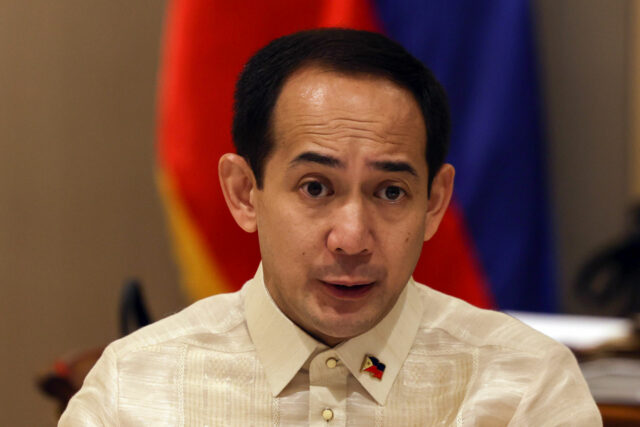
DTI chief seeks investors to establish franchises

THE DEPARTMENT of Trade and Industry (DTI) is expecting more franchises in the Philippines on the back of surging demand for popular brands and establishments.

“Investors are encouraged to set up franchises in the Philippines because of its healthy business climate. The Philippines is the 7th largest franchise market in the world, contributing 7.8% to our country’s gross domestic product (GDP) and creating two million direct and indirect jobs,” Trade Secretary Alfredo E. Pascual said in a speech during the Franchise Asia Philippines 2022 virtual conference on Tuesday.

“With a growing middle class, our country is considered one of the largest franchise markets in the Southeast Asian region. Eating at a popular establishment or owning branded items signals societal status in one of Asia’s most social media savvy populations,” he added.

According to Mr. Pascual, the food service sector accounts for almost half of the franchise categories in the country.

“Of the two basic franchise categories, food expectedly takes precedence over non-food. Food makes up almost half (43%) of the estimated 1,800 franchise brands in the Philippines. According to Philippine Franchise Association data, food franchises have an aggregate value of P538 billion or $10.8 billion,” Mr. Pascual said.

He added that aspiring entrepreneurs should start a business via franchising since it has a higher success rate.

“Unlike starting a business on your own, franchisees build on tried-and-tested business models. A team of experts guides franchise owners to achieve management and operational efficiencies, as well as excellent quality control systems,” Mr. Pascual said.

“Market-wise, franchisees have an advantage in terms of brand recognition. Name recall makes franchise brands popular, making sales easier. Building up new brands requires substantial expenditures to generate brand awareness, and new brands also need to develop a steady clientele,” he added.

Meanwhile, Mr. Pascual said that the DTI has been providing financial assistance to micro, small, and medium enterprises (MSMEs) since many franchisees come from the said sector.

“Through SB Corp., the DTI has been extending financial assistance to MSMEs to provide them access to capital. We assist them in their debt obligation payment, repurposing existing business capital, and acquiring new technologies and systems. We help them adjust their business processes to adapt to the new normal,” Mr. Pascual said. — Revin Mikhael D. Ochave


Monitoring blood glucose without needles

Abbott Laboratories’ FreeStyle Libre Flash system, a continuous glucose monitoring (CGM) system, consists of a coin-sized glucose arm sensor and a handheld reader that provides the last eight hours of glucose history. 

CGM is wearable technology that measures the glucose levels in the fluids inside the body. To obtain a glucose reading, the user scans the reader over the sensor — a painless one-second procedure that doesn’t need finger pricks. The system also comes with software that generates reports and analyzes the user’s glucose data.   

Gary S. Valenciano, a 58-year-old singer, songwriter, and music producer who has been living with diabetes since he was 14, has seen how innovations in glucose monitoring such as these have eased the “balancing act” of diabetes management.  

“Diabetes can be the most deceiving of all illnesses, because sometimes you think you’re okay, but then things can be going on inside of you, if you don’t take care of yourself the way you should,” said Mr. Valenciano, at a Sept. 14 event organized by the multinational medical devices and healthcare company.  

When Mr. Valenciano started monitoring his blood glucose four decades ago, it involved a test tube, a tablet, and a urine sample.   

“I felt like a chemist. … I would have to gather a few drops of [urine] to a dropper, and then determine how high or low my sugar was, depending on how the tablet inside would respond,” he said. “It was more or less a guessing game to see where I was.”   

When finger stick checks became available, the concern then became remembering to bring the required gadgets, looking for a private place to prick one’s finger, and waiting 45 seconds to get the results.  

“The finger stick method measures blood sugar at that point in time,” said Dr. Michael L. Villa, immediate past president of the Philippine Society of Endocrinology, Diabetes, and Metabolism. “You need to measure it many times in one day.”  

He noted that a fear of needles made some patients less willing to monitor their blood sugar levels.  

CGM, meanwhile, removes the need for multiple finger pricks and provides more data. “I am very happy with this new development in glucose monitoring, as it gives enough information for the patient to act on,” Dr. Villa said. “Some people claim they’re asymptomatic, but this gives me information throughout the day.”  

Diabetes is a disease that occurs when the body’s blood glucose is too high. High blood sugar can lead to problems such as heart disease, kidney disease, and nerve damage.  

Philippine Statistics Authority data show that deaths due to diabetes mellitus ranked fourth in 2020 at 37,265, after heart diseases (99,680), cancer (62,289), and cerebrovascular diseases (59,736). This is an increase of 7.8% from the 2019 tally.  

The Shining Light Foundation, established by Mr. Valenciano and his wife, Angeli P. Valenciano, provides medical assistance to Filipino diabetics. 

“Through donations and diabetes education, I want to inspire more Filipinos living with diabetes that it is possible to remove the mystery behind the condition,” he said. “[You can] live better through proper diabetes management that’s powered by accurate and real-time data.” — Patricia B. Mirasol 

Gaza farmer unearths Byzantine-era mosaic

PALESTINIAN farmer Salman al-Nabahin cleans a mosaic floor he discovered at his farm and which dates back to the Byzantine era, according to officials, in the central Gaza Strip, Sept. 18. — REUTERS/IBRAHEEM ABU MUSTAFA

GAZA — An ornate Byzantine floor mosaic showing a variety of colorful birds and other animals has been discovered by chance in Gaza after a Palestinian farmer tried to plant new trees on his land.

Salman al-Nabahin unearthed the relic six months ago while working in his olive orchard in the Bureij refugee camp, about a kilometer from the border with Israel.

Trying to figure out why some trees had not properly taken root, Mr. Nabahin said he and his son began digging. Then the son’s axe hit something hard and unfamiliar in appearance.

“I searched on the internet … We learnt it was mosaic belonging to the Byzantine era,” said the father-of-seven, sitting next to his discovery. “I see it as a treasure, dearer than a treasure. It isn’t personal, it belongs to every Palestinian.”

The Palestinian Ministry of Tourism and Antiquities said the flooring included several mosaic panels depicting animals and other features of social life during the Byzantine era.

“The archaeological discovery is still in its early stages and we await to know more of the secrets and civilization values,” the ministry said in a statement. “National research teams are working in partnership with international experts and scientists from the French Archaeology School.”

Gaza is rich with antiquities, having been an important trading spot for civilizations dating as far back as the ancient Egyptians and the Philistines depicted in the Bible, through to the Roman empire and the crusades.

Several discoveries have been made in recent years. But due to a lack of funds and relevant professionals, Gaza has usually invited international groups to help with the process of excavation and preservation. — Reuters

AUB sees rising demand for dollar-denominated assets

BW FILE PHOTO

ASIA UNITED BANK Corp. (AUB) expects dollar-denominated investments to be in high demand amid the peso’s depreciation as the US Federal Reserve sustains its aggressive policy stance.

“Dollar-denominated assets should be favorable when the US dollar exchange rate is strengthening, especially if it is on account of increasing interest rates, as the case is today,” AUB Executive Vice-President and Head of Treasury Antonio V. Agcaoili, Jr. said in a statement on Tuesday.

“The US Federal Reserve has made it clear it is on a path of sustained rate hikes. Until it is convinced that the threat of runaway inflation is completely eradicated, the dollar will remain elevated and reach historic highs,” Mr. Agcaoili said.

The peso has further weakened against the dollar, trading above the P57-a-dollar level since Sept. 14, following the US Federal Reserve’s hawkish policy stance in taming US inflation.

On Tuesday, the local unit closed at a new record low of P57.48 against the greenback, losing eight centavos from its P57.40 finish on Monday, Bankers Association of the Philippines data showed.

Year to date, the peso has weakened by 12.7% or P6.48 from its P51-per-dollar close on Dec. 31, 2021.

According to Mr. Agcaoili, while there would be a seasonal uptick of remittances from overseas Filipino workers (OFWs) towards the fourth quarter of the year, it may not be enough to support the peso against the greenback.

“The demand for foreign exchange is much bigger than the amount coming from OFWs,” Mr. Agcaoili said.

AUB Senior Vice-President and Head of Trust Andrew A. Chua said investors in search of higher-yielding assets are in a good position to load up on dollar assets.

“The bank is already seeing pent-up demand for its award-winning AUB Gold Dollar Fund (GDF) which offers retail investors access to the US dollar bond market normally reserved for foreigners and high net worth investors,” AUB said.

The AUB GDF offers returns that can be withdrawn at any time after the minimum holding period. Investors will also have a team of fund managers that will safeguard their investments as risk and returns are balanced appropriately. 

The GDF invests in a diversified portfolio of fixed-income securities. It also offers a rate of return equal to the rolling yield of the 5-year US treasury notes, net of fees.

“With expectations for interest rates to continue to rise in the near term, the GDF’s net asset value (NAV) will remain depressed. However, as prospects for a US economic recession rise, we expect the US Fed to end its hawkish policies soon. This, in turn, will result in a more stable interest rate environment and will allow the fund to accrue at high yields,” Mr. Chua said.

“As such, we see the current situation as a good opportunity for our clients to start accumulating investments in the GDF and expect to reap the benefits from their investments over the next two to three years,” he added.

AUB won as the Best Managed Fund in the Dollar Medium-Term Bond Fund category at the CFA Society Philippines’ 2022 Best Managed Fund Awards for six years straight.

“Consistency is key. Short- to medium-term volatility amplifies the noise in the market, but with consistent fund management, long-term performance of the fund will almost always result to positive returns,” Mr. Chua said.

“Having been awarded by the CFA as the Best Medium Term Bond Fund for six years in a row is a solid validation to our fund management capabilities,” he added.

AUB and its subsidiaries saw their consolidated net income surge in the first semester amid a higher total operating income and lower loan loss provisions.

The AUB group’s consolidated net profit was at P2.9 billion in the first half of the year, rising by 50% from the P1.9 billion seen a year prior. This translated to a return on assets of 1.8%, up from 1.2%, and a return on equity of 15.8%, improving from 11% last year.

AUB shares closed at P43.10 apiece on Tuesday, down by 25 centavos or 0.58%. — Keisha B. Ta-asan

ACEN solar farm in Australia set to start operating next year

ACEN CORP. announced on Tuesday that its New England solar farm project in Australia is expected to commence operation by 2023, making it the Ayala-led firm’s first running project in that country.

In a disclosure, the Ayala-led listed energy company said that the projects of ACEN Australia are currently under development. These include solar, wind, battery, pumped hydro and energy storage.

ACEN Australia is the platform representing ACEN’s renewable energy assets in Australia.

“The New England Solar farm, the first of these projects, is expected to be in operation by 2023,” ACEN said.

Once fully constructed, the solar farm project is said to produce enough energy to power approximately 250,000 households annually.

On its website, ACEN said that the project is a combined 720-megawatt (MW) solar and 400-MW-hour  battery.

In the company’s disclosure on Sept. 15, ACEN said that as a guarantor to ACEN Australia, it executed a common provision and a facility agreement between ACEN Australia and MUFG Bank, Ltd. in Sydney for a long-term revolving green loan facility amounting to 140 million Australian dollars.

The disclosure quoted Manoj S. Bhatia, MUFG Bank’s global head of subsidiary banking, as saying: “MUFG has been steadfast in leveraging its unrivaled global network and its expertise in financing the renewable energy sector. ACEN’s aspiration towards becoming a leading renewable energy provider in Asia is aligned with MUFG’s sustainability mission.”

On Tuesday, shares in the company closed 0.45% lower at P6.67 apiece. — Ashley Erika O. Jose

Designing a better future for the breast cancer community

PIXABAY

Cancer patient group ICanServe Foundation, in partnership with US-based non-profit organization Global Focus on Cancer, will host this year’s Southeast Asian Breast Cancer Symposium (SEABCS) in Manila from Sept. 23 to 25. 

Each year, SEABCS gathers the region’s cancer survivors, patient advocates, health professionals, researchers, and policymakers in order to exchange ideas, share successful strategies, and keep up with the latest in breast cancer, as well as the many challenges that face the breast cancer community on a personal, local, national, regional and international level. 

Carrying the theme “Designing a Better Future for the Global Breast Cancer Community,” the event seeks to improve the quality of life of breast cancer survivors by enhancing key aspects of the cancer continuum of care from prevention, early diagnosis, treatment, palliative care to survivorship and hospice.  

It will also provide advocates with data and best practices needed to influence positive change in the health systems of their countries. The conference will likewise be an opportunity for the region to come together to continually find common ground for collaboration. 

Breast cancer is the most common cancer among Filipino women, and the third leading cause of cancer-related deaths in the country. 

Globally, the World Health Organization (WHO) said that there were 2.3 million women diagnosed with breast cancer and 685,000 deaths in 2020. By the end of the same year, the WHO added that there were 7.8 million women alive who were diagnosed with breast cancer in the past five years, making it the world’s most prevalent cancer. 

The US Centers for Disease Control and Prevention (CDC) said that women can take steps to lower their risks for breast cancer, such as: maintaining a healthy weight; exercising regularly and voiding or limiting alcohol intake; breastfeeding children; seeing a doctor if there is family history of breast cancer or inherited changes in BRCA1 (breast cancer gene 1) and BRCA2 (breast cancer gene 2). 

Women can have different symptoms of breast cancer some do not have any signs or symptoms at all, the CDC noted. Warning signs of breast cancer include a new lump in the breast or underarm (armpit); thickening or swelling of part of the breast; irritation or dimpling of breast skin; redness or flaky skin in the nipple area or the breast; pulling in of the nipple or pain in the nipple area; nipple discharge other than breast milk, including blood; any change in the size or the shape of the breast; and pain in any area of the breast. If you have any signs or symptoms that worry you, see your doctor immediately. 

The Department of Health (DoH) emphasized the importance of regular breast self-examination (BSE) and the critical role of regular mammograms in the early detection and treatment of breast cancer.  

“Kamay Gabay, Sariling Salat sa Suso,” a series of four-minute animated BSE tutorial videos in Cebuano and Tagalog, aims to teach Filipino women how and when to do BSE and raise awareness on the importance of regular BSE to facilitate early detection and prompt treatment of breast cancer. 

“Unlike other cancers, breast cancer can be screened and diagnosed early. Performing BSE regularly makes women aware of their breasts and they will be the first to notice any notable changes. It is important to perform BSE especially during the pandemic when many women are afraid of going to the hospitals whether they be non-breast cancer patients going for a routine screening, cancer patients on treatment or cancer survivors on their regular checkup,” said Kara Magsanoc-Alikpala, founding president of ICanServe. 


Teodoro B. Padilla is the executive director of the Pharmaceutical and Healthcare Association of the Philippines (PHAP), which represents the biopharmaceutical medicines and vaccines industry in the country. Its members are at the forefront of research and development efforts for COVID-19 and other diseases that affect Filipinos. 

Philippines drops in property rights list

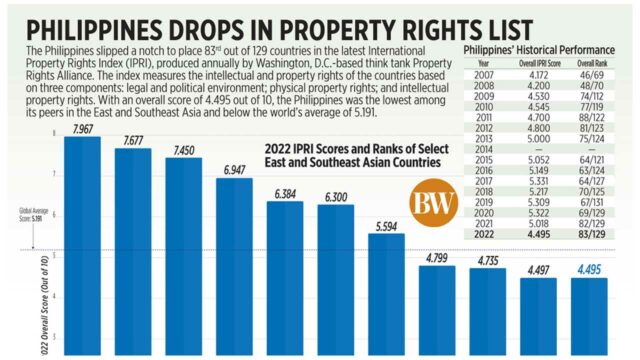
The Philippines slipped a notch to place 83rd out of 129 countries in the latest International Property Rights Index (IPRI), produced annually by Washington, D.C.-based think tank Property Rights Alliance. The index measures the intellectual and property rights of the countries based on three components: legal and political environment; physical property rights; and intellectual property rights. With an overall score of 4.495 out of 10, the Philippines was the lowest among its peers in the East and Southeast Asia and below the world’s average of 5.191.

Philippines drops in property rights list

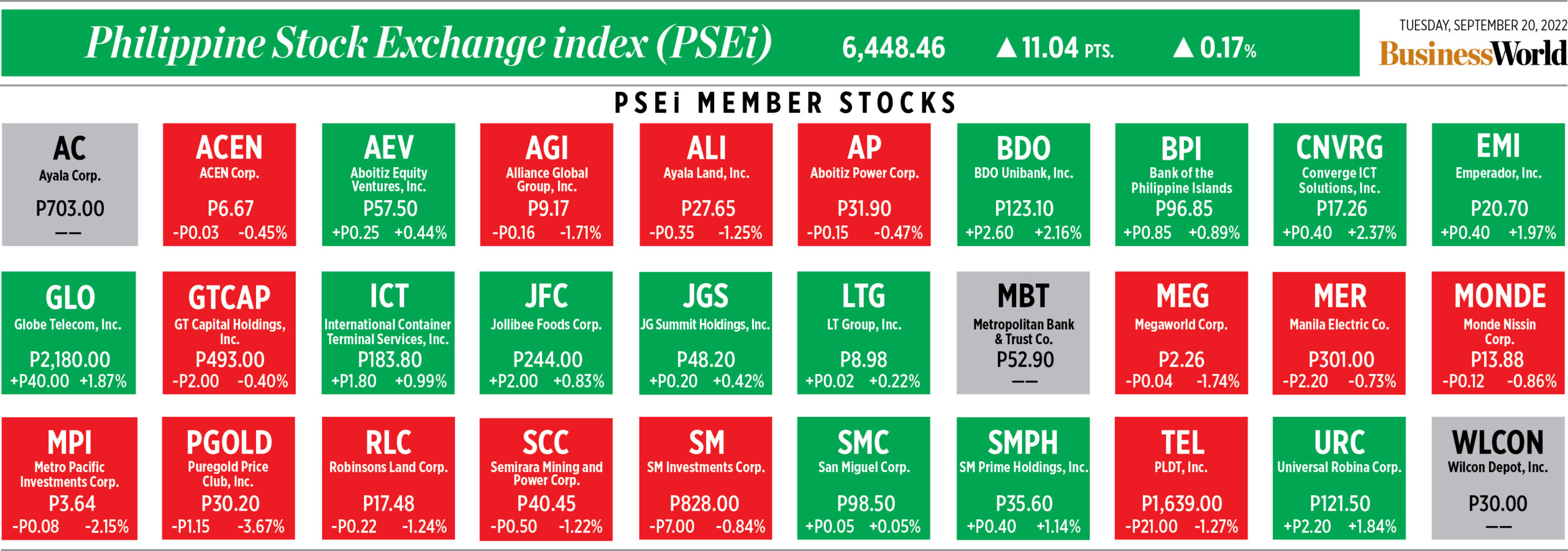
How PSEi member stocks performed — September 20, 2022

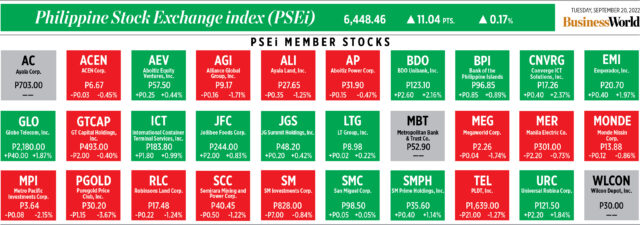
Here’s a quick glance at how PSEi stocks fared on Tuesday, September 20, 2022.


Marcos does not see a future without US

PRESIDENT Ferdinand R. Marcos, Jr. at the New York Stock Exchange on Tuesday — OFFICE OF THE PRESS SECRETARY

By Kyle Aristophere T. Atienza, Reporter

PHILIPPINE President Ferdinand R. Marcos, Jr. on Tuesday said the United States remains a key partner, adding that not having it as an ally is inconceivable. 

“I cannot see the Philippines in the future without having the United States as a partner,” he told New York Stock Exchange chief commercial officer John Tuttle, based on a transcript sent by the presidential palace.

“Many of the drivers of our early economy were actually American corporations,” he added.

Mr. Marcos made the remark amid escalating competition between the US and China in the Indo-Pacific region.

“Many of the strongest corporate benefactors to the government and to the rest of society in the Philippines were coming from the United States,” he said.

Strengthening the Philippine-US alliance is “extremely necessary” as the world faces economic and geopolitical crises, Mr. Marcos said. “This is something that is central to our thinking when it comes to the economic planning for the Philippines.”

The president noted that when the Philippines is in a crisis, it always looks to the US. “The reason we have done that is that for the most part, we can say that the United States has not failed us.”

“We are driven together in many ways by forces that exist now in the world.”

Ex-President Rodrigo R. Duterte, his predecessor, led a foreign policy pivot to China away from western super powers such as the US. He terminated an unpopular visiting forces agreement with the US and often verbally assaulted top US officials, including ex-President Barack Obama, who have been critical of his war on drugs. 

“The President is not saying anything new,” policy analyst Michael Henry Ll. Yusingco said in a Facebook Messenger chat. “He is merely restating what the reality is between the Philippines and US.”

“The reality is our foreign policy has always been to be friendly with the US,” he said. “This has never changed, even during the time of President Duterte.”

Mr. Yusingco noted that being an ally of the US does not automatically mean that the Philippines needs to join it in its “geopolitical adventurism.”

“The enemy of the US does not automatically become our enemy. Being their ally does not isolate us from the community of nations.”

The Philippines Government, represented by ex-Trade Secretary Ramon M. Lopez joined US President Joseph R. Biden, Jr. and 11 other leaders and ministers of regional partners from Australia, Brunei, India, Indonesia, Japan, Republic of Korea, Malaysia, New Zealand, Singapore, Thailand, and Vietnam in virtually launching the Indo-Pacific Economic Framework in May.

Member-countries account for 40% of the world’s economy.

Experts said the level of Philippines participation in the US-led economic platform would be a litmus test for the Marcos government’s independent foreign policy push.

Robin Michael U. Garcia, who teaches political economy at the University of Asia and the Pacific, said Mr. Marcos’ recent statements do not necessarily signal a pro-US stance.

“I would not say it is a pro-US statement and I do not think it is a complete return to pre-Duterte Philippine-US relations of reliance in and full accommodation of the United States,” he said in a Messenger chat. “The statement is rather general, broad, and safe.”

Mr. Garcia said the Philippines has yet to craft a “rigorous and comprehensive” approach toward China and other rising powers. “The foreign policy direction of the Philippines is still vague.”

Mr. Marcos, 65, took office in June amid tensions in the South China Sea and naval competition for influence among Southeast Asian countries.

In his first address to Congress, he promised to protect Philippine territories, although he did not name China as an aggressor. He neither sided with China nor the US, saying the Philippines “shall continue to be a friend to all and an enemy to none.”

Mr. Marcos had been criticized during the campaign for supposedly taking a conciliatory stance toward Beijing, which has refused to recognize a 2016 arbitral ruling that voided its claims to more than 80% of the waterway.

“The primary concern of the prez should always be the national interest of the Philippine and nothing else,” Mr. Yusingco said. “His words here still fall within that ambit.”

“It should stay that way regardless if he was talking about the US or China or any nation-state for that matter.”

Executive secretary replacement eyed

PHILIPPINE STAR/KRIZ JOHN ROSALES

PHILIPPINE President Ferdinand R. Marcos, Jr. is considering several people for executive secretary, the presidential palace said on Tuesday.

“There are names being considered but there is still no appointment being released,” Press Secretary Trixie Cruz-Angeles told a news briefing.

Victor D. Rodriguez at the weekend said he had resigned as executive secretary but would stay on as presidential chief of staff, a new position created through an administrative order signed by Mr. Marcos.

Mr. Marcos’ appointment of his resigned executive secretary to a new post reeks of bad governance and is contrary to his rightsizing push, political analysts said at the weekend.

The move is an act of self-preservation for Mr. Rodriguez, who is now under pressure after being hounded by controversies, said Arjan P. Aguirre, a political science professor at the Ateneo De Manila University.

The Senate majority recently cleared Mr. Rodriguez in its investigation of a sugar import order that Mr. Marcos later vetoed, but the Senate minority bloc said he failed to communicate the palace import policy.

The executive secretary, who is also called the “little president,” directly helps the president in managing the affairs of the government.

The late President Corazon C. Aquino restored the pre-martial law executive secretary position, according to the Official Gazette. Her predecessor, the late dictator Ferdinand E. Marcos — Marcos Jr.’s father — abolished the position and replaced it with the presidential assistant in 1975.

Mr. Rodriguez, 48, was executive secretary for only 79 days. Peter D. Garrucho, the late President Fidel V. Ramos’ executive secretary, lasted 74 days, while Edgardo J. Angara, who served under ex-President Joseph E. Estrada, had 20 days, Cleve V. Arguelles, who teaches political science at De La Salle University, tweeted at the weekend.

Ms. Angeles earlier said the president issued the administrative order reviving the chief of staff post.

In a Sept. 15 memo for Mr. Marcos, presidential legal counsel Juan Ponce Enrile opposed Mr. Rodriguez’s draft administrative order reviving the Office of the Presidential Chief of Staff and draft special order giving him more powers.

“There is no need to create the position of the presidential chief of staff, much less grant it so much power,” he said in the five-page memo, noting that other government agencies were already doing the job. — Kyle Aristophere T. Atienza

Information and Communications Technology dep’t eyes more wi-fi hotspots

THE DEPARTMENT of Information and Communications Technology (DICT) on Tuesday said it aims to provide free internet access in 8,701 public areas nationwide by yearend.

DICT Undersecretary Jocelle Batapa-Sigue noted that as of Aug. 20, free internet access was available in 4,681 public sites.

“President Ferdinand R. Marcos, Jr. has ordered the DICT to deploy digital connectivity and vital infrastructure to reach underserved areas of the country,”  DICT Secretary Ivan John E. Uy told a Senate hearing.

“The DICT was tasked to provide more opportunities to Filipinos to create wealth and to help steer the country towards economic recovery,” he said.

Senator Mary Grace S. Poe-Llamanzares asked why many expert workers at the DICT were hired as contractors.

“You are handling delicate information and employees handling these should be permanent to avoid data leakage of sensitive information,” she said.

DICT Undersecretary David L. Almirol, Jr. noted that IT experts at the agency often resign due to low salaries. 

Ms. Poe-Llamanzares said the Senate committee would release a report on deliberations on the agency’s budget at a later date.

The Philippines’ ranking in an index measuring digital well-being went down seven places amid lower scores in internet connection affordability, quality and stability, as well as in cyber-security.

The country ranked 55th out of 117 countries in the Digital Quality of Life Index 2022 by virtual private network service provider Surfshark from 48th last year.

This year’s index included seven countries more than in 2021. In Asia, the Philippines placed 14th out of 34 countries. — John Victor D. Ordoñez

Peso closes at P57.48 a dollar

BW FILE PHOTO

THE PESO weakened versus the dollar on Tuesday as market players expect the US Federal Reserve to remain aggressive in its meeting this week.

The local unit closed at a new all-time low of P57.48 against the greenback on Tuesday, losing eight centavos from its P57.40 finish on Monday, Bankers Association of the Philippines data showed.

Year to date, the peso has weakened by 12.7% or P6.48 from its P51-per-dollar close on Dec. 31, 2021.

The local unit opened Tuesday’s trading session at P57.40 versus the dollar. Its weakest showing was at P57.50, while its intraday best was at P57.355 against the greenback.

Dollars exchanged went up to $967 million on Tuesday from $508.4 million on Monday.

“The US dollar/peso exchange rate posted a new record high ahead of the widely expected large/jumbo Fed rate hike of 0.75-1.00 on Sep. 21, 2022,” Rizal Commercial Banking Corp. Chief Economist Michael L. Ricafort said in a Viber message.

This would increase the allure of the dollar with higher interest rate income on dollar-denominated deposits, fixed-income investments and securities, Mr. Ricafort added.

“The peso weakened as rate differentials are expected to narrow due to stronger rate hike from the US Federal Reserve,” a trader said in an e-mail.

Investors have priced another 75-basis-point (bp) increase by the Federal Open Market Committee (FOMC) at its Sept. 20-21 policy meeting. Market players are also factoring in a full percentage point rate hike.

The Fed has raised benchmark rates by 225 bps since March as it seeks to rein in rising prices.

“The peso also weaker after the balance of payments (BoP) deficit data from January-August 2022 widened by more than 5 times compared to the same period last year,” Mr. Ricafort said.

For the eight months to August, the country’s BoP deficit widened to $5.492 billion from the $253 million seen in the same period in 2021, central bank data showed.

The Bangko Sentral ng Pilipinas (BSP) expects the country’s BoP position to end the year at an $8.4-billion deficit equivalent to -2% of gross domestic product amid weaker global demand. In 2021, the Philippines posted a BoP surplus of $1.345 billion.

This “may be largely brought about by the significantly wider trade deficits as imports have been bloated by elevated global commodity prices earlier this year largely attributed to the Russia-Ukraine war,” Mr. Ricafort added.

However, Mr. Ricafort said, lower global crude oil prices that led to the latest rollback in diesel prices may have been an offsetting factor for the peso today.

Brent crude futures for November settlement fell 7 cents or 0.1% to $91.93 a barrel by 0659 GMT.

US West Texas Intermediate crude for October delivery was at $85.60 a barrel, down 13 cents or 0.2%. The October contract will expire on Tuesday and the more active November contract was at $85.15, down 21 cents or 0.3%.

Back home, local oil companies implemented a per liter decrease in diesel by P4.15 and P4.45 for kerosene, effective Sept. 20.

“The local currency might continue to depreciate due to some caution ahead of the Fed decision early Thursday morning,” the trader said.

For Wednesday, Mr. Ricafort gave a forecast range of P57.35 to P57.55, while the trader expects the local unit to move from P57.40 to P57.60. — Keisha B. Ta-asan