Home Blog Page 5858

Unemployment rate rises 6% in May

The country’s unemployment rate went up to a three-month high of 6% in May while job quality deteriorated, the Philippine Statistics Authority (PSA) reported on Thursday morning.

Preliminary data from the statistics agency showed this was higher than the jobless rate of 5.7% in April, but remained lower than 7.7% in May last year.

It was the highest unemployment rate recorded since the 6.4% in February this year.

May’s unemployment rate was equivalent to 2.927 million jobless Filipinos in May, up 165,000 from 2.762 million in April.

Job quality deteriorated as the underemployment rate — the proportion of those already working but still looking for more work or longer working hours to the total employed population — rose to 14.5% in May from 14% in April.

It was the highest underemployment rate in two months or since March’s 15.8%.

In absolute terms, this translated to 6.668 million underemployed Filipinos in May, 269,000 more than the 6.399 million the previous month.

The size of the labor force in May was approximately 49.011 million, up by 618,000 from 48.393 million in April. This brought the labor force participation rate (LFPR) to 64% of the country’s working-age population in May improving from 63.4% the previous month.

New entrants to the labor force reached 1.216 million in May, higher than 1.148 million in April.

The employment rate was recorded at 94% in May from 94.3% in April. This was equivalent to 46.084 million employed people in May from 45.631 million previously.

Services sector remained the top employer in May after recording employment rate of 59%, a bit higher than 58% in April. Industry also improved a bit to 19% from 18.4%.

However, employment rate in agriculture eased to 22% in May from 23.6% in April.

On average, an employed Filipino worked 39.8 hours a week in May, decreasing from the 40.1 hours logged the previous month, but higher than the 39 hours in May last year. — A. O. A. Tirona

BPI AMTC welcomes new President and CEO

BPI Asset Management and Trust Corporation (AMTC), the wealth management arm of the Bank of the Philippine Islands (BPI), announces the appointment of Maria Theresa D. Marcial as its new President and Chief Executive Officer effective June 15, 2022. 

Taking the helm of the Philippines’ largest fund house, Marcial is an accomplished banker who brings with her more than 25 years of experience in the Philippine financial services industry, as well as expertise in strategic planning and finance, corporate banking, debt and equity capital markets, and investment management and trust.

“It is an honor to take charge of a company with an unrelenting commitment to provide the investing public with the best options and services that will help them build wealth and reach their goals. Looking ahead, we will continue to pursue excellence in fund management and steer towards the direction of shared success,” Marcial noted.

BPI AMTC sits on a total of over Php 890 billion in assets under management as of March 2022, with 18 percent of the market share in the Philippines. The company is home to 37 multi-awarded and innovative BPI Invest funds that allow Filipinos to access the fastest growing industries in the local and global investment space.

Prior to Marcial’s appointment as President and CEO of BPI AMTC, she held the position of Chief Finance Officer, Chief Sustainability Officer, and Head of Strategy and Finance at BPI, responsible for strategic planning, accounting, financial control, capital management, balance sheet analytics, corporate legal affairs and litigation, and investor relations.

She has also held various leadership positions at the Fund Managers Association of the Philippines, Trust Officers Association of the Philippines, Capital Markets Development Committee of FINEX, Market Governance Board of Philippine Dealing and Exchange Corporation, and the National Advisory Council of World Wide Fund for Nature (WWF) Philippines.

An outdoor enthusiast and true lover of adventure, Marcial is into offshore sailing and yacht racing, open water scuba and wreck diving, underwater exploration and photography, and 4×4 overland adventures and trail driving. Earlier this year, she copped one of the top three awards at the Cruising Class of the recently concluded 2022 BPI Busuanga Cup, one of the longest-running yachting tournaments in the country.

She is also a Fellow of Foundation for Economic Freedom, trustee and treasurer of the WWF Philippines, treasurer of BPI Foundation, and board director of the Philippine Inter-Island Sailing Federation.

Marcial completed the Advanced Management Program at Harvard Business School. She was also recognized as one of Top 25 Most Influential Women in Asset Management in Asia by Asian Investor, and Most Outstanding Alumnus of the University of the Philippines Los Baños.


Spotlight is BusinessWorld’s sponsored section that allows advertisers to amplify their brand and connect with BusinessWorld’s audience by enabling them to publish their stories directly on the BusinessWorld Web site. For more information, send an email to online@bworldonline.com.

Join us on Viber to get more updates from BusinessWorld: https://bit.ly/3hv6bLA.

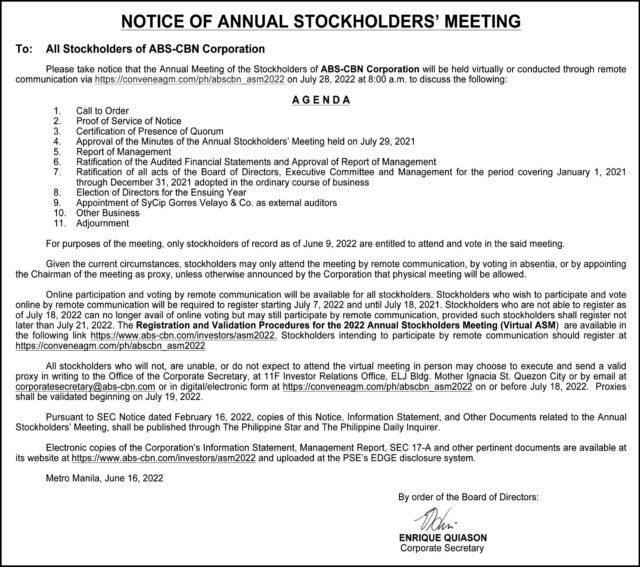
ABS-CBN Corp. to conduct annual stockholders’ meeting via remote communication on July 28


Spotlight is BusinessWorld’s sponsored section that allows advertisers to amplify their brand and connect with BusinessWorld’s audience by enabling them to publish their stories directly on the BusinessWorld Web site. For more information, send an email to online@bworldonline.com.

Join us on Viber to get more updates from BusinessWorld: https://bit.ly/3hv6bLA.

PHL lags ASEAN in solar, wind energy generation — think tank

Coca-Cola’s Davao Del Sur plant with close to 4,000 solar panels installed by TeaM Energy

THE PHILIPPINES lags regional peers in terms of the share taken up by solar and wind energy in its power mix, energy think tank Ember said in a report on Thursday.

The Philippines accounts for 10% of power generated in the region, but solar and wind made up only 2.6% of its power mix in 2021, it said.

This is below the 4% average across the Association of Southeast Asian Nations (ASEAN) and the 10% global average, Ember said.

Despite having the second-highest demand growth in the region, only 12% of total electricity demand in the Philippines was serviced by clean sources, it said.

Electricity demand between 2015 and 2021 rose 31%, of which 88% was serviced with fossil fuels, the report added.

While clean electricity generation nearly doubled, power generated from coal power rose 75%.

The share of solar and wind grew from 1.1% to 2.6% during the period, but this was offset by the growth in the share of coal from 27% to 47%, it said.

According to Ember, the Philippine power sector’s CO2 emissions rose accordingly by 42%.

Ember projects the Philippines to increase the share of power generated from solar and wind energy to 16.5% by 2030.

According to the Philippine Energy Plan (2020-2040), the Philippines plans to install an additional 0.76 gigawatts of wind and 18.5 gigawatts of solar power.

Ember said even with these augmentations, solar and wind will only satisfy 38% of the Philippines’ demand in the upcoming decade.

“Solar and wind need to grow rapidly in ASEAN nations, especially considering that they are currently the most economical and fastest way to replace coal,” Ember said. — Diego Gabriel C. Robles

Gov’t tempers 2022 growth target

Finance Secretary Benjamin E. Diokno — PHILIPPINE STAR/KRIZ JOHN ROSALES

THE PHILIPPINE government tempered its economic growth target for this year, as rising inflation and ballooning debt threaten to hamper the economy’s recovery from the pandemic.

Finance Secretary Benjamin E. Diokno on Wednesday said they are now aiming for gross domestic product (GDP) growth of 6.5-7.5% for this year.

This is slightly lower than the 7-8% target set by the Development Budget Coordination Committee (DBCC), but faster than the 5.7% GDP expansion in 2021.

The government also set a 6.5-8% GDP target for 2023 to 2028, higher than the DBCC’s 6-7% goal for 2023 to 2025.

“This is the highest growth rate among all ASEAN+3 countries this year and next year,” Mr. Diokno said at a Palace briefing.

The DBCC is set to review the economic assumptions on Friday.

Mr. Diokno said the new targets are part of a medium-term fiscal framework for 2023-2028, which was approved during the first Cabinet meeting on Tuesday.

“This framework will set the tone, our game plan for the next six years,” he said. “We’re more ambitious.”

The government is targeting to bring down the poverty rate to 9% by the end of President Ferdinand R. Marcos, Jr.’s term in 2028, Mr. Diokno said.

The Duterte administration had initially aimed to bring down poverty rate to 13-15% by 2022, but this was revised to 15-17.5% due to the pandemic. As of the first semester of 2022, the poverty rate stood at 23.7%.

The Finance chief said the debt-to-GDP ratio would be lowered to 60% by 2025. At the end of the first quarter of 2022, the ratio stood at 63.5%, exceeding the 60% threshold that multilateral lenders consider suitable for developing economies.

“We want to show the world that we’re conscious of having sound fiscal management,” Mr. Diokno said.

He added that the government also seeks to lower the deficit-to-GDP ratio to 3% starting 2026.

“We still have a lot of fiscal space, we are confident revenues will pick up,” he added.

Mr. Marcos, 64, is expected to continue his predecessor’s infrastructure program.

“We are committed to spend 5-6% of GDP for infrastructure annually from 2023 to 2028,” Mr. Diokno said, adding that the government would pursue public-private partnerships.

The Philippines is still aiming achieve to upper middle-income status, although Mr. Diokno said this would likely be achieved by the end of Mr. Marcos’ term.

The Philippines had originally targeted to graduate to the upper middle-income status by 2022, but this was derailed by the coronavirus pandemic.

Latest World Bank data showed the Philippines remains a lower middle-income country, as its gross national income (GNI) per capita stood at $3,640 in 2021. This is slightly higher than its $3,430 GNI in 2020.

The World Bank set the income range for the upper middle-income bracket of GNI per capita at $4,256-13,205, higher than the $4,096-$12,695 threshold last year.

TAXES
Mr. Diokno said the Marcos government would push for the completion of the Duterte administration’s Comprehensive Tax Reform Program (CTRP).

“There are two packages left that are revenue-neutral. These will simplify the tax system a lot so we’ll push for that,” he said. “We expect them to be approved before yearend.”

The previous Congress had failed to approve the remaining CTRP packages, which seek to standardize the real property valuation and assessment, and simplify taxes on passive income.

Mr. Diokno, a former central bank governor, also backed taxes on digital services, saying this is “only fair.”

In a separate interview with the ABS-CBN News Channel, Mr. Diokno also mentioned the possibility of imposing a tax on single-use plastics.

“I think we on our part, on the tax side, should think of some measures that we can do to reduce pollution. For example, tax on single-use plastic is worth considering,” he said.

“The Philippines is probably one of the most vulnerable with respect to climate change, and so it is in our own interest that the movement towards climate change should be supported.”

Former Finance Secretary Carlos G. Dominguez III earlier proposed a fiscal consolidation plan that included measures that would generate fresh revenues to pay for the country’s P12.5-trillion debt.

A P20 excise tax per kilogram of single-use plastics is part of package 1 of the fiscal consolidation plan. — Kyle Aristophere T. Atienza with Diego Gabriel C. Robles


PHL bad loan ratio falls to 16-month low

A worker inspects peso bills inside a money changer in Manila. — REUTERS

By Keisha B. Ta-asan

SOURED LOANS held by Philippine banks declined for a third straight month in May, bringing the nonperforming loan (NPL) ratio to its lowest in 16 months amid improved economic conditions.   

Preliminary data released by the Bangko Sentral ng Pilipinas (BSP) on Wednesday showed the banking industry’s gross NPL ratio stood at 3.75%, falling from 4.49% a year ago and 3.93% in April.

The May NPL ratio is the lowest since 3.72% in January 2021.

Bad loans declined by 10.5% to P429.106 billion in May from P479.481 billion a year ago. It was also 4.09% lower than P447.438 billion in April.

Loans are considered nonperforming once they are unpaid for at least 30 days after the due date. They are deemed as risk assets given borrowers are unlikely to settle such loans.

“Improved economic conditions helped firms and households generate enough cash flow to service debt obligations. This in turn helped lower overall NPL,” ING Bank N.V. Manila Senior Economist Nicholas Antonio T. Mapa said in an e-mail.   

The government placed Metro Manila and some provinces under the most lenient alert level starting March as the number of coronavirus disease 2019 (COVID-19) infections plunged.

“As the economy continues its recovery, the outlook for the banking sector also improves. Not just in terms of nonperforming loans but also its ability to lend to businesses,” China Banking Corp. Chief Economist Domini S. Velasquez said in a Viber message.

As bad loans declined, the lenders’ gross loan portfolio expanded by 7.3% to P11.44 trillion in May from P10.66 trillion a year ago. It also edged up by 0.4% from the P11.39 trillion in April.

Meanwhile, past due loans dropped by 14.2% to P508.508 billion in May from P593.346 billion a year ago. This brought the ratio to 4.44% from 5.56% a year ago.

Restructured loans climbed by 27.78% to P336.723 billion from P263.514 billion a year ago. These borrowings accounted for 2.94% of banks’ loan portfolio as of May.

In May, banks continued to boost their loan loss reserves to P406.61 billion from P383.39 billion a year ago. This brought the ratio to 3.55%, slightly lower than 3.59% a year ago.

The industry’s NPL coverage ratio, which gauges the allowance for potential losses due to bad loans, improved to 94.76% from 79.96% a year ago.

“The government’s push to support the MSME (micro, small, and medium enterprises) sector and programs and policies to make sure businesses — domestic or foreign -— thrive in the country, will contribute to improvements in the banking sector and the economy,” Ms. Velasquez said.   

Mr. Mapa said he expects conditions to improve if economic activity remains robust.

The BSP earlier said the NPL ratio of Philippine banks might peak at 8.2% this year. The ratio stood at 3.99% as of end-December 2021, as the economy started to reopen.

Diokno wants local gov’t units to tap Mandanas funds for agriculture

PHILIPPINE STAR/ MICHAEL VARCAS

THE NATIONAL Government is hoping local government units (LGUs) will channel their expanded budgets into raising agricultural output, Finance Secretary Benjamin E. Diokno said.

Mr. Diokno said in an interview with ANC on Wednesday that LGUs “incidentally have a lot more money now because of the Mandanas ruling,” referring to a Supreme Court (SC) decision that ordered the National Government to make bigger transfers to local governments.

In effect, “there will be a friendly competition among LGUs to boost agricultural products,” Mr. Diokno added.

The Supreme Court’s Mandanas-Garcia ruling granted LGUs a larger share of the national taxes after the SC liberally interpreted the Local Government Code in the LGUs’ favor. The Code requires that any doubt in interpretation must be resolved in favor of more decentralization.

The National Government’s old interpretation of the Code was that LGUs were entitled to 40% of the National Government’s “internal revenue,” which is reflected in the old name of the fund transfers from the National Government to LGUs, the “Internal Revenue Allotment (IRA).”

The Supreme Court ruled that LGUs are entitled to a share of all national taxes, including customs duties, and not just the collections generated by the Bureau of Internal Revenue (BIR). As a result, the IRA is now known as the National Tax Allotment (NTA).

Mr. Diokno added that the policy of importing food to address domestic shortages would continue even after the president said the government would exert greater effort in boosting rice and corn production.

“We will continue to import if demand exceeds supply… for our food requirements and that’s to keep the prices reasonable and affordable for ordinary people.”

“Simultaneously, we plan to increase production, to increase efficiency and planting more — that’s why (President Ferdinand R. Marcos, Jr.) accepted the Agriculture post; he wants to focus on production and he will do that through more sustained productive activity and increasing productivity in the sector.”

Inflation accelerated to 6.1% year on year in June, exceeding the Bangko Sentral ng Pilipinas’ (BSP) 2-4% target for a third straight month. In May, inflation was 5.4%. The year-earlier level was 3.7%.

Food accounts for about 39% of the CPI basket, giving food prices an outsized impact on the movement of the indicator. Food tends to command a bigger share of household budgets in poor countries.

Mr. Diokno described Philippine agriculture as a laggard.

“Industry has been growing, services have been growing but the agriculture sector has been in and out of recession,” he said.

Even if “there’s a budget for the Department of Agriculture, that should not be equated to how much the economy will need to increase agricultural production,” he said.

“As you know, the government is not doing agriculture; it’s the private sector.”

Mr. Diokno also said Mr. Marcos would look into each of the individual subsectors in agriculture — crops, rice, corn, high-value crops and fish.

In June, Mr. Marcos appointed himself Agriculture secretary to address the severe problems facing the farm sector. — Diego Gabriel C. Robles

Businesses concerned over rising electricity rates

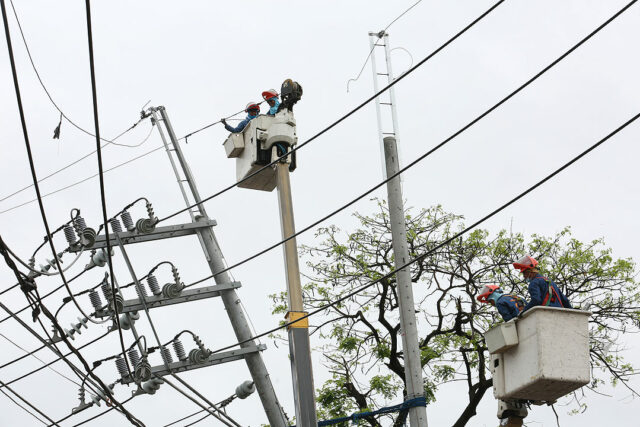
WORKERS fix an electric line in Payatas, Quezon City, March 13. — PHILIPPINE STAR/ MICHAEL VARCAS

THE MARCOS administration should immediately address power supply shortages and high electricity rates, which are affecting businesses in the country, the Philippine Chamber of Commerce and Industry (PCCI) said.

In a statement, PCCI President George T. Barcelon said businesses are concerned over the continued increase in electricity rates and the power supply shortages especially during the summer months.

“But a more pressing concern is our power rate. Industries such as steel, cement and glass have expressed their apprehension to us over how much electricity rates are forecast to increase as supply for reliable baseload like coal, oil and liquefied natural gas (LNG) are becoming scarce commodity,” he said.

Global oil prices soared this year due to the Russia-Ukraine war and tight global supply. LNG prices have also recently jumped.

Mr. Barcelon noted that electricity rates in the Philippines are already much higher than other Southeast Asian countries.

“Studies have shown that electricity rates for residential, commercial and the industrial sectors in the Philippines have been significantly higher from between 25% to as high as 87% than its Association of Southeast Asian Nations (ASEAN) neighbors, namely Malaysia (87.5%), Indonesia (87.5%), Vietnam (50%) and Thailand (36%),” the PCCI said.

Only Japan and Singapore have higher power rates than the Philippines.

Mr. Barcelon said soaring power rates have affected manufacturing industries, who say that fuel and power costs account for 60% of their operational expenses.

The government should ensure that there is “reasonably priced” and steady power supply to be able to attract foreign investments that will create more jobs, the PCCI said.

“For legislation such as CREATE (Corporate Recovery and Tax Incentives for Enterprises) and the amendments to the Public Service Act and Foreign Investment Act to succeed in their intended results to bring back a dynamic production/manufacturing sector, we must effectively solve that ‘high cost of electricity’ impediment soonest, and ensure that there is enough supply to support businesses and industries,” PCCI Chairman for Energy and Power Jose S. Alejandro said.

Mr. Marcos had included energy as one of his administration’s main priorities, along with agriculture, digital infrastructure, and the “Build, Build, Build” program.   

“This is a good platform to start taking actions to carve out recovery in new and better than light manufacturing industries for foreign and local investments,” PCCI Director for Energy and Power Franklin A. Carbon said.

The PCCI also urged the Marcos administration to consider renewable energy sources that have “higher proven and acknowledged availability, known technology, no subsidy requirement from either government or consumer to meet reasonable cost to consumers, and can deliver quality, reliable supply to industries.” 

The business group also recommended the conservation, rehabilitation, and upgrade of hydropower, geothermal power, and LNG, and to accelerate the approval for new plants that can power industries at affordable costs.   

“Addressing the country’s power woes is a big challenge that needs a concrete agenda, commitment and the concerted effort and support of all stakeholders,” the PCCI said.

Mr. Marcos has yet to announce his pick for Energy secretary. — RMDO

Meralco ‘will comply’ with ERC’s refund order

PHILSTAR FILE PHOTO

MANILA Electric Co. (Meralco) has confirmed receipt of an order from the Energy Regulatory Commission (ERC) directing the country’s largest power distribution utility to refund distribution-related charges amounting to P21.8 billion or 87 centavos per kilowatt-hour (kWh) for residential customers.

“We will comply with the ERC’s directive. We are currently studying the order so we can start reflecting this in the power bills this month,” said Joe R. Zaldarriaga, Meralco vice-president and head of corporate communications.

“While we have yet to receive suppliers’ billings, there is a possibility that the refund can offset the expected increase in generation charge and lead to a reduction in the overall power rates for July,” he added.

His comments come after the ERC came out with an order on Wednesday calling for the refund. The regulator placed an average refund rate of 48 centavos per kWh.

Meralco used the residential rate for the amount it plans to refund, while the ERC used the average refund rate.

In its order, the regulator said the amount covers the period from July 2015 to June 2022, and that it will be implemented in the next billing cycle from Meralco’s receipt of the order.

“The Commission has carefully evaluated the case at hand of [Meralco] and considered the views and concerns of the various stakeholders. We are confident that our decision exercised fairness, and promoted the interests of the consuming public who bears the brunt of all these electricity charges,” ERC Chairperson and Chief Executive Officer Agnes VST Devanadera said.

The latest derivative, which was dated on June 16, will be the fourth since January 2021: the first at P13.9 billion was on Jan. 21, 2021; followed by P4.8 billion on Feb. 23, 2022; and P7.7 billion on March 8, 2022.

The ERC further directed Meralco to execute the refund in approximately 12 months or until the amount is fully refunded to its customers.

It also directed the company to include the refund rate as a separate line item in the bills of Meralco’s customers during the refund period.

Adding the latest amount of P21.8 billion, residential consumers now have a P1.80 per kWh of refund.

Meralco is the Philippines’ largest electric power distribution company, with a franchise area covering 9,685 square kilometers.

It provides power to almost 7.3 million customer accounts in 36 cities and 75 municipalities, which include Metro Manila, all of the provinces of Rizal, Cavite, and Bulacan, and parts of the provinces of Pampanga, Batangas, Laguna, and Quezon.

In its first-quarter financial report, Meralco recorded an increase in net profit of 29.9% to P5.66 billion from P4.36 billion in the same period last year.

At the stock exchange, Meralco shares ended lower by P1.00 or 0.28% to P358 apiece on Wednesday.

Meralco’s controlling stakeholder, Beacon Electric Asset Holdings, Inc., is partly owned by PLDT, Inc. Hastings Holdings, Inc., a unit of PLDT Beneficial Trust Fund subsidiary MediaQuest Holdings, Inc., has interest in BusinessWorld through the Philippine Star Group, which it controls.— Justine Irish DP. Tabile

ACEN plans P30-B bonds, readies 458-MW solar farms

AC ENERGY Corp. (ACEN) is planning a P30-billion debt securities program to be shelf-registered with the corporate regulator, with a P10-billion first tranche allocated for three solar projects with a combined capacity of 458 megawatts (MW).

In a regulatory filing, the Ayala-led renewable energy (RE) company said that its executive committee in a meeting on Wednesday authorized the debt securities to be offered and issued in one or more tranches.

“All (three solar farms are for) completion next year,” Eric T. Francia, ACEN president and chief executive officer, separately told reporters partly in Filipino after the meeting.

ACEN identified the projects as the expansion of its 72-MW Arayat-Mexico, Pampanga solar farm by another 42 MW; the first phase 133-MW solar farm in Lal-lo, Cagayan; and the first phase 283-MW solar farm in San Marcelino, Zambales.

“Arayat is the only expansion, ‘yung dalawa bago (the other two are new),” Mr. Francia said.

In its filing, ACEN said the P10-billion initial tranche would be peso-denominated ASEAN green fixed-rate, five-year bonds that would be applied for listing with the Philippine Dealing & Exchange Corp.

The company’s executive committee authorized Mr. Francia, Chief Finance Officer Maria Corazon G. Dizon, and Deputy Chief Finance Officer Juan Martin L. Syquia to jointly determine and finalize the terms and conditions for the bonds and the debt securities program.

It also approved the total transaction costs related to the bond issuance of up to 1.4% of the issue size.

The Pampanga solar farm expansion comes after ACEN unit ACE Endevor, Inc. entered into a “framework agreement” in February 2020 for the joint development, ownership and operation of solar and other power plants in the Philippines.

Under the agreement, Citicore Renewable Energy Corp. and ACE Endevor are to be shareholders in a company — Natures Renewable Energy Development Corp. — incorporated to own and undertake the development of the solar farm in Arayat and Mexico.

In March this year, ACEN set up a joint venture with CleanTech Renewable Energy 4 Corp. to start building the 133-MW solar farm and transmission line in Lal-lo.

Late last year, it disclosed that it had agreed to subscribe to the shares of subsidiary Santa Cruz Solar Energy, Inc., which is developing the 283-MW solar farm in San Marcelino.

ACEN aims to become the largest listed renewables platform in Southeast Asia. It is also committed to achieving net-zero greenhouse gas emissions by 2050.

Earlier this year, ACEN said it had invested more than $200 million in what it calls “priority markets,” namely: Australia, Vietnam and Indonesia. It targets to add renewable capacity in the United States to its portfolio ahead of its goal of installing 5,000 MW of renewables by 2025.

Thus far, the company has an attributable capacity of 3,800 MW in the Philippines, Vietnam, Indonesia, India, and Australia. Of this figure, renewables account for 87%, which it claims to be the highest in the region.

Mr. Francia said the company is set to disclose next month a new target installed capacity for completion by 2030. — VVS

PCC targets to finish six cartel cases by end-2022 

By Revin Mikhael D. Ochave, Reporter

THE Philippine Competition Commission (PCC) is aiming to finish by the end of 2022 the investigation of six cases related to cartels or abuse of dominant position.

According to the PCC, it is targeting within the year to rule on all competition cases submitted for decision, including the six cartel cases, apart from investigations that have been pending for at least two years.

“[We are targeting] for six statements of objections or show-cause orders or some form of remedy or conclusion to any investigation that is ongoing, whether two years old or more, or less than two years, to be concluded. Six cases [are] to be concluded before the end of the year,” PCC Officer-in-Charge (OIC) Chairperson Johannes Benjamin R. Bernabe told reporters during a virtual press conference on Wednesday.

Mr. Bernabe disclosed that the PCC has a two-year limit that is internally imposed when it comes to the investigation of cases. However, he said that there are exceptions to the limit due to difficulties experienced during the investigation such as challenges in finding evidence.

“[We want] to make sure that whatever cases that are still pending before the enforcement office, particularly those which have been ongoing for more than two years in terms of investigation will be concluded by our enforcement office either by termination or archiving, by filing statements of objections when warranted, or pursuing some form of non-adversarial remedies to put a stop to any anti-competitive practice,” Mr. Bernabe said.

Mr. Bernabe became the PCC’s top official after former PCC chairperson Arsenio M. Balisacan was tapped by President Ferdinand R. Marcos, Jr. as the new Socioeconomic Planning secretary.

As a result, Mr. Bernabe will serve the remaining term of Mr. Balisacan in the PCC, which is until the first week of January next year.

According to Mr. Bernabe, the PCC’s enforcement office has four cases currently under investigation.

“Right now, there are four statements of objections arising from investigation by our enforcement office before the commission for our final ruling. These involve various sectors ranging from tourism, medical services, trade associations, and property development arrangements with internet service providers (ISPs),” he said.

“We would like to see that all these cases being investigated by the enforcement office are concluded one way or another,” he added.

Aside from the conclusion of cases, the PCC is also eyeing to initiate two motu proprio un-notified or anti-competitive merger cases, codify all PCC rules and procedures, and roll out the national competition policy in the public sector.

Meanwhile, Mr. Bernabe said that there will be a revision in the thresholds for the compulsory notification of mergers and acquisition (M&A) deals to go under the PCC’s review.

Currently, there is an increased threshold of less than P50 billion as provided under Republic Act No. 11494 or the Bayanihan to Recover as One Act (Bayanihan II). The law is set to expire in September this year.

Once the law expires, firms whose parent company assets exceed P6 billion and whose M&A transactions exceed P2.4 billion will once again be required to notify the PCC.

“Given the adjustment in the inflation rates and the adjustment of other economic indicators, you may see that these thresholds that we applied prior to Bayanihan II will be revised as well,” Mr. Bernabe said.

However, Mr. Bernabe said that the PCC has yet to determine the final adjusted thresholds, adding that the commission will “come up with the appropriate computation closer to September.”

“We normally make these adjustments in March of the calendar year. In March of this year, we didn’t really make an estimation because we thought that it would be more appropriate to compute that threshold come September,” Mr. Bernabe said.

“We will have to reckon in a couple of months what these new thresholds will be. There are adjustments on the nominal gross domestic product (GDP) growth from the previous year. As you know, because of various geopolitical factors, because of the pandemic, this has fluctuated with some degree of unpredictability,” he added.

SEC flags Wellcons anew on investment scheme

THE Securities and Exchange Commission (SEC) has ordered Wellcons Unlimited Systems, Inc. once again to stop offering investment packages to the public without the necessary license from the commission.

The SEC’s order dated July 5 comes after the commission on June 23 directed Wellcons to immediately cease engaging in the unlawful solicitation, offer, and sale of securities until it has filed the required registration statement and secured the necessary approval from the commission.

Wellcons and all the people and subsidiaries involved under the name have been ordered to stop their investment solicitation activities and immediately cease their internet presence related to the unauthorized investment scheme.

They have also been prohibited from transacting any business involving funds in Wellcons’ depository banks, and from transferring, disposing, or conveying any related assets to ensure the preservation of the assets of the investors.

The cease-and-desist order was issued after the SEC’s Enforcement and Investor Protection Department found that Wellcons has been offering investment packages worth P2,500 to P13,890 with guaranteed returns of up to P9,000 to P32,000 per day.

Members who availed of investment packages can further earn through Wellcon’s Pangkabuhayan Program, where they can supposedly double their money within six months based on investment packages worth P1,500 to P5,000.

Aside from these investment packages, Wellcons also promised leadership bonuses and referral fees to its members.

“[I]t is clear that Wellcons’ business model which promises high return of investments is not sustainable, and can only be carried out as long as new investors continue to come in,” the commission en banc said.

The scheme involves the sale and offer of securities to the public in the form of investment contracts, whereby a person invests money in a common enterprise and is led to expect profits primarily from the efforts of others.

SEC finds this scheme a violation of Section 8 of the Securities Regulation Code (SRC) because Wellcons has no license to carry out sales or offers of securities. Although the company is a duly registered corporation, it has never secured a secondary license from the commission to operate as a broker or dealer of securities, nor is it a registered issuer of any securities.

The SRC provides that securities should not be sold or offered for sale or distribution within the Philippines without a registration statement duly filed with and approved by the SEC.

“This is a fraudulent scheme which will likely cause grave or irreparable injury or prejudice to the investing public. Thus, we hold that the act of Wellcons in selling/offering unregistered securities operates as a fraud to the public which, if unrestrained, will likely cause grave or irreparable injury or prejudice to the investing public,” the commission added.

As early as Feb. 2, the SEC sent an advisory to Wellcons in order to warn the public against investing in the group and similar entities.

Wellcons registered with the commission on April 19, 2021 with a primary purpose of distribution of products through multi-level marketing, buying and selling, and marketing through online channels, as permitted by law, goods and merchandise that primary target the basic needs of individuals and households.

BusinessWorld tried to reach out to Wellcons via Facebook pages under its name and a phone number attached to one of the pages but has not received a reply as of press time. — Justine Irish DP. Tabile