Home Blog Page 5853

FINA allows PSI event in Capas, Tarlac as World Championships qualifier

THE PHILIPPINE Swimming, Inc. (PSI) got the blessing of the International Swimming Federation (FINA) to allow the 2022 PSI Long Course Grand Prix National Championships set Oct. 13 to 16 at the New Clark City in Capas, Tarlac to serve as a doorway to the World Championships.

But of course, Filipino swimmers must meet the Standard Entry Times set by FINA.

“We are more than excited to announce that FINA has approved our event in Capas, Tarlac as a qualifying event for two World Championships,” said PSI President Lani Velasco.

Ms. Velasco was referring to the 16th edition of the world tilt in Melbourne, Australia late this year and the 20th staging in Fukuoka, Japan next year.

This meant local tankers would no longer spend that much to make the cut by going abroad.

“It means that if your times meet the standard entry times set by FINA, you will have a chance to represent the Philippines and compete at Melbourne and or Fukuoka,” said Ms. Velasco.

“This is a big deal for our community since you no longer need to go overseas to compete in FINA qualifying events should you wish to qualify for the Worlds,” she added.

Ms. Velasco said PSI would continue to provide the local swimmers opportunities to prove their worth and get the golden chance of competing with some of the globe’s best and brightest.

“The 2022 PSI LC Grand Prix National Championships is one of many opportunities we plan to provide for our community,” she said. — Joey Villar

Eala beats Marcinkeva to advance in second round in W80 Rancho Santa Fe qualifier

ALEX Eala netted a 6-1, 6-3 win over Latvia’s Deniza Marcinkeva to advance in the second round of the W80 Rancho Santa Fe qualifying draw in California yesterday.

The Filipina tennis pride faces home bet Alana Smith next in the second round today for a seat in the main draw featuring some Top-200 players in the Women’s Tennis Association (WTA).

Ms. Eala is ranked No. 281 as per the latest WTA list yesterday and found no problem taking care of her Latvian counterpart in only 75 minutes of play in the prestigious $80,000 tourney.

This is the second women’s pro tournament of the 17-year-old sensation after a historic win in the US Open juniors championships earlier this month.

Ms. Eala was the first Filipino to win any junior singles Grand Slam in her young but already decorated career that also included two junior doubles Slams in the 2020 Australian Open and 2021 French Open.

Her US open conquest catapulted her from No. 167 to No. 33 of the International Tennis Federation (ITF) junior rankings before returning to the women’s pro circuit in the W60 Templeton also in California last week.

She, however, settled for a second-round finish with hopes of surpassing it this time in a bid to claim her third pro title after winning in the 2021 W15 Manacor in Spain and the 2022 W25 Chiang Rai in Thailand. — John Bryan Ulanday

San Francisco 49ers’ defense shuts down rival Los Angeles Rams

DEEBO Samuel caught six passes for 115 yards, including a long catch-and-run touchdown, and Talanoa Hufanga scored on an interception return to help the San Francisco 49ers notch a 24-9 victory over the Los Angeles Rams on Monday night at Santa Clara, Calif.

Jimmy Garoppolo completed 16 of 27 passes for 239 yards and one touchdown and Jeff Wilson, Jr. rushed for 74 yards and one score as San Francisco (2-2) won its seventh consecutive regular-season game over the Rams (2-2). Of course, Los Angeles won the biggest recent meeting, beating the 49ers in last season’s NFC Championship Game en route to winning the Super Bowl.

Matthew Stafford connected on 32 of 48 passes for 254 yards with one interception and one lost fumble for the Rams. Cooper Kupp caught a career-best 14 passes for 122 yards, Tyler Higbee made 10 catches for 73 yards.

Nick Bosa and Samson Ebukam each had two of San Francisco’s seven sacks. Mr. Bosa leads the NFL with six. Mr. Ebukam forced Mr. Stafford to fumble on one of his sacks.

The 49ers outgained Los Angeles 327 yards to 257. The Rams didn’t have a single 20-yard offensive play. The Rams controlled the ball for the first 8:12 of the contest, but their drive stalled and they settled for Gay’s 39-yard field goal. — Reuters

Lakers’ fundamental infirmities

Listening to the Lakers talk about the 2022-23 season, you’d think Lakers head coach Darvin Ham has managed to invent a new system. As longtime habitues of the sport know, however, the notion can’t be farther from the truth. Mentoring in the pro ranks isn’t rocket science in the sense that everything has become apparent for a while now; those practicing the profession willingly share information and impart institutional knowledge, and they understand that, no matter how proficient they are in Xs and Os, the bottom line the extent of the talent they have at their disposal, and how that pool of talent responds to their entreaties.

That said, the Lakers do have reason for optimism, and not simply because the start of the campaign — as with any other — brings with it a clean slate. The fact that Ham is a first timer to the hot seat likewise underscores the new beginning. And for the first time in a long while, they’re healthy — for the most part, at least. Which is why even veteran stars LeBron James, Anthony Davis, and Russell Westbrook, fresh off a disappointing run that saw them fail to make the playoffs after being installed as preseason favorites to take the title, can’t help but be bullish about their prospects.

Whether the Lakers’ cheery disposition will remain until the end of the season remains to be seen. Needless to say, they’re on-court performance figures to dictate the degree to which their positive vibes carry over from Game One to Game 82 and, hopefully, beyond. And, for all their sanguinary, their roster continues to exhibit fundamental infirmities; while they’ve been busy picking up warm bodies, not a single one of their acquisitions addresses the need for reliable volume three-point shooting. Considering that James is passable at best from beyond the arc and both Davis and Westbrook possess cringe-worthy forms insofar as treys are concerned, it’s fair to wonder why the front office didn’t make a concerted effort to correct the glaring imbalance.

To be fair, Lakers general manager Rob Pelinka did tackle the issue head on; he noted that the lineup cannot but be deemed a work in progress. Still, there’s cause to argue that the purple and gold once again got enamored with the trees that they forgot to see the forest. Certainly, any team with James on it — especially when backstopped by a determined Davis — has a chance, Westbrook’s mere presence is a negative not even they can overcome. Too bad. And because the obvious solution is not easily implemented, the worst is yet to come.


Anthony L. Cuaycong has been writing Courtside since BusinessWorld introduced a Sports section in 1994. He is a consultant on strategic planning, operations and Human Resources management, corporate communications, and business development.

Addressing the Philippine education crisis: Upskilling, reskilling and retooling

LIFESTYLEMEMORY/§FREEPIK

(Part 2)

If we have the goal of transitioning from being an upper middle-income economy to a high-income economy (with a per capita income in today’s prices of over $13,000, about three times the present amount), it is imperative that we address our poor quality of basic education in the next five to six years.

The children who are in the primary and secondary levels of education today are the ones who will be the knowledge workers needed 15 to 20 years from now in an economy that, if it is to be First World, must compete with the rest of the world in the so-called Industrial Revolution 4.0 in which the predominant technologies will be Artificial Intelligence, the Internet of Things, Big Data, and Robotization, among others. It is obvious that we will not have a workforce fit for such a technology-intensive economy if our grade school and high school students today continue to perform very poorly in reading comprehension, math literacy, and science know-how. The present Administration has a tremendous responsibility to the generations of the future. It is imperative that our leaders today, working with the State, exert every effort to arrest the deterioration of the quality of our basic education.

On the other hand, we cannot ignore the present problem of continuing to reskill, upskill, and retool the existing labor force who have already acquired some basic education and a good number of them tertiary education, no matter how poor in quality. These are the human resources who will help the country transition from upper-middle income to high-income in the next 10 or so years.

According to the Philippine Statistics Authority, in July 2022, there were 47.39 million employed persons, 2.6 million unemployed, and 6.54 million underemployed (those who are employed but still express the desire to have additional hours of work in their present job or to have an additional job, or to have a new job with longer hours of work in order to make both ends meet). The vast majority of those employed or underemployed workers are far from being in the sector referred to as Industrial Revolution 4.0. They straddle IR 1.0 (working with simple machines), IR 2.0 (electricity-driven), and IR 3.0 (electronic products). In fact, some 23% of them are still struggling to increase their productivity in what should have preceded our industrial revolution, the so-called Green Revolution that our country missed because of erroneous and failed economic policies of past Administrations.

To get an idea of the occupations in which most Filipino workers are employed, data from the Philippine Statistics Authority show that more than one-fourth (26.1%) are laborers and unskilled workers; 16.1% are officials of Government and Special Interest Organizations; corporate executives, managers, managing proprietors and supervisors; 15% are service workers and shop and market sales workers; 13.5% are farmers, forestry workers, and fishermen; 7.9% are trades and related workers; 6.3% are plant and machine operators and assemblers; 5.7% are clerks; 5.3% are professionals; 3.8% are technicians and associate professionals; and 0.2% are special occupations. These workers, mostly in the age range between 25 to 50 years have also been generally products of mediocre education in the past 20 years, like the present generation of the youth who are doing poorly in international tests in reading comprehension, mathematical literacy and science literacy. We can assume that the officials of Government and Special Interest Organizations, the corporate executives, managers, managing proprietors, and supervisors; the professionals and the technicians and associate professionals (a total of 25.2% of the labor force) have been the ones who proceeded to tertiary education and got above-average quality education. The rest, especially the laborers and unskilled workers, farmers, forestry workers and fishermen, clerks, trades and related workers — whether employed or underemployed —are the ones who can benefit from continuing programs of upskilling, reskilling and retooling that can be given by the Government, the business sector and educational and training institutions in non-degree programs.

Instead of fretting too much about the long-term challenge of improving the quality of the education we give to our children and youth, let us give special attention to training programs that can improve the skills or give new skills to those who are already in the labor force, with special emphasis on the 6.54 million workers who are underemployed. The very fact that there are more than 10 million OFWs who also did not exactly get a world-class education but are being praised for their skills and work habits abroad should encourage us to consider ways and means of reskilling and upskilling those who are already in the workforce, especially in the occupations that are suffering from serious shortages such as those in construction, healthcare, and hospitality.

For this to happen, we should all be liberated from our obsession with college degrees and diplomas. The group of business leaders, academics, and other concerned citizens who have banded together under the Philippine Business for Education have been very vocal about companies getting to focus on job competencies rather than on college degrees during their recruitment process. Even Secretary of Trade and Industry, Alfredo Pascual, has been appealing to business enterprises to hire more graduates of the K-12 program instead of making a college diploma a pre-requisite to employment.

As reported by Revin Mikhael Ochave of BusinessWorld, Secretary Pascual gave the following advice to potential employers: “When you check the job descriptions nowadays, almost all require college degrees. This should change because we already have the K-12 program. But it’s not to say that having the program is enough. We need to prove that the K-12 program is able to produce holistically developed individuals. The mindset of people is that you cannot fully prepare for work when you don’t have a college degree, which is totally an erroneous mindset.”

In this regard, it was a wise move on the part of President Ferdinand Marcos, Jr. to issue Executive Order 5 transferring the Technical Education and Skills Development Authority (TESDA) to the Department of Labor and Employment (DoLE). TESDA was created by RA 7796 to be the primary agency responsible for the formulation of technical education and skills development policies, plans, and programs, taking special consideration of the task of improving linkages between industry, labor, and government in the crafting of any national-level plan. With the signing of RA 7796, TESDA replaced and absorbed the powers and functions of the then National Manpower and Youth Council and the apprenticeship program of the Bureau of Local Employment under DoLE. With TESDA under the management of DoLE, there can be this direct link between programs for upskilling, reskilling, and retooling existing workers that will directly result in employment.

Our educational sector has been very notorious for producing graduates who do not have the skills and aptitudes required by industry. There has been a terrible mismatch, mainly because of the obsession with college degrees and not with the actual competencies required by the workplace. Instead of producing too many accounting, business administration, and political science bachelor’s degree holders, we should have been producing many more carpenters, plumbers, mechanics, electricians, brick layers, and others who are now needed in our Build, Build, Build program.

In this regard, it was also good news to learn that the Department of Agrarian Reform (whose reason for existence should be seriously re-examined) is launching a program that will upskill and reskill farmers and farm workers belonging to agrarian reform beneficiary organizations (ARBOs) on new farming technology via a network of demonstration farms. This should be the equivalent of what TESDA will be doing under DoLE. In fact, it might be a good idea to convert DAR into a technical training arm of the Department of Agriculture so that it can focus on the training of farmers, farm workers, fisher folk and other workers in the rural areas.

There are about 7,500 ARBOs nationwide which DAR can tap to improve the productivity of the human resources in the agricultural sector, focusing especially on the numerous school drop outs in the rural areas, most of whom are either unemployed or underemployed. The President, who is also the Secretary of Agriculture, should really rely on DAR (whose name can be changed) to mobilize ARBOs and implement demonstration farms under the Farm Business School project. There are a good number of NGOs with which DAR can partner in developing different forms of family farm schools that can be patterned after the schools for the children of farmers that were successfully developed by the French and the Spaniards in the last century, which schools contributed significantly to the progress of the countryside in these countries.

(To be continued.)


Bernardo M. Villegas has a Ph.D. in Economics from Harvard, is professor emeritus at the University of Asia and the Pacific, and a visiting professor at the IESE Business School in Barcelona, Spain. He was a member of the 1986 Constitutional Commission.

bernardo.villegas@uap.asia

A revitalized US alliance: Pivot, or slow boat back to Washington?

BW FILE PHOTO

On Sept. 29, 2022, Philippine Department of National Defense (DND) Undersecretary and Officer-in-Charge Jose Faustino and US Secretary of Department of Defense (DoD) Lloyd J. Austin announced their countries’ commitment to the 1951 Philippine-US Mutual Defense Treaty (MDT). The commitment would be seen through the enhancement of maritime cooperation and improvement of their respective armed forces’ interoperability and information sharing. Both secretaries acknowledged the need to secure the Philippines’ future, address regional security challenges, and promote peace and security in the Indo-Pacific region.

This goal requires the two allies to accelerate the implementation of the 2014 Enhanced Defense Cooperation Agreement (EDCA) by concluding infrastructure enhancements and repair projects at existing EDCA-agreed locations inside five Philippine Air Force (PAF) bases all over the country. This also entails the exploration of new locations that will be built to create their credible mutual defense posture. The defense secretaries revealed the signing of the US-Philippine Maritime Framework that will jumpstart the two countries’ maritime cooperative activities in the South China Sea – this might include the resumption of joint naval patrols by the US and Philippine navies.

The meeting happened after the Philippines and US armed services held the annual Mutual Defense (MDB) and Security Engagement (SEB) Boards meeting in the US Indo-Pacific Command in Hawaii. Armed Forces of the Philippines (AFP) Chairman of the Joint Chief of Staff Lt. General Vicente Baccaro and US Indo-Pacific Command Admiral John Aquilino convened the 2022 MDB-SEB meeting on Sept. 27, concluding almost two years’ worth of bilateral defense planning between the two allies. They agreed to sustain robust military-to-military relations; both sides agreed to hold over 500 joint activities in 2023.

PIVOTING BACK TO THE ALLIANCE?
These activities are seen as President Ferdinand “Bongbong” Marcos, Jr.’s efforts to firm up security ties with the US. Under the previous administration, the Philippines moved away from its alliance with the US, and closer to China, despite the issues in the West Philippine Sea/South China Sea.

President Duterte did not only distance the Philippines from its only treaty ally. He also set aside the July 12, 2016, Arbitral Ruling on the South China Sea despite it being in our favor. He expected a massive inflow of Chinese public investment to finance the development of Philippine infrastructure projects, and a moderation of the People’s Liberation Army’s Navy (PLAN) and Chinese Coast Guard’s (CCG) behavior toward the Philippine military in the South China Sea.

Ironically, the move to gravitate again to the alliance began in 2020 – immediately after Duterte abrogated the 1999 Visiting Forces Agreement (VFA) on Feb. 10. Less than a week later, on Feb. 17, a PLAN corvette directed its Gun Control Director (GCD) on the PN’s anti-submarine frigate, the BRP Conrado Yap, near Rizal Reef in the South China Sea. In March, a Chinese military transport plane landed on Fiery Cross or Kagitingan Reef on a routine supply mission to consolidate its control of the South China Sea. In early April, China started the operations of two marine research stations in two artificial islands claimed by the Philippines: Fiery Cross and Subi or Zamora Reefs.

In late March 2021, the Philippine Coast Guard (PCG) reported the presence of 220 Chinese fishing boats in Whitsun Reef, 170 nautical miles from the country’s westernmost island of Palawan. The DND claimed that these fishing boats were manned by Chinese maritime militia who were sheltering from bad weather. Satellite photos also revealed that the boats were devoid of any fishing equipment.

Filipino military officers and diplomats regarded the maneuver as a prelude to a gray zone operation.

Early in the stand-off, the US assured the Philippines of its diplomatic and military support. In early April 2021, the nuclear powered-aircraft carrier, USS Theodore Roosevelt, accompanied by its escorts and by an amphibious assault ship the USS Makin Island, entered the South China Sea as a demonstration of American military support to the Philippines at the height of the Whitsun Reef stand-off.

SLOW BOAT TO WASHINGTON
These developments unnerved the Duterte administration, which realized that its appeasement policy toward China failed to moderate the latter’s aggressive behavior. On July 30, 2021, President Duterte withdrew the letter for the VFA termination after he met Secretary Austin during the latter’s official visit to the Philippines. From Nov. 15 to 16, 2021, Philippine and US defense and foreign affairs officials met in Washington D.C. to reinvigorate the alliance.

The two countries’ defense departments also agreed to promote their respective armed forces’ interoperability — establishment of a coordination center, development of joint command and control for operations, and formulation of a maritime framework to enable Filipino and American troops to conduct joint operations more effectively. Finally, the two countries formulated a new bilateral defense guideline that came in the form of the Nov. 16, 2021 “Joint Vision for a 21st Century United States-Philippines Partnership.”

President Marcos did not reverse the previous administration’s policy toward the alliance. Rather, he plans to continue its policy of revitalizing the alliance in light of what he described as “a volatile situation that points to the importance of the (security) relations between the Philippines and the United States.”

At the very least, this is an encouraging development.


Dr. Renato De Castro is a trustee and program convenor of the Stratbase ADR Institute.

POGOs: What’s at stake?

(I am pleased to share with readers a post that Christine Tang and I wrote for subscribers of Globalsource Partners [globalsourcepartners.com], a New York based network of independent analysts.)

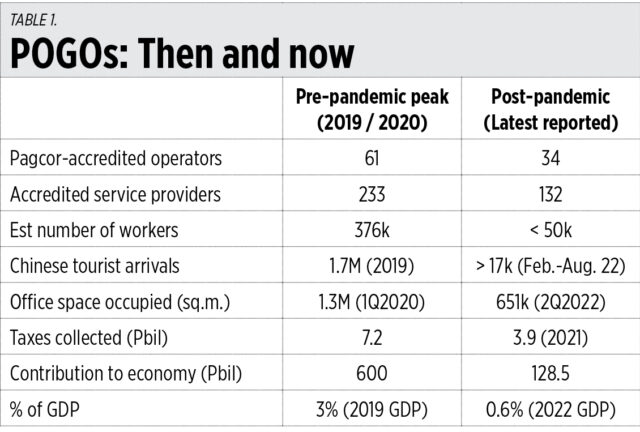
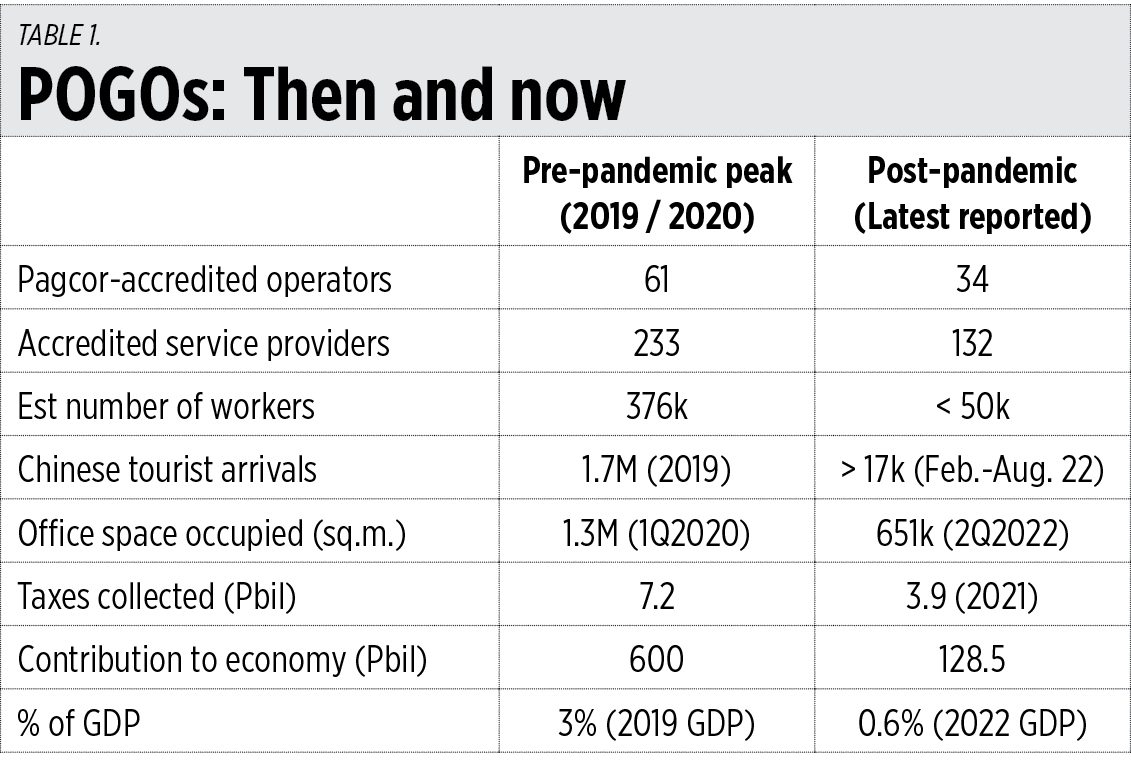
We momentarily turn our eyes away from the turmoil in financial markets and take a look at the uproar in the online gambling industry. Called POGOs, short for Philippine offshore gaming operators, the industry is akin to business process outsourcing (BPO) in that firms set up bases in the Philippines that provide services to foreign markets, in this case, internet gambling. However, POGOs have attracted a lot of unwanted attention because of the following:

1. Unlike BPOs, POGOs employ mostly foreign nationals as it needs workers who could speak the native languages of target markets, most prominently China where gambling is illegal.

2. Regulatory oversight is weak resulting in monitoring and taxation issues. The Philippine Amusement and Gaming Corporation (PAGCOR), which is in charge of licensing POGOs, has conflicting mandates as regulator and casino operator that has yet to be addressed. Clearer tax regulations were put in place only in September 2021 through Republic Act 11590, spelling out applicable tax rates on gaming revenues and incomes of foreign workers. Additionally, there have been enforcement issues related to immigration and security forces.

3. Another major concern is monitoring of money laundering risks. In its risk assessments of POGOs, the country’s Anti-Money Laundering Council (AMLC) found “a low level of AML/CTF awareness and regulation; an increasing level of threat to money laundering and other fraudulent activities; a high number of unregulated or unsupervised service providers (SPs); and a low level of beneficial ownership identification.”

4. Rising crime associated with the industry, particularly kidnap-for-ransom resulting from disputes over debts and alleged human trafficking that has placed the industry in a most unfavorable light.

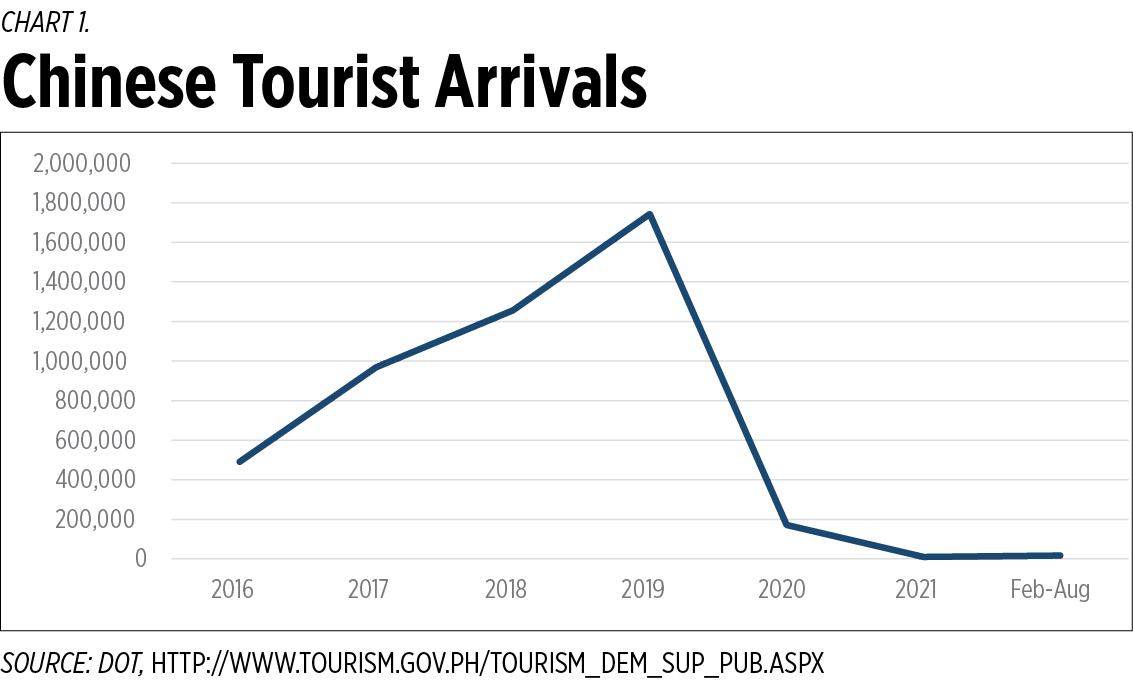
5. Analysts have always been sensitive to the risk of a sudden stop in POGO activities should China (which has expressed disapproval of POGOs’ negative influence not just on nationals’ gambling habits but also the reported crimes against Chinese workers) tighten immigration regulation and/or shut down internet gambling sites and prevent wire transfers through Chinese payment systems. 

TO BAN OR NOT TO BAN
Philippine legislators are calling for banning POGOs, arguing that the social costs outweigh the financial benefits. Supporters argue that strengthening law enforcement would be superior to a total ban. They claim that a total ban would cost the economy anywhere from 0.6% to 1% of GDP.

OUR VIEW
We think the risk of a system-wide property sector collapse and/or banking sector stress is manageable since most firms and banks deliberately limit exposures to the sector and the decline in real estate prices would help the country be more competitive in attracting a bigger slice of the expanding global BPO market.

While a complete ban would come with some amount of economic pain especially for certain property firms that have outsized exposures to the industry as well as the knock-on effects on housing, food, retail and other services catering to the foreign workers, we are more concerned with the incalculable costs of allowing POGOs to operate in the country. These include:

1. “Reputational risk” cited by Finance Secretary Benjamin Diokno. We take this to refer to the negative perception associated with the country’s inclusion since June 2021 in the Paris-based Financial Action Task Force’s (FATF) list of jurisdictions under increased monitoring or the so-called “grey list.” Money laundering through casinos, actual or virtual, has been a major worry for authorities especially after the Bangladesh Bank cyber heist scandal in 2016.

2. Security experts we consulted tell us that kidnappings are “systemic” and “recurring” in the industry.

3. A prominent sociologist worries about POGO operators’ agility in exploiting “the corruptibility of our public institutions,” as well as the longer-term harm to the economy of government’s dependence on POGOs at the expense of finding “more enduring and less (socially) costly sources of revenue.” 

All told, while it is true that POGOs could help cushion the economy against current strong external headwinds, we would rather argue that allowing these to continue and climb back up to its pre-pandemic size would only increase the economy’s vulnerability to a sudden and massive pullout.

The latter may be triggered on the Chinese side by authorities’ social policy vs. gambling, a crackdown on money laundering and the state of Philippine-China relations, and/or on the Philippine side, if online gambling becomes a reason for the country’s blacklisting by the FATF which could damage remittances and investment flows immensely. The current upheaval in global financial markets, with China and other emerging market central banks looking for alternative ways to manage money outflows to help ease exchange rate pressures, could even make the case for banning POGOs stronger.


Romeo L. Bernardo was finance undersecretary from 1990-96. He is a trustee/director of the Foundation for Economic Freedom, the Management Association of the Philippines, and the FINEX Foundation. He also serves as a board director in leading companies in banking and financial services, telecommunication, energy, food and beverage, education, real estate, and others.

globalsourcepartners.com

romeo.lopez.bernard@gmail.com

Panalo ka ng 1 million: The proliferation of text scams and breaches of data privacy

BW FILE PHOTO

Apart from the much-awaited text message that your Lazada or Shopee delivery is out for delivery or the OTP that closes your transaction, another type of text message frequents our mobile phones nowadays — scam text messages. It has become a common experience for a lot of people who use mobile phones to receive spam messages ranging from prizes allegedly won, to distant relatives requesting financial support. Of late, these text messages have even evolved to include the recipient’s name — a clear cause for concern.

It is thus a source of curiosity, if not suspicion, regarding how the personal data such as a person’s name, identity, or contact information is harvested and abused, more so as data subjects under the Data Privacy Act of 2012 (DPA) are entitled to be informed when personal information pertaining to him or her are being or have been processed.

Under the DPA, personal information of data subjects must only be collected for specified and legitimate purposes and processed in such a way that is compatible with such purposes. It is then the responsibility of personal information controllers to ensure that personal information is processed responsibly and is not leaked or harvested by unscrupulous individuals.

As regards the personal information of data subjects, specifically their names, there is an obligation on the part of controllers and processors alike to only act in accordance with the legitimate and specified purposes for which a data subject is providing his or her information. Additionally ensuring the security of personal information falls under the responsibility of personal information controllers. Measures need to be implemented to prevent accidental or unlawful disclosure as well as unlawful processing of personal information. Should personal information controllers transfer the personal information, for whatever specified purpose, the level of protection imposed on the personal information must be maintained. With the mandated obligation of entities that control and process people’s personal information, a high level of diligence must be exercised and appropriate penalties be imposed for falling below the standards of the law.

The DPA itself provides for the penalties to be imposed on personal information controllers and processors that fail to comply with their obligations under the law. A penalty of imprisonment, as well as a fine, is accordingly imposed on those who violate the provisions of the DPA. Unauthorized processing of personal information, or the processing without a data subject’s consent, is penalized with imprisonment ranging from one year to three years and a fine of not less than P500,000 but not more than P2,000,000. Processing of personal information for unauthorized purposes is penalized with imprisonment ranging from one year and six months to five years and a fine of not less than P500,000 but not more than P1,000,000. Unauthorized disclosure, or the disclosure of personal information to a third party without the data subject’s consent, done without malice or in good faith, can be punished with imprisonment ranging from one year to three years, and a fine of not less than P500,000 but not more than P1,000,000.

If the offender is a juridical person, the penalty is to be imposed on the responsible officers who participated in, or even by their gross negligence allowed the commission of the crime. In addition, any of the entity’s rights to control or process data under the DPA may be suspended or revoked. The law even goes further by punishing violations committed on a large-scale, or when personal information of at least 100 persons is involved. The maximum penalty is imposed when the violation is committed on a large-scale.

With the foregoing, how did these text scams come to be?

Remember — “contract tracing forms” were imposed during the height of the pandemic, when the public submitted personal information with the expectation that such was to be used only for the given purpose of monitoring the spread of the COVID-19. Online shopping and money transfer applications with increasing users made the public provide their personal information. With a surge of these platforms where one provides his or her personal information, a data privacy breach could cause several data subjects to have their personal information used for improper purposes. The proliferation of text scams can be traced here because clearly data subjects’ personal information was illegally accessed. To be sure, data subjects do not provide their information with knowledge nor consent to receive spam messages that seek to take advantage of them by including them in an elaborate scam to part with their money.

Due to the growing concern of the public regarding their personal information being used in such a way, as well as the unfortunate situation when people are scammed of their money through text phishing, the relevant government agencies must ensure the safety of personal information and enforce the existing laws. The National Privacy Commission and the Department of Trade and Industry have issued various advisories warning the public of spam messages that seek to deceive people into believing that they have been employed by an imaginary employer they did not apply with or won a considerable amount which would bring the lottery prize money to shame.

Not only are the public themselves warned to take extra care in falling prey to text phishing, but telcos themselves are also being directed by the National Telecommunications Commission (NTC) to use their reach in warning the public against these text scams. In the most recent NTC Memorandum Order No. 006-09-2022, the NTC even directed mobile phone manufacturers, distributors, and dealers to educate the public on protective mobile phone features.

Are these safeguards enough? Given the provisions of law which enumerate responsibilities and punish violations, entities that handle personal information of the public should be more diligent in ensuring the security of information entrusted to them. Heavier protection should be imposed to ensure the confidentiality of information submitted by the public, especially those who are prime victims who are likely to fall prey and believe seemingly harmless, but indeed very damaging, text messages.

This article is for informational and educational purposes only. It is not offered and does not constitute legal advice or legal opinion.


Mary Clarence Angela T. Protacio is an associate of the Litigation and Dispute Resolution Department (LDRD) of the Angara Abello Concepcion Regala & Cruz Law Offices or ACCRALAW.

(632) 8830-8000

ctprotacio@accralaw.com

Tutoring service reports learning gaps in K-to-12 students

A tutoring service reported gaps between students’ skills and their grade level upon assessment. 

“We are seeing 2–3 years learning gap in both literacy and numeracy skills across all grade levels,” said Cecilia Calvo-Lewis, vice-president of tutorial services at Edukasyon.ph, an online learning platform, in an e-mail. “For reading, the learning gaps are more prominent in emerging readers. Most 5th and 6th graders we meet – maybe close to 90% – are not proficient in reading.”  

This improficiency also extends to Tagalog, she added. 

About 1,000 K-12 students from Luzon and Visayas have enrolled in EDGE, a live tutoring service launched this May by Edukasyon.ph, which offers English, Math, and Tagalog subjects. 

EDGE also partnered this July with Children International, a non-profit child sponsorship organization, to deliver tutorial and remedial lessons in reading and math to more than 150 public school students. The program includes grade-level assessment; personalized digital learning instruction; and a mobile phone plan to ensure continued learning.  

“This is how the private sector can have more active involvement in responding to the learning crisis in the country. We hope more are encouraged to do the same,” said Grace M. David, Edukasyon.ph chief executive officer, in a Sept. 30 statement.  

BusinessWorld previously reported that the Philippines’ learning poverty is among the highest in the region, with nine of 10 Filipinos unable to read and understand short age-appropriate texts by the age of 10, according to the World Bank. 

The Department of Education (DepEd) on Sept. 14 asked Congress for an additional P100 billion to “solve all the problems of basic education” in the country.  

EDGE is offering a 15% discount on its remote tutorial services this October with the code OCTOBER2022. — Patricia B. Mirasol

N. Korea conducts longest-range ballistic missile test yet over Japan

KCNA VIA REUTERS

SEOUL/TOKYO — Nuclear-armed North Korea fired a ballistic missile over Japan for the first time in five years on Tuesday, prompting a warning for residents to take cover and a temporary suspension of train operations in northern Japan.

The Japanese government warned citizens to take cover as the missile appeared to have flown over and past its territory before falling into the Pacific Ocean.

It was the first North Korean missile to follow such a trajectory since 2017, and Tokyo said its 4,600 km (2,850 miles) range may have been the longest distance traveled for a North Korean test flight, which are more often “lofted” higher into space to avoid flying over neighboring countries.

The latest launch was Pyongyang’s fifth in 10 days, amid military muscle-flexing by the United States, South Korea and Japan. Last week, the three countries conducted trilateral anti-submarine exercises that included a US aircraft carrier, which stopped in South Korea for the first time since 2017.

Recent tests have drawn relatively muted responses from Washington, which is focused on the war in Ukraine as well as other domestic and foreign crises, but the US military has stepped up displays of force in the region.

Tokyo said it took no steps to shoot the missile down. Defense Minister Yasukazu Hamada said Japan wouldn’t rule out any options, including counterattack capabilities, as it looks to strengthen its defenses in the face of repeated missile launches from North Korea. South Korea also said it would boost its military and increase allied cooperation.

The United States said it strongly condemned North Korea’s “dangerous and reckless” decision to launch a long-range ballistic missile over Japan.

“This action is destabilizing and shows the DPRK’s blatant disregard for United Nations Security Council resolutions and international safety norms,” National Security Council spokesperson Adrienne Watson said in a statement, using the initials for North Korea’s official name.

US Secretary of State Antony Blinken held phone calls with his South Korean and Japanese counterparts during which they “strongly condemned” the North’s latest test. The launch violates U.N. Security Council resolutions, which have imposed sanctions over Pyongyang’s nuclear and missile programs.

‘REAL-WORLD’ TEST
Officials in Tokyo and Seoul said the missile flew 4,500 to 4,600 kilometers (2,850 miles) to a maximum altitude of about 1,000 km.

South Korea’s Joint Chiefs of Staff (JCS) said it appeared to have been an intermediate-range ballistic missile (IRBM) launched from North Korea’s Jagang Province. North Korea has used that province to launch several recent tests, including multiple missiles that it claimed were “hypersonic.”

The test prompted East Japan Railway Co 9020.T to suspend train operations in the northern regions, Japanese broadcaster NHK reported.

The initial flight details suggest the missile may have been the Hwasong-12 IRBM, which North Korea unveiled in 2017 as part of its threatened plan to strike US military bases in Guam, said Kim Dong-yup, a former South Korea Navy officer who now teaches at Kyungnam University.

The Hwasong-12 was used in 2017 tests that overflew Japan, and Kim noted it was also test fired from Jagang Province in January.

Flying a missile such a long distance allows North Korea’s scientists to test missiles under more realistic conditions, said Ankit Panda of the US-based Carnegie Endowment for International Peace.

“Compared to the usual highly lofted trajectory, this allows them to expose a long-range reentry vehicle to thermal loads and atmospheric reentry stresses that are more representative of the conditions they’d endure in real-world use,” he said.

POLITICAL BACKLASH
South Korean President Yoon Suk-yeol called the test “reckless” and said it would bring a decisive response from his country’s military, its allies and the international community.

Speaking to reporters in Tokyo, Japanese Prime Minister Fumio Kishida called North Korea’s actions “barbaric”, and said the government would continue to gather and analyze information.

The launch over Japan was “not a productive path forward” but Washington remained open to talks, Daniel Kritenbrink, the top US diplomat for East Asia, said during an online event hosted by the Institute for Corean-American Studies.

South Korea’s defense minister, Lee Jong-sup, told parliament on Tuesday that the North completed preparations for a nuclear test around May. If there is a test, he said, it might use a smaller weapon meant for operational use, or a device with a higher yield than in previous tests.

Mr. Lee said it was difficult to predict when Pyongyang would conduct its seventh nuclear test, but lawmakers briefed by intelligence officials last week said that a possible window could be between China’s Communist Party Congress this month and US mid-term elections in November.

Mr. Kritenbrink said the nuclear test was “likely awaiting a political decision to do so,” warning such a “dangerous” act would represent “a grave escalation that would seriously threaten regional and international stability and security.” — Reuters

Ukraine estimates $35B in environment damage from Russia invasion

MAX KUKURUDZIAK-UNSPLASH

BRUSSELS — Environmental damage in Ukraine caused by Russia’s invasion was estimated at around 36 billion euros ($35.3 billion), with millions of hectares of natural reserves under threat, Ukraine’s environment minister said on Monday.

One fifth of protected areas in Ukraine is at risk of destruction and about 2,000 cases of environmental damages have already been recorded, the environment minister, Ruslan Strilets, said, showing slides to European Union lawmakers at a hearing in the EU Parliament in Strasbourg, France.

According to estimates from the Ukrainian government, the bill from air pollution caused by the war in Ukraine is so far about 25 billion euros and another 11.4 billion euros are needed to address damage to soil.

Citing a new methodology developed by the Ukrainian government to calculate the damages, Mr. Strilets said the seven-month-old war alone had caused 31 million tons of CO2 emissions, roughly the amount produced by New Zealand annually.

He said another 79 million tons of greenhouse emissions could be produced for the reconstruction of infrastructure and buildings destroyed during the war. — Reuters

Diageo boss warns on Scottish water shortage

JACEK DYLAG-UNSPLASH

LONDON — Diageo PLC’s Chief Executive Ivan Menezes believes Scotland could face a water shortage due to climate change unless businesses and lawmakers act, he said at the Reuters Impact conference on Monday.

The threat in Scotland, where Diageo is the biggest exporter of Scotch whisky through brands like Johnnie Walker, depends on how successful the world is at averting climate change and hitting a 1.5-degree Celsius limit on global warming, he said.

“There are scenarios where we could see water being stressed in Scotland,” Mr. Menezes said.

Diageo’s beer business manufacturing Guinness stout consumes more water than spirits, he added.

Mr. Menezes said that part of his compensation is tied to Diageo hitting specific environmental goals including water conservation.

Diageo also makes Don Julio tequila, Smirnoff Vodka and Baileys liqueur.

Separately, Menezes said that Diageo is “not immune” to inflationary pressure and soaring energy costs but “should be OK” if Europe faces energy blackouts as soon as tomorrow.

Russia’s war on Ukraine has driven energy prices to record highs, hitting Europe particularly hard because of its dependence on Russian gas. “We should be well-covered,” he said.

Diageo sees water conservation and environmental efforts as “really core to the long-term health of the business,” Mr. Menezes said.

“We’re a consumer business so it will translate into consumer preference over time,” Mr. Menezes said. “We have a strong conviction about that.” The company is replenishing water in stressed areas it operates in, including in India by 2024.

The spirits industry has managed to avoid taking a hit from an ongoing cost-of-living crisis in Europe. Diageo recently reported strong sales of its most expensive products.

The company said during its earnings call in July that its products were selling because people consider them an occasional indulgence, even as high inflation stoked by Russia’s war with Ukraine shows no signs of abating. — Reuters