Home Blog Page 5842

AMRO raises PHL growth forecast for 2022

Buildings are seen along EDSA in Quezon City, July 3 — PHILIPPINE STAR/ MIGUEL DE GUZMAN

THE ASEAN+3 Macroeconomic Research Office (AMRO) raised its growth projection for the Philippines this year amid the further reopening of the economy and rising inflation.

In the AMRO Regional Economic Outlook Update released on Tuesday, the think tank said it upgraded the Philippines’ gross domestic product (GDP) growth projection to 6.9% this year, from the 6.5% forecast previously given in April.

“We’re very optimistic on the Philippines… 6.9% is among the highest growth rate in the [ASEAN +3] region,” AMRO Chief Economist Hoe Ee Khor said during a virtual press briefing.

AMRO'S ASEAN+3 GDP growth and inflation rate forecasts

The new AMRO forecast is just below the government’s 7-8% target for this year.

The Philippine economy expanded by 5.6% in 2021 and by 8.3% in the first quarter this year.

“The driver for this growth is really the reopening of the economy… Despite the spike in the infection rate, we expect the economy to remain relatively open because of the vaccination,” Mr. Khor said.

Metro Manila and most areas in the country are under the most lenient Alert Level 1 until July 15, although there is an uptick in coronavirus disease 2019 (COVID-19) infections.

He also noted the main growth drivers are domestic demand and investment. He mentioned the continuation of the “Build, Build, Build” program will help further improve the infrastructure in the country.

For 2023, AMRO retained its growth forecast at 6.5%, well within the government’s 6-7% target.

The think tank also raised its average inflation forecast for the Philippines to 4.4% from the 4.1% estimate made in April. This is above the Bangko Sentral ng Pilipinas’ (BSP) 2-4% inflation target, but consistent with the Development Budget Coordination Committee’s (DBCC) forecast of 3.7-4.7%.

The BSP last month revised its average inflation forecast for this year to 5%, from 4.6%, reflecting the impact of higher oil and food prices.

For 2023, AMRO also raised its inflation forecast to 3.8%, higher than the 3.5% projection given in April.

The BSP hiked its key interest rate by 25 basis points to 2.5% for a second straight meeting on June 23 to cool inflation.

“We don’t think that the increase in the interest rate or policy rate will have significant impact on growth this year or next year,” Mr. Khor said.

“Growth is self-sustaining [and] it’s prudent for the (BSP) to raise rates now in order to create more headroom for the economy in case there’s another shock and they need to lower rate[s].”

The Monetary Board will hold its next rate-setting meeting on Aug. 18.

REGIONAL OUTLOOK
Meanwhile, AMRO downgraded its growth projection for the ASEAN+3 region to 4.3%, from the 4.7% forecast given in April, which reflected the impact of the coronavirus outbreak in China, the prolonged Russia-Ukraine war and tighter global conditions.

The region is composed of the 10 Association of Southeast Asian Nations (ASEAN) members, China, Hong Kong, Japan, and South Korea.

For 2023, AMRO raised the region’s GDP forecast to 4.9% in 2023, from 4.4% previously, and inflation projection to 2.8%, from 2.3% previously.

“Just as the ASEAN+3 region is starting to emerge from the COVID-19 health crisis, the protracted war in Ukraine and persistent inflation in the United States have ushered in a new set of challenges for policy makers,” Mr. Khor said.

On its own, the ASEAN region is expected to grow by 5.1% this year, and by 5.2% in 2023.

“The Plus-3 economies — not just China, but also Hong Kong, Japan, and Korea — saw flare-ups of COVID-19 infections and attendant restrictions that weighed on growth in the first quarter of 2022. Growth was relatively stronger in ASEAN, as economic reopening gained further traction,” AMRO said.

AMRO also upgraded the region’s inflation forecast to 5.2% this year, from the 3.5% projection given in April.

“Much of it is coming from the supply shock because of the oil prices,” Mr. Khor said.

Risks to the growth outlook for the ASEAN+3 region have increased, including sustained rise in energy and food prices and supply chain disruptions.

Other risks cited by AMRO include the sharper-than-expected slowdown in China, aggressive monetary policy tightening in the United States, and the possible emergence of new COVID-19 variants. — Diego Gabriel C. Robles

Marcos puts focus on economy in first Cabinet meeting

President Ferdinand R. Marcos, Jr. answers questions from the media after his first Cabinet meeting at the Heroes Hall of the Malacañan Palace, July 5. — PHILIPPINE STAR/KRIZ JOHN ROSALES

PHILIPPINE President Ferdinand R. Marcos, Jr. on Tuesday said his government would strive to limit imports, even as the prices of basic goods continue to soar.

The new Philippine leader made the statement after he held his first Cabinet meeting that heavily focused on the economy earlier in the day.

Mr. Marcos said his administration would rather boost local production than rely on importation to address an impending food crisis, vowing to significantly increase the output of rice and corn.

“We will do it in the Department of Agriculture to boost the production of rice and corn in the next two quarters, until Christmas,” he told a televised news briefing. “We prefer not to import. We prefer to import as little as possible.”

Still, the Philippines would still import pork due to tight local supply as the hog industry is still recovering from African Swine Fever (ASF) outbreak, Mr. Marcos said.

Mr. Marcos said they “were not able to cover everything” during the Cabinet meeting. He asked his economic team to lead the meeting by giving an overview of the country’s current economic situation, based on a video streamed live on Facebook.

“We can all understand that the most important area that we will have to deal with will have to be the economy,” he told his Cabinet. “The central policy that everybody else would be following will be that set out by our economic managers.”

The economic team is composed of Finance Secretary Benjamin E. Diokno, Bangko Sentral ng Pilipinas Governor Felipe M. Medalla, and Socioeconomic Planning Secretary Arsenio M. Balisacan.

Also present during the first Cabinet meeting were Education Secretary Sara Z. Duterte-Carpio, Interior Secretary Benjamin Abalos, Jr., Social Welfare Secretary Erwin T. Tulfo, Solicitor General Menardo I. Guevarra, and Executive Secretary Victor D. Rodriguez, among others.

“We don’t want anyone out of a job at this point,” Mr. Marcos supposedly said when asked by his Cabinet members to rationalize the government’s workforce to save funds, based on Mr. Tulfo’s Facebook post.

Mr. Marcos inherited a record amount of debt from his predecessor, which experts said might push the government to reduce spending. The government is expected to implement austerity measures and find ways to increase its revenues to address its ballooning external debt.

“The goal is not to reduce the debt but to increase growth to a level sufficient to pay for the debts,” said Leonardo A. Lanzona, who teaches economics at the Ateneo de Manila University. “Expenditures have to be properly allocated to projects with high returns.”

Also, Mr. Marcos said the Cabinet discussed ways to improve government services “so it would be easier for the public to do business with the government.”

“We are also trying to streamline the government so its function is better, its function is much more efficient. I want to make sure that every department, every agency has already the plan in mind so that our Cabinet secretaries are coordinated with each other,” the President said.

“Let’s get our bureaucracies streamlined. I said you’d have a relatively free hand in deciding who you want to hire and how you want to change the structure of your department if that’s what you want to do. But do it soon.”

Mr. Marcos, 64, faces economic problems worsened by the soaring prices of basic goods.

During the media briefing, Mr. Marcos seemed to have disagreed with the 6.1% inflation recorded last month.

“We are not that high,” he said, without elaborating. The data was released by the government’s statisticians.

“Unfortunately, it looks like we may cross that threshold, tatawid tayo sa 4%,” Mr. Marcos said when asked to comment on the June inflation. “We have to think about interest rate levels. But there’s a conflicting force in [foreign] exchange rate levels.”

June inflation accelerated to 6.1%, above the central bank’s 2-4% target range. Year to date, inflation averaged 4.4%, mainly due to higher prices of food, utilities and transport.

“The forces that have pushed commodity prices up are beyond our control. Much of our inflation is imported,” Mr. Marcos said, referring to the spike in global commodity and oil prices due to the Russia-Ukraine war. “It’s inflation on products that have suffered inflation that we import.” — Kyle Aristophere T. Atienza

PetroEnergy unit’s solar farms get DoE, DENR nod

A UNIT of Yuchengco-led PetroEnergy Resources Corp. has secured the approval of the Energy and Environment departments for two utility-scale solar farms with a combined capacity of 52 megawatts of direct current (MWdc).

In a disclosure to the stock exchange on Tuesday, the listed company said its subsidiary PetroGreen Energy Corp. has reached “key milestones” for its utility-scale solar power projects, namely: the 25-MWdc Bugallon project in Pangasinan and the 27-MWdc Dagohoy project in Bohol.

“We have secured the solar energy operating contracts from the Department of Energy (DoE) and the corresponding environmental compliance certificate (ECCs) from the Department of Environment and Natural Resources (DENR) for these two new ventures,” PetroEnergy Associate Vice-President for Operations Maria Victoria M. Olivar said.

She added that resolutions of support for the projects had been granted by the local governments of provinces.

“Our final investment decision now awaits the closing of ongoing discussions with selected contractors and project lender,” Ms. Olivar said.

The company said the two new projects follow through with its calibrated expansion of renewable energy (RE) assets in its transition from petroleum to completely RE operations.

“These new projects not only contribute to the government’s goal of increasing RE’s share in our generation mix but will also provide fresh investments and critical power supply in two high-growth areas of the country — Bohol and Pangasinan,” said PetroEnergy President Milagros V. Reyes said.

PetroGreen has 65% stake Maibarara Geothermal, Inc., which operates the 32-MW Maibarara geothermal facility in Batangas; the 36-MW Nabas1 wind power project in Aklan under 40%-owned PetroWind Energy Inc.; and the 70-MWdc Tarlac solar power facility under 56%-owned PetroSolar Corp.

It recently acquired three new offshore wind blocks from the Energy department covering areas off the coast of northern Luzon, northern Mindoro, and eastern Panay.

PetroEnergy previously said that it was planning to develop the three offshore wind power projects in its pipeline with a foreign partner. It did not disclose the identity of the foreign partner nor the status of its partnership, but it said one of the proposed projects had secured the endorsement of the DoE on securing government permits.

The company is developing the projects through its unit PetroGreen, which in 2021 secured three wind energy service contracts from the DoE covering the three wind blocks.

On Dec. 28, 2021, the Energy department issued to PetroGreen the agency’s formal endorsement for the National Grid Corp. of the Philippines to conduct system impact studies for the three blocks.

PetroEnergy also said that PetroGreen secured the DoE’s endorsement to local government units and national government agencies for the northern Luzon project in January 2022.

PetroEnergy started with the primary purpose of oil exploration and development and mining activities. In 1999, it assumed Petrofields Corp.’s oil exploration contracts in the Philippines and the production sharing contract covering the Etame discovery block in Gabon, West Africa.

The company incorporated its now 90%-owned subsidiary, PetroGreen, to act as its renewable energy arm and holding company.

On Tuesday, PetroEnergy shares ended lower by P0.17 or 3.51% to P4.68 apiece. — Justine Irish DP. Tabile

Filipinas battle Singapore after 1-0 stunner against Australia

SARINA Bolden leads the Filipinas with the 1-0 stunner over Australia. — PFF

By Olmin Leyba

THE thunderous 1-0 stunner over fancied Australia won’t satiate host Philippines’ hunger for further growth and success as it continues its campaign in the ASEAN Football Federation (AFF) Women’s Championship.

But the Filipinas do hope this amazing result should make countrymen hungrier to see them in action and start trooping to the 13,000-seater Rizal Memorial Stadium in droves from hereon.

The FIFA Women’s World Cup-qualified booters return to the Rizal’s pitch at 7 p.m. on Wednesday night against Singapore, raring to put their put foot forward in their second match in Group A before hopefully a full house.

“I think this team really deserves a sellout (crowd),” Philippine coach Alen Stajcic said. “We need to do everything we can to give this team the love they deserve.”

In front of a loud crowd of around 1,450 on Monday, Alen Stajcic’s troops took down the Australians with Sarina Bolden heading in the 60th-minute winner and keeper Olivia McDaniel leading a practically impenetrable defense.

It was a homecoming to remember for Ms. Bolden, whose last game on home ground was a numbing 2-1 defeat to Myanmar in the battle for the Southeast Asian Games bronze in the 2019.

“Last time we’re here, it was heartbreaking. Now, starting the tournament winning, that means so much to me and the girls,” said Ms. Bolden.

“We just want to continue to grow to get better because we have the World Cup coming up and we want to go as far as we can in this AFF tournament to better arm ourselves for the World Cup. We want to continue to keep winning, growing and getting better than the last time we played.”

The opening-day victory gave the Filipinas three points and +1 goal difference, level on points with leader Thailand, which scored a 4-0 romp over Indonesia in their kickoff game over at the Biñan Stadium. Malaysia and Singapore trail with one point apiece after their 0-0 draw on Monday.

The Thais, meanwhile, go for back to back as they tangle with the Aussies in Wednesday’s 4 p.m. curtain raiser.

Art festival showcases masters and emerging artists

Still Life with Bread, Fruit and Wine (1975) by Federico Aguilar Alcuaz

ART magazine and publishing house Art+ will mount the inaugural Modern and Contemporary Art Festival or MoCAF to highlight what artists have been working on during the coronavirus pandemic lockdown and to get the art scene back into the rhythm of seeing works in person, up close, and interacting with each other.

To be held from July 29 to 31 at the Grand Ballroom at Fairmont Hotel in Makati City, MoCAF will showcase both “revered masters and up-and-coming artists that reflects the fast-developing modern and contemporary art scene in the Philippines,” a press release stated.

At a press conference on June 22 in Raffles Makati, organizers added that the art festival’s mission is to “provide a platform for artists, galleries, art institutions, and to create an inclusive and exciting opportunity amongst the sectors in the growing industry.” 

The solo artist presentations and group exhibitions were curated by Ricky Francisco, director of Fundacion Sansó.

“The conscious decision to be more inclusive was there,” Mr. Francisco told BusinessWorld shortly after the program. “We wanted to … include sectors of art that are not often given the chance.”

The inaugural edition of the festival will feature artists that have “a good working relationship” with the magazine and galleries that may not be considered mainstream, said Art+ managing editor and MoCAF head of operations Jewel Chuaunsu.

The art festival will complement the works by National Artists with those of young artists with less than three years of practice.

MORE THAN A HUNDRED ARTISTS
The event will showcase 122 Filipino artists from across the country, local and international galleries, special exhibitions, and art talks.

Local galleries include Ysobel Art Gallery, Village Art Gallery, DF Art Agency, Leon Gallery, Secret Fresh, and Qube Gallery.

International galleries include YOD Gallery, which will showcase pop art by Japanese artists, and Gallery Kogure of Japan.

Filipino artists Ramon Orlina, Michael Cacnio, Anton Del Castilo, Robert Alejandro, and National Artist Federico Aguilar Alcuaz are part of the festival’s Special Exhibitions. The section will also include rare works by Juvenal Sansó.

Meanwhile, Elmer Borlongan, Angela Silva, Maya Muñoz, and Henrielle Pagkaliwangan will host a contemporary printing making exhibition.

The festival features Art+ Discoveries, which showcases young and emerging artists, and MoCAF Dialogues, a lecture series that includes topics such as “Economic Outlook and Its Impact in the Art World,” as well as “Art World Today and The Luxurious Market.”

Jose Mari “Jomari” Cariño, director general of the Foreign Service Institute of the Department of Foreign Affairs (DFA), and Gus Vibal, executive director of Vibal Foundation, will hold a talk titled “The Future of Art Publishing,” while Julius Babao will take part in a lecture called “Collecting Art: Perspective of Collectors.”

Those who would like to know more about how Philippine art fares in the global scene can take part in “Curators Speak: Philippine Arts in Venice Biennale” with co-curators Arvin Flores and Yael Buencamino-Borromeo.

In line with MoCAF’s aims to provide new artistic and cultural experiences beyond the norm, MAGIS Creative Space will hold an art therapy talk and workshop with Robert Alejandro.

The art festival also features a partnership with global information and communications technology provider Huawei. Artists Jea Gaviña and Margaux Janelle will be awarded as the Huawei Digital Artists for 2022. They each will create their respective digital artworks using the latest Huawei MatePad 10.4. The theme for this year is “Digital Technology and Art in the 21st Century.”

ACCESSIBILITY AND COMFORT
Fairmont Makati was chosen with consideration to accessibility and comfort.

“We wanted somewhere in Makati that is easy to go to and maybe more buyers might be nearer this area. We definitely wanted to put it in a hotel so that it’s in a different setting,” Ms. Chuaunsu said.   

Fairmont Makati’s Grand Ballroom offers 859 square meters of space. There will be 24 booths in the main hall of the Grand Ballroom, seven booths in the foyer, a designated area for the talks, and a lounge area.

“We made a conscious decision to have some highlights on every side in the main gallery area. But at the front where the Special Exhibitions are, our goal is to provide a leisurely experience,” Mr. Francisco said.

The booths are square-shaped with ample walking space.

“Hopefully if this one is a success, we’ll open it to more galleries and more groups in the future, [and a] bigger venue,” Mr. Francisco said.

MoCAF is sponsored by Aurelia Residences, Huawei, Philippine Chinese Chamber of Commerce and Industry, Inc., Fairmont Makati, Smart Infinity, Vibal Group, Inc., and Xception.

MoCAF will run from July 29 to 31, 2022 at the Grand Ballroom of Fairmont Makati. For more information and for ticket registration, visit www.mocaf.net. Tickets are at P250. Visit @mocaf.net on Facebook and @mocafmanila on Instagram. — Michelle Anne P. Soliman

Medilines says P2-billion sales target on track

MEDILINES Distributors, Inc. expects to exceed last year’s sales, saying it is on track to hit P2 billion in its 20th year in business.

In a press release on Tuesday, the medical equipment provider said its forecast of surpassing its “record financial performance” last year was based on the continued expansion of its consumables business.

It also cited the completion of public and private healthcare facilities ahead of its founding anniversary.

“Our goal is to push sales to P2 billion this year,” said Medilines Chairman Virgilio Villar.

In 2021, the company recorded gross revenues of P1.59 billion, up 8.2% from P1.47 billion previously.

Medilines reported a 65% year-on-year growth in net profit to a record P169.63 million last year.

Mr. Villar said that due to quarantine restrictions, some projects were suspended and the company’s operations were affected, slowing down its ability to collect from customers.

“We expect sales to improve this year in the wake of increased vaccinations and more relaxed mobility restrictions,” he said.

In the first quarter, Medilines recorded a net profit of P28.47 million, more than three times higher than the P8.14 million posted a year ago.

Medilines President and Chief Executive Officer Maria Patricia Dolor V. Yambing said that at the end of the first quarter, the company was already working on P1-billion worth of purchase orders.

“We are confident that sales will continue to increase post-pandemic. The health crisis caused by COVID-19 (coronavirus disease 2019) highlighted the need for the government, the private sector, and individuals to put a premium on healthcare,” Ms. Yambing said.

The company also said that it is further expanding its consumables product segment with the completion of its 1,282-square meter warehouse which will be used to store consumables and medical machines.

Medilines’ primary purpose is to establish, conduct and maintain the business of trading and distribution of medical devices.

It sources and maintains a portfolio of critical medical equipment from multinational medical device companies that cater to the specialized care segments.

Its customers are primarily the Philippine government through the Department of Health and local government units, and private healthcare facilities such as hospitals, clinics and diagnostic centers.

Mr. Villar is optimistic that Medilines’ improving financial performance will eventually be reflected in the market value of its stock, which has fallen below its initial public offering price.

In the stock market on Tuesday, Medilines shares closed unchanged at P0.58 apiece. — Justine Irish DP. Tabile

Skateboarder Margie Didal targets ’24 Paris Olympics

MARGIE Didal determined to gain another shot at Olympics. — MARGIE DIDAL FB PAGE

MARGIE Didal had the Olympic rings tattooed onto the inside of her right arm as a reminder that she had taken part in skateboard’s historic debut in the quadrennial event in Tokyo, Japan last year.

Don’t be surprised if she has reserved the left arm for the 2024 Paris Games.

In the first of many Paris Olympics qualifying meets, Ms. Didal got what she wanted as she earned points by making the 32-skater quarterfinals and eventually winding up 18th overall in World Street Skateboard Championships in Rome, Italy.

The Asian Games gold medalist had a 37.95 in the second of two allowed routine in the Open qualifier to rank 18th of the 32 skaters who advanced to the quarters.

There, she had 43.79 and failed to make it to the semis.

She wound up at No. 18 and earned qualifying points.

Ms. Didal will have a chance to earn more points as all competitions sanctioned by World Skate from June this year until June 2024 will serve as one of the roadways to Paris where a total of 22 slots — 20 quota places, one host country nominee and one universality slot — are up for grabs in women’s street event.

And Ms. Didal would be determined to gain another shot at an Olympic medal after ending up seventh in Tokyo a year ago and possibly get another set of Olympic rings tattoo inked on that left arm of hers. — Joey Villar

Galeria Paloma bridges traditional art and NFTs

TO Touch Forever, acrylic on canvas by Carlos Rocha.

NON-FUNGIBLE tokens (NFTs), unique digital items traded on the blockchain and cryptocurrency market) have been on the Philippine scene for quite some time now, usually through in-game purchases. In the international art scene, they’ve been known as playthings of the very rich, with digital art being traded in the millions.

This week, NFTs in the form of digital artwork by Carlos Rocha (known as just “Carlos”) in collaboration with crypto-artist and motion designer Isaiah Cacnio are getting the posh treatment with an exhibit in Rockwell.

Titled “The Colors of Carlos,” the exhibit will feature paintings, sculpture, and crypto art NFTs at the North Court of the Power Plant Mall from July 8 to 12.

The exhibition is organized by Galeria Paloma, in partnership with The Frame by Samsung, a screen that blends with decor. A portion of the proceeds will be donated to Mano Amiga, an organization that provides quality education for underprivileged children and sustainable livelihood opportunities to families from disadvantaged communities.

“The Colors of Carlos” launches a series of upcoming shows by Galeria Paloma that aims to bridge the gap between the familiar media of visual art and the emerging genre of crypto art.

In these exhibitions, traditional forms of art will be displayed side-by-side with crypto art shown on Samsung The Frame TV screens.

The works of Carlos, who previously exhibited NFTs at an online show this March, were animated by Mr. Cacnio, with close consultation with the artist.

“At first, I heard the story about the painting,” said Mr. Cacnio. “Most of his works already convey a motion, even though they’re just standing.”

Artworks presented on Samsung screens during the press conference showed swaying trees and docked boats moving to and fro.

Carlos, born in 1950, enjoys a career spanning 40 years. “For him, especially as an artist, age is but a number; he feels as though every artist continues to try to evolve and progress and push their own personal boundaries in art, bravely stepping out of their comfort zones to further their artist philosophy,” said Galeria Paloma in a statement.

NFTs are arguably a young person’s game, but Carlos’ daughter, Galeria Paloma co-director Kimi Delgado, explained how their father began dabbling in NFTs. “He sort of heard about it, right? We were talking to him about possibly producing NFTs this year for his works. When he saw the possibility of NFTs — the possibility of making the artworks a little bit more than just a still painting — he was like, ‘I’m for that.’”

Having his paintings come alive through animation became one of the highlights for creating the NFTs. “He really loved the idea of enveloping the viewer into his world. His philosophy is, he just wants to make people happy with his paintings,” said Ms. Delgado.

While most of the paintings that the NFT artworks were based on have already been sold, some new NFTs will appear on the exhibit alongside their physical counterparts. “Our whole point is just bridging the traditional artists and the collectors of traditional art with the crypto-art space,” she said.

The paintings will have starting bids of two Ether (the blockchain currency from Ethereum), estimated at about P65,000 per unit.

“We consider it as a work of art that is independent from the painting that it’s based on,” said Ms. Delgado. “Preserving the integrity of the original — that would have to depend on what you consider the original artwork.” — Joseph L. Garcia

Germany’s AEB forms local unit

LOGISTICS software company AEB has announced its expansion in the Philippines as it formed a team to handle local operations and introduced new features to its cold chain warehouse management system (WMS).

The Germany-based firm said that its Philippine team, announced on June 24, is overseeing and managing its project management and sales in the country. The team, led by AEB Asia Pacific General Manager Frans Kok, is comprised of project managers, solution consultants, business development managers, and pre-sales consultants.

AEB added that its new team in the Philippines has international and local experts to better serve the local cold chain community and boost its local presence.

“Recognizing the importance of investing in employees in countries where it operates, AEB is steadfast to grow its Philippine team not only to foster diversity in the company culture, but also to better serve its customers, potential or existing,” AEB said in a statement.

“The company’s project management and sales teams are committed to supporting the growing cold chain sector by providing industry-leading solutions and strong support models for project success,” it added.

According to AEB, Brandon Boen is the lead project manager for all of the company’s WMS project implementations in the Philippines, while Jennifer Laddaran is the local unit’s business development manager tasked with supervising commercial operations and business development for the local market.

Further, the company said it also included value-added services for its Philippine operations such as an interactive and secure support portal, local support, standard support, hypercare and extended support for infrastructure, and technical consultation.

Meanwhile, AEB also unveiled new upgrades to its cold chain WMS as part of efforts to ensure safe, seamless, and cost-efficient operations.

The company said the latest features of its cold chain warehouse management include blast freezer or bundle receiving, returnable packaging management, and product recall functionality management.

“The blast freezer or bundle receiving feature helps users automatically bundle frozen goods while the returnable packaging management allows businesses to monitor their customers’ packaging materials and provide an updated inventory of materials received and dispatched by the warehouse,” AEB said.

“Product recall functionality management enables high-degree product tractability during an internal product recall within the warehouse or an external product recall from a customer,” it added.

Aside from the new features, AEB said it has also developed new picking strategies for better management of frozen product storage, delivery, and expiration date.

The company also added a ready-to-integrate business intelligence tool that can be deployed in a short amount of time and can be used with cold chain warehouse management.

“This business intelligence tool can enhance the standard package with more content and data sources and can be easily adapted for customers’ context without the need for additional standard implementation developments. Users can also easily create and design their own reports and dashboards using standard visualizations,” AEB said.

AEB entered the Philippines in 2016 as part of its expansion efforts. The company’s head office and on-site data centers are located in Germany. It has international offices in the United Kingdom, Singapore, Switzerland, Sweden, the Netherlands, the Czech Republic and the United States. — Revin Mikhael D. Ochave

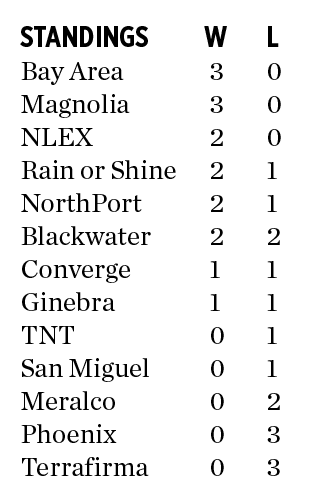
Gin Kings eye Philippine Cup playoffs slot vs injury-hit Terrafirma Dyip crew

BARANGAY Ginebra targets playoff berth. — PBA IMAGES

BARANGAY Ginebra, with interim coach Richard del Rosario still at the helm, seeks to take care of business against cellar-dwelling Terrafirma on Wednesday at the Smart Araneta Coliseum to ensure their place in the Philippine Basketball Association (PBA) Philippine Cup playoffs.

Mr. Del Rosario, who is in charge while decorated mentor Tim Cone is with the Miami Heat in the NBA Summer League, steered the Gin Kings a 105-89 beating of Converge in his first stand-in stint last Friday for their third straight win and 5-1 overall.

Though heavily-favored against an injury-hit Dyip crew that has lost all six assignments in the new season, Mr. Del Rosario and the crowd darlings have no intention of taking their opponent in the 6 p.m. encounter lightly especially with the chase for prime positions in the quarterfinals heating up.

Goal namin is makapasok muna sa playoffs then ‘pag nakapasok na, try namin makuha yung Top 2,” said Mr. Del Rosario, whose team runs second behind San Miguel Beer (6-1) and narrowly paces Blackwater (4-1) and TnT (7-2) in a tight team standings.

Mr. Cone will be out for two more Ginebra games after this and the plan is to put his squad in a favorable standing when he finally returns.

Meanwhile, Meralco (3-3) is also without its chief strategist, Norman Black, as it tries to arrest a two-game slide at 3 p.m. against struggling Rain or Shine (1-5).

Mr. Black left for the US after the Bolts’ 90-89 heartbreaker to the Bossing last Thursday to attend to his ailing mother and assistant coach Ronnie Magsanoc was tasked with the chores of reigniting Meralco’s quest.

“We really have to pick things up moving forward,” Mr. Black reiterated before going on indefinite leave.

That rings true as well for the Elasto Painters, who have dropped five straight since opening their campaign with a 79-77 win over Converge last June 5. — Olmin Leyba

Young women more vulnerable to triple-negative breast cancer

PIXABAY
PIXABAY

TRIPLE-NEGATIVE breast cancer (TNBC), an aggressive type of breast cancer, tends to be more common in women under the age of 40.  

This cancer type tests negative for three of the most common types of receptors found in breast cancer: estrogen receptors; progesterone receptors; and HER2 protein, a type of protein responsible for cancer-signaling pathways, said Dr. Josephine Contreras-Tolentino, a medical oncologist from the Philippine Society of Medical Oncology. 

Most vulnerable to TNBC, which has a faster growth rate and a higher risk of metastasis and recurrence, are women who are young and those breast cancer gene mutations, she added at a June 28 discussion organized by Hope From Within, an MSD Philippines–led cancer advocacy campaign. 

 A breast lump is the most common sign.  

Treatment options include chemotherapy (which can shrink tumors or make them less aggressive), lumpectomy (which is a type of surgery that removes breast lumps), and immunotherapy (which helps the immune system better combat cancer).  

Because cancer is complex, outcomes are improved when management is handled by healthcare professionals with different specializations.  

“I take the multidisciplinary approach,” Dr. Tolentino said.   

“In oncology, there is no one doctor who can know everything,” she added. “With the many advancements now, we need a team to create the best treatment plan for the patient.”  

A multidisciplinary team (MDT) approach is said to be “the gold standard” for diagnosis and treatment of cancer. Based on a 2020 study, MDT care was associated with a substantially lower relative risk of recurrence and death in patients with breast cancer.  

Jaymee T. Joaquin, a 43-year-old breast cancer survivor who has been living with the disease since 2017, highlighted the importance of communicating with one’s medical team.  

“You will have a long relationship with your medical team,” she said. “You have to trust them. It’s important to feel at ease with them.”  

While the management of cancer is financially draining, the National Integrated Cancer Control Act or Republic Act No. 11215 was meant to address the inequities in the provision of healthcare access for cancer patients. 

“If we can implement — to the letter — the intent of the law, then many families could benefit from it, and we could greatly contribute to the successful implementation of universal health care,” said Dr. Clarito U. Cairo, Jr., program manager for cancer of the Department of Health.  

The Cancer Control Assistance Program, which aims to be launched by the third quarter of this year, will provide assistance in terms of out-of-pocket expenses such as screening and diagnostics that are not covered by the Philippine Health Insurance Corp.  — Patricia B. Mirasol 

Joseph the Dreamer returns to the stage

GARY VALENCIANO as Jacob in Trumpets’ staging of Joseph the Dreamer.

AFTER two years, Trumpets, Inc., reopens the musical theater scene with a limited run of Joseph the Dreamer at the Maybank Performing Arts Theater from July 15 to 31. In March 2020, Trumpets ended its run of the same show a week before the country went into a total lockdown due to the coronavirus pandemic.

“We were the last musical to close and complete our show in 2020. And now in 2022, we will be one of the first musical theater shows to reopen Philippine musical theater. And we thought of no better way to do that by sharing the story of Joseph the Dreamer again,” said Miguel Jimenez, marketing head of Trumpets, in an online press conference on June 28.

Joseph the Dreamer is a show that speaks to the family with messages of love and forgiveness. It is a show about enduring struggles with messages of perseverance, having grit, overcoming all obstacles, no matter how long it takes. And it is a show about having an unwavering faith in God,” he said. 

Written by Freddie Santos, the musical is based on Cam Floria’s cantata Dreamer: What Really Happened to Joseph, which is based on the biblical story of Jacob’s 11th son, Joseph.

First staged in Cebu in 1989, the musical was restaged several times in the past 30 years. The actors who have played the titular roles include Audie Gemora, Gary Valenciano, Franco Laurel, and Alvin de la Peña.

In this year’s production, Sam Concepcion, who played Joseph in the staging in 2020, reprises his role.

“We all went through the pandemic together. We’ve all gone through some personal hardships in the past one or two years. And so, in many ways, having that run right before the lockdowns is, to me, like preparation,” Mr. Concepcion said.

“I felt like I saw the whole story, before it actually happened in my life… [I’m] coming into this run with a new energy, and it’s more of a celebration for me now,” he said. 

Mr. Concepcion will share the stage with Mr. Valenciano and original cast member Mr. Gemora, who alternate as Joseph’s father, Jacob. 

“It’s good because I’m using now a different range of my voice, which allows me to express myself in better ways and in fresh new ways, because if it’s always up there, like the way I often sing, there might not be a difference between that character and the person that you see on stage,” said Mr. Valenciano 

SIGN LANGUAGE
The show scheduled on July 17, 3 p.m. will include a live Filipino sign language interpreter for the deaf-mute community.

Neo Rivera, who alternates with Mr. Concepcion as Joseph, said that the idea came from a friend’s suggestion. The idea was then pitched to the show’s creative team.

“It’s a first and we’re happy that Trumpets said yes to this. So hopefully there are more shows that are deaf friendly and more inclusive,” Mr. Rivera said.

Other actors reprising their roles are Kayla Rivera as Asenath, Carlo Orosa as the Pharaoh, and Bituin Escalante and Carla Guevarra-Laforteza alternating in the role of Rachel (Joseph’s mother).

Joining the rest of the cast are: Alys Serdenia, Aldo Vencilao, RJ Dela Fuente, Matthew Barbers, Carlos Canlas, Paul Anthony Valdez, Jim Ferrer, Renz Bernardo, Edrei Tan, Dan Delgado, Diego Aranda, Eggo Velasco, Mateo Jimenez, Anton Posadas, Kiara Dario, Jom Logdat, Coleen Paz, Samantha Libao, Kathleen Francisco, Justine Narciso, and young actors, Elai Estrella, and Eli Luis.

The musical is directed by Paolo Valenciano and Nelsito Gomez, with musical direction by Myke Salomon, choreography by MJ Arda of the A-Team, and production design by Mio Infante.

“This is actually a show on hope. It’s something that a lot of people lost the last couple of years, so we’re really hoping to inspire a lot of these people. We know that a lot of our audience are broken because of what’s happened in the last two years,” Mr. Valenciano said. 

“It’s the live exchange between an audience and a story and that synergy [is what] you can’t get anywhere else. So, the audience does get something out of it. They invest something and they get something back and that’s what theater is all about. And we’re glad that it’s starting to pick up again and that’s what we promote more than anything,” co-director Nelsito Gomez said.

For tickets, contact Ticketworld at 8891-9999 or visit https://bit.ly/JTD2022. Follow @JTDTheMusical and @trumpetsinc on Facebook and Instagram for updates. — Michelle Anne P. Soliman