Home Blog Page 5841

PHL inflation still manageable — ECoP

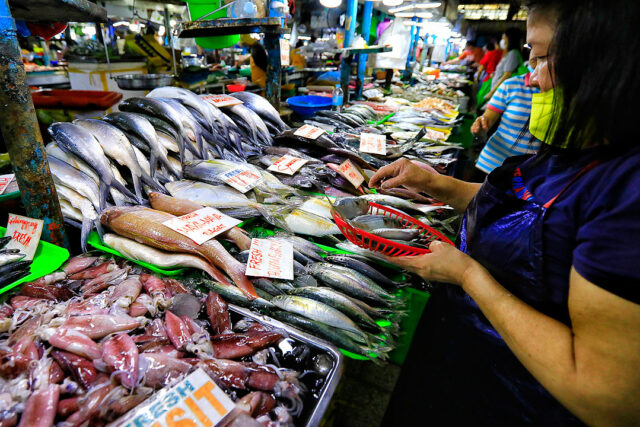
A wide variety of fish at the Marikina Public Market. — PHILIPPINE STAR/ WALTER BOLLOZOS

THE 6.9% inflation rate in September remains “manageable” and is expected to normalize, the Employers Confederation of the Philippines (ECoP) said on Thursday.

Sergio R. Ortiz-Luis, Jr., ECoP president, said on the BusinessWorld Live program on One News Channel that he considers 8% the threshold for manageable inflation.

The Philippine Statistics Authority reported on Wednesday a preliminary inflation estimate of 6.9% in September, against 6.3% in August, and 4.2% from a year earlier. Inflation in September was the highest since the 7.2% posted in February 2009, at the height of the global financial crisis.

“Some time ago, we commissioned studies regarding inflation… It turned out that even inflation as high as 8% is very manageable. The Bangko Sentral ng Pilipinas (BSP) has enough weapons in its arsenal to be able to temper this,” Mr. Ortiz-Luis said.

“So long as it (inflation) does not run away that much, I think it is very manageable. Eventually, after these temporary problems like Ukraine-Russia conflict (which) affects fuel and even imports of prime commodities… I think (inflation) will normalize eventually,” he added.

The BSP said in a statement on Wednesday that inflation remains within its forecast range of 6.6% to 7.4%.

Mr. Ortiz-Luis added that the dollar’s strength is affecting importers the most.

“Who are suffering from a weak peso? The importers, some of which are also exporters like the garments and electronics sector,” he added.

The peso closed at P58.653 against the dollar on Thursday, little changed from its P58.65 finish on Wednesday, according to the Bankers Association of the Philippines.

The peso’s recent low was recorded on Oct. 3, when it closed at P59 against the dollar. — Revin Mikhael D. Ochave

Geothermal, biomass, hydro classified as preferred dispatchers of power

Geothermal - Unified Leyte Power Plants

THE Department of Energy (DoE) said on Thursday that geothermal, biomass, and hydroelectric power plants have been designated preferred dispatchers of power on the wholesale electricity spot market (WESM).   

Energy Secretary Raphael P.M. Lotilla said in a statement that giving preferential dispatch will encourage investment in additional capacity for the three types of renewable plants “because of guaranteed dispatch to the grid at their full available capacities under merchant pricing, allowing recovery of investment.”   

WESM is the market for power not committed under long-term supply contracts, which command a premium relative to power procured under long-term deals.

The DoE defines priority dispatch as preferential treatment for qualified and registered RE plants.

The department classifies as “must dispatch” generating units that use intermittent renewable energy (RE) sources such as wind, solar, run-of-river hydro or ocean energy. This classification applies whether or not the plant participates in the feed-in tariff (FIT) system, which provides eligible RE plants fixed tariffs for 20 years. 

A previous DoE circular classified solar, wind, and run-of-river as must dispatch, with biomass enjoying FIT.

“Granting all generating units utilizing RE resources either ‘must dispatch’ or ‘priority dispatch’ (status) will aid in accelerating the development and utilization of indigenous RE resources and reduce the dependence on imported conventional energy sources,” Mr. Lotilla said.

Mr. Lotilla said greater reliance on domestic RE will minimize exposure to global fuel price fluctuations.

In the new circular, the DoE has also authorized WESM, the system operator, and distribution utilities to make necessary amendments to the WESM rules and manuals to ensure the efficient and effective scheduling of preferential dispatch generating units. — Ashley Erika O. Jose

World Bank urges Philippines to cement place in industrial, tech and health value chains

REUTERS

THE PHILIPPINES must establish its niche in the global value chains for manufacturing, technology, and health and life sciences, the World Bank said.

At the launch of its Global Value Chain report on Thursday, the World Bank said the Philippines has three areas it may elect to focus on: Industrials, Manufacturing, and Transport (IMT); Technology, Media, and Telecommunications (TMT); and Health and Life Sciences (HLS).

“The Philippines is coming from a position of advantage but the challenges are steep. It is a world leader of the voice sector in the business process outsourcing (BPO) industry, as well as known for (expertise in) electronics and components. It is globally regarded for its skilled nurses, seafarers, and a vibrant labor force,” Cecile Thioro Niang, a practice manager for East Asia and the Pacific for the World Bank, said at the event.

“These comparative advantages must be fully capitalized and utilized to advance the country’s GVC (global value chains) participation. These are challenging times with the rise of automation and artificial intelligence, the use of services in manufacturing, and the increasing regional concentration of goods production,” she added.

The World Bank said every percentage point increase in GVC participation raises gross domestic product per capita by more than one percent via increased exports and poverty reduction.

“One key area is really talent and skills. There is a need to really scale up the efforts and bridge the gap between what the system produces and what the industries need,” Ndiamé Diop, World Bank country director for Brunei, Malaysia, the Philippines and Thailand, said during the event.

In a separate note, Mr. Diop added that “countries that embrace GVCs are able to leverage their strengths in specific tasks and roles in manufacturing and services and export at scale, enabling them to sustain growth, create more jobs, and reduce poverty faster.”

Souleymane Coulibaly, the World Bank’s program leader for Brunei, Malaysia, the Philippines, and Thailand, said: “The Philippines’ post-COVID recovery could benefit from a configuration of its leading exports… IMT can build on the country’s strong position in electronics parts and components.”

“TMT can build on the country’s strong position in IT-BPO (Information Technology – BPO) and HLS can build on the country’s skilled healthcare professionals, pharma sector, and emerging telehealth sector,” he added.

Trade Secretary Alfredo E. Pascual said the Department of Trade and Industry (DTI) has adopted these recommendations, but notes that it has added another focus area, Modern Basic Needs and Resilient Economy.

“In terms of policies to make the Philippines an attractive destination for foreign direct investment (FDI), we are implementing recently passed laws that either ease foreign ownership restrictions or incentivize investment,” Mr. Pascual said, referencing the Corporate Recovery and Tax Incentives for Enterprises (CREATE) Act, as well as amendments to the Public Service Act, Foreign Investment Act, and Retail Trade Liberalization Act.

“Specifically, on CREATE, there are a lot of elements aligned with enhancing the GVC competency of the Philippines,” Juvy C. Danofrata, the head of the Fiscal Incentives Review Board Secretariat, said.

“We really encourage participation and partnership with the private sector in order to further make the Philippines more competitive,” she added. — Diego Gabriel C. Robles

Frozen pork inventory rises 15% at end of September

PHILSTAR FILE PHOTO

THE inventory of frozen pork in accredited storage facilities rose 15% year on year to 94,234.80 metric tons (MT) at the end of September, according to the National Meat Inspection Service.

Imported pork accounted for 91,645.46 MT of the total, it said.

Region III accounted for 27,082.81 MT of the pork in cold storage, followed by Region IV-A with 26,463.68 MT and the National Capital Region (NCR) 25,732.74 MT.

The inventory of dressed chicken in cold storage declined 13.4% year on year to 48,626.49 MT.

Of the total inventory, 29,246.72 MT was imported.

Region IV-A had the largest stock of frozen chicken at 17,968.83 MT. This was followed by Region III with 8,307.23 MT and the NCR with 7,851.72 MT.

In the eight months to August, meat and meat product imports totaled 851.8 million kilograms (kg), according to the Bureau of Animal Industry.

Of this total, pork imports arriving during the period amounted to 464.8 million kg, with chicken imports at 244.8 million kg. — Luisa Maria Jacinta C. Jocson

Marcos says agri ambitions go beyond self-sufficiency

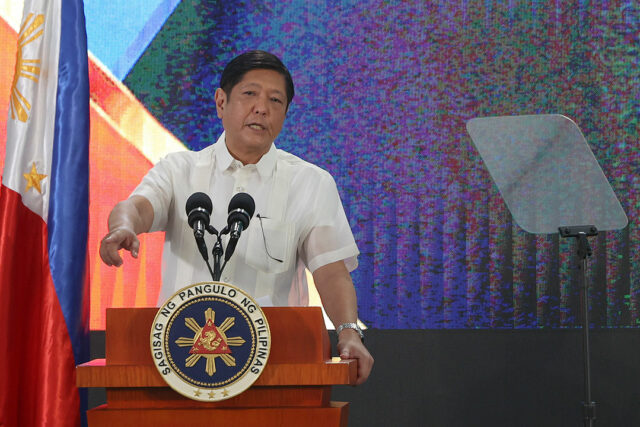
PRESIDENT FERDINAND R. MARCOS, JR. — PHILIPPINE STAR/KRIZ JOHN ROSALES

PRESIDENT Ferdinand R. Marcos, Jr. said on Thursday that his goals for agriculture go beyond achieving self-sufficiency, and extend to making the Philippines a global leader in food production.

“The work to improve our agricultural sector and improve the plight of our farmers and fisherfolk has only just begun. We need to continue to open more opportunities to improve their wellbeing,” he said at a trade show.

Mr. Marcos said the Philippines is currently only “playing catch-up” in strengthening its agriculture sector, whose contribution to economic growth has been “diminished.”

“That is why it is important that we accelerate all our efforts,” Mr. Marcos said.

“With our energies and resources combined, I am confident that we will not only achieve our goal of feeding the Filipino people but also achieve our dream of making the Philippines a leading agricultural resource hub in the region and the world.”

Agricultural output declined 0.3% by value in the first quarter led by fisheries, livestock and crops.

Mr. Marcos said the government has expanded irrigation projects, created food logistics hubs and agri-trading centers, and aided cooperatives and associations in procuring refrigerated vans, freezers, chillers, and other equipment.

He added that the government has also provided various forms of aid, disbursing more than P590 million in financial assistance to rice farmers and P320 million for the Fuel Discount Program.

Mr. Marcos has decided to serve as his own Secretary of Agriculture with a promise to boost food production and limit imports where possible.

He faces challenges like inflation and the rising cost of farm inputs as a result of the war between Russia and Ukraine, and could be under pressure to take a free-trade approach despite signaling protectionist policies. — Kyle Aristophere T. Atienza

Q1 building permit approval growth slows on rising costs

APPROVED building permit applications rose 1.8% year on year in the first quarter, slowing from the 9.2% posted in the fourth quarter and the 4.7% year-earlier rate.

Preliminary data from the Philippine Statistics Authority indicated that first-quarter permit approvals totaled 37,270, with the building projects covered by the permits valued at P86.78 billion with a floor area of 7.720 million square meters (sq.m.).

The value of approved projects fell 0.9% year on year, while floor area rose 6.5%.

“The rising cost of construction materials brought about by rising inflation, interest rates, currency depreciation and the persistent supply chain constraints contributed to the slower growth despite the economy being open,” Asian Institute of Management economist John Paolo R. Rivera said in a text message. 

The Russia-Ukraine war began in the first quarter of the year, which disrupted the global supply chain and caused oil prices to surge. This trickled down to commodity prices of goods and services to rise.

Metro Manila and surrounding provinces were placed under Alert Level 3 in January, gradually easing to a more permissive Alert Level 1 in March.

Retail price growth of construction materials accelerated to 3.7% in the first quarter from 1.2% a year earlier. Growth in wholesale prices for the period also accelerated to 5.7% from 1.8% a year earlier.

Permits issued for residential projects, which accounted for 71.2% of the total, rose 4% to 26,546. These projects were valued at P45.01 billion with a floor area of 4.132 million sq.m.

Permits for single detached homes, which accounted for 85.9% of all residential construction, rose 0.6% to 22,790, with growth slowing from 3.1% in the fourth quarter and the 9.3% recorded a year earlier.

Non-residential project permits totaled 6,145 during the period, up 6.0%.

Commercial construction accounted for 4,324 approved permits (up 10.2%); institutional, 1,007 (up 1.7%); and other non-residential projects, 175 (up 2.9%). 

Industrial building permits declined 9.1% to 450 while agriculture project permits fell 14.5% to 189. Permits for additions to existing structures climbed 28.1% to 1,131 in the first quarter, while alteration and repair permits dropped 21.7% to 3,448.

The Calabarzon region — which is composed of Cavite, Laguna, Batangas, Rizal, and Quezon — accounted for 26.1% of all approved building permits in the first quarter with a tally of 9,725, followed by Central Luzon with 13.4% (5,002 permits), and Ilocos region with 9.9% (3,699).

By value, Calabarzon accounted for P20.22 billion worth of construction products in the first three months. This was followed by the National Capital Region with P14.79 billion and Central Luzon with P10.26 billion.

“Individuals and companies may seem to delay construction until the economic headwinds taper hopefully by 2023. Should the current trend in economic fundamentals continue, a slowdown is expected until the end of the year” Mr. Rivera said. — Ana Olivia A. Tirona

Budget realignments dismissed as insignificant

PHILSTAR FILE PHOTO

THE adjustments to the budget bill following its initial passage by the House of Representatives are minor and failed to touch discretionary items like confidential or intelligence funds, analysts said.

Terry L. Ridon, a public investment analyst, said via chat that the amount realigned accounts for little more than 1% of the total budget.

“The budget augmentation for public and social services could have been more if Congress reduced the funding for discretionary items,” he added.

The People’s Budget Coalition considers the adjustments “incremental,” according to Zyza Nadine M. Suzara, executive director of coalition member I-Lead. She added via chat that “there is still a need to revisit the budget priorities.”

She noted that the programs that received “relatively significant boosts in the (General Appropriations Bill) that were passed by the House of Representatives include items where soft projects of legislators are lodged… There can still be changes in bicameral conference committee.”

President Ferdinand R. Marcos, Jr. asked for a P4.5-billion budget for confidential and intelligence funds.

Hansley A. Juliano, a former political science professor, said via chat that the realignments could be a means of saving face after negative developments like the failure to confirm key administration officials or the backlash against Mr. Marcos arising from his decision to attend the Singapore Grand Prix.

Analysts noted that budget items remain subject to Presidential veto.

On Oct. 5, a House of Representatives panel working on amendments after the GAB was approved authorized an additional P77.5 billion for the 2023 budget, with augmented allocations for health, education, transportation, and other social services. In the form approved by the House plenary, the GAB outlined a spending plan of P5.268 trillion.

The additional allocations were realigned from programs that can be implemented in later years. — Kyanna Angela Bulan

Electronics, food exports seen little affected by slowing global trade

REUTERS

THE Department of Trade and Industry (DTI) said resilient electronics and food exports will be the Philippines’ best bets for weathering the 2023 slowdown in trade forecast by the World Trade Organization (WTO).

Trade Undersecretary Ceferino S. Rodolfo said on the sidelines of a World Bank event in Makati City on Thursday that electronics and food exports are not expected to be heavily affected by global headwinds.

“We are always affected by global developments, especially when it comes to our export sector. But we are banking on the resilience that they have exhibited during this pandemic and post-pandemic,” Mr. Rodolfo said.

“On the ground, we can see that our exporters, particularly those in the electronics sector or food … are critical, (and) not too sensitive when it comes to global downturns. Despite that projection, we will be working with the private sector so that we could sustain the recovery of the export sector,” he added.

On Oct. 5, the WTO said that global merchandise trade volume is projected to grow slower in 2023.

“WTO economists now predict global merchandise trade volumes to grow by 3.5% in 2022 — slightly better than the 3.0% forecast in April. For 2023, however, they foresee a 1.0% increase — down sharply from the previous estimate of 3.4%,” the WTO said in a statement.

The WTO said import demand is expected to soften due to various economic challenges such as high energy prices arising from the Russia-Ukraine war, monetary policy tightening in the US, restrictive coronavirus disease 2019 (COVID-19) policy in China, and the growing cost of fuel, food, and fertilizer.

“Policymakers are confronted with unenviable choices as they try to find an optimal balance among tackling inflation, maintaining full employment, and advancing important policy goals such as transitioning to clean energy…,” WTO Director-General Ngozi Okonjo-Iweala said.

“While trade restrictions may be a tempting response to the supply vulnerabilities that have been exposed by the shocks of the past two years, a retrenchment of global supply chains would only deepen inflationary pressures, leading to slower economic growth and reduced living standards over time. What we need is a deeper, more diversified and less concentrated base for producing goods and services,” she added.

The Philippines posted a $43.23-billion trade deficit in 2021, wider than the $24.597 billion reported in 2020, the Philippine Statistics Authority (PSA) said in April.

On the other hand, total trade, or the sum of exports and imports, rose 24.2% to $192.53 billion in 2021.

Mr. Rodolfo said the Philippines hopes to improve its ranking in Southeast Asia in terms of net foreign direct investment (FDI) inflows, noting that the country’s current rank is fourth.

“We are still lagging behind our neighbors. Actually, the Bangko Sentral ng Pilipinas (BSP) just revised its net FDI inflows for the Philippines for 2021. Previously reported was $10.5 billion but they just revised it to $12.5 billion,” Mr. Rodolfo said.

“First is Singapore at about $80 billion. Indonesia is about $20 billion. Vietnam is about $15.7 billion. Then us (Philippines) at $12.5 billion. So, the target is maybe we can surpass Vietnam in the first half of this administration, then surpass Indonesia in the latter part of this administration,” he added. — Revin Mikhael D. Ochave 

50 power distributors seen non-compliant with order to itemize generation charge

BW FILE PHOTO

THE Energy Regulatory Commission (ERC) said on Thursday that 50 distribution utilities (DUs) are now under evaluation for alleged non-compliance with an order to provide their clients a breakdown of their generation charge.

In a statement, the ERC said that only 65% or 91 out of the total 141 DUs itemized their generation charges.

ERC Resolution No. 05 series of 2007 directed DUs to list the components of their generation charges.

The ERC said that this resolution requires “all DUs to post on their respective websites the breakdown of their generation charges, including, but not limited to, their sources.”

The ERC did not identify the DUs nor discuss possible penalties.

The ERC said section 25 of the Electric Power Industry Reform Act of 2001 (EPIRA) obliges DUs to supply electricity on a least-cost basis.

The generation charge is the direct cost of obtaining energy from power generators. It accounts for over half of a typical consumer’s power bill.

“By posting the detailed breakdown of the generation cost, the consumers are well informed of the different sources of power that the DU had contracted including the cost per supply source,” the ERC said.

The ERC noted that the order compels DUs to be transparent and accountable in procuring their power supply. — Ashley Erika O. Jose

An alternative approach to agriculture

TUAN ANH TRAN-UNSPLASH

IN ITS MAY 21, 2022 cover story on India, the Economist noted that the Indian government used a direct, real-time, digital welfare system to pay $200 billion over three years to about 950 million people. How did this come about?

In January 2013, the government of India introduced the Direct Benefit Transfer or DBT scheme to streamline the transfer of government-provided subsidies from various Indian welfare schemes directly into the beneficiaries’ bank accounts. This has been one of the most ambitious financial inclusion initiatives ever seen anywhere in the world, bringing over 330 million people into the formal financial sector.

By 2020, 318 subsidy schemes from 53 ministries have been directly transferred to the farmer beneficiaries. And the program is so successful that India is now a wheat and rice exporter.

Here in the Philippines, we also provide subsidies to the farmers.

In a Nov. 9, 2012 press release, then Senator Franklin M. Drilon allayed fears of tobacco farmers and workers in Northern Luzon about the supposed drawback of the sin tax reform bill on their livelihood.

“Our farmers can be assured of a variety of assistance from the government once this sin tax bill is passed. We will double the safety net being provided under the law to help them augment their income and to support alternative livelihoods for the farmers,” stressed Drilon, the acting chair of the Senate Ways and Means committee. Under Republic Act 7171, tobacco farmers are entitled to a 15% share of the incremental tobacco revenue collected from the excise tax on tobacco products.

In a May 22, 2022 press release, the Department of Finance noted that in the first three years of its implementation, the law liberalizing rice trading has earned a total of P46.6 billion in rice import duties, which directly benefited palay (unhusked rice) farmers through a P10-billion annual fund created to finance programs that will sharpen their global competitiveness by way of farm mechanization, high-quality seeds, access to credit, and training.

Under Republic Act (RA) No. 11203 or the Rice Tariffication Law (RTL), tariffs collected from rice imports go to the Rice Competitiveness Enhancement Fund (RCEF). Collections in excess of the P10-billion fund go to the Rice Farmer Financial Assistance or RFFA. The law took effect on March 5, 2019.

The big difference between India and the Philippines is that the subsidies in the Philippines are not in cash deposited directly to the bank accounts of farmer beneficiaries. Instead, they are coursed through an intermediary, the Department of Agriculture. The Department of Agriculture was mandated to procure the agricultural inputs and, more importantly, advise the farmers on their proper use. The expected result in the case of the rice farmers is that with the added advantage of a 35% tariff on imported rice, they could compete against the rice imports.

Alas, such has not been the case. Our agricultural sector continues to be a drag on our economy and, judging from the complaints of the farmers, the Department of Agriculture has not made them competitive in rice as well as in numerous other agricultural commodities.

We argue that we should follow the Indian model of converting all agricultural subsidies into cash for direct deposit to the bank account of the farmer beneficiaries.

In the interest of efficiency, modern technology now allows us to bypass the middleman. We are no longer reduced to the unpalatable alternative of continually shoveling good money to the middle man in the forlorn hope that they will exceed our modest expectations.

But there are more compelling policy, nay, moral, issues that should compel us to adopt the Indian model. Under the present system, the government in effect tells the farmer, “I will help you only on condition that you continue to be a farmer no matter your talent or inclination. Hence, I give you agricultural inputs and this middleman and not cash.”

Far better for the government to tell the farmer, “I am depositing this cash into your bank account. As an adult you may use the money to improve your farm or explore another livelihood or send your children to school. That is your choice.”

Critics will argue that many farmers will now abandon farming. I agree. Surveys indicate that many farmers do not wish their children to follow in their footsteps and become farmers. For me this is not an unwelcome outcome.

In 1900, 40% of the US population were farmers. By 2016 only 1% were farmers. And yet this 1% of the population produces more than enough food to feed the more than 300 million Americans and a good portion of the world, the Philippines included.

Apparently unlike the Philippine Department of Agriculture, the US Department of Agriculture did not define its mission as sustaining the teeming number of farmers to subsist in a marginal livelihood, but rather to nurture a group of progressive and entrepreneurial farmers who have astounded the world with their productivity.


Dr. Victor S. Limlingan is the chairman of the Cristina Research Foundation, Inc., a public policy advisory firm, and the Regina Capital Development Corp. He is presently a Regent of the Board of Regents of the Pamantasan ng Lunsod ng Pasig. Among the books he has written are The Overseas Chinese in ASEAN: Business Strategies and Management Practices and The Visible Hand and the Developing Economy. As public policy adviser to the legislative branch, he advised on legislation such as Kalakalan 20, Overseas Workers Development Fund, the charter of the Banko Sentral ng Pilipinas and the EPIRA Law.

CHR should prove HRW wrong

CHRISTIAN LUE-UNSPLASH

“President Ferdinand Marcos, Jr.,” said Human Rights Watch (HRW) Deputy Asia Director Phil Robertson in a Sept. 28 statement, “just slapped victims of human rights abuses in the face with his appointment of a loyalist lawyer with no discernible experience in human rights work as new CHR chair.”

Robertson was referring to Richard Palpal-latoc, whose appointment as Chair of the Commission on Human Rights (CHR), although signed in early September, was announced only on the 27th of the month. His description of Palpal-latoc as a “loyalist” is based on his being Marcos Jr.’s Deputy Executive Secretary when he was appointed to the CHR as one of his two choices to fill the vacancies in that Constitutional body. Like the new CHR Chair, the other Marcos appointee, a Beda Angeles Epres, has no background in human rights work either.

In his speech at the 17th United Nations General Assembly on Sept. 20 (Sept. 21 in the Philippines — and the 50th anniversary of his father’s 1972 declaration of martial law) in New York City, Marcos Jr. agreed with the UN on the need for all countries to respect human rights, and praised the UN Joint Program on Human Rights as “an example of a constructive approach” to ending racism and prejudice.

But because of Marcos Jr.’s appointment of Palpal-latoc, Robertson dismissed those seeming indicators of respect for human rights as mere rhetoric. He noted that no human rights group or defender was consulted in the selection of the new CHR Chair. The Palpal-latoc appointment, he continued, therefore raises the question of whether Marcos Jr. “is embarking on a process to gut the CHR as an independent and impartial body empowered to investigate rights abuses without fear or favor of those in power.” Robertson concluded by saying that “Chairman Palpal-latoc will have a steep hill to climb to demonstrate that he deserves to sit in that chair, and that he knows up from down about the Philippines’ international commitments on human rights.”

The number and breadth of those commitments are considerable. They go back to the late 1940s when, as one of the first members of the United Nations, the Philippines was a signatory to the Universal Declaration of Human Rights. Since then, the country has signed on to various covenants, conventions, treaties, and protocols for the defense and advancement of civil, social, political, cultural, and economic rights, as well as against gender, ethnic, and racial discrimination, slavery, unlawful imprisonment, cruel and unusual punishment, torture, and human trafficking, among many others.

But neither those international commitments nor the Philippines’ own laws, such as the presumption of innocence and the right to a fair trial, prevented the gross violations of human rights during the Marcos Sr. dictatorship and even the years prior to it. Among those violations were arbitrary arrest and detention, torture, cruel and degrading treatment, summary executions and extrajudicial killings, and enforced disappearances.

Together with the Bill of Rights and those provisions in the 1987 Constitution limiting the power of the President to declare and prolong martial rule, the creation of the Commission on Human Rights was among the means the drafters of that document saw as necessary in preventing the repetition of the gross human rights violations committed by the military and police thugs that kept the Marcos Sr. dictatorship in power from 1972 to 1986. (Marcos’ first term was in 1965, and his second in 1969. He was twice elected democratically, but declared martial law in 1972, and was thus President for a total of 21 years.)

Despite the Bill of Rights and the CHR, human rights abuses continued during the Corazon Aquino, Fidel Ramos, and Joseph Estrada regimes, with the most violations occurring during Gloria Macapagal-Arroyo’s nine-year occupation of Malacañang. Her term culminated in the record-breaking Nov. 23, 2009 Maguindanao Massacre which claimed the lives of 58 men and women, among them 32 journalists and media workers.

The number of abuses, including the killing of journalists, declined somewhat during the Benigno Aquino III presidency. But it surged to near-unprecedented levels during the Duterte regime, due mostly to, but not solely because of, its bloody “war on drugs.” Almost from Day One of his administration, President Rodrigo Duterte had also demonstrated in words and deeds his contempt for human rights, which he claimed are merely convenient shields for criminal behavior. At one point he described himself as “for human lives” rather than for human rights, as if extrajudicial killings were not violations of the fundamental right to life.

In 2017 Mr. Duterte declared in his State of the Nation Address (SONA) that the CHR should be abolished — which of course would have required a Constitutional amendment.

Nothing came of regime attempts to cripple the CHR. But to Mr. Duterte, it might as well have ceased to exist. Ignoring it completely, on a number of occasions he ordered the police and military to kill his and his regime’s perceived enemies, while promising to protect them from prosecution, in effect sanctifying the culture of impunity that has enabled even the worst wrong-doers to escape punishment.

During Mr. Duterte’s six years in office, neither Amnesty International (AI), Human Rights Watch, the US State Department Report on Human Rights Practices, nor Philippine human rights groups ever ran out of accounts of extrajudicial killings, arbitrary arrests, massacres, physical assaults, torture, and other assaults against regime critics, lawyers, activists, journalists, and even human rights defenders despite the Constitution and the many international conventions, covenants, protocols, and treaties protecting them to which the Philippines is a signatory.

In its 2021 report on the Philippines, Amnesty International echoed the findings of other monitoring groups that human rights defenders, government critics, political activists, and even some politicians have been targeted for assassinations, harassment, and arbitrary arrest and detention. Indigenous Peoples (IPs) were also attacked, with some of them killed by government security forces and other assailants. AI correctly noted that lack of accountability — the exemption from punishment of wrongdoers, or the impunity so loudly sanctioned by the Duterte regime — encourages killings and other rights violations.

It is to the reversal, or just the mitigation of this dire human rights situation that the CHR can and should contribute. Without a background in human rights work, Chairman Palpal-latoc, so as to prove that he deserves the post for which he applied and has been appointed, has to very quickly acquaint himself with the abysmal state of human rights observance in the Philippines.

Even more urgent is for the CHR during his seven-year watch to more rigorously monitor and investigate the gross abuses that the six years of the Duterte regime have encouraged — and for him to urge government, particularly President Ferdinand Marcos, Jr., to hold to account those responsible.

To paraphrase HRW’s Phil Robertson’s remarks, his doing so would help dispel fears that he has been charged with reducing the CHR into just another instrument in propagandizing the myth that human rights abuses are no more than the imaginings of enemies of the State and of criminal minds — as they supposedly were during the Marcos, Sr. dictatorship and as former President Rodrigo Duterte claimed them to be.

It is Chairman Palpal-latoc and his fellow commissioners’ burden to prove Robertson wrong. They would otherwise validate the latter’s view that his appointment is “a slap in the face” of the many victims and survivors of human rights violations in these isles of woe.


Luis V. Teodoro is on Facebook and Twitter (@luisteodoro).

www.luisteodoro.com

Greatness of spirit

LARM RMAH-UNSPLASH

“To nurture a better tomorrow, we need to strengthen the child protection in our country.” — Dr. Bernadette J. Madrid, Ramon Magsaysay Laureate 2022.

The 14th annual Ako Para Sa Bata (APSB) conference opened at the Magsaysay Center with an inspiring lecture by Dr. Madrid, the champion for child protection.

Present onstage were panelists and speakers: Emily Abrera, Trustee of the Ramon Magsaysay Awards Foundation; Mariella S. Castillo, MD, Consuelo Foundation Managing Director; Dr. Shantha Sinha, 2003 Ramon Magsaysay Awardee, India (who participated via Zoom); Patricia Lim Ah Ken, Chief of Child Protection, UNICEF Philippines; Stella G. Manalo, MD, Conference Chair, APSB; Carmencita D. Padilla, MD, Chancellor UP Manila. And Integrated Bar of the Philippines representatives who signed a memorandum of agreement (MOA) with the Child Protection Network (CPN).

“[There are] certain formal and informal structures, functions and capacities that have been assembled to prevent and respond to violence, abuse, neglect, and exploitation of children. A child protection system is to be comprised of the following components:

“Human resources, finance, laws and policies, governance, monitoring and data collection as well as protection and response services and care management.

“It also includes different actors — children, families, those working at sub-national or national level and those working internationally. Most important are the relationships and interactions between and among these components and these actors within the system. It is the outcomes of these interactions that comprise the system.” (UNICEF 2021)

The Philippine National Baseline Study on Violence against Children (CWC, 2016) reveals that 80% of Filipino children have experienced violence. Physical, emotional abuse and bullying affect three out of five children. Sexual violence: one out of five children.

“Beyond the numbers, this is about the needless suffering of our children. A moral disgrace and the consequences are borne by this generation and the next,” Dr. Madrid remarked.

“I will share with you the lessons we have learned the past 25 years — my personal experiences as a pediatrician and Head of the Child Protection Unit at the Philippine General Hospital (CPU-PGH) of the University of the Philippines Manila and as Executive Director of the Child Protection Network Foundation, that led to the strengthening of the child protection system.

“Child protection does not really have a concrete identity for government such as health, education, justice….

“In a developing country like the Philippines there will always be competing priorities because there are not enough resources even for basic needs.

“We identified the Department of Health as the best fit because it already has the personnel for a multidisciplinary team of doctors, social workers and mental health providers. Health is the gateway for so many victims of violence. It is a natural entry point for receiving care, especially for those who are ready to disclose abuse. It has the capacity for both intervention and prevention work and data collection…”

The Department of Health Order in the establishment of Women and Children Protection Units (WCPUs) in all government hospitals is a major achievement.

Dr. Madrid enumerated additional challenges:

1. “Convincing the health sector, including the Department of Health, that violence against women and children is a public health concern.

2. “Making sure that the WCPUs is an adaptive general response mechanism to violence against women and children.

3. “Expansion of the team to include legal service”

At the conference, the memorandum of agreement with the IBP was signed by CPN’s Executive Director Dr. Bernadette J. Madrid, Katrina Legarda, National Director of the National Network of WCPUs, and IBP’s Marienne M. Ibadlit, National Director on Gender and Development, and Myline Urmenita-Palisoc, Deputy Director on National Center for Legal Aid.

4. “Mental Health Gap. Our patients need a spectrum of mental health services from acute to long term. More abused adolescents are at high risk for suicide (during the pandemic.) Telepsychiatry is a strategy.”

She mentioned the development services for all children and adults regardless of gender. What about the boys? LGBTQI +?

There is a need to strengthen the children and women protection workforce, from social service to health, to legal, to education. Training programs now include doctors, social workers, police, the judiciary and the barangay.

“Multidisciplinary training is important because we all must learn how to work together.”

Trainers should have the expertise and specialized training based on Clinical Practice guidelines and peer-review that is being institutionalized.

“Convincing the Education sector that in order to learn, children need to be protected from violence. Our experience shows that so many children drop out of school or do poorly in school because of violence that they have experienced at home or in school.”

Based on research, globally, the potential loss in human capital wealth due to violence in school is $11 trillion for 2019.

There are changing norms and practices.

“We found that the messenger is as important as the message,” she emphasized.

There is a carefully designed competency and skills-based training to sensitize our family judges and personnel handling child witnesses and victims of abuse.

Violence against children can be prevented. INSPIRE (WHO, 2016) are evidence-based prevention and response interventions that are scientifically evaluated. “Masayang Pamilya” is a controlled study Filipino adaptation of the Parenting for Lifelong Health Program. It showed reduced child maltreatment, emotional abuse and neglect in families.

Dr. Madrid shared her personal thoughts.

“It has been 25 years. System strengthening takes a long time…. We are in the frontlines. Witnessing what is happening with our children… and what they experience when they go through the system. We feel their pain. That is what guides us in all that we do.

“It is also about relationships… We would never have made a difference without all the partnerships. The support that was unstintingly given by people who do not even want to be known. We are members of a community that protects all children and hold each other’s hands when it is needed. I take this opportunity to thank you.

“We all know that we serve a purpose greater than ourselves.”

It took a foreigner who came here when he was a young man to start all of this. His name is David Bradley. After 25 years, he is still with us. He leads the CPN Foundation board that works quietly and effectively.

“Greatness of spirit comes in many forms. I consider myself blessed to experience it every day. Our children deserve nothing less.”

Warm congratulations, Dr. Bernadette J. Madrid and CPN.

Happy 25th Anniversary to CPU-PGH!

The “Ako Para Sa Bata” conference meetings, with the theme “The Beginning, the Building and the Institution in the Philippines,” are being held every Thursday until Nov. 24 at 10-11:30 a.m. via Zoom and Face Book Live. Registration is free. Register online at bit.ly/akoparasabata2022. Follow @AkoParaSaBataConference on FB for updates and announcements.


Maria Victoria Rufino is an artist, writer and businesswoman. She is president and executive producer of Maverick Productions.

mavrufino@gmail.com

ADVERTISEMENT
ADVERTISEMENT