Home Blog Page 580

P60-B PhilHealth funds to be restored as ‘savings’ in 2026 budget — Recto

PNA/JOAN BONDOC

By Aubrey Rose A. Inosante and Chloe Mari A. Hufana, Reporters

THE GOVERNMENT will restore the P60 billion in excess funds of the Philippine Health Insurance Corp. (PhilHealth) as “savings” in the proposed 2026 national budget, Finance Secretary Ralph G. Recto said.

Mr. Recto, who defended the National Government’s decision to reallocate the funds before the Supreme Court (SC), is now under orders from President Ferdinand R. Marcos, Jr. to restore the funds to PhilHealth.

“(Savings) will be included in the NEP26 (National Expenditure Program for 2026). We are also looking for legal authority to do it this year,” he told BusinessWorld in a Viber message over the weekend.

The Department of Finance (DoF) said it issued a “solicited opinion” supporting the restoration of the funds, citing PhilHealth’s improved revenue position and the availability of savings from other agencies after the termination of flood control projects.

The DoF’s response came after Mr. Marcos on Saturday ordered the return of the P60 billion to PhilHealth, which would allow the agency to expand its benefit packages and strengthen the Zero Balance Billing program.

The President acknowledged public concerns that the transfer of excess funds could affect PhilHealth’s programs and services, saying such worries are understandable given that healthcare involves life-and-death situations.

“No matter how much we explained, no matter how much we showed that PhilHealth has been expanding the services it covers, people still had fears that services might be reduced,” Mr. Marcos said.

The President’s move may render the SC’s ruling on the issue moot and academic.

The SC has yet to issue a ruling on three petitions questioning the legality of the original P60-billion transfer from PhilHealth to the Bureau of the Treasury in 2024.

Asked if the agency will wait for the SC decision, Mr. Recto said: “We’re following PBBM’s (President Marcos) directive.”

‘FACE-SAVING MEASURE’
Meanwhile, analysts said Mr. Marcos’ decision to return P60 billion to PhilHealth is a “face-saving” measure and is aimed at easing public discontent amid ongoing corruption investigation in public works projects.

“I can only assume that this is intended to further ease the growing tension and disillusionment among the people caused by the flood control mess,” said Arjan P. Aguirre, a political analyst at the Ateneo de Manila University, via Facebook Messenger.

“In the coming days, it may be used to create the impression that Marcos, Jr. cares about the people’s welfare — particularly health concerns — and that he is also fulfilling his SONA (State of the Nation Address) promise. This is all about optics and projecting a positive image of the President,” he added.

On Sunday, thousands of Filipinos took to the streets to protest massive corruption in government.

Former Health adviser Anthony C. Leachon called the move a “face-saving measure” amid growing public outrage over corruption.

“It must not preempt the Supreme Court’s decision on the matter. Without a ruling, the petition risks being declared moot — setting a dangerous precedent for future abuse,” he said in a statement on Sept. 21.

“If the Court affirms that the P60-billion transfer was unconstitutional, then how much more indefensible is the zero subsidy for PhilHealth in the 2025 budget? That is not just a fiscal error — it is a moral failure.”

Mr. Leachon also questioned the DoF’s role in the original transfer, saying the agency is now attempting to “wash its hands” of responsibility.

He also noted that PhilHealth was not the only institution forced to surrender reserves, and the Philippine Deposit Insurance Corp. remitted over P107 billion justified as “unrestricted funds” for infrastructure and social programs.

“If the DoF is truly sincere, it should return those funds too,” Mr. Leachon added.

Former Finance Undersecretary Cielo D. Magno said a SC ruling is still necessary to “prevent the illegal diversion of PhilHealth funds from happening again.”

“Let’s keep raising our voices and staying vigilant,” she said in a Facebook post on Sept. 20.

The Federation of Free Workers (FFW) and the Nagkaisa Labor Coalition welcomed Mr. Marcos’ order to return P60 billion to the state health insurer but stressed that the case before the High Court is still alive.

FFW and Nagkaisa Labor Coalition are intervenors in G.R. No. 274778, with petitioners including Ms. Magno, former Senator Aquilino L. Pimentel III, and the Philippine Medical Association, among others.

“This is no small amount, and returning it to PhilHealth is already a moral and political victory for workers and the people. On the contrary, it strengthens our case,” FFW President and Nagkaisa Chair Jose Sonny G. Matula said via Viber.

He urged the High Court to declare the transfer unconstitutional, warning that without such a ruling the same diversion of funds could recur.

He also called on the government to source the refund from budgetary savings — particularly from delayed or suspended public works projects — rather than through new taxes or borrowings that would burden workers.

SC Spokesperson Camille Sue Mae L. Ting did not immediately reply to a Viber chat seeking comment.

Globe harnesses AI to keep strategic edge — Cruz

Globe President and Chief Executive Officer Carl Raymond R. Cruz

GLOBE Telecom, Inc. is betting on artificial intelligence (AI) to streamline operations and drive growth as it aims to sharpen its edge in a highly competitive industry, its top executive said.

Globe President and Chief Executive Officer Carl Raymond R. Cruz said the telco giant is now using AI in all facets of the organization.

“We are in a very fast-paced industry telecommunications and we need to stay ahead or two, ahead of everyone else. And we do feel that this technology can keep us very, very competitive moving forward,” he told BusinessWorld Editor-in-Chief Cathy Rose A. Garcia as part of BusinessWorld One-on-One’s online interview series.

Mr. Cruz is optimistic that the company’s adoption of AI will serve as a catalyst for growth.

“The vision is to be the best in terms of where the customers are. Whatever point they engage with the network, we will use whatever technology is required for us to continuously elevate the customer experience that we provide on the network,” he said. 

Emerging technologies like AI are reshaping strategies and how businesses operate, Mr. Cruz said, noting that the company is looking to unlock its potential from automation, hyper-personalization of its offerings and services, network enhancement and even in the prediction of threats. 

“At Globe, we have been probably one of the leaders in deployment because instead of looking at AI as a project, we have actually deployed AI and we have given access to each and every of our employees. We are not limiting access to the technology, simply because we actually want the larger organization to be comfortable in using the new technology,” he said. 

Globe established an AI Development and Enablement Group (AIDE) in June 2024 to lead its AI initiatives. It appointed cybersecurity expert Anton Bonifacio as its first chief AI officer.

The company is using the technology for its business operations particularly in its service offerings by deploying AI to study customer behavior and tailor-fit services to match their needs, as well as identifying areas where it should enhance network coverage.

“We are using the technology for network planning, determining the best possible locations where we will deploy new towers or new sites and allowing us to predict where potential points of failure will be. That is to ensure that the experience of our subscribers on the network remains to be very consistent and also best in class,” Mr. Cruz said.

“We will use whatever technology is required for us to continuously elevate the customer experience… Our heritage is all about being customer centric. And we will use a combination of both, of course, technology and human-centric customer service approach to make sure that that journey continues to move forward,” he added.

Globe has also democratized AI use across its workforce, encouraging experimentation and innovation.

Mr. Cruz emphasized that governance and safeguards around the use of technology and cybersecurity are priorities for Globe.

However, he noted there should be human-centric approach when it comes to using AI.

Upskilling is also a very important piece of the puzzle in advancing and ensuring the ethical use of AI, Mr. Cruz said.

“A lot of the tasks, especially the repetitive ones will actually benefit from technology and in that way, we are freeing up valuable time for our employees to do other value-adding roles or value-adding tasks and processes,” he said.

Asked if he has advice for other Philippine companies that are embarking on their AI journey, Mr. Cruz said they should start now.

“If you stand still in today’s day and age, you’re actually moving backwards. There’s really a high chance that organizations that do not leverage this technology, the probability of getting left behind is very, very high,” he said.

PRIORITIES
Meanwhile, Mr. Cruz, who took the helm of Globe in April this year, said his number one priority in his first year is to continue to elevate the customer experience.

“Number two, we will diversify. The intent is to diversify our revenue streams, again leveraging the potential of the Philippines to be the fastest-growing digital economy. We have a young population who are already digital savvy and who want to be online most of the time,” he said.

Mr. Cruz said the company will also continue to play a leading role in driving growth in the Philippines’ digital economy.

“One of the key objectives is for us… is to play a leading role in the digital journey of the Philippines every Filipino, every Filipino home, Filipino businesses, and the country,” he said.

“We cannot stay stagnant just being a core connectivity provider. We have to make sure that we get into the digital space… Telecoms is the backbone of any digital economy. It really enables development because once you have core connectivity, education is possible, employment is possible, inclusion is definitely possible.” Ashley Erika O. Jose

Catch BusinessWorld One-on-One online interview series “Reconfiguring Business Amid Megatrends” from Sept. 22-25. The interview with Globe President and CEO Carl Raymond R. Cruz will be streamed at 11 a.m., Sept. 22 (Monday) on BusinessWorld’s Facebook and YouTube pages.

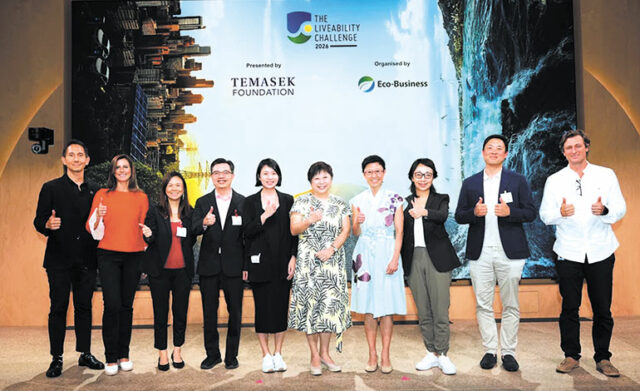
The Liveability Challenge 2026 pledges over SG$4 million in catalytic funding for deep-tech startups

The Liveability Challenge (TLC) announced an injection of over SG$4 million in catalytic funding and support to fast-track cutting-edge sustainable innovations from the lab to market, its biggest pledge yet in the program’s nine-year history.

This includes SG$2 million in catalytic grants from Temasek Foundation, SG$2 million worth of development support from Agency for Science, Technology and Research (A*STAR) and grant support from Enterprise Singapore, as announced during the launch of the ninth edition of TLC at Google Singapore today.

Presented by Temasek Foundation and organized by Eco-Business, TLC was established in 2018 and has grown to become a global crowdsourcing platform for sustainability solutions. 

With eight successful editions concluded, the annual crowdsourcing platform has attracted thousands of applications globally, short-listed and incubated 54 finalists and deployed almost SG$14 million in catalytic funding to help these startups scale and commercialize.

“This catalytic boost of more than SG$4 million represents our commitment to turning bold ideas into real-world impact for the environment. Through The Liveability Challenge, Temasek Foundation is providing catalytic funding to empower innovators to push boundaries, tackle pressing challenges and create lasting benefits for the planet and future generations,” said Heng Li Lang, head of Climate and Liveability at Temasek Foundation.

“We are also delighted to welcome A*STAR on board as a new partner, whose development support and resources will further strengthen the innovators’ journey from lab to market,” she added.

The 2026 edition will seek out innovative, groundbreaking solutions addressing urban challenges across two themes — Decarbonization and Cool Earth.

A*STAR joins as the co-presenter of the Decarbonization theme, lending its scientific know-how, industry partnerships and national test-bedding facilities to help finalists pilot and scale their innovations locally and globally.

Committing up to SG$2 million annually for the next three years, A*STAR will significantly contribute to TLC’s mission of accelerating technology development and commercialization pathways.

“Climate change affects all of us, impacting our health, work and how we live. As part of A*STAR’s efforts to decarbonize Jurong Island and play an active role in enabling Singapore’s goal to achieve net zero by 2050, we are delighted to partner Temasek Foundation in The Liveability Challenge. We look forward to partnering with start-ups from all over the world to co-develop innovative solutions to accelerate solutions for decarbonization, and achieve these important goals together,” said Irene Cheong, assistant chief executive (Innovation & Enterprise) at A*STAR.

Each TLC edition culminates in a Grand Finale during Ecosperity Week in Singapore, showcasing the finalists’ deep-tech solutions. Two steering committees on the two themes will select the finalists to pitch their solutions to judges and investors at The Liveability Challenge Grand Finale during Ecosperity Week 2026 on May 18 to 21 next year.

The Decarbonization theme revolves around disruptive deep-tech solutions that provide scalable and impactful solutions to reduce carbon emissions across diverse industries, including waste-to-resource, renewable energy and energy efficiency.

To support the Decarbonization theme, A*STAR is opening its doors to finalists, granting them access to cutting-edge scientific expertise at the A*STAR Institute of Sustainability for Chemicals, Energy and Environment (A*STAR ISCE²), as well as national test-bedding facilities such as the Low Carbon Technology Translational Testbed (LCT³) on Jurong Island.

These facilities will enable technologies to be trialed in real-world industrial conditions in Singapore, a critical step that de-risks commercial adoption and ready solutions for international deployment.

Meanwhile, the Cool Earth theme is about Innovative solutions that enhance mitigation, resilience and adaptation to extreme weather events (especially heat) for a more liveable planet, including large-scale cooling benefits and adaptive solutions that strengthen resilience across diverse industries.

The launch event also featured a high-level panel on “Catalytic capital: Accelerating climate innovation” with thought leaders from A*STAR, Google, Breakthrough Energy and Antares Ventures sharing strategies to unleash the next wave of climate tech solutions.

Under the theme “Solutions that scale. Impact that lasts,” TLC 2026 opened the call for submissions and will close on Feb. 9, 2026.


SparkUp is BusinessWorld’s multimedia brand created to inform, inspire, and empower the Philippine startups; micro, small and medium enterprises (MSMEs); and future business leaders. This section will be published every other Monday. For pitches and releases about startups, e-mail to bmbeltran@bworldonline.com (cc: abconoza@bworldonline.com). Materials sent become BW property.

11 women named as recipients of the 2025 ASEAN-UK SAGE Women in STEM Scholarships

The UK and ASEAN, through the ASEAN-UK SAGE Programme, announced the 2025 recipients of the ASEAN-UK SAGE Women in STEM Scholarships last Aug. 21. Launched in 2024, this scholarship aims to address gender disparities in access to science, technology, engineering and mathematics (STEM) education and careers across ASEAN countries and Timor-Leste, and empower the next generation of women in STEM.

“With the second cohort of scholarship recipients set to make their journey to the UK, this highlights the UK and ASEAN’s shared ongoing commitment to gender equality and female empowerment in STEM,” Secretary-General of ASEAN, H. E. Dr. Kao Kim Hourn said.

“By supporting girls and marginalized communities in accessing education and improving foundational learning, we aim to bridge the gender gap and foster a more inclusive and innovative future. ASEAN is pleased with the positive outcomes from the ASEAN-UK SAGE Programme, which aims to enhance collaboration and mutual benefits between the regions.”

After a highly competitive selection process, which saw hundreds of students from across all 10 ASEAN countries and Timor-Leste apply, ASEAN-UK SAGE is delighted to announce 11 outstanding women from eight countries will be traveling to the UK later this year to begin their master’s studies at either the University of Manchester or the University of Warwick. These talented individuals share a passion and vision to make a difference in their respective countries through STEM, a field where women have traditionally been underrepresented.

This includes two scholarship recipients from the Philippines, Dannah Celine Gutierrez and Marie Eirene Fabon, who will be studying Renewable Energy and Clean Technology at the University of Manchester, and Humanitarian Engineering at the University of Warwick, respectively.

Each recipient will receive a fully funded opportunity to complete a master’s degree at the prestigious University of Warwick or the University of Manchester and will be traveling to the UK to take up their studies beginning September. It is hoped that the scholars will go on to have successful careers in STEM, and to become inspirational role models to other women, as advocates and leaders in their field.

The scholarships have been developed by the British Council and are funded by the UK Government through the ASEAN-UK SAGE Programme.

UK Development Director for Indonesia and ASEAN Amanda McLoughlin said, “As a dedicated ASEAN Dialogue Partner, the UK is proud to support these exceptional women in STEM through the ASEAN-UK SAGE scholarships. Investing in women’s education is not just about equality. It’s about unlocking economic potential and driving inclusive development across ASEAN. Through this program, we’re helping build the skills and leadership needed for a more prosperous and equitable region.”

Summer Xia, director Southeast Asia, British Council said, “We are thrilled to announce the second cohort of ASEAN-UK SAGE Women in STEM scholars and can’t wait to see the impact they will make as they embark on their master’s studies in the UK. As a lead implementation partner of the ASEAN-UK SAGE Programme, the British Council is proud to support these exceptional women on their academic journeys. We look forward to seeing how they will advance STEM in their communities and across the region in the years to come.”

The ASEAN-UK SAGE Programme aims to foster the integration of the ASEAN Member States by bridging the educational gap through collaboration with key decision-makers and players to improve foundational learning for girls, address out-of-school girls and marginalized groups, and tackle gender barriers to digital skills and employment.

The ASEAN-UK SAGE Women in STEM Scholarships program affirms ASEAN’s commitment for gender equality and women’s empowerment, and supports its objectives of creating opportunities for greater women’s participation in STEM fields. It also contributes to the ASEAN-UK Plan of Action 2022-2026 particularly in strengthening engagement between UK and ASEAN education institutions, staff, and students through scholarship initiatives.


SparkUp is BusinessWorld’s multimedia brand created to inform, inspire, and empower the Philippine startups; micro, small and medium enterprises (MSMEs); and future business leaders. This section will be published every other Monday. For pitches and releases about startups, e-mail to bmbeltran@bworldonline.com (cc: abconoza@bworldonline.com). Materials sent become BW property.

First Gen sets $20-B plan to grow capacity to 13GW

FIRSTGEN.COM.PH

LOPEZ-LED First Gen Corp. expects to spend around $20 billion over the next five years to expand its power portfolio to 13 gigawatts (GW) within and outside the Philippines.

First Gen President and Chief Executive Officer Francis Giles B. Puno said the company is banking on renewable energy initiatives to drive growth.

“Part of (the 13-GW goal) is really growing of geothermal, solar, and hydro,” Mr. Puno told reporters last week.

The company currently has a total generating capacity of 3,688 megawatts (MW) from geothermal, wind, hydropower, solar, and natural gas plants.

First Gen, known as a leading geothermal producer through subsidiary Energy Development Corp., is hoping to start drilling for its Amacan geothermal project in Mindanao next month.

“We’re hoping to generate at least 70 to 100 MW,” Mr. Puno said.

Outside the Philippines, the company is planning to expand in Indonesia by developing up to 600 MW of geothermal capacity. The Philippines has 1,952 MW of geothermal capacity, making it the third-largest producer after Indonesia.

First Gen is also aiming to scale up its solar and hydropower initiatives as part of its growth plan.

Mr. Puno said the company is also working with Razon-led Prime Infrastructure Capital, Inc. to expand its natural gas business. Prime Infra is acquiring a 60% equity stake in First Gen’s gas portfolio for P50 billion, which covers five power plants and an interim offshore liquefied natural gas terminal.

While there is momentum toward its target, Mr. Puno said achieving 13 GW by 2030 remains challenging due to the long development timelines of power projects.

“The reason why we came up with the 13 GW is to align with the pronouncement of the government on how much capacity is needed,” he said.

Under the Power Development Plan 2023-2050, the country’s total peak demand is projected to rise from 16,596 MW in 2022 to 68,483 MW in 2050. — Sheldeen Joy Talavera

Cary Santiago’s animal chic

complements Diagold’s sparkle

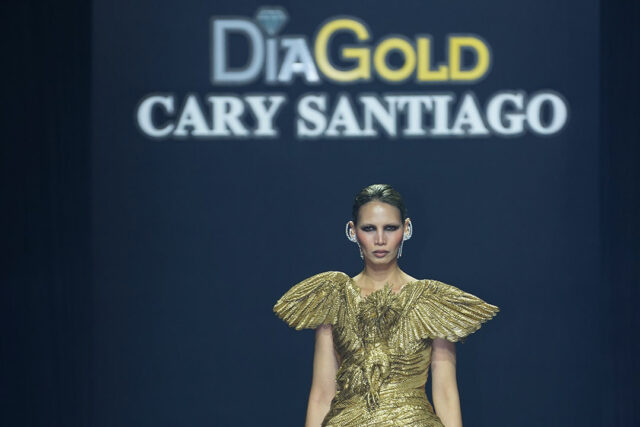
THERE was no escaping the glam at the Diagold and Cary Santiago show on Sept. 11. Amid all the (literal) gold and diamonds (not just on the jewels, but the clothes themselves), one felt strangely inadequate in plain black and white.

Prior to the show at the Shangri-La The Fort, the Cebu-based jewelry brand (which was collaborating with the Cebuano designer), showed off its new collection in a showcase at the center of the ballroom. The collection, called Crown Jewels, showed bold colored gemstones — rubies, sapphires, emeralds, and yellow diamonds — in royal-worthy settings, surrounded and paved by halos of diamonds.

The jewels were worn on the runway: dresses accented with diamond drop pendants, pink sapphire eardrops, a large diamond brooch, an emerald parure, a necklace made of numerous rows of sapphires, and more than a sprinkling of yellow diamonds.

The clothes held their own, despite the sheer weight of the jewels (we noted that some of the stones were as large as bird eggs).

The first dress out on the runway had a huge gold eagle at the bust and skirt, executed in braid. A hat that looked like it came from the Dior archives accompanied a dress with a skirt scattered with ostrich feathers, followed by an all-black lace outfit. Silver baroque foliage added to the drama of a cape with silver tubes, then tassels added movement to a white net dress.

More tassels are seen in an underrobe worn by a man, accompanying a suit. A gold lamé dress similar to a 1953 William Travilla gown made for Marilyn Monroe made an appearance on the runway, improved with sculptured bows and cranes at the back.

There was a sculptured bodice with padded hips (similar to a 1950s Balenciaga creation). A beaded flapper dress made one think of Liza Minelli in Cabaret, while the men joined the fun with a velvet hooded jacket.

Gold “feathers” (actually fabric designed to look like them) were all around a floor-length dress, that got a nod of approval from an audience member wearing (almost) the same thing.

A dress was quite literal with sculptured spiders crawling over it, followed by a dove-gray dress adorned with (you guessed it) gray doves. Another dress came with anatomically correct herons, while another dress had the birds forming the gown’s hips.

Numerous animals made it on the runway: we’ve covered the birds, but there was another dress in bronze, with an iguana on the shoulder, its mouth holding the skirt. Another dress came in the shape of a cobra, the snake’s hood forming, well, the hood, with an embossed pattern that mimicked the snake’s scales. Animal prints also came in the picture, with stylized interpretations of leopard and zebra print.

The finale dress showed off mounds of fabric cut and layered to look like feathers, fluttering as it went down the runway, seeming almost alive.

That is Cary Santiago’s gift: using natural forms of animals and making them wearable. Active in the business for over 20 years, the show on Sept. 11 marked his first Manila solo show in a decade. One might argue that he’s one-note, but if he’s good at it, he might as well keep at it.

“My collection is inspired by fauna: those that fly, run, and grow,” he said in a video shown prior to the show. “I also love the feathery softness of birds in flight.”

DiaGold has branches in Ascott Makati, Glorietta 1, SM Grand Central, SM City Iloilo, SM City Cebu, SM Seaside City Cebu, SM City Davao, SM City Bacolod, Ayala Malls Capitol Central Bacolod, Ayala Center Cebu, Nustar Resort & Casino Cebu, and Waterfront Hotel and Casino Cebu. — Joseph L. Garcia

Creative innovators recognized in Benilde Alumni Technopreneur Awards

Entrepreneurs and innovators whose young businesses promise potential for growth and future success in their respective industries were recognized at the recently concluded Benilde Alumni Technopreneur (BeAT) Awards.

Established in 2019 by the De La Salle-College of Saint Benilde (DLS-CSB) through the Center for Partnership Advancement (CPA), the BeAT Awards began as a platform to guide and honor startups which utilize technology to bridge entrepreneurship and social transformation.

It has since drawn homegrown talents across various disciplines, to include IT and digital media, business and marketing, tourism and hospitality, human resource development, and the creative industries.

In collaboration with the Hub of Innovation for Inclusion (HiFi) and Center for Intellectual Property Management (CIPM) — with aid from the Department of Science and Technology and generosity of HiFi benefactor and patron, Peter D. Garrucho, Jr., OBE — the initiative has grown into a launchpad which offers cash grants, business development support, and mentorships to assist founders to scale their missions.

Led by the CPA, this year’s edition commenced with a peer-driven boot camp which challenged, equipped, and connected the finalists for the realities of startup life.

The judging adapted a Shark Tank–style format, wherein the finalists presented their ideas to a panel composed of CWC Interiors President Fred Yuson, Paragon Brokerage Corp. President and Federation of La Salle Alumni Associations of the Philippines Chairman Henry Atayde, and marketing and advertising expert and former Benilde Center for Institutional Communications (CIC) Director Adie Peña.

The entries were screened based on technological innovation, entrepreneurial spirit, economic sustainability, and social, environmental and community impact. Their Benilde X factor — their ability to do “ordinary things extraordinarily well” — was likewise commended. 

Mary Grace Silverio, Career Development Program scholar and Business Administration graduate, nabbed the Grand Trailblazing Beat Award for her Tambanokano Aqua Farms, a social enterprise which aims to revolutionize the mud crab aquaculture through sustainable Crab Condominium technology and Recirculating Aquaculture Systems (RAS). 

Ms. Silverio aims to empower coastal communities with high-yield and eco-friendly farming solutions which bridge the gap between seafood demand and responsible production. Her goal is to ensure a quality seafood supply while enhancing fishermen’s livelihoods and to promote marine conservation.

The Trailblazing Tech-for-Good recognition was granted to Interior Design alumna Lalaine Almoro. With Gussy Design, Inc., she elevates home styling through a tech-powered platform which delivers professional, quick, affordable, and seamless design services.

Amy Nayve, a homegrown talent from the Industrial Design Program, was hailed as the Trailblazing Creative Disruptor. She is the founder of Pumapapel PopUp Design Studio, the country’s first and only studio dedicated to paper engineering — transforming stories and blank sheets into moving works of art and brands into interactive experiences. 

Finally, the Trailblazing Social Impact Award was bestowed upon Hospitality Management major Diana Joyce Lorenzo from the School of Hotel, Restaurant, and Institution Management (SHRIM). Through Unit 605 Coffee, Ms. Lorenzo serves mindfully crafted cold brew which is gentler on the gut and friendlier to the acidic.


SparkUp is BusinessWorld’s multimedia brand created to inform, inspire, and empower the Philippine startups; micro, small and medium enterprises (MSMEs); and future business leaders. This section will be published every other Monday. For pitches and releases about startups, e-mail to bmbeltran@bworldonline.com (cc: abconoza@bworldonline.com). Materials sent become BW property.

MGEN eyes Malaysia entry to supply data center power

STOCK PHOTO | Image by Esmonde Yong from Unsplash

MERALCO POWERGEN CORP. (MGEN), the power generation arm of Manila Electric Co. (Meralco), is planning to enter Malaysia to capture rising electricity demand from data centers.

MGEN President and Chief Executive Officer Emmanuel V. Rubio said the company is eyeing the development of new or existing power plants with a capacity of up to 1,500 megawatts (MW) by 2028.

“There’s opportunity. Malaysia’s preparing for investments in data centers,” he told reporters last week.

“They’re expecting or trying to attract 8,000 MW of capacity (for data centers).”

Malaysia has become a data center hub in Southeast Asia, benefiting from its proximity to Singapore and the growing need for cloud and artificial intelligence services.

These facilities require large amounts of uninterrupted power to operate.

To pursue its Malaysia expansion, MGEN is seeking a local partner, according to Mr. Rubio.

MGEN and its subsidiaries have a total net sellable capacity of over 5,000 MW from coal, liquefied natural gas, diesel, and solar facilities.

Outside the Philippines, MGEN holds investments in Singapore-based PacificLight Power (PLP), which recently completed a 100-MW fast start ancillary services facility.

PLP is also preparing to construct a 670-MW hydrogen combined cycle gas turbine plant, targeted for completion by January 2029.

Meralco’s controlling stakeholder, Beacon Electric Asset Holdings, Inc., is partly owned by PLDT Inc. Hastings Holdings, Inc., a unit of PLDT Beneficial Trust Fund subsidiary MediaQuest Holdings, Inc., has an interest in BusinessWorld through the Philippine Star Group, which it controls. — Sheldeen Joy Talavera

Luxury brands’ big challenge: figuring out Gen Z

MIU MIU has attracted first-time luxury buyers with leather bag charms, which retail in the range of $240 to $1,250. — MIUMIU.COM

NEW YORK — Fleur Arbel and Christophe Kairouz, both from France, were lured into Louis Vuitton’s New York flagship recently by a colorful sculpture of a monogrammed giraffe and ostrich above the store’s entrance.

But the two 24-year-olds are more likely to spend their shopping dollars elsewhere, as Louis Vuitton’s heavy logos and styles strike them as passé.

“I think they failed to keep the luxury image in a way,” said Kairouz. “I think they need to create something new, original.”

Arbel and Kairouz are a tiny fraction of the Gen Z cohort born between 1998 and 2012: the luxury industry’s new frontier. The group made up 4% of global luxury spending before the pandemic; by 2030, they will account for 25%, according to Boston Consulting Group.

Executives, consultants, and analysts say this generation is harder to pin down than their predecessors. They are influenced by a global social media landscape and tend to mix-and-match goods from established names with trendier labels, shopping everywhere from TikTok to thrift stores. Legacy brands trying to attract Gen Z consumers have used influencers, pop-up shops, and affordable items like bag charms.

“There’s a lot of similarity between Gen Z in Shanghai and Los Angeles and London,” said Scott Roe, chief financial officer and chief operating officer of Coach-parent Tapestry.

More affordable luxury companies like Coach and Ralph Lauren — whose revenue rose 6.8% in the 12-month period ended in March — are capitalizing on the generational shift. Coach has gained cache with Gen Z due to using influencers, personalization services, and focusing on sustainability, experts said. Coach’s total revenue rose 9.9% to about $5.6 billion for the 12-month period ended in June.

Tapestry’s Roe said Gen Z is not less brand-loyal than other generations, but it is harder for brands to reach these consumers because shoppers have more choices. “To break through, you need to have a strong share of voice.”

That voice is pricey: Tapestry increased its marketing spend from 3% of sales pre-pandemic to 10% this year, according to its May earnings call, but did not disclose how much it targeted Gen Z specifically.

Brands are contending with upstarts and smaller established labels like Collina Strada and Mary-Kate and Ashley Olsen’s The Row, which climbed two spots to sixth place in the most recent Lyst Index of hottest luxury brands. Lyst, a global fashion shopping platform, tracks shopper behavior and social media engagement for more than 160 million users on its site and is the “biggest dataset in fashion,” according to the company.

Hillary Taymour, creative director of Collina Strada, said they started targeting Gen Z in 2020 with digital ads. Now, Gen Z and Millennials account for 58% of its business. “It mixes sustainability with a playful, meme-driven aesthetic,” she said, citing the brand’s “inclusive casting and diverse runway shows” that make younger audiences feel like part of a community.

AFFORDABLE ITEMS DRAW IN YOUNGER SHOPPERS
Not all fashion powerhouses are being left on the shelf. Luxury labels from Kering-owned Bottega Veneta, Prada Group’s Miu Miu, and LVMH-owned Loewe continue to do well with Gen Z, as Miu Miu currently ranks first on the Lyst Index, followed by Loewe.

Miu Miu sales rose 49% in the first half of 2025 compared to the same period in 2024, capturing first-time luxury buyers with leather bag charms, which retail in the range of $240 to $1,250. “Brands like Miu Miu succeeded because single pieces mirror the brand identity, allowing Gen Z consumers to buy into the brand without having to purchase a full look,” said Achim Berg, founder of FashionSIGHTS, an industry think-tank.

Less expensive items draw in younger luxury shoppers, who are still more budget-conscious than their elders. In August, spending among Gen Z and Millennials — those born after 1978 — rose by just 0.5% from the previous year, according to Bank of America, in comparison to a 2.4% increase for Baby Boomers.

“When I shop luxury, I think about ‘what’s going to last me a long time?’ I’m spending a lot of money on an item, I want something I’m not going to get sick of in five or 10 years,” said Kendall Still, a 26-year-old Los Angeles native.

Some brands have struggled. Sales at Kering-owned Gucci fell 25% in the second quarter, and the company ousted CEO Stefano Cantino after just nine months on the job on Sept. 17.

Data from Gen Z researcher dcdx, which tracks mentions and interactions with user-generated brand content, showed Gucci suffered the sharpest decline on social media among top luxury labels over the past year.

Over the last two years, Kering shares have lost 43% of their value while Tapestry has more than tripled. Gucci did not respond to a request for comment.

“Legacy brands are splitting into clear winners and losers,” said Frederica Levato, senior partner at Bain & Co.

The next players to emerge globally could be Chinese brands like Uma Wang and Shushu/Tong. In Asia, newer Chinese companies are gaining traction with younger shoppers, due to their digital fluency and ability to capture China’s national identity, Chanel CEO Leena Nair said at The Economic Club of New York on Sept. 16.

“You cannot take the longevity of a brand for granted; you stay in the public consciousness and you have the iconicity because you’re relevant and timely, and constantly modern,” she said. — Reuters

From ballet to Marrakech: Rustan’s Christmas tableaus show a wide range of inspirations

CHRISTMAS came early at Rustan’s on Sept. 18 (or if you’re going by the Filipino “-ber” months calendar, just in time) with a display of holiday tableaux on their home floor created by leading holiday hosts and hostesses.

The list of figures that collaborated with Rustan’s for the Rustan’s Christmas Shop 2025 includes STEPS founder and heiress Sofia Elizalde, Michelle Suzuki, restaurateur Happy Ongpauco-Tiu, architect Miko de los Reyes, floral designer Pam Lopez (Mr. De los Reyes and Ms. Lopez are members of the Tantoco family behind Rustan’s), interior designer Myze Bangayan, and designer Jia Estrella.

The tableaux will be displayed throughout the season, accompanying the grand Christmas decors and Rustan’s holiday shop windows, launching next month.

“My mother (Bea Zobel) always brought out her best piña tablecloth for such a special evening, and paired it with all her favorite plates and good crystal glasses to serve water, white wine, red wine, and of course, champagne,” said Ms. Elizalde. She placed white magnolias at the center of the table — a nod to one of her favorite cities, New York. “The white magnolias add a touch of white and green to the lovely Filipino piña tablecloth,” she said. Around it, she included sweets, always a must for any special occasion, along with playful touches inspired by The Nutcracker, her forever favorite Christmas ballet.

Ms. Suzuki did her tables in red, inspired by ikebana, the Japanese art of flower arrangement. At its heart stands a striking red Christmas tree, embellished with cherry blossoms, red berries, and jewel-toned ornaments in shades of ruby, fuchsia, and pink. Mr. De los Reyes featured Rustan’s signature blue, paired with toile de jouy prints. Ms. Lopez showed off a tree using tropical plants instead of the traditional pine. Ms. Bangayan meanwhile, showed a cozy tea setup, while Ms. Estrella showed off blues (including a bejeweled blue Christmas tree), inspired by the Majorelle Gardens in Marrakech. The chairs in her setup, showing a blue and white pattern, were hand-painted by herself.

Speaking with BusinessWorld, Ms. Ongpauco-Tiu said she wanted something timeless and elegant. This resulted in her using black and champagne tableware and crystal glassware. “At home, I also like traditional and elegant pieces,” she said. “It depends on the theme of my parties. I love doing themed parties; it depends on the cuisine I serve.” She recalled using Moroccan tagines as centerpieces for a themed dinner.

For this Christmas, she’s thinking of going Latin — Latin American, that is. “I want to do Peruvian,” she said, mentioning that she was thinking of an eight-to-10 course dinner. “Something different.”

All the items used in the tableaux, except for Ms. Lopez’ tree and Ms. Estrella’s chairs, are available at Rustan’s Makati. — JL Garcia

Treasury bill, bond rates likely to decline further

STOCK PHOTO | Image by RJ Joquico from Unsplash

RATES of the Treasury bill (T-bill) and Treasury bonds (T-bonds) to be offered this week may decline further as hopes for looser monetary conditions here and in the United States grow after the Federal Reserve resumed its easing cycle last week and signaled more cuts to come.

The Bureau of the Treasury (BTr) will auction off P25 billion in T-bills on Monday, or P8.5 billion each in 91-day and 182-day securities and P8 billion in 364-day papers.

On Tuesday, the government will offer P35 billion in a dual-tranche T-bond offering, or P10 billion in reissued seven-year papers with a remaining life of two years and seven months, and P25 billion in reissued 20-year securities with a remaining life of 16 years and nine months.

T-bill rates could drop this week, similar to the decline seen at the secondary market, due to expectations of further monetary easing by both the Bangko Sentral ng Pilipinas (BSP) and the Fed, Rizal Commercial Banking Corp. Chief Economist Michael L. Ricafort said in a Viber message.

This is after the Fed penciled in more rate cuts this year that could be matched by the BSP, he said.

Meanwhile, a trader said in an e-mail that the T-bonds on offer this week could see good demand, with the reissued seven-year bond fetching rates ranging from 5.585% to 5.625% and the 20-year debt attracting bid yields between 6.275% and 6.325%.

At Wednesday’s meeting, the Fed lowered its policy rate by 25 basis points (bps) to a range of 4%-4.25%, its first cut since December, and signaled a gradual easing cycle in response to mounting labor market concerns, Reuters reported.

At the same time, Fed Chair Jerome H. Powell highlighted “a challenging situation” for policymakers, noting that risks to inflation were tilted to the upside and risks to employment to the downside.

The US central bank’s release on Wednesday of updated quarterly economic projections, including rate forecasts issued in a chart known as the “dot plot,” reflected expectations of more easing this year when compared to the ‘dots’ from the June meeting, with 50 bps in cuts seen before yearend.

Meanwhile, the BSP last month lowered borrowing costs by 25 bps for a third straight meeting, bringing the target reverse repurchase rate to 5%. It has now slashed benchmark rates by a cumulative 150 bps since the start of its easing cycle in August 2024.

BSP Governor Eli M. Remolona, Jr. has said that the policy rate is now at a “sweet spot” in terms of both inflation and output, but left the door open to one last cut this year to support growth if needed, which would likely mark the end of its current easing cycle.

The Monetary Board’s last two meetings this year are scheduled in October and December.

At the secondary market on Friday, yields on the 91-, 182-, and 364-day T-bills dropped by 14.38 bps, 1.67 bps, and 4.9 bps week on week to end at 4.9458%, 5.1976%, and 5.3041%, respectively, based on PHP Bloomberg Valuation Service Reference Rates data as of Sept. 19 published on the Philippine Dealing System’s website.

Meanwhile, the seven-year bond dropped by 2.06 bps week on week to yield 5.8705%, while the rate of the three-year paper, the benchmark tenor closest to the remaining life of the bonds on offer, went down by 2.69 bps to 5.6533%.

The 20-year bond’s yield also slipped by 0.48 bp week on week to close at 6.3445% on Friday.

Last week, the government raised P25 billion as planned from its T-bill auction as the offer was more than six times oversubscribed, with total bids reaching P154.154 billion.

Broken down, the Treasury borrowed the planned P8.5 billion via the 91-day T-bills as total tenders for the tenor reached P47.86 billion. The three-month paper was quoted at an average rate of 4.95%, down by 9.6 bps week on week. Yields accepted were from 4.908% to 5%.

The government likewise raised P8.5 billion as programmed from the 182-day securities as tenders amounted to P53.92 billion. The average rate of the six-month T-bill was at 5.148%, easing by 7.4 bps from the previous week, with accepted rates spanning from 5.11% to 5.175%.

Lastly, the Treasury sold P8 billion as planned in 364-day debt as demand for the tenor totaled P52.374 billion. The average rate of the one-year T-bill dropped by 10.4 bps to 5.272%. Tenders awarded carried rates from 5.263% to 5.283%.

The BTr is looking to raise P220 billion from the domestic market this month, or P100 billion via T-bills and P120 billion through T-bonds.

The government borrows from local and foreign sources to help fund its budget deficit, which is capped at P1.56 trillion or 5.5% of gross domestic product this year. — A.M.C. Sy with Reuters

Manila stages WRO Asia Pacific Open Championship 2025 to foster innovators in robotics and AI

The Philippines hosted the World Robot Olympiad (WRO) Asia Pacific Open Championship 2025 last Sept. 19-21 in Manila, with FELTA Multi-Media, Inc. serving as the exclusive national organizer.

The international robotics competition gathered delegations from more than 30 countries across the Asia-Pacific region and beyond, making it the largest robotics event ever staged in the Philippines.

The championship was organized in partnership with the Department of Education (DepEd), Department of Science and Technology-Science Education Institute (DoST-SEI), Department of Information and Communications Technology (DICT), Department of Tourism (DoT), Commission on Higher Education (CHEd), Tourism Promotions Board (TPB), and Intramuros Administration (IA), alongside private sector sponsors.

The World Robot Olympiad is a global robotics competition that brings together young minds to develop creativity, problem-solving, and critical thinking skills through science, technology, engineering, and mathematics (STEM). The Asia Pacific Open serves as a regional championship fostering cross-cultural engagement, technical exchange, and innovation among future leaders.

Hosting the competition highlighted the Philippines’ growing influence in the global tech-education landscape, aligning with the government’s thrust toward digital transformation, inclusive education, and global competitiveness through science and innovation. The event also supports the Philippine Development Plan 2023-2028, particularly in enhancing the digital economy, promoting lifelong learning, and empowering youth for the Fourth Industrial Revolution.

The championship set out five objectives: to bring together over 1,000 student participants, coaches, and delegates from more than 30 countries; to promote STEM education and innovation in the Asia-Pacific region; to position the Philippines as a global hub for youth innovation and robotics; to provide an international platform for Filipino youth to showcase their talents and skills in AI and robotics; and to encourage tourism, cultural exchange, and goodwill among students, educators, and families.

Competitions were held under four categories: RoboMission, which featured autonomous robotics tasks; Future Innovators, which focused on open-ended innovation projects with real-world impact; Future Engineers, with advanced robotics engineering challenges; and RoboSports, a fast-paced two-on-two robot sports game, which this year carried the theme “Robo Tennis.”

Beyond competitions, the program also included a Cultural Exchange Night celebrating unity among nations, a Technology Showcase and Exhibits highlighting innovations from agencies, tech companies and Filipino startups, as well as educational workshops and seminars on STEM, AI and robotics. Participants also joined guided tours around Intramuros, Manila’s historic cultural district.

The event brought together over 1,000 students aged 8-19, more than 300 coaches and mentors, and some 200 international and local officials, judges, and volunteers.

Mylene Abiva, president and CEO of FELTA Multi-Media, said that the WRO Asia Pacific Open Championship 2025 is a “convergence of education, innovation, and international partnerships.” 

“With the full support of key Philippine government agencies and FELTA Multi-Media, Inc.’s commitment to advancing STEM education, this event marks a bold step in preparing Filipino youth for a dynamic, tech-driven global future,” she said.

“Let the world witness Filipino talent. Let Manila be the stage of innovation. Let us build the future, one robot at a time.”


SparkUp is BusinessWorld’s multimedia brand created to inform, inspire, and empower the Philippine startups; micro, small and medium enterprises (MSMEs); and future business leaders. This section will be published every other Monday. For pitches and releases about startups, e-mail to bmbeltran@bworldonline.com (cc: abconoza@bworldonline.com). Materials sent become BW property.