Home Blog Page 5784

PPA: Connecting the Philippines as one maritime nation

Time really flies… Fast! This as the Philippine Ports Authority (PPA) celebrates its 48th Founding Anniversary today with the theme: “Kaagapay sa Pag-ahon sa hamon ng Panahon.”

Let us go back in memory lane as we highlight the accomplishments of the agency leading to its status as one of the most successful Government-Owned and -Controlled Corporations as it continues to be a member of the ‘billionaires’ club in terms of dividend remittance.

While there is still a lot of work to be done, the realization of the plans and programs of the previous administration has prepared the PPA for years to come as the world recovers from the effect of the COVID-19 pandemic, and also as the PPA slowly transitions to the new administration.

The Get Go

In 2016, the PPA changed its mindset from top management down. This drastic paradigm shift was undertaken to implement change and improve the way PPA serves the public, the way the Authority carries out its projects, and raise the level of comfort and convenience it provides to the sea-traveling public.

From that time forward, PPA personnel slowly embraced and live the dreams and aspirations of the administration, thus, all other changes were very smoothly enforced.

This shift in outlook resulted in positive deviation across all aspects of operations of the agency and filled the first full year of the new leadership with great possibilities, anticipations, and enthusiasm.

Stepping Up The Pace

To continue the positive momentum, the PPA initiated another change in 2017, this time on the very symbol that represents the Authority, its Logo.

The reason behind the change is to integrate all aspects of port operations instead of focusing only on the core business of the agency.

Positive results were immediately seen with the Manila Ports, composed of the MICT, the South Harbor, and the North Harbor, as it jumped four notches higher in the Top 100 container ports in the world from 36th to 32nd and finished 22nd in the Top 100 container ports in Asia.

Year 2017 was likewise the year, where the Golden Age of Infrastructure was ushered in.

With the even better performance of the agency for the year, PPA was even more encouraged in pursuing its plans and programs the following year.

Full Steam Ahead

If in 2017 the PPA implemented the change to PPA Logo, the year 2018 showed the launching of the new PPA logo, signaling the rebirth of the PPA, armed with renewed enthusiasm and eagerness to dispense unparalleled public service not only to the port users but to the entire nation.

Accomplishments abound the PPA for the year 2018 starting from the APSN Green Port Awards for the Ports of Batangas and Cagayan de Oro.

The Development Academy of the Philippines also recognized the PPA and PMO Misamis Oriental/CDO for fostering a Green Culture for Port Operations and Management under the Government Best Practice Recognition.

The Port Management Offices also got their respective ISO QMS, EMS, and OSH certification.

The awards were testaments to the initiatives of the PPA toward environmental protection. The Authority slowly reaped the benefits of its hard work particularly in complying with the stringent requirements on Environmental Management and Occupational Safety and Health.

During this period, the PPA also emphasized its workforce development, both Organic and Outsourced, by implementing a bridging program to uplift the competencies of existing personnel while giving its outsourced personnel equal opportunity to dangle an entry-level position provided, they possess the required eligibility requirements.

This year, the PPA injected some P3.3 billion for its infrastructure projects in support of the BBB initiative of the National Government.

Cruise Control

Year 2019 was a milestone year for the PPA as it posted all-time highs in terms of shipcalls, passengers, cargo volumes, revenues, total taxes paid, and dividend remittance.

This kind of performance was due to the shift from manual to automated processes, installation of sophisticated, effective, and highly productive port equipment, compliance with the world’s best practices, and most especially the shift in the outlook of employees to public service with reliability, integrity, and accountability.

This enabled the PPA to help the government achieve its goal of giving comfortable lives to every Filipino not only through higher dividend remittances but also through efficient, effective, and fast delivery of port services to our stakeholders and port users.

During this period, the PPA invested P4.6 billion in its port projects, the biggest expense since 2010.

Year 2019 was also the second straight year that the PPA scored big in the annual port user satisfaction survey, particularly on the aspect of integrity. With a satisfaction rating of 4.43 or equivalent to Very Satisfactory on top of its port facilities and services rendered.

Undeniably, 2019 was a banner year for the Authority.

Speed Bump

Year 2020 was an upbeat year for PPA hoping to overshadow its performance from the preceding year until it hit a hump: the COVID-19 pandemic.

Nonetheless, PPA wasted no time and immediately mobilized its personnel and other resources to help the government respond properly to the health emergency initially by remitting in advance its dividend worth about P5 billion, which is 7.5% higher than the regular 50% required by law.

Despite the pandemic, PPA made sure that all ports remained open to handle the processing and delivery of cargoes, particularly essential products, to the rest of the country and to the country’s foreign trading partners while establishing the needed border controls as well as safety, security, and travel protocols to prevent any sustained COVID-19 transmission in any PPA port.

In cooperation with the private sector, led by the Lopez Group of Companies, the PPA established two COVID-19 recovery facilities, the first one in the Manila South Harbor in April 2020 and in Port Capinpin in Bataan in October of the same year. These amenities also served as quarantine facilities for on-signer and off-signer seafarers since the two ports were also declared as dedicated crew change hubs and guaranteed the movement of seafarers manning the international fleet. Eventually, several more ports under the auspices of PPA like Batangas and Davao were declared as additional crew change hubs.

PPA likewise granted Financial Assistance for the Critically Impacted Sector in line with RA No. 11494 or the Bayanihan to Recover as One Act as well as waived and/or reduced Port Fees and charges in consonance with the Hatid-Tulong Program of the Office of the President for Locally Stranded Individuals.

Several more initiatives were undertaken to show the bayanihan spirit between and among the PPA PMOs and help not only its affected personnel but also its nearby communities.

PPA was also able to complete more than 27 port projects despite the pandemic without any transmission or casualty due to COVID-19.

The pandemic, however, affected its volumes and revenues. Nonetheless, PPA saw an opportunity to work together with the government and improve its services given to the public.

The speed bump, it slowed down the Authority to get a 2020 vision of the future. With all the experiences from the pandemic, the PPA was prepared more than ever to face the new normal and sustain the progress with the end goal of giving Filipinos comfortable and convenient lives.

Moving Forward

The rebound from the pandemic. The PPA remained undeterred to move forward to deliver its contribution to the advocacies of the Government.

Recognizing the things that still needed to be done to provide seamless connectivity between and among the islands, the PPA prepared a plan to ensure that PPA ports are ready for the transition and ready for the future when nations are expected to recover from the adverse effects of the global health emergency.

PPA was able to complete 88 port projects, which included the new Port Operations Building at the Port of Dumaguete, the seven seaport development projects in Bohol, the seaport expansion project in Puerto Princesa, Palawan, the eight seaport developments in the twin provinces of the Mindoro island, and the seaport expansion and development projects in Zamboanga City.

PPA also revised its mission-vision statements and calibrated its core values to guide the PPA until 2030.

PPA also upped the ante by remitting at least 60% of its net income to national coffers.

Overall, the PPA exceeded expectations across all aspects of its operations. In fact, the 6-year dividend remittance or from 2016-2021 recorded by PPA overshadowed the combined dividend remittance post EDSA through 2015 and almost tripled the amount registered from 2010 through 2015.

In terms of infrastructure, the PPA completed 248 seaport development projects, which formed part of the total 586 seaport projects completed under the Build-Build-Build program of the Duterte Administration.

In fact, at least seven seaport projects can be inaugurated by the new administration in its first 100 days in office.

This is your PPA, 48 years after!

BSP has room to raise rates — IMF

A woman buys food items at a supermarket in Quezon City, March 4, 2022. — PHILIPPINE STAR/ MICHAEL VARCAS

By Keisha B. Ta-asan

THE BANGKO SENTRAL ng Pilipinas (BSP) has room to raise rates without derailing economic recovery, the International Monetary Fund (IMF) said.

“Considering the strength of GDP (gross domestic product) growth — as observed in the first quarter of 2022 — raising interest rates to contain inflationary pressures and thwart second-round effects on domestic prices is warranted,” IMF Representative to the Philippines Ragnar Gudmundsson said in an e-mail interview.

“With a policy rate at 2.5% and yearly inflation projected to run at about 5%, there is room to raise interest rates without undermining credit growth and the ongoing economic recovery,” he added.

The economy expanded by a faster-than-expected 8.3% in the first quarter of 2022. Economic managers are targeting 6.5-7.5% gross domestic product (GDP) growth this year.

Inflation rose 6.1% year on year in June, exceeding the central bank’s 2-4 target band for a third straight month. The average inflation rate in the first six months is 4.4%, still below the BSP’s full-year forecast of 5%.

The Monetary Board has raised benchmark interest rates by a total of 50 basis points (bps) so far this year via 25-bp hikes at its May 19 and June 23 meetings, which brought the policy rate to 2.5%.

BSP Governor Felipe M. Medalla last Thursday said they are ready to take more aggressive policy action amid rising inflation and currency pressures. The peso breached the P56 level against the US dollar last week.

“In particular, BSP is prepared to raise its policy rate by 50 bps by August. The BSP is ready to take further policy actions, if needed,” Mr. Medalla said.

UNCERTAINTY
The IMF’s Mr. Gudmundsson said monetary policy tightening and supporting economic growth “are compatible, not least in terms of ensuring the sustainability of growth.”

However, the outlook for the global economy is now clouded by the Russia-Ukraine war, a slowdown in China, and the monetary policy tightening in the United States, he said.

“Tighter global financial conditions do pose risks related to higher volatility for the emerging economies. Fortunately, the impact is somewhat mitigated in the Philippines by the flexible exchange rate and relatively low non-resident portfolio investment,” Mr. Gudmundsson said.

He noted the Philippines is “well-positioned to withstand external shocks,” as its economy is one of the fastest-growing in the region and has adequate foreign exchange reserves.

“Looking forward, it will be important to continue to adhere to sound macroeconomic policies, to rebuild buffers through gradual fiscal consolidation, to attract foreign investment, and to promote green and inclusive growth,” Mr. Gudmundsson said.

‘STILL LOW’
Finance Secretary and former BSP Governor Benjamin E. Diokno said that even with the central bank’s planned rate hikes, it will still be lower than the pre-pandemic policy rate of 4%.

“With Governor Medalla’s forward guidance, we will increase it by (50 bps) which will bring it to 3%. That will still be lower than where we came from. I think we should not panic that it is rising. It’s gradual,” Mr. Diokno said during a press briefing after the Development Budget Coordination Committee (DBCC) meeting on Friday.

“All of this is calculated so as to not jeopardize economic growth while at the same time, making sure that over the medium-term, inflation is brought back to within the target band,” BSP Deputy Governor Francisco G. Dakila, Jr. added.

At its June 23 meeting, the BSP raised its inflation forecast for 2022 and 2023 to 5% and 4.2%, respectively, taking into account higher oil and commodity prices.

The DBCC on Friday said the average inflation rate assumption was raised to 4.5-5.5% for 2022, from 3.7-4.7% previously, reflecting the impact of soaring transport, fuel, and food expenses.

It expects inflation to ease to 2.5-4.5 % in 2023, before returning to the 2-4% target range starting 2024 to 2028.

Former BSP Deputy Governor Diwa C. Guinigundo said monetary tightening will not necessarily have a large impact on economic activity.

“The Philippines is poised for some good recovery starting in the first quarter of the year. Even if the BSP should decide to tighten monetary policy to gain more traction in the event of another shock, the economy is robust enough to withstand more aggressive monetary action,” Mr. Guinigundo said in his July 8 column published in BusinessWorld.

But with rising inflation, Mr. Guinigundo said it was right for Mr. Medalla to embrace a more aggressive monetary policy.

“The BSP that we are seeing today has taken those baby steps, communicated its policy intent that is conditional to sustained price increases and exchange rate volatilities, and conveyed that it’s now on a warpath against inflation,” Mr. Guinigundo said.

Marcos economic team’s targets achievable — experts

Jeepneys wait for passengers at the corner of EDSA-Aurora Boulevard in Quezon City, July 1. — PHILIPPINE STAR/ MIGUEL DE GUZMAN

By Diego Gabriel C. Robles

THE NEW growth targets set by President Ferdinand R. Marcos, Jr.’s economic team are achievable if the government will continue to reopen the economy, address its debt burden, and pursue aggressive infrastructure spending.

The Development Budget Coordination Committee (DBCC) on Friday approved the medium-term macroeconomic assumptions and fiscal program for 2022 to 2028. The DBCC set the gross domestic product (GDP) growth target at 6.5-7.5% this year, lower than the 7-8% given by the previous administration. However, it expects the economy to grow by 6.5-8% annually from 2023 to 2028, higher than the previous administration’s assumption of 6-7% from 2023 to 2025.

“Yes, these targets are achievable. In fact, if President Marcos Jr. is able to significantly root out corruption and cronyism, the GDP can grow at 8 to 10% annually during the second half of his term,” Bernardo M. Villegas, economist at the University of Asia and the Pacific, said.

Ruben Carlo O. Asuncion, chief economist at UnionBank of the Philippines, said in an e-mail these adjusted targets can be achieved if the government ensures that there will be no new coronavirus disease 2019 (COVID-19) surges and that economic reopening will continue.

“Protecting economic recovery gains is also a matter of keeping inflation in check and not [letting] monetary policy tweaks get in the way of growing the economy in the short- to medium-term,” Mr. Asuncion said.

The DBCC also raised the average inflation rate assumption to 4.5-5.5 % for 2022, from 3.7-4.7% previously, reflecting the impact of soaring transport, fuel, and food expenses. Inflation is expected to ease to 2.5- 4.5 % in 2023 and return to the 2-4% target range from 2024 to 2028.

Also, Rizal Commercial Banking Corp. Chief Economist Michael L. Ricafort said the increased foreign and domestic tourism, as well as face-to-face schooling will help support the economy’s continued recovery.

“Other growth drivers include increased infrastructure spending; fiscal/tax reform measures that would pay for the debts incurred during the pandemic… increased local and foreign investments; further boosting the productivity and output of agriculture and manufacturing sectors,” Mr. Ricafort said in a Viber message.

The Marcos administration is targeting an infrastructure spending-to-GDP ratio of 5-6% annually.

Mr. Villegas said the Philippines is expected to attract at least $10 billion of foreign direct investments (FDIs) annually, after the amended Public Service Act opened up airports, seaports, subways, railways and other sectors to full foreign ownership.

“I foresee leading transport, telecom, and energy companies from South Korea, Taiwan, Japan, China, Spain and Germany, among others, investing heavily in our infrastructures, helping us to continue the ‘Build, Build, Build’ program despite the handicap of our debt burden. This is the only way we can continue to invest 6 % of our GDP in infrastructure,” he said.

Infrastructure development must also extend to the agriculture sector, Mr. Villegas said citing farm-to-market roads, irrigation systems, post-harvest facilities, and mechanisms for economies of scale such as cooperatives and nucleus estate farming.

Economists also underscored the need to implement fiscal reform and tax measures to pay for debt incurred during the pandemic.

“To achieve these goals, the government must address the debt burden by increasing tax collections,” Mr. Villegas said.

As of end-May, the government’s outstanding debt stood at P12.5 trillion.

Finance Secretary Benjamin E. Diokno last week said they will support the passage of a bill that would regulate or tax the consumption of single-use plastics, as well as a bill that would tax digital services.

The DBCC is targeting to bring down the debt-to-GDP ratio to 61.8% this year and all the way to 52.5% by 2028.

The country’s debt-to-GDP ratio stood at 63.5% as of the end of the first quarter, which surpasses the 60% threshold considered as manageable by multilateral lenders for developing economies.

UPPER MIDDLE-INCOME STATUS
Meanwhile, economists said the Philippines’ goal to achieve upper middle-income status may be achieved as early as 2025.

“By 2025, we shall be an upper middle-income economy with a per capita income of more than $4,000. With such an income, our 112 million population would be a predominantly middle-income society that will be the main engine of growth as the domestic market will provide enough economies of scale to all type of industrial products and services,” Mr. Villegas said.

Mr. Diokno last week said the Philippines will achieve upper middle-income status by the end of Mr. Marcos’ term in 2028.

The Philippines had originally targeted to graduate to the upper middle-income status by 2022, but this was derailed by the coronavirus pandemic.

Latest World Bank data showed the Philippines remains a lower middle-income country, as its gross national income (GNI) per capita stood at $3,640 in 2021. This is slightly higher than its $3,430 GNI per capita in 2020.

This fell within the lender’s income bracket for lower middle-income economies of $1,086-$4,255 GNI per capita, which was raised from $1,046-$4,095 GNI per capita last year to account for inflation.

The World Bank set the income range for the upper middle-income bracket of GNI per capita at $4,256-13,205, higher than the $4,096-$12,695 threshold last year.

“With the right policy mix and government’s capability to temper inflation, manage the pandemic, and mitigate unemployment rate, continue infrastructure projects, [and] enhance education, among others, all of these would help reduce poverty towards a middle-income status in the foreseeable future,” John Paolo R. Rivera, economist at the Asian Institute of Management, said.

DPWH identifies more priority PPP projects

Workers are seen at a construction site in Manila. — PHILIPPINE STAR/ RUSSELL PALMA

THE DEPARTMENT of Public Works and Highways (DPWH) has identified more priority public-private partnership (PPP) projects for implementation, including expressways in Cebu and Central Luzon.

In an advisory published in a newspaper over the weekend, the DPWH said it added 10 more to its list of priority PPP projects proposed for implementation.

The list includes the P12.6-billion Central Luzon Link Expressway (CLLEX) Phase 11, which will link Cabanatuan City to San Jose City in Nueva Ecija and the P56.9-billion Metro Cebu Expressway.

A PPP project is a service or business venture that is funded, constructed, and operated through a partnership between the government and the private sector. This financing mode is preferred if the government has limited resources to invest in important infrastructure projects.

Public Works Secretary Manuel M. Bonoan has said that the Marcos administration will work to entice more investors in its infrastructure program through PPPs.

To recall, former President Rodrigo R. Duterte had steered clear of PPPs which was preferred by the Aquino administration, due to allegedly disadvantageous provisions such as state subsidies and sovereign guarantees.

The DPWH also identified as a priority the P12.45-billion improvement, operation and maintenance of Kennon Road, a major access road leading to Benguet province.

Other PPP projects identified by the DPWH are the P44.6-billion North Luzon Expressway East Phase II, a 91.10-kilometer (km) expressway that is seen to enhance the transport network in North Luzon; the 15-km Floating Bridge, which will link Mindoro Island to Batangas; and the 226.5-km Pacific-Eastern Seaboard Expressway from Atimonan in Quezon to Dinagalan, Aurora.

Projects in Luzon include the 180-km Pangasinan-Nueva Ecija Expressway from Bolinao, Pangasinan, to San Jose City, Nueva Ecija; and the 190-km Dingalan-Capas-Botolan Expressway, an east-west toll road that is expected to expedite travel from Botolan, Zambales via Capas, Tarlac to Dingalan, Aurora and vice versa.

An expressway that aims to connect the provinces of Iloilo, Capiz, and Aklan was identified as a priority PPP project in the Visayas.

For Mindanao, the DPWH said the Naawan-Opol-Cagayan de Oro City-Villanueva Expressway is a priority project.

Finance Secretary Benjamin E. Diokno, who served as Budget secretary and was central bank governor under the Duterte administration, said at a Palace briefing last week that the PPP mode was not adopted in the previous government because “there were no available (PPP) projects ready for implementation.”

“Now, we are able to develop some… projects, ready to go, so if there are some private sector interests, we will welcome that,” he added.

At a press briefing on Friday, Mr. Diokno said that “there are some airports (that) we can actually offer… for unsolicited or solicited proposals.”

“For example, in Bohol. We constructed the Bohol International Airport. I think it will significantly improve the operations and management of the airport if the private sector will run it. We might consider giving it to the private sector,” he added.

Socioeconomic Planning Secretary Arsenio M. Balisacan has said the Marcos government “will invigorate our public-private partnership thrust to building infrastructure.”

“We… believe this private sector can bring in innovations, technologies in the improvement and management in our public services. There is much that can be gained from getting the private sector involved in our infrastructure development,” he said in a Bloomberg TV interview in June.

The government has set aside P1.199 trillion, or 5.5% of the gross domestic product, for its infrastructure program this year.

The Marcos administration is targeting an infrastructure spending-to-GDP ratio of 5-6% annually. — Arjay L. Balinbin

Filipino cockfighters who went missing show pitfalls of getting hooked

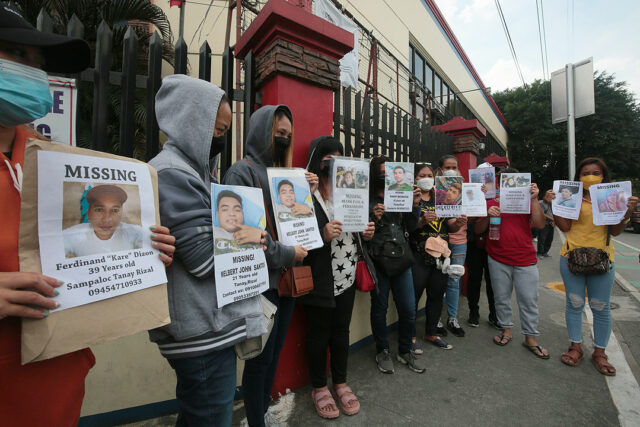
RELATIVES hold photos of some missing cockfighting aficionados (sabungeros) from Manila and Laguna, as they sought help from Malacañang, Jan. 31, 2022. — PHILIPPINE STAR/ MICHAEL VARCAS

By Patricia B. Mirasol, Reporter

DIANNE V. LOYOLA’S husband, whose job was to strap hook-shaped blades to the legs of roosters that spar to the death, went missing in January amid suspicions of game-fixing in the online version of a multibillion-peso industry that has since been banned.

The husband, Ferdinand, was one of about three-dozen cockpit workers and players from the main Philippine island of Luzon believed to have been kidnapped over a period of time, when many Filipinos locked down by a coronavirus pandemic got hooked on gambling including e-sabong or online cockfighting.

“E-sabong flourished in our village during the pandemic,” Ms. Loyola, a 32-year-old housewife from Tanay, Rizal, said by telephone in Filipino. “It’s easy to place a bet but it’s easy to lose as well.”

Cockfighting had become an online craze in the Philippines before the government banned the bloodsport amid the disappearance of the workers and players under suspicious circumstances.


The online game carried on livestreaming platforms allowed Filipinos to place bets on their mobile phones while locked down at home.

An international study by David Hodgins in 2021 found that gambling flourished during the lockdown, especially among younger males.

“As a gaffer (a person who puts blades on roosters’ legs) he came home with P500 per win,” said Ms. Loyola, whose husband used to sell motorcycles at Motorlandia. “In e-sabong, he got as much as P2,000. If the rooster lost, he didn’t get anything from his boss.”

Online cockfighting was bad for business, said Verman T. Reyes, who owns lending company Verman Loans, Inc.

“We have employees who got hooked on it,” he said in a Facebook Messenger chat. “Some of our collectors used company money to bet.”

He said some of these workers ended up borrowing to pay back his company. “Others couldn’t be traced anymore.”

Gambling destroys the family, said Randolf S. David, professor emeritus of sociology at the University of the Philippines.

“Trust is eroded, savings meant for emergencies are lost and worse, debts pile up,” he said in an e-mail, noting how the game has been made easily available by technology. “I am glad the government finally decided to stop it, but a lot have gone underground.”

IN JAIL OR DEAD
“Responsible governments that are aware of gambling’s effects on their citizens think twice before they license it under very strict regulations,” Mr. David said, noting that it could complement tourism and never as an exclusive revenue source.

Gambling addiction has social costs including domestic violence, child neglect and mental illnesses such as depression, Irene B. Dumlao, officer-in-charge and a director at the Social Welfare department, said in an e-mail.

Recovering gambling addicts advise that it is always best not to even start.

“Nothing can beat the first high,” said 41-year-old Reagan, a recovering gambling addict who has been sober for 11 years. “You’re constantly going to chase that high. I got caught in the thrill of the chase. The more I lost, the stronger my motivation to play.”

He said a gambler usually ends up either in jail, a health institution or dead.

Melbert John Santos, one of the 34 who went missing, was merely hired to drive a group of cockfighters to the AA Cobra Cockpit Arena in Sta. Cruz, Laguna early this year, his live-in partner Rowelyn S. Ebit said by telephone. “His father’s van was hired and he was asked to drive it,” she said. “He wasn’t a gambler.”

Gambling addiction is categorized as a substance-related and addictive disorder in the Diagnostic and Statistical Manual of Mental Disorders, the first recognized nonsubstance behavioral addiction.

Under a local law on mental health, people suffering from addiction may avail themselves of psychosocial and neurological services.

Gambling disorders may run in the family, said Beverly Denice T. Ongson, a registered psychologist and chartered business administrator of Dear Future Self PH, a mental health service organization. Trauma and social inequity are risk factors, she said in an e-mail.

“Counseling can assist the person in taking control of their gambling habits, mending broken relationships, coping with gambling urges and managing life or work stress,” she said. “It can also help maintain recovery and avoid triggers.”

“Sometimes, I thought of taking my own life,” said Reagan. “Sad to say, the addict holds the stability of the family. If we’re not okay everything falls apart.”

Ms. Loyola and the families of the missing cockfighters are still looking forward to the time when they will see them again.

“Our wish is for them to be released,” she said. “That’s what’s important, that we see our loved ones again.”

Everyone in the cockfighting arena in Sta. Cruz, is tight-lipped, Ms. Ebit said.

“I know that those who took them have families of their own,” she said. “A lot of children are waiting to be nurtured by their fathers again. I wouldn’t wish this to happen to anyone.”

Top Frontier maps expansion, plans expressways

TOP FRONTIER Investment Holdings, Inc., the largest shareholder of listed conglomerate San Miguel Corp. (SMC), has outlined the group’s plans for the coming years, including the expansion of its expressway projects.

“Our company’s strategic thrust is to continue the expansion of the existing businesses such as food and beverages,” said Top Frontier President and Chief Executive Ramon S. Ang during the company’s virtual annual stockholders meeting held on Friday.

“I think I may take the whole afternoon explaining about the expansion,” he added.

Mr. Ang said the construction of expressways and skyways would give greater access to New Manila International Airport, an ongoing project in Bulakan, Bulacan.

The company plans to expand Metro Manila Skyway Stage 3 (MMSS-3) to go through Sgt. Rivera in Quezon City to Road 10 (R-10) and Bulacan airport. It aims to shorten the travel time from Manila Hotel to the Bulacan airport to 15 minutes by car.

In addition to the expansion in MMSS-3 — an elevated expressway from Buendia, Makati City to the North Luzon Expressway in Balintawak, Quezon City — the company also plans to construct airport access through Tullahan.

Top Frontier plans to have at least eight new access to the Bulacan airport through the construction of more airport access in expressways: North Luzon Expressway (NLEX) through Mabalacat, Pampanga; NLEX through Tabang, Bulacan; and NLEX through Marilao, Bulacan.

The company also plans to build EDSA Buendia exit through MMSS-3 north and south-bound, which it will further on extend to Macapagal Ave., to NAIA Expressway (NAIAx) and to Manila-Cavite Toll Expressway (CAVITEx) plaza. It also disclosed a plan to build EDSA-Tramo-NAIAx, which will eventually be connected to the R-10 link.

In tollways, the company plans to build a 64-kilometer (km) Toll Road 4, which will be from Santo Tomas, Batangas to Lucena, Quezon, a 417-km Toll Road 5, which will be from Lucena, Quezon to Matnog, Sorsogon, and an expansion of Tarlac-Pangasinan-La Union Expressway (TPLEx) from Rosario, La Union first phase to San Juan, La Union and eventually to Laoag, Ilocos Norte.

Aside from expressway expansions, Mr. Ang also outlined expansions in its food and beverages business. The company is building six new breweries of two million hectoliters and is expanding its integrated poultry business of 960 million birds per year capacity to be ready-to-eat. A hectoliter is equivalent to 100 liters.

The company also has plans to expand power generation through the expansion of its clean energy and battery storage facilities, which is aimed at addressing a shortage in the current base load.

“Our company is in full blast — all its existing businesses and much, much more. We are also expanding into our cement manufacturing, we are expanding our bank — our Bank of Commerce is now a universal bank, and so much more,” Mr. Ang said.

“All businesses delivered strong results in the first quarter of 2022. Varying any surge in COVID cases we are confident that all our businesses will benefit from the opening of more sectors of the economy and be able to sustain [the company’s] growth in the full year 2022,” Top Frontier Director Aurora T. Calderon said during the same meeting.

In the first quarter, Top Frontier reported a decrease in attributable net income by 45.01% to P1.99 billion from the P3.62 billion recorded in the same period last year.

Meanwhile, it recorded an increase in revenues to P316.76 billion from the P201.16 billion recorded in the January-March period last year.

Listed holding firm Top Frontier holds a 65.99% stake in SMC. Other than its ownership in SMC and Clariden Holdings, Inc., the company has no other operations as of Dec. 31, 2021.

In the stock market on Friday, shares of Top Frontier remained unchanged at 117.00 apiece. — Justine Irish DP. Tabile

Senators say they are open to amending Rice Tariffication Law

PHILSTAR FILE PHOTO

By Alyssa Nicole O. Tan, Reporter

SENATORS have signaled their intent to amend the Rice Tariffication Law to address farmer complaints that the law has exposed them to unfair competition from imported rice, and to address more of the country’s food needs from domestic production.

The law “should be reviewed with a view to amending and correcting some of the unintended effects on our rice farmers,” Senator Francis Joseph G. Escudero told BusinessWorld in a Viber message.

“The only way to boost production and lower cost is for both the government and private sector to spend and invest more on agriculture,” he added.

The Federation of Free Farmers (FFF) has said that farmer incomes have dropped significantly since the law passed in 2019 due to “excessive” rice imports alongside the rising cost of production.

It said the law has made little to no progress in meeting its objective of improving farmer prosperity, noting the “drastic and recurrent drop in farmers’ incomes and farmgate prices.”

“There were only minimal gains for consumers, no significant improvement in farmers’ productivity, cost of production, and competitiveness, as well as flawed packaging and poor implementation of adjustment and relief measures for farmers,” FFF National Manager Raul Q. Montemayor has said.

He estimated that for the first three years after the law came into force in 2019, farmers have lost some P66 billion in income.

“The cost of producing palay (unmilled rice) went up… Cash assistance is only a band-aid solution to the problem. The government gives P5,000 per hectare and free seed, but it doesn’t fix the broken system that we have. There is a disconnect between the disease and the remedy,” he said.

“I am for the strengthening of the agriculture sector,” Senator Joseph Victor G. Ejercito told BusinessWorld in a text message, noting as well that he was the principal author of the Republic Act 10845 or the Anti-Agri Smuggling Law which categorized large-scale smuggling of agricultural products as economic sabotage.

“If the rice tariffication law has affected the price of palay, then I am for its amendment,” he added.

The law, which is in the books as Republic Act 11203, liberalizes rice imports, which used to be heavily regulated, with most foreign rice brought in via government-to-government deals. Instead, the law allowed private parties to import with fewer restrictions, though importers need to pay a tariff of 35% on grain brought in from Southeast Asia.

The tariffs support the Rice Competitiveness Enhancement Fund (RCEF) to the extent of P10 billion a year. The RCEF is funded for six years and supports farm mechanization, seed development, propagation and promotion, credit assistance, and extension services projects.

The Kilusang Magbubukid ng Pilipinas (KMP) has said the law “destroyed the lives of millions of rice farmers.”

By removing quotas on rice imports and replacing them with tariffs, the law was supposed to solve the problem of rising rice prices in 2018. The government also promised to use the tariffs to support programs that will make rice farmers more competitive.

The KMP contends that since the law passed, the rice industry has been “wrecked,” endangering food security.

The law “endangered the welfare of both producers and consumers. It undermined the livelihoods of millions of rice farmers and pushed many into hunger, bankruptcy, and indebtedness, while retail prices remain unaffordable to poor families,” KMP National Chairperson Danilo Ramos said.

President Ferdinand R. Marcos, Jr., who is concurrently the Secretary of Agriculture, has called for an assessment of the law, calling on his staff to review its pros and cons.

Finance Secretary Benjamin E. Diokno said on Friday that he will advise Mr. Marcos “not go back to the old system” of rice import quotas and government-to-government purchasing.

He pointed out the inflationary consequences of the law’s repeal, noting that rice used to be the biggest driver of inflation.

“That’s a really good law, it had a major contribution to our desire to control inflation. I think it’s not smart to go back to the old system,” he said. “(High rice prices) have been our problem for the last 50 years.”

Former Socioeconomic Planning Secretary Karl Kendrick T. Chua said that “since the passage of (the law) three years ago, it has had a negative to minimal contribution to inflation.”

“Imports are a way to address supply and price volatility. If we did not have that, people would have faced much higher inflation today,” he added.

Inflation climbed to its highest level in nearly four years in June, further eroding purchasing power, the Philippine Statistics Authority (PSA) said on Tuesday.

Preliminary data from the PSA showed that growth in the consumer price index accelerated to 6.1% year on year in June, exceeding the Bangko Sentral ng Pilipinas’ 2-4% official target range for a third straight month. The June reading exceeded the 5.4% posted in May and the year-earlier 3.7%.

The law benefits 2 million farmers, 110 million consumers, and thousands of retailers, wholesalers, millers, and those in the warehousing and transport businesses, Mr. Chua said.

“Last year, we collected P18.9 billion from rice tariffs. We gave all that back to rice farmers. Those calling for the removal of the law risk taking away what we are giving to farmers to improve their productivity,” he said.

“Further lowering the price of rice for all Filipinos is really possible if we help farmers improve productivity. That is exactly what the law is doing by providing them with mechanization, seed, and other support,” he added.

Farmer organizations have lobbied the government to reduce dependency on imports.

“We have to aim for self-sufficiency and stop relying on imports. Food security depends on our farmers but our government allows our farmers to be harmed first before they do anything about it,” the Magsasaka at Siyentipiko para sa Pag-unlad ng Agrikultura Regional Coordinator Rowena A. Buena has said.

Injured Ramos ruled out of the Asia Cup campaign in Indonesia

DWIGHT RAMOS — FIBA

ALREADY burdened with manpower woes, Gilas Pilipinas took another heavy blow as Dwight Ramos, one of its key players, is sitting out the International Basketball Federation (FIBA) Asia Cup campaign in Indonesia due to injury.

Mr. Ramos, according to the Samahang Basketbol ng Pilipinas (SBP), is suffering from “medial tibial stress syndrome” or shin splints, which forced him out of action in the July 12-24 Continental meet altogether.

“(Mr.) Ramos has been dealing with pain in his left leg for the past week but it has become too much to overcome as he could not join the team for practice anymore,” the SBP said on Sunday.

Mr. Ramos, who produced 21 points, five rebounds, two assists and four steals in Gilas’ 79-63 rout of India last Sunday in the FIBA World Cup (WC) Asian Qualifiers third window, joined Ange Kouame (ACL tear) and Dave Ildefonso (knee) in sick bay.

Reserve Rhenz Abando, pending clearance from FIBA Asia, is being eyed to take Mr. Ramos’ spot and link up with skipper Kiefer Ravena, Poy Erram, Thirdy Ravena, Ray Parks, RJ Abarrientos, SJ Belangel, William Navarro, Carl Tamayo, Francis Lopez, Geo Chiu and Kevin Quiambao.

“We will definitely miss Dwight (Ramos) who’s one of our starters,” said Gilas program director Chot Reyes, who is tasked to call the shots for the youth-laden five.

“But that’s the value of having a pool and the reason why Rhenz (Abando) is making the trip with the team.”

Gilas is set to launch its bid in Group D on Wednesday against Lebanon before facing off with old rivals from the recent WC Qualifiers in India and New Zealand on Friday and Sunday, respectively.

Mr. Reyes’ wards need to top the group to gain outright entry into the quarterfinals or at least finish second or third for a chance to advance via the qualification to the quarterfinal stage. — Olmin Leyba

MPTC yet to feel impact of high fuel prices on vehicle volume

TOLL road developer and operator Metro Pacific Tollways Corp. (MPTC) has yet to feel the impact of rising fuel prices on the vehicle traffic volume on its road network in the country, its chief financial officer said.

“We haven’t felt the impact of the fuel price increases. For the first half, we have already exceeded the 2019 traffic volumes, so pre-pandemic,” MPTC Chief Finance Officer Christopher Daniel C. Lizo told reporters during a gathering in Cavite last week.

“In total, across the network, I think we are maybe 5-6% above the 2019 traffic volumes,” he said, referring to the traffic volume seen in June. “That’s excluding the new roads that opened.”

On its website, MPTC said it handles 700,000 vehicles per day on average during the pandemic and close to a million vehicles per day pre-pandemic.

The company’s toll roads include North Luzon Expressway, Subic–Clark–Tarlac Expressway, Manila–Cavite Expressway, Cavite–Laguna Expressway,  and Cebu–Cordova Link Expressway.

The company saw a slowdown in traffic in the first five days of July, Mr. Lizo said.

“Maybe by 6% compared to June. It’s also a function of seasonality. Traffic peaks in the second quarter, summer. Kapag tag-ulan na, bumababa talaga yan. (In the rainy season, traffic falls.)”

MPCALA Holdings, Inc., a subsidiary of MPTC, is eyeing the operationalization of its upcoming interchange, the Silang (Aguinaldo) Interchange, in the latter part of the year.

“This will extend CALAX’s operational sections from Mamplasan, Laguna, to Aguinaldo Highway in Silang, Cavite,” the company said in an e-mailed statement.

“As of today, the 3.9-kilometer 2×2 lane CALAX subsection reaches 56% of completion. Part of the ongoing works includes drainage and bridge constructions, excavation and roadway earthworks, and installation of fence and coco net,” it added.

Raul L. Ignacio, MPCALA Holdings president and general manager, said the Silang (Aguinaldo) Interchange is expected to help decongest the busiest highway in Cavite, the 41-kilometer Emilio Aguinaldo Highway. 

“Motorists from Manila going to the famous tourist destinations of Silang and Tagaytay, Cavite will surely benefit from this upcoming project as it offers convenience and shorter travel time.”

The 45-kilometer CALAX project has eight subsections: Kawit to Open Canal (subsection 1), Open Canal to Governor’s Drive (subsection 2), Governor’s Drive to Silang (subsection 3), Silang to Silang East (subsection 4), Silang East to Santa Rosa (subsection 5), and Santa Rosa to Mamplasan (subsections 6, 7, & 8).

Subsections 6 to 8 started operations in 2019 and CALAX Laguna segment interchanges, which are part of the subsections 6 to 8, opened the following year. These interchanges are the Laguna Boulevard Interchange and the Laguna Technopark Interchange.

Last year, CALAX Subsection 5, which connects Silang East to Sta. Rosa-Tagaytay Road Interchange, was inaugurated, extending the expressway’s operating sections from 10 to 14.24 kilometers.

Full completion of the CALAX project is expected in 2023. Once fully operational, the project is expected to cut travel time between the CAVITEX and SLEX to 45 minutes from the current 2.5 hours.

MPTC is the tollways unit of Metro Pacific Investments Corp., one of three key Philippine units of Hong Kong-based First Pacific Co. Ltd., the others being Philex Mining Corp. and PLDT Inc.

Hastings Holdings, Inc., a unit of PLDT Beneficial Trust Fund subsidiary MediaQuest Holdings, Inc., has a majority stake in BusinessWorld through the Philippine Star Group, which it controls. — Arjay L. Balinbin

For EV and ever

Shell officials pose at the Shell Recharge bay next to an all-electric Jaguar I-Pace. — PHOTO BY KAP MACEDA AGUILA

Pilipinas Shell unveils first electric vehicle charging facility, rolls out carbon offset program

IF ANYONE asks about the feasibility of electric vehicles in the country, you can say that it’s surely getting better by the day. The most obvious pain point — the enduring issue of range — is being addressed on multiple fronts through better battery technology and energy recuperation at the OEM end, while the dearth of charging infrastructure is slowly being solved as well.

While the Philippines is admittedly still at the infancy stage of mainstream EV adoption, progress is happening from more favorable legislation and policies, to the aforementioned steady establishment of charging facilities.

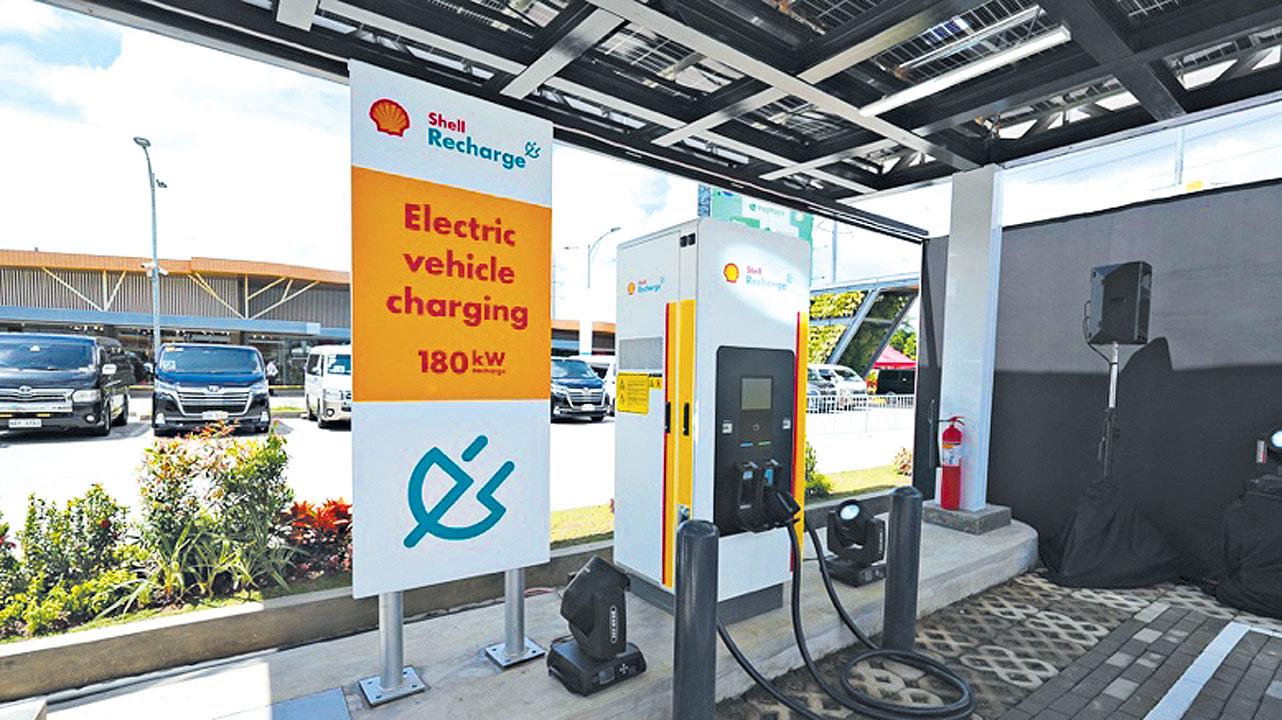
By all indications, last Thursday was a big win for the EV sector, as Pilipinas Shell, which has a network of 1,100 “mobility stations” in the country, made a historic step of introducing its very first electric vehicle charging facility here. Located within the sprawl of Shell Mamplasan on the northbound lane of the South Luzon Expressway (or SLEx), a high-power Titan 180kWh 300A charger with CCS2 connectors will be able to service up to two compatible electric vehicles simultaneously. The DC charger is, according to Shell, the most powerful of its kind, and can fully charge a vehicle from low battery status to “optimal battery charge” in as little as 30 minutes. For the service, customers are charged P65 per minute. Now if you multiply that by 30, then that’s P1,950 to get the full range of your EV — surely way less than topping up your conventional internal-combustion-engine-powered vehicle with fossil fuel.

Branded as Shell Recharge, the service will gradually be introduced in more locations over the next 12 months — and beyond. In an exclusive interview with “Velocity,” Pilipinas Shell Vice-President and General Manager for Mobility Randy Del Valle revealed that up to eight stations may feature the service by the end of the year.

Aside from Shell Recharge, Pilipinas Shell presented another program in line with its vision of “decarbonizing mobility.” Now available for retail customers here is the brand’s so-called Nature-based Solutions (NBS) Carbon Offset Service. In 2020, Shell became “the first energy company in the Philippines to offer the (service) to its B2B fleet customers.” Now, everyday consumers can get to make up for their carbon emissions from ICE-powered vehicles.

“By being the first Shell market in Asia to offer this particular service to everyday customers, Pilipinas Shell underscores its commitment to continue powering progress to achieve a more sustainable future,” said Pilipinas Shell Country Head Lorelie Quiambao-Osial. “These two new low-emission energy solutions encapsulate what Pilipinas Shell means when we say sustainability. It’s about providing energy in a responsible manner to our consumers so that we can minimize the impact we make on the environment while achieving a lower-carbon future,” she added.

Continued Mr. Del Valle to this writer: “The NBS Carbon Offset Service is (a result of us noticing that) customers here in the Philippines really want to make sure that they are actually net zero. This gives everyone an opportunity to be so. Every time our customers gas up at Shell, we can offset their fuel consumption.”

What does this all mean? “Because fuel comes from oil, there’s some carbon that is actually used to develop the fuel. So, for you to be net zero, we’re giving you an offset that if you buy credits, you can have that carbon offset by helping plant forests around the world — equivalent to the fuel you’ve consumed.” This target of negating one’s carbon footprint is achieved, of course, by “investing” in nature’s carbon sinks such as forests. The total number of liters purchased with carbon offsets by customers are then assigned the equivalent carbon credits from Shell’s “independently verified global portfolio of Shell NBS afforestation, reforestation, and conservation projects.” These credits are then retired by Shell on behalf of the customer. The voluntary contribution of P2.50 per liter of fuel can be made at participating Shell stations.

“There are a lot of forests around the world that we support. There are various locations in South America, and here in Asia. And then for the Philippines, we’re continuing to explore some locations where we can do this as well,” he added.

In tandem with Shell Recharge, this carbon offset drives home the company’s push to decarbonize mobility “by helping customers in avoiding, reducing, and compensating for carbon emissions, as well as its transformation toward becoming the mobility destination of choice for motorists.”

“Shell is rapidly becoming the Philippines’ leading mobility company and this launch is a testament to the range of its offer to motorists,” said Shell Mobility Global Executive Vice-President Istvan Kapitany. “The NBS Carbon Offset Service and Shell’s first EV charger in the country are among the initiatives to reduce carbon emissions and to cater to a growing number of customers whose needs are changing fast… We are making sure that Shell sites will become the go-to place for all customers, whether they drive traditional or EV, thanks to an integrated offer of fuel, EV, and convenience retail. They will be mobility destinations for everyone.”

Farm industry calls for more imports of raw materials for animal feed

REUTERS

By Luisa Maria Jacinta C. Jocson, Reporter

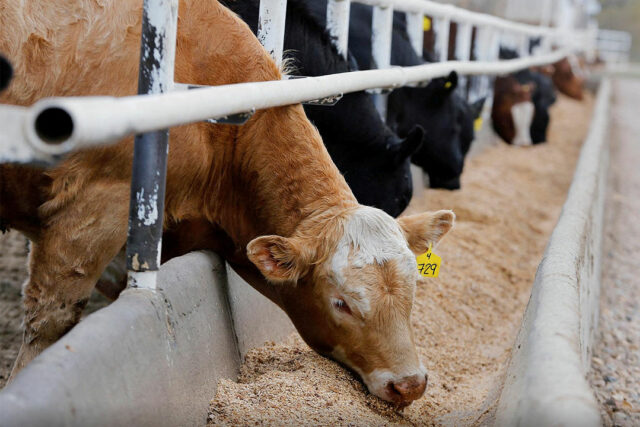
FARMERS called for increased imports of the raw materials used in animal feed, citing the need to provide relief to growers suffering from rising input prices in the wake of the Russia-Ukraine war and the logistics disruptions caused by the pandemic.

“The priority should be the ease of importing ingredients, not finished products. (That way,) we can keep the livelihoods here and have the by-products. As of the moment, I believe there is no need to import chicken. Too much importing will discourage poultry growers who are… taking on the extra challenges due to the Russia-Ukraine war and other global disruptions,” Feedmix Specialist II, Inc. Vice-President Norberto O. Chingcuanco said in a Viber message.

He added that the input costs have been rising due to the cost of soy and other proteins used in animal feed, as well as wheat.

“There are weather and disease related problems, in addition to the rising cost of feed. Then there is uncertainty over imports which discourages raisers from investing and rehabilitating or expanding their facilities. There could have also been a shift in demand from pork to chicken as a result of the high prices of pork,” Federation of Free Farmers National Chairman Raul Q. Montemayor added in a Viber message.

The price of whole chicken in Metro Manila markets increased by P25 from a month earlier to P200 per kilogram in June, according to the Department of Agriculture (DA).

Rising input costs have been an industry problem even before the onset of the pandemic and the crisis in Europe, according to United Broiler Raisers Association President Elias Jose M. Inciong.

“Even before the Ukraine war, prices of corn and soy already went up. In the case of local corn especially, corn farmers lost confidence because a large portion of their market, which was the hog industry, disappeared because of African Swine Fever,” he said.

Corn prices have risen to P22-P23 per kilogram from P14-P16 per kilogram in 2021, according to Mr. Inciong.

Soy likewise increased to P34-P36 per kilogram this year from P24-P26 per kilogram last year.

“This has impacted the performance of the broiler industry, whether terminal broiler farms or breeders. Right now, the day-old chicks that used to cost P28-P30 per kilogram now cost P38 pesos,” he said.

Due to poor production by the poultry sector, Mr. Inciong said that undersized chickens have proliferated and are now finding their way into the markets to meet demand.

“In the normal course of things, chicken below 1 kilogram is not sold. It’s too small. But now it can be sold. Because it is in short supply, even the poor-quality (birds) will have buyers because they want to continue production,” he said.

Fast food chains like Jollibee and McDonald’s have reported supply problems, particularly in procuring chicken that passes their quality standards.

Mr. Inciong said, “They won’t buy the runt chickens of course.”

In order to augment supply and solve the shortage for the long term, Mr. Inciong said that the government must look into policy reforms while consulting producers.

“This is the culmination of almost two and a half decades of the neglect of the agriculture sector. Every one of us will be paying for the price of wrong policies and false narratives,” he said.

“The more important step is for the government to interface with the frontliners and producers, because there are details in every industry that (the President) needs to know. They will be the first one to say what needs to be done,” he added.

President Ferdinand R. Marcos, Jr., who is also the Agriculture Secretary, said that the government might consider additional imports of chicken and pork to meet the growing demand and temper rising prices.

“With the African Swine Fever still affecting the pork industry and a shortage in feed posing a problem for the broiler industry, the Department of Agriculture (DA) may still look into importing minimal volumes of pork and chicken,” he said in a virtual briefing on Tuesday.

“Production is not sufficient. Our production is not sufficient in rice, corn, livestock and fisheries. That is why I made agriculture the highest priority of what we are doing because you cannot build a strong economy if you don’t have the foundation of a robust agricultural sector which assures food supply even in emergencies,” he added.

The DA, through the Bureau of Animal Industry (BAI), also announced that it has taken steps to increase production and stabilize supply and market prices.

“Among the measures being undertaken is allowing inter-island movement from mainland Luzon of day-old chicks, hatching eggs and ready-to-lay pullets. For day-old chicks and hatching eggs, movement is allowed provided they tested negative for 28 days from the date of sample collection. For ready-to-lay pullets, movement is allowed provided they tested negative 14 days from the date of sample collection,” it said.

The BAI has issued special import permits for vaccines in order to address poultry diseases such as Infectious Body Hepatitis.

CTA affirms partial refund for Deutsche Knowledge

THE Court of Tax Appeals (CTA) affirmed its division ruling partially granting Deutsche Knowledge Services Pte. Ltd.’s (DKSPL) claim for a refund worth P990,730.56 representing its excess input value-added tax (VAT) traced to zero-rated sales for the first quarter of 2007.

In a 23-page decision on July 1 and made public on July 6, The CTA full court said DKSPL was able to sufficiently prove that its clients were foreign corporations not engaged in trade or business in the Philippines.

The court noted the company presented certificates of non-registration from the Securities and Exchange Commission (SEC), which the court deemed competent evidence to prove its clients were foreign entities.

“This court finds no compelling reason to reverse or modify the findings of the court a quo in the assailed decision and resolution,” according to the ruling written by CTA Associate Justice Erlinda P. Uy.

The CTA Second Division earlier ruled DKSPL successfully substantiated P990,730.56 out of the original P12,549,446.30 claim.

“The commissioner of internal revenue (CIR) did not indicate any reversible error made by the Court in Division in its appreciation of the subject Certificates, nor did he disprove DKSPL’s justifications for the said disparities,” said the tribunal.

The CIR, the petitioner, argued that the CTA Second Division made an error in giving weight to the SEC certifications of non-registration.

The CTA full court also rejected DKSPL’s appeal to refund its original claim of P12,549,446, as the court upheld its division ruling.

DKSPL provides its clients with corporate finance advisory services, research and development services, and logistics services among others. The company is also a subsidiary of Deutsche Bank Group in Singapore.

The CIR has the authority to act upon and approve claims for refund or tax credit in accordance with the country’s tax code.

Under the country’s tax code, a transaction should be treated as zero-rated VAT if the following conditions are met: services must be performed outside the Philippines, the recipient of services is doing business outside the country, service offered must be other than processing, manufacturing or repacking of goods and paid in acceptable foreign currency accounted for in the laws of the local bank. — John Victor D. Ordoñez