Home Blog Page 5753

Saving a traditional art by going modern
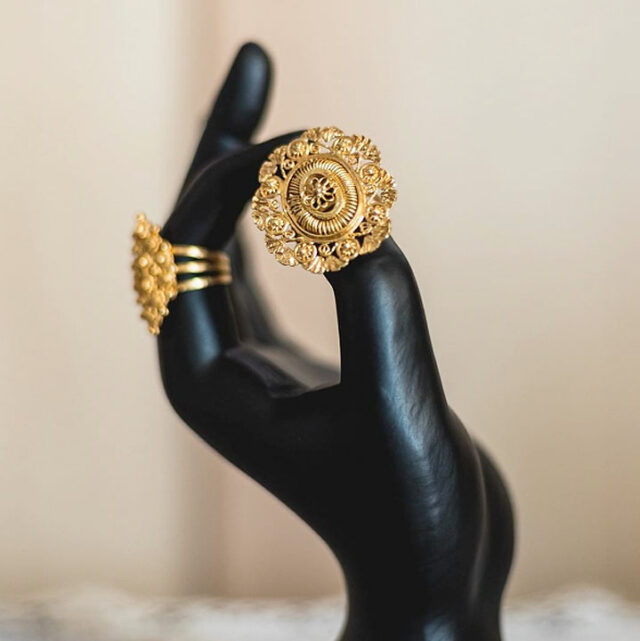
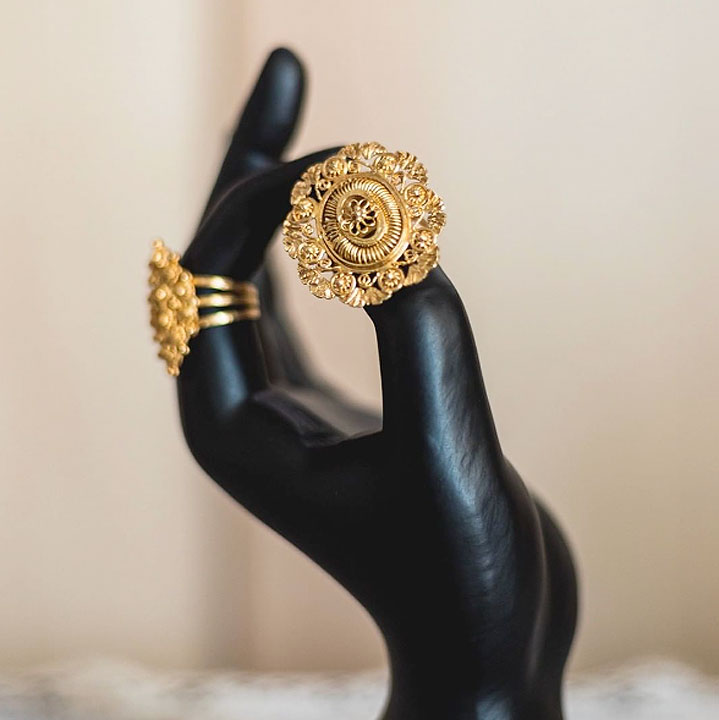
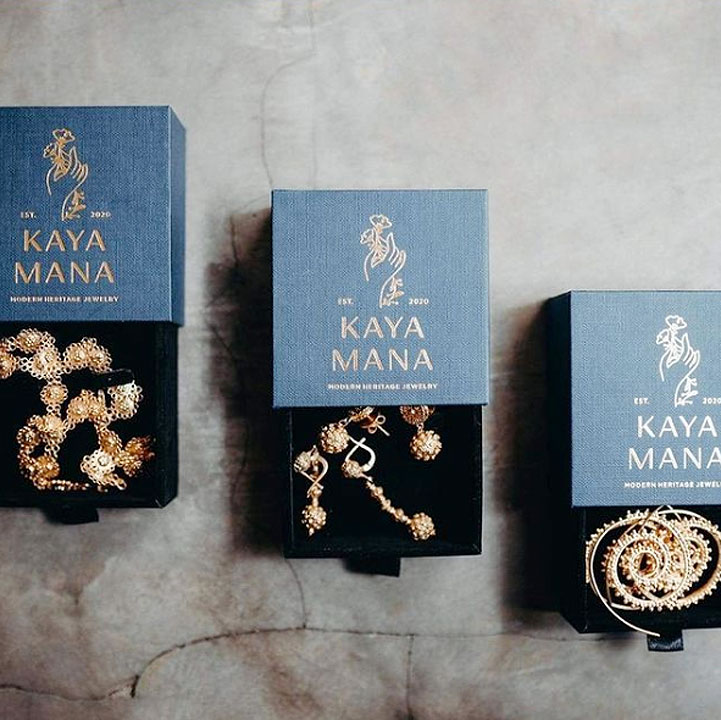
RELIKARYO ring — INSTAGRAM.COM/KAYAMANA.PH

PURSUING a research project for university made a student strike gold — literally.

Paolo Palanca, founder of Kaya Mana PH, found a maker of traditional Filipino tambourine jewelry during a research trip to Ilocos Sur, and has since parlayed that into a business. More than an enterprise, it has become a shared mission between Mr. Palanca and his platero, Mang Nelson* to save a part of cultural heritage, improve a dying industry, and improve Mang Nelson’s life.

We chanced upon Mr. Palanca at his stall at the Likhang Habi Fair in Glorietta, which ran from Oct. 14 to 16. Sitting at his booth, we watched several customers, both young and old, ask about the jewelry.

Tambourine jewelry is a hybrid art of pre-colonial Filipino skills in crafting gold, as well as Spanish influences. Many samples of tambourine jewelry from the Spanish colonial period are religious artifacts, such as reliquaries and rosaries.

Mr. Palanca explained why the demand for traditional jewelry fell by the wayside, starting from the 1980s. “The price of gold increased a lot over that period,” he said, with Mang Nelson saying that when he was a boy, gold could be had for P50 per gram, while it now sits at P3,300 per gram, and the price is still increasing. Another reason was the presence of counterfeit tambourine jewelry (liked as it was by collectors and costumers), which scared off customers from artisans. Finally, it just faded from fashion, what with the presence of easily manufactured jewelry from around the world; as well as changing tastes.

STARSTRUCK
Why then did Mr. Palanca decide to invest in an industry that was already dying? At the time Mr. Palanca and Mang Nelson met in 2017, Mr. Palanca had been working under the assumption that the jeweler was the last one in the Philippines (it turns out that there were more traditional jewelers around the country, but the number is still small). During that research trip, Mr. Palanca and his groupmates were shown several pieces by Mang Nelson, things that he couldn’t sell.

Unang kita pa lang, starstruck na kami (We were starstruck at first sight),” said Mr. Palanca. “We found it so impressive that not only did he make this by hand, but the details were so fine.”

“It didn’t make sense that he was having a hard time, struggling to provide for his family, when the things he was making were so beautiful.”

Prior to their partnership, Mang Nelson had been ready to pack up his things and follow his wife to be an Overseas Filipino Worker in Canada, and with him, the heritage and skill involved in making filigree jewelry would have gone away as well. Mr. Palanca and his groupmates took the pieces and sold them to friends and family, while leaving Mang Nelson with some start-up funds to create more pieces. With the proceeds of the initial sale, they reinvested it back into the business, and Kaya Mana was born.

POWER OF INHERITANCE
Mr. Palanca talked about the name. At first, they picked “mana” (a Filipino word for “inheritance”) to reflect the letters in Mang Nelson’s name, as well as recalling ideas of heritage. They added “kaya” (a word associated with “ability”) to differentiate themselves from other businesses, but also to add depth to their name. Of course, combining the two words would result in something close to “kayamanan” (wealth, or treasure), but, “We wanted to be close enough to it, but more than it. It’s not just kayamanan, it’s ‘kaya mana’: the power of our inheritance.”

Tambourine jewelry is made by flattening gold into sheets and turning those sheets into fine wires that can be woven together. In the process of helping Mang Nelson, they’ve also modernized some equipment to make the process faster, as well as making it safer. Some of the designs have been slightly modernized to appeal to a younger audience. Think former rosary beads turned into charms, or earrings, or bracelets. Instead of the traditional 18-karat gold, some pieces are made of gold-plated silver (vermeil). A stunning necklace was being sold for P50,000; but there were bracelets available at P7,500.

With adaptation comes the question of authenticity. Mr. Palanca answers with an insight from Mang Nelson: “The purpose of it is still there. Even if you’re changing some parts, it’s still filigree tambourine jewelry.”

It also comes with the realization that some things are really better when made by hand. “Your hands are better than the machines. You can make pieces that are more finely detailed, more intricate, than any machine could do,” he pointed out.

MAKING A LIVING
“One of the reasons why we want people to come back and do it is (for people to know) that you can make money, you can survive off of being an artisan,” he said. “We want to make it enticing to people.”

According to Mr. Palanca, the minimum wage in Ilocos Sur, where Mang Nelson lives and works, is about P200; a sum they have increased so Mang Nelson could continue making jewelry. In the first year since Kaya Mana’s founding in 2017, Mang Nelson was able to fund for his wife’s first vacation from Canada, which they spent in Baguio.

“The whole point is to get them back to the level where they were before the decline,” said Mr. Palanca. “Eventually, they can be independent again.”

In Aja Raden’s book Stoned: Jewelry, Obsession, and How Desire Shapes The World, she writes: “The very purpose and nature of jewels is one and the same: to transfix and reflect. Just like their glittering surfaces, jewels have one, and only one power: they reflect our desires back to us and show us who we are.”

“As Filipinos, this is something we didn’t know we could be proud of,” said Mr. Palanca. “It’s something that we are very grateful to discover.”

“It’s sad that we had to discover it,” he said. “We wish that we were taught about it in school.”

Kaya Mana is available at the Frankie General Stores in Rockwell and SM Aura, as well as through their Instagram, @kayamana.ph. — Joseph L. Garcia

*For security reasons, BusinessWorld was asked not to use Mang Nelson’s full name.

SNAP considers expanding floating solar project in Magat 

RENEWABLE energy company SN Aboitiz Power (SNAP) is planning to scale up its 200-kilowatt floating solar power project in Magat dam, its top official said last week.

Joseph S. Yu, president and chief executive officer of SNAP, told BusinessWorld that the company is upgrading its solar panels to ones with higher efficiency and newer design.

“We are currently upgrading the panels to a newer design. In the meantime, we still have yet to see the system being challenged by a strong typhoon that would allow us to develop the technical resiliency aspect of the system,” Mr. Yu said.

He said that at present, the company is in coordination with the National Irrigation Administration and National Grid Corp. of the Philippines to work out the access to the reservoir and the transmission units.

“We have a service contract to upscale it to around 67-megawatts,” he added.

“Numbers are changing, almost every time so it is hard to pin it down, but [the] rule of thumb I am assuming [is] that it would be a million dollars per megawatt,” Mr. Yu said.

In 2019, SNAP said it invested around P24 million in the floating solar project in Ramon, Isabela, which consisted of 720 solar panels. The facility is situated over a 2,500-square meter area in the Magat reservoir.

SNAP is a joint venture between SN Power of Norway and Aboitiz Power Corp. — Ashley Erika O. Jose

SC finds transport firm, president liable for tax evasion

FREEPIK

THE Supreme Court (SC) has affirmed the tax evasion convictions of Kingsam Express, Inc. (KEI) and its president for failing to pay deficiency income tax for the taxable years 2008 and 2009 worth more than P4 million and P10.8 million, respectively.

In a 14-page resolution dated Sept. 7 and made public on Oct. 14, the SC First division said the firm and its president “willfully” attempted to evade the tax obligations.

“The president and responsible officer, knew of KEI’s purchase of bus units in 2008 and 2009 and yet he deliberately omitted the transactions in the corporation’s income tax returns and financial statements,” said the High Court.

The ruling affirmed the findings of the Court of Tax Appeals (CTA), which sentenced KEI President Samuel S. Santos to up to four years of imprisonment and a fine of P100,000 for the four indictments against him.

The tax court said noted that the transport firm and Mr. Santos underdeclared their income for 2008 and 2009 by at least 620% and 650%, respectively.

Under the country’s revenue code, taxpayers are required to file an accurate quarterly income tax return and a final or adjustment return.

The law also provides the internal revenue commissioner with the authority to assess a taxpayer’s tax deficiencies based on the “best evidence obtainable.”

KEI argued that the CTA’s ruling should be overturned since Mr. Santos was not properly identified by government prosecutors in the case.

The High Court disagreed saying the firm’s president himself admitted to the tax tribunal that he was in charge of information on the tax returns.

“The state can resort to administrative and judicial remedies to collect taxes from erring taxpayers which comprise both civil and criminal suits,” it noted.

“Thus, the State, through the CIR, can directly file a  criminal complaint to enforce the collection of taxes.” — John Victor D. Ordoñez

37th Honda Cars Philippines dealership opens in Isabela

Cutting the ceremonial ribbon at the Honda Cars Cauayan inauguration are (from left) Honda Cars Philippines, Inc. (HCPI) General Manager for Sales Division Atty. Louie Soriano; Gateway Group Executive Vice-President Michael Goho; Cauayan City Vice-Mayor Leoncio Dalin, Jr.; and Gateway Group President Raymund Basubas — PHOTO FROM HONDA CARS PHILIPPINES

HONDA CARS CAUAYAN (HCCU) in Isabela opened last Oct. 3, bringing the Honda Cars Philippines, Inc. (HCPI) dealership count to 37.

HCCU is strategically located in Barangay Tagaran along the National Highway of Cauayan City. In a release, HCPI said that the new dealership makes the Honda brand even closer to customers in Northeastern Luzon. HCCU measures 3,545 sq.m., and features a five-car display showroom, spacious customer lounge, and a Modulo and Mugen parts and accessories corner. Honda owners may also bring their vehicles for after-sales services such as preventive maintenance and general repairs as HCCU’s service area has 15 work bays and eight lifters, along with “state-of-the-art facilities and equipment.” Customers will be assisted by HCCU’s well-trained sales consultants, service advisors, and technicians.

HCCU is the fourth Honda Cars dealer under the management of the Gateway Group. Through HCCU, Honda will “fortify its presence in an already widely established dealer network in the Luzon area.” Furthermore, HCCU “embodies Honda’s global standard of delivering excellent products, as well as services throughout the customer journey.” HCCU is also the first dealership to adopt the complete new visual identity that sports a refreshed look and new dealership signage design, aligned with Honda Motor Co., Ltd. in Japan.

“We are delighted to welcome Honda Cars Cauayan once again into HCPI’s roster of dealerships. The growing network of Honda Cars dealers in the Philippines affirms Honda’s commitment to reaching out to more customers to help ensure a smooth and convenient ownership experience for them. Congratulations and all the best to the Gateway Group. We look forward to serving more customers in partnership with them,” said HCPI President Masahiko Nakamura.

Honda Cars Cauayan is open from Mondays to Saturdays, 8 a.m. to 5 p.m. For appointments or inquiries, contact 0917-844-6586. Alternatively, customers may check Honda’s Virtual Showroom at www.hondaphil.com for convenience in exploring Honda vehicles, online reservations, or booking service appointments.

Piña-silk, wool-like silk, and cocoon exfoliators

A SCARF made of silk yarn

Negros’ silk industry goes beyond the usual fabric

WE didn’t expect to find luxurious silk in rustic Bago City in Negros Oriental, but there it was, in scarves and cocoons at last month’s Negros Trade Fair in Glorietta.

The silk-reeling operations in Negros began around 20 years ago, according to Thelma Watanabe, President of the Negros Silk Producers’ Association during an interview with BusinessWorld at the Negros Trade Fair, which ran in late September. The project was spearheaded by Japanese-headquartered non-government organization OISCA (The Organization for Industrial, Spiritual and Cultural Advancement). During a tree-planting project, Japanese supporters of the organization saw the potential to plant mulberry trees. “Mulberry is very suitable for our climate,” said Ms. Watanabe. “It grows anywhere except in swampy places.” Mulberry leaves also happen to be the food of choice for caterpillars of the Bombyx mori, otherwise known as the silkworm.

The parent stock is from both China and Japan, and are provided to silk farmers who maintain the mulberry plants from which silkworms eat. The silkworms weave a cocoon as part of their metamorphosis, and these cocoons are then processed into silk threads.

“With our efforts, we were able to see the industry take off. We are now supplying the bulk of the silk being circulated in the local market,” said Ms. Watanabe. Most of the silk is used in Aklan, where silk is woven along with piña (pineapple fiber) to make a piña-seda (silk) blend. She showed a sample of the piña-silk hybrid, which was made into barongs that were worn by world leaders at the 2015 APEC Summit.

“When we started producing the cocoons, it was examined at random in Japan, and it proved to be of very competitive quality,” she said. “Maybe because of the water in Negros.”

She showed off a scarf, made of silk yarn. It did not have the smooth and silky nature that lent the material’s name to the adjective. Instead, it was fuzzy, like very light wool. “This is another type of yarn, which we produce from the innermost part of the cocoon,” she said.

“It may look like cotton, but it’s really very soft. Lighter, softer, and you can see the glow,” she said. “To produce the yarn for this is very hard. You will have to manually make it into yarn, with saliva,” she said. The spinner’s fingers are wet with spit to draw out the thread from the innermost part of the cocoon.

Speaking of cocoons, Ms. Watanabe showed us another product. Individual silk cocoons are cleaned and packed, and are placed on fingertips to use as facial exfoliators. According to her, not only do the cocoons slough off dead skin, but also impart silk proteins (sericin) to the skin, making the skin smoother and firmer. We did try using the exfoliators at home, and they did leave us with a glow that lasted about two days.

Silk farmers harvest around six to seven times in a year, and they are paid for the top-grade cocoons per kilogram, with the highest grade (AA) sold at P260 per kilogram, with farmers bringing about 26 to 28 kilograms per harvest.

“In the beginning, producing silk just augmented their income. But as they get so skilled in producing the raw cocoons, they have additional income, and maybe they can expand, and our silk industry will really put the Philippines on the map.”

For more information, contact the OISCA-Bago Training Center for native silk products at nspa.oisca@gmail.com. — Joseph L. Garcia

Rice inventory up 3.5% in August

PHILIPPINE STAR/WALTER BOLLOZOS

THE rice inventory in August rose 3.5% to 1,633.36 thousand metric tons (MT), the Philippine Statistics Authority said.

On a month-on-month basis, inventory declined 19.7% from July.

Rice held by households rose 5.4% year on year, while that held by commercial warehouses, wholesalers, and retailers rose 9.1%. On the other hand, stocks held by the National Food Authority (NFA) fell 24.7%.

Households accounted for about 48.5% of the month’s rice inventory, followed by commercial warehouses, wholesalers and retailers with 43.3% and the NFA 8.2%.

Meanwhile, corn inventory was estimated at 704.46 thousand MT, down 0.4% year on year.

Compared to the July inventory, corn stocks dropped 5.7%.

Inventory levels in commercial warehouses, wholesalers, and retailers grew 3.3% while households stocks fell 20.5%.

Some 87.9% of the corn inventory was held by commercial warehouses, wholesalers, and retailers, with the remainder in households. — Luisa Maria Jacinta C. Jocson

Hospital networks important in managing healthcare facilities better 

TUNG NGUYEN-PIXABAY

HAVING a hospital network in the Philippines will help in making healthcare efficient, affordable and accessible, a top official of Metro Pacific Hospital Holdings, Inc. (MPHHI) said.

“Hospitals [in the Philippines] were actually left alone to do their own thing so there was a lack of standardization across the network,” MPHHI Chief Executive Officer Harish Pillai said in an interview.

“We have a few good hospitals, especially in the National Capital Region, like Makati Medical Center and Cardinal Santos Medical Center but there’s a great value to leverage the power of a network,” Mr. Pillai added.

According to the official, MPHHI addressed this by introducing co-creation and collaboration principles through the creation of experience councils.

“As a holding company, we now have clinical functions. We have a group chief medical officer, we are now going to appoint a chief nursing officer, we have a quality head, patient experience head, and information technology head,” Mr. Pillai said.

“This new leadership at the holding company will influence our hospitals also to really work in a totally different way focusing on the code that is basically patient-focused,” Mr. Pillai added.

Although the Philippines is fortunate to have a very talented healthcare workforce, Mr. Pillai said that since it is fragmented, collaboration among doctors is difficult.

“So, one of our big projects is the digital architecture that we are trying to create. That will really benefit patients at large, especially in the provinces,” Mr. Pillai said.

Through this project, medical experts will be able to share their expertise in a digital ecosystem with the hospitals in the area.

Mr. Pillai said that the digital ecosystem will allow patients in provinces to access the same level of expertise as those in Metro Manila.

To date, MPHHI has 19 hospitals in its network, making it the largest private hospital operator in the country. It also has two allied health colleges, a growing number of primary care clinics and a cancer care center, and a central clinical laboratory. — Justine Irish D. Tabile

Isuzu D-Max, mu-X breach 20kpl in five-day test

At the flag-off of the Isuzu Challenge are (from left) Isuzu Philippines Corp. (IPC) President Noboru Murakami; professional drivers Johnsy Reyes, Mon Dimapilis, Alvin Mañalac, and Alex Lao; and IPC Vice-President for Sales Yasuhiko Oyama. — PHOTO FROM ISUZU PHILIPPINES

AMID FLUCTUATING fuel prices, Isuzu Philippines Corp. (IPC) sent out two of its best-selling model variants — the D-Max 3.0L 4×2 LS-A AT and the mu-X 3.0L 4×2 LS-A AT — on a five-day journey to “push the limits of… fuel-efficiency” through the so-called Isuzu Challenge.

Boasting a five-star ASEAN NCAP rating and luxurious styling, the D-Max and mu-X units were driven by two teams from the Isuzu Subic dealership up north going to Isabela then Cagayan, accompanied by official verifiers from the Automobile Association Philippines (AAP). Faced with torrential rain brought by Typhoon Florita, the drive was made even more challenging as strong winds brought created more drag on the vehicles. Still, both made the trip uneventfully and smoothly even amid road blocks and debris.

Driving down south, the vehicles made their way through the twisty roads of Nueva Vizcaya before heading to Alabang. Through their final stretch down to Bicol, the Isuzu D-Max mustered 20.58kpl on one full tank — a total of 1,564 kilometers. Having a bigger fuel tank capacity of 80 liters, the mu-X went even farther — 1,675 km or 20.94kpl.

Stated IPC Vice-President for Sales Yasuhiko Oyama in a release, “(These vehicles’) highly advanced 4JJ3-TCX engine optimizes engine performance with fuel-efficiency.” An intelligent six-speed automatic transmission with sequential shift is said to provide the driver more control over gear changes.

The executive added, “More than highlighting Isuzu’s superiority when it comes to diesel engine technology, we would like to provide solution to our customers especially in the face of increasing fuel prices. Excellent fuel economy is just one of the many Isuzu advantages they can enjoy while driving these models.”

For more information, visit www.isuzuphil.com.

Rates of T-bills, bonds to climb

BW FILE PHOTO

RATES of government securities on offer this week may rise as the Bangko Sentral ng Pilipinas (BSP) chief signaled another aggressive hike next month amid growing inflation pressures.

The Bureau of the Treasury (BTr) will auction off P15 billion in Treasury bills (T-bills) on Monday, made up of P5 billion each in 91-, 182-, and 364-day debt papers.

On Tuesday, it will offer P35 billion in fresh 10-year Treasury bonds (T-bonds).

A trader sees T-bill and T-bond yields moving higher at this week’s auctions after BSP Governor Felipe M. Medalla hinted at another big rate increase at their policy meeting next month.

“Expect investors to demand higher T-bill yields as the BSP bills were awarded at as high as 5.2125% earlier,” the trader said, referring to the full awarding of 28-day BSP securities worth P120 billion on Friday, with accepted yields ranging from 4.7% to 5.2125% for an average of 4.9781%.

“This can be attributed to the BSP governor’s statement of a possible 50-75 bps (basis points) hike next month.”

Bid yields for the 10-year T-bond are expected to range from 7.35% to 7.5%, the trader added.

Rizal Commercial Banking Corp. Chief Economist Michael L. Ricafort likewise said T-bill and T-bond yields could go up again as traders anticipate policy makers to fire off a large increase at the Monetary Board’s rate-setting meeting on Nov. 17.

“BSP Governor Medalla signaled possible large local policy rate hike of 50 or 75 bps at the next rate-setting meeting … in an effort to reduce the pressure on the peso and also cool inflation as this could impact economic recovery,” Mr. Ricafort said in a Viber message.

The BSP “also signaled a combination of measures such as using international reserves, raising rates, and, if possible, some form of international cooperation,” Mr. Ricafort added.

Meanwhile, UnionBank of the Philippines, Inc. Chief Economist Ruben Carlo O. Asuncion said higher US inflation, which fueled expectations for a fourth straight 75-bp increase from the Federal Reserve, will likely keep rates of long tenors above 7%, with this week’s offering of 10-year bonds expected to fetch yields between 7.25% and 7.5%.

On Thursday, Mr. Medalla said in a Bloomberg Television interview that the BSP will consider another outsized rate increase in their Nov. 17 review to support the currency and prevent its depreciation against the dollar from further stoking inflation.

The BSP chief said they are looking at a 50-bp or 75-bp increase next month to help rein in inflation and ease currency pressures stemming from a strong dollar amid the Fed’s hawkish stance.

The Philippine central bank has raised benchmark rates by 225 bps since May.

Meanwhile, US consumer prices increased by 0.4% in September as rent and food costs surged. Year on year, the US consumer price index advanced by 8.2%, reinforcing expectations that the Fed will deliver a fourth straight 75-bp rate hike next month.

The US Fed has raised borrowing costs by 300 bps since March.

At the secondary market on Friday, the 91- 182- and 364-day T-bills were quoted at 3.3704%, 4.0154%, and 3.881%, respectively, based on the PHP Bloomberg Valuation Service Reference Rates published on the Philippine Dealing System’s website.

Meanwhile, the 10-year bond fetched a yield of 7.2021%.

Last week, the Bureau of the Treasury (BTr) raised just P3.97 billion from its T-bill offer, even as total tenders reached P16.31 billion, above the P15 billion on the auction block.

Broken down, the BTr borrowed just P1.27 billion through the 91-day T-bills, even with total bids reaching P7.58 billion, above the P5-billion plan. The average rate of the tenor rose by 150.1 bps to 3.819% from the 2.318% seen on Sept. 5, the last successful award. Accepted rates ranged from 3.6% to 4.25%.

The Treasury also raised only P2.695 billion via the 182-day securities despite tenders reaching P5.645 billion versus the P5-billion program. The average rate of the six-month T-bill went up by 45.7 bps to 4.415% from the 3.958% quoted during for the last successful award on Sept. 26. Accepted rates ranged from 4% to 4.65%.   

Meanwhile, the BTr refused to award any 364-day debt papers, with demand for the tenor only reaching P3.081 billion versus the P5 billion on the auction block. Had the government accepted all bids, the one-year T-bill’s average rate would have climbed by 161.9 bps to 5.401% from 3.782% fetched for the last successful award on Aug. 22.

The BTr wants to raise P200 billion from the domestic market this month, or P60 billion through T-bills and P140 billion via T-bonds.

The government borrows from local and external sources to help fund a budget deficit capped at 7.6% of gross domestic product this year. — Luisa Maria Jacinta C. Jocson

Mattel celebrates Tina Turner with Barbie creation

PICTURE of a Barbie doll created by Mattel resembling singer Tina Turner due to the celebration of the 40th anniversary of her hit song What’s Love Got To Do With It, Oct. 13. — MATTEL/HANDOUT VIA REUTERS

TOY company Mattel is honoring Tina Turner on the 40th anniversary of her hit song “What’s Love Got To Do With It” with a Barbie doll created in her likeness.

The doll, which is part of their Barbie Signature Music Series, is wearing an outfit inspired by the music video for the song — a black mini dress paired with a denim jacket and her signature hairstyle.

“I am honored to welcome my Barbie into the group of trailblazing women already represented and introduce more kids to my journey,” Ms. Turner, 82, said in a statement.

The eight-time Grammy winner enjoyed huge success in the late 1960s and early 1970s performing with her former husband, Ike Turner, but the couple divorced in 1978 after a stormy marriage.

In early November 2019, Turner attended the opening night of The Tina Turner Musical on Broadway, which chronicles her life and work.

She retired from performing after her last tour, which ended in 2009.

Turner, who was born in Tennessee, moved to Switzerland in 1995 to join her German-born record producer partner Erwin Bach, who she later married in 2013, and became a citizen in April of that year.

The doll is available for purchase on MattelCreations.com and through Amazon, Walmart and Target. — Reuters

On New Zealand farm, scientists reduce cow burps to save the world

REUTERS

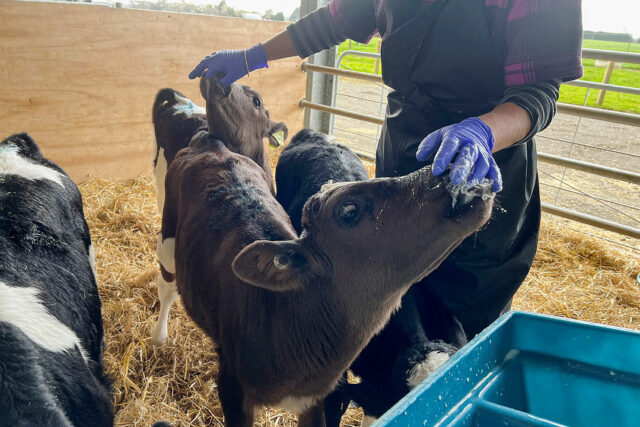
PALMERSTON NORTH, NEW ZEALAND — More than a dozen calves wait at a research farm in New Zealand to be fed Kowbucha, a punnily named probiotic that studies show reduces burps — or methane emissions.

The Kowbucha powder is blended into a milk-like drink fed to the calves at the Massey University farm in Palmerston North.

The regular feeds are part of a series of trials being carried out by New Zealand dairy giant Fonterra since 2021 to gauge how effective the probiotic is in reducing methane emissions.

New Zealand has pledged to cut biogenic methane emissions by 10% on 2017 levels by 2030 and by up to 47% by 2050.

The “true eureka moment” came when early trials suggested that calves emit up to 20% less methane when they receive the probiotic supplement, said Shalome Bassett, principal scientist at Fonterra Research and Development Centre.

“Probiotics are great because they’re a really natural solution,” Ms. Bassett told Reuters. “Whatever we do, it has to be something that’s easy for the farmer to use, has to be cost effective, and we have to ensure that it’s good for the cow and doesn’t have any effect on the milk.”

Ongoing trials have shown similar, promising results, she said. If that continues, Fonterra hopes to have Kowbucha sachets in stores by the end of 2024, Ms. Bassett said, before farmers have to start paying for animal burps.

Fonterra said it did not yet have any pricing information for the sachets. Some feed additives available abroad have proved to be more efficient. Royal DSM’s Bovaer feed additive can reduce methane emissions by 30% in dairy cows and by more in beef cattle.

Fonterra said Kowbucha likely provides an easier solution generally as farmers only have to feed it to calves when they are being reared, given it is expected to have a lasting impact.

New Zealand will in 2025 become the first country to price agricultural emissions, including methane emissions from burping cows and sheep, whose digestive systems produce methane when breaking down vegetation.

Agricultural emissions account for around half of the country’s greenhouse gas emissions. Ahead of that, farmers, businesses and scientists are working on ways to cut emissions without reducing herd number, given agricultural products make up more than 75% of the country’s goods exports.

As well as the early optimism around Kowbucha, AgResearch scientists said in December they had successfully bred low-methane producing sheep, while a product called EcoPond that almost eradicates methane in farm sewage has been on sale since late 2021.

New Zealand is also considering whether supplements that have had success abroad can be adapted locally. Much of the science overseas focuses on altering barn animals’ food and is harder to implement in a country where animals largely live outdoors and eat grass.

“The easiest way to reduce emissions is to reduce production or have less animals basically, so that’s a real challenge when we’re trying to also produce food and keep our export returns at the level that we want them,” said ANZ agricultural economist Susan Kilsby.

Ahead of 2025, the government is considering exactly how to price agricultural emissions. While pricing farm emissions is not universally popular, many believe it is the push farmers need to reduce them.

Mike Manning, general manager of innovation and strategy at agricultural cooperative Ravensdown, said farmers have been slow to adopt its EcoPond technology without financial incentives.

The system cuts up to 99% of the methane emitted from the manure-sludge left behind in a dairy shed after milking.

“People go ‘well, I might wait until I have a price of methane then I have a financial driver,’” Mr. Manning added.

New Zealand’s government said in May it would spend NZ$380 million ($213.22 million) on research over four years to counter agricultural emissions. The cash injection may accelerate research and get some emerging technologies into the hands of farmers and growers “much earlier” said Sinead Leahy, principal science advisor at government-funded Agricultural Greenhouse Gas Research Centre.

A lot of research is already under way. After discovering that some sheep naturally produce less methane than others, AgResearch headquartered in Hamilton bred sheep with this inheritable trait with one another and found that the lowest emitting sheep produced close to 13% less methane than the highest emitters.

If such breeding were to be carried out on a national level, it could reduce New Zealand’s methane emissions by up to 1%, said AgResearch.

The dairy industry is now looking at how to apply that research to cows, Ms. Leahy said.

For Fonterra, research also remains key as it aims to cap farm emissions at 2015 levels. In addition to Kowbucha, it is also trialing other feed additives and seaweed.

“It’s definitely important for us to be leading in this space. Our farmers need a solution and New Zealand needs a solution,” said Ms. Bassett. — Reuters

Economic reopening boosts appetite for SM Prime stocks

SM PRIME HOLDINGS, Inc. was one of the most actively traded stocks in the local bourse last week as investors’ appetite increased due to normalized stock prices following the further improvement of the economy.

SM Prime had the second highest value turnover last week, with P1.27 billion worth of 40.315 million shares exchanging hands from Oct. 8 to 14, data from the Philippine Stock Exchange show.

The share price of the Sy-led property firm closed at P31.80 apiece on Friday, up 1.3% from the previous day and 1.1% week on week. For the year, the stock has gone down 5.1%.

SM Prime’s stock price fell 1% and 0.5% to P31.15 and P31 per share on the first two trading days last week, but the next three days saw its price rebound by 0.6%, 0.6%, and 1.3%, respectively.

“Investor appetite is focused on stocks that have normalized (back to pre-pandemic) like SM Prime’s foot traffic, a strong indicator of recovering fundamentals,” said Cristina S. Ulang, research head at First Metro Investment Corp.

Ms. Ulang added that the opening of SM City Tanza would add to the company’s net asset value, revenue, and earnings per share growth outlook next year.

SM City Tanza opened its doors to the public last week, making it SM Prime’s 80th mall. It is also the seventh “supermall” in Cavite after SM City Bacoor, SM City Dasmariñas, SM City Molino, SM City Rosario, SM City Trece Martires, and SM Center Imus.

“With the continuous improvement in our local economy, we hope that SM City Tanza will be an avenue of opportunities for local SMSEs to grow as well as for local employment to prosper and drive progress not only in Tanza but in the whole province of Cavite,” SM Prime President Jeffrey C. Lim said in a report.

For Aniceto K. Pangan, equity trader at Diversified Securities, Inc., SM Prime became one of the most active stocks last week following a sell-off in the market.

“SM Prime is among the most active stocks this week as investors accumulated with price valuation becoming attractive as price go down with the recent selloff in the market despite its recent expansion in Tanza, Cavite and earnings growth due to the reopening of the economy,” Mr. Pangan said in a mobile phone message.

Mr. Pangan added that with the easing in restrictions and reopening of the economy, the company may continue to expect a double-digit rise in revenue for the year. He gave an estimate of P18 billion for the third quarter. —In the second quarter, the company’s consolidated net income rose 32.7% to P6.857 billion. Buoyed by mall business revenues, first-half income grew by 23% to P14.373 billion.

SM Prime opened SM City Tanza last Friday with an 89% space lease awarded at its two levels. Its shops will be led by the SM group’s The SM Store, SM Supermarket, Ace Hardware, SM Appliance Center, Watsons, Pet Express, Miniso, Uniqlo, Crocs, Surplus, and Banco De Oro.

The mall will house five cinemas, a Cyberzone, a food court, a carpark with around 800 slots, and public transport terminals.

SM Prime has been named Most Outstanding Real Estate Company in the Philippines by Asiamoney, an international financial publication.

For the coming week, Ms. Ulang said that SM Prime’s stock price would continue to increase.

“It will surely be rising because it has been a very resilient stock, a play on [the] Philippines’ strong consumption story even during the high inflation years,” said Ms. Ulang.

She placed the stock’s support level at P30 per share and its resistance at P32 per share. She also gave a near-term target of P35 to P36 a share.

Mr. Pangan said that with the start of the release of third-quarter earnings, optimism might ensue and “a rebound in SM Prime price prior to the release of its earnings.”

He pegged the stock’s immediate support at P30.85 while its immediate resistance at P32.45. — Lourdes O. Pilar