Home Blog Page 5752

South Korea kicks off military drills amid talk of North Korean nuclear test

REUTERS

 – South Korea‘s troops kicked off their annual Hoguk defense drills on Monday, designed to boost their ability to respond to North Korea‘s nuclear and missile threats amid simmering tension over both sides’ military activities.

The drills, due to end on Saturday, are the latest in a series of military exercises by South Korea in recent weeks, including joint activities with the United States and Japan.

The latest field training came as North Korea has been carrying out weapons tests at an unprecedented pace this year, firing a short-range ballistic missile and hundreds of artillery rounds near the heavily armed inter-Korean border on Friday.

Pyongyang has angrily reacted to the South Korean and joint military activities, calling them provocations and threatening countermeasures. Seoul says its exercises are regular and defense-oriented.

Joined by some U.S. forces, the South Korean troops will focus on maintaining readiness and improving the troops’ ability to execute joint operations during the Hoguk drills, the South‘s Joint Chiefs of Staff said.

“The forces will conduct real-world day and night maneuvers simulated to counter North Korea‘s nuclear, missile and other various threats, so that they can master wartime and peacetime mission performance capabilities and enhance interoperability with some U.S. forces,” it said in a statement.

Last week, tensions flared after the North fired a missile, shot more than 500 artillery shells and flew a multitude of warplanes near the skirmish-prone sea border.

Seoul condemned Pyongyang and imposed its first unilateral sanctions in nearly five years, describing the moves as a violation of a 2018 bilateral military pact banning “hostile acts” in the border area.

But the North accused the South‘s military of escalating tension with its own artillery firing.

South Korean lawmakers have said the North has completed preparations for what would be its first nuclear test since 2017, and might conduct it between China’s key ruling Communist Party congress, which began on Sunday, and the Nov. 7 U.S. midterm elections. But some analysts do not expect any tests before the Chinese congress ends. – Reuters

PEZA-approved investments decline

REUTERS

THE PHILIPPINE Economic Zone Authority (PEZA) reported a 10% decline in approved investment pledges in the third quarter amid global uncertainties.

In a statement on Sunday, the investment promotion agency said it approved 58 new and expansion projects worth an estimated P17.142 billion during the July to September period, 10.46% lower than the P19.145 billion worth of approved investments recorded in the same quarter last year. 

“(The) decline can be attributed to the lower baseline for investments approved last year due to the continuing impact of coronavirus disease 2019 (COVID-19) pandemic and the surging cost of fuel in the global market with the protracted Russia-Ukraine war,” PEZA Officer-in-Charge and Deputy Director General for Planning and Policy Tereso O. Panga said in a Viber message.

PEZA said the new projects are expected to generate $877.807 million worth of exports and create 13,904 jobs.

“Among the approved new and expansion projects, 21 will be for export, 19 for information technology (IT), seven for facilities, and three for tourism,” it said.

The agency also approved eight economic zone (ecozone) development projects in the third quarter as part of efforts to boost countryside development. These include three manufacturing ecozones in Cavite, Batangas, and Pampanga; two IT parks in Iloilo and Davao; and two agro-industrial zones in Iloilo.

In the first nine months, PEZA approved P39.631 billion worth of investments from 148 new and expansion projects, a 22.60% drop from P51.203 billion recorded in the same period last year.

“It is a decline but we were able to narrow down the gap (in the third quarter). We expect more big-ticket projects to register in the last quarter of 2022,” Mr. Panga said.   

PEZA also gave the greenlight for 20 big-ticket projects (with a minimum of P1-billion capital each) which will bring in P24.758 billion worth of investments, and generate $654.338 million worth of exports. These projects are expected to create 9,649 direct jobs.

It said Cebu Mitsumi, Inc., Robinsons Land Corp., and TDK Philippines Corp. are among the companies behind these major projects.

“These investments will be into manufacturing of various products, accommodation, real estate activities, office administrative, business support activities among others,” PEZA said.

Despite the year-on-year decline in approved investments, Mr. Panga expressed optimism the agency will still be able to meet its 6-7% investment growth target in 2022.

“We remain bullish that we will be able to achieve our 6% to 7% investments target for the year taking into consideration the firm growth forecasts for 2022 of our winner ecozone sectors at 10% to 15% for IT & Business Process Association of the Philippines (IBPAP) and 10% for Semiconductor and Electronics Industries in the Philippines Foundation, Inc. (SEIPI),” Mr. Panga said.

“These bright outlooks are aligned with the calibrated year-end gross domestic product (GDP) growth for the Philippines at 6.5%- 7.5%, which makes the country among the fastest-growing economies in the region,” he added.

Mr. Panga said that the PEZA is looking into new types of ecozones to entice more investors. 

These ecozones include knowledge, innovation, science and technology parks, mineral processing ecozones, renewable energy hubs, aquamarine ecozones, halal hubs, bio-tech centers, defense industrial complexes, and pharmaceutical parks.

“PEZA is eyeing to attract high-tech industries and emerging technologies in the fields of industrial manufacturing transport, technology media and telecommunications, health and life sciences including mineral processing of green metals,” Mr. Panga said. 

Also, Mr. Panga said the PEZA is awaiting the guidelines that will allow 100% work-from-home (WFH) arrangement for registered IT-BPO firms.

Last month, the Fiscal Incentives Review Board (FIRB) announced that registered IT-BPO firms can conduct a 100% WFH and still enjoy tax incentives if they conduct a “paper transfer” or shift their registration to the Board of Investments (BoI) from the PEZA. 

“As long as we are kept whole with PEZA’s exercise of its regulatory powers, investment facilitation and income-generating functions — together with the IT locators’ enjoyment of flexiwork with incentives regardless of location — we are all for it,” Mr. Panga said. 

The PEZA previously sought for a law that will institutionalize hybrid work, especially for IT firms, so that they can have the same footing with BoI-registered business enterprises (RBEs).

“With the interim ‘paper transfer’ arrangement, we hope that it will allow as well for a reregistration mechanism for transferee RBEs in the IT Centers that may want to restore their PEZA status once the enabling law is in place,” Mr. Panga said. — Revin Mikhael D. Ochave

PHL central bank may need to continue rate hikes — IMF

BW FILE PHOTO

By Keisha B. Ta-asan, Reporter

THE BANGKO Sentral ng Pilipinas (BSP) may have to continue raising interest rates in tandem with the US Federal Reserve amid higher inflation and the peso depreciation, an International Monetary Fund (IMF) official said.

“Depending on what the Fed does, depending on how we see the interest rate differential between the US dollar and the Philippine peso, depending on how we see inflation developments in the Philippines. I think the BSP will take these issues into consideration and decide on the next move,” IMF Mission Chief for the Philippines Cheng Hoon Lim told BusinessWorld in an Oct. 13 interview.

“If inflation pressures persist in the Philippines and if you know, there’s a further widening of interest rate differential there, the BSP may have to continue to hike interest rates, but they’re going to have to see what incoming data tells them,” she added.

The US Federal Reserve is widely expected to hike rates at its Nov. 1-2 meeting, as inflation remains elevated.

The Monetary Board has raised benchmark interest rates by a total of 225 basis points (bps) so far this year. Its next policy-setting meeting is scheduled on Nov. 17.

Philippine headline inflation quickened to 6.9% year on year in September, exceeding the central bank’s 2-4 target band for a six straight month. The average inflation rate for the year so far is at 5.1%, still below the BSP’s full-year forecast of 5.6%.

“The strength of the US dollar has led to capital outflows from many countries and that has caused currencies in Asia and elsewhere in the world to depreciate,” Ms. Lim said.   

The local unit closed at P58.935 per dollar on Friday, gaining 6.5 centavos from its record-low finish of P59 on Thursday, based on Bankers Association of the Philippines data.

Year to date, the peso has depreciated by 15.55% or P7.935 from its P51 close on Dec. 31, 2021.   

Asked if the BSP has room to raise interest rates further, Ms. Lim said its monetary policy stance is still accommodative.   

“(Policy) goes back up to what economists call the neutral rate where we can get full employment without inflation rising. So as long as they are normalizing, we do not see the growth for next year to be jeopardized, Ms. Lim said.   

“They can raise interest rates while still preserving economic recovery,” she added.   

On Friday, BSP Governor Felipe M. Medalla said the central bank will consider a 75-bp hike in November to keep the peso from further weakening and contributing to inflationary pressures.   

“The argument for not responding point-by-point is that our inflation rate is lower, but the argument for doing something bolder is that the question of the currency also has to be addressed,” Mr. Medalla told Bloomberg Television.   

GROWTH
The IMF expects the Philippine economy to expand by 6.5% this year, lower than its previous estimate of 6.7%, and matches the lower end of the government’s 6.5-7.5% goal.

“We expect the Philippine economy will meet the government’s growth target for this year,” Ms. Lim said, adding that private consumption and investment will be the main drivers of growth in 2022.   

The economy expanded by 7.8% in the first half of 2022.

However, Ms. Lim said the growth outlook remained clouded by uncertainties caused by the slowdown in major trading partners such as the United States and China, and tightening monetary policy.

In its latest World Economic Outlook (WEO) the IMF slashed the global gross domestic product (GDP) growth outlook to 3.2% from 3.6% this year and to 2.9% from 3.6% for 2023.

“In line with this, we are therefore projecting a moderation for growth in 2023 to 5%. Obviously if downside risks materialize growth could be slower than that,” Ms. Lim said.

However, a global recession may also lead to inflation easing next year, she said.   

“If there is a global recession, commodity prices will likely also come down more than we project and that would be helpful in the sense of imported inflation for the Philippines. Growth may slow down a little bit, but inflation will also moderate,” she added.   

The IMF sees Philippine inflation rising to 5.3% this year before declining to 4.3% in 2023.   

FISCAL CONSOLIDATION
Ms. Lim said the Philippine government is “doing the right thing” in its fiscal consolidation efforts.

“We want our fiscal and monetary policy to work together in the current juncture when inflation is high,” she said.

The Philippines is planning to undertake fiscal consolidation to ensure the sustainability of public debt. As of end June, the debt-to-GDP ratio stood at 62.1%, beyond the 60% threshold prescribed by multilateral lenders for developing economies.

The Marcos administration is aiming to bring down the debt-to-GDP ratio to 52.5% by 2028.

“In the longer-term perspective, we would like to see greater revenue mobilization and cost-effective government spending,” Ms. Lim said, adding that the country needs to have more funds for infrastructure and other social and development objectives.   

“A concrete medium-term fiscal strategy on how the Philippines can raise additional revenues would be very helpful,” she said.   

When asked how can the government narrow down the country’s fiscal deficit, Ms. Lim said it is important to make sure that the pace of fiscal consolidation is right.   

“Now, if there’s a global recession and downside risks materialize, then we need to rethink the pace of fiscal consolidation,” she said.   

“But that is a downside risk scenario and if that happens, the pace of fiscal consolidation should be slower.”


BSP looking at possible cases of peso speculation

A man accepts Philippine peso bills at a money remittance center in Makati City, Metro Manila, Philippines, Sept. 19, 2018. — REUTERS/ELOISA LOPEZ

THE BANGKO Sentral ng Pilipinas (BSP) is closely monitoring possible cases of speculative activities amid the peso’s continued weakness, Finance Secretary Benjamin E. Diokno said on Friday.

“The central bank has initiated actions to moderate sudden movements in the peso including participation in the foreign exchange market as well as looking at possible cases of speculative activities,” Mr. Diokno said in a conference at the Philippine Embassy in Washington, D.C. on Friday.

“The central bank encourages the use of an organized and accessible formal market for all transactions and is taking steps to manage any disruption in the Philippine financial market,” he added.

On Friday, the local unit closed at P58.935 against the greenback. For the year so far, the peso has weakened by 15.55% or P7.935 from its P51 close on Dec. 31, 2021.

Mr. Diokno, a former BSP governor and a current member of the Monetary Board, attributed the peso’s weakness to the US Federal Reserve’s hawkish monetary policy and market expectations of further tightening, as well as concern over a possible global recession.

“While we continue to subscribe to a flexible foreign exchange rate regime, we are looking closely at the implications of the foreign exchange rate movement on inflation,” he added.

Headline inflation surged to 6.9% in September, its fastest pace in over 13 years, mainly driven by rising food, utilities and transport costs. This also marked the sixth straight month that inflation breached the BSP’s 2-4% target this year.

“Inflation has continued to remain elevated among both emerging and developed markets. Most countries have already breached their targets, mainly due to a combination of high global commodity prices and the broad strengthening of the US dollar. Furthermore, the scarring effects of the pandemic on the economy linger,” Mr. Diokno added.

Rizal Commercial Banking Corp. Chief Economist Michael L. Ricafort said that local banks are supportive of the BSP’s initiatives against peso speculation.

He also noted regulators have recently sent signals that would discourage undue speculation on the peso, such as tightening reporting of banks’ foreign exchange transactions and increasing intervention in the foreign exchange market. The BSP is also planning to increase debt issuance to reduce supply of pesos that could be used to purchase US dollars in the market.

“All of these discourage undue speculation on the peso, while emphasizing the continued servicing of legitimate forex transactions as supported by the required documents,” he added.

The BSP earlier this month warned market players not to take “undue advantage” of the peso.

“We ask those who have the means not to take undue advantage of changing market conditions. This does not help the Philippine peso; it does not help the Philippines,” it said.

Last week, Bankers Association of the Philippines said it “continues to work closely with the BSP for orderly, fair and transparent markets minus the unproductive activities that only hurt the public.” — Luisa Maria Jacinta C. Jocson

Biden brushes off risks of strong dollar on global economy

REUTERS

US PRESIDENT Joseph R. Biden dismissed the risks of a strong US dollar and instead blamed anemic growth and policy missteps in other parts of the world for dragging down the global economy.   

“I’m not concerned about the strength of the dollar, I’m concerned about the rest of the world,” Mr. Biden told reporters on Saturday during a campaign stop in Portland, Oregon. “Our economy is strong as hell.”

Mr. Biden’s comments stand in contrast with top leaders from other countries, who have increasingly voiced concerns about how the rising greenback is fueling inflation in their own economies. The dollar has climbed roughly 15% this year as the US Federal Reserve embarked on an aggressive campaign to raise interest rates to tamp US price increases.

The impact of the rising dollar was a key topic among delegates at the International Monetary Fund and World Bank, which concluded their fall meetings on Saturday in Washington. Fed officials heard a constant barrage of concerns from other nations about how the surge in the greenback has raised the cost of their imports and increased inflation, setting off their own cycles of tightening.

But with the Fed on track to continue lifting borrowing costs through the end of the year, Mr. Biden sought to deflect blame for the slowing global economy. On Saturday, he criticized UK Prime Minister Liz Truss’ tax-cutting plans for causing turmoil in markets, calling it a “mistake.”

“It’s predictable. I mean, I wasn’t the only one that thought it was a mistake,” Mr. Biden said in Portland. “I think that the idea of cutting taxes on the super wealthy at a time when — anyway, I just think — I disagreed with the policy,” he added.

Ms. Truss’ policies, including a controversial tax cut for the wealthy that she’s since reversed, sparked a plunge in the pound and forced the Bank of England to step in to support gilts. The turmoil spilled over into global markets, as traders wary of further volatility sought refuge in havens, further boosting the dollar.

But beyond the UK, the strong dollar continues to weigh on the global economy, particularly poorer nations that rely on food imports. The destructive combination of the soaring greenback, high interest rates, and elevated commodity prices is eroding their power to pay for goods typically priced in the dollar and compounding a worsening global food crisis, among others.

Mr. Biden’s remarks stand in contrast with his predecessor. During his administration, Donald Trump took swipes at the Fed, saying he doesn’t want a strong dollar that hinders trade with other nations. Before that, previous US presidents in recent decades have generally refrained from commenting about the currency.   

In response to the growing global complaints about the US currency, Treasury Secretary Janet Yellen told an international audience during the meetings in Washington this week that fighting inflation is the administration’s top priority, even while acknowledging “spillovers from tightening monetary policy in advanced countries.” She reiterated that “market-determined exchange rates are the best regime for the dollar.”

Mr. Biden’s latest messaging contrasted with his comment in a CNN interview on Tuesday that allowed for the possibility of a US recession, though he said: “If it is, it’ll be a very slight recession.”

On Saturday, he reiterated the administration’s insistence that inflation “is worldwide.”

“The problem is the lack of economic growth and sound policy in other countries,” Mr. Biden said. — Bloomberg

First Gen sees first imported LNG delivery after July 2023

LOPEZ-LED energy company First Gen Corp. said its unit’s liquefied natural gas (LNG) terminal is on track for completion by the first quarter of 2023, with the possibility of making the first gas delivery after July, a company official said last week.

“I think the progress is good. It should actually be completed by the end of March or positively before,” Jonathan C. Russell, executive vice president and chief commercial officer of First Gen, told reporters on Friday.

In a presentation during the Norway-Philippines Maritime and Energy Conference on Friday, he showed a video on the status of the project, which First Gen’s subsidiary FGEN LNG Corp. intends to complete early next year.

“It’s looking substantially complete now. We really need to get into the control systems, which were the things that were delayed because some of those were coming from China, which was affected by very severe lockdown,” Mr. Russel said.

In its disclosure last month, First Gen said Norwegian firm BW LNG, which is a floating gas infrastructure developer, will provide LNG storage and regasification services to First Gen’s existing and planned gas-fired power plants and third-party terminal users.

Last Friday, Mr. Russell has given his assurance that by 2023, the LNG unit will run and start its operations.

“For the first year of operations we will be looking probably to consume up to half a million tons of LNG,” he said, “and possibly a million tons for the second year that could be adjusted up if the demand requires it.”

Yngvil Asheim, chief executive officer of BW LNG, said the company does not expect any delay in its commitment.

“The vessel is essentially ready to go. She needs going for a few and final modifications for the terminal. That is already well-planned, but she is ready to go in whenever the terminal is ready,” she said.

Mr. Russel said: “We’re in discussions with gas or LNG suppliers right now. I can’t say too much because those negotiations are ongoing.”

“The first delivery of LNG won’t happen until after July,” he said, adding that the month is the schedule for bringing in the floating storage and regasification unit.

According to a report from the Department of Energy (DoE), FGEN LNG’s terminal has a total capacity of 5.26 million tons per annum (MTPA) and an estimated construction cost of P13 billion.

Further, the DoE’s Natural Gas Development Plan showed that LNG terminal projects in the country have an overall investment of P69.23 billion and a potential capacity that is projected to reach 24.6 MTPA by 2040.

The DoE said that 20% of the Philippines’ total power requirements, together with 27% of the Luzon grid, is provided by the Malampaya gas field. However, the Malampaya concession will expire in 2024, with its supply expected to reduce starting this year.

LNG projects in the country are concentrated in Luzon, which has the highest demand for natural gas, the DoE said. — Ashley Erika O. Jose

PAL revises 2022 target revenues to $2.6 billion

BW FILE PHOTO

PHILIPPINE Airlines, Inc. (PAL) upwardly revised its 2022 topline target to $2.6 billion after reaching its previous $2-billion revenue goal as early as October.

“We exceeded our target already so it’s quite good. Of course, we forecast another target, for the year it’s $2.6-billion revenue,” PAL Holdings, Inc. President and Chief Operating Officer Stanley K. Ng said on the sidelines of a Management Association of the Philippines event last week.

PAL Holdings is the listed company that operates Philippine Airlines, the country’s flag carrier.

“If I remember correctly, [considering] we have three more months to go, [we are at] around $2 billion already,” Mr. Ng said, referring to Philippine Airlines’ total revenue by the month of October.

Meanwhile, Mr. Ng said that he expects a full recovery in domestic sales and 70% of pre-pandemic levels in international sales by December.

“This year has been strong. In domestic, we’re already about 90% [of pre-pandemic level]. In December, we are approaching 100% of pre-pandemic level in domestic travels,” Mr. Ng said.

For international sales, Mr. Ng said that the airline is already at 60% of its pre-pandemic level.

“By December it’s going to be around 70% already. China is about 20% of our market so that’s why we still can’t go back to 100% of pre-pandemic,” Mr. Ng said.

In the first half of this year, the carrier generated $1.1 billion in revenues representing a 258% growth in passenger revenues and 31% growth in cargo revenues from the same period last year.

Destinations such as New Zealand, London, and Sapporo are still those not being served by the flag carrier after returning more than 20 aircraft to its lessor.

“We don’t have that [many] airplanes to fly to those destinations right now,” Mr. Ng said.

He added that if things improve for the airline, it expects to start servicing the three destinations by next year.

However, more than concerns about adding more planes, Philippine Airlines is putting more focus on re-fleeting to provide better customer experience, Mr. Ng said.

“Some of our [planes] are getting a little bit old in terms of aesthetic but in terms of engines and safety it’s perfect but of course, people right now are more demanding of the seats,” Mr. Ng said.

As a first step, Mr. Ng said that the airline has started by improving the food it serves by partnering with local chefs to introduce Filipino cuisine to the world.

“Here and there if we can do it, we’ve been doing it already. But the metal, the hardware, the aircraft it will take some time but we are in the process of deciding also,” Mr. Ng said about the airline’s target to grow back its fleet. — Justine Irish D. Tabile

Software we’re headed

Hyundai will future-proof its mobility offerings

YOU KNOW you’re living in a completely new era of mobility when “software-defined vehicles” start becoming a thing. Back in the day, the involvement of computer software interfacing with us drivers was usually limited to navigation functions and multimedia options. But these days, we talk about connected cars and autonomous driving — and this is only the tip of the iceberg when we try to imagine where the world’s fast-evolving software technology is taking us.

Hyundai Motor Group, for one, has decided to keep astride with such advancements, and has very recently announced its future road map for software-defined vehicles, during an online global forum entitled “Unlock the Software Age.” Basically, it was an impressive revelation of the company’s new goal to transform all its vehicles into software-defined vehicles or SDVs by 2025. If you think about it, that’s less than three years from now — and that’s why from 2023, all the newly launched vehicles of Hyundai will already be capable of benefiting from over the air or OTA software updates, which will allow for car performance and functions to be remotely upgraded, eliminating the need to take them to a service center for such updates.

“By transforming all vehicles to software-defined vehicles by 2025, Hyundai Motor Group will completely redefine the concept of the automobile and take the lead in ushering in a never-before-experienced era of mobility,” shared Hyundai Motor Group R&D Division President and Head Chung Kook Park. He added, “Creating visionary vehicles empowered with the ability to evolve through software will enable customers to keep their vehicles up to date with the latest features and technology, long after they have left the factory.”

Vehicle functions, such as those meant for safety, convenience — connectivity, security and driving performance — will soon qualify for over-the-air (OTA) software upgrades. And to keep the ball rolling, the Hyundai group plans to invest about KRW18 trillion (around P742 billion) into even more resources — including the formation of a Global Software Center where SDV development could be further accelerated.

And mind you, these transformations are not exclusively geared toward electric vehicles, but will also apply to vehicles with internal combustion engines. In fact, all of Hyundai’s vehicle segments sold worldwide are destined to become software-defined by 2025.

Another interesting development scheduled for take-off next year is Hyundai’s FoD or Features on Demand service. This will enable users to select and purchase particular features they want to have in their car, without having to physically bring it to the shop.

Moreover, the Hyundai Group has also taken the route of developing a shared hardware and software platform for their vehicles (Integrated Modular Architecture), in order to enable parts sharing and reduce R&D and manufacturing costs. Its new EV platforms are eM and eS.

eM is a passenger-EV-dedicated platform, whereas eS is the platform for purpose-built vehicles. The eM will provide a 50% improvement in driving range, based on a single charge; while the eS is meant for PBVs (purpose-built vehicles).

“Hyundai Motor Group’s data platform will not only be simply for driving. It will also play an important role in enhancing the convenience and diversity of the customer’s mobility experience by engaging throughout the vehicle’s entire life cycle,” said Executive Vice-President and Head of ICT Innovation Division Eunsook Jin, adding: “Going forward, we’ll also help create a new mobility ecosystem, connecting cars with other mobility devices, based on data connectivity and scalability.”

What complex albeit exciting changes to come! Congratulations Hyundai Motor Group, on pursuing this big move.

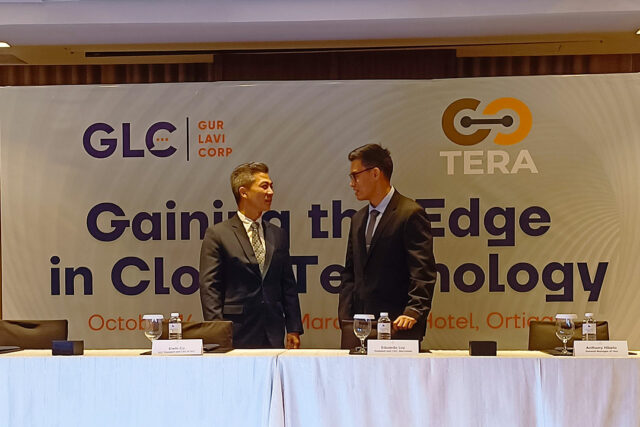
MacroAsia’s TERA targets to become major internet service provider, partners with Gur Lavi 

MACROASIA Corp. President and COO Eduardo Luis T. Luy signed on Oct. 14 a partnership deal for the company’s subsidiary, Tera Information and Connectivity Solutions, Inc., with Gur Lavi Corp. President and CEO Erwin Co.

TERA Information and Connectivity Solutions, Inc. (TERA), a subsidiary of MacroAsia Corp., is working to become a fixed-line internet service provider for both business and residential users in the next three to five years, a company official said.

“That’s our aspiration … for the next three to five years,” TERA General Manager Anthony G. Hilario told reporters on Friday after the company signed a partnership deal with telco solutions distributor Gur Lavi Corp.

“[We take] baby steps to become a service provider,” he added.

Under the partnership, TERA aims to deliver “end-user experiences as technology and tier 1 internet services provider to the LT Group, Inc,” a listed holding company of business tycoon Lucio C. Tan.

With Gur Lavi, MacroAsia hopes to reduce operational costs and boost its digitalization efforts as it strives to recover from the pandemic crisis.

Gur Lavi is the company behind TeLavi Cloud, an all-in communication platform introduced amid the pandemic. It provides cloud telephony solutions, team messaging, videoconferencing, and call center solutions to enterprise and residential customers.

“We feel that Gur Lavi has very good expertise and technical understanding of the whole technology side. That is something we can leverage on. Hopefully we can learn a lot from them,” MacroAsia President and Chief Operating Officer Eduardo Luis T. Luy said.

For his part, Gur Lavi President and Chief Executive Officer Erwin Co said: “We wish to impart our expertise, our knowledge in helping TERA and the other companies in their group in their digital transformation journey.” — Arjay L. Balinbin

Toyota ‘adopts’ Laguna, Batangas forests

Toyota Motor Philippines’ local tree-planting, mangrove-planting, and coastal and riverside clean-up activities are part of the “All Toyota Green Wave Project,” a Global Toyota initiative which was started in 2015. — PHOTO FROM TOYOTA MOTOR PHILIPPINES

TO EXPAND its “climate mitigation and biodiversity protection efforts,” Toyota Motor Philippines Corp. (TMP) “adopted” an upland forest block in Siniloan, Laguna and mangrove forests in Calatagan, Batangas.

Under the National Greening Program or NGP, TMP will sign two separate agreements with the Department of Environment and Natural Resources (DENR)-Region IV-A CALABARZON this month to formalize the adoption of the planting sites. TMP commits to plant 41,000 tree and mangrove saplings over a span of five years — aiming for a 80% survival rate.

In the initial phase of reforestation activities, TMP mobilized groups of volunteer team members to plant 10,000 tree and 5,000 mangrove saplings in the two areas in the month of September. TMP also participated in the International Coastal Clean-up Day, turning over to the local authority 150 kilograms or 21 sacks of plastic waste collected from the Calatagan coastline.

“Toyota shares the responsibility in protecting the planet Earth and in fighting climate change in line with United Nations Sustainable Development Goals,” said TMP President Atsuhiro Okamoto, who spearheaded the simultaneous mangrove-planting and coast clean-up activities. “Global Toyota implements the Toyota Environmental Challenge 2050 to achieve zero carbon dioxide (CO2) emissions and net positive environmental impact by year 2050.”

As a biodiversity conservation effort, TMP will plant native and fruit-bearing tree species in a 50-hectare area at the tail-end of Sierra Madre mountain range in Siniloan, Laguna. This area, according to University of the Philippines Los Baños, is the habitat of endemic flora and fauna such as the Philippine Hornbill, Gray’s Monitor Lizard, Civet Cat, Cave Nectar Bat, and Wax Plant species. Moreover, the Sierra Madre hosts some of the country’s oldest forests and serves as a natural barrier against typhoons with its long mountain range on the east of Luzon.

TMP also commits to plant 16,000 mangrove propagules in an eight-hectare area on the coast of Calatagan. This project extends TMP’s existing NGP planting site in Lian, Batangas where the company has already planted 30,000 mangroves since 2018. These two coastal sites are both part of the Verde Island Passage which is considered as the “Center of the Center of Marine Shorefish Biodiversity” in the world.

According to TMP Environment Manager Mark Anthony Marcelo, mangroves are a distinct part of Toyota’s climate change solution in the Philippines. “Mangroves have a high capacity to absorb CO2 as they store up to 10 times more per hectare than terrestrial forests. Mangroves also serve as a blockade against storm surges and are crucial to marine life and livelihood of coastal communities,” he said.

TMP’s local tree-planting, mangrove-planting, and coastal and riverside cleanup activities are part of the “All Toyota Green Wave Project,” a Global Toyota initiative which was started in 2015. This project connects the Toyota Network — including TMP team members, dealers and suppliers — to nature conservation activities while mitigating climate risks and supporting livelihoods of local communities in the long run.

In April 2022, TMP also adopted a 40-hectare NGP planting site in the rainforests of Maragondon, Cavite and initially planted 10,000 seedlings of native and fruit-bearing tree species.

Norway’s Scatec plans 2.4 gigawatts of wind energy projects in PHL

NORWEGIAN renewables company Scatec ASA has lined up five wind energy projects in the Philippines with a combined capacity of 2.4 gigawatts (GW), its regional head said.

“We have a wind energy service contract of 2.4 GW. Five contracts we have, which in total gives you 2.4 GW,” Torbjørn Elliot Kirkeby-Garstad, Scatec general manager for Southeast Asia, told reporters on the sidelines of the Norway-Philippines Maritime and Energy Conference on Friday.

“Four of them [are offshore]. Then we have [an] onshore [project] close to the offshore ones,” he added.

Asked about the value of investments that Scatec is setting aside for the projects, he said: “We’re talking of billions [of dollars] to develop and build those.”

On its website, Scatec describes itself as “a leading integrated independent renewable power producer, delivering affordable, rapidly deployable and sustainable clean energy worldwide.”

The company develops, builds, owns and operates solar, wind and hydropower plants and storage solutions.

It placed the capacity of its projects in operation at 3,355 megawatts (MW) and 1,266 MW under construction. It also said that it has 15.5 GW “in project backlog and pipeline.”

“Our presence in the Philippines is together with Aboitiz, where we own SN Aboitiz Power (SNAP) — it’s largely hydropower, it’s Magat, Ambuklao,” Mr. Kirkeby-Garstad said, referring to the joint venture with Aboitiz Power Corp.

“We’re a partnership with them and we’re also discussing growth opportunities with Aboitiz, also through SNAP,” he added.

He said Scatec is doing the five projects with local partners, and that it will not insist on having a controlling stake.

“My approach to this is shoulder-to-shoulder,” he said. “This can be structured in many ways. You could even have three partners in it.”

“We will be doing these with [a] good local partner, and obviously Aboitiz is our partner,” he said. — VVS

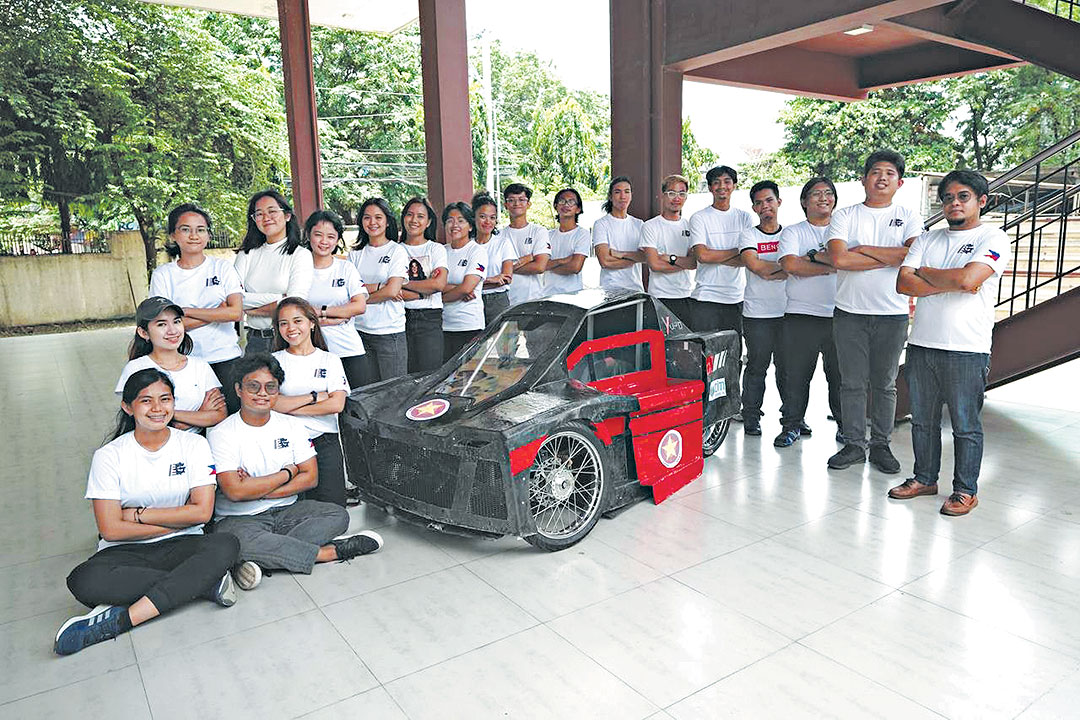
DLSU, PUP to represent PHL in Asian leg of Shell Eco-marathon

The De La Salle University Eco Car Team — PHOTO FROM PILIPINAS SHELL

THE DE LA SALLE University (DLSU) Eco Car Team and Polytechnic University of the Philippines (PUP) Hygears will carry the country’s colors when they compete against 49 teams from eight other countries in the Shell Eco-marathon (SEM) Asia.

To be held this year in Lombok, Indonesia, Shell’s annual event provides students of Science, Technology, Engineering, and Math (STEM) an avenue to design, build, and operate automotive vehicles to achieve the highest possible fuel-efficiency.

Pilipinas Shell Petroleum Corp. Vice-President of Corporate Relations Serge Bernal encouraged the students to take the opportunity to learn, collaborate, and make friends not just with members of the Philippine teams, but also with those from other countries’ teams even as he reminded them that SEM is a competition. “Make your family, friends, school, and the Philippines proud,” he said.

For her part, DLSU Eco Car Team Manager Eunice Nicole Rupisan averred, “As a team, we expect the best because we want to surpass our benchmark in testing. Pilipinas Shell has been helping us from the start, helping us communicate with Shell Global. They’ve played a big role in getting us far into the competition.”

PUP Hygears Manager Nicole Tugay described joining SEM as an opportunity. “We will experience working in the industry not only in the technical sense, but also in a managerial sense,” she shared.

The panelists providing practical advice to the teams are SEM alumni: Shell Business Operations Process Data Engineer for Technical Asset Operations (TAO) Meg Celine Cruz, Upstream Turnaround Manager Jericho Paolo Rivera, and Process Data Engineer Joven Talape. “SEM is a great venue to meet people and expand your connections. This is a culmination of your sleepless nights and all your hard work,” Ms. Cruz said to the students.

Making cars more efficient since 1939, SEM shifted to its current eco-friendly focus in 1985. SEM participants are tasked to design an energy-efficient battery-powered vehicle that can outlast others on a track. SEM 2022 will be held at the Pertamina Mandalika International Street Circuit in Lombok, Indonesia from Oct. 11 to 15, resuming face-to-face interactions after running virtually for its 2020 to 2021 season. For more info about the SEM and about joining its 2023 season, visit https://www.makethefuture.shell/en-gb/shell-eco-marathon/2023-programme-on-track.