Home Blog Page 5737

Harden returns to 76ers on 2-year, $68.6-M deal

GUARD James Harden has agreed to a two-year, $68.6-million deal with the Philadelphia 76ers, ESPN reported Wednesday.

The deal features a player option on the second year of the contract worth $35.6 million. If Mr. Harden rejects the option, he will become a free agent following the 2022-23 season. Mr. Harden had previously rejected a one-year, $47.3 million option for next season, making him a free agent.

The 10-time All-Star spent the final two-plus months of last season with the 76ers after being traded from the Brooklyn Nets in February, along with Paul Millsap. In 21 regular-season games with Philadelphia, all of which were starts, he averaged 21.0 points, 7.1 rebounds and 10.5 assists while shooting 40.2 percent from the field and 32.6 percent from 3-point range. — Reuters

Major League Baseball All-Star Game ratings hit all-time record low

TELEVISION ratings for Tuesday’s All-Star Game continued a downward trend that began nine years ago, hitting an all-time low.

The Fox telecast drew 7.51 million viewers, down 8% from 8.14 million viewers in 2019, according to SBJ Unpacks, a podcast of the Sports Business Journal. Viewership was slightly better at 8.24 million in 2021.

The American League defeated the National League 3-2 at Dodger Stadium in Los Angeles to run its winning streak to nine games.

Ratings have fallen significantly with the explosion of television channels, internet channels and streaming services available. Before the plethora of other viewing options, All-Star Game viewership reached as high as 36.3 million in 1976 and again in 1980, according to Baseball-Almanac.com.

Ratings fell below 20 million in 1996 (18.5 million), and settled beneath 10 million in 2016 (8.7 million).

This weekend also saw a decrease in viewership for MLB’s Home Run Derby, which was on ESPN, and the MLB first-year player draft, which was aired on ESPN and MLB Network.

Despite the All-Star Game decline, baseball remained ahead of the other major pro sports. The NFL Pro Bowl (ABC/ESPN/DisneyXD) on Feb. 6 drew 6.69 million viewers.

The NBA All-Star Game (TNT/TBS) on Feb. 20 drew 6.28 million viewers, and the NHL All-Star Game (ABC) on Feb. 5 finished at 1.15 million on ABC. — Reuters

Carlsen will not defend world title next year

MAGNUS Carlsen will not defend his world championship in 2023 against Russia’s Ian Nepomniachtchi as he is not motivated to play another match, the Norwegian five-time champion said in a podcast on Wednesday.

If Mr. Carlsen does not defend his title, Mr. Nepomniachtchi is likely to face the runner up in the recent Candidates tournament, China’s Ding Liren.

“I feel I don’t have a lot to gain, I don’t particularly like (the championship matches), and although I’m sure a match would be interesting for historical reasons and all of that, I don’t have any inclination to play and I will simply not play the match,” he said on the podcast for his sponsor Unibet.

“Ultimately the conclusion stands, one that I’m pretty comfortable with, one that I’ve thought a lot about for a long time now, I would say more than a year… since long before the last match” in which he beat Mr. Nepomniachtchi without losing a game, Mr. Carlsen said.

“And I’ve spoken to people in my team, I’ve spoken to FIDE, I spoke to Ian as well. And the conclusion is, it’s simple, that I am not motivated to play another match,” said Mr. Carlsen, who has spent over a decade as the top-ranked player in the world.

FIDE President Arkady Dvorkovich said Mr. Carlsen, who stressed that he was not retiring from the sport and would remain an active player, deserved nothing but respect from FIDE and the chess community.

“Only a handful of people in history can understand and assess the tremendous toll it takes playing five matches for the title,” Dvorkovich said in a statement.

“His decision not to defend his title is undoubtedly a disappointment for the fans, and bad news for the spectacle. It leaves a big void.

“But chess is now stronger than ever — in part thanks to Magnus — and the world championship match, one of the longest, most respected traditions in the world of sport, will go on.”

Mr. Carlsen had previously said he would be ready to let go of his world title unless his next opponent was Iranian-French teenager Alireza Firouzja, who is the world number three currently.

Instead, Mr. Nepomniachtchi set up a rematch by winning the Candidates Tournament in Madrid earlier this month with a round to spare.

Mr. Liren edged out chess YouTuber Hikaru Nakamura of the United States for second place in the Candidates Tournament by beating him in the final round. — Reuters

Stanway stunner sends England past Spain into Euro semis

BRIGHTON, England — England’s Georgia Stanway scored with a wonderful extra-time strike to earn them a 2-1 win over Spain on Wednesday in an excellent Euro 2022 quarter-final that sent the Lionesses into the last four.

Hosts England were facing an exit from the tournament with six minutes of normal time remaining, but went on to earn a semi-final clash with Belgium or Sweden to the delight of the home crowd.

It was a match which showcased the European women’s game at its best with both teams playing smart technical football at a high-tempo.

But as the familiar chants of ‘Football’s Coming Home’ indicated, it was also a victory which will spark optimism that England, under the guidance of Dutch coach Sarina Wiegman, can win their first major tournament.

There was little to separate the teams in the early stages although England had a 37th-minute effort from Ellen White ruled out for offside.

However it was Spain who grabbed a 54th-minute lead when taking advantage of some sloppy play from England as Athenea del Castillo did well down the right flank and squared the ball to Esther Gonzalez, who recovered after a poor first touch to drill home.

Del Castillo then went close to a second with a cross-shot which was clawed away by England keeper Mary Earps at full-stretch .

Spain were buzzing and playing with real confidence but six minutes from the end of normal time, the Lionesses found a way to keep the game alive when Alessia Russo headed Lauren Hemp’s cross into the path of substitute Ella Toone who poked home to take the game into extra time.

The decisive moment came when Stanway found space in the Spanish half and pushed forward before unleashing a fierce shot from 20 metres out which flew past Sandra Panos.

Spain, who have yet to win a knockout game in a major tournament, were devastated and left the field in tears but for the 28,994 crowd, the biggest for a Euro quarter-final, it was party time. — Reuters

Reasonable gambit

Don’t think for a moment that the Pacers simply wanted to take on the role of spoiler when they presented Suns slotman DeAndre Ayton with a maximum contract offer last week. They were dead serious in their intent to spread the welcome mat for the 2018 first overall draft pick; they even waived three players and expressed willingness to use the stretch provision to spread the effects of their planned acquisition over three seasons. As far as they were concerned, he figured to be the anchor of their efforts to be relevant anew.

It was a reasonable gambit, to be sure. The Pacers hoped the Suns would not match the offer sheet given the prospect of welcoming Kevin Durant to the fold; doing so would most certainly derail negotiations with the Nets. Moreover, they knew ties were already strained, and not just because head coach Monty Williams benched Ayton throughout the second half of a disappointing showing in Game Seven of the 2022 Western Conference semifinals.

As things turned out, the Suns wasted no time matching the Pacers’ offer — perhaps to Ayton’s chagrin. He had already been looking forward to playing with promising point guard Tyrese Haliburton and rookie Benedict Mathurin, recently named the Pac-12 Conference Player of the Year. And he most certainly wasn’t happy that his employers refused to extend him a max contract, instead daring him to get one in free agency.

In view of the setback, the Pacers must now survey the scene prior to formulating their next steps. The same goes for Ayton, who now returns to an environment of fractured relationships. Make no mistake, though; they will recover and thrive. They know the game, and they’ve played it to the hilt.


Anthony L. Cuaycong has been writing Courtside since BusinessWorld introduced a Sports section in 1994. He is a consultant on strategic planning, operations and Human Resources management, corporate communications, and business development.

Microsoft Teams back up for some users after service disruption

Microsoft Corp’s Teams was back up for some users, the company said on Thursday, after an hours-long outage that disrupted the chat application for thousands of customers.

The Redmond, Washington-based company pinpointed a disruption “on a recent deployment that contained a broken connection to an internal storage service”, but did not disclose the number of users affected by the outage.

“We’re receiving many reports that users are able to access Microsoft Teams, and many functions are beginning to recover,” the company said.

MS Teams forms an integral part of daily operations for businesses as workers use the service to communicate internally, message each other, make calls, and organize their workflow.

There were more than 4,800 incidents of people who reported issues with MS Teams on Wednesday, said Downdetector.com, which tracks outages by collating status reports from sources including user-submitted errors on its platform.

Some 530 users are currently affected as of 12:15 AM ET, Downdetector said.

The web monitoring firm also showed earlier that there were more than 150 incidents of people reporting issues with Microsoft Office 365.

Microsoft tweeted it has identified downstream impact to multiple Microsoft 365 services with Teams integration, such as Microsoft Word, Office Online and SharePoint Online.

“We’ve taken action to reroute a portion of traffic to provide some relief within the environment,” it said.

Microsoft in its earnings call in January had said that MS Teams surpassed 270 million monthly active users, as demand for remote business-oriented teleconferencing and messaging tools soared and became a key fixture for organizations during the COVID-19 pandemic as people worked from homes.

Other big technology companies have also been hit by outages in the past year, with a near six-hour disruption at Meta Platforms META.O keeping WhatsApp, Instagram and Messenger out of reach for billions of users last October. — Reuters

Protests and street blockades against soaring prices persist in Panama

PANAMA CITY — Hundreds of people took to the streets of Panama on Wednesday to protest the government’s failed efforts to stem the rising cost of living, among other demands. 

Across the Central American nation protesters blocked roads and stopped trucks from delivering food, a pressure tactic that has been increasingly used since protests broke out two weeks ago as inflation accelerated to 5.2% in the year through June. 

“The situation is critical,” said Humberto Montero, a member of the Veraguenses Educators Association, which has sought, along with other organizations, to reach an agreement with the government. 

Protesters are also demanding the government curb public spending, apart from new investments in health and education, and bring a halt to corruption. 

The blockades are now leading to shortages, particularly of agricultural products, in the capital Panama City. 

Since the beginning of the protests, President Laurentino Cortizo’s government, which implemented austerity measures and froze gasoline and diesel prices, has unsuccessfully tried to reach an agreement with protesters. 

On Tuesday, Panamanian police fired tear gas on protesters blocking road access in the country’s west on Tuesday. 

“If the police continue with repression, the dialogue will be affected,” Mr. Montero said. 

Producers have asked protesters to establish “humanitarian corridors” to allow food to be distributed. 

The Ministry of Agricultural Development did not immediately respond to a Reuters request for comment. — Reuters

Biden stops short of declaring climate emergency, takes steps on wind power

President Joe Biden/Facebook

SOMERSET, Mass./WASHINGTON — US President Joseph R. Biden, Jr., said on Wednesday that climate change is an emergency but stopped short of a formal declaration, announcing a modest package of executive actions and promising more aggressive efforts. 

Mr. Biden made the comments during a visit to Massachusetts and as a historic heat wave batters Europe and the United States. Some 100 million Americans from New York City to Las Vegas will be under heat warnings this week. 

“Climate change is literally an existential threat to our nation and to the world,” Mr. Biden said. “This is an emergency, an emergency, and I will look at it that way.” 

The announcements included new funding for cooling centers and pushing for new off-shore wind projects in the oil-rich Gulf of Mexico. 

Still, those actions fall short of demands by Democratic lawmakers and environmental activists who want Mr. Biden to formally declare a climate emergency, which would enable the use of the Defense Production Act to ramp up production of a wide range of renewable energy products and systems. 

Mr. Biden told reporters that he would decide shortly on whether to make such a declaration. 

“I’m running the traps on the … authority I have,” he told reporters as he traveled home from Massachusetts. “I’ll make that decision soon.” 

Mr. Biden is under increasing pressure after conservative Democratic Senator Joe Manchin said last week he was not ready to support key climate provisions in Congress, a critical loss in the evenly divided Senate. 

Mr. Biden has not spoken with Mr. Manchin since, he told reporters on Wednesday. 

The Federal Emergency Management Agency will provide $2.3 billion in funding to help states build cooling centers to deal with excessive heat and to tackle other impacts of climate change, the White House said as it announced the largest ever investment to the Building Resilient Infrastructure and Communities Program. 

New funding could expand flood control, shore up utilities, retrofit buildings, and help low-income families pay for heating and cooling costs. 

Mr. Biden also announced new support for the domestic offshore wind industry. The administration has identified 700,000 acres for possible offshore wind energy development in the Gulf of Mexico, the White House said. 

Mr. Biden spoke from a former coal-fired plant that is playing a role in supporting the state’s offshore wind industry as a manufacturing hub for undersea cables. 

Mr. Biden said more is to come. 

“In the coming days, my administration will announce the executive actions we have developed to combat this emergency,” Mr. Biden said. 

Senator Jeff Merkley and eight other Democrats sent a letter to Mr. Biden on Wednesday urging him to declare a climate emergency and use aggressive executive actions to limit emissions from fossil fuels produced on public lands and waters and maximize use of electric vehicles. 

Mr. Biden promised tough action on climate change in his presidential campaign, and it remains a key priority for some voters ahead of Nov. 8 midterms for control of Congress. The US president also pledged in international climate negotiations to cut climate pollution by 50% by 2030 and reach 100% clean electricity by 2035. 

But that climate agenda has been derailed by several major setbacks, including Congress failing to pass crucial climate and clean energy measures in a federal budget bill, record-setting gasoline prices, and Russia’s invasion of Ukraine disrupting global energy markets. 

A Supreme Court ruling last month limiting the federal government’s authority to issue sweeping regulations to reduce carbon emissions from power plants also is undermining Mr. Biden’s climate plans. 

When asked whether Mr. Biden has concluded there is no longer any option for a climate bill, a senior White House official told reporters that other people could answer that question, evidently suggesting a lot depends on Mr. Manchin. 

“Our focus is on what we can do,” the official said. — Jeff Mason and Timothy Gardner/Reuters

ECB to finally join rate hike club with big move on agenda

Euro banknotes are displayed in this picture illustration taken Nov. 14, 2017. — REUTERS/BENOIT TESSIER/ILLUSTRATION

FRANKFURT — The European Central Bank (ECB) will raise interest rates for the first time in 11 years on Thursday with a bigger-than-flagged move seen as increasingly likely as policymakers fear losing control of runaway consumer price growth. 

With inflation already approaching double digit territory, it is now at risk of getting entrenched above the ECB’s 2% target, requiring rate hikes even if that slows — or crashes — an economy already suffering from the impact of Russia’s war in Ukraine. 

But policymakers appear far from united on just how fast the ECB should move with some arguing that it is already a long way behind the curve, especially compared to global peers like the US Federal Reserve, while others point to a looming recession the ECB risks exacerbating. 

The bank until recently was signaling just a 25-basis-point increase to be followed by a bigger move in September but sources close to the discussion said a 50-basis-point increase would also be on the table on Thursday as the inflation outlook is deteriorating quickly. 

Economists polled by Reuters predicted only a 25-basis-point increase but most said the bank should actually hike by 50 basis points, lifting its record low minus 0.5% deposit rate to zero. 

Complicating the decision, the euro’s recent drop to a two-decade low against the dollar also boosts inflation pressures, adding to the case for a bigger rate hike even if that ultimately hurts growth. 

A larger increase would, however, require the ECB to shield more indebted nations like Italy or Spain from soaring borrowing costs, so a deal on a new bond purchase scheme, already close to being reached according to sources, would also be needed. 

When rates rise, borrowing costs on the bloc’s periphery often increase disproportionately and the ECB has promised to fight this sort of fragmentation with a new instrument. 

While not all the details of this tool are expected to be announced, ECB chief Christine Lagarde is likely to make a firm commitment and must offer financial markets at least some specifics including on the requirements for triggering ECB aid. 

In June, when she made only a vague commitment, investors immediately challenged the ECB, pushing up Italian yields to their highest in a decade, forcing the ECB into an emergency policy meeting and a stronger pledge. 

The ECB announces its policy decision at 1215 GMT, 30 minutes later than previously, while Ms. Lagarde’s news conference is scheduled for 1245 GMT, 15 minutes later than in the past. 

INFLATION VS RECESSION 

Along with the rate hike, the ECB is also set to signal a string of subsequent increases. It already flagged a 50-basis-point hike for September and that is likely to remain on the cards. 

It is also expected to pledge further moves, though it is less likely to make firm commitments. 

“Our central case is for a 50-basis-point hike in September, but we think … the Governing Council will leave the door open for a larger move,” BNP Paribas said in a note. “We still expect a … 50 basis point hike in October.” 

Markets now see almost 100 basis points worth of moves by September and a combined 170 basis points of hikes by the end of the year, or increases at all four meetings, with several 50-basis-point moves along the way. 

The dilemma for policymakers will be to balance growth and inflation considerations. 

Confidence has already taken a hit from the war and high raw materials prices are depleting purchasing power, pushing the block towards a possible recession, especially with looming gas shortages over the winter. 

Raising rates in a downturn is controversial, however, and could magnify the pain as businesses and households face higher financing costs. 

“One problem is that, for example, a gas shutdown would not only hit growth, but would also boost inflation and therefore the ECB may not immediately become more growth sensitive,” JP Morgan economist Greg Fuzesi said. 

The ECB’s ultimate mandate is controlling inflation, however, and rapid price growth for too long could perpetuate the problem as firms automatically adjust prices. 

Europe’s labor market is also increasingly tight suggesting that pressure from wages is also likely to keep price growth high. 

Some central banks, most particularly the Fed, have made clear they are willing to crash growth to control inflation because the risk of a new “inflation regime” setting in is too high. 

But if a recession is coming, the ECB needs to front load rate hikes so it gets done quicker. — Balazs Koranyi and Francesco Canepa/Reuters

EU tells members to cut gas usage amid new Putin warning

NORD STREAM AG

BRUSSELS/LONDON — The European Union (EU) told member states on Wednesday to cut gas usage by 15% until March as an emergency step after President Vladimir Putin warned that Russian supplies sent via the biggest pipeline to Europe could be reduced further and might even stop. 

Deliveries via Nord Stream 1, which accounts for more than a third of Russian gas exports to the EU, are due to resume on Thursday after a 10-day halt for annual maintenance. 

German gas network operator Gascade said on Wednesday it expects flows to resume at pre-maintenance levels based on current requests for gas. 

On July 10, the last full day before maintenance on the pipeline started, flows stood at around 698 GWh. 

Supplies via the route had been reduced even before the maintenance outage in a dispute over sanctions, and may now be cut further, while flows via other routes, such as Ukraine, have also fallen since Russia invaded its neighbor in February. 

The disruptions have hampered Europe’s efforts to refill gas storage before winter, raising the risk of rationing and another hit to fragile economic growth if Moscow further restricts flows in retaliation for Western sanctions over the war in Ukraine. 

The European Commission proposed a voluntary target for all EU states to cut gas use by 15% from August to March, compared with their average consumption in the same period in 2016–2021. 

“Russia is blackmailing us. Russia is using energy as a weapon. And therefore, in any event, whether it’s a partial, major cut-off of Russian gas or a total cut-off of Russian gas, Europe needs to be ready,” EU Commission President Ursula von der Leyen said. 

The Commission proposal would enable Brussels to make the target mandatory in a supply emergency, if the EU declared a substantial risk of severe gas shortages. 

The move, which needs the backing of EU states, will be discussed on Friday so ministers can approve it on July 26. 

“We believe that a full disruption is likely,” one EU official said. “If we wait, it will be more expensive and it will mean us dancing to Russia’s tune.” 

EU states are trying to ensure storage facilities are 80% full by Nov. 1, from about 65% now. 

WILL FLOWS RESUME? 

European politicians say Russia is using technical issues as a pretext to cut deliveries. The Kremlin says Russia is a reliable energy supplier and blames sanctions for reduced flows. 

Two Russian sources familiar with export plans said flows via Nord Stream 1 were expected to restart on Thursday but below capacity of 160 million cubic meters (mcm) per day. 

Kremlin-controlled Gazprom cut gas exports via the route to 40% capacity in June, blaming delays to the return of a turbine that Siemens Energy was servicing in Canada. 

That turbine, which was caught up in sanctions, was reported this week to be on its way back, although Gazprom said on Wednesday it had not received documentation to reinstall it and said the turbine’s return and maintenance of other equipment was needed to keep the pipeline running safely. 

Mr. Putin said there might be a further reduction in supplies or even a complete halt to flows via the pipeline that runs under the Baltic Sea to Germany, which relies heavily on Russian fuel. 

He said equipment was being returned from Canada but said the quality of the returned gear and other parameters meant the pipeline might still be shut down in the future. 

“Maybe… they will turn it off at some point, and that’s it, and Nord Stream 1 will stop, because they came from there, from Canada,” he said in televised comments, without elaborating. 

Gas prices have rocketed in volatile trade since the Ukraine crisis erupted. The front-month gas contract climbed above 160 euros per megawatt hour (MWh) on Wednesday, 360% up on a year ago but below its March peak of 335 euros. 

‘CRUMBLING’ EQUIPMENT 

The surge in price has squeezed utility companies, triggering bankruptcies. In Germany, the government plans to inject billions of euros into the country’s biggest buyer of Russian gas, Uniper. 

Siemens Energy said maintaining turbines for Nord Stream 1 would normally be a routine matter. It said it would continue maintaining equipment under sanctions if possible and where required, and it would work as fast as it could. 

In earlier remarks, Mr. Putin said one of the five gas pumping units, operated by Siemens Energy at Nord Stream 1, was out of order due to a “crumbling of inside lining” and another was due to be sent for maintenance on July 26. 

Mr. Putin said Gazprom, which has a monopoly on Russian gas exports by pipeline, was not to blame for the reduction of gas transit capacity via a network of pipelines to Europe. 

He blamed Kyiv for closing one route via Ukraine, although Ukraine’s authorities blame the shutdown on Russia’s invasion. 

In its pivot east, Gazprom said on Wednesday Russian gas supplies heading to China hit a new daily record. Moscow has been expanding capacity to supply China as deliveries to Europe dwindle, although Russia’s far east network is not connected to the European supply system. 

European nations, meanwhile, have been chasing alternative supplies, although the global gas market was stretched even before the Ukraine crisis, with demand for the fuel recovering from the pandemic-induced downturn. 

Those efforts have included seeking more gas from suppliers linked to Europe by pipeline, such as Algeria, and by building or expanding more liquefied natural gas (LNG) terminals to receive shipments from much further afield, such as the United States. — Kate Abnett and Nina Chestney/Reuters

Ukraine war, higher rates to limit growth in developing Asia – ADB

REUTERS

MANILA – The Asian Development Bank (ADB) on Thursday slashed its growth forecasts for developing Asia for this year and next, reflecting the economic fallout from Russia’s war in Ukraine and aggressive tightening by global central banks to tame inflation.

Also contributing to its weaker growth forecasts was a sharper-than-expected deceleration in China prompted by its lingering COVID-19 lockdowns, the ADB said in a supplement to its Asian Development Outlook report.

Downgrading its 2022 forecast for a third time, the ADB said it now expects the bloc’s combined economy, which includes China and India, to expand 4.6%, slower than its 5.2% projection in April.

“Risks to developing Asia’s economic outlook remain elevated and mainly associated with external factors,” the ADB said, citing a substantial slowdown in global growth, the U.S. Federal Reserve’s aggressive tightening, and surge in commodity prices.

For 2023, the region is forecast to grow 5.2%, down slightly from its earlier forecast of 5.3%, the ADB said.

“From within the region, downside risks could arise from the potentially lingering effects on supply chains from (China’s) latest round of lockdowns and the country’s growth slowdown, which could hinder developing Asia’s growth momentum,” the multilateral lending organization said.

China’s economy will likely expand 4.0% this year, the ADB said, a drop of 1 percentage point from its April forecast, but will recover lost ground in 2023 with growth seen at 4.8%.

The growth outlook for the sub-regions was mixed, with Southeast Asia, Central Asia and the Pacific expected to grow faster than initially projected, while South Asia was forecast to expand more slowly due to the economic crisis in Sri Lanka and high inflation in India.

The ADB chopped its growth forecast for South Asia to 6.5% from 7.0% this year and to 7.1% from 7.4% in 2023.

With soaring inflation gripping much of the world, the ADB upgraded its inflation forecasts for this year and next to 4.2% and 3.5 % from 3.7% and 3.1%, respectively.

“Inflation pressures in the region, are however, less than elsewhere in the world,” the ADB said. — Reuters

BoP deficit hits $1.57 billion in June

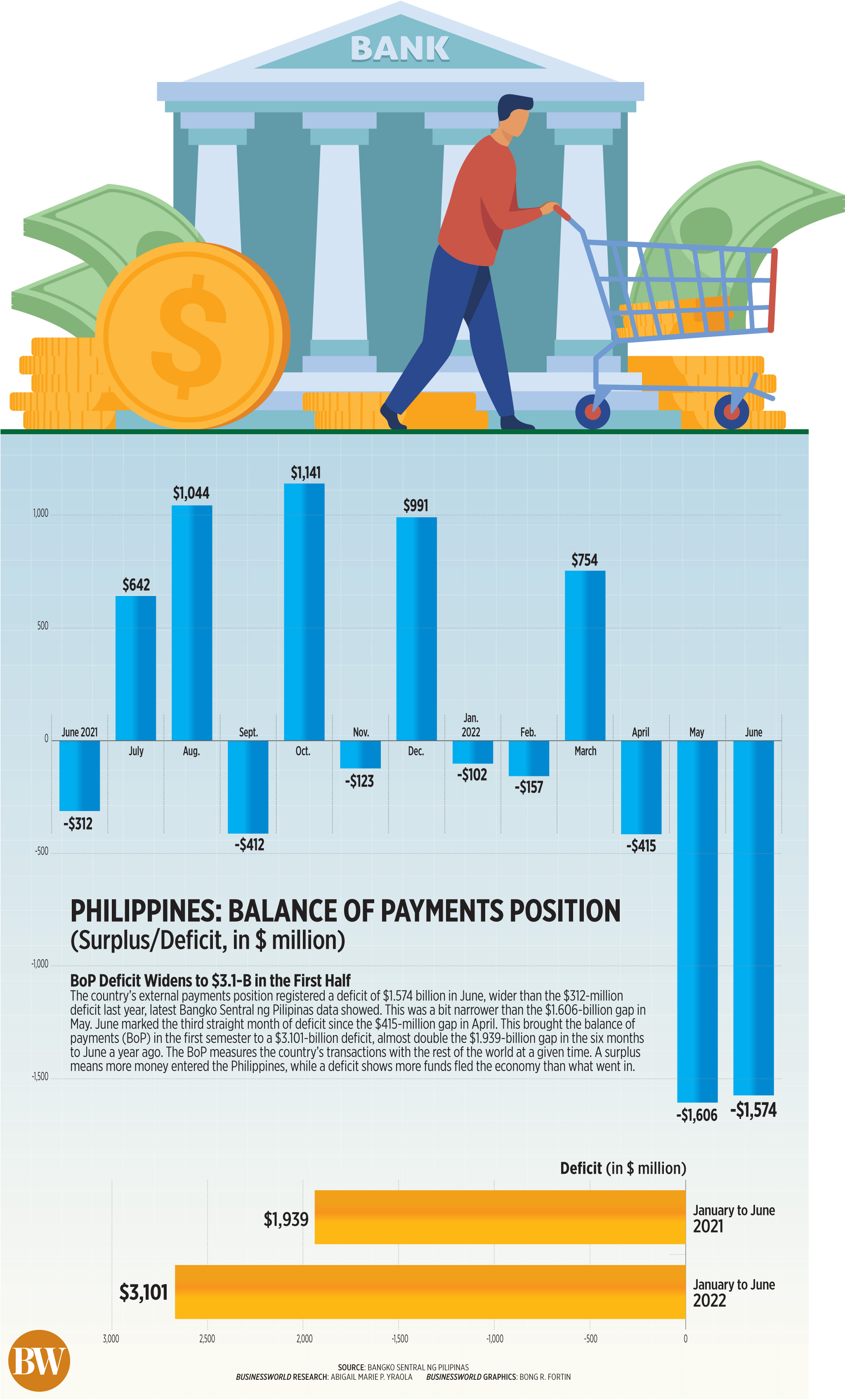
THE PHILIPPINES’ balance of payments (BoP) position remained in a deficit for a third straight month in June, as more dollars flowed out of the country to pay for the government’s foreign debt.    

Data released by the Bangko Sentral ng Pilipinas (BSP) late on Tuesday showed the BoP deficit widened to $1.57 billion in June, from the $312-million deficit in the same month last year.

However, the June deficit slightly narrowed from the $1.61-billion gap in May, which was the widest since $2.019 billion in February 2021.

Philippines: Balance of payments position“The BoP deficit in June 2022 reflected outflows arising mainly from the National Government’s payments of its foreign currency debt obligations,” the BSP said in a statement.

The BoP measures the country’s transactions with the rest of the world at a given time. A deficit means more funds fled the economy than what went in, while a surplus shows that more money entered the Philippines.

In the first half of the year, the BoP deficit widened to $3.1 billion, from the $1.9-billion deficit in the same period in 2021.   

“Based on preliminary data, this cumulative BoP deficit reflected the widening trade in goods deficit,” the central bank said.   

The trade deficit for January-May 2022 rose by 70.5% to $24.9 billion from the $14.6-billion deficit in the same period a year prior, preliminary data from the Philippine Statistics Authority’s (PSA) showed.

The BoP deficit reflected the near-record trade gap as net imports have been bloated by elevated prices of imported oil and other commodities, Rizal Commercial Banking Corp. Chief Economist Michael L. Ricafort said in a note.

Global prices of oil and other commodities have spiked since Russia invaded Ukraine in late February.

The central bank noted that this BoP position reflects the final gross international reserves (GIR) level of $100.9 billion, 2.6% lower than the $103.6 billion as of end-May.

“Nonetheless, the latest GIR level represents a more than adequate external liquidity buffer equivalent to 8.4 months’ worth of imports of goods and payments of services and primary income,” the BSP said.

“Specifically, it ensures availability of foreign exchange to meet balance of payments financing needs, such as for payment of imports and debt service, in extreme conditions when there are no export earnings or foreign loans.”

The GIR can also cover up to 7.1 times the country’s short-term external debt based on original maturity and 4.5 times based on residual maturity.

“Short-term debt based on residual maturity refers to outstanding external debt with original maturity of one year or less, plus principal payments on medium- and long-term loans of the public and private sectors falling due within the next 12 months,” the BSP said.

China Banking Corp. Chief Economist Domini S. Velasquez said the country will likely continue to post BoP deficits in the next few months, as the current account is expected to remain in deficit.

“However, we expect more contained deficits in the next few months as import prices of major commodities such as oil and food are coming off from its highs after Russia invaded Ukraine,” Ms. Velasquez said in a Viber message.

Mr. Ricafort said a prolonged Russia-Ukraine war could continue driving up the prices of oil and other commodities, which “may lead to near record-high trade deficits/net imports, thereby partly leading to weaker peso exchange rate vs. the US dollar as seen in recent weeks/months.”

At the same time, Mr. Ricafort said the country’s BoP could still improve as remittances from overseas Filipino workers remain high and the economy further reopens.

Ms. Velasquez also said that expectations of lower commodity prices will bring the BoP deficit “to more sustainable levels” next year.

Last month, the BSP said it expects the country to post a wider BoP deficit this year due to a weaker global growth outlook that could affect trade and capital flows.

Earlier, the Monetary Board revised its BoP deficit forecast to $6.3 billion, or equivalent to -1.5% of gross domestic product (GDP), higher than the previous projection of a $4.3-billion gap (-1% of GDP).

The BSP also projected a wider current account deficit at $19.1 billion (-4.6% of GDP) this year, from $16.3 billion (-3.8% of GDP) previously.

The country’s GIR is expected to hit $105 billion by end-2022 and $106 billion by end-2023, lower than the March projections of $108 billion and $109 billion, respectively. — Keisha B. Ta-asan