Fumio Kishida, Prime Minister of Japan | source: https://bit.ly/3p7NLDU CC BY 4.0
TOKYO – Public approval ratings for the government of Japan‘s Prime Minister Fumio Kishida touched a new low in one opinion poll and clung near lows in another, hit by his party’s ties to a controversial church and doubts about a massive spending plan.
Support slid to 42% in a poll conducted by the Nikkei newspaper at the weekend, the lowest since Kishida took office in October 2021. Approval edged up slightly in a Kyodo news agency survey to 37.6% from 35% at the start of October.
The announcement of a $200 billion economic stimulus package has not helped lift Kishida’s approval ratings significantly, nor has last week’s resignation of economic revitalisation minister Daishiro Yamagiwa for his connection to the Unification Church, whose ties to the ruling Liberal Democratic Party (LDP) are being investigated in connection with the July 8 assassination of former premier Shinzo Abe. Read full storyRead full story
The Unification Church, founded in South Korea in the 1950s and famous for its mass weddings, has been fending off criticism for the means by which it collects donations.
The suspect in Abe’s shooting bore a grudge against the church, alleging it bankrupted his mother, and blamed Abe for promoting it, according to his social media posts and news reports.
The LDP has since acknowledged that many lawmakers had individual ties to the church but said there was no organisational link to the party.
Kishida this month announced an investigation into the church, and 78% of respondents to the Nikkei poll said the government should call on the church to disband. Only 14% opposed such action.
In the Kyodo poll, nearly 80% of respondents thought the LDP should expand its investigation into the church. Asked about the stimulus plan, 71.1% said they did not expect much from it.
At its peak, support for Kishida’s government hovered over 60%. A poll earlier this month showed it had slid to 27.4%, a level low enough to make it difficult to carry out policy. – Reuters
A vendor sells vegetables at the Quinta Market in Quiapo, Manila, Oct. 6. — PHILIPPINE STAR/EDD GUMBAN
By Keisha B. Ta-asan, Reporter
INFLATION likely quickened beyond 7% in October amid surging food prices and broadening second-round effects, analysts said.
A BusinessWorld poll of 14 analysts conducted last week yielded a median estimate of 7.2% for the consumer price index (CPI) in October.
If realized, October inflation would be faster than the 6.9% seen in September and the 4% last year. It would also be the quickest pace in over 14 years or since the 7.8% in December 2008 at the height of the global financial crisis.
This would also mark the seventh straight month that inflation breached the central bank’s 2-4% target band.
The Bangko Sentral ng Pilipinas (BSP) is scheduled to release its inflation forecast range for the month today (Oct. 31). The Philippine Statistics Authority will release the official inflation data on Nov. 4.
Analysts noted that food prices, particularly meat, fish, and vegetables, continued to rise as a result of supply shortages caused by typhoons this month.
“For October inflation, I’m looking at 7%, driven by food prices as the recent typhoon Karding and current rain conditions have seen some supply tightness in food and food logistics challenges,” Sun Life Investment Management and Trust Co. economist Patrick M. Ella said in an e-mail.
Agricultural damage due to Super Typhoon Karding (international name: Noru) reached P3.12 billion, while damage due to Tropical Depression Maymay and Typhoon Neneng stood at P594.02 million.
“Storm damage recently could have led to some temporary increase in the prices of food and other agricultural commodities, as well as on overall inflation, until supply chains normalize,” Rizal Commercial Banking Corp. Chief Economist Michael L. Ricafort said.
ING Bank N.V. Manila Senior Economist Nicholas Antonio T. Mapa said the follow-through price increase for food items likely pushed inflation beyond 7% in October.
“Transport fare adjustment also kicked in by October while pump prices increased for two weeks after successive price drops. We expect inflation to peak in November then only gradually decelerate going into 2023,” Mr. Mapa added.
Traditional and modern jeepneys recently raised the minimum fares to P12 and P14, respectively. Ordinary passenger buses also hiked the minimum fare to P13.
In October alone, oil companies increased pump prices for gasoline by P0.50 per liter, diesel by P8 per liter, and kerosene by P4.25 per liter, data from the Energy department showed.
ANZ Research economist Debalika Sarkar said in an e-mail that lower electricity rates may have provided partial relief for consumers.
Manila Electric Co. lowered the overall electricity rate by P0.0737 per kilowatt-hour (kWh) to P9.8628 in October.
Also, the continued weakness of the peso may have fueled inflation as it made imports more expensive, Colegio de San Juan de Letran Graduate School Associate Professor Emmanuel J. Lopez said.
“In our view, the pace of inflation will continue since the second-round impact of the global commodities increases and impact of the depreciating value of the peso against the US dollar will likely still be felt in the near term,” Philippine National Bank economist Alvin Joseph A. Arogo likewise said.
The peso traded around P58 to P59 per dollar this month. It went back to the P57 level when it closed at P57.97 on Friday.
In October alone, the peso has strengthened by P0.655 or 1.13% from its Sept. 30 close of P58.625.
“Basic commodities prices also followed the upward trend in anticipation of the holiday season,” Mitzie Irene P. Conchada, an economist from De La Salle University, said.
IS THE PEAK NEAR? China Banking Corp. Chief Economist Domini S. Velasquez said inflation may likely peak this month.
“Key risks would include the inability of the government to address current and potential shortages and possible increase in electricity rates. The proposed increase in water tariffs next year might push up 2023 average inflation above the high-end target of BSP after averaging by an estimated 5.6% this year,” Ms. Velasquez said.
Manila Water Co., Inc. has proposed a rate increase of P20 per cubic meter from 2023 to 2027.
“Although it seems like inflation is approaching its peak, it is still a long way from gravitating back into the official 2-4% target range,” ANZ Research’s Ms. Sarkar said.
Noting the strong domestic demand and volatility in the foreign exchange market, Ms. Sarkar said she expects the BSP to continue hiking rates until the second quarter of 2023.
“Our 2022 and 2023 year-end policy rate forecasts are 4.75% and 5.25%, respectively,” she added.
The Monetary Board has so far raised 225 basis points (bps) to 4.25% since May.
“BSP has communicated clearly that it would like to match Fed point by point. Given our outlook for a 75-bp rate hike by the Fed in November and a 50-75 bp rate hike in December, expect that BSP can raise rates to 5.5-5.75% by yearend,” ING’s Mr. Mapa said.
BSP Governor Felipe M. Medalla said last week the BSP may have to respond to the US Federal Reserve point by point to tame inflation and slow down the peso’s depreciation.
He said the Monetary Board may hike by 75 bps at its next rate-setting meeting on Nov. 17 if the US central bank delivers its fourth 75-bp rate increase on Nov. 1-2.
A WOMAN in a remote meeting via videoconference works from her living room. — REUTERS
THE DIGITAL ECONOMY contributed 9.6% to the country’s gross domestic product (GDP), an equivalent of P1.87 trillion in 2021, according to the Philippine Statistics Authority (PSA).
PSA data showed the digital economy in absolute terms grew by 7.8% or P134.754 billion last year from P1.735 trillion in 2020.
The country’s digital transactions have yet to recover to the pre-pandemic level of P1.955 trillion in 2019.
As a percentage of GDP, the digital economy has been on a decline since 2018 when it stood at 10.1%. It dipped to 10% in 2019 and dropped to 9.7% in 2020.
According to the PSA, the digital economy covers digital transactions such as e-commerce and online media/content.
The sector’s gross value-added (GVA) expanded by 7.8%, a reversal of the 11.3% contraction in 2020, and higher than the 6.1% GVA growth in 2019.
All sub-components posted growth, reversing the decline seen in 2020. Digital media and content grew by 10.3%, from a 10.8% contraction in 2020. E-commerce rose by 8.2% (-31.4% in 2020), while digital-enabling infrastructure expanded by 7.6% (-5.2% in 2020).
Digital-enabling infrastructure contributed 79.6% or P1.488 trillion to the economy, slightly lower than the 79.7% share in 2020. This sub-component covers computers, electronic products, telecommunications services, among others.
E-commerce’s share to the economy was unchanged at 17.6% (P329.675 billion) in 2021, while digital media/content’s share stood at 2.8% (P51.473 billion), up from 2.7% in 2020.
PSA data showed an 11.6% rise in the number of Filipinos employed in the digital economy to 5.59 million in 2021, from 5.01 million in 2020.
Broken down, 77% or 4.3 million were employed by companies involved in digital-enabling infrastructure, followed by e-commerce with 20.7% or 1.157 million, and digital media/content with 2.4% or 135,486.
UnionBank of the Philippines, Inc. Chief Economist Ruben Carlo O. Asuncion said the return to office of many workers may have partly contributed to the dip in the digital economy last year.
“I think it did play a role. Nevertheless, the difference is marginal and that people will continue to go digital in a lot of ways,” he said in a Viber message.
In the latest e-Conomy Southeast Asia Report 2022 by Google, Temasek, and Bain & Co., the Philippines’ digital economy is seen to reach a gross merchandise value (GMV) of $35 billion by 2025, from $20 billion this year.
The country’s overall digital economy is expected to hit a GMV of $100-150 billion by 2030, according to the report.
“As long as the economy will robustly grow and grow higher than historical average (6%), I believe the projected growth are within reach. There seem to be an economic slowdown next year, but succeeding years may see the economy going back to average growth,” Mr. Asuncion said. — Bernadette Therese M. Gadon
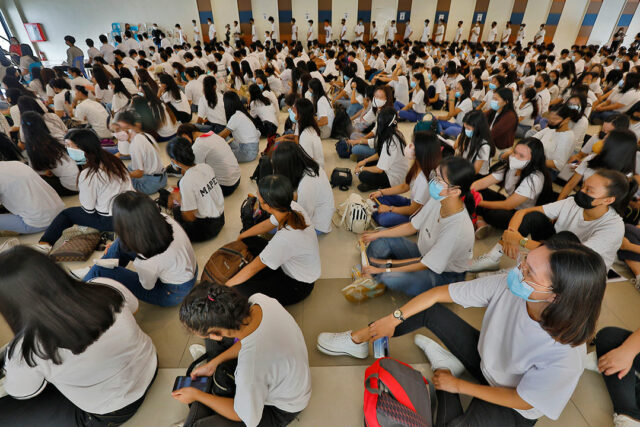
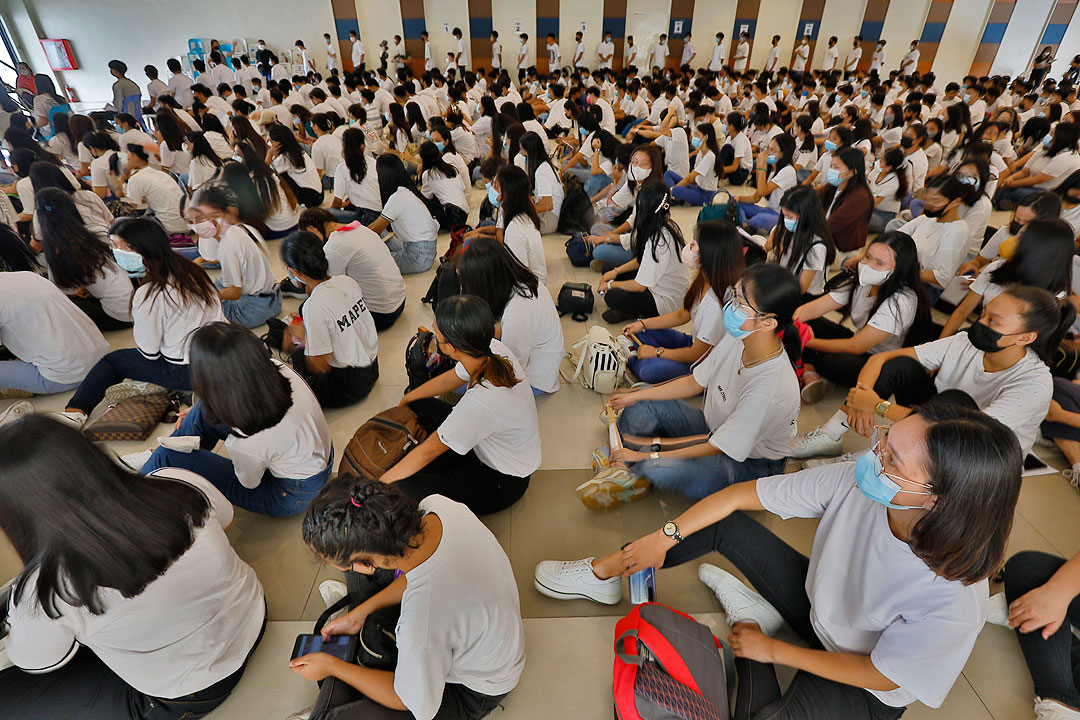
Students attend an event at Parang High School in Marikina City. The Education department said a quarter-million students moved from private to public schools in 2020 and 2021. — PHILIPPINE STAR/ WALTER BOLLOZOS
By Arjay L. Balinbin, Senior Reporter
NADINE CHANTALLE V. PONCE, 22, was an incoming third-year broadcasting student at the Colegio de San Lorenzo near the Philippine capital when it suddenly shut down amid a coronavirus pandemic.
“We were all caught off guard,” she said by telephone. “My brothers and I grew up in that school. Teachers there were like family, so it was tough for me to accept that it had to end that way.”
It was among the 425 private schools that have permanently closed since 2020, according to the Education department. About half of their 21,000 private school students have transferred to public schools where tuition is free.
St. Joseph Academy of San Jose, Northern Samar, Inc. in the Eastern Visayas Region also shut down its kindergarten department due to lack of enrollment.
A quarter-million students moved from private to public schools in 2020 and 2021, according to the Education department, as many parents lost their jobs.
This seems to be the opposite of what’s happening in western countries including the United States where many parents increasingly sought out, regardless of the price tag, independent schools that offered physical rather than remote classes as the coronavirus crisis raged on, CNBC reported last year.
Reports of significant academic learning loss in school districts underscored concerns about the toll that virtual learning has had on education at every level. Private schools, which generally have larger campuses, smaller classes and greater autonomy, often demonstrated more flexibility when it came to reopening, it said.
As a result, families managed to send their children to school in person, alleviating the burden on parents and, in many cases, allowing them to go to work or pursue employment opportunities from home.
Filipino students who enrolled this year rose to 28.04 million from 27.23 million last year when physical classes were still banned.
The exodus of teachers from private to public schools, where the pay is said to be higher, had also spurred the closure of many independent schools, education specialist and school owner Elna Leah L. Fonacier said.
“A large number of private school teachers have transferred to public schools because of the attractive salary offer, which is triple the price offered by small private schools,” she said in a Facebook Messenger chat.
Big private schools offer an average monthly salary of P18,000, while the smaller ones pay P8,000 to 12,000, compared with a P25,000 starting salary offered by government schools, she said.
Private school closures could well have worsened the country’s joblessness during the pandemic.
Almost 2.7 million Filipinos were jobless in August, 79,000 more than in July, though 1.2 million down from a year earlier, according to the local statistics agency.
Ms. Fonacier said private schools have also found it hard to comply with the Department of Education’s (DepEd) pandemic school safety requirements for face-to-face classes.
The DepEd said it would allow private schools to continue offering online classes beyond Nov. 2, revising an order that would have forced them to enforce five days of face-to-face classes by next month.
“DepEd is cognizant of the current situation of the private sector due to the impact of the COVID-19 pandemic — the amount of investment in online learning technologies, the development and institutionalization of best practices on blended learning, and the unfortunate closure of small private schools because of losses,” it said in a statement.
School closures affect communities socially and economically, according to the United Nations Educational, Scientific and Cultural Organization (UNESCO).
Disruptions worsen disparities within the education system and result in interrupted learning, poor nutrition, gaps in childcare, rise in dropout rates and high economic costs, it added.
The Philippines had a learning poverty rate of 91% and a learning deprivation rate of 90.4%, among the highest in Southeast Asia, according to a 2022 report by the World Bank.
Private school closures have also limited the choices of parents and students to access the “distinct education services that they provide,” University of the Philippines Diliman College of Education Dean Jerome T. Buenviaje said in an e-mailed reply to questions.
There were 47,144 public schools and 14,425 private schools before the pandemic, he pointed out. Out of 2,418 higher education institutions as of 2021, there were 1,734 private compared with 684 institutions under the Commission on Higher Education, he added.
The figures show that the quality of graduates joining the Philippine labor force is highly dependent on the private school sector, he said.
“The closure of private schools means fewer graduates that could join the labor sector,” Mr. Buenviaje said. “If this trend goes on, the government would have to establish more schools or further strengthen their existing programs, which would mean additional funding.”
LEARNING ‘TRAP’ Mr. Buenviaje also said it would take time for such changes to take place “while the demand for quality graduates joining the labor force continues.”
The government should work with stakeholders to save private schools from collapse because they play a vital role in the country’s education system, he said.
Increasing teachers’ salaries could persuade them to stay. The state could also grant private institutions wage subsidies, Ms. Fonacier said.
“Tax relief for private schools will never be enough though it’s an initial reform to consider,” Mr. Buenviaje said.
Under the law, private schools are eligible for a temporary 1% tax from July 2020 to June 2023, after which the rate will go back to 10%.
“To save private schools from collapse, there are existing policies abroad that support the sustainability of the private education sector through government funding,” Mr. Buenviaje said. “These models can be reviewed and adopted if they are suitable in our context and existing laws.”
“Congress can also pass a bill expanding the coverage of voucher programs for primary education and increase the voucher allocations for the tertiary level under the tertiary education subsidy fund or through other programs,” Anthony Jose M. Tamayo, chairman of the Coordinating Council of Private Educational Associations of the Philippines, said in an e-mail.
“Students will have the chance to go to their private schools of choice if the voucher system will be expanded to the tertiary level,” he said. It’s also better if the college voucher system has fewer restrictions so that more students can go to private schools.
More students going to private schools also means savings for the state, Mr. Tamayo said. “They don’t have to build additional classrooms and private schools can help in decongesting public schools.”
“Expanding productive engagement between the government and private education sector can help in getting the country out of the low learning proficiency trap.”
Ms. Ponce, the third-year broadcasting student, said schools should be more transparent to parents and students about their financial situation.
“Maybe we could have done something,” she said. “For us, it’s not just about the education, it’s the family that we’ve built inside the school.”
THE NATIONAL Government’s (NG) gross borrowings from January to September dropped by 28%, preliminary data from the Bureau of the Treasury (BTr) showed.
Total gross borrowings stood at P1.87 trillion as of end-September, lower than the P2.6 trillion a year earlier.
In the January to September period, gross domestic borrowings fell 27.4% to P1.52 billion.
The government raised P878.25 billion from retail Treasury bonds (RTBs), and P930.38 billion from fixed-rate Treasury bonds (T-bonds).
External gross borrowings declined 31.7% to P345.96 billion in the nine-month period.
In September alone, gross borrowings more than doubled to P488.64 billion, from P215.11 billion a year ago.
Domestic gross borrowings almost tripled to P480.48 billion in September, from P166.95 billion a year ago.
There was a net redemption of Treasury bills (T-bills) worth P19.97 billion in September. The government raised P80 billion in fixed-rate T-bonds during the month.
On the other hand, gross foreign borrowings slid 83% to P8.17 billion in September, which consisted only of project loans.
The government repaid P18.77 billion to foreign creditors during the month.
The government borrows from domestic and foreign sources in order to fund a budget deficit capped at P1.65 trillion this year, equivalent to 7.6% of gross domestic product (GDP).
The NG outstanding debt stood at P13.02 trillion at end-August, up 11.8% year on year.
As of end-June, the country’s outstanding debt as a share of GDP stood at 62.1%. — L.M.J.C. Jocson
THE property sector is expected to slow down next year because of incoming stock coupled with higher interest rates and commodity prices, Jones Lang Lasalle (JLL) said.
JLL Philippines Head of Research and Consultancy Janlo de los Reyes said that the office segment would move slower next year as new work spaces enter the market.
“We have a significant volume of stock coming in not only for the fourth quarter but also for 2023. We have 326,000 sq.m. that’s coming in the fourth quarter and if you will add that to the future stock, that’s going to bloat up what we have here,” Mr. De los Reyes said in a chance interview last week.
In the third quarter, the office market added 61,500 sq.m. of new space, bringing the total stock to 10.36 million sq.m.
Mr. De los Reyes expects the new office developments from the fourth quarter onwards to pull up the vacancy rate amid a weaker leasing volume and weaker leasing demand.
“So, we might see vacancy increase to around 17.5% to 18% or even north of that depending on what the volume of take-up we will see next year,” he added.
Meanwhile, Mr. De los Reyes said that the residential market is expected to slow down next year due to higher interest rates.
“I think residential will also slow down [and] the reason is that we think the interest rates will catch up now and will impact demand coming from consumers and buyers,” he said.
“I think the upscale and luxury market will continue to grow because they have the financial muscle or financial flexibility and are able to weather this pandemic,” he said, adding that higher interest rates will particularly hit the mid-scale market.
Mr. De los Reyes said that for the residential market, big developers are expected to be more resilient in facing the economic climate.
“They would be able to fund launches and the new projects that they have compared to boutique or small developers, which have limited cash to play with in terms of developing the projects,” he said.
Meanwhile, retail and hotel segments are expected to pick up in the fourth quarter this year on seasonal demand.
“I think for [the] fourth quarter, you’d see that it’s going to improve given the seasonality of demand,” Mr. De los Reyes said.
However, he said the property market’s performance will depend on how cases of the coronavirus disease 2019 (COVID-19) are contained.
“We’re seeing more foot traffic in terms of the malls and I think that will continue assuming that there is no significant surge or there will be no significant development on COVID-19,” Mr. De los Reyes said.
“But even if there were, I think we’ll have less restrictions now so it’s not as restrictive as before,” he added.
Mr. de los Reyes said that inflation could also affect the hotel and retail segment, as prices are expected to go higher.
“Also with inflation soaring, I think the non-essentials will be hit … but likely it’s still going to be resilient and stable now that we’ve opened the borders,” he said.
He said spending might be curbed because of inflation, “but I think it will be felt by 2023.”
“Overall, I think developers are still quite optimistic in terms of the retail market given that the market has been stabilizing,” he added. — Justine Irish D. Tabile
ALTERNERGY Holdings Corp. has entered into a partnership with a foreign company for its Calavite Passage offshore wind project, a company official said last week.
“For the (Calavite) offshore project, there is already a definitive agreement for the partnership. We already executed a shareholders’ agreement with that company,” Alternergy’s Vice President and General Counsel Janina A. Bonoan told BusinessWorld in an interview.
Ms. Bonoan declined to identify the foreign company.
Vicente S. Pérez, Jr., chairman of Altenergy, said in a media release earlier in October that the power company received inquiries from foreign companies on renewable energy (RE) after the legal opinion of the Department of Justice that RE investments are not subject to foreign ownership restrictions.
The Calavite Passage offshore wind farm is among Alternergy’s renewables projects that are under early-stage development. It is located in Occidental Mindoro and has a potential capacity of 1,000 megawatts (MW).
“We have currently a 100% [ownership] of that (Calavite) project, but as I have said, we have a partner coming in,” she said, adding that “we are not at liberty to disclose it as of the moment.”
Ms. Bonoan said that Alternergy’s 28-MW-direct current Solana solar power project in Hermosa, Bataan is also among the company’s projects that are getting inquiries from foreign RE companies.
“For Solana, we also have foreign companies interested in developing Solana,” she said.
The construction of the Solana project is set to begin by the first quarter of 2023. The solar farm is expected to start operation by the last quarter of 2023.
Earlier in October, the Department of Energy (DoE) said foreign ownership restrictions on investments in the RE sector might be eased following the legal opinion of the Justice department. The move is expected to bring more foreign investments in RE projects.
“What’s good for the industry is also good for Alternergy and we think that opening up RE to foreign capital is good for the industry to reach our target to increase RE share,” Ms. Bonoan said.
Under the DoE’s National Renewable Energy Program, the government is targeting to increase the share of renewables in the power generation mix to 35% by 2030 and to 50% by 2040. — Ashley Erika O. Jose
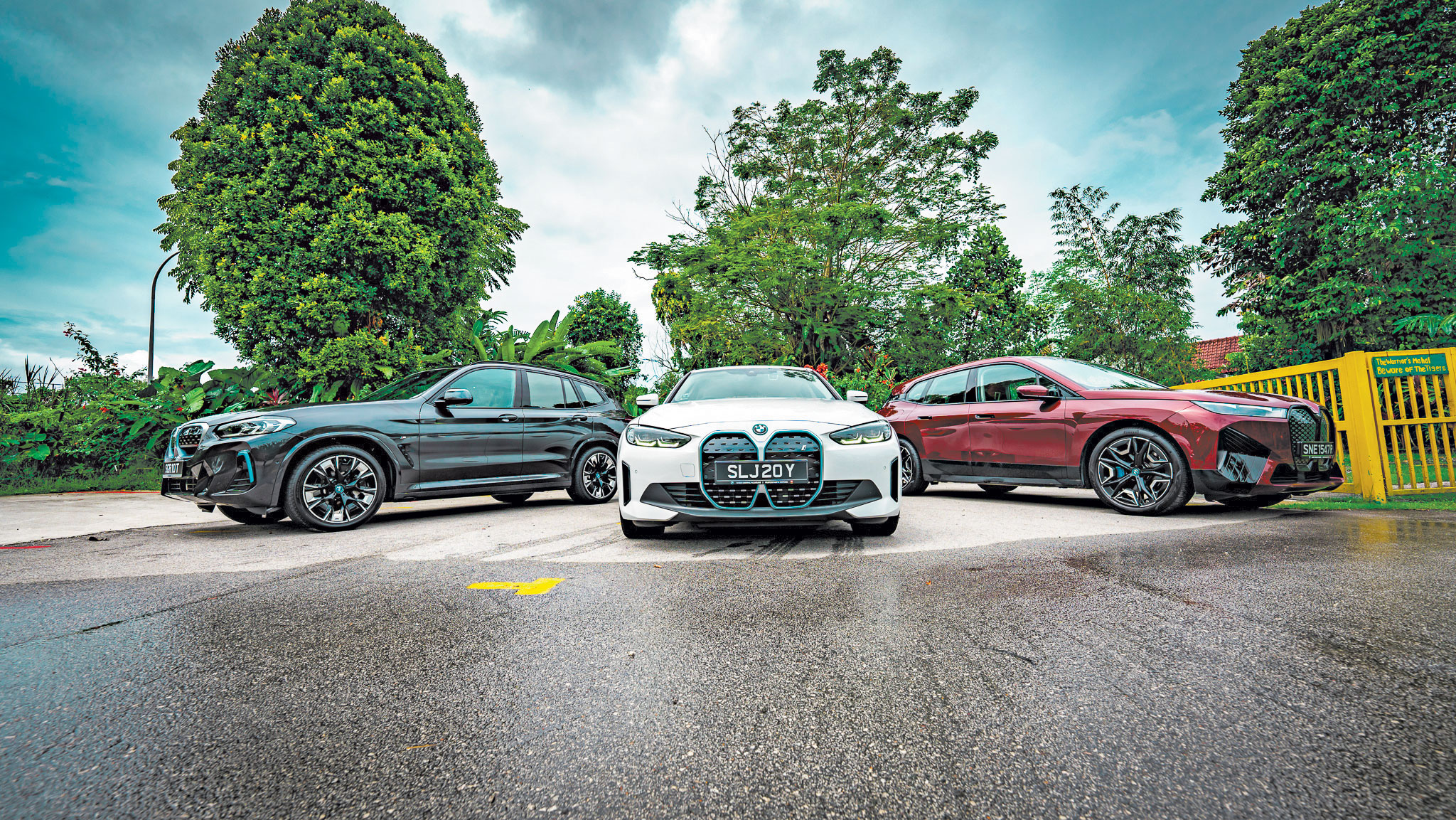
Electric trio: From left are the BMW iX3, i4, and iX. — PHOTO BY KAP MACEDA AGUILA
1 of 9
Electric trio: From left are the BMW iX3, i4, and iX. — PHOTO BY KAP MACEDA AGUILA
The BMW iX3 (left) is set to launch in the Philippines before yearend, following the bigger iX. — PHOTO BY KAP MACEDA AGUILA
The iX3 shares the same platform with its X3 siblings. — PHOTO BY KAP MACEDA AGUILA
Boasting space, function, and good looks, only blue touches give away the iX’s electrified drivetrain. — PHOTO BY KAP MACEDA AGUILA
PHOTO BY KAP MACEDA AGUILA
PHOTO BY KAP MACEDA AGUILA
PHOTO BY KAP MACEDA AGUILA
PHOTO BY KAP MACEDA AGUILA
PHOTO BY KAP MACEDA AGUILA
We drive BMW’s electrified offerings in Singapore, including the soon-to-arrive iX3
THE MONTH of October is curiously bookended by two ultimately related events. Toward its end was the 10th Philippine Electric Vehicle Summit (which we wrote about at length last week); the other an interesting drive in Singapore for a handful of us motoring journalists.
Our group had ample time aboard and at the wheel of three pure-electric vehicles (whose nomenclatures are predicated by an “i” to denote this): the BMW iX (launched in the Philippines last April), and two yet to arrive in the market — the i4 sedan and the iX3.
In a briefing at our hotel before hitting the road, BMW Group Asia Senior Product and e-Mobility Manager Alan Yi reminded us about BMW Group CEO Oliver Zipse’s recent words, perhaps appropriately encapsulating why we were at the prosperous island state for this drive: “We want to become the world’s most sustainable automaker,” Mr. Zipse had said this ahead of the IAA (Internationale Automobil-Ausstellung) Mobility last year, where the brand made “circular economy and sustainable urban mobility” its theme for the auto exhibition. “How much can we reduce the CO2 footprint of vehicles over their entire life cycle? To this end, we are setting ourselves transparent and ambitious targets for substantially reducing CO2 emissions,” the executive continued.
Speaking of electric vehicles (EVs), BMW actually had a working all-electric prototype way back in 1972 — a 1602e deployed to the Munich Olympics as a camera car. The decision to go electric even back then wasn’t whimsical. Since the vehicle would be around athletes, it behooved BMW to field one that wouldn’t be belching unhealthy fumes on their faces.
Fast-forward to the present, the Germany-headquartered premium brand’s aspirations are clear as they are measurable: sustainability through the slashing of emissions by 40% across the lifecycle of vehicles it rolls out from 2019 to 2030. Carbon dioxide output is to be cut by 20% in its supply chain, by 80% in production, and by 50% in the “use phase.” This includes the Mini brand, which BMW has owned since 1996. Meanwhile, BMW Group plant production has also been made carbon-neutral, and a share of secondary materials (above 30% today) will be increased to 50%.
These developments are neither happening in a vacuum nor merely on snazzy PowerPoint presentations. In fact, just last April, SMC Asia Car Distributors Corp. (or BMW Philippines) brought in the iX all-electric SAV (or Sports Activity Vehicle, the brand’s term for SUV). We’ve heard it’s been selling relatively well, notwithstanding the industry-wide supply chain and parts challenges.
BMW Group Asia — which oversees 14 markets, including the Philippines — said to expect the iX3 SAV to join the iX. The exact timing will be left to BMW Philippines, of course. Its officials hope to unveil the model before the end of the year.
Over dinner, BMW Group Asia Managing Director Lars Nielsen told us that the Philippines will be only the fourth market in the area (following Singapore, Thailand, and Malaysia), to get the iX3. “Velocity” asked him what the brand sees in our market for that kind of confidence in launching full electrics.
Mr. Nielsen cited regulations, our country’s goals, and ranking in the region in terms of readiness and even adoption rate. The Danish executive described electrification as a “chicken-and-egg” situation, though. One can’t simply just wait for the tipping point. You could say it’s about, well, taking charge.
For now, we can only dream about the kind of charging infrastructure that Singapore boasts. Its largest EV charging network, Bluecharge, has some 1,500 charging points in the country. This ties in with the national aspiration to have at least 60,000 of them by 2030.
Still, Mr. Nielsen believes that discussions on the ground, as well as relevant legislation (such as EVIDA) are promising and tangible evidence that EVs are set to take off in the Philippines. Having said that, automakers like BMW are also not sitting on their thumbs while waiting for an ideal situation. “You should have a charging solution with you,” he said. In case of a charging point unavailability, the so-called BMW Flexible Charger can plug into a domestic socket outlet.
And while range anxiety remains a relevant pain point, battery technology is evolving all the time and the distance between charges is ever-lengthening.
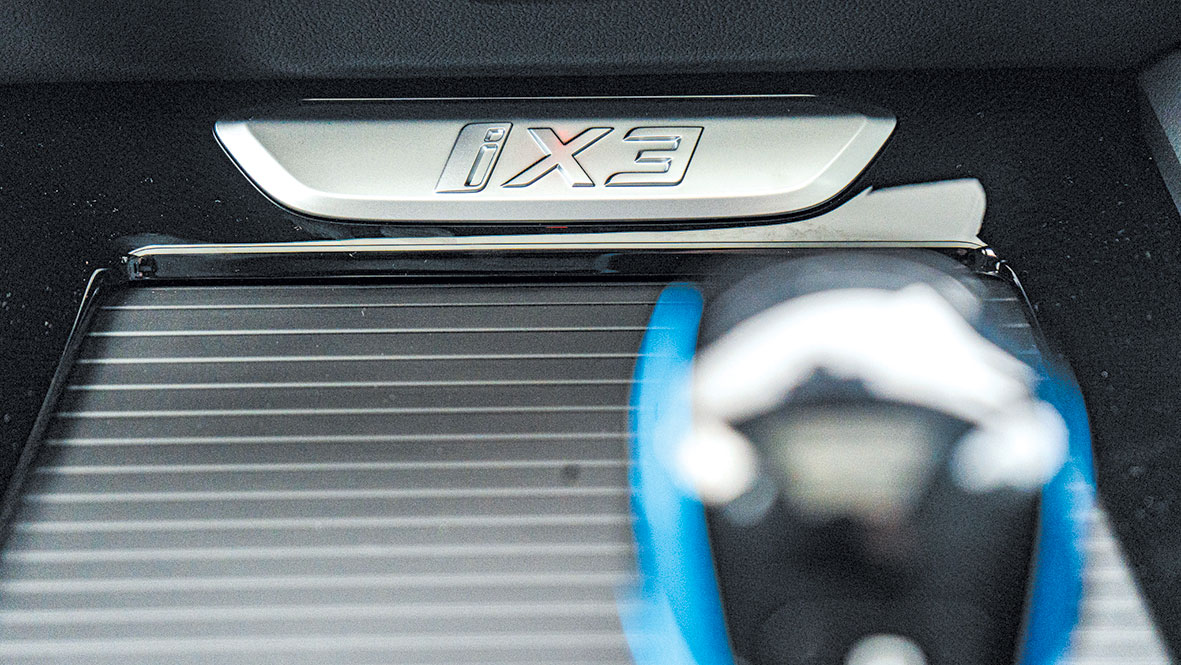
Back to the BMW iX3, I suspect this is an EV sleeper — particularly if it’s priced right. Sharing bones with the ICE-powered X3 (which effectively becomes the first BMW to be offered in four different drivetrains [diesel, BEV, PHEV, and gasoline]), the iX3 is powered by a 400V lithium-ion battery hooked up to the brand’s proprietary eDrive system. An electric motor generates 286hp and 400Nm. Consumption is estimated at 19.4kWh/100km — for a claimed electric range of 450 to 459 kilometers. Sprightly performance is evidenced by a standstill-to-100kph time of 6.8 seconds — up to an electrically governed 180kph. Using a DC/150kW charger, enough juice can be put in for 100 kilometers in just 10 minutes. Using a home-installed Wallbox, BMW claims, gets zero-to-100% charging done in 7.5 hours.
The company’s sustainability goals are also expressed in the production of the iX3. BMW is said to make the model using CO2-free electricity, and its electric motor doesn’t employ rare earth materials. “Magnets are not as sustainable,” declared Mr. Yi.
Additionally, he shared that BMW has been working on its batteries in-house since 2008, leading to “further optimization of the interaction among the electric motor, transmission, power electronics, and battery… This is an expertise not left to outsiders.”
The earnest work and attention the company has been putting into its battery tech has been reaping dividends such as “silent operation, balance between high peak power and stable torque even at high rpm,” reported Mr. Yi.
Engineers and designers have also worked to develop a modular design for the high-voltage battery — allowing a good package and stacking potential.
For the end user, the iX3 strikes a very different ethos from the previously launched iX. While the iX is a study in futuristic styling and elements, the iX3 is pretty similar to the garden-variety X3. And that surely will help make it more palatable for browsers who are looking for a more “normal-looking” BMW. It’s pretty much the blue-colored accents that give away its electric nature.
The iX and i4 sedan, on the other hand, look like concept vehicles which underscore the arrival of the future through design execution that leaps rather than progressively evolves. Taken as a whole, this triumvirate doesn’t just embody the electric and sustainability goals for BMW but, really, another litmus test of our country’s readiness to make the switch.
Not to be all Inception about it, but there are choices within the choice.
THE Bureau of Fisheries and Aquatic Resources (BFAR) is considering the direct sale of diesel to fisherfolk to mitigate the impact of high fuel prices.
Demosthenes R. Escoto, BFAR officer-in-charge, said that the BFAR is trying to arrange access to diesel for fisherfolk at a lower price.
“We’ve initially talked with Philippine National Oil Co. (PNOC) because we are exploring the possibility of coming up with a direct sale of diesel for our fisherfolk. The PNOC told us to discuss this in detail with the Department of Energy (DoE), which in turn is asking for some data on the requirements of these fishers’ groups,” Mr. Escoto said last week.
“We will give them all the data and hopefully they can offer some sort of an arrangement wherein our fisherfolk can buy fuel at discounted price,” he added.
According to Mr. Escoto, the proposed discounted fuel will be an “industry to industry” arrangement, describing the BFAR’s role as facilitating the transaction.
“We will bring the fishers associations to talk with (the private sector) on the discounted fuel since we know that the price will go down with bulk purchasing,” Mr. Escoto said.
Fisherfolk association Pambansang Lakas ng Kilusang Mamamalakaya ng Pilipinas (PAMALAKAYA) has said that high fuel prices will dampen fisheries production in the fourth quarter.
PAMALAKAYA added that fuel expenses, which account for 80% of overall production costs, are forcing members to take on other jobs due to the inability to operate their boats.
On Friday, the DoE said that there might be a P1 rollback next week in the price of all fuel products. Oil companies announce fuel price adjustments every Monday and implement the changes a day after.
On Oct. 25, oil companies implemented a P0.35 per liter decrease for gasoline, a P1.10 decrease for diesel, and a P0.45 decrease for kerosene. The adjustments bring the year-to-date price increases to P16.10/liter for gasoline, P37.40 for diesel, and P29.20 for kerosene.
Asked to comment, Federation of Free Farmers Raul Q. Montemayor national manager, said that subsidies need to be delivered efficiently to the fisherfolk.
“Fuel subsidies would be very helpful to small fishermen but (the BFAR) has to devise an efficient way to deliver the subsidy.”
He added that “As with many other commodities, fishermen get a very small percentage of what consumers pay for the seafood they buy. So, we also need to address the marketing side,” Mr. Montemayor said in a Viber message. — Revin Mikhael D. Ochave
MANILA Electric Co. (Meralco) expects to post higher profits this year on sustained growth in energy sales and higher earnings from its power generation businesses.
“The forecast expectation for the whole year is that we’ll be better than the core income last year where we reported P24.6 billion,” Meralco Chairman Manuel V. Pangilinan said during a virtual press briefing on Friday.
Meralco Chief Finance Officer Betty C. Siy-Yap said the electricity distributor posted an increase in its consolidated core net income for the nine months that ended on Sept. 30.
Meralco saw an 8.6% increase in its consolidated core net income to P19.61 billion for the January-September period from P18.06 billion in the same stretch last year.
Further, Meralco’s nine-month reported net income rose by 19.6% to P19.76 billion from P16.52 billion previously. Its consolidated revenues were recorded at P314.88 billion, a 35.9% increase from P231.72 billion in the same period last year.
As of September, Meralco said its consolidated capital expenditures (capex) stood at P20.8 billion, of which P13.5 billion went to spending for its network.
The power distributor company said network capex consisted of new connections, asset renewals, and load growth projects.
Mr. Pangilinan said that with strong recovery efforts, the power utility is expecting to exceed its consolidated net income last year.
“Despite the challenges the country is currently facing, including elevated food and energy prices, Meralco expects power demand to continue growing, which makes the energy sector maintain its critical role in supporting economic growth and progress,” Mr. Pangilinan said in a media release.
Meanwhile, Jose Ronald V. Valles, Meralco’s head of regulatory management, said during the virtual briefing that the company is seeking emergency power supply agreements (EPSAs) after the decision of the Energy Regulatory Commission (ERC) to deny its joint petition with San Miguel Corp. (SMC) for a rate increase.
“Yes, we filed with the DoE (Department of Energy) a request for a certificate of exemption for an equivalent capacity of 1,070 megawatts presumably to cover the 1,070 megawatts that will expire, assuming that the ERC will allow expiration of those contracts with San Miguel,” Mr. Valles said.
However, Mr. Valles said that Meralco asked the DoE to put on hold the evaluation of the request after SMC’s letter signifying its intent to supply power to Meralco.
“But because they continue supplying power to Meralco continuously up to this time there is no need for EPSAs at the moment, but it is still with the DoE and it has not been withdrawn,” he said.
“If San Miguel will pursue termination of the two contracts, we have to await a notice of termination from them, then we will immediately manifest to the ERC our opposition and request guidance to resolve the matter,” Mr. Valles added.
Earlier this month, the ERC denied the rate increase petitions of SMC’s South Premiere Power Corp. (SPPC) and San Miguel Energy Corp. (SMEC) jointly filed with Meralco.
SPPC and SMEC, respectively, are the administrators of the coal power plant in Sual, Pangasinan and the natural gas-fired power plant in Ilijan, Batangas.
Before the ERC decision, SMC said that its units had sent a notice of termination to Meralco. It earlier said that their previously agreed power supply agreements were based on assumptions that were taken over by a change in circumstances that brought losses to the power generation firms.
Meralco’s controlling stakeholder, Beacon Electric Asset Holdings, Inc., is partly owned by PLDT Inc. Hastings Holdings, Inc., a unit of PLDT Beneficial Trust Fund subsidiary MediaQuest Holdings, Inc., has an interest in BusinessWorld through the Philippine Star Group, which it controls. — Ashley Erika O. Jose
TOYOTA MOTOR Philippines Corp. (TMP) presents deals for people on the lookout for a new vehicle. This promotion is available across its nationwide dealership network until Oct. 31.
The Toyota Innova J Dsl M/T variant goes for P12,787 per month through Pay Light (low monthly plans, 50% down payment, 60 months to pay). Customers can also opt to get the J Dsl M/T variant at P178,650 down payment with the Pay Low option (all-in cash out with down payment as low as 15%, free one-year insurance and three-year LTO registration, and free chattel mortgage at 60 months to pay). Those who purchase in cash can also get up to P20,000 in savings for the E A/T and M/T variants.
TMP also bundles a purchase of any Toyota Vios G, E, or XLE unit with a five-year warranty, and the Pay Light option offers the XE CVT at only P8,212 per month. Via the Pay Low option, it’s available with an all-in down payment of P115,350. Purchasing in cash nets up to P45,000 in savings for the brand-new Vios XLE CVT. Meanwhile, the Raize can be had through Pay Light, offering the G CVT variant for only P10,110 a month. The all-new Veloz goes for P13,210 a month via Pay Light.
Pay Low, Pay Light or savings promos are also applicable to other Toyota models such as the Rush, Corolla Altis, Wigo, Avanza, Hilux, Hiace and Fortuner.
Each purchase of a brand-new Vios, Wigo, Corolla Altis, Innova, Hilux, Avanza, Veloz, Rush, and Fortuner until Oct. 31 entitles buyers to free one-year insurance. Toyota Insure’s comprehensive insurance includes 24/7 personal accident insurance, passenger auto personal accident insurance, protection for damage caused by acts of nature, and emergency roadside assistance, among others.
Toyota also rolls out a trade-in rebate promo this month. Up to P35,000 in rebates can be realized when a Wigo, Vios, or Innova is traded in, or up to P30,000 when a customer switches up from a Vios to the Raize G CVT. An Avanza can be upgraded to a Veloz, and the client gets a P20,000 rebate. Rebates can be used as cash discount in the purchase of participating models until Oct. 31, 2022 only. Rebates can also be used to purchase car accessories and be used on top of existing promotions.
For the entire month of October, a brand-new Vios, Altis, Raize, Avanza, Veloz, Rush, Innova, Fortuner, Hilux or Hiace purchased from any authorized Toyota dealer nationwide is entitled to free periodic maintenance service (PMS). Owners of the brand-new Toyota Lite Ace can avail, until month’s end, a fixed periodic maintenance package up to 40,000 kilometers (km). Lite Ace owners will only need to pay P1,999 per service until the 40,000-km maintenance check.
For more information, visit https://toyota.com.ph/promos/SharedSmiles, or follow TMP’s official pages: Toyota Motor Philippines on Facebook and Instagram, toyota.com.ph, Twitter (ToyotaMotorPH), and Viber (Toyota PH). For safely distanced viewing, check out toyota.com.ph/showroom and choose a preferred dealership. The company also suggests to download the myToyota PH app for Android and iOS for all Toyota needs.
THE agricultural trade deficit widened 15% year on year in the second quarter to $2.72 billion, according to preliminary data issued by the Philippine Statistics Authority (PSA).
The PSA said in a report released on Oct. 28 that overall agricultural trade during the second quarter rose 25% year on year to $6.95 billion.
The PSA said agricultural exports rose 32.4% year-on-year to $2.12 billion during the period, accounting for 11.1% of all exports, while agricultural imports rose 22% to $4.84 billion or 13.5% of all imports.
According to the PSA, exports of fats and oils, which includes animal or vegetable fats and oils and their cleavage products; prepared edible fats; and animal or vegetable wax, accounted for the biggest share by value, at $690.14 million.
Agricultural exports to the Association of Southeast Asian Nations (ASEAN) totaled $336.56 million, equivalent to 9.8% of all exports to the region. Malaysia was the leading destination at $158.58 million.
The top three major agricultural commodities exported to ASEAN were animal or vegetable fats and oils ($180.39 million), tobacco and manufactured tobacco substitutes ($69.75 million), and miscellaneous edible preparations ($16.48 million).
The PSA said cereals were the leading import commodity at $944.43 million or 19.5% of the total.
Agricultural imports from ASEAN amounted to $1.56 billion or 14.4% of overall imports. Vietnam was the biggest ASEAN source of agricultural products, accounting for $420.38 million.
The top three imports from ASEAN countries were animal or vegetable fats and oils ($451.04 million), miscellaneous edible preparations ($352.19 million), and cereals ($290.28 million).
Within the European Union (EU), the PSA said Netherlands was the leading destination ofagricultural exports, accounting for $274.60 million or 55.6% of all shipments to Europe. Spain was the top EU source of agricultural products with $114.82 million. — Revin Mikhael D. Ochave






 This seems to be the opposite of what’s happening in western countries including the United States where many parents increasingly sought out, regardless of the price tag, independent schools that offered physical rather than remote classes as the coronavirus crisis raged on, CNBC reported last year.