Home Blog Page 5675

Infra damage from Luzon earthquake hits P33.8 million

OFFICE OF REP. CHING BERNOS

INFRASTRUCTURE damage from Wednesday’s magnitude 7 earthquake that rocked the northwestern part of the Philippines’ main island of Luzon has hit P33.8 million, according to the local disaster agency.

“The estimated cost of damage to infrastructure of P33.8 million was incurred in Region 1 (Ilocos), Region 3 (Central Luzon) and National Capital Region,” the National Disaster Risk Reduction and Management Council (NDRRMC) said in a 6 a.m. bulletin on Thursday.

Power in 36 of 37 towns that experienced brownouts had been restored, according to the report.

The Department of Public Works and Highways (DPWH) said it was working double time to reopen the remaining four closed roads in quake-hit Northern Luzon.

Seventeen of 21 road sections affected by the earthquake had been reopened to traffic, Public Works Secretary Manuel M. Bonoan said in a separate statement.

Meanwhile, the Department of Agriculture said road closures in Benguet and Mountain Province was unlikely to cause significant delays in the delivery of agri-fishery goods to Metro Manila.

“To date, there are no reported damage and losses yet in the agriculture and fisheries commodities and infrastructure that could hamper the food supply system,” it said in a bulletin.

Wednesday’s quake damaged several bell towers, churches and heritage houses as well as cars and other properties in northern Philippines.

The quake’s tremors were also felt in the capital Manila and nearby areas, forcing workers to evacuate buildings and halting train operations.

The Philippines’ seismological agency said it had recorded more than 800 aftershocks almost 24 hours after the temblor rocked Abra province, where the epicenter was located.

More than 20,000 people from 4,000 families in the Ilocos Region and Cordillera Administrative Region (CAR) were affected by the quake, Defense department officer-in-charge Jose Faustino, Jr. told a briefing led by President Ferdinand R. Marcos, Jr. in Abra.

He said more than 2,000 families remained in evacuation centers as of Thursday morning. “Inside 31 evacuation centers, there were 2,312 families from Regions I and CAR,” he said.

“We have a total of 4,969 families or 20,000 persons more or less that were affected in 110 barangays in Region I and CAR, Social Welfare Secretary Erwin T. Tulfo said at the same briefing. More than 300 houses were damaged.

He said 1,657 people from 413 families were staying in temporary shelters outside evacuation centers.

At least 35 schools were damaged, the Department of Education said, citing initial reports. Eleven of these were in Central Luzon, nine in Cagayan Valley, eight in CAR and seven in Ilocos. It estimated the cost of the damage at almost P230 million.

The agency said 8,027 schools were also affected by the quake.

At the briefing, Mr. Marcos ordered authorities to prioritize the restoration of electricity and communication lines in affected areas.

He said electricity and communication are needed for the government’s relief efforts. He also cited the need for sufficient water supply. — KATA and ALB

Bill on creation of department for disaster management ready for refiling in House

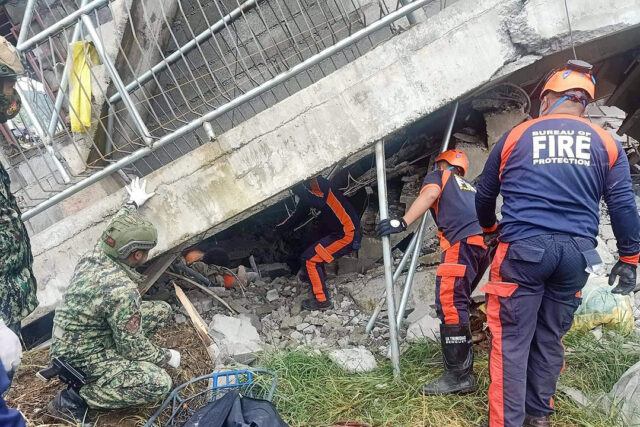
EMERGENCY responders — including firefighters, police, military, and local government teams — at a site of a collapsed building in La Trinidad, Benguet following the magnitude 7 earthquake that struck northwestern Luzon on July 27. — BUREAU OF FIRE PROTECTION

A BILL that will create a new department focusing on disaster management is ready for refiling in the House of Representatives while another related measure has already been submitted, according to lawmakers.  

Ang Probinsyano Party-list Rep. Alfred C. Delos Santos said in a news release on Thursday that the July 27 earthquake that hit the northwestern part of the main island of Luzon should be the last reminder to Congress on the urgent need of creating a Department of Disaster Resilience.   

I was a co-author of the Department of Disaster Resilience (DDR) bill during the 18th Congress. It was approved on third and final reading; so, I add my voice in agreement to the fast-track approach to bills that the House previously approved on third and final reading, he said.  

A DDR bill was approved by the House in the previous Congress but its counterpart measure did not hurdle the Senate as several legislators questioned its practicality and the funding required to set up another department.    

Emergency preparedness and response programs are currently under the multi-agency National Disaster Risk Reduction and Management Council (NDRRMC), which is led by the Department of National Defense.  

President Ferdinand R. Marcos, Jr. on Wednesday said he will push Congress to prioritize the establishment of a DDR.  

Mr. Delos Santos said he has filed House Bill 1923, otherwise known as Laging Handa bill, which seeks to integrate basic medical training and disaster awareness or response in all institutions of learning. 

BHW Party-list Rep. Angelica Natasha Co said other bills relating to disaster resilience are ready to be filed.  

In times of disasters and more so before disasters strike, we need the proposed Medical Reserve Corps, Philippine Center for Disease Prevention and Control, and fully-functioning State Universities and Colleges Mental Health Services,said Ms. Co. 

AID
Meanwhile, House Speaker Ferdinand Martin R. Romualdez said in a separate statement that the lower chamber will support the allocation of funds in the national budget for the rehabilitation and restoration of public infrastructure in affected provinces.   

The newly-formed Department of Migrant Workers (DMW) also announced on Thursday that it has allocated P20 million to assist families of overseas Filipino workers (OFWs) affected by the earthquake.

“This is just an initial allotment to help OFW families affected by the earthquake. I have directed the Overseas Workers Welfare Administration to immediately provide help and find out what other forms of assistance the DMW can provide,” DMW Secretary Susan V. Ople said in a statement. 

Ms. Ople added that the department will wait for the damage assessment report of the NDRRMC to determine the areas most affected by the tremor.

She has also asked the state-run Home Development Mutual Fund or Pag-IBIG to open an emergency loan window for affected OFW families. Matthew Carl L. Montecillo and John Victor D. Ordoñez 

Land, guns are pressure points in Bangsamoro transition, sustainable peace — IA report

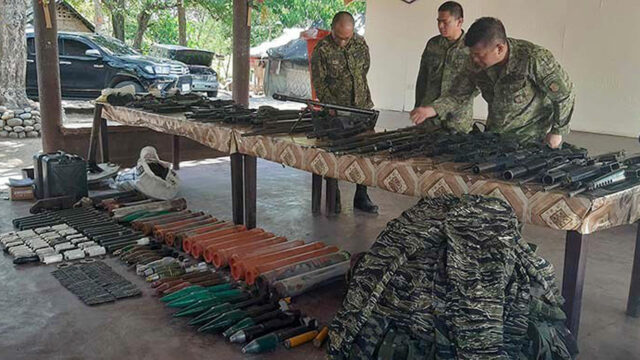
UNREGISTERED weapons seized by the military in Maguindanao in 2019. — WESTMINCOM

CONFLICTS over land ownership and continued proliferation of illegal guns are two of the main threats to the Bangsamoros ongoing political transition and sustaining peace in a restive region, according to a global peacebuilding organization.   

International Alert (IA), in its book Conflicts Long Game: A Decade of Violence in the Bangsamoro launched on Thursday, said measures that will settle land disputes and curb loose firearms must be prioritized by the regional and national governments to mitigate continued cycles of violence.   

What is lingering, what is continuing is always those issues pertaining to land. And what should be raised is the increasing tendency even among violent extremist groups to involve themselves in land issues,International Alert Senior Peace and Conflict Adviser Francisco Lara, Jr. said during the launch.   

Violent incidents in the Bangsamoro Autonomous Region in Muslim Mindanao was on a downtrend from 2016 to 2020, based on the data-driven book. However, the 2020 total was still more than double the under 1,000 recorded in 2011.   

The problem on illegal guns is partly tied to the slow implementation of the decommissioning program wherein armed combatants of the former rebel group Moro Islamic Liberation Front (MILF), which signed a peace deal with the government, are to give up their weapons.   

The longer that is delayed will create a lot of problems,Mr. Lara said.   

An immediate solution, he said, is to require all non-decommissioned MILF members to register their guns based on the countrys firearms regulation law under Republic Act 10591.  

Loose firearms are also linked to the return of the illegal drug trade,a major facet of the underground economy in the region, especially in urban areas such as the cities of Marawi and Cotabato.   

International Alert Philippines Country Director Nikki C. de la Rosa said getting the Bangsamoro out of the conflict trap and cycles of violencerequires an understanding of the dynamics of identitiesin a multi-cultural region with a Muslim majority.  

What cuts across the ebb and flow of violence in the last 10 years is identities,Ms. De la Rosa said.    

Identities can be instrumentalized for political gains during election period, for specific things whether that relates to the use of your affiliation with a certain armed group, and land issues, and non-Moro indigenous peoples land, and so on.MSJ

Palace extends authority of officers-in-charge until yearend

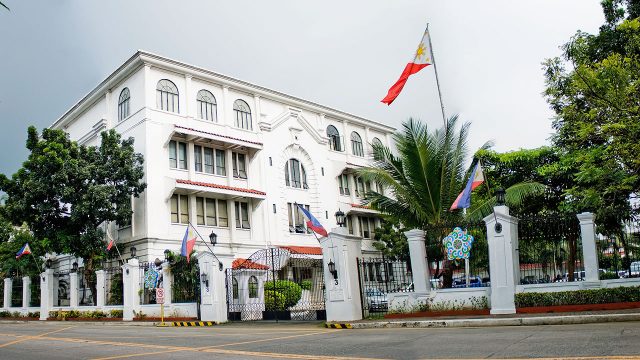
MALACANANG.GOV.PH

THE PRESIDENTIAL Palace on Thursday released a memorandum circular extending the authority of officers-in-charge of agencies under the Executive department until the end of the year. 

This extends the authority of Officers in Charge until December 2022, unless a replacement has been designated or appointed, whichever comes first,Press Secretary Trixie Cruz-Angeles said in a statement. 

In Memorandum Circular (MC) 3, Executive Secretary Victor D. Rodriguez said the extension of the term of OICs until end-December will “ensure the continuous and effective delivery of government services.” 

Among those covered by the memo is Health Undersecretary Maria Rosario S. Vergeire who is currently OIC head of the department. 

The Department of National Defense and the Department of Science and Technology are also among the agencies with OICs. 

The latest memo supplements and amends MC 1, which facilitates the designation of OICs in government agencies where Mr. Marcos has yet to appoint a secretary or head. Kyle Aristophere T. Atienza

Teachers’ party-list denounces DepEd plan on added benefits instead of pay hike

A GRADE 1 teacher at an elementary school in Montalban, Rizal holds tutorial classes on Nov. 15, 2021. — PHILIPPINE STAR/ MICHAEL VARCAS

DEPUTY Minority Leader and ACT Teachers Party-list Rep. France L. Castro on Thursday said their group is disappointed by the Department of Educations (DepEd) proposal to grant additional benefits to teachers instead of a pay increase.  

“Teachers in the public sector have been left behind by other professions with similar qualifications,Ms. Castro said in a statement.   

It is only just that the government gives our teachers increases in their salaries,” she said, noting governments lack of support in terms of overtime pay and provision of allowances for additional costs required under the blended learning system during the coronavirus pandemic.   

She cited Section 15 of Republic Act 4670, or the Magna Carta for Public School teachers, which states that ‘Teachers’ salaries shall compare favorably with those paid in other occupations requiring equivalent or similar qualifications, training and abilities and that they shall be such as to insure teachers a reasonable standard of life for themselves and their families.”   

Ms. Castro also said that the government needs to raise public school teachers’ salaries to set the standard for those teaching in private schools.   

For the longest time, the government has been denying public school teachers salary increases by pitting their salaries against teachers in the private sector, which is wrong because most private school teachers are paid at very low rates, even near-starvation salaries,” she said.  

The ACT Teachers Party-list filed House Bill 203 which seeks to upgrade the salary grade of public school educators.   

“These are part of our priority measures that reflect the demands of our teachers in both the public and private sector. We urge the House leadership to pass these bills into law,” Ms. Castro said. Matthew Carl L. Montecillo 

Almost 2,600 kilos of trash collected in Muntinlupa under Maynilad’s clean-up drive for Laguna Lake

MAYNILAD PHOTO HANDOUT

HUNDREDS of sacks of solid waste weighing a total of 2,584 kilograms were collected during a recent clean-up drive in Muntinlupa Citys two rivers as part of Maynilad Water Services, Inc.s (Maynilad) program to protect the water quality in Laguna Lake.  

The Magdaong and Alabang-Bayanan rivers in the city are among the tributaries that flow into Laguna Lake, which serves as a raw water source for about two million consumers within Maynilads concession area, the company said in a statement on Thursday.    

These river clean-up drives are among the interventions we are taking to help reduce pollution load into Laguna Lake, which is being used as a source for drinking water and should therefore be protected,” says Maynilad President and Chief Executive Officer Ramoncito S. Fernandez.  

We call on other stakeholders to also partner with us in this environmental conservation initiative, he said.   

Maynilad said the clean-up activity also helped unclog waterways that cause flooding.  

The water company also said it is donating solar paddle wheels and a water quality analyzer equipment to Muntinlupa City to help mitigate algal bloom episodes in Laguna Lake.   

Maynilad provides water and wastewater services in the west zone of the greater Metro Manila area, covering 17 cities and municipalities.   

Metro Pacific Investments Corp., which has a majority stake in Maynilad, is one of three Philippine units of Hong Kong-based First Pacific Co. Ltd., the others being Philex Mining Corp. and PLDT, Inc. 

Hastings Holdings, Inc., a unit of PLDT Beneficial Trust Fund subsidiary MediaQuest Holdings, Inc., has an interest in BusinessWorld through the Philippine Star Group, which it controls. 

North Korea’s Kim says nuclear deterrent is ready, slams South Korea’s Yoon

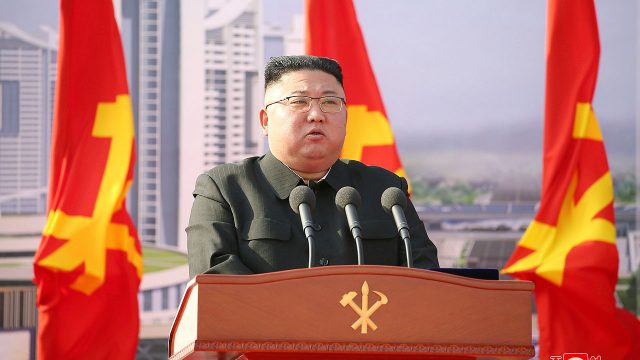
KCNA VIA REUTERS

SEOUL — North Korean leader Kim Jong Un said his country is ready to mobilize its nuclear war deterrent and counter any US military clash, and criticized South Korea’s new president for the first time, warning Seoul was pushing towards the brink of war. 

Mr. Kim made the remarks during a speech at an event to mark the 69th anniversary of the July 27 Korean War armistice, which left the two Koreas technically still at war, according to the official KCNA news agency on Thursday. 

The confrontation with the United States posed nuclear threats since the 1950–53 war required the North to achieve an “urgent historical task” of beefing up its self-defense, Mr. Kim said. 

“Our armed forces are thoroughly prepared to respond to any crisis, and our nation’s nuclear war deterrence is also fully ready to mobilize its absolute strength faithfully, accurately and promptly to its mission,” he said. 

The speech came after Seoul and Washington officials said Pyongyang has completed preparations to conduct its first nuclear test since 2017. 

South Korea’s unification minister handling inter-Korean affairs said on Tuesday there was a “possibility” of the test around the anniversary of the armistice, though a military official said there were no immediate signs for it. 

North Korea is likely to face stronger sanctions including measures targeting its cyberattack capabilities if it goes ahead with the test, South Korea’s foreign minister said on Wednesday. 

In the speech, Mr. Kim said Washington continues “dangerous, illegal hostile acts” with South Korea against the North, and seeks to justify its behavior by “demonizing” the country. 

The North has long accused the United States of double standards over military activities and pursuing a hostile policy towards Pyongyang, saying it hampers a restart of talks aimed at dismantling the country’s nuclear and missile programs in return for sanctions relief. 

“The duplex act of the United States, which is misleading all the routine actions of our armed forces as ‘provocation’ and ‘threat’ while holding large-scale joint military exercises that seriously threaten our security, is literally a robbery,” Mr. Kim said. 

“That is driving bilateral relations to the point where it is difficult to turn back, into a state of conflict.” 

‘ABSOLUTE WEAPON’
Mr. Kim also denounced South Korea’s new conservative President Yoon Suk-yeol by name for the first time, accusing him of threatening the North’s security and right to self-defense. 

“Warmongers” and “disgusting thugs” in Mr. Yoon’s administration are bent on confrontational military activities, Mr. Kim said, singling out Seoul’s weapons developments and drive to bring back US nuclear strategic assets as well as allied military drills. 

Their “heinous confrontational policy” toward the North and “toadyish, treacherous acts” are pushing the situation to the brink of war, he said. 

North Korea in recent months has tested hypersonic missiles and missiles that it says could carry tactical nuclear weapons, narrowing the time that Seoul would have to respond to a pending attack. 

Mr. Yoon has vowed to complete the so-called “Kill Chain” system that calls for preemptive strikes against the North’s missiles and possibly its leadership if an imminent attack is detected. 

But that system would never be able to cover the North’s “absolute weapon,” Mr. Kim said. 

“If you think you can counter us militarily and preemptively neutralize or destroy part of our military power,” he said. “Such a dangerous attempt will immediately be punished by a powerful force, and Yoon Suk-yeol’s government and his army will be annihilated.” 

Seoul’s defense ministry spokesman said it would continue reinforcing its own capabilities and the US extended deterrence including its nuclear umbrella to better respond to Pyongyang’s threats. 

Yang Moo-jin, a professor at the University of North Korean Studies in Seoul, said Mr. Kim’s remarks seem to be intended to highlight the legitimacy for weapons developments and his “eye for eye” approach toward Washington and Seoul. — Hyonhee Shin and Soo-hyang Choi/Reuters

Biden looks to tamp down Taiwan tension during call with Xi

REUTERS

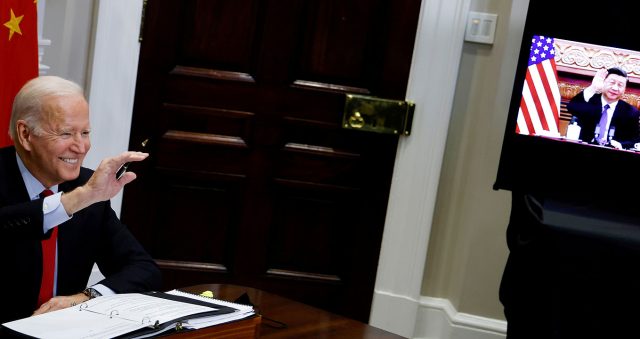
WASHINGTON — US President Joseph R. Biden and China’s Xi Jinping may hold their fifth call as leaders as soon as today, as concerns rise over a possible visit to Chinese-claimed Taiwan by US House Speaker Nancy Pelosi.

White House officials have said the long-planned call will have a broad agenda, including discussion of Russia’s invasion of Ukraine, which China has yet to condemn.

At its core, US officials see the exchange as another chance to manage competition between the world’s two largest economies, whose ties are increasingly clouded by tensions over democratically governed Taiwan, which Mr. Xi has vowed to reunite with the mainland, by force if necessary.

Beijing has issued escalating warnings about repercussions should Ms. Pelosi visit Taiwan, a move that would be a dramatic, though not unprecedented, show of US support for the island, which says it is facing increasing Chinese military and economic threats.

Washington does not have official relations with Taiwan and follows a “one-China” policy that recognizes Beijing, not Taipei diplomatically. But it is obliged by US law to provide the island with the means to defend itself, and pressure has been mounting in Congress for more explicit support.

“This is about keeping the lines of communication open with the president of China, one of the most consequential bilateral relationships that we have, not just in that region, but around the world, because it touches so much,” White House national security spokesman John Kirby told reporters on Wednesday.

One person briefed on planning for the call said the Biden administration thinks leader-to-leader engagement is the best way to lower tensions over Taiwan.

Mr. Xi has an interest in avoiding a tense confrontation with the United States as he seeks an unprecedented third term in office at a congress of China’s ruling Communist Party, which is expected in October or November, some analysts believe.

Mr. Biden also wants to discuss climate and economic competition issues, the person briefed said, as well as the idea of placing a price cap on Russian oil to punish Moscow for its war in Ukraine, an issue Treasury Secretary Janet Yellen raised with Chinese counterparts earlier in July.

The Biden administration has been debating whether to lift some tariffs on Chinese goods as a way to ease soaring inflation, but US officials have said a decision was not expected ahead of the call.

When Mr. Biden last spoke to Mr. Xi in March, he warned of “consequences” if Beijing gave material support for Russia’s war, and the US government believes, that red line has not been crossed in the months since.

TOXIC TIES
The White House has reiterated that its “one-China” policy has not changed despite speculation over a possible trip by Ms. Pelosi, which the speaker has yet to confirm.

The last time a speaker of the US House of Representatives visited Taiwan was in 1997, and as a co-equal branch of government, the US executive has little control over congressional travel.

China has grown more powerful militarily and economically since, and some analysts worry such a visit at a time of fraught ties, could spur a crisis across the 100-mile (160-km) wide Taiwan Strait waterway separating China and Taiwan.

“The relationship is in such a toxic state. Mutual distrust is really at an all-time high. I think people don’t realize how dangerous this particular moment is,” said Bonnie Glaser, a China expert at the German Marshall Fund of the United States.

She said Mr. Biden and Mr. Xi needed to focus their call on de-escalation, including possible mechanisms to reduce the risk of mishaps.

Mr. Kirby said the administration has been in touch with Ms. Pelosi’s office to make sure she has “all the context” she needs to make decisions about her travel.

China has given few clues to specific responses it might take if Ms. Pelosi, a longtime critic of China, particularly on human rights issues, does go to Taiwan.

Martin Chorzempa, a senior research fellow at the Peterson Institute for International Economics, said playing up the Taiwan issue could serve Mr. Xi as a domestic distraction from China’s slowing economy, but “any reaction strong enough to trigger US sanctions would create massive damage to China and the world economy.” — Reuters

After cannabis, Thailand takes step to allow casinos to operate

AFTER decriminalizing cannabis, Thailand is now considering casinos to attract foreign money and lure more tourists to galvanize its pandemic-hit economy.

A panel of Thai lawmakers submitted a report on Wednesday to Parliament, recommending the government issue a decree allowing “entertainment complexes” that include legal casinos to be built in key cities across the country.

The proposal comes as Thailand seeks to revive its all-important tourism industry, a key to rebooting the country’s economy. The blueprint, if adopted, could help Thailand generate billions of dollars from foreign investors, travelers and Thai gamblers — who would otherwise spend gaming money in neighboring countries, according to the panel.

“We’re focused on attracting foreigners to step up tourism and draw more money out of their pockets,” said Pichet Chuamuangphan, a lawmaker from the Pheu Thai Party, who is a vice chairman of the panel. “This will also stem the outflow of money from Thai gamblers and help the government collect hefty taxes for our economic security.”

The proposal for casinos comes amid Thailand’s broader move toward a more-liberal legal landscape. Last month, Thailand became the first country in Asia to decriminalize cannabis and first in Southeast Asia to move toward legalizing same-sex unions.

Greater Bangkok would be ideal for the initial casino, followed by facilities in seaside southern provinces such as Phuket, Krabi or Phang Nga, Mr. Pichet said. Tourist destinations like Chiang Mai in the north and Chonburi, home to beach resort Pattaya, are also obvious contenders among the 77 provinces.

At least 400 billion baht ($11 billion) in additional tax revenue would be collected annually once several facilities are operating, he said.

The panel’s recommendations are built upon Thailand’s Gambling Act of 1935, which prohibits most types of betting but contains a provision that gives the government powers to issue decrees or licenses that green-light certain gaming activities and venues.

A key to successful facilities in Thailand would be to allow locals to participate, as foreigner-only properties in Vietnam and South Korea “showed how casinos suffer without steady foot traffic,” Bloomberg Intelligence analysts Angela Hanlee and Kai Lin Choo said in a March report. Currently, casinos in Poipet, a Cambodian city across the border, “are fed by Thai gamblers,” the report said.

Public-private partnerships with domestic or foreign companies could be set up or the operating licenses may be issued directly to private firms. Either way, complexes must include facilities such as hotels, amusement parks and retail outlets, Mr. Pichet said. Providing multiple activities will avoid the creation of gambling dens and broaden the appeal of the tourism industry, he said. 

Thais who are at least 20 and have a minimum 500,000 baht in bank accounts would be allowed to gamble, according to the proposal, which stipulates a minimum 30% tax on casino operators’ revenue.

With the blueprint’s submission Wednesday, Thai lawmakers will next deliberate on whether to act on the recommendations, which could be concluded before a parliamentary recess in September, Pichet said. — Bloomberg

Spain asks EU Parliament to make Catalan its first regional language

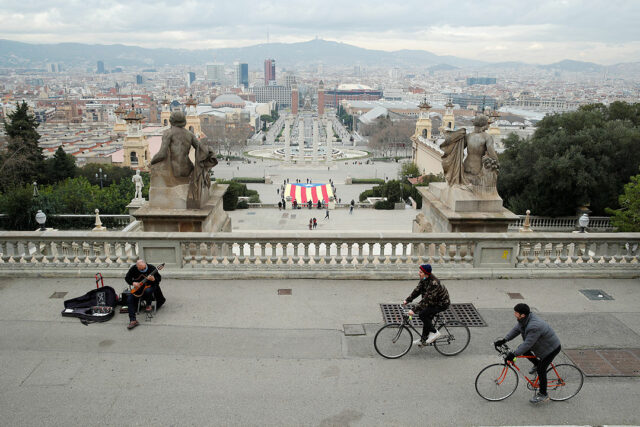
A giant Estelada flag (Catalan separatist flag) is seen in Barcelona, Spain Feb. 12, 2021. — REUTERS/ALBERT GEA

MADRID — The Spanish government said on Wednesday it will ask the European Parliament to consider allowing the use of Catalan in the chamber, in what would be a first for a European regional language.

Madrid will present to the Parliament’s board in Brussels a “technically and financially viable” proposal and work to gather a majority among the board’s members to support the change, with the aim of getting it approved before year-end, the Catalan regional and central governments said in a joint statement.

Spain will extend the request to be used at the parliament for its the other two official regional languages, Basque and Galician, if their regional governments ask for it.

In order for a language to be declared official, it is necessary for the government of an European Union (EU) member state to request it expressly and to receive unanimous approval from the EU Council, a parliament spokesperson said.

Catalan is widely spoken in Catalonia, along with Spanish, and is also used with certain variations in two nearby regions. Its use was suppressed during General Francisco Franco’s 1939-1975 dictatorship in Spain.

Catalonia’s separatist government is on a drive to protect and promote the use of Catalan following several recent legal battles in courts by citizens and groups seeking to curb its use in public schools.

The plan to approach the European Parliament for permission to use it there was announced after talks with the Spanish leftist coalition government, which has taken a more conciliatory approach to the separatists than its conservative predecessor.

There are currently 24 official languages in the European Parliament and any new language would imply significant additional translation requirements.

Catalan nationalist parties have long pushed for the language’s use in European institutions.

They argue that the northeastern Spanish region has a higher population — over seven million people — than EU countries such as Denmark, Croatia and Slovenia, whose national languages are used in the bloc’s parliament.

Spain will also look to extend the use of Catalan in the chamber of its national Senate, Spain’s presidency minister Felix Bolanos told a media briefing after the announcement. — Reuters

Oldest patient yet cured of HIV after stem cell transplant — researchers

LONDON — The oldest patient yet has been cured of HIV after receiving a stem cell transplant for leukemia, researchers reported on Wednesday.

While the transplant was planned to treat the now-66-year-old’s leukemia, the doctors also sought a donor who was naturally resistant to the virus that causes AIDS, a mechanism that first worked to cure the “Berlin patient,” Timothy Ray Brown, in 2007.

The latest patient, the fourth to be cured in this way, is known as the “City of Hope” patient after the US facility in Duarte, California, where he was treated, because he does not want to be identified.

As well as being the oldest, the patient has also had HIV the longest, having been diagnosed in 1988 with what he described as a “death sentence” that killed many of his friends.

He has been on antiretroviral therapy (ART) to control his condition for more than 30 years.

Doctors who presented the data ahead of the International Aids Society’s (IAS) 2022 meeting said the case opened up the potential for older patients with HIV and blood cancer to access the treatment, particularly as the stem cell donor was not a family member.

Describing a cure as the “holy grail,” Sharon Lewin, president-elect of the IAS, said the case provided “continued hope … and inspiration” for people with HIV and the wider scientific community, although it was unlikely to be an option for most people with HIV due to the risks of the procedure.

Scientists think the process works because the donor individual’s stem cells have a specific, rare genetic mutation which means they lack the receptors used by HIV to infect cells.

After the transplant three and a half years ago, which followed chemotherapy, the City of Hope patient stopped taking ART in March 2021. He has now been in remission from both HIV and leukemia for more than a year, the team said.

On Wednesday, researchers in Spain also presented details of a 59-year-old woman who is one of a rare group of what is known as “post-treatment controllers”. They can maintain undetectable viral loads after stopping ART, and also provide clues to a potential cure, Ms. Lewin said.

Ahead of the IAS conference that starts on Friday, the Joint United Nations Program on HIV/AIDS (UNAIDS) also presented data showing how the COVID-19 pandemic had derailed global efforts to tackle HIV, including a reversal of progress in the world’s most populous region, Asia and the Pacific. — Reuters

That ‘piece of paper’

PHILIPPINE STAR/ RUSSELL PALMA

The International Observer Mission that monitored the May 9 election claims that it was neither free, fair, nor honest. But if it was, with over 31 million votes in his favor, or some 56% of the votes cast, Ferdinand Marcos, Jr. won the Presidency by an unprecedented landslide.

That would make him the most popular of all the candidates last May. Only 25 days into his six-year term of office last Monday, he therefore had nothing — or little — to fear from his countrymen and women.

But nearly 22,000 police personnel, plus some 8,000 more from the Presidential Security Group (PSG), the Bureau of Fire Protection, the Philippine Coast Guard, the Metropolitan Manila Development Authority, and even the Bureau of Jail Management and Penology were deployed to secure Mr. Marcos Jr. and his family during his first State of the Nation Address (SONA) last Monday, July 25.

The Philippine National Police (PNP) also banned protest actions such as rallies and demonstrations in several streets including Manila’s Mendiola, despite its being kilometers away from the Batasang Pambansa where he delivered his first SONA.

Those attending the SONA were also told not to wear anything with a political statement on it, which was of course in violation of the right to free expression mandated by the Constitution. And only when the PNP realized that there would be pro-Marcos gatherings too did they agree with the Quezon City government to allow protesters on Commonwealth Avenue.

Local government units, not the police, have the authority to approve or deny applications for permits to hold public gatherings. But usually ignored is the more basic fact that permits are required only to forewarn local authorities early enough for them to reroute traffic and assure the safety of the public. Instead, however, in violation of Article III, Section 4 of the Constitution, permits are often either granted or denied on the basis of whether the group involved is perceived to be pro- or anti-government.

Those groups initially denied permits were obviously thought to be in the latter category, thus the police’s earlier insistence in denying them their right to protest and bring their grievances to government attention.

These excessive measures made it appear that Mr. Marcos Jr. is as unpopular as, say, Australian politician Clive Palmer, who has a dismal -51% approval rating, or the United Kingdom’s former Prime Minister Boris Johnson, whose disapproval rating was 70% at the time of his resignation.

Granted that because it puts the Executive and Legislative branches of government together in one venue, every President’s SONA needs extra attention in terms of those participants’ and attendees’ safety. But does doing that really need almost two divisions of armed men for it to succeed, especially since the PSG themselves said that they knew of no threat against the person of Mr. Marcos or of anyone else in government?

Benigno Aquino III’s security people apparently did not think that such a huge army was needed in 2015, and neither did Rodrigo Duterte’s last year. The late Mr. Aquino’s last SONA was secured by 10,000 police and military personnel, while 7,000 did the same for Mr. Duterte’s 2021 SONA. In neither case were protests banned, except in the immediate vicinity of the Batasan.

The measures the new administration took to secure Mr. Marcos Jr. and his family — those measures were certainly adopted primarily for that purpose — do not only raise eyebrows. They also provoke such questions as:

1.) Are they indicative of the same reliance on the coercive powers of the State that characterized Marcos Sr.’s rule?

2.) Given how, this early, restrictions on free expression and the right to peaceable assembly are being implemented, is this a portent of things to come? and,

3) Is the new Marcos regime thus replicating the anti-free expression and other repressive policies of its predecessor?

The fears implicit in these questions are far from unfounded. There is, after all, a context in which the use of coercion as the primary policy in dealing with dissent occurred: during the martial law period which, despite the Marcos family’s efforts at prettifying it, is nevertheless still equated with repression by many Filipinos including those too young to have lived through it, but whose elders have told them about it.

Question No. 3 is equally relevant. These are not exactly the best of times for the exercise of free speech, free expression, and press freedom. All had been diminished — or, to borrow the word the Constitution uses in Article III, Section 4, “abridged”— during the six years of the Duterte despotism through such attacks on media organizations as withdrawing their registrations and shutting them down, encouraging the filing of libel suits against journalists, blocking access to their websites, and “red-tagging” and barring reporters from covering Malacañang. Equally restrictive and in some instances even lethal for those targeted was the regime’s labeling as terrorists sectoral groups such as teachers’, students’, workers’, youth, and women’s organizations, and even religious charities, book stores, and entire universities.

The Duterte regime was as dependent on the police and military as the Marcos dictatorship. Its response to the COVID-19 pandemic was grossly militarized and like its failed “war on drugs,” as deadly to such fundamental rights as those to life and due process. As a consequence — the Bill of Rights is the heart of that document — only with some exaggeration did the Constitution become no more than the “piece of paper” the power elite reduced it to. Together with its frequent violations and the perception that it is of no consequence to Filipino lives and fortunes came the country’s descent into even worse poverty, political and social instability, and hopelessness.

His first SONA, as announced earlier, did focus on Mr. Marcos Jr.’s economic recovery program; his plans to improve the government’s capacity to help the underprivileged; revive the tourism industry; develop alternative energy sources; reform the healthcare and educational systems; and support agriculture and farmers, among others. He also vowed never to surrender “even an inch” of Philippine territory to any foreign power.

But although insulated by the police and military from the grievances of protesters, he could have also dwelt on the need for any administration with democratic pretensions to make the Constitution more than the veritable piece of paper into which it has been reduced by the past regime. He could have assured the press of State protection of its freedom as a necessary pillar of democratic rule, together with free speech, free expression —and, yes, re-affirmed the citizenry’s right “peaceably to assemble and petition the government for the redress of grievances.”

That he did not, one can only hope, was not indicative of any policy that would continue rather than end his predecessor’s war against democratic rights and the Constitution. That would be to the detriment of the unity and national recovery of which Mr. Marcos Jr. claims to be both herald and champion.

Rather than just a document worth only the paper it is written on, the 1987 Constitution restored such democratic institutions as the elections that put Mr. Marcos Jr. in power, and bound the Filipino community together in a new social contract with government.

It is the government’s primary responsibility to defend the Constitution as the guardian and guarantor of the people’s and this country’s freedom, welfare, and development. The past regime reneged on that responsibility. May the present one be more than aware of the need to respect, honor, and, most of all, abide by it.


Luis V. Teodoro is on Facebook and Twitter (@luisteodoro).

www.luisteodoro.com