Home Blog Page 5594

National Dragonboat Open slated at the Club Balai Isabel this weekend

SLOTS to the national pool will be up for grabs as the Philippine Canoe Kayak Dragonboat Federation stages the National Dragonboat Open this weekend at the Club Balai Isabel fronting the scenic Taal Lake in Talisay, Batangas.

The two-day race, however, will be supervised by Philippine Olympic Committee president Abraham Tolentino in selecting members of the national team seeing action in the 32nd Southeast Asian Games set in May next year in Phnom Penh, Cambodia.

PCKDF President Teresita Uy thanked the Tagaytay City Mayor and PhilCycling chief for organizing and Talisay Mayor Nestor Natanauan and Club Balai Isabel CEO and President Nelson Terrible for backing the important meet.

Divisions to be competed at are Under-23 500-meter (3-crew), mixed U23 250m, 500m and 800m (12-crew), men’s open (12-crew) in 250m, 500m and 800m, U23 (12-crew) in 250m, 500m and 800m and U23 (5-crew) 250m, 500m and 800m.

Organizers have allotted Friday as team practice sessions for participants before they plunge into action in the competition proper the next two days.

Mr. Tolentino has waived the entry to allow more participants to register.

Traditional boat race will make a much-awaited return in the biennial meet’s sports calendar after a seven-year absence.

The last time there was dragonboat in the SEA Games was in Singapore where the country wound up with just a bronze medal in the women’s 200m (6-crew).

The sport, along with canoe-kayak and rowing, will be held in Kampot, one of the four Cambodian cities co-hosting the SEA Games.

Details could be obtained from Duch Co. or email duck.pckdf@gmail.com, call or text 0917 328 4081 or Borgs Pelias at arthurpelias@gmail.com or 0917 532 4334. — Joey Villar

Aaron Judge

Last week, owner Hal Steinbrenner held a one-on-one meeting with Aaron Judge to underscore the Yankees’ commitment to bring back the newly minted American League Most Valuable Player awardee to the fold. “I do believe [the star center fielder] wants to be a Yankee. I think we’ve got a good thing going here,” he said. As far as he’s concerned, there should be no restraint in talks with the free agent, not even other pressing commitments. “We know where we’re at, and I can tell you that that’s not going to stop us.”

For the Yankees, the good news is that Judge clearly wants to keep wearing pinstripes. And he has cause to do so; after all, his seventh year in the Bronx yielded a record-breaking season that highlighted his favorable position as the presumptive captain of the franchise. The bad news is that he could have been inked to a contract extension prior to the 2022 campaign had he been slated to receive the same blank check now being promised.

True, the Yankees’ proposal of $213 million through seven years ending 2029 was nothing to scoff at. Judge could have signed then. Instead, he declined the option and figured that he would produce monster numbers to justify suitors’ frenzied jockeying for position. That he went on to shatter the single-season home run benchmark in the AL, hitherto held by fellow Bomber for 61 years, affirmed the gamble he took. He bet on himself, and is now poised to reap the dividends.

Considering the humility with which Judge has approached the game, there is every reason to believe that his first choice is to stay with the Yankees. That said, he fought for, and earned, the right to maximize the possibilities. Certainly, it’s why he went through the wringer and rejected the path of least resistance. Which, notwithstanding Steinbrenner’s deep pockets, could spell disaster. And unless and until he affixes his Hancock on a new contract, it’s anybody’s guess on what the future holds.


Anthony L. Cuaycong has been writing Courtside since BusinessWorld introduced a Sports section in 1994. He is a consultant on strategic planning, operations and human resources management, corporate communications, and business development.

Palace orders DENR to ensure small-miner safety net coverage

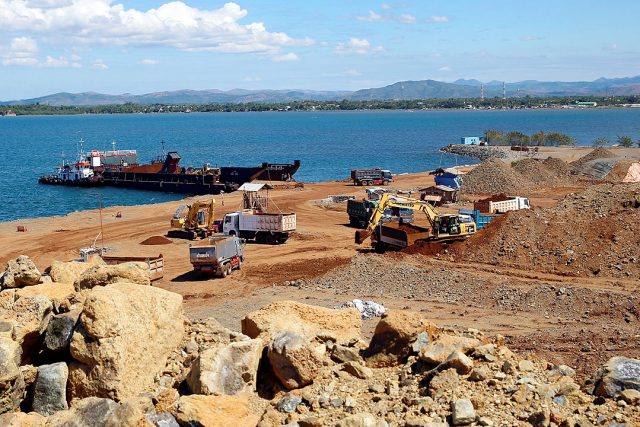
Trucks load rocks and soil containing nickel ore minerals into a barge in the mining town of Sta Cruz in Zambales, Feb. 8, 2017. — REUTERS

PRESIDENT Ferdinand R. Marcos, Jr. ordered the Department of Environment and Natural Resources (DENR) to more closely regulate smaller miners to ensure their safety practices are compliant with regulations, and that their workers are adequately covered in terms of social protections.

Mr. Marcos issued the instructions in a meeting with DENR officials in Malacañang, the Office of the Press Secretary (OPS) said in a statement.

“We want to legalize small-scale mining firms because many of them are illegal, therefore the miners do not have protections,” he said. “We want to strengthen the regulatory framework so that they can legally operate and we can give our miners assistance and protection.”

“They might be able to access financing (and) social protections” if brought within the regulator’s purview, he added.

The OPS said the President may certify some bills on small-scale mining, including amendments to Republic Act (RA) No. 7076, to offer incentives to the industry and “to provide social assistance and labor protection as well as government assistance programs.”

Under RA 7076, the small-scale mining category refers to mines that rely heavily on manual labor, without the use of explosives or heavy equipment. 

“I think for now the need is for the regulatory capabilities, especially over small scale (miners),” the President told the DENR officials.

Finance Secretary Benjamin E. Diokno earlier said the mining industry can support the Philippines’ long-term expansion.

Separately, Mr. Marcos cited the need to upskill and reskill seafarers in preparation for the expected shift of ocean-going vessels to green hydrogen between 2030 and 2040.

The President said Filipino seafarers would need additional training in handling alternative fuels.

At the 27th Conference of the Parties of the United Nations Framework Convention on Climate Change (COP27), leading shipping organizations and major producers of green hydrogen signed a joint statement committing to the rapid production and use of low-carbon fuels based on green hydrogen to accelerate the decarbonization of global shipping. 

The shipping sector accounts for 3% of global greenhouse gas emissions but is expected to grow rapidly without intervention. — Kyle Aristophere A. Atienza

Marcos dismisses as ‘fake news’ report Diokno on way out at DoF

PHILIPPINE STAR/KRIZ JOHN ROSALES

PRESIDENT Ferdinand R. Marcos, Jr. dismissed as “fake news” reports that Finance Secretary Benjamin E. Diokno will exit the Department of Finance (DoF).

“Fake news. I don’t know where it comes from,” Mr. Marcos told reporters when asked about Mr. Diokno’s status.

A website reported on Monday that Mr. Marcos is looking to replace Mr. Diokno and named as a possible replacement Albay Rep. Jose Ma. Clemente S. Salceda, who chairs the House ways and means committee.

“Why would I do that? We’ve assembled a great team,” Mr. Marcos said. “We’re trying to go down a certain direction. It’s the wrong — it’s very, very poor time to… change horses in midstream.”

Earlier in the day, Mr. Diokno described his relations with the President as “very good.”

“I don’t know where this is coming from. I’m old enough in this game to even bother about this. I just work nonstop,” he told reporters.

He said he has spoken with Mr. Salceda about the matter.

Mr. Salceda, an economist, has also rejected speculation that he is in line for the DoF.

Mr. Salceda said on Monday that he didn’t “start this DoF news flow.”

“In past administrations, as in the present, I was able to move fiscal policy from my seat in Congress,” he said in a statement. — Kyle Aristophere T. Atienza

Selective buying behavior noted in PHL FMCG segment as inflation bites

JCOMP-FREEPIK

THE fast-moving consumer goods (FMCG) market has been marked by more selective purchasing behavior because of inflation, according to data and analytics firm Kantar.

Laurice Padlan-Obana, Kantar Philippines Worldpanel Division shopper insight director, said in a virtual media briefing on Tuesday that value is becoming more of a consideration for buyers.

“While value can be as straightforward as cheaper goods or paying less for the same quantity, other factors such as the increase in gas prices, traffic and uncomfortable modes of transportation have redefined value in more encompassing terms when it comes to shopping,” Ms. Padlan-Obana said.

“What we have seen is that, in general for packaged goods, shoppers are coping with rising prices by being more open to value brands. To some extent, however, they also take into consideration where to shop. Nowadays, with multiple retailers and channel options within reach, shoppers can easily adapt to what would best fit their budgets and lifestyle that will address their needs at the moment,” she added.

Inflation surged to 7.7% in October, driven by higher food costs.

Ms. Padlan-Obana said 41% of FMCG purchases in 2022 were accounted for by neighborhood stores, known as sari-sari stores.

“There is a bit of pressure on hypermarkets and supermarkets as most Filipinos who are feeling the economic strain are buying their basic FMCG needs in smaller proximity stores. Meanwhile, a 6% value share decline in hypermarkets and supermarkets was noted from 34% in 2020 to 28% in 2022,” Ms. Padlan-Obana said.

Ms. Padlan-Obana added that Filipino shoppers are also growing more conscious of convenience and availability.

“Value delivery in forms of rewards, lower prices or promotions is a given. Convenience or the ease of access and availability of options are also important factors that shoppers now consider,” Kantar said.

Kantar said the top 10 most chosen retailers in 2022 were Puregold, SM Supermarket, Mercury Drug, Robinsons Supermarket, CSI Supermarket, Prince Hypermart, Alfamart, Gaisano, LCC Supermarket, and 7-Eleven.

The list was compiled based on a study of where shoppers made purchases within the past 12 months.

“The more a retailer is able to check most if not all the boxes that Filipino shoppers consider when purchasing their FMCG needs, the more retailers become the shopper’s choice. When retailers are able to understand and address those needs, shoppers will keep coming back,” Ms. Padlan-Obana said. — Revin Mikhael D. Ochave

Cebu health info project worth P143.4M approved for registration by BoI

PETR MACHACEK-UNSPLASH

THE Board of Investments (BoI) has approved a new contact center project involving an investment of P143.4 million in Cebu City, which will focus on healthcare information management services (HIMS).

In a statement on Tuesday, the BoI said that it has approved the registration of Optum Global Solutions (Philippines), Inc.’s contact center project, which is expected to create 350 full-time direct and indirect jobs. Workers will be allowed to work from home.

According to the BoI, the project will provide coding, testing, and maintenance services, as well as help-desk troubleshooting support.

The project will also offer call center services, back-office operations as well as transaction processing, clinical process services, analytics services, trending and reporting.

“The approval of this project in Cebu City proves that we are persistent in our efforts to enhance the growth of the country’s information technology and business process management (IT-BPM) industry, particularly in the HIMS sector,” Trade Undersecretary and BoI Managing Head Ceferino S. Rodolfo said.

Optum Global has seven projects registered with the Philippine Economic Zone Authority in Taguig City, Quezon City, Cebu City, and Muntinlupa City.

The company mainly supports a group company, Optum Technology, LLC, a US unit of UnitedHealth Group, Inc.

“We are further advancing the IT-BPM industry, and this is just the beginning of more investments being injected into the economy. We are on track to making more investment opportunities happen in the Philippines,” he added.

The BoI said that the proposed project is also expected to help create jobs in Cebu City, where the poverty rate was 26.9% in 2021. 

“Maximizing the country’s valuable resources, the company picked the Philippines as the site for its new project because of the Filipino workforce that is recognized as competitive with high technical skills and a level of English proficiency,” the BoI said.

“As of 2021, the HIMS industry accounted for (around $3.1 billion in revenue), providing jobs to over 200,000 Filipinos. The persisting pandemic did not hamper the positive outlook for the HIMS industry, as revenue is projected to grow by 7.3% to 10%,” it added. — Revin Mikhael D. Ochave

Thailand, PHL top Asia corporate sustainability reporting rankings

PRESSFOTO-FREEPIK

THAILAND and the Philippines came out on top in a study of Asian corporate sustainability reporting practices, National University of Singapore (NUS) said.

The NUS study, “Nature-related Reporting in Asia-Pacific Corporations,” found that Thai and Philippine companies were further along in their adoption of climate-related financial disclosures.

“Given the interconnectedness of climate and nature issues, it is possible that the provisions from the governments in Thailand and Philippines accelerated the awareness of nature-related issues among its listed companies,” NUS said.

Listed companies in these countries were found to have received high-quality training on climate disclosure from the United Nations Sustainable Stock Exchange and the International Finance Corp., among others.

Philippine listed companies are currently required to file a sustainability report employing an internationally recognized framework or a template offered by the Securities and Exchange Commission (SEC).

The SEC is currently looking to introduce mandatory sustainability reporting for non-listed companies.

NUS singled out Ayala Corp. for its governance reporting, which is prepared by a sustainability committee with input from its risk management and related party transactions committee.

The other top performing companies in biodiversity and nature disclosures in the Philippines were Aboitiz Equity Ventures, Inc., AC Energy Corp., Ayala Land, Inc., First Gen Corp., First Philippine Holdings Corp., International Container Terminal Services, Inc., Manila Electric Co., Manila Water Co., Inc., Nickel Asia Corp., Rizal Commercial Banking Corp., and Semirara Mining and Power Corp.

The study focused on the top 50 listed companies by market capitalization across 13 jurisdictions in the Asia-Pacific. It reviewed the sustainability reports available from 2021 to 2022. — Justine Irish D. Tabile

Power, water services upgrades seen needed to boost investment

PHILIPPINE STAR/EDD GUMBAN

UPGRADES to the distribution and supply of electricity and water are required to attract more investment, according to the Philippine Chamber of Commerce and Industry (PCCI).

PCCI President George T. Barcelon said on the sidelines of the Stratbase ADR Institute Pilipinas Conference in Makati City on Tuesday that investors place substantial weight on power and water services before entering a market.

“We need to have enough and reliable electricity. They were talking about putting up data centers. Data centers require megawatts of power that is reliable, not fluctuating,” Mr. Barcelon said.

“Water is also an issue. We need to have good water management since it is used for farming, and many (other industries),” he added.

Mr. Barcelon was asked to comment after the Board of Investments (BoI) said it will likely fail to meet its P1-trillion investment approval target for 2022.

The BoI took in P644.4 billion worth of approved investments as of Nov. 15, equivalent to 64.4% of its target.

Some 81% or P518.3 billion of the approved investments are domestic while 19% or P126.1 billion are from foreign sources. 

The power sector took up the biggest share of investment with P343.8 billion, followed by information and communication (P197.6 billion), administrative and support services activities (P26.8 billion), transportation and storage (P25.2 billion), and real estate (P23.8 billion).

Trade Undersecretary Ceferino S. Rodolfo said that the BoI’s investment approvals this year are expected to exceed the 2021 total of P655.4 billion.

Management Association of the Philippines President Rogelio L. Singson said that predictability and defined government roles are important in attracting more investment.

“For one, the predictability and assurance of contracts. Predictability is very important. The second one is in terms of defining the roles of government. The local government units have their own (requirements). You may be doing some construction, but at the end of the day, whether you can operate or not is something else,” Mr. Singson said. — Revin Mikhael D. Ochave

DoE expects nuclear power to take 10 years before joining energy mix

THE BATAAN NUCLEAR POWER PLANT — BW FILE PHOTO

THE Department of Energy (DoE) estimates a timeline of 10 years before nuclear power can join the energy mix.

“If you want to (tap) nuclear, small and modular (reactors are) more feasible. The technology exists in the US. In order for us to procure we need to comply with the international bilateral agreements,” Energy Undersecretary Sharon S. Garin said on Tuesday. 

Ms. Garin added: “If we do it the regular way (with) site (and) feasibility studies, I think (it will take) 10 years — 10 years to operational status,” Ms. Garin said.

On Monday, US Vice-President Kamala Harris said that the US and the Philippines will launch negotiations on a nuclear energy program for civilian use.

Ms. Garin said that in order for the Philippines to procure small modular reactors it needs to comply with various international agreements.

“One of that is the 123 Agreement. (Ms. Harris announced that the US is) willing to start negotiations,” Ms. Garin said.

Ms. Garin called the negotiations a good start in accessing US technology.

The 123 Agreement helps ensure that civilian nuclear energy programs are not diverted to weapons development and proliferation. 

This agreement also establishes a legal framework for significant nuclear cooperation with other countries.

Ms. Garin said the Energy department is open to any technology to ensure energy security.

“We are open to any technology when it comes to renewable energy or green energy or transition to any kind of energy other than coal or petroleum. Nuclear can be a technology (that can be developed into a) better technology in 10 years,” she said.

The International Atomic Energy Agency has laid down 19 milestones for countries seeking to develop a nuclear power program.

The Philippines is currently in the first stage — the establishment of a national nuclear policy.

In 2020, former President Rodrigo R. Duterte signed an executive order setting the national position on the development of nuclear energy.

Ms. Garin also said that the DoE is also looking to commission a third-party assessment on reviving the Bataan Nuclear Power Plant.  

“We are not saying that Bataan is the only way to go, but we need to be very careful, we need to make sure the people… feel safe,” Ms. Garin said.

Ms. Garin added that the DoE tap its 2023 budget to finance the third-party assessment.

“Hopefully we can use the 2023 budget for that so we can proceed. Once we know that it is safe or not. If it is safe, we can start deciding who will operate,” Ms. Garin said. — Ashley Erika O. Jose

PLDT in talks to sell 2,000 more towers

BW FILE PHOTO

THE PLDT group said on Tuesday that it has received preliminary approaches from potential buyers regarding the sale of an additional 2,000 telecom towers.

The group is expediting the sale of the towers and is requiring interested parties to submit letters of intent (LOIs) as a preliminary to striking a formal and detailed purchase deal.

The potential buyers include those that bid on a first batch of towers sold, PLDT, Inc. and Smart Communications, Inc. President and Chief Executive Officer Alfredo S. Panlilio told reporters on the sidelines of the Stratbase Pilipinas Conference 2022.

“If we can arrive at an LOI… it’s just a matter of completing the contract before the yearend,” he added.

The group has sold almost half of its 12,000 telecom towers. Its subsidiaries, Smart Communications, Inc. and Digitel Mobile Philippines, Inc., signed in April sale and purchase deals in connection with the sale of 5,907 telecom towers and related passive telecom infrastructure for P77 billion to the subsidiaries of international telecommunications infrastructure services companies edotco Group and EdgePoint.

“We’ve sold close to 6,000 towers and (are now selling) another 2,000, so we’ll still have about 4,000 towers left,” Mr. Panlilio said.

“After the second batch, we’ll stop. I think the other 4,000 towers… are mostly strategically located. A lot of them are in our premises, so it’s a bit harder to sell them,” he added.

The group is selling its tower assets as part of a transformation strategy, which is also in line with the government’s Common Tower Policy.

The policy calls for more than one telco to have access to towers, thereby increasing the number of subscribers being served by each tower. The government has been encouraging tower sharing to improve cell site density, which is believed to be one of the lowest in the region at 4,000 subscribers per tower.

“The common tower sale is a one-time benefit for us,” Mr. Panlilio said, referring to the gains generated by the sale. “I think, as a company, we need to continue to be efficient by bringing down costs to serve,” he added.

At the forum, Mr. Panlilio noted more opportunities for the private sector to dialogue with the government because of the creation of a Private Sector Advisory Council. He said the group was formed to support the new administration in meeting its objectives of economic growth, job generation, improved government service through digitization, universal healthcare, food security, and the improvement of tourism and infrastructure.

Aboitiz InfraCapital, Inc. President and Chief Executive Officer Cosette V. Canilao noted that the private sector continues to push for the review of policies in order to enhance the business environment.

Christian Razon Gonzalez, executive vice-president and chief risk officer at the International Container Terminal Services, Inc., said supercharging foreign investment in manufacturing will require the government to make strategic decisions on infrastructure.

“In order to drive the manufacturing industry or attract foreign investment in manufacturing, you have to have a privatization and infrastructure program that’s driven by a broader strategy,” he said.

“Right now, infrastructure and digitization are done piecemeal and in isolation. Someone has an unsolicited proposal over there. Someone wants to build something over here. The government wants to invest there, for what? For what purpose? Where is the master plan for creating industrial zones in areas that are already connected to global partners? Where is the master plan to create infrastructure in places that will later become industrial commercial areas meant to be connected to the rest of the world?,” he said.

“Unless we start thinking based on a broader infrastructure plan and move out of this isolated system of privatization and building infrastructure, frankly we will not accelerate foreign investment nor manufacturing.”

Hastings Holdings, Inc., a unit of PLDT Beneficial Trust Fund subsidiary MediaQuest Holdings, Inc., has a stake in BusinessWorld through the Philippine Star Group, which it controls. — Arjay L. Balinbin

US VP Harris visits Philippine isle on edge of the South China Sea

US Vice-President Kamala Harris leaves Puerto Princesa port in the Philippines, en route to Yokota Air Base in Japan in this Nov. 22 photo. — HAIYUN JIANG/POOL VIA REUTERS

US Vice-President Kamala Harris on Tuesday visited the Philippine island of Palawan in the South China Sea as part of a three-day trip to an Asian ally that is central to America’s bid to counter China’s increasingly assertive stance in the region.

China claims more than 80% of the South China Sea, which is believed to contain massive oil and gas deposits and through which billions of dollars in trade passes each year.

Ms. Harris on Monday pledged the US would defend the Philippines if it came under attack in the waterway, reaffirming Washington’s unwavering commitment to its former colony.

Her visit to the Philippines sends a strong message to China that Washington will stand by its defense commitments to Manila, Chester B. Cabalza, president and founder of the International Development and Security Cooperation, said in a Facebook Messenger chat.

“Both the US and Philippines have realized that they need each other amidst China’s economic and military rise,” he said. “And this alliance will remain amid China’s aggression in the South China Sea and Taiwan Strait.”

Ms. Harris’ comments followed a meeting on Monday with President Ferdinand R. Marcos Jr., who welcomed Ms. Harris for the first time at the Philippine presidential palace in Manila.

Mr. Marcos said the two nations’ strong ties had become even more important, given what he called upheavals in the region.

He said her visit to the Philippines is a “very strong symbol” that the relationship of the Philippines with its former colonizer “remains strong.”

Mr. Marcos also said Philippine relations with the United States had gone through different phases and has been strengthened in every way.

The Philippines signed an Enhanced Defense Cooperation Agreement (EDCA) with the US, the country’s key western ally, under the late President Benigno S.C. Aquino III.

His successor Rodrigo R. Duterte had threatened to scrap a visiting forces agreement with the US after the US Embassy canceled the visa of his ally Senator Ronald M. de la Rosa, his former police chief who led his deadly war on drugs.

Ms. Harris’ visit to the Philippines, the highest-level trip to the Philippines by a Biden administration official, is seen as part of Washington’s effort to revive ties with Manila, which moved closer to China under ex-President Rodrigo R. Duterte.

“We stand with you in defense of international rules and norms as it relates to the South China Sea,” Ms. Harris told Mr. Marcos.

A 2016 ruling by an arbitration tribunal in the Hague said Beijing’s South China Sea claims had no legal basis, delivering a victory for Manila.

The Philippines has been unable to enforce the ruling and has since filed hundreds of protests over what it calls encroachment and harassment by China’s coast guard and its vast fishing fleet.

While in Palawan, Ms. Harris was expected to reaffirm Washington’s support for the 2016 tribunal ruling, a US official said.

Palawan is about 320 kilometers (200 miles) from the Spratly islands, where China has dredged the sea floor to build harbors and airstrips. Parts of the archipelago are also claimed by Brunei, Malaysia, the Philippines, Taiwan and Vietnam.

The vice president was set to visit a fishing village and tour a Philippine coast guard vessel during her trip, said a US official, on condition of anonymity.

The visit comes with US-Sino tensions high, particularly over Taiwan, the democratically governed island China has long vowed to bring under its control.

“We are not against the US interaction with regional countries,” said Chinese Foreign Ministry spokeswoman Mao Ning when asked to comment on Ms. Harris’ visit to Palawan. “But it should be good for regional peace and stability and not damaging to other countries’ interests.”

Illustrating tensions in the area, China denied on Monday that one of its coastguard ships used force to retrieve a piece of a rocket floating in the ocean that was being towed by a Philippine vessel in the South China Sea.

A Philippine military commander said the Chinese coastguard ship had “forcefully retrieved” the object by cutting a line attaching it to a Philippine boat.

Dozens of protesters rallied in Manila on Monday against the visit by Ms. Harris, saying they did not want the Philippines to be caught between US and Chinese rivalry.

The US and Philippines have moved ahead with the EDCA, dating from the Obama administration, though it languished under Mr. Duterte.

The military pact allows the United States to maintain a military presence, but not a permanent one, through the rotation of ships and aircraft for humanitarian and maritime security operations at mutually agreed Philippine bases.

Ms. Harris also said the United States stood by the Philippines in the face of intimidation and coercion in the South China Sea.

The US seeks to pursue its Enhanced Defense Cooperation Agreement with the Philippines, which was signed in 2014 and builds on the Mutual Defense Treaty and 1999 visiting forces agreement, according to a fact sheet e-mailed by the US Embassy in Manila on Monday. It was also posted on the White House website.

US and Philippine forces have also used EDCA sites during Kamandag and Balikatan military exercises.

The US has allotted more than $82 million toward EDCA implementation at five existing locations in the Philippines, according to the statement.

New EDCA locations have also been identified to enable the US and Philippines to continue to work together to meet the objectives of the military pact. — Reuters with KATA


Philippine police arrest 13,391 suspects in Marcos drug war

PHILIPPINE STAR/ MIGUEL DE GUZMAN
THE PHILIPPINES accepted 200 recommendations from the United Nations Human Rights Council, including investigating extralegal killings during its anti-illegal drug campaign. — PHILIPPINE STAR/ MIGUEL DE GUZMAN

PHILIPPINE police arrested 13,391 drug suspects in the first 100 days of President Ferdinand R. Marcos, Jr.’s term, according to the national police chief, who called it a “notable breakthrough.”

In a statement on Tuesday, national police chief Rodolfo S. Azurin, Jr. said 1,531 of those arrested were tagged as high-value drug personalities. The arrests were made in 12,231 anti-illegal drug operations from July 1 to Oct. 8.

“This notable breakthrough is a result of consistent and smooth coordination between the Philippine National Police and Philippine Drug Enforcement Agency enforcement units for the past three months,” he said.

Law enforcers used nonviolent methods to arrest the suspects, he added. The Central Visayas regional police office had the most arrests at 250.

The police chief told a press briefing on Nov. 14 police had killed 46 suspects during illegal drug operations five months into Mr. Marcos’ term.

“We tell our police officers that we are for the preservation of life, while keeping them safe during operations,” he said in mixed English and Filipino last week.

In a statement on Nov. 15, the presidential palace said the Marcos government commits to improve peace and order by eliminating illegal drugs.

The state was working with religious groups to persuade drug suspects to surrender, Acting Press Secretary Cheloy Velicaria-Garafil said, citing Mr. Azurin.

Last week, the Philippines accepted 200 recommendations from the United Nations Human Rights Council, including investigating extralegal killings during its anti-illegal drug campaign.

At least 25 police officers have been charged with murder in connection with ex-President Rodrigo R. Duterte’s drug war, Justice Secretary Jesus Crispin C. Remulla told the United Nations (UN)Human Rights Council this month.

More than 30 member-states of the UN Human Rights Council urged the Marcos administration to do something about extralegal killings and human rights abuses in its deadly drug war.

In August, Mr. Marcos told police to temper their use of force while enforcing the law. Interior Secretary Benjamin C. Abalos, Jr. said in July the drug war would be “as intensive as before.”

There were 221-drug-related killings from January to August this year, Human Rights Watch said in September, citing a joint study by the University of the Philippines and Belgium’s Ghent University.

The global watchdog has said human rights violations in connection with the Philippines’ anti-illegal drug campaign continue under the Marcos government.

The UN Rights Committee has said the government should cooperate with the International Criminal Court’s probe of the drug war.

The UN Office of the High Commissioner for Human Rights has said the country’s probe of human rights abuses in the drug war lacked transparency.

In September, Philippine Solicitor General Menardo I. Guevarra said the country would block an investigation by the ICC on the drug campaign and ensure suspects are tried under local courts.

At least 6,117 suspected drug dealers had been killed in police operations, according to data released by the Philippine government in June last year. Human rights groups estimate that as many as 30,000 suspects died.

“Let’s work together to fight illegal drugs through a more intensified program so that we can finally catch big syndicates that distribute illegal drugs in the country,” Mr. Azurin said in Filipino. — John Victor D. Ordoñez