Home Blog Page 5593

Peso weakens on lower GIR, Fed worries

MARI GIMENEZ-UNSPLASH

THE PESO ended weaker against the dollar on Monday as the country’s reserves continued to decline and on expectations of more monetary tightening by the US Federal Reserve.

The local unit closed at P55.55 versus the dollar on Monday, losing 35 centavos from its P55.20 finish on Friday, data from the Bankers Association of the Philippines’ website showed.

The peso opened Monday’s session sharply weaker at P55.50 against the dollar. Its weakest point was at P55.72, while its intraday best was at P55.45 versus the greenback.

Dollars exchanged went down to $886.97 million on Monday from $1.22 billion on Friday.

Rizal Commercial Banking Corp. Chief Economist Michael L. Ricafort attributed the peso’s depreciation to the decline in the country’s gross international reserves (GIR) fell below the $100-billion level for the first time since August 2020.

Data from the Bangko Sentral ng Pilipinas (BSP) showed GIR stood at $98.83 billion as of end-July, 2% lower than the $100.85 billion level as of end-June.

Higher inflation and record high outstanding national debt also affected sentiment, Mr. Ricafort said.

Headline inflation stood at a near four-year high of 6.4% in July, from 6.1% in June and 3.7% a year ago.

Meanwhile, the government’s outstanding debt rose to a record-high P12.79 trillion at the end of June, beating the previous high of P12.76 trillion in April.

The peso was also weaker as stronger US jobs data supported a further Fed hike of 50 or 75 basis points (bp) in their next policy meeting, Mr. Ricafort added.

“The peso weakened amid heightened bets of a 75-bp rate hike by the US Federal Reserve in September following the strong US labor reports for July 2022. The local currency might rebound tomorrow from expectations of an upbeat Philippine GDP (gross domestic product) report,” a trader said. The Philippine GDP report is set to be released on Tuesday.

Fed Chair Jerome H. Powell said last month the US central bank may consider another “unusually large” rate hike at their Sept. 20-21 policy meeting as inflation in the world’s largest economy remains at a multi-decade high.

The Fed raised interest rates by 75 bps for a second straight meeting in July. It has hiked borrowing costs by a total of 225 bps since March.

For Tuesday, Mr. Ricafort gave a forecast range of P55.40 to P55.60 per dollar, while the trader said the peso could move from P55.45 to P55.65. — D.G.C. Robles

Philippine infection rate rose by 13% in past week

PHILIPPINE STAR/EDD GUMBAN

DAILY coronavirus infections in the Philippines rose by 13% in the past week from a week earlier, according to the Department of Health (DoH).

In a bulletin, the agency said 27,331 more Filipinos got infected on Aug. 1 to 7, or a daily average of 3,904 cases. Of the new cases, 76 were severe and critical cases.

DoH verified 80 more deaths in the past week, 32 of which occurred from July 25 to Aug. 7.

It said 624 of 2,514 intensive care unit (ICU) beds had been used as of Aug. 7, while 6,648 of 21,548 non-ICU beds were occupied. There were 772 severe and critical admissions.

Almost 72 million Filipinos have been fully vaccinated against the coronavirus, while more than 16.6 million have received booster shots, DoH said.

Meanwhile, the OCTA Research Group said the infection wave spurred by more contagious Omicron subvariants could last as long as five months.

“Our current wave is already longer than we expected,” OCTA fellow Fredegusto P. David told a televised news briefing. “Initially, we expected a two-month wave due to Omicron BA4 and BA5.”

He said the wave had not yet reached its peak. “It [could] last up to four or five months.” “It’s taking longer.”

The infection wave experienced by the Philippines now is probably being prolonged by waning immunity among vaccinated Filipinos, Mr. David said.

Despite the prolonged wave, the infection rate in the capital region has fallen to 8% from 14%, Mr. David said.

“Our growth rate is now less than 10%,” he said. “It’s still possible that we will see a peak soon. It’s not guaranteed because as we have seen, our [infection] wave has been prolonged,” he said in mixed English and Filipino.

“It’s a slight concern that we are not seeing a slowdown yet,” he separately told CNN Philippines. “We might see more than 5,000 cases this week or early next week.”

Majority or 85% of coronavirus samples were of the Omicron BA.5 subvariant, the Philippine Genome Center told the same briefing. The country had detected 3,107 Omicron BA.5 cases as of Friday, health authorities said.

“In the past month alone, BA.5 was the predominant sample or variant,” Genome Center Director Cynthia Saloma said.

The sublineage of the predominant Omicron subvariant in the country is mostly BA.5.2, while the ones in the US and Europe are BA.5.1, she said, adding that they were watching for signs of further mutation in BA.5.

Health authorities have also detected two BA.2.75 cases, 174 BA.2.12.1 cases, and 104 BA.4 cases, DoH said.

There was no evidence yet that the BA.2.75 subvariant would cause another infection surge in the country, DoH technical advisory group member Edsel Salvana said.

“There is a preliminary study that there’s a chance of it being more transmissible, though this has not been confirmed,” he said in Filipino. “Let us not panic, but we should be vigilant.

Also on Monday, the Health department said the country’s first monkeypox patient finished his 21-day isolation on Aug. 5 and might soon be released from isolation.

The 10 close contacts of the 31-year-old patient were still under quarantine, it told reporters in a Viber message.

The country’s first monkeypox patient was confirmed on July 29. The patient arrived from overseas on July 19 and had visited countries with documented cases of the disease. — K.A.T. Atienza

Boost transport capacity before physical classes, agencies urged

DEPED

By Kyle Aristophere T. Atienza, Reporter

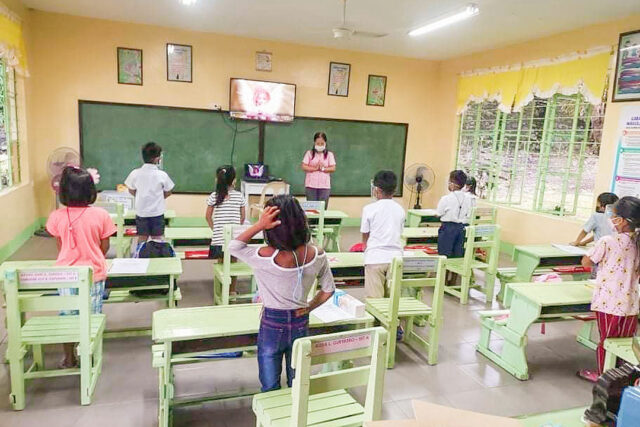
A TRANSPORT group on Monday urged the Philippine government to increase the capacity of public transportation as the country shifts to face-to-face classes starting this month.

“We need to focus on road-based public transportation — our buses, jeepneys, UV Express and tricycles working with each sector — to restore as much capacity as possible and to make them run reliably and efficiently,” transport economist Robert Y. Siy of the Move As One Coalition said in a Facebook Messenger chat.

The government should also promote walking and cycling as a “safe and attractive” option, especially for short trips, he said.

“With inadequate public transport and high transportation inflation, spending to improve sidewalks and bike lanes in every city is one of the best investments we can make,” he said. “The government should deliver tangible results in the short to medium term while making our cities more livable.”

Traffic congestion in Metro Manila has returned to pre-pandemic levels as schools and offices resumed face-to-face operations.

Elementary and high schools will start five days of physical classes starting November, while universities will begin more face-to-face classes this month.

Mr. Siy said it is difficult to boost public transportation months before a significant increase in demand. He also cited President Ferdinand R. Marcos, Jr.’s failure to offer a solution to the transport crisis in his first address to Congress last month.

“He highlighted railways and airports,” he said. “While we need to invest in railways, especially in metropolitan areas, they require many years to complete. They are not a meaningful response to today’s emergency.”

He said the state should encourage people to walk or ride a bicycle “as millions do in many cities all over the world.” “The difference is that the best cities in the world prioritize their roads and bridges for pedestrians and cyclists.”

Mr. Siy said the government keeps “prioritizing cars on our roads and bridges, even though the vast majority of Filipinos are not car owners.” “We can improve the safety and efficiency of public transportation, walking and cycling by revising how our roads are used.”

“Not only will the new bridges move more people, they will also encourage car owners to leave their cars at home and shift to sustainable travel modes,” he added.

Meanwhile, the Passenger Forum asked the Department of Transportation (DoTR) to announce how it solves bus congestion on the main EDSA highway in the capital region.

“Three weeks have already passed since the DoTR and the Land Transportation and Franchising Regulatory Board revealed their action plan for the EDSA busway,” the group said in a statement. “We want to know if there is any progress as the situation of EDSA carousel passengers has hardly improved.”

Under the plan, the transport agencies will increase buses allowed in the EDSA bus carousel to 440 from 200.

The country loses about P3 billion daily due to the traffic congestion in Metro Manila, according to the Japan International Cooperation Agency (JICA). This could balloon to P5.4 billion by 2035, it said.

Marcos asks cops to temper use of force while on duty

PHILIPPINE STAR/ GABRIEL BONJOC

PHILIPPINE President Ferdinand R. Marcos, Jr. on Monday asked police to temper their use of force while enforcing the law.

“The use of force must always be reasonable, justifiable and only undertaken when necessary,” he said at a ceremony marking 121 years of police service.

He told cops they should be fair and impartial. “It is only then that you can effectively sustain with great respect and wide support the authority that you possess as uniformed servicemen of the republic.”

The president said the Philippine National Police (PNP), which human rights groups have accused of executing drug suspects, should be accountable to ensure public rapport and support.

“In the previous years, the PNP has proven its seriousness and intent to prevent criminality and solve crimes for peace to reign supreme in our land,” Mr. Marcos said.

“The obstacles in front of you will be difficult. They might be overwhelming at times. They will put your resolve and patience to the test,” he added.

“Baseless and unfair criticism will be forthcoming and this will come from the center, the left and the right.” 

Meanwhile, the Armed Forces of the Philippines welcomed Bartolome Vicente O. Bacarro as its new chief.

At a change of command ceremony, Mr. Marcos described the new AFP chief as “a source of national pride.” “He was fearless in combat,” he said in a speech.

The president expects Mr. Bacarro to lead the AFP “as it marches forward and undertakes a new journey that will eventually pave the way for a much improved and stronger AFP in the days ahead.” — Kyle Aristophere T. Atienza

Sugar prices have risen 42%, supermarkets say

BW FILE PHOTO

SUGAR prices have risen between 40% and 42% since the start of June, an association of supermarkets said, forcing consumers to modify their shopping behavior by buying smaller quantities at a time or switching to brown sugar.

Steven T. Cua, Philippine Amalgamated Supermarkets Association president, told BusinessWorld Live on One News on Monday: “I was surprised when I checked (and) found out that (the price of refined sugar was) P100, P105, P108 per kilogram (/kg)… I checked again when the price of sugar started to climb. As of June 1, it (was) around P72.50/kg… So that’s around a 40%-42% increase in two months. A very steep price for one commodity that everyone uses every day.”

“I noticed that people have been buying smaller and smaller packs of sugar. Supermarkets that did not carry these items before are now carrying 1/4 kg of sugar because people are looking for that. People are also shifting, especially in the countryside, to brown sugar (which prices) did not increase as much,” Mr. Cua said.  

Mr. Cua called for a long-term plan to address the sugar supply problem.

“We really have to fix this (issue) for the long term, beyond a six-year term of any administration. It has to be continuous for food security purposes and for the economy,” Mr. Cua said.

“If you’re going to flood the market with a supply of sugar (imports), definitely prices will go down but again that’s a quick fix,” he added.

The Department of Agriculture (DA) has announced that it is verifying the overall supply of sugar on hand and expected to be milled and is considering increasing the volume of sugar classified for consumer use.

It is also consulting the industry on the appropriate volume of sugar to be imported if necessary.

The Sugar Regulatory Administration (SRA) has said that it is recommending the import of 300,000 metric tons of sugar. — Revin Mikhael D. Ochave

Climate emergency declaration awaited from national gov’t

REUTERS

By Kyle Aristophere T. Atienza, Reporter

THE government must declare a climate emergency to wield extraordinary powers that will facilitate a shift to renewable energy, which analysts and economists said will address prevailing problems like the unreliable food supply and the Philippines’ vulnerability to calamities.

They said on Sunday that senior officials and the public should initiate wide-ranging discussions on the economic costs of climate change.

“The climate crisis precedes — and is a factor in — many of the issues we are facing today, and so declaring a climate emergency should have been done years ago,” Lea Guerrero, country director of Greenpeace Philippines, said in an e-mail.

President Ferdinand R. Marcos, Jr. said in his first address to Congress that he will work towards a shift to green energy and boost investment in climate-resilient infrastructure.

Mr. Marcos has yet to declare a climate emergency, which would authorize the government to mobilize funds to step up climate mitigation efforts.

Makati City, home to a major business district, declared a climate emergency last week, introducing a plan to put up solar panels in schools and government offices to ensure uninterrupted power services during disasters. It also encouraged the business community to enforce mitigation measures.

The House of Representatives made a similar declaration in 2019, but Greenpeace said “we have not seen the follow-through from our national government.”

“This tells us that a declaration itself isn’t enough — the sitting administration must ensure there is a coherent plan to address the climate crisis with urgency and efficiency,” it said.

“More than 60% of (the Philippine) population is coastal, and the majority of our cities are in coastal areas,” Greenpeace said, noting that extreme weather events and slow-onset impacts of climate change, including ocean heating and acidification, also affect economic performance.

“The World Bank estimates that we spend 0.5% of our gross domestic product on natural disasters annually,” it said.

Citing its own study on rising sea levels, Greenpeace said as much as 80% of Manila could be submerged by 2030, “potentially impacting 87% of its GDP.” 

“(Climate change) will further affect not just fisheries and agriculture and livelihoods, but also access to water and secure shelters and homes.”

Renato E. Reside, Jr., an associate professor at the University of the Philippines School of Economics (UPSE), said climate change effects impede economic productivity — a reality that the government should recognize as early as now.

“Climate and environmental problems lead to poor health outcomes which reduce worker and student productivity,” he said in a Messenger chat. “So, the social cost of climate problems is very large and growing. The cost of abatement and cleanup is itself part of the social cost and it is growing too.”

Climate change took its toll on Europe recently, with the region experiencing record-breaking temperatures last month. The European Parliament declared a climate emergency in 2019.

The US has also not been spared from the effects of climate change. Last month, some 100 million Americans from New York City to Las Vegas were under heat warnings as temperatures rose well above 100°F (38°C), Reuters reported.

The US has yet to declare a climate emergency, nor has China. The two economies accounted for 41.89% and 34.75% of world GDP in nominal and purchasing power parity terms, respectively.

Mr. Marcos, 64, needs to collaborate with Congress to implement a massive plan to combat climate change, policy analyst Michael Henry Ll. Yusingco said in an e-mail. “The supermajority support he has in both chambers is a huge plus, but he will still have to deal with various interests and agenda that could dilute his original objective.”

Mr. Yusingco said the President and his team need to provide an evidence-based rationale that can be understood by the public to gain broad support.

“Whether the emergency declaration is as provided for in the constitution or not, a coherent and cogent explanation is very crucial in order to gain public support for the declaration as well as the moves that will follow after it,” he said.

“A lot of sacrifices will be made by the people, so it’s very important that they understand why we are doing this radical step,” he added. “More critically, civil society and the business sector need to be engaged every step of the way.”

Mr. Marcos has said he would make infrastructure more resilient to disasters, vowing to modernize ports and update housing standards.

Terry L. Ridon, convenor of infrastructure think tank InfraWatchPH, said “infrastructure and government projects must be designed to achieve net zero emissions.”

“It means incorporating climate adaptation… in designing various infrastructure projects,” he said in an e-mail. “It means installing solar panels and other renewable energy solutions in unused infrastructure spaces.”

The former legislator said the government needs to determine an appropriate level of climate intervention, “as we are not expected to introduce advanced measures… unlike developed economies.”

“The appropriate level of intervention determines whether low or moderate levels of emissions produced by infrastructure projects remain acceptable in the medium term,” he said. “A higher level of intervention will certainly incur significantly higher immediate costs, and this is a question which both government and the private sector will have to address together.”

Mr. Ridon said the government needs to expand tax and nontax incentives for firms undertaking climate-resilient projects and programs. “This is ‘the only way’ for the private sector to participate in accelerated climate intervention.”

“These incentives should be long-lasting, as the purpose for the incentive, climate intervention and resilience, is a long-term national and international undertaking,” he said.

Mr. Reside of UPSE said the government needs to revisit climate abatement laws and rules, including a policy that provides incentives to businesses that reduce air pollution. “Have they actually abated pollution in any way since they were passed? If so, by how much? No one is doing the math.”

“We already have the Clean Air Act and this law provides tax incentives for pollution abatement, but the take-up of tax benefits from this law in exchange for abatement is very low,” Mr. Reside said. “Climate-targeted financing could also be made available to fund initiatives to protect the environment at various levels of government.”

Greenpeace urged the government to institute a “rapid and just” transition to a low-carbon pathway through a massive uptake of renewable energy solutions.

“It should strengthen energy security starting by scaling up renewable energy targets to at least 50% by 2030, and instituting a blueprint for 100% RE by 2050,” it said.

The government also needs to ratchet up its Nationally Determined Contributions (NDC) under the Paris Agreement, it said. The Philippines has promised a 75% carbon emissions reduction between 2020 and 2030, subject to foreign funding. The reduction target using internal resources is only 2.72%.

Greenpeace also challenged the government to expand coverage of the coal-fired power plant moratorium to include projects in the pipeline and implement a phaseout plan for operating coal projects.

It said businesses should be required to align with the government’s commitments under the Paris Agreement “to address the human rights impacts of climate change.”


Farmers cite ASF threat with easing of import rules on fish feed materials

FREEPIK

FARMERS’ associations said they will oppose an easing of import restrictions on fish feed raw materials from countries affected by African Swine Fever (ASF).

“(This) will further expose the still-vulnerable livestock industry to the spread of ASF,” Samahang Industriya ng Agrikultura (SINAG) Chairman Rosendo O. So said in a statement.

“Clearly, this was not approved or allowed by the industry because of the possible damage to the livestock industry,” he added.

Last week, the Department of Agriculture (DA) authorized imports of processed animal protein (PAP) used in fish feed from countries affected by ASF.

The DA had earlier banned imports of processed porcine or pork meal for animal feed use from countries affected by ASF in March.

In 2019, the Philippines recorded its first case of ASF, which eventually decimated its pig herd.

Mr. So said that SINAG, along with other agri-industry groups, will file an appeal against the memorandum.

“(ASF) continues to wreak havoc in some regions, (reducing) the hog population by a little over 3 million… As a result of the ASF disease outbreaks, thousands of farmers suffered complete loss of income and livelihood, with smallholder farmers suffering the most,” it said.

“The DA has said that there is evidence that contaminated feed can possibly transmit the ASF virus to pigs consuming the feed. The private sector, veterinarians, veterinary drug companies and even the government have been creating programs to improve swine biosecurity practices and to encourage the swine farmers to re-populate safely in the absence of a viable vaccine,” it added.

The association said that while the livestock industry recognizes the aquaculture sector’s need to reduce the costs of feed to be more competitive, any threat to biosecurity is the concern of the entire agriculture industry.

“The aquaculture sector’s request to lift the ban of porcine animal protein from countries with ASF cases limited to wild boars will certainly expose the fragile and recovering swine industry to further threats from contaminated raw materials,” it added.

The easing of import rules is expected to “reverse the decline in fish production, enable expansion, and ensure the nutrition of Filipino consumers,” the aquaculture industry said.

“If the import ban on PAPs had continued, the Bureau of Fisheries and Aquatic Resources said 20% of aquaculture production would be imperiled. The aquaculture sector surely welcomes this initiative as it has been requesting for this since April of this year,” Asis G. Perez, co-convenor of food advocacy group Tugon Kabuhayan, said in a briefing on Monday.

“The general public will stand to benefit from this decision as there will be a continuing supply of affordable protein coming from aquaculture,” he added.

Feedmix Specialist II, Inc. Vice-President Norberto O. Chingcuanco, also co-convenor of Tugon Kabuhayan, said that PAP is a key, irreplaceable ingredient for aquaculture feed, and its production process can be expected to kill the ASF virus.

“PAPs are processed at high temperatures that kill all forms of bacteria and viruses,” he said.

“Fish growth slowed down because of the absence of proper ingredients. Nutritionists had a hard time balancing nutritional needs without PAPs. Fish production is not growing. Tugon Kabuhayan has been vigorously advocating to allow imports of PAPs, 70% of which are from Italy, from where they were disallowed starting January,” Mr. Perez added. — Luisa Maria Jacinta C. Jocson

PHL lining up US support for climate, health, digitalization

PHILSTAR FILE PHOTO

THE Philippines discussed potential support from the US for its climate finance, health, and tax system digitalization efforts, the Department of Finance (DoF) said.

In a tweet following the Aug. 1 meeting, Finance Secretary Benjamin E. Diokno said he heard expressions of willingness from the US, represented by Ambassador to the Philippines MaryKay L. Carlson, to increase its support in those areas.

“As of December 2021, the US was the Philippines’ largest source of grants reaching $628.20 million. The amount accounts for 33.23% of total grant assistance received by the country from all its bilateral and multilateral development partners,” the DoF said in a statement on Monday.

The US is the Philippines’ seventh-largest provider of official development assistance (ODA).

On climate change, Ms. Carlson said that the US is willing to increase climate financing support to the Philippines.

The Philippine position on climate change is that the industrialized countries must do their share in funding mitigation efforts. The Philippines accounts for only 0.3% of global emissions but is being counted on to reduce its emissions from dirty sources of energy that have been crucial in other countries’ industrial transitions.

“Though we are a minor contributor to climate change globally, we have the unfortunate distinction of being one of the most vulnerable countries to the effects of climate change,” President Ferdinand R. Marcos, Jr. said during his first State of the Nation Address (SONA) on July 25.

“The use of renewable energy is at the top of our climate agenda. We will increase our use of renewable energy sources such as hydropower, geothermal power, solar, and wind,” he added.

Mr. Diokno told finance ministers and central bank governors at a Group of 20 (G20) event last month that climate financing will be sourced from bond issues, new taxes, and aid from the international community.

“We are supporting the passage of a bill that will either regulate or tax the use of single-use plastics to cut pollution and adopt more sustainable practices. We are also considering the imposition of a carbon tax,” he told the G20.

The mobilization of climate finance will be directed by the so-called Green Force, an interagency body led by the DoF along with the Bangko Sentral ng Pilipinas (BSP).

In April, the government committed to reducing greenhouse gas emissions by 75% by 2030 when then-President Rodrigo R. Duterte approved the Philippines’ first Nationally Determined Contribution.

On health security, both sides discussed efforts to increase coronavirus vaccination rates, as well as “the need for awareness of a possible next pandemic or any global issue that could affect economic and human development.”

On Sunday, the Department of Health reported 4,621 additional coronavirus disease 2019 (COVID-19) cases, bringing total active cases to 37,805.

“Nariyan pa rin ang banta ng COVID-19, lalo’t may mga nadidiskubreng bagong variants ng coronavirus. Pero hindi na natin kakayanin ang isa pang lockdown. Wala na tayong gagawing lockdown (The threat of COVID-19 is still with us, with new variants emerging. But we cannot afford another lockdown. We will no longer resort to lockdowns)” Mr. Marcos said during the SONA.

Mr. Diokno brought up previous US assistance in reforming the Philippine tax system.

“The USAID (US Agency for International Development) previously supported the DoF in crafting the comprehensive tax reform program through technical assistance, while the US Trade and Development Agency (USTDA) provided a grant worth $809,450 for the Bureau of Internal Revenue’s (BIR) Information Communication Technology Modernization Strategy and Data Center,” the DoF said.

The grant, which helped finance the BIR’s full automation by 2030, was signed last year by then-Finance Secretary Carlos G. Dominguez III and by the US Embassy in Manila on behalf of the USTDA.

“The long lines during the tax payment period (are) gone. I think almost 99% paid electronically. That’s good,” Mr. Diokno said.

Ms. Carlson also said that the US government is “very reassured” by the appointment of Mr. Diokno and the other members of the economic team.

The composition of the economic team sends a positive signal to US companies who want stability, predictability, and transparency, she added. — Diego Gabriel C. Robles

Online shopping sites pressed to halt ads for skin whiteners containing mercury

TIRACHARDZ-FREEPIK

ONLINE shopping sites have been asked to stop carrying advertising for cosmetics products like skin whiteners containing mercury, as identified by the Food and Drug Administration (FDA).

Aileen A. Lucero, EcoWaste Coalition national coordinator, said the organization is tracking “unauthorized and unsafe cosmetics” offered by third-party sellers on e-commerce platforms Lazada and Shopee.

“In time for the 8.8 online shopping sale, our (group) carefully monitored these hugely popular online shopping sites from August 1 to 6.  Much to our disappointment, hundreds of FDA-banned or flagged skin care products, especially skin lightening facial creams, are being advertised and sold as if these products are legal and safe,” Ms. Lucero said in a statement on Monday.

“It’s high time for government regulators to crack the whip and stop the use of online shopping platforms to peddle mercury-added skin whiteners,” she added.

According to the group, it used the various advisories issued by the FDA as reference for listings of products that are banned or flagged, as well as public health warnings issued since 2010.

“Among those found widely sold online are Goree Beauty Cream with Lycopene and Goree Day & Night Beauty Cream from Pakistan. To recall, the FDA through Advisory No. 2017-289 advised consumers not to purchase and use these products, which the agency tested and found to contain mercury in excess of one part per million (ppm),” EcoWaste Coalition said.

EcoWaste Coalition said the ASEAN Cosmetic Directive has identified mercury and its compounds among the substances that are not allowed in cosmetics.

According to the regional directive, the upper limit for mercury content is one part per million (ppm).

Cosmetic products with mercury content higher than one ppm, such as skin lightening creams and soaps, are among the products whose manufacture, import and export were phased out in 2020.

“The continued use of online shopping platforms for the unlawful trade of mercury-added skin lighteners is a brazen violation of the 2020 global phase-out deadline for such hazardous cosmetics,” Ms. Lucero said.

EcoWaste Coalition also urged the Environment and Trade departments to fast-track the completion of their pending joint administrative order that will restrict the online trade of regulated chemicals such as mercury.

Sought for comment, Lazada said in a statement that the sale of products containing hazardous substances is prohibited on the platform.

“Our team does a daily manual sweep of product listings which violate existing policies and are removed when identified. We will continue to take strong action against sellers found breaching our platform’s terms and conditions,” Lazada said.

BusinessWorld solicited a comment from Shopee, but it had not replied at deadline time. — Revin Mikhael D. Ochave 

Status of regular BIR audits under the new administration

Last week, I received inquiries from several clients — “Has the suspension on tax audits been lifted?” The reason for their question is that these clients received assessment notices from the Bureau of Internal Revenue (BIR) such as the Notice of Discrepancy (NoD) and Preliminary Assessment Notice (PAN) that were personally served at their respective offices.

My clients were referring to Revenue Memorandum Circular (RMC) No. 77-2022 issued by the previous BIR Commissioner on May 30, with respect to the suspension of tax audit investigations. Per the RMC, the Bureau suspended all field operations of the BIR covered by Letters of Authority (LoA) and/or Mission Orders (MO) relative to the examination of taxpayers’ books of account and accounting records until further notice.

The new BIR Commissioner issued RMC No. 115-2022 on July 28, which lifted the suspension of the Tax Compliance Verification Drive (TCVD) only. Note that the TCVD focuses on taxpayer compliance with BIR registration and other requirements such as the posting of the Certificate of Registration (BIR Form 2303) conspicuously on the premises of the business, payment of the annual registration fee (BIR Form 0605), the authority to print receipts or invoices, maintaining the registered books of account or the computerized accounting system, and registration of the cash register machine or point-of-sale machine, if applicable.

My clients’ confusion began because of the provisions of this new RMC. They asked whether the suspension of regular tax audits has been lifted by the new RMC. Are the NoD and PAN that they received after the new RMC was issued valid and enforceable?

If we look into the salient provisions of the earlier RMC, it was stated there that no written orders to audit and/or investigate taxpayers’ internal revenue tax liabilities are to be issued and/or served, except in the following cases:

• Investigation of cases prescribing on or before Oct. 31, 2022;

• Processing and verification of Estate Tax returns, Donor’s Tax returns, Capital Gains Tax returns, and Withholding Tax returns on the sale of real property or shares of stock, together with the Documentary Stamp Tax returns related thereto;

• Examination and/or verification of internal revenue tax liabilities of taxpayers retiring from business;

• Audit of National Government Agencies, Local Government Units, and Government-Owned and Controlled Corporations, including subsidiaries and affiliates; and

• Other matters/concerns where deadlines have been imposed or under the orders of the Commissioner of Internal Revenue.

The earlier RMC also stated that the service of Assessment Notices, Warrants, and Seizures Notices should still be effected.

Interpreting the above provisions, the BIR can continually serve assessment notices like NoD and PAN to taxpayers despite the suspension of field audits.

Thus, taxpayers have no other choice but to diligently respond once they receive an assessment notice. Note that the BIR assessment is a procedural process whose rules the BIR and taxpayers must strictly abide by. We have heard a lot of horror stories about taxpayers neglecting assessment notices which resulted in full-blown investigations and the assessments becoming final and executory. Such failure by default of the taxpayers had led to serious repercussions involving monetary penalties. Thus, taxpayers must be mindful of the number of days prescribed by the rules in submitting their written reply and supporting documents.

It is also advisable that taxpayers maintain an open line of communication and cooperate with the assigned BIR examiners. This way, any material tax findings and discrepancies could be reconciled and discussed by the taxpayer and be canceled as early as possible. The best way to close an assessment case is at the earliest stage and not to wait for the final assessment notice. Otherwise, taxpayers should be prepared to elevate the case to court as one of the remedies.

In the past, suspensions of field audits lasted for short periods because normally, the purpose of the suspension is for the BIR to conduct an inventory of all issued and outstanding or unresolved LoAs and MOs. With this activity, the BIR could properly monitor the status of assignments given to case officers and make plans to further expedite the tax investigation.

In a month or so, we should expect that the BIR to lift the suspension as the field audit is indispensable in the audit process to determine compliance. It is with fervent hope that once the BIR officially lifts the suspension, we will see improvements in the way the BIR conducts its field audit and investigation, producing reasonable tax findings supported by facts and with solid legal grounding — not the usual table audit that produces unreasonable and bloated assessments.

Let’s Talk Tax is a weekly newspaper column of P&A Grant Thornton that aims to keep the public informed of various developments in taxation. This article is not intended to be a substitute for competent professional advice.


Richard R. Ibarra is a director of Tax Advisory & Compliance division of P&A Grant Thornton, the Philippine member firm of Grant Thornton International Ltd.

pagrantthornton@ph.gt.com

PHL can’t claim independent foreign policy with military ties to US — new research institute 

AMERICAN and Filipino troops attend the opening of the annual joint military exercises called Balikatan on March 28, 2022 at the Philippine military’s headquarters in Quezon City. — PHILIPPINE STAR/ WALTER BOLLOZOS

THE PHILIPPINE government’s aim of pursuing an independent foreign policy amid rising China-United States tensions would not be possible if it maintains bilateral treaties with the US, according to newly-formed think tank Asian Century Philippines Strategic Studies Institute.

President Ferdinand R. Marcos. Jr. has said his administrations goal is to be a friend to all and an enemy of none. Under this policy, the main consideration will be the interests and welfare of the Filipino people. 

What I wish to pursue is his statement that our ties with the Americans must evolve. But I wish to add — evolve into abrogation. All this talk about the Philippines having an independent foreign policy is a lot of horse pucky,Asian Century Vice President for Internal Affairs Adolfo Q. Paglinawan said during the Pandesal Forum on Monday. 

With the Mutual Defense Treaty, the Visiting Forces Agreement (VFA), the Enhanced Defense Cooperation Agreement (EDCA) and the 2016 Ruling of the Permanent Court of Arbitration, our dice is loaded in favor of the United States and in the disfavor of our genuine national interests,he added. 

They are swords hanging over the head of our national security. They are magnets for Chinas Dong Feng missiles.

Mr. Marcos, Jr. has said that he sought for the constant evolutionof the MDT, which requires both sides to help each other in case of any external aggression. US Secretary of State Antony Blinken has also reaffirmed their commitment to the treaty. 

We can no longer isolate one part of our relationship from the other. We are too closely tied because of the special relationship between the United States and the Philippines and the history that we share,Mr. Marcos said during the US officials courtesy call at the Presidential Palace on Saturday.

They can no longer be categorized as one thing or another because they cover such a large scope,he added. 

Asian Century Vice President for External Affairs Anna Rosario Malindog-Uy, however, said keeping such a relationship puts Manila at risk of being used as a pawn in the chess match between Washington and Beijing. 

Abrogating or revisiting or renegotiating the MDT, EDCA and the VFA is like a liberation for the Philippines from the indirect control and its subservience or the state of being submissive to the US, especially in military aspects,she said. 

Amid the rising tensions in the Taiwan Strait, just north of the Philippines, the Department of Foreign Affairs has said: The Philippines adheres to the One-China policy. 

The Philippines urges restraint by all parties concerned,it added. Diplomacy and dialogue must prevail. 

The One-China principle, recognized by 181 countries including the US, provides that there is only one sovereign state under the name China, with People’s Republic of China serving as its sole legitimate government, while naming Taiwan as a part of China. Alyssa Nicole O. Tan 

Contingency plan for Filipino workers in Taiwan pushed

PHILSTAR

A SENATOR on Monday called on authorities in the executive branch to prepare a contingency plan for the protection of some 200,000 Filipino workers in Taiwan amid rising global tensions.  

“The tension between China and Taiwan is not something to be taken lightly. The DFA (Department of Foreign Affairs), OWWA (Overseas Workers Welfare Administration), and POLO (Philippine Overseas Labor Office) should be making a contingency plan right now in the event that this problem worsens,Senator Rafael T. Tulfo, who is set to lead the Senate Migrant Workers Committee, said in a statement.  

This is the perfect time for government agencies to show their united strength by working together for the safety and security of our workers abroad,” he added. 

Mr. Tulfo cited that the Philippine government in the past two decades had been more reactive than proactive when dealing with crisis situations involving overseas Filipino workers (OFWs).  

Only when troubles and issues are already present, where OFWs are stuck in other countries without money or food, do they act. It shouldn’t be like that!  

“We should be ready to evacuate OFWs in the event that the current situation escalates into a war,” he said. 

United States House Speaker Nancy Patricia Pelosis visit to Taiwan last week angered China, which conducted air and naval drills that involved test launches of ballistic missiles as it blockaded the island.  

The Taiwanese government reported that some Chinese fighter jets have passed through the median lines in the Taiwan Strait despite condemnation from the US, Japan and the European Union. 

“The situation for OFWs in Taiwan is fraught with too much risk and many Filipino workers are now worried about their future abroad. First, we need to ensure the safety of OFWs because the lives of each one of them are very important,” he said.  

“The national government should provide enough funding assistance to all Filipino workers to ensure that they can smoothly re-enter the country once they are evacuated,” he added.  

Political analysts on Sunday urged the government to craft an overall emergency strategy to help the Philippines withstand possible shocks from escalating tensions between the United States and China over Taiwan.  

Herman Joseph S. Kraft, who heads the University of the Philippines Political Science Department, said: Given that Taiwan seems to be at the center of the current issue, the country should have contingencies activated that are not just about how we are going to get our overseas workers out of Taiwan.Alyssa Nicole O. Tan