Home Blog Page 5566

Citi banker says Wall Street’s cuts are culls, not mass pullback

RECENT JOB CUTS across Wall Street are the typical culling of underperformers rather than a sign the industry is undergoing a mass retrenchment, said a top Citigroup, Inc. banker.

While the New York-based bank and some rivals have made small cuts, Citigroup has also been spending more on talent across its investment-banking unit, especially for technology and healthcare industry groups, said Leon Kalvaria, chairman of Citigroup’s institutional clients group.

“That said, we have to make sure we’re right-sized here going into the next year or two, so this will be an inevitable period where there will be some level of right-sizing,” Mr. Kalvaria said in a Bloomberg Television interview Tuesday.

“I don’t see anything that people can look at and say, ‘This is just a mass retrenchment of the business.’ Not at all, because there’s still plenty of growth out there, and there are still great areas for us to invest in. And I think that applies to the rest of Wall Street,” he said.

The industry’s biggest firms regularly cull underperformers ahead of the annual bonus season that comes at the start of the year. This year, though, they come as US banks have been hurt by a dramatic slowdown in investment-banking activity as the volatility that spurred gains for trading also weighed on capital markets.

Just a year ago, bankers were lamenting the relentless pace of their workloads during the pandemic, when activity was high and many staffers were still trapped at home due to lockdowns.

Mr. Kalvaria said Citigroup’s return to the office has helped make life easier for the legions of junior bankers who might have felt overworked during the pandemic.

“Work from home was a stress for many of these people. They were working long hours, and I think what most of them have found is that the return to the office has allowed them to have a much more balanced lifestyle,” Mr. Kalvaria said. “I think we’re seeing much happier people in the office than sitting at home on Zooms for 12 hours.” — Bloomberg

Food of the future: London air raid shelter to underground farm

PHOTO FROM ZEROCARBONFARMS.CO.UK

LONDON — In an underground World War II air raid shelter where London tube trains can be heard rattling overhead, aromatic coriander leaves tilt towards the pink glow of LED bulbs — a vision of how farms could look in the future.

Zero Carbon Farms grows herbs and salads in Clapham, south London, a densely populated area with no room for conventional agriculture. But 30 meters below ground there is a kilometer of tunnels, and technology has made farming here a reality.

Seven years after its first harvest, the company will soon double its growing space, responding to strong demand for its peashoots, rocket, and watercress from major British retailers like Marks & Spencer and local restaurants.

Buyers like the freshness of the produce, which can make it onto a diner’s plate within two hours of harvesting, as well as its arrival into the city without racking up emissions by air or from a long journey.

“The future is very, very bright for this industry and I think that what really is going to be the fundamental pivot point is the right application of technology,” said the farm’s head grower Tommaso Vermeir.

Vertical farming, the name given to the production of crops in a series of stacked levels, often in a controlled environment, is a fast-growing industry with billions of dollars being pumped into projects across the globe.

It is seen as part of the solution to the food security challenge posed by population expansion at a time when climate change and geopolitics threaten supply. But growing by artificial light is more energy intensive than conventional farming and the high costs of production have been a challenge for vertical farms across the world.

“What makes this industry so exciting and challenging is that no one’s quite cracked it,” said Zero Carbon Farm’s business development director Olivia O’Brien.

INBUILT INSULATION
The farm’s subterranean location provides inbuilt insulation from the cold. The company has what it calls “virtual private wiring” bringing in energy from renewable sources.

Energy prices have soared this year but Mr. Vermeir said an arrangement with supplier Octopus Energy’s business unit gave it a better price than if it were taking energy from the grid like other customers.

Farming here uses 70-90% less water and 95% less fertilizer than typical agriculture. Growing takes place all year round at faster rates.

Zero Carbon Farms reckons it has an edge over the dozens of other vertical farm projects springing up in Britain because of its sustainable credentials and its years of experience, which it hopes will translate into higher yields from the new farm space.

Seeds are sowed on carpet off cuts and although there is no soil on this farm, workers do wear a uniform which includes the classic farming accessory of Wellington boots.

Slicing leaves from their stems with a huge knife, farm supervisor Riley Anderson, 27, one of the company’s 35 employees, said this wasn’t a typical London job.

“I didn’t want to work in an office. I wanted to do something different and this certainly ticks the boxes,” he said. — Reuters

How Asian businesses can step into the future with hyperautomation

TRUSTPAIR.COM

By David Irecki

AUTOMATION carves out new avenues to achieve new business outcomes that would otherwise not be possible. It is safe to say that the disruption caused by automation will continue to have a significant impact across industries. While businesses in Singapore are well prepared to take these new disruptions in stride, companies in other Southeast Asian nations — like the Philippines, who lies at the lower end of the spectrum — are in danger of missing out.

With the convergence of automation technologies and data analytics, organizations are now in line to move at breakneck speed, gain unprecedented agility and resilience. With data enablement platforms no longer being tedious, time-consuming and highly manual, businesses are now positioned to reduce workloads, streamline repetitive, mundane tasks, and improve efficiency. As a result, businesses are eyeing the enhanced orchestration that hyperautomation promises, in a bid to further drive connection between everyone and everything, anywhere.

While digitizing workflows is a priority for businesses across Southeast Asia and in the Philippines, it is crucial for companies to understand how intelligent connectivity can drive automation that is fit for their specific needs.

Across the region, as a result of the pandemic-driven move to the cloud and the automation boom, analysts project businesses will further leverage enhanced collective intelligence well into the middle of this decade. However, to achieve this, it is crucial to have proven techniques and patterns on anything from creating new canonical models and mapping data attributes, to enabling mass data migrations and automating entire process orchestrations.

With the range of processes that modern platforms offer, it is crucial that organizations are able to ensure seamless connection of workflows and processes across their digital architecture. That is critical to reaching data enablement goals of empowering people and devices with information and automation to streamline processes, apply analytics, and make informed decisions.

Concurrently, businesses across Southeast Asia are facing an acute digital skills gap. As a result, many organizations are grappling with how to get the best from development-oriented and complex software such as Kubernetes.

These tools typically require a high degree of skill, and that becomes a major issue with a growing shortage of developers and other information technology professionals with the necessary skills to maximize the business impact of these tools.

There is, however, another set of automation tools that took a low code approach, enabling a wide variety of users, not just developers. Designed for ease of use and implementing standardized, enterprise-grade code in a secure, streamlined, and repeatable manner — these tools are accelerating digital resiliency, especially when it comes to large scale tasks like supply chain management.

Consider how coronavirus disease 2019 and labor shortages have created a global supply chain nightmare, and more specifically, exposed the flaws in expedited manufacturing. The impact has included shortages of items from toilet paper, masks and protective equipment, to shortages of semiconductor chips that hobbled auto manufacturing and other industries.

To address these issues and future-proof their businesses, it is imperative that local organizations turn to low-code artificial intelligence and machine learning solutions that modernizes the supply chain. As a result of harnessing predictive modeling, businesses will respond to shifts in customer demand in near real time, which will drive growth.

The agility provided by low code also eases the roll out of applications that make users’ lives easier. For example, during the pandemic, shopping online for groceries reached record levels, and continues to grow.

Similarly, most governmental bodies implemented paperless workflow solutions to typical civil services such as driver license renewals. Some governments even relied on low code to quickly develop applications and services to address public health issues. These programs include things like contact tracing or logistics for distributing vaccines.

While adapting to “The New Normal” that comes with endemicity will pose new challenges for business leaders, organizations that go down the path of hyperautomation will be well placed to manage all facets of their operations. Done correctly, intelligent connectivity and automation will make the difference when it comes to preventing operation bottlenecks and intelligently allocating resources.

As consumer demands continue to scale new heights, businesses must ensure they are able to deliver on those expectations and this will require steamlined business processes across the organizations.

From self-service digital channels powering government services to real-time predictive analytics guiding manufacturing through supply chain crises, intelligent connectivity and automation will pave the way for new streams of work and next-level innovation in every sphere of business. That is why a platform should go beyond integration to support end-to-end data processes and the automation of manual repetitive tasks.

A unified platform empowers businesses to initiate interactions efficiently for intelligent and seamless data management, transforming workflows from siloed and inefficient to frictionless and hyper-connected.

With hybrid and multi-cloud strategies set to dominate the way organizations conduct business, chief information officers need to approach integration with a view to the future. Ultimately, Philippines businesses that can call upon a single, unified platform will have the agility to tackle existing problems as well as the flexibility to meet future challenges head-on.


David Irecki is the Director of Solution Consulting for Asia-Pacific & Japan (APJ) at Boomi

Global bonds add record $2.8 trillion in market value in November

GLOBAL BONDS rebounded in November, adding a record $2.8 trillion in market value, as investors bet that central banks are getting a grip on inflation. But how long the party lasts is another matter.

Government and investment-grade corporate debt securities have risen to a market value of $59.2 trillion from $56.4 trillion at the end of October, making for the biggest monthly increase in a Bloomberg index stretching back to 1990. The gauge — which fell into a bear market in September — rebounded after US inflation cooled more than expected and the US Federal Reserve indicated a possible slowdown of aggressive rate hikes, buoying sentiment.

“We are starting to see a number of economic indicators that point to the fact that inflation has peaked or is peaking,” said Omar Slim, a fixed-income portfolio manager at PineBridge Investments in Singapore. While trading in US Treasuries is likely to be volatile amid economic data and Fed rhetoric, the bond market rally “has legs,” he said.

Expectations for a Fed pivot have grown ever since softer inflation data earlier this month spurred a massive relief rally across asset classes, reviving a bond market languishing in its worst rout in a generation. But with the threat of recession looming, a recovery won’t be smooth.

Strategists at Goldman Sachs Group Inc. expect US and European corporate bond spreads — which have recently narrowed — to widen in the first quarter of 2023 as central banks continue to raise rates, before tightening again as a soft-landing for the US economy becomes clearer. They see US investment-grade corporate bond spreads peaking at 180 basis points (bps) and ending the year at 150 bps.

For 2023, “we expect low, but positive, excess returns, while total returns will likely feature a far more pronounced improvement in performance” after this year’s historic plunge in bond prices, strategists at the bank including Lotfi Karoui wrote in a note this week.

In Europe, investors are also betting on a better year, with spreads declining sharply of late. Yield premiums for euro-denominated corporate bonds have tightened for six consecutive weeks and are now flirting with their lowest level in six months on optimism that rate hikes will slow and amid a rush by investors to capture some of the highest yields in a decade.

Safer company debt in the common currency has become a top trading idea for next year, with strategists at UBS Group AG predicting better returns from the asset class than for European stocks or German government bonds.

And in Asia, high-grade dollar credit spreads have widened by less than their US peers this year. Some in the region — including PineBridge’s Slim — reckon that the region’s better-rated credits such as sovereigns or quasi-sovereign entities like utilities may be an opportunity heading into 2023, given their stable fundamentals.

Stronger growth in Asia, loose central bank policy in China and Japan, and a sizable drop-off in dollar issuance in the region are all supportive of credit, though investors have to be selective, he said.

But not all investors are convinced that recent gains mark a long-lasting turnaround.

Nicholas Elfner, co-head of research at Breckinridge Capital Advisors, is less optimistic about the US avoiding a recession. He is keeping an eye on the shape of the yield curve and its inverted front end, which suggests investors are anticipating a significant slowdown and that Fed policy is probably a little too tight, he said.

High-grade credit spreads tend to historically peak around 175-200 bps in a mild recession and between 200-250 bps in a full-blown recession, said Mr. Elfner. While rates volatility may have peaked, credit spreads have not if the economic scenario suggested by the yield curve plays out, he said.

But even if credit spreads do widen in 2023, an almost-tripling in global investment-grade corporate bond yields in the past 12 months gives investor returns a far bigger cushion to absorb such a move.

A crucial data point will come in mid-December, with the final Fed announcement of the year. Key payrolls and inflation data will be watched before then for clues about the central bank’s path forward and its implications for the bond market recovery.

“This hiking cycle is going to extend for longer than people anticipate,” said Steven Boothe, portfolio manager and head of the investment-grade fixed- income team at T. Rowe Price Group, Inc.

And as for November’s rebound: “The market was a bit over-hedged so it didn’t really take much in terms of relatively good news in order to get this snapback rally,” Mr. Boothe said. “I would not expect this to persist.” — Bloomberg

Will Smith on slapping Chris Rock at Oscars: ‘I lost it’

WILL SMITH in a scene from his new film, Emancipation.

ACTOR Will Smith addressed the shocking moment he slapped and shouted a vulgarity at comedian Chris Rock for joking about his wife’s hairstyle at this year’s Oscars, saying “I lost it” and that he understood if some people were not ready yet to see his new film.

Appearing on TV’s The Daily Show with Trevor Noah, on Monday night to promote his new movie, Emancipation, the actor recalled the incident that overshadowed Hollywood’s top awards ceremony last March.

Mr. Smith, who won his first Oscar, for best actor, for his role in tennis movie King Richard at that same ceremony, was subsequently banned from attending the Academy Awards for 10 years.

“That was a horrific night as you can imagine. There’s many nuances and complexities to it. But at the end of the day, I lost it,” Mr. Smith told Mr. Noah.

“I was going through something that night … not that, that justifies my behavior at all. … It was a lot of things. It was the little boy that watched his father beat up his mother … all of that just bubbled up in that moment. That’s not who I want to be.”

At the Oscars, Mr. Rock was on stage presenting an award when he made a joke about Smith’s wife, Jada Pinkett Smith, that referenced the 1997 film G.I. Jane in which actress Demi Moore shaved her head. It was unclear whether Rock was aware that Pinkett Smith has a condition that causes hair loss.

Smith marched onto the stage and slapped Rock. The 54-year-old actor has publicly apologized to the comedian and the film academy.

“I was gone. … That was a rage that had been bottled for a really long time … but I understand the pain,” Mr. Smith told Mr. Noah.

Emancipation, about a man who escapes from slavery, is to be released next month, making it eligible for the 2023 Oscars.

In a separate interview with FOX 5 television, Mr. Smith said he would “completely understand” if some people were not yet ready to watch him in a new movie.

“I would absolutely respect that and allow them their space to not be ready,” he said. “My deepest hope is that my actions don’t penalize my (production) team.” — Reuters

Capital A to combine AirAsia and AirAsia X

BW FILE PHOTO

MALAYSIA’S Capital A will combine its AirAsia budget airline business with long-haul offshoot AirAsia X as part of a corporate restructuring designed to shed its status as a financially distressed firm, its Chief Executive Tony Fernandes said.

Capital A, headed by Mr. Fernandes, will retain the digital, logistics and aviation services businesses, while AirAsia X will be renamed AirAsia Aviation and be led by long-time Executive Bo Lingam under the plan. Capital A hopes to submit to Bursa Malaysia Securities for approval in February.

Capital A, which racked up losses during the pandemic, was in January classified as a “Practice Note 17” or PN17 company by the Malaysian bourse, a tag given to financially distressed firms. PN17 companies may be de-listed if they fail to regularize their finances within a set time frame.

AirAsia X is also classified as PN17, but in an interview with Reuters on Tuesday, Mr. Fernandes said under the restructuring plan, both listed companies would emerge from that status by July 2023. Capital A investors will receive an in-specie distribution in the former AirAsia X, giving them exposure to a pure airline business with multiple brands.

“From what looked like a very sick airline, we’ve saved it,” he said of AirAsia, which grounded most of its fleet during the pandemic. “We are refloating it and listing it as an independent listed vehicle.”

The AirAsia Aviation business would raise capital, possibly in tandem with a dual listing in the United States or elsewhere in Asia, Mr. Fernandes said, and pursue growth opportunities like setting up new airlines in places such as Vietnam and Cambodia.

Capital A, in turn, could look to list its aviation services business, including maintenance and catering, in Singapore where rivals like Singapore Technologies Engineering and Singapore Airport Terminal Services could serve as comparable companies, he added.

AirAsia expects to have 140 planes out of its fleet of 205 back in service by the end of the year, down from an August estimate of 160, as it faces maintenance capacity bottlenecks after more than two years of groundings, Mr. Fernandes said.

Capital A will release its third-quarter financial results on Wednesday. Mr. Fernandes said a recent decline in the oil price and strengthening of local currencies was helping to improve the company’s outlook.

Capital A shares have fallen 25% since the start of the year, underperforming rivals with stronger balance sheets such as Singapore Airlines and Cathay Pacific Airways, which have posted gains of 9% and 21%, respectively.

Mr. Fernandes said the distressed-company status had a “major impact” on the airline’s share price by reducing investor confidence, which he hoped to restore through the restructuring plan. — Reuters

iPhone Pro wait times hit new peak after factory disruptions

TRUSTPAIR.COM

APPLE Inc.’ iPhone 14 Pro models are taking longer to deliver than ever as the company’ key assembly plant in China’ Zhengzhou weathers COVID lockdowns and worker unrest.

Customers buying Apple’ most premium devices in the US this year can now expect to wait as long as 37 days, according to Counterpoint Research, which monitors delivery times every year. That’ far higher than the predecessor iPhone 13 Pro family and longer than the initial launch of the current generation. Delivery days are “increasing significantly” for iPhone 14 Pro and Pro Max models across all markets, Counterpoint analysts said.

The Zhengzhou facility, operated by Foxconn Technology Group, accounts for most of the world’ iPhone Pro supply and houses as many as 200,000 workers during the peak holiday season. It’ been through a series of disruptions after a COVID outbreak in October, including an abrupt government-imposed lockdown and violent worker protests against restrictions and living conditions.

“The zero China CIVUD policy has been an absolute gut punch to Apple’ supply chain with the Foxconn protests in Zhengzhou a black eye for both Apple and Foxconn,” said Dan Ives of Wedbush Securities. “We estimate that Apple now has significant iPhone shortages that could take off roughly at least 5% of units in the quarter and potentially up to 10% depending on the next few weeks in China.”

Apple is now expected to face a shortfall of 6 million iPhone Pro units this year as a result of those disruptions, Bloomberg News has reported, and the company has said it anticipates longer delivery times this year. Apple and Foxconn, also known as Hon Hai Precision Industry Co., anticipate making up for orders lost this quarter by catching up on production in 2023, though it’ not certain that customers will still want to buy at that time.

Counterpoint’ research is based on averaged data the firm collects three to four times per week. The current wait time in certain locations, including California, is 30 days.

“It’ unfortunate for Apple to be short of its flagship Pro series going into the holiday season, especially if buyers end up pivoting to a competing product,” IDC’ Bryan Ma said. “The good thing for Apple is that it has plenty of ecosystem stickiness to contain most of the leakage and satiate this demand in the following quarters.”

This year’ iPhone Pro models are more critical to Apple than ever, as they have been making up for sluggish demand for its regular iPhone 14 series. Counterpoint’ trackers found wait times for iPhone 14 handsets low, remaining at less than three days since launch. The company cut back its production plans for the lower-end devices earlier this month because of that disappointing demand. — Bloomberg

How the Philippines’ military advancements compare with its peers in the region

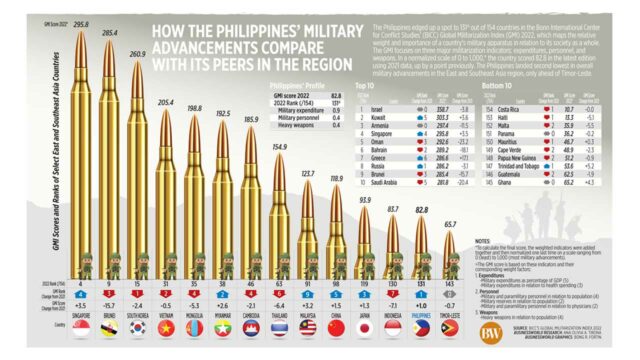
The Philippines edged up a spot to 131st out of 154 countries in the Bonn International Center for Conflict Studies’ (BICC) Global Militarization Index (GMI) 2022, which maps the relative weight and importance of a country’s military apparatus in relation to its society as a whole. The GMI focuses on three major militarization indicators: expenditures, personnel, and weapons. In a normalized scale of 0 to 1,000,* the country scored 82.8 in the latest edition using 2021 data, up by a point previously. The Philippines landed second lowest in overall military advancements in the East and Southeast Asia region, only ahead of Timor-Leste.

How the Philippines’ military advancements compare with its peers in the region

Local shares seen to slip ahead of US inflation

BW FILE PHOTO

LOCAL equities are expected to decline in December as investors are seen to pocket their gains from the market’s recent rally as investors await the release of US inflation data.

The Philippine Stock Exchange index (PSEi) closed at 6,780.78 on Nov. 29, the last trading day of November, up by 10.2% from its finish of 6,153.43 on Oct. 28.

In a Viber message, Rizal Commercial Banking Corp. Chief Economist Michael L. Ricafort said that the US financial market lifted the local index for November.

“Largely triggered by gains in the US financial markets after the easing of the latest US inflation data,” he said, referring to the local stock market’s movement.

Separately, COL Investment Management, Inc. said via e-mail that the PSE index had shown “resilience” over the past two to three weeks.

“The backdrop of stronger peso, net foreign stock inflows, and potential peak US inflation have catalyzed the move,” it said.

The peso returned to the P56-per-dollar level in November after two months. The local unit closed on Nov. 29 at P56.56 per dollar, up by P1.41 from its P57.97 close on Oct. 28.

The US consumer price index (CPI) rose 0.4% in October. In the 12 months through October, the CPI increased 7.7%, slower than the 8.2% logged in September.

For December, China Bank Securities Corp. Research Director Rastine Mackie D. Mercado said that local shares might drop as investors are expected to pocket profits from the market’s recent rally.

“We think the market is due for a pullback on profit taking following the sustained rally from end of third quarter. We note that a consolidation phase is part of a healthy longer-term uptrend, and provides investors with redeployment opportunities at more favorable risk-reward profiles,” Mr. Mercado said in an e-mail.

Mr. Mercado said that US November inflation data will continue to influence the local market for December.

“December inflation data will be much awaited. Any surprise above consensus expectation or an acceleration above 8% will be negative to market sentiment,” First Metro Investment Corp. Head of Research Cristina S. Ulang said in an e-mail.

Ms. Ulang noted that US Federal Reserve’s (Fed) and Bangko Sentral ng Pilipinas’ (BSP) next policy move will drive market sentiment the month.

The US Fed raised borrowing costs by 75 basis points (bps) for a fourth consecutive time in November. So far, the Fed has hiked rates by 375 bps since March and is expected to deliver smaller increases on its next policy meeting set on Dec. 13-14.

The BSP has raised borrowing costs by 75 bps to 5%. The Monetary Board’s next policy meeting is on Dec. 15.

“The upcoming US CPI report with the US Fed’s interest rate decision the following day may provide some clues on the pace of the global monetary tightening going into 2023,” RCBC Securities, Inc. Head of Research Erwin Rommel C. Fuentes said in an e-mail.

Meanwhile, RCBC Securities’ Mr. Fuentes said that the PSEi might end at around 6,600 for the year, while he sees its support at 6,400 and resistance at 6,800.

COL Investment Management said that the local index is expected to range between 6,000 and 6,850 in December. — Ashley Erika O. Jose

PCCI says concerns about RCEP no bar to joining trade bloc

REUTERS

THE Philippine Chamber of Commerce and Industry (PCCI) said the issues raised against joining the Regional Comprehensive Economic Partnership (RCEP) should pose no obstacle to participating in the trade deal.

“Regarding the concerns of other sectors, I don’t think it should stop us. If you look at the broader picture, many of our Association of Southeast Asian Nations (ASEAN) neighbors are on board with the RCEP. It will be a waste if we are not a part of it,” PCCI President George T. Barcelon told BusinessWorld.

Mr. Barcelon was asked to comment on President Ferdinand R. Marcos, Jr.’s declaration of support for participating in RCEP after the palace concluded a review on the trade deal’s potential impact on industries like agriculture.

“I am glad that the President backed (ratification). We have always taken the view that the RCEP should be ratified by the Senate,” Mr. Barcelon said.

“If the Senate can ratify the RCEP before the year ends, why not? At least, the Philippines will be on equal footing with other countries,” he added.

Trade Secretary Alfredo E. Pascual had announced that Mr. Marcos threw his backing behind joining RCEP.

Mr. Pascual also confirmed that the Cabinet has agreed to ask the Senate for its concurrence.

“When I asked President Marcos about the RCEP, he said that he has reviewed it and that it is okay with him. We had a Cabinet decision in October that the Cabinet, as a whole, (will) request the concurrence of the Senate,” Mr. Pascual said.  

Mr. Marcos called for the RCEP review to ensure that safeguards are in place for agriculture.

RCEP started taking effect in the various jurisdictions on Jan. 1. It is the largest free trade agreement (FTA) with participating countries including the 10 ASEAN members, Australia, China, Japan, South Korea, and New Zealand.

The Philippines Senate considered the FTA in the previous sitting of Congress but failed to come to a decision before the session adjourned.   

The Philippines and Myanmar are the last two countries that have yet to confirm their participation in RCEP.

RCEP participation was approved by former President Rodrigo R. Duterte in September 2021 but must be ratified by the Senate to take effect. — Revin Mikhael D. Ochave

PHL energy security to hinge on emerging tech

REUTERS

THE PHILIPPINES will need to tap emerging technology like green hydrogen to shore up energy security during its transition to green sources of power, an Energy department official said.

Michael O. Sinocruz, director for Energy Policy and Planning at the Department of Energy (DoE), said during the BusinessWorld Economic Forum Forecast 2023 that diversifying the energy mix is a key step in achieving energy security.

As such, Mr. Sinocruz said that the government is “looking to harness” alternative fuels like green hydrogen and ammonia.

According to the DoE’s Philippine Energy Plan for 2020 to 2040, the Philippines is focusing on increasing the share of renewables in the power mix.  

Energy Secretary Raphael P.M. Lotilla has noted the Philippines’ dependence on imported coal for its power needs.

“The perspective (that the Russia-Ukraine war) gives us is that curve balls like this happen. Specific to the Philippines, it magnifies our reliance, our dependence on many things that are not innate to the country,” James A. Villaroman, chief renewable energy officer of Aboitiz Power Corp. said on the sidelines of the forum. 

Mr. Villaroman said “the implications of increasing REs to 35%, (needs to be understood in terms of) system needs; how the system will behave and what infrastructure we need to manage in energy system which is 35% RE (and) largely variable and intermittent.” — Ashley Erika O. Jose

Heightened cybersecurity seen as necessary accompaniment to broader tech adoption

A broken ethernet cable is seen in front of binary code and words “cyber security” in this illustration taken on March 8, 2022. — REUTERS

UPGRADED CYBER-DEFENSES need to accompany greater adoption of the blockchain, artificial intelligence, and financial technology, extending the blanket of security to other entities that a company deals with, an association of technology security officers said.

“Before, we only protected our castle. Now, we have to go beyond that and protect even those even outside of it,” according to Archieval B. Tolentino, president of the Information Security Officers Group, speaking on Tuesday at the BusinessWorld Economic Forum.

Mr. Tolentino added that companies need to be wise to the risks associated with social media use.

“The ugly truth about social media is that it can make or break a company, based on information and misinformation online,” he said. 

Nevertheless, companies must press on with technology adoption because of the new generations’ comfort level with the new ways of doing things.

“These are opportunities for us to see where things are going for the next generation. They are digital natives. As banks, it challenges us to see how we can participate in this development,” Fitzgerald S. Chee, vice-president and head of consumer platforms at Bank of the Philippine Islands said at the forum.

Mr. Chee said that while investing in cybersecurity is important, digital literacy is just as critical.

Marvin P. Germo, Stock Smarts chief executive officer, noted that the pandemic accelerated the adoption of technology, including online banking applications.

“These opportunities continue to play today,” he said.

Mr. Germo, who has been investing in the crypto market, also said interest in digital assets will continue.

“Bitcoin is a decentralized asset. When you store it can never be shut down. When you have something that is decentralized, no one can put it down, and you’ll have something perpetually,” he said.

“It’s easy to lump cryptocurrency as one thing. The failure of one exchange is not a failure of crypto. It does not change the use cases of bitcoin, ethereum, etc.,” he added.

Kristoffer Eduard M. Rada, head of public policy at TikTok Philippines, said social media platforms like TikTok have been creating opportunities for online businesses.

He said that TikTok has evolved from an entertainment platform to an informational and now entrepreneurial one, with many users now engaging in “live selling.”

According to a recent report by Google, Temasek, and Bain & Co., the Philippines’ digital economy is expected to hit a gross merchandise value of $35 billion by 2025, posting a 20% compound annual growth rate (CAGR) from $20 billion currently. The main driver will be the e-commerce sector, which is expected to grow to $22 billion by 2025, suggesting a CAGR of 17%.

“(Digital media now) gives you the freedom to pursue your passions and form communities based on those passions,” Mr. Rada said, adding that social media platforms now also contribute to economic growth by supporting and enabling e-commerce.

Mr. Rada proposed a multisectoral approach to misinformation or disinformation. He said that TikTok Philippines is partnering with media organizations and the academic community to address the problem. He added that the presence of credible sources of information, such as media organizations on TikTok, will help counter and eliminate the spread of false information. — Arjay L. Balinbin

ADVERTISEMENT
ADVERTISEMENT