The advent of social media has increased people’s desire to experience spirituality in their personal and professional lives. The public disclosure of mass layoffs, such as those at Meta, Twitter, and Amazon, has created uncertainty and stress.
People are becoming increasingly concerned about losing their jobs due to massive corporate downsizing and relocation offshore, which is occurring at an alarming rate. Companies such as Nokia, Wells Fargo, and Honda have decided to pull out their operations in the Philippines.
The message is clear: our jobs are no longer secure. As a result, employees are dispirited and desire to find meaning in work. Fortunately, a paradigm that has been around for a while can address this phenomenon: workplace spirituality.
According to Milliman et al. (2003), spirituality is a shared human quality that manifests as the desire of a person to fully experience life, be present, and feel a part of something larger than ourselves. Petchsawang et al. (2009) define workplace spirituality as having compassion for others, having a mindful inner consciousness while doing meaningful work, and thus enabling transcendence.
Simply put, incorporating spirituality in the workplace is about finding meaning, value, and motivation in one’s work outside of pay and performance. Workplace spirituality is about discovering a sense of oneness and belonging within a larger organization where they can openly express their talent, brilliance, and genius. This paradigm is about creating a space where employees can see their work, not as a means to survive but as a path toward self-actualization.
Non-traditional management techniques and organizational structures are required to deal with this framework of organizational values. Instead of forceful command and rigid control, organization leaders can achieve productivity by: (1) encouraging employees to express themselves; (2) making the workplace an inclusive and diverse environment where employees’ thoughts and ideas are encouraged; (3) educating and training employees in self-leadership and self-awareness skills; and (4) encouraging employees to recognize their worth and value.
Leaders also must learn about their employees individually and motivate them to learn more about one another. These interventions will make them appreciate their leaders’ concern for them, resulting in a better working environment and increased team morale and productivity.
Today is my twelfth anniversary at my current job. I have been wondering what makes me stay. I have deduced, just like the other managers and staff, it is because I am well cared for. My boss considers me and his other direct reports as “family,” and helps us develop as employees and individuals by: (1) allowing us to pursue higher education and other interests; (2) nurturing open communication in which our ideas are heard and respected; (3) guiding us on occupational and even personal concerns; and (4) being sympathetic to our plights.
My boss’ actions demonstrate integrity, goodness, interconnectedness, and compassion, making me value and find meaning in my work. He has enabled me to pursue doctorate studies. He has also financially assisted managers and other employees for illnesses not covered by company benefits. But more crucially, he acts as our collective “father,” advising us on every life decision. When we fail, he consoles us, and when we succeed, he rejoices with us. Imagine a company where everyone feels valued; there would be loyalty, resilience, creativity, and innovation.
A survey of employees of credit institutions in Indonesia confirmed the positive impact of workplace spirituality on organizational commitment and organizational citizenship behavior (OCB). OCB refers to all constructive employee actions that benefit their colleagues and the organization, such as cooperation, volunteerism, and idea sharing. Other research has shown that organizations that embrace values such as collaboration, creativity, and compassion are often more successful in terms of firm performance and innovation than those that don’t. Examples of these are Pixar, Netflix, and Southwest Airlines.
According to Dubey et al. (2022), workplace spirituality continues to spread worldwide. Organizations are now helping employees realize their full potential and find meaning and fulfillment in their jobs. Ultimately, spiritual employees benefit businesses in ways other than improved performance and productivity. At the very least, they are happier and more content. They make workplaces more enjoyable and help businesses contribute to a better world for everyone.
Erwin R. Lapuz is a doctor of Business Administration candidate at the Ramon V. Del Rosario College of Business of De La Salle University.
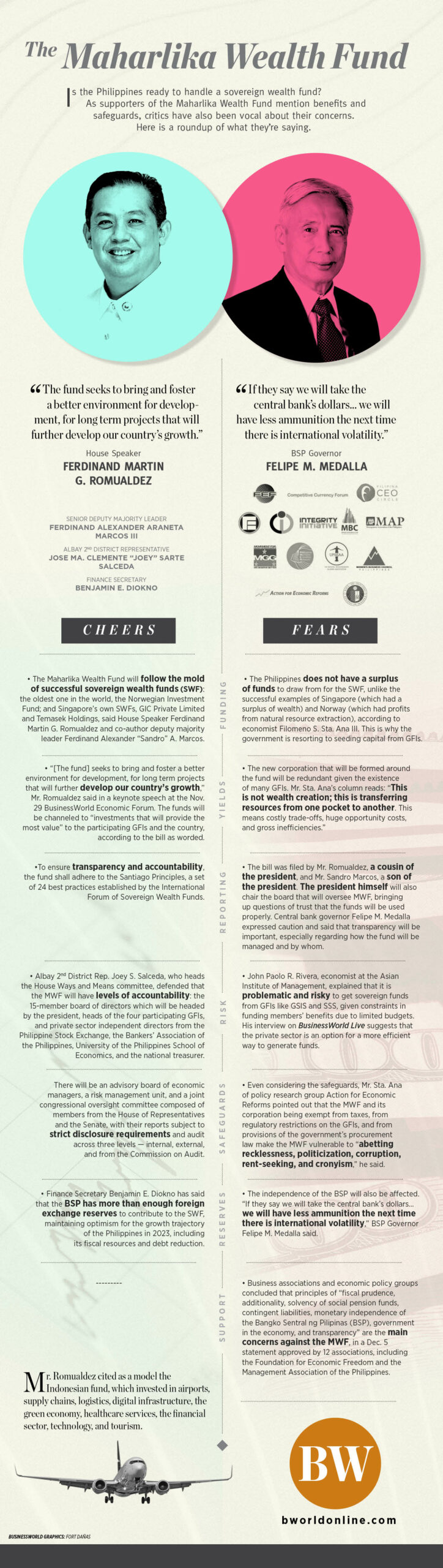
CRITICS from various sectors — including private citizens, economists, academics, bankers, and government officials — have decried the Maharlika Wealth Fund (MWF), citing lack of fiscal space, high debt levels, and possible mishandling of funds as reasons the Philippines is not ready for a sovereign wealth fund (SWF).
“There’s a problem in terms of the timing. Why is it that we are pushing for this when we don’t have any excess capital at the present?” said Leonardo A. Lanzona, an economist at Ateneo de Manila University, in a Dec. 7 interview with BusinessWorld.
“This muddled, inconsistent, and redundant bill is only setting the MWF up for failure, and will only enable cronyism, rent seeking, and corruption,” said a Dec. 7 statement signed by a group of fellows and members of economic think tank Action for Economic Reforms, faculty members and professor emeriti of the University of the Philippines School of Economics and other universities, faculty members of Ateneo de Manila University, and former senior government officials, including former Cabinet Secretaries and Undersecretaries.
Business associations and economic policy groups, in a Dec. 5 statement, said that they do not support the creation of a SWF. “We register our serious concerns and reservations against the proposed MWF on the principles of fiscal prudence, additionality, solvency of social pension funds, contingent liabilities, monetary independence of the Bangko Sentral ng Pilipinas, government in the economy, and transparency,” said a statement approved by 12 associations, including the Foundation For Economic Freedom and the Management Association of the Philippines.
“[The fund] seeks to bring and foster a better environment for development, for long term projects that will further develop our country’s growth,” he said in his keynote speech at the Nov. 29 BusinessWorld Economic Forum.
It will follow the mold of the oldest SWF in the world, the Norwegian Investment Fund, and Singapore’s own SWFs, GIC Private Limited and Temasek Holdings, he added.
There is a catch, however, including the fact that SWFs in Norway and Singapore were financed by their respective country’s profits from natural resource extraction (Norway) or surplus of wealth (Singapore), according to economist Filomeno S. Sta. Ana III.
In his BusinessWorld column, he said that the Philippines hasno huge surplus to preserve. The MWF will have to take capital from government financial institutions (GFIs): the Government Service Insurance System (GSIS), Social Security System (SSS), Land Bank of the Philippines, and Development Bank of the Philippines (DBP). The fund will require a total of P275 billion, or $4.91 billion, in seed money.
CHANNELING INVESTMENTS House Bill 6398, which Mr. Romualdez filed with deputy majority leader Ferdinand Alexander “Sandro” A. Marcos (Mr. Romualdez’s cousin and President Ferdinand R. Marcos, Jr.’s son) names the president as chairman of the board that will oversee the fund.
Its goal will be to “optimize investment allocation” by the previously mentioned GFIs, as worded in the bill. It will also ensure that resources are efficiently channeled to “investments that will provide the most value” to participating GFIs and the country.
Central bank governor Felipe M. Medallaexpressed caution with regards to the fund, saying in an interview with Bloomberg TV that transparency will be very important.
His key concerns are how the fund will be managed and by whom, and to what extent it will affect the independence of the Bangko Sentral ng Pilipinas (BSP).
“If they say we will take the central bank’s dollars…we will have less ammunition the next time there is international volatility,” he said.
Mr. Sta. Ana echoed this concern, calling the new corporation that will be formed around the fund as redundant. His column reads: “This is not wealth creation; this is transferring resources from one pocket to another. This means costly trade-offs, huge opportunity costs, and gross inefficiencies.”
SAFEGUARDS IN PLACE To ensure transparency and accountability, the bill’s proponents have said that the fund shall adhere to the 2008 Santiago Principles, a set of24 best practices established by the International Forum of Sovereign Wealth Funds.
Albay Second District Rep. Joey S. Salceda, who heads the House Ways and Means committee, defended that the MWF will have several levels of accountability: the 15-member board of directors which will be headed by the president as well as heads of the four participating GFIs.
The board will also have private sector independent directors from the Philippine Stock Exchange, the Bankers’ Association of the Philippines, University of the Philippines School of Economics, and the national treasurer.
There will be an advisory board composed of economic managers, a risk management unit, and a joint congressional oversight committee composed of five members each from the House of Representatives and the Senate, he said in a statement.
“It will be subject to rigorous accountability requirements via strict disclosure requirements which will entail its books being audited across three levels — internal, external, and Commission on Audit,” he added.
VULNERABLE TO CORRUPTION John Paolo R. Rivera, economist at the Asian Institute of Management, explained that it is problematic and risky to get sovereign funds from GFIs like GSIS AND SSS, given existing constraints in funding members’ benefits due to limited budgets.
He suggested in an interview on BusinessWorld Live thatthe private sector is an option for an efficient way to generate funds.
“Most economies invest their surplus funds into their sovereign fund because they want to expand their liquidity further and faster, so the role of the private sector is very important because they are the ones who have surplus funds,” he said.
Even considering the safeguards, Mr. Sta. Ana of policy research group Action for Economic Reforms pointed out that the President heading the board and the MWF and its corporation being exempt from taxes, from regulatory restrictions on the GFIs, and from provisions of the government’s procurement law are cause for concern.
These make the MWF “most vulnerable to abetting recklessness, politicization, corruption, rent-seeking, and cronyism,” he said.
The bill’s backers are seeking to complete the third and final reading before Christmas break on Dec. 17. — Brontë H. Lacsamana
BEIJING — A patchwork easing of the world’s toughest COVID-19 curbs sowed confusion across China on Monday, spurring hopes for more clarity as officials shift tone on the dangers posed by the coronavirus in the wake of last month’s unprecedented protests.
Three years into the pandemic, China’s zero-tolerance measures, from shutting its borders to stifling lockdowns, provide a stark contrast with the rest of the world, which has largely opened up in its efforts to live with the virus.
The strict approach has battered the world’s second-largest economy, put mental strain on hundreds of millions and last month prompted the biggest show of public discontent in mainland China since President Xi Jinping took power in 2012.
Although the protests largely petered out amid a heavy police presence across major cities, in their wake numerous regional authorities have announced some relaxations of lockdowns, quarantine rules and testing requirements.
Daily tallies of new COVID infections have also dropped in some regions as authorities row back on testing.
“The information at this stage will be a bit chaotic,” commentator Hu Xijin, a former editor-in-chief of state-controlled tabloid Global Times, said on the Twitter-like microblog Weibo on Sunday, flagging the risk that fewer tests could skew infection figures.
China is soon set to announce a nationwide easing of testing requirements as well as allowing positive cases and close contacts to isolate at home under certain conditions, people familiar with the matter told Reuters last week.
But until then, a lack of clarity has left some scared of being caught on the wrong side of fast-changing rules.
Yin, a resident of a small city near Beijing, the capital, said her in-laws had come down with a fever and she herself now had a sore throat, but they did not want to be tested.
She added that they feared the risk of being thrown into government quarantine facilities, described by many as shoddily built and unhygienic.
“All we want is to recover at home, by ourselves,” she told Reuters, speaking on condition of anonymity.
CHANGING MESSAGE Alongside the easing of local curbs, Vice Premier Sun Chunlan, who oversees COVID efforts, said last week the ability of the virus to cause disease was weakening.
That change in messaging aligns with the position adopted by many health authorities around the world for more than a year.
As the virus weakens, conditions are improving for China to scale back management of COVID-19 as a serious contagious disease, state media outlet Yicai said late on Sunday, in comments that are among the first to float the idea.
Since January 2020, China has classified COVID-19 as a Category B infectious disease but has managed it under Category A protocols, giving authorities the power to put patients and their close contacts into quarantine and lockdown regions.
In recent days, major cities across China have continued to loosening the severest of those measures.
Authorities in the southwestern municipality of Chongqing urged local bodies not to test too much. “Do not repeat testing or increase testing,” they said.
The eastern province of Zhejiang said it planned to largely end mass testing, while the metropolis of Nanjing dropped COVID tests for use of public transport.
The capital, Beijing, has also dropped testing for public transport, but entry to many office buildings still requires negative tests, leaving workers confused.
The scrapping of the rule for showing negative tests to buy medicines for cold and fever in various cities, a step intended to deter people from using the drugs to disguise symptoms, has led to mass buying, some state media said. — Reuters
A GENERAL VIEW during an opening ceremony before a group stage match during the 2022 FIFA World Cup between Qatar and Ecuador at Al Bayt Stadium. — DANIELLE PARHIZKARAN-USA TODAY SPORTS
DOHA — Senegal’s loss to England on Sunday saw Africa’s hopes of lifting the trophy in Qatar recede even further but the migrant workers watching the game at a specially-built fan zone were still hoping for the biggest prize of all — work beyond the World Cup.
Senegal’s 3-0 defeat at the Al Bayt Stadium means Morocco are the continent’s only sporting representatives remaining in the tournament but in Asian Town, about 60km away, some African fans were already looking beyond the final.
“The ones who came just for the World Cup will definitely go back after the World Cup, but I still have my future here because I still have work to do,” Ugandan Wambaka Isaac told Reuters.
“We’ll go doing cleaning work, offices, everywhere (there’s) a lot of work, and of course the building keeps on going,” he added.
Proudly wearing the shirt of his national team, Mr. Isaac was one of thousands of migrant workers who made their way to the fan zone after sundown to watch Sunday’s last-16 tie between France and Poland before England and Senegal took centre stage.
Qatar has come in for intense criticism from human rights groups about the treatment of its migrant workers, who together with other foreigners make up a majority of the population.
“It’s complicated,” said a young traffic marshal from Kenya, who declined to give his name, when asked whether or not he would be able to stay on after the final.
“I worked in construction on the Lusail Stadium, the Al Thumama (stadium). I worked for a contractor, so you go wherever they send you. We’re marshals today, next week we might be in construction again,” he explained.
“We worked in the summer when it was very hot, long days, very hot. I was very tired all the time.”
NO WORK AT HOME For Rahim, a ride-share driver from Bangladesh, his three-and-a-half years in Qatar have been tough but there is no work in his home village so he feels he has no choice but to stay on.
“I work every day, seven days a week. First I have to pay a company for the car, it’s not mine. Then I have to pay for my food and my rent, and what is left I send to my family,” Mr. Rahim said.
“During the pandemic there was no work so we lived on nothing. I’m trying to save up to go home; I haven’t seen my family in three-and-a-half years (but) if I go home there is no work so I have to have even more money.”
Mr. Rahim said he would like to bring his wife and daughter to live with him in Qatar but that he did not make enough money to be able to do so, so they remained in Bangladesh.
The FIFA fan zone in Asian Town, close to where many of the migrant workers have their living quarters, is one of the few public places in Doha showing World Cup games on big outdoor screens.
Most evenings the men come out to sit on the grass or in the bleachers at the cricket stadium, where the fan zone has been built, to watch but with an early start in the morning many head home to bed before the final whistle.
Many of the workers are dependent on their employers to be allowed to stay in Qatar and the goal is to ensure that they can stay in a job.
Jonathan, another Ugandan, is not really a fan of his job as a mechanic and would prefer to get an education, but he is aiming to be here long after the final.
“I’m going to stay until my contract finishes,” he said. — Reuters
The British union flag flutters on the Victoria Tower at the Houses of Parliamen, in London, Britain Dec. 30, 2020. — REUTERS/TOBY MELVILLE
LONDON — Britain’s government is launching a consultation into how to amend pension rules for workers in the National Health Service (NHS) to help retain more staff, at a time when the sector faces strikes over pay this month that could halt some procedures.
The governing Conservative Party has long promised to sort out a health service which has struggled to recover after being stretched to its limits during the COVID-19 pandemic and now faces strikes by thousands of nurses and ambulance workers.
“The generous NHS Pension Scheme is one of the best in the country, but it’s not working as it should for everyone,” health minister Steve Barclay said in a statement.
“We need a system where our most experienced clinicians don’t feel they have to reduce their workload or take early retirement because of financial worries. I also want to make it easier for staff that want to return to work to support the NHS to be able to do so without penalties.”
To provide more flexibility, the proposals will include allowing retired and partially retired staff to return to work or increase their working hours without having payments to their pension reduced or suspended. That would allow staff to claim a portion or all of their pension benefits but continue working and contributing to their pension.
The proposals are also aimed at fixing the unintended impacts of inflation, so senior clinicians are not taxed more than is necessary, the health ministry said in its statement.
The consultation will be open for eight weeks, with the reforms expected to be implemented in 2023.
On Sunday, Conservative chairman Nadhim Zahawi said the government was looking to bring in the military to help maintain services if strikes by NHS staff go ahead, urging health workers to reconsider their plans for industrial action. — Reuters
WELLINGTON — The New Zealand government said on Monday it would launch an inquiry into the country’s handling of the COVID-19 pandemic so future governments could learn from the experience.
A Royal Commission, a public inquiry of the highest level in New Zealand, would look at the overall response, the government said in a statement. That would include considering economic measures, such as fiscal and monetary policy responses but without reviewing particular central bank decisions.
The aim would be identifying lessons that could be applied in a future pandemic.
“It had been over 100 years since we experienced a pandemic of this scale, so it’s critical we compile what worked and what we can learn from it should it ever happen again,” Prime Minister Jacinda Ardern said in a statement.
A one-time poster child for tackling the coronavirus, New Zealand’s swift response to the pandemic and its geographic isolation kept the country largely COVID-19 free until the end of 2021, winning Ms. Ardern strong domestic support.
But anger over vaccine mandates for people working in sectors such as health and education and strict border closures prompted protests earlier this year. The government’s financial response is also now being blamed by some political opposition parties for contributing to three-decade high inflation.
The review will be concluded in mid-2024, the government said. — Reuters
UIWANG, South Korea – Inside five white tents outside the Uiwang container depot near Seoul, about 200 striking truckers huddle around gas heaters, trying to fight the bitter cold and the government narrative that they are well paid “labor aristocracy.”
They are all too aware of the impact their strike has had on South Koreans at a time of record inflation. But these drivers, and tens of thousands of others striking across the country, say their calls for stronger minimum pay protections are all that stand between them and poverty.
“We are not the enemy. We are loyal to our country, because we are contributing to exports,” said Kim Young-chan, a 63-year-old container truck driver transporting exports such as home appliances and cosmetics between Uiwang and Busan port. “Our money is stretched to eat and live for a month. Labor aristocracy? That is nonsense.”
Amid soaring fuel costs, as many as 25,000 truckers are calling on the government for a permanent minimum-pay system known as the “Safe Freight Rate”, which was introduced temporarily in 2020 for a small portion of the more than 400,000 truckers.
President Yoon Suk-yeol has said his administration would not give in to what it calls “unjustified demands” by the truckers union as the second major strike in less than six months disrupts supplies of cars, cement and fuel. The interior minister and a ruling party spokesperson have both called the truckers “labor aristocracy”.
Pale and unshaven, the drivers venture out of their tents a couple of times a day to chant slogans and hand out leaflets.
Kim said high diesel prices mean their lives are no better than in June, when they went on an eight-day strike. He earns about 3 million won ($2,300) per month, far less than last year because diesel prices have nearly doubled.
The country’s consumer prices also jumped 5% in November compared with a year earlier.
Kim said it broke his heart that his wife, who is past retirement age, must work to support the family, mopping floors and cooking for pay.
“Maybe our life can be better if freight rates are stable,” he said.
The government and the union have sat down for talks twice but remain far apart on two key issues: extending the minimum pay rules beyond the end of this year and expanding them to benefit more truckers.
The government has specifically said it will not expand minimum pay protection to truckers in the fuel and steel industries, saying they are already well paid.
Concerns are mounting over shortages of petrol and pricier groceries causing economic pain.
Lee Ji-eun, 36, a physician and mother of two, said she hurried to fuel up her car on Thursday over shortage fears.
“I want the government and the truckers to reach a deal as soon as possible. Strikes like this or by subway workers or public officials – that damage is done straight to ordinary people like me,” Lee said.
Early in the strike, near a major oil storage facility that supplies petrol stations in Seoul, a dozen striking tanker drivers had positioned their trucks to hamper traffic. On Thursday, they stopped after residents complained.
“I know people are getting cold about this strike, and they are like, ‘Why again?'” said Ham Sang-jun, 49, a driver transporting oil from top refiner S-Oil Corp 010950.KS to petrol stations.
As of mid-Friday,60 petrol stations had run dry, the industry ministry said. Stations nationwide had an average of about a week’s supply, as they had secured stock before the strike. Read full story
Along with Ham, about 90% out the 340 tanker drivers contracted to supply S-Oil’s products have walked off the job, according to Lee Geum-sang, their union leader.
Their families worry they lose their jobs.
Ham, the father of two teens, earns about 3 million to 4 million won a month working 12 hours a day, five days a week, often overnight and weekends. That is 2 million won less than last year because of fuel costs.
“I am sorry to my wife and children, because I am not a good father,” he said. “But we have to keep up the strike for a better future 10 years ahead.” – Reuters
Construction of the world’s biggest radio astronomy facility, the SKA Observatory, begins today. The observatory is a global project 30 years in the making.
With two huge two telescopes, one in Australia and the other in South Africa, the project will see further into the history of the Universe than ever before.
Astronomers like me will use the telescopes to trace hydrogen over cosmic time and make precise measurements of gravity in extreme environments. What’s more, we hope to uncover the existence of complex molecules in planet-forming clouds around distant stars, which could be the early signs of life elsewhere in the Universe.
I have been involved in the SKA and its precursor telescopes for the past ten years, and as the chief operations scientist of the Australian telescope since July. I am helping to build the team of scientists, engineers and technicians who will construct and operate the telescope, along with undertaking science to map primordial hydrogen in the infant universe.
The SKA Observatory is an intergovernmental organization with dozens of countries involved. The observatory is much more than the two physical telescopes, with headquarters in the UK and collaborators around the world harnessing advanced computers and software to tailor the telescope signals to the precise science being undertaken.
The telescope in South Africa (called SKA-Mid) will use 197 radio dishes to observe middle-frequency radio waves from 350 MHz to more than 15 GHz. It will study the extreme environments of neutron stars, organic molecules around newly forming planets, and the structure of the Universe on the largest scales.
The Australian telescope (SKA-Low), in Western Australia, will observe lower frequencies with 512 stations of radio antennas spread out over a 74-kilometre span of outback.
The site is located within Inyarrimanha Ilgari Bundara, the CSIRO Murchison Radio-astronomy Observatory. This name, which means “sharing sky and stars”, was given to the observatory by the Wajarri Yamaji, the traditional owners and native title holders of the observatory site.
After decades of planning, developing precursor telescopes and testing, today we are holding a ceremony to mark the start of on-site construction. We expect both telescopes will be fully operational late this decade.
Each of the 512 stations of SKA-Low is made up of 256 wide-band dipole antennas, spread over a diameter of 35 meters. The signals from these Christmas-tree-shaped antennas in each station are electronically combined to point to different parts of the sky, forming a single view.
These antennas are designed to tune in to low radio frequencies of 50 to 350 MHz. At these frequencies, the radio waves are very long – comparable to the height of a person – which means more familiar-looking dishes are an inefficient way to catch them. Instead the dipole antennas operate much like TV antennas, with the radio waves from the Universe exciting electrons within their metal arms.
Collectively, the 131,072 dipoles in the completed array will provide the deepest and widest view of the Universe to date.
They will allow us to see out and back to the very beginning of the Universe, when the first stars and galaxies formed.
This key period, more than 13 billion years in our past, is termed the “cosmic dawn”: when stars and galaxies began to form, lighting up the cosmos for the first time.
The cosmic dawn marks the end of the cosmic dark ages, a period after the Big Bang when the Universe had cooled down through expansion. All that remained was the ubiquitous background glow of the early Universe light, and a cosmos filled with dark matter and neutral atoms of hydrogen and helium.
The light from the first stars transformed the Universe, tearing apart the electrons and protons in neutral hydrogen atoms. The Universe went from dark and neutral to bright and ionized.
The SKA Observatory will map this fog of neutral hydrogen at low radio frequencies, which will allow scientists to explore the births and deaths of the earliest stars and galaxies. Exploration of this key period is the final missing piece in our understanding of the life story of the Universe.
Closer to home, the low-frequency telescope will time the revolutions of pulsars. These rapidly spinning neutron stars, which fire out sweeping beams of radiation like lighthouses, are the Universe’s ultra-precise clocks.
Changes to the ticking of these clocks can indicate the passage of gravitational waves through the Universe, allowing us to map these deformations of spacetime with radio waves.
It will also help us to understand the Sun, our own star, and the space environment that we on Earth live within.
These are the things we expect to find with the SKA Observatory. But the unexpected discoveries will most likely be the most exciting. With an observatory of this size and power, we are bound to uncover as-yet-unimagined mysteries of the Universe. – Reuters
TAIPEI – The chair of the British parliament‘s defense select committee said there is “much to explore” in boosting military help for Taiwan and that he had discussed the island’s submarine program while visiting Taipei last week.
Britain, like most countries, has no formal diplomatic ties with democratically governed and Chinese-claimed Taiwan but has stepped up its support for the island in the face of a rising military threat from Beijing, as have other Western nations.
While the United States is Taiwan‘s most important foreign source of weapons, British companies have been helping develop Taiwan‘s new fleet of domestically built submarines.
Asked whether Britain should help support Taiwan militarily, whether with weapons or intelligence sharing, Tobias Ellwood said: “Yes – very much so”.
Referencing British Prime Minister Rishi Sunak’s comments last month that the “golden era” of relations with China was over, Ellwood added: “There is much to explore here”.
“I will endeavor to bring my Committee back in May to look at this in more detail,” he said in response to emailed questions.
Ellwood, who is a senior lawmaker from the ruling Conservative Party and a former defense minister, said he had also discussed Taiwan‘s indigenous submarine program on his trip, but added he needed to learn a little more about it before saying anything publicly.
While in Taipei, Ellwood met President Tsai Ing-wen, Foreign Minister Joseph Wu and Wellington Koo, head of Taiwan‘s National Security Council.
He said Britain should have greater military and security interaction with Taiwan, which security sources have said largely happens behind closed doors, and should be braver in supporting Taiwan internationally.
“Britain has stepped forward, more so than other nations, in helping Ukraine. Other nations then followed. There should be nothing preventing us doing the same again with Taiwan,” Ellwood said.
“There are so many lessons to be drawn from our timidity in Ukraine. The economic and security fallout is privately making many Western leaders realize the folly of not preventing the invasion in the first place.” – Reuters
US Secretary of State Antony Blinken. Official White House — CAMERON SMITH VIA FLICKR
WASHINGTON – The US plans to work closely with Israel‘s new government, Secretary of State Antony Blinken told a left-leaning Jewish group in Washington on Sunday, and continues to support a two–state solution to end the decades-long conflict with Palestinians.
The US administration expects “the new Israeli Government to continue to work with us to advance our shared values, just as we have previous governments,” Blinken told the nonprofit J Street liberal advocacy group. “We will gauge the government by the policies it pursues rather than individual personalities,” he said.
“Security assistance to Israel is sacrosanct,” Mr. Blinken said, noting the more than $3 billion the US provides to Israel in foreign military funding.
Last week, Israeli Prime Minister-designate Benjamin Netanyahu reached a coalition deal with the far-right Religious Zionism party, which opposes Palestinian statehood and supports extending Israeli sovereignty into the West Bank.
Itamar Ben-Gvir, who was convicted in 2007 of racist incitement against Arabs and backing a group considered by Israel and the United States to be a terrorist organization, is Israel‘s new security minister, with responsibility for Border Police in the occupied West Bank.
President Joe Biden remains committed to “realizing the enduring goal of two states,” Mr. Blinken said. “We believe Palestinians and Israelis, like people everywhere, are entitled to the same rights and the same opportunities.”
The US “will also continue to unequivocally oppose any acts that undermine the prospects of a two–state solution,” Mr. Blinken said, including settlement expansion, moves toward annexation of the West Bank, disruption to the historic status quo at holy sites, demolitions and evictions, and incitement to violence. – Reuters
LONDON/DUBAI – OPEC+ agreed to stick to its oil output targets at a meeting on Sunday as the oil markets struggle to assess the impact of a slowing Chinese economy on demand and a G7 price cap on Russian oil on supply.
The decision comes two days after the Group of Seven (G7) nations agreed a price cap on Russian oil.
OPEC+, which comprises the Organization of the Petroleum Exporting Countries (OPEC) and allies including Russia, angered the United States and other Western nations in October when it agreed to cut output by 2 million barrels per day (bpd), about 2% of world demand, from November until the end of 2023.
Washington accused the group and one of its leaders, Saudi Arabia, of siding with Russia despite Moscow’s war in Ukraine.
OPEC+ argued it had cut output because of a weaker economic outlook. Oil prices have declined since October due to slower Chinese and global growth and higher interest rates, prompting market speculation the group could cut output again. O/R
But on Sunday the group of oil producers decided to keep the policy unchanged. Its key ministers will next meet on Feb. 1 for a monitoring committee while a full meeting is scheduled for June 3-4.
On Friday, G7 nations and Australia agreed a $60 per barrel price cap on Russian seaborne crude oil in a move to deprive President Vladimir Putin of revenue while keeping Russian oil flowing to global markets.
Many analysts and OPEC ministers have said the price cap is confusing and probably inefficient as Moscow has been selling most of its oil to countries like China and India, which have refused to condemn the war in Ukraine.
Neither an OPEC meeting on Saturday nor the OPEC+ meeting on Sunday discussed the Russian price cap, sources said.
Russia’s Deputy Prime Minister Alexander Novak said on Sunday Russia would rather cut production than supply oil under the price cap and said the cap may affect other producers.
Sources have told Reuters several OPEC+ members have expressed frustration at the cap saying the anti-market measure could ultimately be used by the West against any producer.
JP Morgan said on Friday that OPEC+ could review production in the new year based on fresh data on Chinese demand trends and consumer compliance with price caps on Russia crude output and tanker flow. – Reuters
From left to right: Magellan Fetalino III, head of Alternative Finance and Innovation Garage, UBX Philippines Corp. and Trustee of Fintech Alliance.PH; Martha Borja, country head, Grab Financial Group-Philippines and Trustee of Fintech Alliance.PH; Edison Tsai, executive director, SeedIn Technology and Trustee of Fintech Alliance.PH; Obaid Alshehi, first secretary, UAE Embassy to the Philippines; His Excellency Tull Traisorat, Ambassador of the Kingdom of Thailand to the Philippines; Lito Villanueva, founding chairman, Fintech Alliance.PH, EVP & Chief Innovation and Inclusion Officer, RCBC Chief Digital Transformation Advisor, YGC, chairman, Alliance of Digital Finance Associations; Her Excellency Titanilla Tóth, Ambassador of Hungary to the Philippines; His Excellency Gerard Ho Wei Hong, Ambassador of Singapore to the Philippines; His Excellency Peter Kell, Ambassador of New Zealand to the Philippines; His Excellency Ilan Fluss, Ambassador of Israel to the Philippines; Victor Aliwalas, CEO, Multisys Technologies Corp.; Allen Guo, country head of Philippines, Alibaba Cloud Intelligence; Imelda Tiongson, chairperson, Pru Life UK & Trustee, Fintech Alliance.PH; and Christina Stieber, commercial counsellor, Austrian Embassy to the Philippines
Fintech Alliance.PH, in cooperation with Enderun Conferences, recently hosted the second edition of Inclusion and Digital Transformation (INDX) Summit last Nov. 22-23, 2022 at the Enderun Tent in McKinley Hill, Taguig City. The event was attended by hundreds of industry practitioners involved in finance and technology locally and internationally, and was participated by some of the country’s highly-esteemed regulators, government officials, economic policy makers, thought leaders, and members of the diplomatic corps.
The goal of the INDX Summit 2.0 was to discuss challenges concerning the digital divide between standards and regulations in e-commerce, health, agriculture, education, MSMEs, open banking, insurance, AI, and the new technologies, among others. It also discussed how Filipino consumers and businesses can use digital technology and digital transformation to deal with the current environment, advance economic recovery, and get back on track in achieving long-term financial goals.
“This monumental event is the gathering of the Philippines’ visionaries and trailblazers. The past two years have been golden for the fintech industry in the Philippines and throughout Southeast Asia. It is only fitting that we reflect on our successes and welcome promising years to come,” said Lito Villanueva, founding chairman of the FinTech Alliance.PH and the executive vice-president and chief innovation and inclusion officer of RCBC.
Statistical Review
According to the Philippine Statistics Authority, the value of the digital economy in the Philippines increased by 7.8% and reached P1.87 trillion in 2021. E-commerce erupted through the pandemic and continued to grow post-lockdown. Online selling transformed from being a side job to becoming a primary source of income. The main drivers of the digital economy, which contributed to 9.6% of the nation’s GDP of the same year, includes digital infrastructure, e-commerce, and digital content.
Figure 1. Gross Value Added (GVA) and Percent Share of Digital Economy to GDP at Current Prices, 2018-2021 — Source: Philippine Statistics Authority
In addition, the ASEAN digital economy has expanded more quickly as a result of the digital boom. According to Google, Temasek Holdings Pte., and Bain & Co., it is anticipated that the internet space will receive US$200 billion and a total value of transactions this year, exceeding the projected target three years earlier than anticipated. However, given these outstanding outcomes, it’s important to keep an eye out for early indications of concerns. As a result, fewer people are using the internet from 10% in the preceding year to only 4% in 2022.
There are also numerous challenges and societal deficits associated with the digital divide. One example is the lack of proper infrastructure. Affordability is also a challenge, owing to a lack of competition and investment. There is also the issue of intimidation, the presence of loan sharks, and a lack of trust in the system, which has prevented businesses from fully embracing a more digitized economy.
The Philippine Economic and Digital Roadmap
From looking at the macro point-of-view, the Bangko Sentral ng Pilipinas (BSP) specifically observed significant progress towards achieving its targets under the Digital Payments Transformation Roadmap 2023 where moving out of cash results in greater efficiency. BSP Governor Felipe M. Medalla stated that “in order to digitize more peer-to-business and business-to-business payments, the BSP collaborates with the payments industry to launch new innovative payment streams.” These are anchored into three pillars such as digital payment streams, digital finance infrastructure, and digital governance and standards. The goal is to make 50% of total retail volume become digital and 70% of Filipino adults become financially included. “To go digital, you will become more efficient. It’s going to be beautiful in the coming years,” he added.
For Finance Secretary Benjamin E. Diokno, “The COVID-19 pandemic has redefined what we considered to be ‘business as usual’ [and] it also presented an opportunity for economists around the world to quicken the pace towards a more digital economy. Although there are strides to adapt to the new normal, there is still much to be done before it is able to reach the goals.”
It is critical to expertly navigate through the pressing global challenges posed by the volatile political landscape. To address these issues, the government developed a set of strategic interventions known as the 8-Point Socioeconomic Agenda. “We will address the impact of inflation and the vulnerable sectors, reduce economic scarring from the pandemic, and ensure some macroeconomic fundamentals,” Mr. Diokno explained.
Philippines Through Digital Transformation and Inclusion
Both the government and the private sector should build a rapport in leading the digital transformation in the country. Leaving it solely to the government wouldn’t be economically feasible. GCash President & CEO Martha Sazon justified that “Digitalization or digital economy is a very complicated value chain. It starts from internet connectivity, device availability, and the various regulators around it, and into our space — fintech, e-commerce, and the various economic services. In the complete value chain, you have the government in each and every step. But you have different private sectors participating in it. While we may provide advanced technology, best practices from our partners and execution, we need the partnership from the government to make it easy for us to participate and to increase the penetration.”
Indeed, as the Philippines transitions to a new digital economy, the government highly supports the fintech industry and is moving in a positive direction by imposing standards and regulations. During the speech of Senator Mark A. Villar in the INDX Summit, he stated that “[although] the pandemic has revealed and brought urgency to necessary reforms in public health, social safety nets, disaster response, and rural development, among others, what reinforces all these reforms is the digital imperative. Going digital is the way and the key.”
Mr. Villar, who also acts as the chairman of the Senate Committee on Banks, Financial Institutions and Currencies, has filed Senate Bill No. 1128 or An Act Promoting the Adoption of Digital Payments for Financial Transactions of the Government and All Merchants, and Resolution No. 126 directing the appropriate Senate committee to conduct an inquiry in aid of legislation on the status of regulations by the Banko Sentral ng Pilipinas and other relevant government agencies concerning cryptocurrencies and other digital currencies in the Philippines.
“We are ready to support further innovations for the more efficient, convenient, and secured use of digital assets, as well as to legislate to ensure that digital transactions are duly protected. Our hopes for a more equitable and successful post-COVID society involve the establishment of crucial digital economy pillars such as robust digital infrastructure, digital skills, e-government, e-commerce, and an enabling legislative and regulatory environment,” said Mr. Villar.
Conclusion
The INDX Summit 2.0 was capped by the Fintech Alliance Ambassador’s Gala, which brought together key heads of missions and other international development agencies as well as regional and global partners. Albay Second District Rep. Joey Salceda, who is also the committee chair for Ways and Mean, culminated the event with a keynote speech where he addressed how “Technology has always been at the heart of finance.”
As the first champion in Congress of the Virtual Banking Act, the Fair and Inclusive Credit Act, the Financial Technology Development Act, the Blockchain Technology Development Act, as well as the parametric insurance for government assets which equalizes risk among LGUs, among others, Mr. Salceda explained, “Digital financial technology must be trustworthy. With more digitalization of finance comes the digitalization of the most predatory practices in the sector, and its underground mutations. Technology can do so much, but its aim must be to create value and virtue in society. The Philippines abounds in problems that the fintech sector can solve. If anything, that makes it a promising market for you.”
Even though the Philippines is lagging behind many of its regional neighbors in terms of digital implementation, there is hope in the adoption, and fintech turns all of these problems into the silver lining. Every Filipino has a fair share of the technology that is currently available, which has the positive effect of empowering everyone digitally by providing access to everything they need for their finances as well as the data they require to expand sustainably. Furthermore, financial literacy is essential when utilizing digital technology. Everyone can benefit from it by learning and understanding its ethics, discipline, and standards.
A number of pioneering initiatives have also been launched during the first FinTech Alliance Ambassadors Gala. These include the first off-campus Fintech and Regulatory Innovations Technology Program in the ASEAN region by the Cambridge Centre for Alternative Finance by the Judge Business School of the University of Cambridge in the United Kingdom in partnership with the Mapua University and the FinTech Alliance; the launching of the BSP Governor Nestor A. Espenilla, Jr. FinTech and Inclusive Finance Grants Matching Program; and the collaboration with the Ant Group’s 10 x 1000 Tech for Inclusion. The event also saw the oath taking of additional members of the Board of Trustees as well as incoming new members.
The INDX Summit is a flagship event of Fintech Alliance.PH and has been running since 2019. It is an excellent learning and networking platform for professionals and stakeholders striving for sustainable digital transformation success.
The INDX Summit 2.0 — Accelerating the Digital Economy: Issues, Impacts, and Innovations was co-presented by Binance Academy and was made possible by the following sponsors: RCBC, Maya, Pru Life UK, InvestHK, Brankas, Grover, Clari5, M2P, Uniphore, Saviynt, CYFIRMA, Ion Management Solutions, Netcore Cloud, Pera Hub, Coins.ph, GSIS, CIBI, UNO Digital Bank, Tala, and ANT Group; government partners: Department of Finance, Banko Sentral ng Pilipinas, Department of Information and Communications Technology, Securities & Exchange Commission, Insurance Commission, Department of Trade & Industry, Credit Information Corp., and National Privacy Commission; and industry organization partners: JCI Manila, Management Association of the Philippines, Women’s Business Council, FINEX,Institute of Corporate Directors, Global Impact FinTech, Mapúa University, 10×1000 Tech for Inclusion, ANT Group, and the University of Cambridge Center for Alternative Finance.
Spotlight is BusinessWorld’s sponsored section that allows advertisers to amplify their brand and connect with BusinessWorld’s audience by enabling them to publish their stories directly on the BusinessWorld Web site. For more information, send an email to online@bworldonline.com.