Home Blog Page 5524

Filipinas dominate higher-ranked Papua New Guinea in 5-1 match

PRESSING high and winning the ball in dangerous areas, the Filipinas opened a 2-0 lead on Carleigh Frilles’ left-footed shot at the 29th and Tahnai Annis’ neat finish nine minutes later. — PFF

CARLEIGH Frilles fired a brace to power the Philippines to a 5-1 romp over Papua New Guinea (PNG) in the first of their two friendly matches Sunday at the Western Sydney Wanderers Park in Australia.

Ms. Frilles blasted goals in each half while skipper Tahnai Annis, veteran Eva Madarang and sub Meryll Serrano also struck as the No. 53 Filipinas dominated an opponent ranked two places higher in the FIFA rankings.

“Good opportunity to play a game where we could dominate possession again and give some more players critical game time,” said Philippine coach Alen Stajcic, whose squad is holding a camp in Sydney as part of its buildup for next year’s FIFA Women’s World Cup.

Pressing high and winning the ball in dangerous areas, the Filipinas opened a 2-0 lead on Ms. Frilles’ left-footed shot at the 29th and Ms. Annis’ neat finish nine minutes later.

PNG pulled one back at the 50th with Calista Maneo nodding the ball in but the Philippines countered with Ms. Madarang’s header, Ms. Frilles’ second and Ms. Serrano’s goal off the bench.

“Even though we were a bit rusty and clunky at times, there were some really good moments, too. Looking forward to building for the next game on Thursday,” said Philippines coach Alen Stajcic.

The return match will also be played at the Wanderers’ Park and will mark the Filipinas’ final game for the year. — Olmin Leyba

Vanessa Sarno plunges into World Championship action in Bogota, Colombia

VANESSA SARNO — PHILSTAR FILE PHOTO

VANESSA Sarno has topped the Tashkent Asian Championships at the age of 17 years old and the Hanoi Southeast Asian Games at 18.

Now a year older, the Tabilaran, Bohol lass will try to add another conquest to her growing list of triumphs and prove she’s the worthy successor to Hidilyn Diaz-Naranjo’s throne as queen of Philippine weightlifting as she plunges into World Championships action in Bogota, Colombia tonight.

The sky is the limit for Ms. Sarno, who is being tipped as the heiress to the Filipina Tokyo Olympics gold winner after her exploits in the international meets that included a fifth-place finish in the Worlds in Tashkent, Uzbekistan a year ago at only 18.

Ms. Sarno will plunge into action in the women’s 71-kilogram division alongside countrywoman Kristel Macrohon, a SEA Games mint winner herself, and try to send some shockwaves down the competition hall against the world’s best and strongest headed by Commonwealth Games titlist Marie Fegue of Cameroon.

Other notable names in Ms. Sarno’s division are two-time Pan-American silver medalist Mari Sanchez of Colombia and three-time European queen Loredana Toma of Romania.

Ms. Sarno will give it her all and try to add to the three glittering gold snared by Ms. Diaz-Naranjo in the 55kg class several days back.

Precious qualifying points to the 2024 Paris Games also await Ms. Sarno, who is being groomed to make the cut in the next edition of the quadrennial event alongside Ms. Diaz-Naranjo and possibly more.

“We’re eyeing to earn qualifying points here, not just medals,” said Samahang Weightlifting ng Pilipinas President Monico Puentevella. — Joey Villar

Concio sees action in rich, tough chessfest in General Santos City

MICHAEL CONCIO JR — FIDE

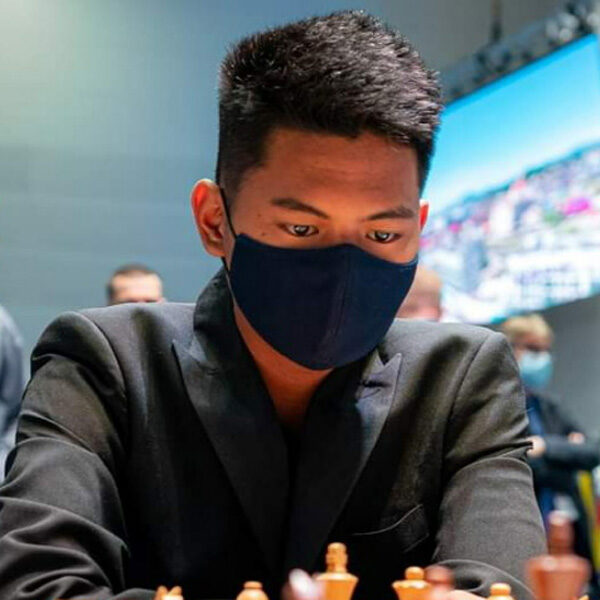
FILIPINO International Master (IM) Michael Concio, Jr. will try to carry over the momentum of his string of recent feats of late as he sees action in the rich Maharlika Pilipinas Chess League’s Manny Pacquiao International Open Chess Festival starting today in General Santos City.

Just over the weekend, the 17-year-old Mr. Concio has topped the sixth edition of the Kamatyas Rapid Invitational at SM Sucat after edging IMs Ronald Dableo and Angelo Young via tiebreak.

It was apart from his rapid title and standard silver in the Asian Juniors Championships in Tagaytay last month and the Hanoi International Master closed tournament last May.

And if things go the way he wants it, Mr. Concio could end up pocketing the top purse worth a cool P1.14 million, and more importantly, a second of the three norms required to become a Grandmaster.

“We’ll just do our best and see what happens,” said the Dasmariñas-based Zonal champion and World Cup veteran, who left yesterday along with GM Darwin Laylo, IM Daniel Quizon and Mark Jay Bacojo for General Santos.

Mr. Concio, however, knows he’s in for a tough ride as he tackles an ultra-competitive field that included GMs Hovhannes Gabuzyan of Armenia, Lucas Van Foreest of the Netherlands, Vitaly Sivuk of Sweden and Pier Luigi Basso of Italy as well as Konstantin Sek of Russia and IMs John Daniel Bryant of the United States and Dragos Ceres of Moldova.

Other players to watch are Mr. Laylo, GM John Paul Gomez, IMs Kim Steven Yap, Chito Garma, Ricky de Guzman, Ronald Bancod, Cris Ramayrat, Joel Pimentel and Angelo Young and FIDE Masters Alekhine Nouri, Mari Joseph Turqueza, David Elorta and Jeth Romy Morado.

The meet is bankrolled by boxing legend and former senator Manny Pacquiao and backed by President Bong Bong Marcos, Philippine Sports Commission Chairman Noli Eala and National Chess Federation of the Philippines Chairman and President Butch Pichay. — Joey Villar

Stephen Carapiet elected to world governing body for motorcycling

STEPHEN MACKY CARAPIET — PHILSTAR FILE PHOTO

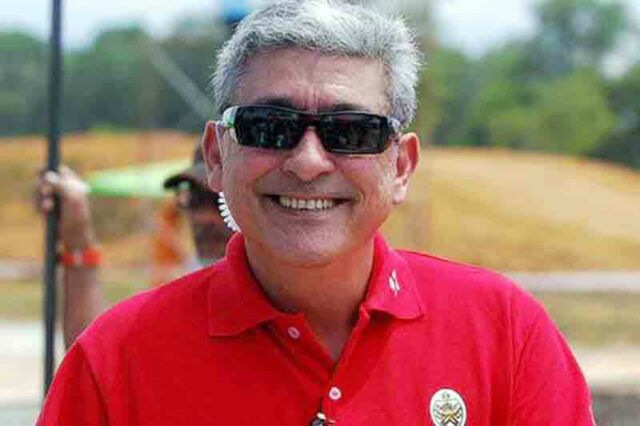
A FILIPINO will have a place in the powerful Federacion Internacionale de Motorcyclisme, or the world governing body of the sport of motorcycling, after Stephen Macky Carapiet was elected as Asia’s sole representative to the executive board last Dec. 2 in Rimini, Italy.

Mr. Carapiet is the head of the   Motorcycle Sports Safety Association or NAMSSA — the national sports association for motorcycle racing — and a re-electionist president of FIM Asia, which has as members, 28 countries.

The NAMSSA is a recognized member of the POC.

Philippine Olympic Committee (POC) President Abraham Tolentino lauded Mr. Carapiet for gaining the sensitive post.

“The POC congratulates Mr. Carapiet for his election in the world governing body for motorcycling,” said Mr. Tolentino. “This is proof of the integrity and capability of Filipino sportsmen and sportswomen on the global stage.”

Mr. Carapiet was also named to the four-member board of the FIM-FIA (Fédération Internationale de l’Automobile) joint committee, which will facilitate joint projects and initiatives on themes that including safety, sustainability, medical and women.

As such, Mr. Carapiet is in the top four in the FIM’s governance.

He was also appointed to the membership and affiliation committees and other working groups for the next four years. — Joey Villar

Letran Knights’ Fran Yu ends collegiate career via suspension

LEAGUE Commissioner Tonichi Pujante officially brought down the one-game ban that everybody expected on Letran Knights’ Fran Yu. — NCAA/SYNERGY-GMA

FRAN Yu has ended his collegiate career in Letran Knights uniform the worst way possible — via suspension.

In a turn of events that could tip the balance of the NCAA Season 98 finals, League Commissioner Tonichi Pujante officially brought down the one-game ban that everybody expected on the wily but emotional Letran captain for elbowing College of St. Benilde’s Mark Sangco on the chin in last Sunday’s Game Two at the Smart Araneta Coliseum.

It was a decision that was forthcoming as video footages of the incident that had gone viral have clearly showed Mr. Yu’s offense, which merited an automatic one-game suspension that he will serve in the decider on Sunday at the Ynares Center in Pasig.

“As per NCAA Ground Rules Art. 7.2, a player who is thrown out of the game by the referee for unsportsmanlike conduct in any game will be suspended for one game, implemented immediately in the next scheduled team game,” Mr. Pujante told The STAR.

The three-peat-seeking Letran Knights took the opener, 81-75, last Dec. 4 but the Blazers, who are eyeing their second title after snaring their breakthrough crown in 2000, claimed Game Two, 76-71, a week after, both played at the Big Dome.

Mr. Yu will be the third player to get the axe after Letran teammates Kyle Tolentino and Kobe Monje were also banned from Game Two for their dangerous fouls in Game One.

Another teammate, Louie Sangalang was also reprimanded and asked to do community work for touching CSB big man and reigning league MVP Will Gozum’s behind also in Game One.

But Mr. Yu’s unfortunate failure to control himself in unleashing that devastating elbow could be the biggest blow for a Letran side seeking a third straight crown and 20th overall, which would have pushed them closer to the league-best 22 titles by archrivals San Beda’s Lions.

Mr. Yu was seen on his knees, covering his face and crying in agony and despair from behind the Knights during the singing of the customary school hymns after Game Two, which was in stark contrast to the bravado and taunt he showed amid the jeers of the opposing fans when he was exiting the court following his ejection in the second quarter.

He knew that he had just played last game for a team he helped win two NCAA championships. — Joey Villar

Lady Bulldogs eye record breaking eight straight titles

NATIONAL UNIVERSITY LADY BULLDOGS — PHILIPPINE STAR/ RUSSELL PALMA

NATIONAL University (NU), now a seven-peat UAAP women’s basketball champion, is not keen on looking ahead of itself despite a chance to set a record-breaking eighth straight title lurking on the horizon moving forward.

Like how their once invulnerable 108-game win streak crashed to the ground in the middle of UAAP Season 85, the Lady Bulldogs reiterated that they’re not after the records — leaving their fates to the hands of their work, day in and day out.

NU, with a sweep of rival De La Salle in the finals, just clinched its seventh straight title to tie University of the East men’s team that achieved it in the 60s-70s for the longest title streak in UAAP basketball history.

“It’s an honor for us to match that record. But this team, ever since our first game, we never talked about records,” said coach Aris Dimaunahan, who also paid tribute to the management, coaching staff and his kumpadre Pat Aquino that paved the way for NU’s dynasty.

“We will not think about. If it happens next year, we’ll take it in time. But that’s not the main goal. Our goal is to prepare and play the game right way and let the results take care of itself.”

For the first time in their dynasty, NU actually absorbed a lone scar with a 16-1 record this time after a 96-0 record in their first six championships by virtue of a 61-57 overtime loss in the eliminations against no less than De La Salle.

And as much as the Lady Bulldogs wanted to have that record intact as an icing on the cake, achieving the ultimate championship goal was more than enough to make their seven-peat somehow a sweeter feat given the rare challenges they had to endure and overcome.

“Hats off to Coach Cholo Villanueva and De La Salle for bringing out the best in this team.

But then again, the credit goes to all of our girls. From Day 1, we’re committed to the goal of being the champions,” added Mr. Dimaunahan.

“This made us better and stronger individually and as a team. That’s what I’m most proud of.” — John Bryan Ulanday

Three life lessons for the next-generation leaders and managers

PRESSFOTO-FREEPIK

(This piece comes from the author’s Acceptance Speech as the Management Association of the Philippines’ Management Man of the Year 2022 Awardee.)

When I learned that I was nominated for the MAP Management Man of the Year Award, I asked if I could be withdrawn from consideration. I didn’t think I had done anything extraordinary to deserve the nomination.

You see, Washington SyCip, Cesar Virata, Cesar Buenaventura, and my father, David Consunji, were my real-life heroes.

Growing up, I witnessed their brilliance, passion, and love for our country. I saw how they shaped their professions, championed progress, and made life better for others. In my mind, they were in a different league altogether.

So, imagine my shock when I received a call from Cesar Buenaventura telling me that I was this year’s awardee.

If my father was here today, I’m sure he would laugh and say, “Pano nangyari ’yan, eh kamote ka?” (How did that happen since you are dumb?)

Dad, wherever you are, I hope this kamote made you and Mom proud.

Some people see life as a series of moments. For me, being an avid reader, I see it as a book with blank chapters. You pen your own story and hope that in the end, it is one worth reading and retelling.

This is my story.

Engineering comes from the Latin words ingeniare and ingenium, which mean “to devise” and “cleverness.” I’m referencing these terms to give you an idea of how I came to be. You see, I never set out to become an engineer.

Initially, I was an Economics major at Ateneo. But after seeing the mini-skirted ladies in UP (University of the Philippines) Diliman, I devised a way to convince my parents to let me transfer schools. I told them that I wanted to take up Civil Engineering — just like my father. Elated with my decision, they allowed me to enroll in UP.

Unfortunately, my cleverness did not translate to strong academic performance. It took me six years to finish a five-year course.

I wasn’t interested in studying so I stopped for two semesters. To earn some money, I worked in our motor pool division and logging concession. The time I spent on the field was enlightening and formative for me. At the age of 18, I learned how to deal with difficult employees, angry suppliers, and tough customers.

Just as crucial, I discovered the importance of productivity, efficiency, and cash flow when running a business.

In millennial parlance, I was #adulting.

Eventually, I went back to UP to finish my degree. I also took the civil engineering board exam to appease my mother.

As the first-born son and second of eight children, I had more than my fair share of tender loving care — may kasama pang palo at sermon (which came with spankings and scolding). I was a handful growing up, and my father did his best to instill discipline in me.

Many of you knew my father and his remarkable work ethic.

He was thorough, structured, and extremely hardworking. He lived and breathed construction, and his passion to build made him an industry legend. Even in his ’90s, he would go around our construction sites, meticulously drilling our project managers on their work programs.

I saw construction through a different lens. To me, it was a business tool and not an end in itself. I was more interested in finding ways to leverage my technical background to identify and maximize commercial opportunities. That’s when I realized that I’m more of a business manager than an engineer. My interest was in value creation and business transformation, not solely construction.

So, I decided to enroll at the Asian Institute of Management (AIM) to learn more about the “science” of business and management.

Unfortunately, I never completed my management course. I became too busy with our hotel projects for the International Monetary Fund conference in Manila.

However, the time I spent at AIM was invaluable as it cemented my passion for business.

When D.M. Consunji, Inc., or DMCI, was founded in 1954, my father’s ultimate objective was to build not only an enterprise but an institution. By that, he meant a business that could provide stability, service to the community, and protection to its people. But fast-forward 30 years, and still, we were nowhere near that.

Ironically, after completing the world’s biggest palace and royal residence in Brunei, DMCI had to retrench many of its best engineers and workers because there was no work coming in. At that time, the Philippine economy was in disarray. Construction demand also dried up almost immediately after the assassination of Senator Ninoy Aquino.

As you all know, laying off people is one of the toughest decisions a company could ever make. It affects the health, livelihood, and well-being of employees, as well as their families.

But being a contractor, we had very limited survival options. We couldn’t formulate a corporate plan or strategy because we were always dependent on the kind of projects our clients will do or won’t do.

And so, from being a contractor, I convinced my father to become an investor as well.

In 1995, we listed DMCI Holdings and raised enough funds to expand and diversify into other industries. We acquired assets and invested in projects that could generate revenues and growth for DMCI. That decision brought us closer to building an institution.

Today, the DMCI Group has a total workforce of over 35,000.

We have engineers and foremen who have been with us for more than 20, 30 years. Some of their children have even found employment in our companies.

Our business portfolio currently includes energy, real estate, mining, and water distribution — all of which draw from our engineering and construction background.

I must admit that luck played a big role in our expansion.

In certain cases, we were delivered from failure and financial ruin by commodity rallies, financial downturns, and wise advice from good friends.

It also took us decades to get to this point. And the process — while fulfilling — was many times daunting, painful, and draining.

Looking back, I can think of three galvanizing moments for the DMCI group:

A year into our listing, the Asian Financial Crisis happened. The whole country had no liquidity, and banks did not renew our short-term credit lines. To generate liquidity, we formed DMCI Homes to turn our idle land into residential condominiums. It took us eight iterations before we got the two-bedroom format right because we knew little about the real estate market. We were a bunch of engineers who tried very hard to become developers, marketers, and salespeople.

I credit Freddie Austria and his team for making DMCI Homes a viable business and a market leader in its main product segment.

In the late 1990s, we invested in what others then considered a zombie company.

Semirara Coal Corp. was not only heavily indebted and hemorrhaging money, its product was also rejected by the market. It was even referred to as Semirara clay.

To transform the company, we focused on raising production and improving coal quality. We changed our mining method from continuous mining to selective mining, and put up a coal washing plant on the island. These initiatives allowed us to create new domestic and foreign markets for Semirara coal.

It was my brother, Victor, and his trusted lieutenant, George San Pedro, who spearheaded the transformation and rallied our people to embrace these changes.

Because of their collective effort, Semirara Mining and Power Corp. is now the most modern coal mine in the country, accounting for over 96% of domestic coal production.

Another galvanizing moment was our acquisition of Maynilad, in partnership with Metro Pacific Investments Corp. of Manny Pangilinan. In 2006, it was our single biggest investment and most dramatic fund-raising activity. Wala kasi kaming pera noon (We had no money then).

Herby Consunji moved mountains to raise the P3 billion we needed for the Maynilad bid. He borrowed money from multiple sources and mortgaged our Semirara shares and DMCI Homes’ contracts-to-sell. Knowing that we would lose our shirts if our joint venture failed, Herby agreed to be the sole DMCI management representative in Maynilad. Together with Babes Singson and Randy Estrellado of Metro Pacific, they did much of the heavy lifting to turn Maynilad around.

In the Book of Proverbs, King Solomon wrote that iron sharpens iron, so likewise, one person sharpens another.

I have been very fortunate to be surrounded by these exceptional people who sharpened me into becoming the manager and leader I am today. I will always be grateful for the roles they played in my life.

At this point, I would like to acknowledge a few more people who were instrumental in redefining the future of the DMCI Group.

I proudly share this honor with them:

My siblings, who support and work together with me in our public and private companies: Ate Jing, Jorge, Lucy, Cristina, and Dinky.

Dad was correct when he said, “none of us is as good as all of us.” He knew we had different strengths and weaknesses, so he insisted that we all work together. I’m glad we followed his advice.

My parents and siblings, Victor and Nene. I wish they were here to share this moment with the rest of our family.

Our board of directors — both past and present — for their invaluable time and wisdom. Their guidance over the years has made our family better stewards and managers.

I would particularly like to thank Cesar A. Buenaventura (CAB), the first civil engineer of DMCI. As my mentor and vice-chairman at DMCI Holdings, CAB showed me that engineers can be great managers in whatever industry they choose to be.

Our professional managers whose determination and hard work allowed our companies to survive many challenging times. Know that I appreciate you all immensely.

The thousands of DMCI workers who — day in and day out — perform difficult, demanding, and sometimes dirty work so we can deliver quality products and services on time (well, at least most of the time). Thank you for everything!

Our creditors, clients, and other business partners — particularly, Tessie Sy-Coson and the team of Nestor Tan in BDO — Ed Francisco and Walter Wassmer. Thank you for not pulling the rug out from under us when the going got tough, and for always giving us the financial backing we needed to grow our businesses.

And to the countless, nameless others who trusted and supported our companies all these years— Maraming, maraming salamat sa inyong lahat (Many, many thanks to all of you).

My story is nowhere near done. I think I have enough gas in the tank to start a second career. In a few years, I may just surprise all of you. With more idle time, I hope to foray into agriculture and create sustainable value in the countryside.

But I think I’ve taken enough of your time. So, I’d like to end my speech by sharing some life lessons from my 50 years as a management professional. I hope that these lessons will find their way into the consciousness of our next-generation leaders and managers.

First, play to your team’s strengths.

When we were building our business portfolio, we didn’t have much financial strength. I had to be cautious in our investments. I would always ask myself: Do we have the organizational competence to make up for our small balance sheet?

As leaders and business managers, we need to have a clear understanding of our organization and what our people can do. I firmly believe self-knowledge and humility lead to better decision-making. That’s pretty much the reason why we’re not in the hospitality or entertainment business. Hindi namin kaya ngumiti buong araw (We are not capable of smiling the entire day).

Second, strive for a win-win outcome.

In 1997, we issued preferred shares to raise P2.4 billion for our expansion plans. Unfortunately, the coal, construction, and real estate markets took a nosedive, and so did our profitability. We struggled to meet our payment obligations, and this caused an uproar among our shareholders. It was Bobbit Panlilio, then PCIBank COO, who got us through that difficult period.

Following his personal advice, we formulated different repayment options for our shareholders. In doing so, we did right by them and escaped corporate bankruptcy.

To this day, I remind our people at the DMCI Group: When you invite others to a party, make sure that everyone eats. Whether in business or in social gatherings, wala dapat nagugutom (no one should go hungry).

Third, spread the sunshine.

I thank Dr. Bernie Villegas for teaching me this lesson. He was responsible for instilling a spiritual character into my work. Through him, I realized that making a profit is not the sole objective of business. Instead, business should be a catalyst for shared prosperity. We should do what we can to bring sunshine into the lives of our fellow Filipinos.

I don’t consider myself a religious man, but I believe that your work can be your prayer.

Ladies and gentlemen, that is my story, so far.

With the urging of Dr. Villegas, I hope to pen new chapters about my second career and agricultural initiatives. I look forward to sharing these with you someday soon.

Thank you for listening.

And to the Board of Governors led by President Babes Singson, as well as the members of the MAP Management Man of the Year Search and Judging committees, my sincerest gratitude for this distinct privilege. I believe that this is the highest recognition that a Filipino management professional could ever receive, and I am humbled to be this year’s awardee.


Isidro “Sid” A. Consunji is chair and president of DMCI Holdings, Inc.

map@map.org.ph

It’s still worth fighting anti-COVID vaccine misinformation

DANIEL SCHLUDI-UNSPLASH

MEDICAL MISINFORMATION has never contributed to as many deaths as in the last 18 months. Recently released statistics show thousands of “excess” deaths concentrated among the US states and counties with the lowest uptake of COVID-19 vaccines — though the vaccines were free and available to everyone.

Uptake has been suppressed in those areas because a significant chunk of the public has remained intensely skeptical of the COVID vaccines — especially those using mRNA technology, which has been in development for decades but never used until now. Among the rumors: that the vaccines change your DNA; cause infertility; or even kill you. None of these are based in fact.

The most widely circulated misinformation tends to exaggerate the vaccines’ side effects — for example, basing false claims that the vaccines cause infertility on real reports that some women observed temporary changes in their menstrual cycles.

Then there are wilder claims, such as those shared by the movie Died Suddenly, which was released Nov. 21 and has already been viewed more than 12 million times. It claims falsely that the COVID vaccines have rapidly caused fatal blood clots and cancers.

Both kind of fears can be debunked with data. For example, if vaccines were killing people, excess mortality would be concentrated in the most vaccinated regions, and should show a spike after the peak of the 2021 vaccination campaign, when 3 million people a day were getting shots. Instead, the data show excess deaths concentrated in the least vaccinated areas, and during times when COVID cases were high — not when the vaccination rate was high.

The most serious documented vaccine side effect is myocarditis. That side effect is serious, but very rare — affecting between 0.3 to 5 people per 100,000 people vaccinated. While 23% of those had to go to the ICU, no one died.

Paul Offit has been battling the anti-vaccine movement for more than 20 years as a physician and head of the Vaccine Education Center at the Children’s Hospital of Philadelphia. He told me he originally thought the anti-vaccine movement would die down with COVID because the disease was so dangerous and the vaccines so good. “I thought this would really push the anti-vaccine movement to the sideline,” he said. “Quite the opposite — this was their fuel.”

What he didn’t anticipate, he said, was that people would be motivated by politics — by the sentiment that the government shouldn’t tell them what to do. In the past, anti-vaxxers were made up of a combination of those on the political right and the left, especially those who were opposed to anything they saw as artificial or genetically modified.

That’s changed. While there are some on the left who are skeptical of the COVID vaccines, Republicans are much significantly less likely to have gotten the shot than Democrats. The counties that voted for Joe Biden in 2020 have higher vaccination rates than those that voted for Donald Trump. The Republican tendency toward vaccine-hesitancy is backed by data showing excess deaths were more than twice as high among Republicans than Democrats in Florida and Ohio after vaccines were made available.

Politics alone might not turn people against a life-saving vaccine, but it influences which information people see and believe — and scare stories about people dropping dead can’t be countered by vaccine cheerleading or the kind of soft information shown in the new Pfizer television commercial, showing happy people hugging and doing normal things.

Vaccine and booster campaigns should rely more on data and nuance. Instead, official channels have pushed an overly broad recommendation to promoting the new booster for everyone over the age of five, something Offit says is not based on data. He hasn’t gotten the newest booster although he’s a member of the panel advising the FDA on vaccines. Offit sees the first booster as valuable — he’s gotten one himself — but additional boosters, he said, should really be recommended for older people or those suffering from conditions that might make the first three shots less effective.

Some might be forgiven for asking: Why does this still matter, if so many have already had COVID and if most deaths are now occurring among the elderly vaccinated? Because some of these deaths may be preventable with higher booster uptake; only 31% of Americans over 65 have gotten the updated booster.

This is not to undersell the initial vaccines. For most of us, they are still doing a good job of keeping us out of the hospital. And keeping us alive. That’s why the primary vaccine series would still be a good idea for the roughly 22% of Americans who have yet to get a single shot.

There’s a lot we still don’t know about COVID. It’s not clear how long natural immunity lasts after a COVID infection or whether natural immunity is as protective as vaccination. It’s not even clear how many people have had COVID; estimates of the total number of US infections remain elusive, ranging from a low of 42% to a high of 94%.  But one thing is clear: Many of the people who’ve died after COVID vaccines and boosters became available should still be alive.

BLOOMBERG OPINION

Ten economic issues to watch

This column continues to monitor many economic issues and developments. There are 10 topics tackled here.

1. Public debt has reached P14 trillion

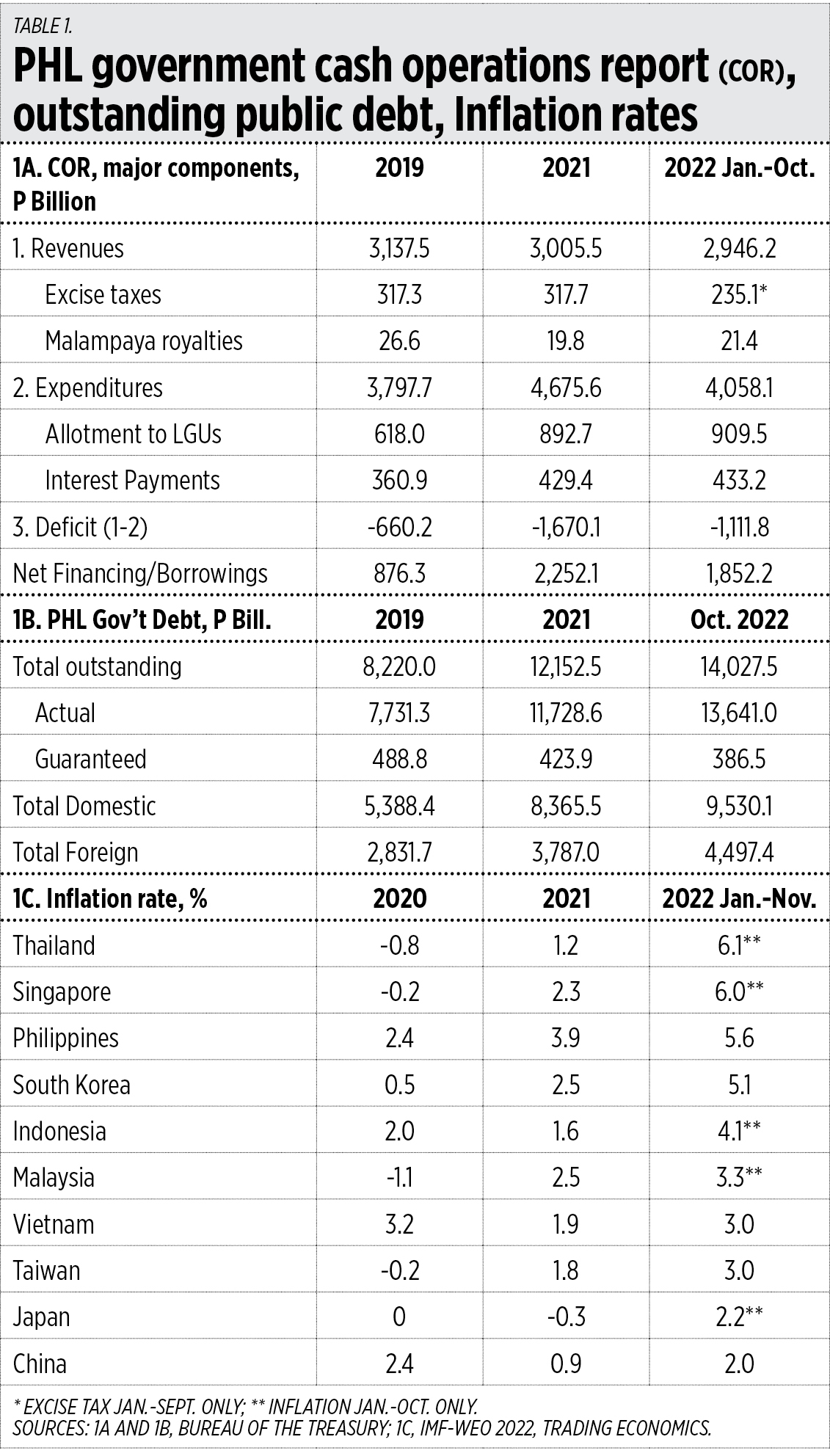
Last week, the Bureau of the Treasury released fiscal data for October 2022. The budget deficit has reached P1.1 trillion, interest payment alone is P43.3 billion/month average and likely to reach P520 billion by end of this year. Total outstanding public debt has reached P14 trillion, actual plus guaranteed. The public debt has been rising by P2 trillion/year from 2020 to 2022 or three years straight, not a good fiscal condition. The debt should significantly decline starting next year. Control should be on the spending side by the national government.

2. Inflation has reached 8%, a 14-year high

Also last week, the Philippine Statistics Authority (PSA) reported that November inflation was 8%, a 14-year high. This is indeed high, but taking the average for 2022, we have a 5.6% inflation rate so far, lower than Thailand and Singapore which experienced deflation in 2020, slight inflation in 2021, and now are at 6% (see Table 2).

3. The Maharlika Wealth Fund (MWF) bill amendment

After a strong public outcry, the authors of the MWF bill in Congress have removed the inclusion of SSS (Social Security System) and GSIS (Government Service Insurance System) funds for the initial capitalization. Good. As argued in this column last week, “State assets should finance the Philippine sovereign wealth fund” — use of Malampaya gas royalties is a good source. If Malampaya funds are used, then no new tax or mandatory contributions would need to be slapped on the people. And the amount generated by Malampaya is huge: P26.57 billion in 2019, P19.08 billion in 2020, P19.79 billion in 2021, and P21.44 billion in January-October 2022 alone.

4. Tobacco smuggling as economic sabotage

Last week, Congress passed on second reading House Bill (HB) 3917 which seeks to amend Republic Act (RA) 10845 or the Anti-Agricultural Smuggling Act of 2016. It will include the smuggling of tobacco products, manufactured or raw, as economic sabotage and a non-bailable offense. The original law includes only the smuggling of rice, sugar, corn, pork, poultry, fish, garlic, onion, carrots, and some other vegetables as economic sabotage.

Party-list Congresswoman Margarita Nograles, as co-author of the bill, cited Euromonitor’s estimate that 16.7% of all cigarettes sold in the Philippines are from illicit trade and the projected revenue losses to government is P26.2 billion in 2022 alone. Notice also in Table 1 that excise tax collections, which include tobacco tax revenues, in 2022 remain low. As tax rates increase, illicit trade and tax evasion also increase.

5. MUP pension reform

The military and uniformed personnel (MUP) pension is among Philippine taxpayers’ burdens. The good news is that there are attempts to address this, like HB 2556, or the “MUP Insurance Fund Act,” filed by Deputy Speaker Ralph Recto. For 2022 alone, the government has obligated P153.1 billion, equivalent to 89% of MUP base pay for the same year. The bill proposes to establish a government-guaranteed insurance fund to cover new entrants to be managed by the GSIS, and agency contributions equivalent to 21% of the total monthly base pay of MUP.

6. A projected power rate hike

Consider these recent reports in BusinessWorld related to the Energy Regulatory Commission (ERC) ruling against the two San Miguel Corp. (SMC) power companies’ petition for a generation rate hike: “SMC Global Power appeals rate hike denial — ERC” (Nov. 25); “SMC Global Power points to ERC for looming rate hike” (Nov. 29); “SMC Global Power offers Ilijan capacity to Meralco” (Dec. 4); “Meralco gets CSP exemption for power supply deal” (Dec. 7); “Higher power rates seen on ceased 670-MW supply” (Dec. 8); “Malampaya consortium denies SMC Global Power’s claim on banked gas delivery” (Dec. 12); and, “Meralco hopes to secure power deal within the week” (Dec. 12).

SMC Global Power and its allies in media continue to demonize the ERC and the agency’s chairperson, Monalisa Dimalanta. There seems to be no acknowledgment by SMC that they made a big mistake in offering a low fixed-price power supply to Meralco which quickly defeated the bid prices of other power companies sometime in 2019 or 2020. Now SMC is turning its blame game on the Malampaya consortium — Prime Energy (the Razon group), UC38 (the Udenna/Dennis Uy group), and the Philippine National Oil Co. (PNOC, government) — for why it cannot get banked gas for its Ilijan gas plant in Batangas.

7. Continuing power deficiency, yellow alerts

Here are related recent reports, also in BusinessWorld: “Investigation looms after six power plants declare outages” (Nov. 28); “PHL energy security to hinge on emerging tech” (Nov. 30); “Luzon grid placed on yellow alert once more after five power plants report forced outages” (Dec. 1); “Red, yellow alerts raised over Visayas grid after four power plant outages” (Dec. 5); “DoE says working to make supply of power more reliable next year” (Dec. 6); and, “Meralco eyes US grant to look into small nuclear reactors” (Dec. 9).

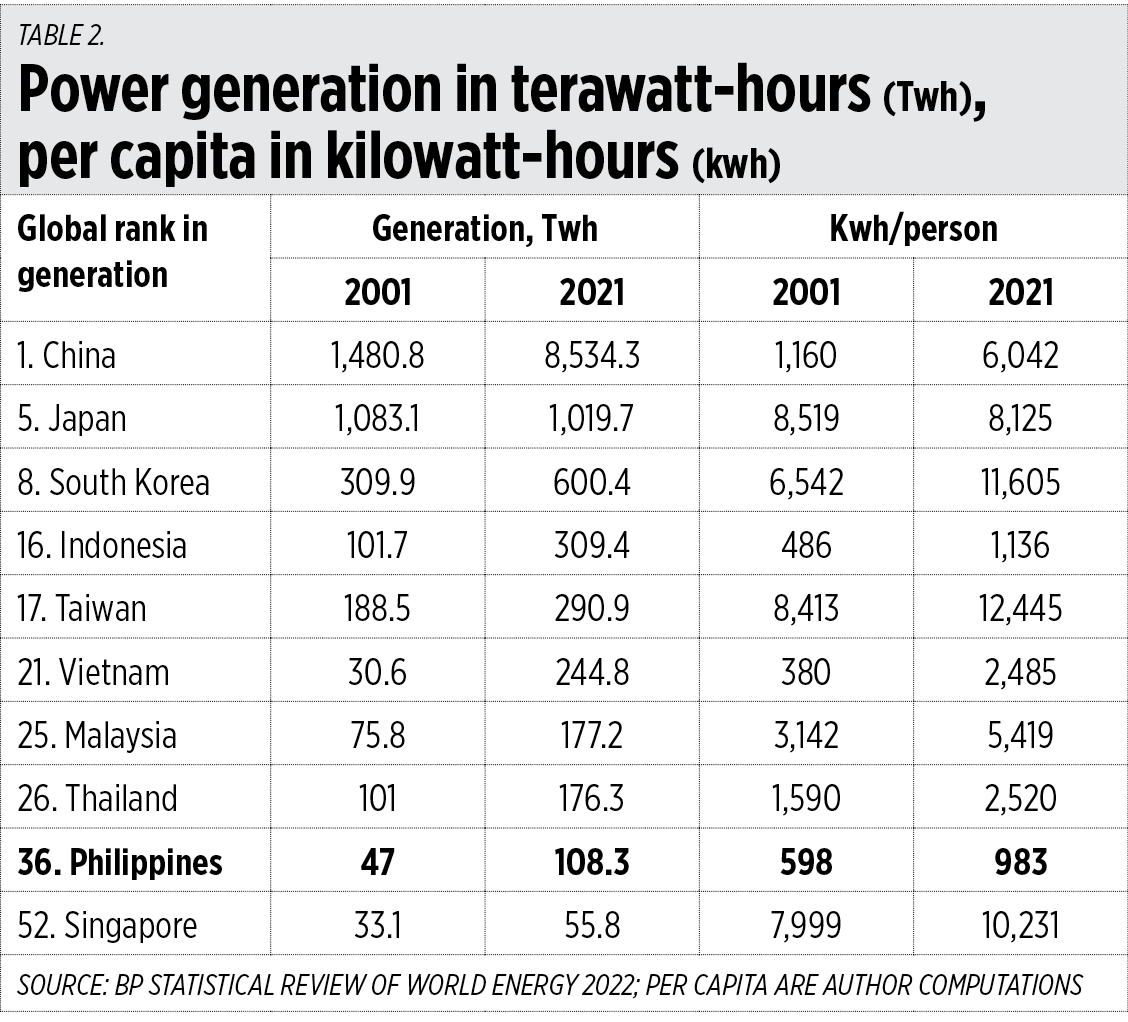
Those yellow alerts can scare potential investors from coming in. Consider also the numbers in Table 2. The main reason why the Philippines’ power prices are high compared to many of its neighbors in East Asia is because it has very low power generation, with low supply relative to demand. And that also explains why many existing power plants tend to conk out more often – they are old and ageing, especially coal, gas, and big hydro plants — but they cannot be retired because new big power plants are few.

Aside from new coal and LNG (liquefied natural gas) plants that are coming soon, we need nuclear power — at least small modular reactors (SMRs) — especially for island provinces like Mindoro, Palawan, Masbate, etc. It is good that Meralco is pioneering this move.

I think the Philippines is wrong to focus on forcible low prices at the generation sector via a mandatory Competitive Selection Process. The country should focus on expanding its power supply and address the problems in the transmission sector like the absence of a firm contract for ancillary services by the transmission operator. If it does, prices will stabilize or decline on their own. From around 6 terawatt-hour (TWH)/year annual increase until 2021, we should have at least 9 to 10 TWH/year increase starting 2023.

8. Deaths increase but births decrease

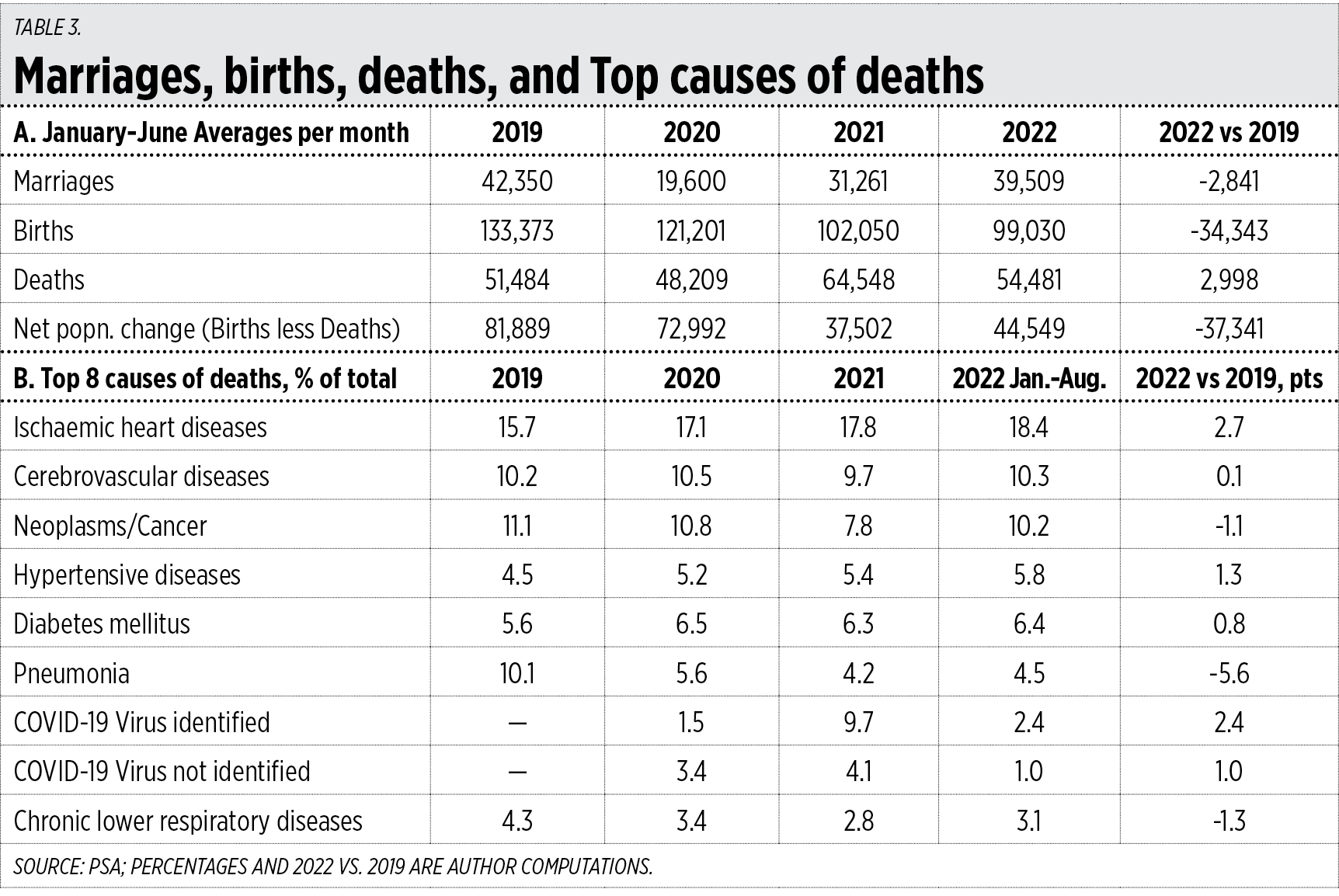
Last week, the PSA also reported the country’s vital statistics. The worrying trend continues of “missing babies.” Among the possible reasons are couples’ continuing economic uncertainties after two years of lockdown, and possible adverse effects of mass vaccination on people’s fertility.

On causes of deaths, notice that deaths from heart diseases such as myocarditis, pericarditis, and related heart problems increased in 2021 and on until today, coinciding with mass vaccination. And there is a big decline in regular pneumonia deaths, from 10% of the total in 2019 to only 4.2% in 2021 and 4.5% in 2022. This implies that many pneumonia deaths are possibly tagged as COVID-19 deaths (see Table 3).

9. The Ruperto P. Alonzo lecture series

The UP School of Economics (UPSE) Program in Development Economics (PDE) Alumni Association has been revived. Elected as its new president is Senen Bacani, a former Education Undersecretary. Starting 2023, the association will organize a quarterly Ruperto P. Alonzo (RPA) lecture series, in honor of the long-time PDE Director, beloved by so many alumni, who passed away five years ago. Topics and speakers have been identified already for quarters 1 to 4 with a PDE alumni homecoming to be held in the second quarter.

10. The PPP Act

The first talk in the RPA lecture series will be held on Feb. 8, 2023 at the UPSE auditorium. It will be about Public-Private Partnership (PPP) and big infrastructure projects. The speaker will be Cynthia Hernandez, Executive Director of the PPP Center.

On this subject, Congress passed on second reading the bill on the “PPP Act.” I saw HB 2557 authored by Mr. Recto, and the provisions are good: automatic endorsement by the Regional Development Council for PPP projects which have complied with the requirements to avoid arbitrary delays, and the classification of infrastructure projects as “Projects of National Significance,” among others. And check again Table 1, local government units’ budgets will be rising — they should undertake more provincial PPP projects, and spare the National Government of more spending and borrowing.


Bienvenido S. Oplas, Jr. is the president of Minimal Government Thinkers.

minimalgovernment@gmail.com

‘I thought crypto exchanges were safe’: The lesson for everyone in FTX’s collapse

STOCK PHOTO | Image by André François McKenzie from Unsplash

Anthony* (a friend) called a few weeks ago, deeply worried.

A deputy principal of a high school in Queensland, over the past year he spent hundreds of thousands of dollars buying cryptocurrencies, borrowing money using his home as equity.

But now all his assets, valued at A$600,000, were stuck in an account he couldn’t access.

He’d bought through FTX, the world’s third-biggest cryptocurrency exchange, endorsed by celebrities such as Seinfeld co-creator Larry David, basketball champions Steph Curry and Shaquille O’Neal, and tennis ace Naomi Osaka.

With FTX’s spectacular collapse, he’s now awaiting the outcome of the liquidation process that is likely to see him, 30,000 other Australians and more than 1.2 million customers worldwide lose everything.

“I thought these exchanges were safe,” Anthony said.

He was wrong.

Cryptocurrency exchanges are sometimes described as being like stock exchanges. But they are very different to the likes of the London or New York stock exchanges, institutions that have weathered multiple financial crises.

Stock exchanges are both highly regulated and help regulate share trading. Cryptocurrency exchanges, on the other hand, are virtually unregulated and serve no regulatory function.

They’re just private businesses that make money by helping “mum and dad” investors to get into crypto trading, profiting from the commission charged on each transaction.

Indeed, the crypto exchanges that have grown to dominate the market — such as Binance, Coinbase, and FTX — arguably undermine the whole vision that drove the creation of Bitcoin and blockchains — because they centralize control in a system meant to decentralize and liberate finance from the power of governments, banks, and other intermediaries.

These centralized exchanges are not needed to trade cryptocurrency, and are pretty much the least safe way to buy and hold crypto assets.

In the early days of Bitcoin (all the way back in 2008) the only way to acquire it was to “mine” it — earning new coins by performing the complex computations required to verify and record transactions on a digital ledger (called a blockchain).

The coins would be stored in a digital “wallet,” an application similar to a private bank account, accessible only by a password or “private key.”

A wallet can be virtual or physical, on a small portable device similar in appearance to a USB stick or small phone. Physical wallets are the safest because they can be unplugged from the internet when not being used, minimizing the risk of being hacked.

Before exchanges emerged, trading involved owners selling directly to buyers via online forums, transferring coins from one wallet to another like any electronic funds transfer.

All this, however, required some technical knowledge.

Cryptocurrency exchanges reduced the need for such knowledge. They made it easy for less tech-savvy investors to get into the market, in the same way web browsers have made it easy to navigate the internet.

Two types of exchanges emerged: decentralized (DEX) and centralized (CEX).

Decentralized exchanges are essentially online platforms to connect the orders of buyers and sellers of cryptocurrencies. They are just there to facilitate trading. You still need to hold cryptocurrencies in your own wallet (known as “self-custody”).

Centralized exchanges go much further, eliminating wallets by offering a one-stop shop service. They aren’t just an intermediary between buyers and sellers. Rather than self-custody, they act as custodian, holding cryptocurrency on customers’ behalf.

Centralized exchanges have proven most popular. Seven of the world’s 10 biggest crypto exchanges by trading volume are centralized.

But what customers gain in simplicity they lose in control.

You don’t give your money to a stock exchange, for example. You trade through a broker, who uses your trading account when you buy and deposits money back into your account when you sell.

A CEX, on the other hand, acts as an exchange, a brokerage (taking customers’ fiat money and converting it into crypto or vice versa), and as a bank (holding customer’s crypto assets as custodian).

This is why FTX was holding cash and crypto assets worth US$10-50 billion. It also acted like a bank by borrowing and lending cryptocurrencies — though without customers’ knowledge or agreement, and without any of the regulatory accountability imposed on banks.

Holding both wallets and keys, founder-owner Sam Bankman-Fried “borrowed” his customers’ funds to prop up his other businesses. Customers realized too late they had little control. When it ran into trouble, FTX simply stopped letting customers withdraw their assets.

Like stockbrokers, crypto exchanges make their money by charging a commission on every trade. They are therefore motivated to increase trading volumes.

FTX did this most through celebrity and sports marketing. Since it was founded in 2019 it has spent an estimated US$375 million on advertising and endorsements, including buying the naming rights to the stadium used by the Miami Heat basketball team.

Such marketing has helped to create the illusion that FTX and other exchanges were as safe as mainstream institutions. Without such marketing, it’s debatable the value of the cryptocurrency market would have risen from US$10 billion in 2014 to US$876 billion in 2022.

There’s an adage among crypto investors: “Not your key, not your coins, it’s that simple.”

What this means is that your crypto isn’t safe unless you have self-custody, storing your own coins in your own wallet to which you alone control the private key.

The bottom line: crypto exchanges are not like stock exchanges, and CEXs are not safe. If the worst eventuates, whether it be an exchange collapse or cyber-attack, you risk losing everything.

All investments carry risks, and the unregulated crypto market carries more risk than most. So, follow three golden rules.

First, do some homework. Understand the process of trading crypto. Learn how to use a self-custody wallet. Until governments regulate crypto markets, especially exchanges, you’re largely on your own.

Second, if you’re going to use an exchange, a DEX is more secure. There is no evidence to date that any DEX has been hacked.

Lastly, in this world of volatility, only risk what you can afford to lose.

THE CONVERSATION VIA REUTERS CONNECT

* Name has been changed.


Paul Mazzola is a lecturer on Banking and Finance, in the Faculty of Business and Law, University of Wollongong, Australia. Mitchell Goroch is a cryptocurrency trader and researcher at the University of Wollongong.

Ukraine steps up diplomacy amid fighting, power outages

REUTERS

KYIV — The United States is prioritizing efforts to boost Ukraine’s air defenses, President Joseph R. Biden told his Ukrainian counterpart on Sunday, as President Volodymyr Zelensky stepped up efforts to secure international assistance over the Russian invasion that is dragging into a 10th month.

Heavy fighting in the country’s east and south continued unabated, while drone and missile strikes on key power infrastructure, notably in the Black Sea port city of Odesa, kept many Ukrainians in the cold and dark.

There are no peace talks and no end in sight to the deadliest conflict in Europe since World War II, which Moscow describes as a “special military operation” and Ukraine and its allies call an unprovoked act of aggression.

“We are constantly working with partners,” Mr. Zelensky said after talking to Mr. Biden and the leaders of France and Turkey, adding that he expects some “important results” next week from a series of international events that will tackle the situation in Ukraine.

German Chancellor Olaf Scholz will hold on Monday an online meeting with G7 leaders and the European Union foreign ministers will to try to agree on further sanctions on Russia and Iran and on additional aid or arms deliveries to Ukraine.

While Mr. Zelensky has held numerous talks with Mr. Biden, French President Emmanuel Macron and Turkish President Tayyip Erdogan since Russian forces invaded in late February, the accumulation of discussions in just one day is not a regular event.

Mr. Zelensky said he had thanked Mr. Biden for “unprecedented defense and financial” help the United States has provided and talked with the US president about Ukraine’s need for effective anti-aircraft defence systems to protect the population.

Mr. Biden “reaffirmed the US commitment to continue providing Ukraine with security, economic, and humanitarian assistance, holding Russia accountable for its war crimes and atrocities, and imposing costs on Russia for its aggression,” the White House said.

US Treasury Secretary Janet Yellen told CBS’s 60 Minutes Washington’s support for Ukraine’s military and economy — more than $50 billion and counting — would continue “for as long as it takes” and reiterated that ending the war was the single best thing the United States could do for the global economy.

TURKEY TALKS
Earlier, Mr. Zelensky said he held “a very meaningful” conversation with Mr. Macron on “defense, energy, economy, diplomacy” that lasted more than an hour and “very specific” talks with Erdogan on assuring Ukraine’s grain exports.

Turkey, which acted as a mediator in peace talks in the early months of the war, also worked alongside the United Nations in a grain deal, which opened up Ukrainian ports for exports in July after a six-month de facto Russian blockade.

Mr. Erdogan’s office said the Turkish leader had a call with Russian President Vladimir Putin on Sunday, in which he had called for a quick end to the conflict.

Mr. Putin said last week that Moscow’s near-total loss of trust in the West would make an eventual settlement over Ukraine much harder to reach and warned of a protracted war.

Moscow shows no signs of being ready to respect Ukraine’s sovereignty and pre-war borders, saying the four regions it claims to have annexed from Ukraine in September are part of Russia “forever.” The government in Kyiv has ruled out conceding any land to Russia in return for peace.

HEAVY FIGHTING
On the ground in Ukraine, the entire eastern front line has been continuously shelled with heavy fighting taking place.

Russian forces continued with attempts to break through Ukrainian defenses, training tank and artillery fire on 26 settlements near Avdiivka and Bakhmut, the General Staff of the Ukrainian Armed Forces said in a Sunday evening update.

Serhiy Gaidai, the exiled governor of the Russian-occupied Luhansk region, told Ukrainian television local forces had attacked a hotel in the town of Kadiivka where members of Russia’s private Wagner military group were based, killing many of them.

Photos posted on Telegram channels showed a building largely reduced to rubble.

“They had a little pop there, just where Wagner headquarters was located,” he said. “A huge number of those who were there died.”

The claims could not be verified by Reuters and Russia’s defense ministry was not immediately available for comment.

Moscow is also targeting Ukraine’s energy infrastructure with waves of missile and drone strikes, at times cutting off electricity for millions of civilians in winter, when temperatures often fall below zero Celsius.

Russian forces used Iranian-made drones to hit two energy plants in the Black Sea port of Odesa on Saturday, knocking out power to about 1.5 million people — virtually all non-critical infrastructure in and around the port.

Mr. Zelensky said other areas experiencing “very difficult” conditions with power supplies included the capital Kyiv and Kyiv region and four regions in western Ukraine and Dnipropetrovsk region in the centre of the country. — Reuters

Investors eye golden visas as Portugal considers program’s end

Augusta street is pictured during partial lockdown as part of state of emergency to combat the coronavirus disease (COVID-19) outbreak in Lisbon, Portugal March 30, 2020. — REUTERS/RAFAEL MARCHANTE/FILE PHOTO

LISBON — Investments through Portugal’s “golden visa,” which gives wealthy foreigners residence rights, jumped nearly 50% last month, data showed on Sunday, as the government considers whether to scrap the controversial scheme.

The golden visa has been heavily criticized at home for sending house prices and rents up, and the European Commission has called for the end of such national programs.

In Portugal, it has attracted 6.6 billion euros ($6.95 billion) in investment over the past decade, mainly from China, Brazil and Turkey, with the bulk of the money going into real estate.

To apply, non-EU nationals must make a significant investment in Portugal, such as buying real estate. They are then given residency rights and are allowed visa-free travel throughout Europe’s Schengen area.

But Prime Minister Antonio Costa said on Nov. 2 his government was going to evaluate the 10-year-old scheme, questioning whether the program could still be justified.

Murat Coskun, Get Golden Visa CEO, said Mr. Costa’s comments had had a “significant impact on the appetite” for the measure, with his company seeing a five-fold increase in inquiries.

Data from border agency SEF on Sunday showed investment through golden visas increased 48% in November from October to 65 million euros, and was up 41% from a year earlier.

Vasco Silva, the CEO of Kleya, which helps foreigners move to Portugal, said his company had received many queries about what was going on, adding that some investors had rushed their decision just in case the program was altered or binned.

“If there is no residence by investment program, (investors) will simply ignore the country,” Mr. Silva warned, arguing the more than 10,000 visas issued since 2012 had put Portugal “on the map”.

The Portuguese branch of anti-corruption group Transparency International (TI) has said the program could be used for money laundering, while the European Commission has said it considers such schemes a potential security risk.

Mr. Silva said that was not the case because those involved in the process, from banks to lawyers, had to comply with “very strict rules”.

“We are not allowing entrance to criminals or money for which we do not know the source,” Mr. Silva said. “Exceptions can happen but it will be one in 10,000 or two in 10,000 and of course those are the ones that go public.”

Britain scrapped golden visas in February following the Russian invasion of Ukraine amid concerns about the inflow of illicit Russian money. Portugal suspended golden visas for Russians, but 431 had already benefited from the scheme since the time of its launch, according to SEF. — Reuters

ADVERTISEMENT
ADVERTISEMENT