Home Blog Page 5522

TDF yields rise on BSP rate hike
REUTERS

YIELDS on term deposit climbed on Wednesday as both tenors on offer were oversubscribed, after the Bangko Sentral ng Pilipinas’ (BSP) policy meeting last week.

Total bids for the central bank’s term deposit facility (TDF) reached P326.384 billion, above the P260-billion offer but below the P341.947 billion in tenders for a P360 billion offering last week.

“The BSP offered a lower volume in the TDF auction at P260 billion from P360 billion last week and allocated P150 billion (from P200 billion) and P110 billion (from P160 billion) to the 7-day and 14-day tenors, respectively,” BSP Deputy Governor Francisco G. Dakila, Jr. said in a statement on Wednesday.

“Both tenors were oversubscribed with bid-to-cover ratios at 1.20x and 1.34x the respective volume offerings in the 7-day and 14-day TDF,” he added.

Broken down, the seven-day papers fetched bids amounting to P179.272 billion, higher than the P150 billion auctioned off by the central bank. However, this fell behind the P182.994 billion in tenders logged in the previous auction for a P220-billion offer.

Banks asked for yields ranging from 6% to 6.35%, a narrower margin compared with the 5.85% to 6.385% band seen a week ago. This caused the average rate of the one-week papers to rise by 10.71 basis points (bps) to 6.2466% from 6.1395%.

Meanwhile, demand for the 14-day term deposits amounted to P147.112 billion, higher than the P110-billion offering, but lower than the P158.953 billion in tenders for a P160-billion offering on Dec. 14.

Accepted yields were seen from 6% to 6.4875%, a slimmer band compared with 5.875% to 6.55% logged the previous week. This brought the average rate of the two-week deposits to 6.3323%, inching up by 8.52 bps from the 6.2471% logged a week ago.

The central bank has not auctioned off 28-day term deposits for more than a year to give way to its weekly offering of securities with the same tenor.

The BSP uses term deposits and 28-day bills to mop up excess liquidity in the financial system and better guide market rates.

“The results of the TDF auction reflect the partial pass-through of the BSP policy rate hike last week amid ample liquidity in the financial system. Looking ahead, the BSP’s monetary operations will remain guided by its assessment of the latest liquidity conditions and market developments,” Mr. Dakila said.

Yields on the term deposit facility were higher again this week after the latest policy rate hike of the central bank, Rizal Commercial Banking Corp. Chief Economist Michael L. Ricafort likewise said in a Viber message.

The BSP raised its benchmark interest rate to its highest in 14 years and has signaled more tightening albeit at a slower pace next year.

The Monetary Board increased its overnight borrowing rate by 50 basis points (bps) to 5.5%, bringing the policy rate to its highest since November 2008, at 6%.

The move followed the 50-bp hike by the US Federal Reserve at its Dec. 13-14 meeting, which brought its key rate to 4.25-4.5%.

The BSP’s rates on the overnight deposit and lending facilities were also increased to 5% and 6%, respectively.

Since May, the central bank has increased borrowing costs by a cumulative 350 bps to tame inflation.

Headline inflation accelerated to a 14-year high of 8% in November, from 7.7% in October. For the January-to-November period, inflation averaged 5.6%. This is still below the 5.8% full-year forecast of the BSP, but way above its 2-4% target.

TDF yields were also higher after recent signals of more rate hikes next year, Mr. Ricafort said.

BSP Governor Felipe M. Medalla said a pause in monetary tightening next year has a low possibility of happening, and that the Monetary Board may have to raise borrowing costs at its first two meetings in 2023.

“Our goal is to have inflation between 2-4%, preferably closer to 3% than to 4% by the third quarter of next year, and then the fourth quarter until 2024 will also be like that. That’s our goal,” Mr. Medalla said.

He also said the BSP may consider smaller rate hikes next year, noting there is a higher chance of 25-bp or 50-bp rate increases at its next two policy meetings.

The schedule of the MB meetings for 2023 has yet to be released. — Keisha B. Ta-asan

First Balfour explores measures against climate change 

LOPEZ-led First Balfour, Inc. said it is exploring measures to adopt in its business operations to help mitigate the effect of climate change.

“Globally, the construction industry is one of the largest consumers of raw materials, and the processing of these materials for use in construction leads to embodied carbon in these materials in large amounts,” First Philippine Holdings Corp. (FPH) Vice-President and Chief Sustainability Officer Agnes C. De Jesus said in a statement.

First Balfour, the engineering and construction arm of (FPH), said that the company is also targeting to partner with its vendors and stakeholders in formulating a collaborative way of decarbonization.

First Balfour Strategic Business Head Vicente de Lima II said that climate change should be addressed through “collaboration with the vendors and subcontractors, government, communities, and even with competitors is most important.”

The engineering and construction firm said it joined pro-environment initiatives aimed to help the country achieve net-zero carbon emissions by 2050.

First Balfour is also targeting to reduce the company’s greenhouse gas emissions by monitoring emissions across its value chain. — Ashley Erika O. Jose

Musk says to step down as Twitter CEO once he finds successor

TRUSTPAIR.COM

BILLIONAIRE Elon Musk said on Tuesday he will step down as chief executive officer (CEO) of Twitter, Inc. once he finds a replacement, but will still run some key divisions of the social media platform.

“I will resign as CEO as soon as I find someone foolish enough to take the job! After that, I will just run the software & servers teams,” Mr. Musk wrote on Twitter.

Mr. Musk’s $44-billion takeover of Twitter in October has been marked by chaos and controversy, with some investors questioning if he is too distracted to also properly run his electric vehicle automaker Tesla, Inc., in which he is personally involved in production and engineering.

This is the first time Mr. Musk has mentioned stepping down as chief of the social media platform, after Twitter users voted for him to resign in a poll, which the billionaire launched on Sunday evening.

In the poll, 57.5% of around 17.5 million people voted “yes.” Mr. Musk had said on Sunday he would abide by the results. He has not provided a time frame for when he will step down and no successor has been named.

The poll results capped a whirlwind week that included changes to Twitter’s privacy policy and the suspension — and reinstatement — of journalists’ accounts that drew condemnation from news organizations, advocacy groups and officials across Europe.

Wall Street calls for Mr. Musk to step down had been growing for weeks and recently even Tesla bulls have questioned his focus on the social media platform and how it might distract him from running the electric vehicle maker.

Mr. Musk has himself said he had too much on his plate, and that he would look for a Twitter CEO. He said on Sunday, though, that there was no successor and that “no one wants the job who can actually keep Twitter alive.” — Reuters

Jeremy Clarkson’s Meghan column most complained about ever UK press regulator

LONDON — A Sun newspaper column by British television presenter Jeremy Clarkson about Prince Harry’s wife Meghan has become the press standards regulator’s most complained about article, it said on Tuesday, with more than 17,500 complaints received.

In a column published on Friday, Clarkson, who gained worldwide fame as presenter of motoring show Top Gear, wrote of Meghan: “I hate her. Not like I hate (Scottish First Minister) Nicola Sturgeon or (serial killer) Rose West. I hate her on a cellular level.

“At night, I’m unable to sleep as I lie there, grinding my teeth and dreaming of the day when she is made to parade naked through the streets of every town in Britain while the crowds chant, ‘Shame!’ and throw lumps of excrement at her.” Mr. Clarkson on Monday said he was “horrified to have caused so much hurt.” The article has now been removed from the Sun’s website.

The Independent Press Standards Organization (IPSO) said it had received more than 17,500 complaints so far, the most about any article since it was established in 2014.

More than 60 lawmakers signed a letter written by Caroline Nokes, chair of parliament’s Women and Equalities Select Committee, to the editor of the Sun warning such articles contribute to a climate of hatred and violence against women.

“Enough is enough. We cannot allow this type of behavior to go unchecked any longer,” said the letter, which was posted on Twitter by Nokes. “We now demand action is taken against Mr. Clarkson and an unreserved apology is issued to Ms. Markle immediately.”

The Duke and Duchess of Sussex, as Harry and Meghan are officially known, stepped down from royal duties in March 2020, saying they wanted to forge new lives in the United States away from media harassment.

In a Netflix documentary series which concluded last week, Meghan spoke about how her treatment by the media had left her feeling suicidal as well as concern over whether she and her children were safe. — Reuters

Court convicts former bank officer for creating fake loans

A FORMER rural bank officer was sentenced to a year of imprisonment for creating fake loan accounts in a financial statement submitted to the Bangko Sentral ng Pilipinas (BSP) for which the executive pleaded guilty.

In a statement on Wednesday, the BSP said: “The Municipal Circuit Trial Court of Carmen-Sto. Tomas-Braulio E. Dujali of Davao del Norte convicted a former officer of the now-closed Rural Bank of Sto. Tomas (Davao), Inc. for violating Section 35 of Republic Act (RA) No. 7653 (The New Central Bank Act).”

Based on charges filed by the central bank, the court convicted Rosele R. Solis for creating several dummy loan accounts in the bank’s Financial Reporting Package-Balance Sheet as of Sept. 30, 2012.

“Section 35 of RA No. 7653 punishes the willful making of a false or misleading statement on a material fact to the Monetary Board or the BSP examiners,” the BSP said.

Under the law, anyone who creates false or misleading statements that are true to the BSP may be fined P100,000 to P200,000 or imprisoned for five years at most, at the court’s discretion.

In a separate statement, the Monetary Board revoked the license to operate as a nonstock savings and loan association of Manila Teachers’ Savings and Loan Association, Inc. (MTSLAI).

The revocation was signed by the Monetary Board in Resolution No. 735 dated May 26 for violating RA 8367 or the Revised Non-Stock Savings and Loan Association Act of 1997 as well as BSP rules and regulations.

The Monetary Board, in Resolution No. 1676 on Nov. 17, denied the request for reconsideration on the revocation of MTSLAI’s license to operate as a nonstock savings and loan association.

“The BSP fosters the soundness of the financial system by promoting good corporate governance and regulatory compliance among its supervised financial institutions,” the central bank said. — Keisha B. Ta-asan

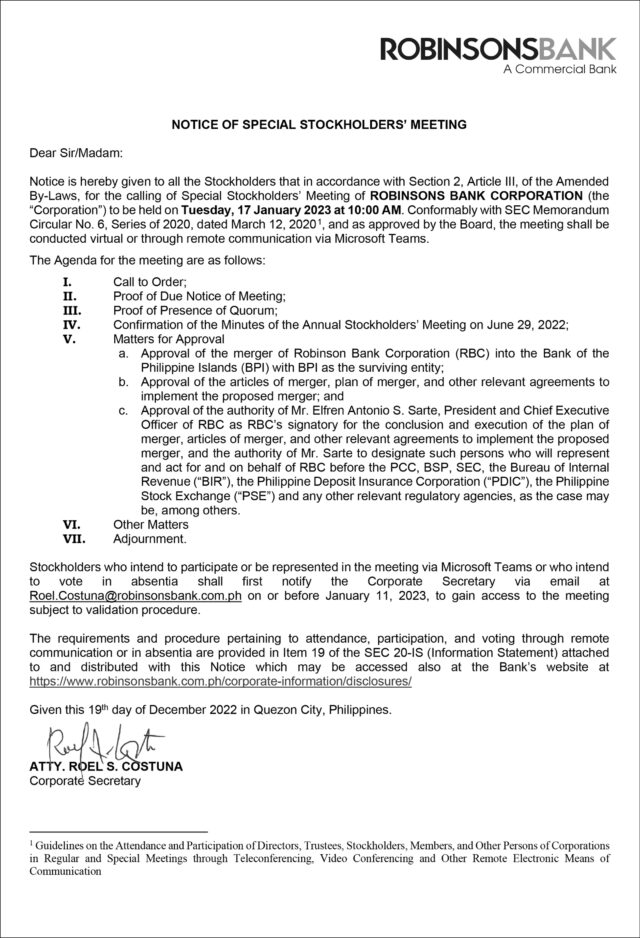
Robinsons Bank Corp. to hold special stockholders’ meeting on Jan. 17


Spotlight is BusinessWorld’s sponsored section that allows advertisers to amplify their brand and connect with BusinessWorld’s audience by enabling them to publish their stories directly on the BusinessWorld Web site. For more information, send an email to online@bworldonline.com.

Join us on Viber to get more updates from BusinessWorld: https://bit.ly/3hv6bLA.

Mastercard, UNO Digital Bank offer numberless debit card

MASTERCARD, Inc. and UNO Digital Bank have partnered to launch the country’s first numberless debit card to address security concerns on online and offline payments.

In a press release on Wednesday, the companies said that the card shows only the cardholder’s name and the logos of Mastercard and UNO Digital Bank. They added that the feature averts the risk of personal or financial data theft in case the card is lost or stolen.

They also said that the important details of the card are instead embedded in its chip for safe transactions.

“The numberless UNO Debit Mastercard combines security with convenience, bringing together the advantages of a safer and more secure debit card,” Mastercard Philippines Country Manager Simon Calasanz said.

“Through this partnership, Mastercard is enabling innovative, easy-to-use and frictionless transactions for consumers as they spend and seek priceless experiences,” he added.

A cardholder is given the option to lock a card temporarily and to reset the daily transaction limit in-app anytime to prevent misuse.

An email or an SMS alert will be sent every time there is a transaction to monitor usage. A cardholder will also be alerted of suspected fraudulent activity.

The physical card is PIN-enabled and contains a Europay Mastercard Visa (EMV) chip to lessen potential fraud or risk.

For convenience, the card also has Mastercard’s Tap & Go feature which can be used at point-of-sale terminals that have the universal contactless symbol for easier checkout.

Aside from online payments, the physical card can be used for cash withdrawals at ATMs where Mastercard is accepted, both locally and overseas.

Mastercard and UNO Digital Bank said the physical card is made from recyclable plastic and is composed of 85.5% polyvinyl chloride plastic, making it eco-friendly.

“Working with Mastercard has provided us with the opportunity to offer our customers an innovative payment experience through a numberless card. While we are on a mission to provide a single trusted interface to manage one’s entire financial life cycle journey, we continue to aim to be a trusted partner,” UNO Digital Bank Chief Executive Officer Manish Bhai said.

“Through the numberless UNO Debit Mastercard, the first in the country, we can demonstrate how innovation can elevate the banking experience,” he added. — Aaron Michael C. Sy

TikTok ban for US government phones advances, threatening its ad revenue, experts say

SOLEN FEYISSA-UNSPLASH

WASHINGTON — A proposal to bar federal employees from using Chinese app TikTok on government devices appeared set to become law, threatening to deal a blow to the company’s reputation and scare off advertisers even if it will not affect many users, experts said.

US lawmakers early on Tuesday included the proposal in a key spending bill, as first reported by Reuters, virtually ensuring its passage later this week following a Senate vote to green-light a similar measure.

The move is the latest US effort to crack down on the popular social media platform, which has been the subject of a slew of recent state bans and a long-running US national security probe over fears the app could be used by the Chinese government to censor content or spy on Americans.

While the new federal ban is not expected to put a significant dent in TikTok’s estimated 130 million US users, experts consulted by Reuters said the measure could damage the company’s reputation, which could in turn scare away valuable advertisers.

“That is what TikTok is at massive risk for: of having that brand reputational (blow) impact the overall revenue monetization that they can make,” said Eunice Shin, a partner at brand strategist Prophet.

TikTok said in a statement it was “disappointed that Congress has moved to ban TikTok on government devices — a political gesture that will do nothing to advance national security interests — rather than encouraging the administration to conclude its national security review.”

The ban was tucked into a massive omnibus measure to fund US government operations that is expected to be voted on this week and then sent to President Joseph R. Biden for his signature. The bill gives the White House Office of Management and Budget 60 days “to develop standards and guidelines for executive agencies requiring the removal” of TikTok from federal devices.

Many federal agencies, including the White House and the Defense, Homeland Security and State departments, already banned TikTok from government-owned devices.

White House National Security Council spokesperson Adrienne Watson said late Tuesday the Biden administration welcomes “Congress codifying this restriction across the federal government” and noted the Biden administration “has never allowed TikTok on White House devices.”

“The ban is minimal, extraordinarily minimal on the overall TikTok user base,” said Matthew Quint, a brand expert at Columbia Business School. “The question is more, ‘will this action get the ball rolling to create a bipartisan movement to fully ban the service because of a potential threat to national security?’”

The proposal last week won the backing of Democratic House Speaker Nancy Pelosi and House Republican Leader Kevin McCarthy.

But prior bids to ban the app have run up against free speech concerns. In 2020, Republican then-President Donald Trump attempted to block new users from downloading TikTok and to ban other transactions that would have effectively barred the app’s use in the United States but lost a series of court battles in part on free-speech grounds.

Efforts to ban the app have gained steam in recent weeks after US FBI Director Christopher Wray said last month it poses national security risks, flagging the threat that the Chinese government could harness the app to influence users or control their devices.

On Monday, state agencies in Louisiana and West Virginia became the latest to ban the use of TikTok on government devices over concern that China could use it to track Americans and censor content.

Some 19 of the 50 US states have now at least partially blocked access on government computers to TikTok. Most of the restrictions came within the past two weeks.

The US government Committee on Foreign Investment in the United States, a national security body, has for months sought to reach a national security agreement to protect the data of US TikTok users, but it appears no deal will be reached before year’s end. — Reuters

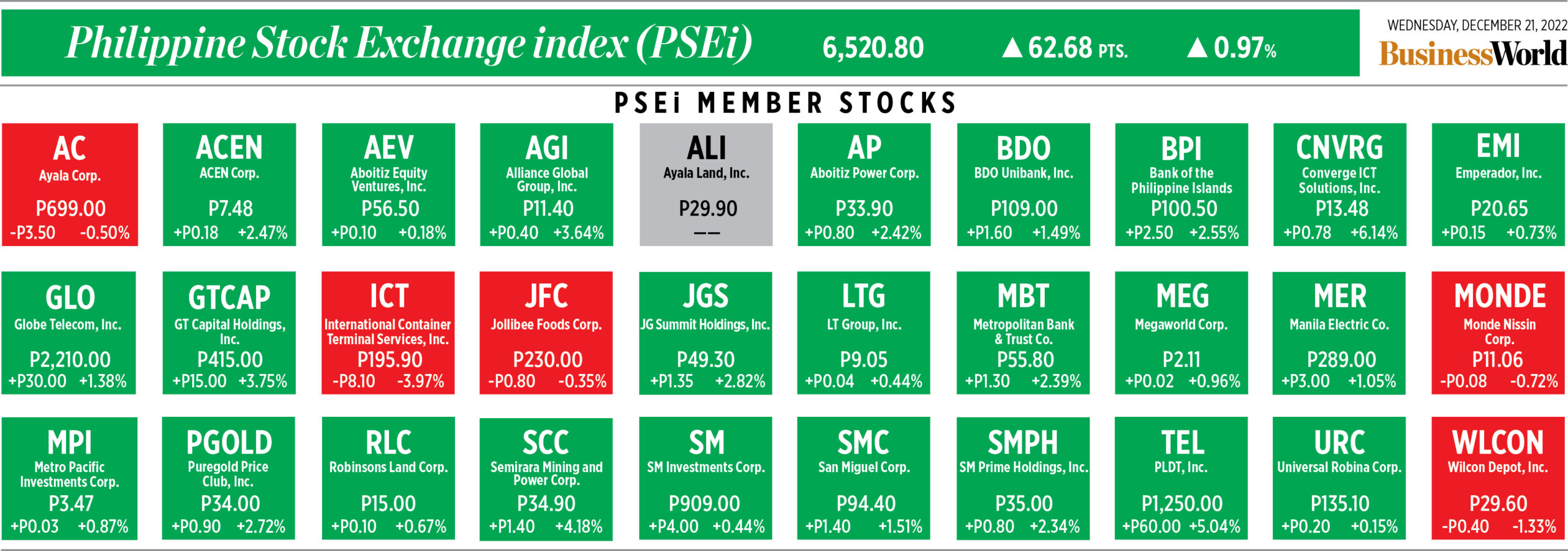
How PSEi member stocks performed — December 21, 2022

Here’s a quick glance at how PSEi stocks fared on Wednesday, December 21, 2022.


Manila ranked 26th most expensive city in Southeast Asia in terms of premium office space occupancy costs

Manila ranked 60th out of 134 real estate markets in the 2022 edition of the Premium Office Rent Tracker report published by real estate consultancy firm Jones Lang LaSalle (JLL). The index measures and compare occupancy costs which include rent, service charges, and taxes of premium office buildings. Manila’s occupancy cost amounted to $41 per square foot per year, making it 26th most expensive premium office space among 36 East and Southeast Asian cities included in the report.

Manila ranked 26<sup>th</sup> most expensive city in Southeast Asia in terms of premium office space occupancy costs

Peso maintains strength on possible future interest rate increases

BW FILE PHOTO

THE PESO further appreciated on Wednesday after the central bank’s hawkish view on future rate hikes, driving the local currency’s strength not seen since its July 4 finish of P55.08 per dollar.

It ended at P55.10 against the greenback, up by 14 centavos from Tuesday’s P55.24 close, data from the Bankers Association of the Philippines showed.

After opening at P55.10 per dollar, the peso reached its weakest showing on Wednesday’s session at P55.29. Its intraday best was at P55.04 versus the greenback. Dollars traded inched down to $833.7 million from $940.55 million on Tuesday.

A trader said in an e-mail that the peso strengthened after the Bangko Sentral ng Pilipinas (BSP) said on Tuesday that it might hike borrowing costs by 25 basis points (bps) in the next two policy meetings.

“The peso strengthened after BSP Governor [Felipe M.] Medalla hinted at more local policy rate hikes in 2023,” the trader said.

The BSP said it aims to bring inflation to nearly 3% by the third quarter.

“Our goal is to have inflation between 2-4%, preferably closer to 3% than to 4% by the third quarter of next year, and then the fourth quarter until 2024 will also be like that. That’s our goal,” Mr. Medalla told reporters on Tuesday.

National inflation accelerated to a 14-year high of 8% in November, bringing the full-year average to 5.6%.

The inflation figure is lower than the BSP’s 5.8% forecast for the whole year but well above its 2-4% target.

The BSP raised borrowing costs by 50 basis points (bps) to 5.5% on Dec. 15, bringing the policy rate to its highest since November 2008 when it was at 6%.

The Monetary Board has hiked rates by a total of 350 bps since May.

Mr. Medalla said that the central bank might consider smaller rate hikes next year, noting a higher chance of 25-bp or 50-bp rate increases at its next two policy meetings.

Meanwhile, a second trader said via Viber that the peso’s strength was more due to “decent” dollar inflows.

In a Viber message, Rizal Commercial Banking Corp. Chief Economist Michael L. Ricafort credited the peso’s further strengthening to the timing of the last two trading days before Christmas, which also caused the continued seasonal increase in foreign exchange inflows.

For Thursday’s movement, Mr. Ricafort expects the local currency to range between P55 and P55.20. The first trader gave a similar forecast of P55 to P55.25 while the second trader sees the peso moving at a range of P55 to P55.35 per dollar. — Aaron Michael C. Sy

Stocks rise on bargain hunting and stronger peso

PHILIPPINE STAR/KRIZ JOHN ROSALES

LOCAL shares climbed on Wednesday on bargain hunting as the peso strengthened versus the greenback amid higher investment pledges approved by the Philippine Economic Zone Authority (PEZA).

The benchmark Philippine Stock Exchange index (PSEi) climbed by 62.68 points or 0.97% to close at 6,520.80 on Wednesday, while the broader all-shares index rose by 35.43 points or 1.04% to 3,419.83.

“Market cheered BSP (Bangko Sentral ng Pilipinas) messaging that the period of strong dollar is over, spurring emerging market risk appetite,” First Metro Investment Corp. Head of Research Cristina S. Ulang said in a Viber message.

On Wednesday, the local currency ended at P55.10 against the greenback, up by 14 centavos from Tuesday’s P55.24 close.

The peso opened the session at P55.10 per dollar, also its closing value, and reached its weakest showing for the day at P55.29. Its intraday best was at P55.04 versus the dollar.

“The local bourse gained … amid continued bargain hunting. Also, strong investment pledges approved by the PEZA, boosted the sentiment,” Philstocks Financial, Inc. Research Analyst Claire T. Alviar said in a Viber message.

PEZA said it approved 198 projects this year, which are expected to generate P140.7 billion or more than double last year’s P69.3 billion. The rise was due to several big-ticket projects, helping the investment promotion agency surpass its 6.7% growth target for 2022.

On Wednesday, most of the sectoral indices closed higher except services, which inched down by 0.79 points or 0.05% to close at 1,589.68.

Meanwhile, mining and oil surged by 364.01 points or 3.54% to close at 10,639.61; financials added 32.54 points or 2% to 1,659.65; property increased by 35.26 points or 1.24% to 2,877.33; holding firms went up by 52.94 points or 0.83% to 6,405.13; and industrials climbed by 42.95 points or 0.46% to close at 9,270.82.

Value turnover went up to P6 billion on Wednesday with 4.36 million shares changing hands from P5.58 billion or 509 million shares traded on Tuesday.

Advancers outnumbered decliners, 103 versus 68, while 46 names closed unchanged.

Foreigners turned buyers with P158.45 million in net purchases on Wednesday from P427.62 million in net selling seen the previous trading day.

First Metro Investment’s Ms. Ulang placed the PSEi’s support at 6,300 and its resistance at 6,600, while Philstocks’ Ms. Alviar put the index’s support at 6,400 and its resistance at the 6,600 level. — Justine Irish D. Tabile