Home Blog Page 5504

PAL to study Manila-Brussels direct flights

PHILIPPINEAIRLINES.COM

PHILIPPINE Airlines, Inc. (PAL) is studying possible direct flights to Brussels after President Ferdinand R. Marcos Jr. met with Belgian airport executives last week, according to the flag carrier’s spokesperson.

“We will work with the government in studying possible options to assess the viability of any future EU (European Union) operations,” PAL Spokesperson Cielo C. Villaluna said in a Viber message when asked to comment on the idea of direct flights to Belgium.

Arnaud Feist, chief executive officer of the Brussels Airport Company, told the Philippine president last week that direct flights would be a “win-win” for both countries as it would increase travel options among tourists from Western Europe and Southeast Asia.

Mr. Marcos backed the proposal, saying it would make more areas accessible for both foreigners and Filipinos.

“When we talk about Brussels, in our mind, it’s really Western Europe because, very clearly, Brussels is the center of that. And that is something of great interest,” he told Belgian airport officials.

The president was accompanied by House Speaker Ferdinand Martin G. Romualdez, Senator Mark A. Villar, and officials from the Department of Trade and Industry, the Department of Transportation, and PAL.

Stanley K. Ng, president and chief operating officer of PAL Holdings, Inc., said in the same meeting that direct flights to Belgium could increase economic activity in the Philippines. PAL Holdings is the listed company that operates Philippines Airlines.

In October, Mr. Ng. said the country’s flag carrier is expected to make a full recovery in domestic sales and reach 70% of pre-pandemic levels in international sales by this month.

PAL made $1.1 billion in revenues in the first half of the year, which translates to a growth of 258% in passenger revenues and 31% in cargo revenues from the same period last year.

European airlines have posted increasing profits during the northern hemisphere summer from June to August as people took advantage of traveling without pandemic restrictions.

“We look forward to exploring opportunities for direct flights to the European Union,” Ms. Villaluna said, citing what was discussed by the Philippine government with Belgian authorities during Mr. Marcos’ Brussels visit. — John Victor D. Ordoñez

AVID set to respond to ‘consumer calls for mobility solutions’

PHOTO FROM AVID

THE ASSOCIATION of Vehicle Importers and Distributors (AVID) recently held its official meeting, followed by its traditional “Landscape Industry Forum” for the year. Mondriaan Group Partner Gerrit W. Kuyntjes discussed post-pandemic challenges and opportunities in the automotive industry, while Embiggen Group Head of Business Development Marrione Pol Camacho shared projections on current and future trends in mobility.

Department of Energy Undersecretary and Director of the Energy Utilization Management Bureau Patrick T. Aquino capped the session by reporting on the status of the country’s road map for the electric vehicle industry.

Said AVID President Maria Fe Perez-Agudo, “We are back together as AVID, the true and relevant voice of Philippine auto importers. Counting on the strength of our individual brands and strong demand, we are here ready to heed and respond to consumer calls for mobility solutions that best suit the need of the times.” AVID is a private, nonstock, nonprofit business association founded in July 2010. Its membership consists of 18 leading auto companies representing 19 global brands. The group advocates for the effective management of diverse commercial, consumer, and legislative aspects that affect the Philippine automotive industry and the Philippine economy.

AVID was established as a response to the need to accelerate government and private enterprise initiatives toward improving industry competitiveness. It partners with a growing network of industry experts from government and the private sectors to provide reasonable and objective information about free and fair competition and consumer welfare. The association said this is how it “makes significant contributions to assisting policy makers in crafting a system of laws and regulations to advance the local and global competitiveness of Philippine businesses.”

Agri tech transfer seen critical for realizing benefits of RCEP

PHILIPPINE STAR/ MICHAEL VARCAS

By Kyle Aristophere T. Atienza, Reporter

THE agriculture industry must harness the technology transfer opportunities if it is to fully take advantage of the Regional Comprehensive Economic Partnership (RCEP), an agriculture analyst said. 

“Beyond 2023 until 2025, the Philippines can open up its economy more by participating in freer trade agreements like RCEP. For as long as it is prepared to harness technology transfer in all possible fronts especially in agriculture, a freer trade regime is good for the (industry),” Roy S. Kempis, a retired professor at the Pampanga State Agricultural University, said in a Viber message.

“Our farmers and agribusinessmen have to learn how technology can improve their productivity,” he added.

Agriculture accounts for about a 10th of Philippine gross domestic product (GDP). Agriculture output contracted in the first two quarters of 2022 but expanded 1.8% in the third quarter.

Of particular concern was the capacity to bring the cost of production to at least level with other countries, Mr. Kempis said. “The idea is to scale up (initially), to achieve sufficiency, and eventually to be able to export what is not needed domestically.”

RCEP is a free trade agreement involving the 10 members of the Association of Southeast Asian Nations (ASEAN) and dialogue partners China, Japan, South Korea, Australia, and New Zealand. 

“With RCEP being ASEAN-based, the Philippines has a platform for extending free trade agreements to non-ASEAN blocs,” Mr. Kempis said. “The country can make itself attractive not only for mutually beneficial trade, but also for needed investments from foreign governments and businesses.”

The Senate failed to ratify RCEP earlier this year, with senators citing the lack of safeguards for the agriculture industry.

RCEP is viewed as a means for China to minimize US influence in the region. As a counter, the US has offered the Indo-Pacific Economic Framework (IPEF), a bid to achieve greater economic integration.

Trade Secretary Alfredo E. Pascual said in July that participation in the RCEP was a government priority. President Ferdinand R. Marcos, Jr. who is concurrently Agriculture Secretary, has said that after a review, he requested that the Senate ratify the trade agreement.

Mr. Kempis said the key for the Philippines is to obtain more investment in research and development to boost farm productivity, and to set up more processing facilities to preserve the harvest, develop the cold chain, add to the logistics and distribution network, and to innovate in the marketing of its produce.

“With President Marcos (expressing a preference for) an investment-led regime (to create) jobs, improving job quality, and generate decent incomes. this in turn will in turn perk up consumer appetite,” Mr. Kempis said. “This cycle when repeated will be good for the economy and well-being of the majority of, if not all Filipinos.”

Style (12/19/22)


LOOK Store opens in SM Mall of Asia

THERE’s a new destination in town for makeup fans and beauty enthusiasts: the LOOK Store at SM Mall of Asia (MOA) in Pasay City. There are more than 70 makeup, skincare, hair and nail care, and fragrance brands to choose from at LOOK, including cult brands like Drunk Elephant, Augustinus Bader, Tom Ford, La Mer, Laura Mercier, Jo Malone, and Shiseido. There are in-store experiences such as skin consultation by La Mer, the nail bar by Barry M, hair analysis and hair styling by Aveda, brow services by Benefit, makeover by NARS, Estee Lauder, and Make Up forever. LOOK has beauty experts who are happy to provide personalized tips as well as more information about the variety of products offered in the store. The LOOK Store is located at 2F SM Mall of Asia, South Wing, Main Building. For more information, visit www.lookatme.com.ph.


Penshoppe’s Holiday Edit collection

FASHION brand Penshoppe has just released its Holiday Edit collection so mixing and matching for holiday events is easy. Its must-haves for a festive look this season include satin, dressy tops, and cozy jackets. There is a cropped fleece cardigans that comes with a top, the perfect set to keep warm and looking pretty; heeled sandals that go well with the dresses; denim shorts, straight-leg or slim jeans, as well as statement tops. These pieces are available online and in select Penshoppe stores.  With Penshoppe’s Shop Online, Pick-up in Store option, shoppers can order online and pick up the items at any participating branch of their choice. Check out the latest from Penshoppe, visit https://www.penshoppe.com/.   


adidas Basketball unveils the 2023 collection

ADIDAS Basketball has unveiled The 2023 Collection: Chapter 01, the first of the brand’s series of premium offerings. The collection features an array of luxury sportswear apparel in a muted palette, ranging from premium sweats, track pants, sleeveless shirts, shorts and more. The collection is designed to consider effortless form and function while delivering on a style versatility – on and beyond the court. The 2023 Collection: Chapter 01 arrives in Halo Green, Metal Grey and Cloud White, available for purchase on the adidas App and at https://www.adidas.com.ph/chapters-basketball, retailing from P1,700 to P5,200.


The Montblanc Star Legacy

FROM the fields of Paris’s Champ-de-Mars horse racing track to the wrist, Montblanc continues to reinvent its Star Legacy Nicolas Rieussec Monopusher Chronograph. The story started on Sept. 1, 1821 at Paris’s Champs-de-Mars horse racing track where Nicolas Rieussec was testing one of his latest inventions, a timekeeper designed to record the precise times of all the horses as they crossed the finish line. Rieussec became the inventor of the world’s first inking chronograph, marking the history of fine watchmaking. Fast forward to 2007, Montblanc unveiled a wristwatch version of Rieussec’s technology, featuring its first in-house movement. Over the years, Montblanc has presented an array of different iterations of the design with different materials, finishings, and colors. This year, this classic timepiece has been given a new contemporary look with several details that reinforces the historical Paris connection, where the story first began, and take the model firmly into the future. There are two new interpretations of this timepiece — one in stainless steel, and the other in DLC-coated stainless steel (limited to 500 pieces). Both come in a new ergonomic pebble-shaped case measuring 43mm in diameter (the previous size was 44.8mm) with blue details that recall the color of ink — as a nod to the original device — and an onion-shaped crown. There are a number of elements that celebrate Paris: a graphic Clous de Paris motif on the dial (replacing the previous Grain d’Orge design) which is continued onto the textile strap and the oscillating weight; open-worked indexes; dynamic dauphine hands with Super-LumiNova1; dark grey baton indexes, a new typography on the chronograph counters; a black, semi-transparent sapphire crystal on the case back; blued screws on the dial and movement, and strong color contrasts between the anthracite grey and electric blue. Completing the Paris connection, a mention of the “Academy of Sciences, Paris” is engraved on the flange, as a reminder that the academy validated Rieussec’s invention in 1821. The name “Chronographe Nicolas Rieussec” is also engraved at 12 o’clock. The Montblanc Star Legacy Chronograph Nicolas Rieussec is powered by the self-winding Manufacture monopusher chronograph movement MB R200 that was the very first in-house movement by the Maison. Montblanc is available at Rustans Makati, Rustans Shangri-La, Rustan’s Cebu, Greenbelt 5, City of Dreams and Resorts World.


J-beauty holy grails

THOSE sleepless nights and hours spent working overtime, holiday shopping and gift wrapping can show, especially on one’s skin. The Japanese always makes sure they have a face lotion which function as skin conditioners, softening and hydrating it, and even performing a few extras. As the key step to “mochi mochi” skin or skin that is baby-soft, bouncy, and velvety matte (that looks and feels like that popular Japanese dessert), face lotions are full water-pushing humectants like hyaluronic acid to plump up dehydrated skin. One of these is cult fave J-beauty brand Hada Labo. The Gokujyun Hydrating Lotion Rich is Hada Labo’s flagship product that’s been updated with an enhanced formulation. It contains five types of hyaluronic acid to deeply hydrate the skin, replenish optimum moisture, create a moisture-locking shield to prevent moisture loss, and enhance absorption of other skin-care ingredients. This formula also has the world’s first fermented hyaluronic acid which improves its barrier function. The Gokujyun line also offers the Gokujyun Hydrating Light Lotion that has the same hydrating formula as the former, just lighter for oily or combination skin. This is just one of the Hada Labo products that help create the mochi-mochi look. The J-beauty skincare brand is treating shoppers to exclusive promos and freebies: purchase Hada Labo products at The SM Store’s Beauty Section in SM North EDSA from Dec. 29 to Jan. 11 to enjoy these perks. Hada Labo face lotions and other products are available at Watsons and Zalora, and through the official Mentholatum store on Lazada and Shopee. For more beauty and skincare tips, visit hadalabo.com.ph and follow @HadaLaboPH on Facebook and Instagram.


Max Mara launches in the Philippines

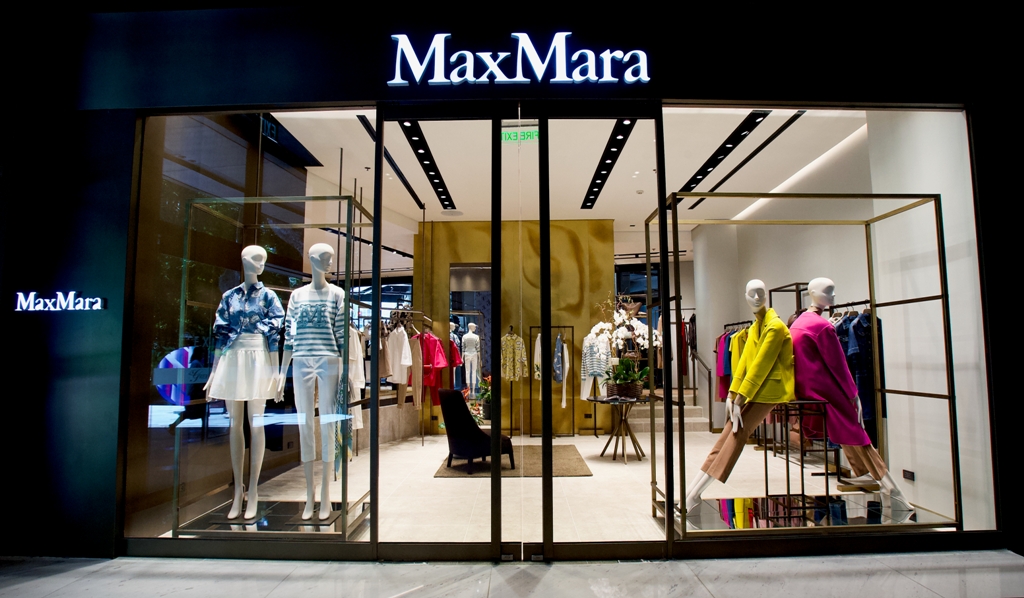
MAX MARA has opened its first store opening in the Philippines in Greenbelt 3, Makati. The opening showcased the latest collections, including the Max Mara mainline, S Max Mara, and its selection of accessories, as well as its iconic coats. Max Mara coats, such as the Manuela, the 101801, the Ludmilla and the Teddy are collected by the best dressed. The store features vaulted ceilings and a skylight, and the interiors are a well-balanced mix of strain gré, brass, metal, oak wood, and colorful marble which create a welcoming atmosphere across the main area, which is centered by a column in raw stone. Sophisticated furnishings from leading Italian design brands make the new store evoke Max Mara’s fundamental brand values of Italian craftsmanship and timeless construction.


Bench partners with UnionBank on store digital payments

UNION Bank of the Philippines (UnionBank) has partnered with Suyen Corp. (BENCH Group) to help the clothing and lifestyle brand digitize payments in its more than 800 brick-and-mortar and affiliate stores all over the country, for easier and more convenient transactions for its customers. The contract between UnionBank and BENCH was signed on Nov. 14 at the UnionBank Plaza in Pasig City. To help BENCH digitize its transactions, UnionBank will be generating in-store QRPH codes that will serve as additional payment channels for shoppers. This will allow them to quickly pay for their purchases without worrying about loose change. They also won’t need to use their on-hand cash or fall in line to withdraw cash at ATMs, saving them time. Because the partnership leverages QRPH’s wide range of accepted payment providers through partner banks and popular digital wallets, shoppers can pay for their purchases digitally without worrying about using services or apps they are not familiar with, and simply opt for those that they are already using. “We believe that the use of QRPH in our offline stores should bring many benefits and convenience to our customers,” said Vice President for Business Development Group of BENCH Bryan Lim.


Brother concept store opens in SM Fairview

BROTHER International Philippines Corp. recently opened the company’s fifth concept store in the Philippines at the 3/F Cyberzone in SM Fairview, Quezon City. The concept store will carry the complete range of Brother products, which includes printers, scanners, labeling machines, cutters, and sewing and embroidery machines. Shoppers will also enjoy special holiday promos and discounts. “The Brother concept store is part of our commitment to giving shoppers an improved shopping experience. They can see the complete range of products, interact with the different features, and get recommendations from our experienced staff,” said Glenn Hocson, President of Brother International Philippines Corp., in a statement. Aside from the SM Fairview branch, Brother concepts stores are located in Gaisano Mall, Davao; SM City North EDSA Annex; Limketkai Center, Cagayan de Oro City; and SM City Cabanatuan, Nueva Ecija. For more information, visit the Brother Facebook page or call the Brother Helpdesk Hotline at (02) 8 581-9898.

Solving crimes in the financial landscape: A Q&A with Tookitaki

By Lourdes O. Pilar, Researcher

“REDEFINING financial crime compliance to make the world a better place.”

Following the company’s motto, Tookitaki’s initiative of breaking silos and providing a platform to collaborate and fight financial crime, the company expanded their business in the Philippine market to bring scalable and machine learning-powered product offerings to help financial institutions address money laundering risks.

Tookitaki (a Thunes company) is a regulatory technology company offering financial crime detection and prevention solutions to some of the world’s leading banks and fintech companies to help them transform their anti-money laundering (AML) and compliance technology needs.

Founded in November 2014, the company employs over 100 people across the US, the UK, Singapore, Taiwan, Indonesia, the Philippines, and the UAE.

To know more about Tookitaki and its approach in providing end-to-end financial crime solutions to some of the world’s leading financial institutions, BusinessWorld reached out to Tookitaki’s Chief Executive Officer and founder Abhishek Chatterjee to share his thoughts and insights. Below is the excerpt of the interview:

Please introduce us to Tookitaki. What are your visions and goals?

Mr. Chatterjee: Headquartered in Singapore, Tookitaki provides end-to-end financial crime solutions to some of the world’s leading financial institutions. In the ASEAN region, some of the largest banks and fintech companies rely on Tookitaki to transform their AML compliance needs. Tookitaki was founded in November 2014 and employs over 100 employees across our offices in Asia, Europe, and the US.

Fighting financial crime needs to be a collective effort through centralized intelligence-gathering. Aimed at breaking silos, the AFC (anti-financial crime) Ecosystem, includes a network of experts and provides a platform for the experts to create a knowledge base to share financial crime scenarios.

This collective intelligence is the ability of a large group of AFC experts to pool their knowledge, data, and skills to tackle complex problems related to financial crime and pursue innovative ideas.

The AFC ecosystem is a game changer since it helps remove the information vacuum created by siloed operations. Our network of experts includes risk advisers, legal firms, AFC specialists, consultancies, and financial institutions from across the globe.

Tookitaki’s AML Suite (AMLS) is an operating system comprising four modules, such as transaction monitoring, smart screening, customer risk scoring, and the Case Manager, under one roof to address our customers’ compliance requirements. It provides holistic risk coverage, sharper detection, and significantly fewer false alerts. It can be deployed in multiple environments including the public cloud, private cloud, and data center.

The AFC Ecosystem and the AMLS work in tandem and help our stakeholders widen their view of risk from an internal one to an industry-wide one across organizations and borders. Moreover, they can do so without compromising privacy and security.

Tookitaki means to hide and seek in Bengali. The name perfectly articulates our intention to uncover the hide-and-seek nature of financial crime with artificial intelligence.

Today, Tookitaki (A Thunes company) is leading AML initiatives in most of the key digital banks in Asia. One of the largest digital banks in the Philippines, one of the world’s largest fintech and payment companies headquartered in China, one of Asia’s largest digital banks based out of Singapore, and one of the fastest-growing crypto wallets based out of Asia.

Tookitaki’s innovations in regulatory compliance have been acknowledged worldwide. Chartis Research named the company a Rising Star in its 2021 RiskTech 100 report. In 2020, the company won the Regulation Asia Awards for Excellence and G20TechSprint accelerator. In 2019, the company was featured in the World Economic Forum’s Technology Pioneer List.

What products and services do you plan to offer in the local market, and how would you differentiate Tookitaki from other vendors providing AML compliance solutions? What makes it “innovative” in addressing a regulatory or market need?

Mr. Chatterjee: At Tookitaki, we have always believed that technology is for the greater good. The AFC Ecosystem is a community-driven first of its kind initiative aimed at breaking silos and providing a platform to collaborate and fight financial crime. The AFC Ecosystem’s single motto is to break silos and provide a platform where AFC experts across the globe can use their knowledge and expertise to build a safer society.

The AFC Ecosystem is a game changer since it helps remove the information vacuum created by siloed operations. Our network of experts includes risk advisers, legal firms, AFC specialists, consultancies, and financial institutions from across the globe.

Underpinning it is a valued partnership program that is mutually beneficial for all stakeholders engaged in reducing the laundering of illicit proceeds of crime and terrorism.

Tookitaki’s offerings in the Philippines primarily include the AFC Ecosystem and the AMLS.

Our community comprises of experts covering the entire spectrum of money laundering: placement, layering, and integration. They include Financial Crime Compliance (FCC), law enforcement, and nongovernment organizations to name a few who are all giants in their own right. With this diverse community approach, financial institutions, who are the first line of defense, are empowered to identify “dirty money” patterns that aren’t easily discoverable. Operationalizing this collective intelligence results in the creation of more comprehensive risk policies.

Tookitaki’s AMLS covers the entire customer onboarding and ongoing processes through its transaction monitoring, smart screening, customer risk scoring, and the case manager. Together they provide holistic risk coverage, sharper detection, and significant effort reduction in managing false alerts. It is uniquely designed to complement existing systems by cutting through the noise and clutter generated by large volumes of alerts in legacy transaction monitoring processes.

For our customers like traditional banks and fintech companies, an extensive understanding of their consumers is a must for effective and comprehensive risk policies. The AMLS is a product that enables this through the combination of its Intelligent Alert Detection (IAD) for detection and prevention along with its Smart Alert Management (SAM) for Management.

With technology touching every facet of society, money mules and fraudulent accounts are a growing problem that needs to be addressed to assist in the country’s efforts to prevent financial crime, notably in the government sector. Tookitaki aims to improve the honesty of the Philippines’ financial market through AML compliance solutions aimed at fintech companies, which include payment service providers, e-wallet providers, and virtual asset service providers.

Please elaborate more on Tookitaki’s Anti-Money Laundering Suite or AMLS and how it would apply to banks.

Mr. Chatterjee: Tookitaki’s AMLS covers the entire customer onboarding and ongoing processes through transaction monitoring, smart screening, customer risk scoring and the case manager. Together they provide holistic risk coverage, sharper detection, and significant effort reduction in managing false alerts. It is uniquely designed to complement existing systems by cutting through the noise and clutter generated by large volumes of alerts in legacy transaction monitoring processes.

As mentioned earlier, our AMLS has two main functionalities: IAD and SAM.

The SAM functionality of AMLS specifically helps banks with:

• management and filtering of false alerts

• ease of integration into their current process governance

• operational guidance from past learnings with other banks

Based on our previous customer case studies, we can say that when customers start using the SAM module, they can expect a RoI (return of investment) in approximately nine months and along with that we deliver a superior experience via:

Operational efficiency through alert prioritization

SAM across transaction monitoring and screening helps in automated triaging and helps categorize all alerts into three risk levels: L1 (Low risk), L2 (Moderate risk), and L3 (High risk).

Hence, as part of the alert handling/treatment process, there is no requirement for manual triaging since all alerts have been triaged by SAM into the aforementioned risk levels.

Faster time to market

SAM automatically builds a machine learning (ML) model that trains on customer data. The model result aligns with customer risk policy and data instead of a generic industry ML solution. The in-built Intelligent risk indicator framework automatically generates thousands of risk indicators (data science features) from input data.

An intelligent model learning framework then selects the most relevant risk indicators and chooses the right hyper-parameters to tune the model to achieve high accuracy at optimal compute cost. This is a fully automated process that requires minimal data science effort from the client team.

Continuous improvement

Through our Champion-Challenger which learns from investigator feedback and changing data, continuous improvement occurs systematically. It takes in incremental data, which includes new customers, accounts, transactions, and the latest investigator feedback, and provides consistent results through continuous learning.

Ease of integration into the current process governance

The module integrates seamlessly with the existing systems as well as the primary using standardized data models and ready adapters. Investigators can still use the existing workflow and click on the link to access alert information. This makes it easier to investigate and dispose of alerts faster.

Apart from AML solutions, what other financial crimes does Tookitaki solve?

Mr. Chatterjee: Tookitaki believes in giving back to society. We are on a mission to improve lives by tackling money laundering.

Crimes such as human trafficking, drug trafficking, illegal arms deals, and many more are tied to money laundering. Vulnerable people are being affected daily by this corruption. We offer resources, information, and a strong commitment to helping eliminate money laundering and related crimes.

We have worked closely with the survivors of human trafficking to understand the patterns of behavior around these heinous crimes and determine how we can help tackle them. Our work in this endeavor is driven by a responsibility to help make the world a safer place for everyone.

We believe in using technology for the greater good. We want to lead from the front, where crimes such as trafficking and terrorism can be eliminated via the prevention of financial crime.

What are the factors you considered in choosing the Philippines to launch an AML software tool?

Mr. Chatterjee: With the rise of technology, the world is slowly shifting to cashless transactions. According to a study from 2020-2025, cashless transactions are expected to increase by 80% and cross border payments will be valued at $156 trillion. This borderless transaction increases money laundering crimes and allows money launderers to hide in plain sight undetected.

In the Philippines, half of Filipinos own a financial account, as more Filipinos become part of the banking system, financial crimes will become more advanced. Financial institutions need to look beyond traditional tools to solve a sophisticated and growing problem to keep pace with increasing business and regulatory requirements.

The Philippines is in a strategic position because of its rising economy and being the center of international trade and traffic makes it vulnerable to a host of financial crimes and financial terrorism. Moreover, the growing number of money transfers sent by overseas Filipino workers to their loved ones adds to the responsibility of the AMLS.

Do you have data on cases of money laundering in the country?

Mr. Chatterjee: The Anti Money Laundering Report states that the country has always been vulnerable when it comes to money laundering and financial terrorism. It is vital that the country address the growing problem.

What we’ve noticed is that the political landscape in the Philippines is ever-changing. In 2000, the Philippines was placed under the Financial Action Task Force (FATF), falling under its list of Non-Cooperative Countries and Territories due to lack of basic AML frameworks.

The Philippine government enacted Republic Act (RA) 9160 of the Anti-Money Laundering Act of 2001, which preserved the integrity of bank accounts and ensured the Philippines does not become a haven for money laundering activities. As an added precaution, Philippine authorities will assist in transnational investigations to prosecute those found who are found guilty. Since then, in recent years, various laws have amended RA 9160 and various industries involving finances have been added to the existing laws as well as harsher sanctions for those found guilty of money laundering activities. Additional powers were also granted to the Anti-Money Laundering Council and other concerned persons.

The Philippines has returned to the “gray list” as of June 2021. The FATF has commended the country for its continuing efforts to eradicate the threats of money laundering and encourage the country to further strengthen its measures. And we as a trusted partner are pleased to assist the Philippine government with its goal of eradicating and eliminating financial terrorism, no country in the world should be a safe haven for criminals.

Financial institutions are inundated with voluminous false positives and case backlogs that add to costs and prevent them from filtering out high-quality alerts. How does your solution help address this problem?

Mr. Chatterjee: Tookitaki was a pioneer in identifying the use case of ML in AML compliance and our ideas came into reality with our historic partnership with the United Overseas Bank Ltd. (UOB) in Singapore.

In December 2020, we became the first in the Asia-Pacific region to deploy a complete AML solution leveraging ML in production concurrently in transaction monitoring and name screening.

The SAM functionality of AMLS specifically helped with management and filtering of false alerts that eliminated the need for manual triaging since all alerts get triaged by SAM as per categorized risk levels, such as low, medium, and high. Ease of integration into their current process governance thereby making it easier for the investigators to investigate and dispose of alerts faster.

As a result, UOB witnessed 70% reduction in false positives for individual names and 60% reduction in false positives for corporate names. The solution also helped with 50% reduction in false positives with less than 1% misclassification and 5% increase in fileable suspicious activity reports.

This is yet another example of how Tookitaki sets new standards for the regulatory compliance industry’s fight against money laundering.

We have partnered with well-known fintech companies in the Philippines to assist local companies to stay on top of their compliance requirements and we hope to expand our partnership with even more fintech companies in the future.

What do you think are the biggest risks faced by banks being used for money laundering and how do you plan to mitigate or eliminate these risks?

Mr. Chatterjee: Banks need to have a holistic view of money laundering risks and the threat scape across various banking segments such as corporate, retail, and private. Existing static and granular rules-based approaches, which are oblivious to the holistic trend with a narrow and uni-dimensional focus, are not capable of doing the same. Existing rules-based systems produced a significant volume of false positives. These false leads are a drain on productivity as they take significant time and resources to be disposed of. In the AML compliance space, banks are wasting more $3.5 billion per year chasing false leads because of outdated AML systems that rely on stale rules and scenarios and generate millions of false positives, according to research.

Undoubtedly, using limited resources to close off non-material and unimportant alerts is manual and onerous, resulting in huge backlogs for both processes and missed/delayed suspicious activity report filings. Furthermore, the ballooning costs of AML compliance coupled with the high volume of backlog alerts swamp compliance teams and potentially distract them from “true” high-risk events and customer circumstances.

Alert investigation becomes a time-consuming and labor-intensive affair as the compliance team spends significant time gathering data and analyzing it to differentiate illegitimate activities from legitimate ones. Disparate data sources and highly complex business processes add to the difficulty of the investigation team in analyzing the links between parties and transactions.

As mentioned earlier, Tookitaki’s AMLS includes transaction monitoring, smart screening, customer risk scoring, and case management, a centralized investigation solution.

Transaction monitoring looks for suspicious transactions across different systems. It unlocks the power of Tookitaki’s library of typologies to detect hidden suspicious patterns.

Tookitaki’s AMLS generates fewer alerts of higher quality and then segregates them into low, medium, or high-risk alerts so companies can prioritize their investigations. The AMLS also updates regularly to include new money laundering patterns.

Smart screening watches out for high-risk individuals and corporate customers. Tookitaki designed the name screening module to handle a wider range of complex name permutations. To reduce the number of undetermined hits, Tookitaki enriched the module with inference features and additional customer profile identifiers. Tookitaki’s name screening module also reduces false positives, which happens when AML software incorrectly flags a customer as high-risk.

The Customer Risk Scoring module empowers banks in reducing their cost of compliance by providing an actual consumer view. This is backed by dynamic risk assessment that is self-evolving based on consumers’ new financial patterns.

ML models, too, benefit AFC ecosystems. For one, it increases effectiveness in identifying suspicious activities due to its sharper focus on data anomalies rather than threshold triggering. ML models also allow for easier customization of data features to accurately target specific risks, as well as enable extended look-back periods to detect more complex scenarios.

Any other insights you’d like to share?

Mr. Chatterjee: The AFC Ecosystem is now live, which means it is now open to the broader public. The ecosystem has grown considerably over the past few months owing to the active contribution by the experts. The AFC Ecosystem is a strong testament to how technology contributes to the critical mission of helping financial services combat crime and the financing of terrorism. With the ecosystem being open to the public, an AFC Honoree Badge Program has been launched because we believe that together we can make a difference.


AboitizPower eyes nuclear project

ABOITIZ Power Corp. (AboitizPower) is exploring possible investments in a nuclear energy project, its top official said, adding that the listed company has ongoing talks with foreign entities on the matter.

“We are in a regular discussion with Rolls-Royce and NuScale, I think these are two entities that are ahead in terms of SMR (small modular reactor) development. From what we are told the earliest commercial operations of SMR will be in 2028,” AboitizPower President and Chief Executive Officer Emmanuel V. Rubio told reporters in a gathering on Dec. 15.

He did not give details of the involved companies nor the stage of their discussions.

On its website, Rolls-Royce SMR Ltd. said that it had designed a factory-built nuclear power plant that will offer clean, affordable energy. NuScale Power, LLC describes itself on its website as “the global leader” in small modular reactor technology.

Mr. Rubio said that more than the technology, the permitting process, and the safety policies should also be in place.

“For the Bataan Nuclear Power Plant (BNPP), I believe most of the agreements for the Philippines to install BNPP have expired,” he said, adding that for the safety policies, the country has to follow requirements of the International Atomic Energy Agency (IAEA).

“The permitting, the country-to-country agreements, the regulations, we have to follow that,” he said.

Mr. Rubio added that the projected year, 2028, for a commercially operating facility gives the country time to develop a policy.

He said that AboitizPower is looking at SMRs as an option because its size and flexibility will be the suitable technology for the Philippines.

“When we develop nuclear, I think social acceptability should be on the top of our list. I think there has to be some government participation when anyone develops nuclear capability,” Mr. Rubio said.

Meanwhile, Mr. Rubio also said that the company is also pushing through with its plan to venture into liquefied natural gas (LNG).

“We are considering Naga as an option for our LNG site. We have a site in Naga, Cebu — the location of our old coal plant,” he said. — Ashley Erika O. Jose

Bosch ‘Care for Life’ launched

Educating the next generation: Bosch and Teach for the Philippines officials pose during the launch of the #CareforEducation program.

BOSCH Automotive Aftermarket (AA) has partnered with Teach for the Philippines (TFP) to help children develop basic literacy, numeracy, and socio-emotional skills through the #CareforEducation campaign. The initiative tackles the challenges of providing education to children in impoverished communities of the Philippines.

“We believe that children are the next generation of leaders. Bosch AA supports this by providing quality education through this campaign. The partnership with TFP is divided into two — Functional Literacy Program (FLP) and Batang Bayani Program (BBP) — dedicated to 700 students and 500 parents of the students,” said Bosch AA ASEAN Vice-President Marcio Coelho. “Learning never stops, and we look forward to working alongside TFP to equip children with the right knowledge and positive behavior toward learning and development.”

FLP through TFP provides an early-grade intervention program for Reading and Math — subject areas that are critical for academic success in the Philippines. BBP, on the other hand, aims at encouraging children to practice positive behavior toward learning at home.

“As an organization, TFP works with progressive champions like Bosch AA to ensure that all Filipino children benefit from an inclusive, relevant, and excellent education. Literacy and life skills, in particular, are critical to develop at an early age. Investments in these skills will help pave the way for our children to succeed in the 21st century. Through Bosch AA’s support, we can influence the lives of public school students all across the country,” said TFP Co-Founder and CEO Clarissa Isabelle Delgado.

The campaign is part of Bosch’s Care For Life initiative, contributing to vulnerable children’s welfare in the ASEAN region. It is supported by Bosch Primavera, a charitable organization founded by Bosch associates, helping children from all over the world since 1990. The launch of #CareForEducation in the Philippines marks the third country where the ASEAN-wide Care For Life campaign has rolled out, after Singapore and Indonesia. Plans are afoot for Malaysia, Vietnam and Thailand — focusing on road safety, health of children, and clean air, respectively. For more information, visit https://teachforthephilippines.com/.

ECB tightening worrying for Italy — minister

ROME — The prospect of subsequent hikes in interest rates by the European Central Bank (ECB) is worrying for highly indebted countries like Italy, its economy minister said on Saturday.

“We have benefited as a country for several years of a favorable situation, with interest rates close to or below zero, and this is now changing,” Economy Minister Giancarlo Giorgetti said speaking at an event in Rome.

The ECB on Thursday raised its benchmark interest rate by 50 basis points as widely expected, but dashed hopes that such hikes were coming to an end, warning instead of further increases in the months ahead.

Ministers of the Italian rightist government criticized the European Central Bank, which raised the financial pressure on one of the euro zone’s most indebted countries.

Mr. Giorgetti, a senior member of the League coalition party, said the rate hikes “should in some way advise us to be even more careful with regard to public finances and assess the consequences for the real economy.”

As sky-high energy prices batter the economy, Italy earmarked around €21 billion in its 2023 budget, which is currently making its way through parliament, to help firms and families cope with electricity and gas bills in the first quarter of next year.

Mr. Giorgetti warned it was “unrealistic” to expect bills to fall by March and said Rome was considering new relief measures, including a scheme to establish a protected price for energy consumption of up to 70-80% compared with previous years.

He said this mechanism could enter into force next spring with the aim of encouraging energy savings.

Mr. Giorgetti also urged the European Union (EU) to give a strong and strategic response to the US Inflation Reduction Act (IRA), which he said was posing threats to the national economy.

The EU fears that the $430-billion IRA scheme, with its generous tax breaks for domestic production of energy sector components, may lure away EU businesses and disadvantage European companies, from car manufacturers to makers of green technology. — Reuters

Avatar sequel rings up $17 million in US debut night

SAM WORTHINGTON in Avatar: The Way of Water

LOS ANGELES — Director James Cameron’s long-awaited Avatar: The Way of Water pulled in $17 million at US and Canadian box offices from its first showings on Thursday night, distributor Walt Disney Co. said.

With international sales, the sequel to the highest-grossing movie of all time has generated $50.4 million at theaters around the globe since the movie started rolling out on Wednesday.

Thursday’s domestic tally was below recent Disney release Black Panther: Wakanda Forever, a Marvel superhero film that racked up $28 million on its first evening in November.

Hollywood’s big question is whether The Way of Water can recoup its massive production and marketing costs. Studios split ticket sales with theaters, and Mr. Cameron told GQ magazine that The Way of Water will need to make $2 billion just to break even.

Sales from first-night screenings do not always correlate with the final tally, particularly around the Christmas holiday season. Box office experts predict The Way of Water will play in theaters for several weeks, as the original movie did, which will be key to earning back its budget. The sequel should end the opening weekend with at least $140 million from domestic theaters, forecasters said.

The Way of Water was released 13 years after the first film wowed audiences with pioneering 3D technology. It remains the all-time box office champion with $2.9 billion in global ticket sales.

In the new installment, actors Sam Worthington and Zoe Saldana return as Jake Sully and Neytiri 10 years later, now parents of five children.

Their peaceful life is interrupted when the Sky People, the Na’vi name for humans, return to go after Jake. The Sully family seeks refuge with the oceanic Metkayina clan and must quickly learn the ways of the water to survive. — Reuters

How dams built by China starve the Mekong River Delta of vital sediment

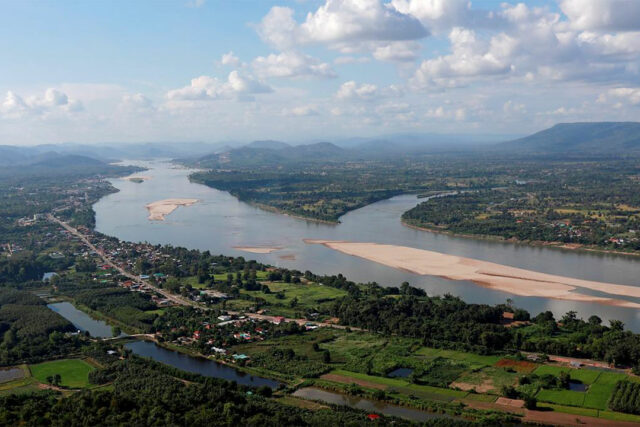
A view of the Mekong river bordering Thailand and Laos is seen from the Thai side in Nong Khai, Thailand, October 29, 2019. — REUTERS

SOC TRANG, Vietnam — Standing on the bank of the Mekong River, Tran Van Cung can see his rice farm wash away before his very eyes. The paddy’s edge is crumbling into the delta.

Just 15 years ago, Southeast Asia’s longest river carried some 143 million tons of sediment — as heavy as about 430 Empire State Buildings — through to the Mekong River Delta every year, dumping nutrients along riverbanks essential to keeping tens of thousands of farms like Mr. Cung’s intact and productive.

But as Chinese-built hydroelectric dams have mushroomed upriver, much of that sediment is being blocked, an analysis of satellite data by Germany-based aquatic remote sensing company EOMAP and Reuters shows.

The analysis reinforces an estimate by the Mekong River Commission, set up in 1995 by countries bordering the river, that in 2020 only about a third of those river-borne soils would reach the Vietnamese floodplains.

At the current rate of decline, the commission estimated, less than five million tons of sediment will reach the delta each year by 2040

Stretching nearly 5,000 kilometers from the Plateau of Tibet to the South China Sea, the Mekong is a farming and fishing lifeline for tens of millions as it swirls through China, Laos, Myanmar, Thailand and Cambodia before reaching Vietnam.

“The river is not bringing sediment, the soil is salinized,” said Mr. Cung, 60, who has grown rice at his family’s 10-hectare farm for more than 40 years. “Without sediment, we are done,” he said.

His diminishing harvest now brings in barely half of the 250 million dong ($10,636) annually that he earned just a few years ago, and his two children and several neighbors have left the area to seek more stable and lucrative work elsewhere.

For decades, scientists and environmentalists have warned upstream dam projects jeopardize livelihoods in a region of some 18 million people and an annual rice market of $10.5 billion that is a major food source for up to 200 million people across Asia, according to World Wildlife Fund (WWF) estimates, Reuters calculations and Vietnam’s Chamber of Commerce and Industry.

Worry shared by Lower Mekong nations has already led Cambodia to pause plans for two dams on the river, according to the Mekong Dam Monitor, an online platform that provides real-time data on dams and their environmental impact.

But in China and Laos, dam-building goes on. Of seven new dams planned in Laos, at least four are co-financed by Chinese companies, according to Mekong Dam Monitor data.

China’s foreign ministry said the country accounted for only a fifth of the total Mekong basin area and only 13.5% of the water flowing out of the Mekong’s estuary, adding that there was already a “scientific consensus” on the impact of China’s upstream dams.

The ministry did not address the slide in sediment levels or the role of Chinese dams in that decline.

Using data derived from thousands of satellite images, EOMAP and Reuters analyzed sediment levels around four major dams on the Mekong, two in China and two in Laos. The analysis showed each dam drastically reduced the sediment that should have otherwise flowed through at those locations — by an average of 81% of the sediment load across the four dams.

“The dams are trapping sediment … each one traps a certain amount, so there isn’t enough reaching the floodplains,” said Marc Goichot, a WWF river specialist in Vietnam who was not involved in the analysis but reviewed the results.

“Sediment and deltas should be able to regenerate and rebuild themselves,” he said. “But the pace at which the natural balance is being forced to change in the Mekong is too fast for the sediment to keep up.”

Farmers in the Vietnamese Mekong River Delta region were not prepared for the speed at which their landscape and fortunes have changed. The area under rice farming has shrunk by 5% in the last five years alone, with many forced to adopt shrimp farming in salty seawater as an alternative.

Incomes in this once-booming region are now among Vietnam’s lowest, even as the national economy grows at a projected 8% for 2022. The region has seen more outward migration than any other in Vietnam since 2009, according to Vietnam’s Chamber of Commerce and Industry.

The Mekong River Commission estimated in 2018 that total sediment flow by now would be around 47 million tons per year. It could be far lower – estimated at just 32 million tons per year, according to scientific studies from the last decade including one published in July 2021 in the journal Nature Communications.

“In the past three or four years there has been a wake-up call about sediment,” said the head of the commission, Anoulak Kittikhoun of Laos. “We definitely cannot return to sediment levels seen in the past. We need to preserve what we have.”

Meanwhile China, eager to boost renewable energy capacity to reduce its reliance on coal, has already built at least 95 hydroelectric dams on tributaries flowing into the Mekong, called the Lancang in China.

Another 11 dams have gone up since 1995 on the main river itself in China — including five mega-dams each standing more than 100 meters tall — while China has helped to build two in Laos. Dozens more are planned.

State-owned Huaneng Lancang River Hydropower, tasked with developing resources, aims to double the network’s 21.3 gigawatt capacity by 2025, its chairman Yuan Xianghua told Reuters.

The analysis by EOMAP and Reuters of satellite images taken over three decades around four major dams in China and Laos found evidence that the dams reduce sediment flow drastically.

The analysis relied on measurements of turbidity depicted in the images — the amount of light scattered by solid particles suspended in water — as a proxy for sediment levels.

Sediment clouds water as it flows: the muddier the water, the higher the turbidity and the more sediment it is likely carrying. EOMAP used the same approach to gauge sediment in the Elbe River in 2010 and in hydropower reservoirs in Switzerland and Albania in 2021.

Its findings on those waterways matched ground observations. The satellite images for the Mekong analysis date back to the 1990s, which “allows us to calculate turbidity levels before many of the dams were built,” said EOMAP data analyst Philipp Bauer.

After discarding images obscured by cloud cover or pollution, the team was left with 1,500 depicting the turbidity around two dams in China and two in Laos. Experts not involved in the analysis agreed the findings made clear the dams were a key culprit behind the delta’s sediment loss.

“Mainstream dams catch everything,” said economist Brian Eyler at the Stimson Center, which runs the Mekong Dam Monitor. “China’s got 11 on the mainstream, plus other countries, so all these are working together to reduce sediment load.”

For example, before China built its fourth-largest dam at Nuozhadu in Yunnan province, the water’s turbidity measure in 2004 averaged 125.61 so-called “nephelometric turbidity units”, or NTUs, according to satellite data.

After the dam was completed in 2012, average turbidity at the same spot plummeted 98% to just 2.38 NTUs – clear enough to meet the World Health Organization’s classification for drinking water.

The Xayaburi and Don Sahong dams in Laos are the most recent to come online, with Xayaburi the largest on the entire Mekong River. Average turbidity before China constructed the Xayaburi dam was 101.51 NTUs, while after the dam came online in 2019, turbidity tumbled 95% to an average of 5.16 NTUs.

And on Laos’ southern border with Cambodia, turbidity fell about 42% to 42.39 NTUs after the Don Sahong dam started up in 2019.

Reuters asked both the Chinese and Laotian governments about the impact of their dams and plans to build more.

China’s foreign ministry did not respond to questions about its existing and planned dams or their impact on sediment levels, while the Laotian government did not respond to requests for comment.

Governments of other countries through which the Mekong flows also did not respond to requests for comment.

At Mr. Cung’s rice farm in Vietnam, riverbank seedlings have little time to take root before they fall into the water as the banks give way. Located about 430 kilometers (270 miles) from the nearest upstream dam — and roughly 1,400 kilometers from the Chinese border — the farm area’s turbidity has dropped about 15% in the last 20 years, to about 61 NTUs on average today, according to the analysis by EOMAP and Reuters.

Downriver countries affected by the dwindling sediment have lobbied unsuccessfully for China to share data on sediment flows as well as details of its dam-building plans. Beijing shares data only about the water levels and flow rates from its mainstream dams.

Last year, the Mekong River Commission launched its own joint study with China looking at the dams’ impacts, but the results won’t be known until 2024 at the earliest. But while the commission has raised concerns about sediment depletion, “We have not had a serious conversation (with China) about sediment yet,” said Commission Chief Kittikhoun. “Water flow is a priority. Working with China, you have to take it one step at a time.”

Sitting cross-legged by the river, rice farmer Mr. Cung said he and his peers have struggled to find information about how to adapt to the changes wrought by dams. “It’s not an easy decision to make but sometimes quitting is the only economic choice that makes sense,” Mr. Cung said. — Reuters

Rising interest rates rock financial markets in Q3

BW FILE PHOTO

By Abigail Marie P. Yraola, Researcher

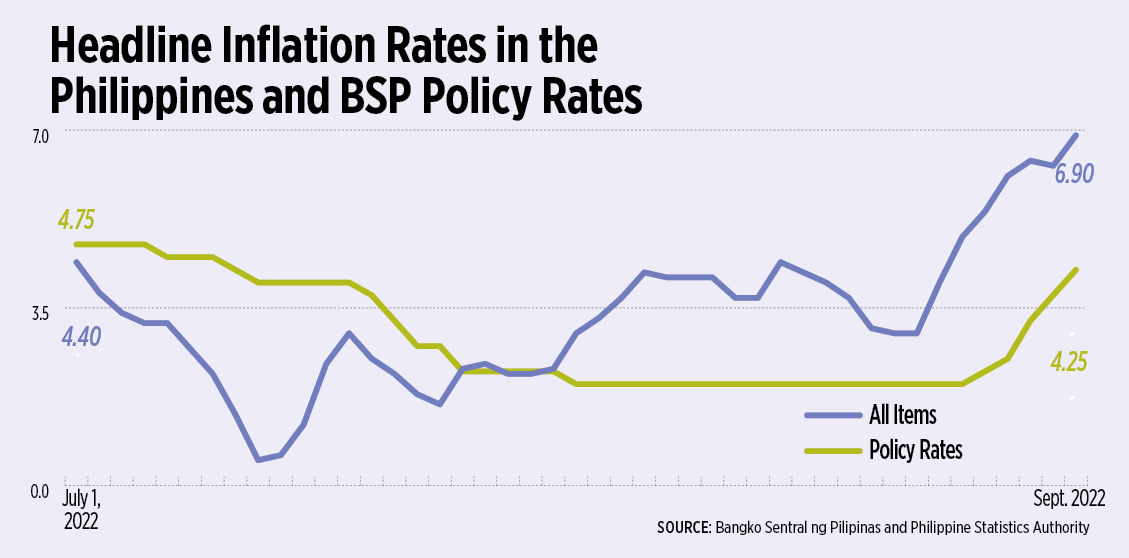
PESO DEPRECIATION, rising interest rates, and high inflation swayed financial markets in the Philippine landscape in the third quarter, indicating a gloomy outlook for the rest of the year.

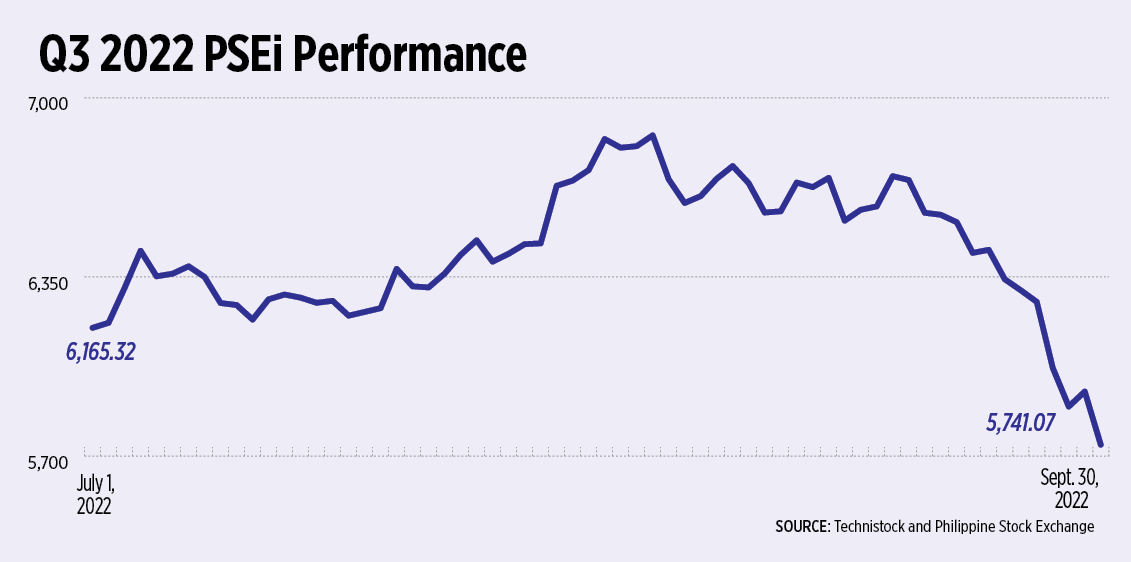
The barometer Philippine Stock Exchange index (PSEi) closed the third quarter with 5,741.07. This was lower by 6.7% quarter on quarter from 6,155.43 seen in the April-to-June period.

In the third quarter, Treasury bill auctions saw total subscription amounting to P397.6 billion while around P130.4 billion was the aggregate offered amount.

However, the oversubscription amount of P267.2 billion was lower than the P333.8 billion in the previous quarter.

Demand for Treasury bonds remained robust during the period as total subscription reached P1.2 trillion more than double compared with the offered amount of P477.7 billion.

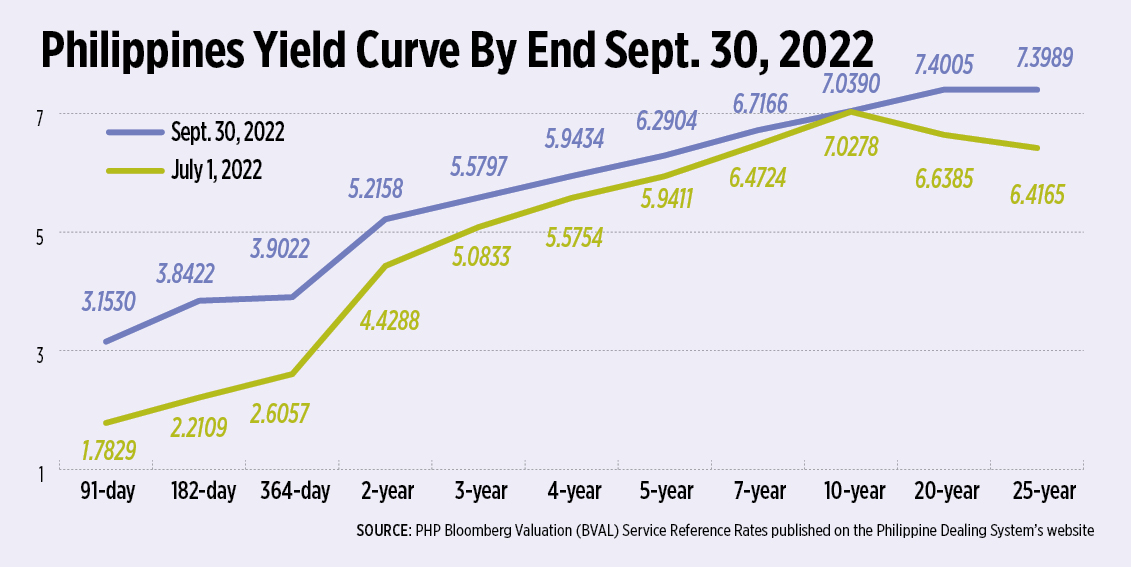
At the secondary bond market, domestic yields saw an increase of 76.7 basis points (bps) on average in benchmark government securities as of end-September compared with end-June levels, based on the PHP Bloomberg Valuation Service Reference Rates published on the Philippine Dealing System’s website.

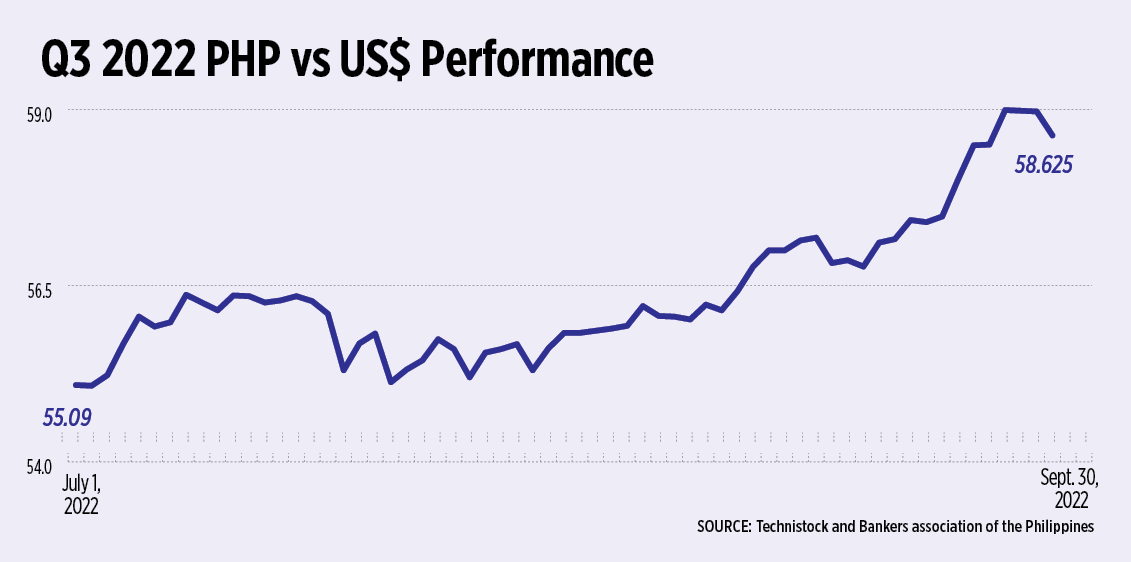
In the third quarter, the Philippine peso weakened against the US dollar. In October alone, the local unit touched its P59-to-a-dollar record low three times, data from the Bankers Association of the Philippines showed.

Meanwhile, the Bangko Sentral ng Pilipinas (BSP) data showed the peso averaged P57.4338 against the greenback in September weakening from P50.1421 last year.

On an end-of-period basis, the local unit finished at P58.910 versus the dollar in September, weaker than P50.959 a year ago.

The third quarter saw local financial markets affected by both domestic and global economic developments such as the aggressive monetary tightening of the US Federal Reserve (US Fed) to contain stubbornly high inflation.

Aside from this, the deterioration of global growth outlook due to the policy tightening was also a factor which caused weaker global demand and risk aversions brought by geopolitical tensions, BSP said.

Mirroring the developments abroad, the Philippines also hiked its key rates. Since May, the BSP has delivered a cumulative 350-bp hike to benchmark interest rates, the latest of which was the half-percentage-point increase on Dec. 15.

Unless these developments are tempered, the country will see continued challenges in balancing inflation rate-interest rate-exchange rate, Asian Institute of Management economist John Paolo R. Rivera said.

“Strong economic leadership is needed to temper excessive movements in these macroeconomic variables,” Mr. Rivera said via e-mail.

EFFECTS OF WEAK PESO
With a sluggish peso, consequences are to be expected as there are sectors who may have profited from it and, in turn may have been affected by it.

“A weaker currency in theory will make exports more attractive as its international price dips, making it cheaper on the global market,” Nicholas Antonio T. Mapa, ING Bank N.V. Manila Branch senior economist, said.

Mr. Mapa also added that, on the other hand, the diminishing peso is “also beneficial for recipients of remittances as each dollar sent home is worth more in peso.”

However, with the peso weakening, demand for exports may increase, which also makes foreign debt costlier to pay back.

UnionBank of the Philippines, Inc. Chief Economist Ruben Carlo O. Asuncion said that sectors that primarily relies on exports will benefit the most from a diminishing peso, while sectors that are net importers will feel the brunt of the adverse effects of the local unit shrinking.

“The transport sector will most likely be one of the sectors most affected due to not only the increase in the price of imported transported equipment, but also for fuel as well,” he said in an e-mail.

BSP said that it will act decisively as peso depreciation fuels inflationary pressures.

When the US Fed started to hike interest rates aggressively to curb inflation, demand for the dollar increased.  The greenback determines how global markets and currencies move as it is the world’s reserve currency.

The BSP said the financial markets around the world have been disrupted by the strong US dollar, which has caused other currencies to depreciate.

“The BSP does not normally react too much to movements in the exchange rate in keeping with our market-determined exchange rate policy,” BSP Governor Felipe M. Medalla said during a virtual convention hosted by the Chamber of Thrift Banks in October.

The BSP chief added that BSP view such moves as healthy market adjustment that sets appropriate signals to producers and consumers.

With the peso depreciation, risks to the outlook of the economy and inflation in the country is plausible.

“This is an issue: monetary policy is not really meant to be announced over and over again as it has the tendency to create speculations that will further disrupt the market,” said Mr. Rivera.

For UnionBank’s Mr. Asuncion, the economy is expected to once again slow down for the remaining quarters due to rate hikes slowing the growth of the economy while positive effects of policy tightening by the BSP will be experienced in 2023 where inflation will be expected to decrease the following year.

INDICATORS TO CONSIDER AND RISKS TO OUTLOOK
Analysts cautioned to continue monitoring trends related to recession, and to watch out for factors such as inflation, monetary tightening, and exchange rates in the next few months to gauge the country’s trajectory to recovery.

“Rate hikes are designed and intended to slow growth in order to produce slower inflation,” said ING’s Mr. Mapa.

The Philippine economy, said Mr. Rivera, can thread persistent headwinds alluding its resilience despite its vulnerability to local and foreign economic developments.

“It easily bounces back because of strong macroeconomic fundamentals that has been installed by previous administrations and BSP governors,” he added.

For ING Bank’s Mr. Mapa, growth in the country will likely slow as 2022 ends and not revert to pre-COVID form of growth as the triple threat caps growth potential.

He pointed out that outlook for next year is quite bleak as well.

“As the US Fed reiterated its commitment to continue its rate hikes well into the following year, albeit at a slower rate, it will take some time for the Philippine economy to return to its pre-pandemic levels,” he said.

He sees the country’s economy to show “small signs of growth” coming into next year due to the repeated rate hikes.

The central bank affirmed these prospects as it expects the economy to sustain its recovery momentum, but downside risks may be increasing due to developments in the external environment.

The BSP reiterated that the Philippine economic growth target for this year remains at 6.5-7.5%.

“The economy has sufficient recovery momentum, which provided the BSP room to tighten monetary policy aimed at bringing inflation back to the government target,” BSP said.

With these insights, how will the local financial markets hold up or perform in the fourth quarter?

FOREIGN EXCHANGE MARKET
BSP: The peso is expected to continue reflecting demand and supply conditions in the foreign-exchange market, driven largely by changes in the US Fed’s monetary policy.

Mr. Mapa: The peso may be on the backfoot as dollar strength is expected to persist.

Mr. Asuncion: Expect the dollar-peso to continue trading at around the P58-P59 level. This is a result of the expectation that subsequent rate hikes by the central bank will match those of the Fed’s to prevent the peso from trading at P59-P60 range and even possibly hit the P60 mark.

EQUITIES MARKET
BSP: High domestic and global inflation and the depreciation of the peso will continue to weigh on the PSEi as continued market concerns over aggressive monetary tightening of the US Fed.

Mr. Mapa: Equity markets may still be supported by decent earnings as the Philippines manages to eke out decent growth despite the challenging environment.

Mr. Asuncion: Per what we can see in recent months, the PSEi has performed better following a rate hike by the central bank. Thus, expect the PSEi to perform better in [the fourth quarter] and maintain its upward trajectory.

FIXED-INCOME MARKET
BSP: Domestic yields are likely to continue their upward trend given expectations of further rate hikes. Moreover, continued market uncertainty is likely to drive investors toward safe assets such as government securities, which can be seen in the high subscription rates consistently seen in the weekly auctions by the Bureau of the Treasury.

Mr. Mapa: Bond yields are expected to rise on prospects for inflation. Government will also need to borrow more, which could exert additional pressure on yields to move higher. 

Mr. Asuncion: With expectations of another rate hike by the central bank, expect short-term bonds to be more profitable, as increase in interest rates would mean that the price of existing bonds will decline, and newer bonds will be more profitable.

Cash dividend lifts BDO

BDO Unibank, Inc. was last week’s most actively traded stock after disclosing a cash dividend declaration on the common shares of stockholders earlier this month.

A total of 26.03 million BDO shares worth P2.89 billion exchanged hands on the trading floor during the Dec. 12-16 week, data from the Philippine Stock Exchange showed.

The Sy-led lender’s share price closed at P107.20 apiece, down 0.3% from P107.50 on Dec. 9. The bank’s share price slipped 11.2% since the start of the year.

For three days last week, its stock gained 3%, 1.6%, and 1%, respectively, from Dec. 12 to 14.

“The main factor that pushed BDO to be one of the most active stocks is its disclosure of stock and cash dividends declaration within this month,” Aniceto K. Pangan, equity trader at Diversified Securities, Inc. said in an e-mail.

In a disclosure to the stock exchange on Dec. 3, BDO said its board of directors approved the declaration of regular cash dividends on common shares amounting to P1.58 billion or P0.30 per share, payable on Dec. 29 to all stockholders on record as of Dec. 20.

On March 26, the BDO board agreed to the declaration of a 20% stock dividend, an increase in its authorized capital stock (common shares) to 8.5 billion shares from 5.5 billion, and an amendment to its articles of incorporation to reflect the increase.

The disclosure also noted that the cash and stock dividend declarations reflect BDO’s commitment to providing consistent, steady returns and value to its shareholders.

BDO’s consolidated net income in the third quarter increased by 46.1% to P16.12 billion as its gross revenues grew by 18.6% to P43.37 billion year on year.

Its profit for nine months to September went up by 23.6% to P40.16 billion. Nine-month gross revenues rose 10.9% to P119.67 billion.

Diversified Securities’ Mr. Pangan estimates revenues of P240 billion for BDO this year.

“BDO is expected to continue to grow its revenue for the year with the ease in mobility restrictions,” said Mr. Pangan.

For this week, Mr. Pangan expects BDO’s stock to range from its immediate support of P102 apiece to its immediate resistance of P115.00 per share. — Lourdes O. Pilar