Home Blog Page 5498

Rising interest rates rock financial markets in Q3

BW FILE PHOTO

By Abigail Marie P. Yraola, Researcher

PESO DEPRECIATION, rising interest rates, and high inflation swayed financial markets in the Philippine landscape in the third quarter, indicating a gloomy outlook for the rest of the year.

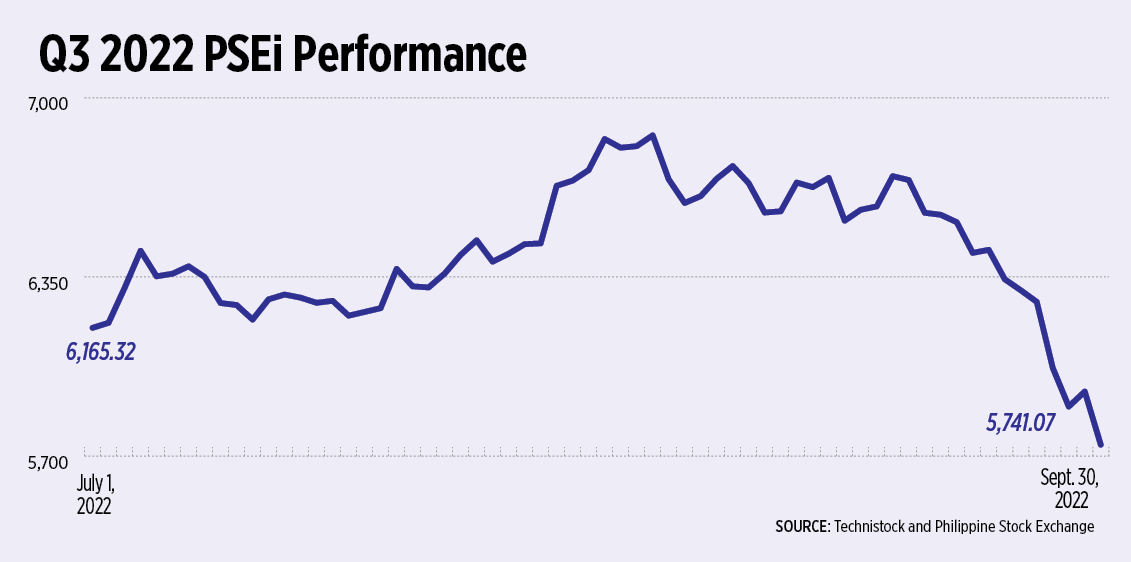
The barometer Philippine Stock Exchange index (PSEi) closed the third quarter with 5,741.07. This was lower by 6.7% quarter on quarter from 6,155.43 seen in the April-to-June period.

In the third quarter, Treasury bill auctions saw total subscription amounting to P397.6 billion while around P130.4 billion was the aggregate offered amount.

However, the oversubscription amount of P267.2 billion was lower than the P333.8 billion in the previous quarter.

Demand for Treasury bonds remained robust during the period as total subscription reached P1.2 trillion more than double compared with the offered amount of P477.7 billion.

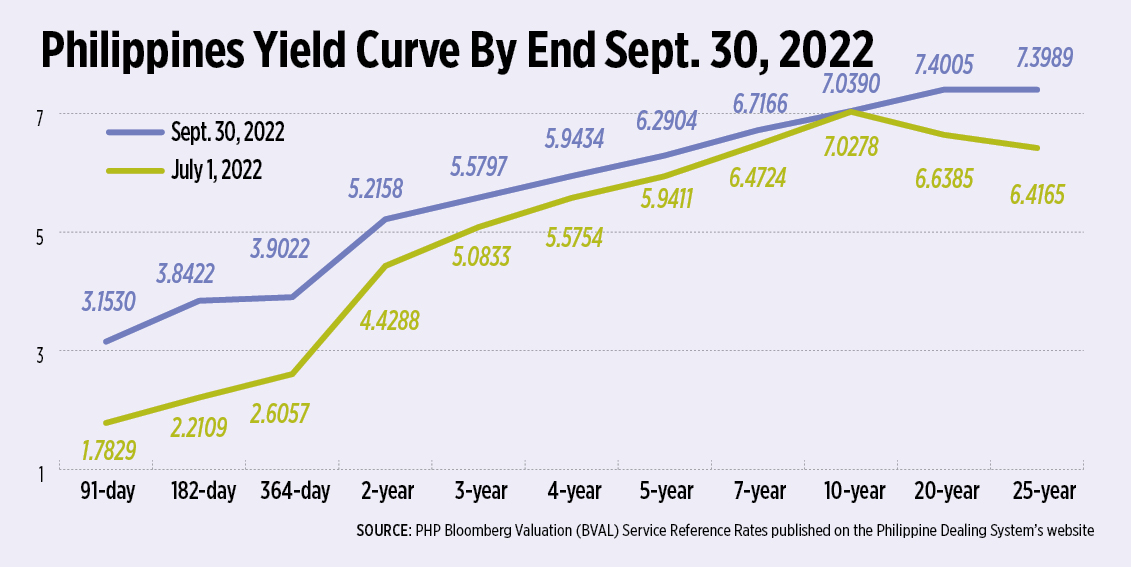
At the secondary bond market, domestic yields saw an increase of 76.7 basis points (bps) on average in benchmark government securities as of end-September compared with end-June levels, based on the PHP Bloomberg Valuation Service Reference Rates published on the Philippine Dealing System’s website.

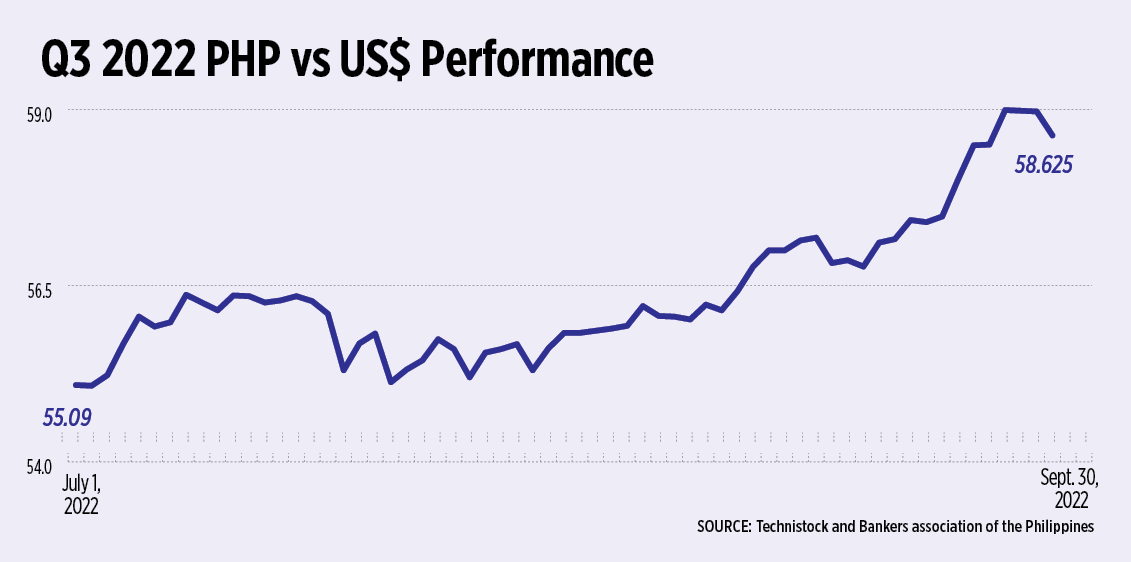
In the third quarter, the Philippine peso weakened against the US dollar. In October alone, the local unit touched its P59-to-a-dollar record low three times, data from the Bankers Association of the Philippines showed.

Meanwhile, the Bangko Sentral ng Pilipinas (BSP) data showed the peso averaged P57.4338 against the greenback in September weakening from P50.1421 last year.

On an end-of-period basis, the local unit finished at P58.910 versus the dollar in September, weaker than P50.959 a year ago.

The third quarter saw local financial markets affected by both domestic and global economic developments such as the aggressive monetary tightening of the US Federal Reserve (US Fed) to contain stubbornly high inflation.

Aside from this, the deterioration of global growth outlook due to the policy tightening was also a factor which caused weaker global demand and risk aversions brought by geopolitical tensions, BSP said.

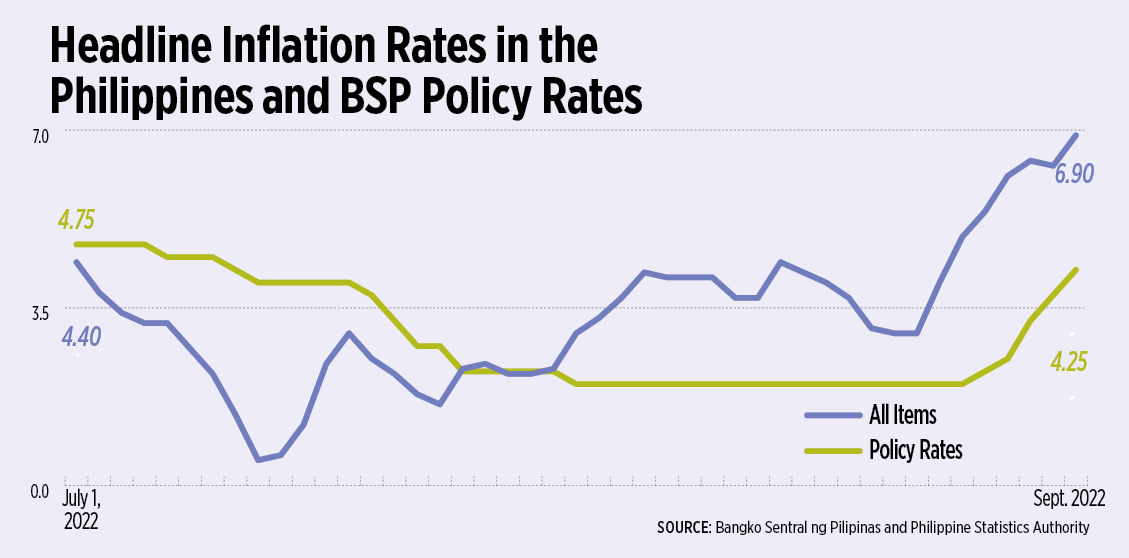
Mirroring the developments abroad, the Philippines also hiked its key rates. Since May, the BSP has delivered a cumulative 350-bp hike to benchmark interest rates, the latest of which was the half-percentage-point increase on Dec. 15.

Unless these developments are tempered, the country will see continued challenges in balancing inflation rate-interest rate-exchange rate, Asian Institute of Management economist John Paolo R. Rivera said.

“Strong economic leadership is needed to temper excessive movements in these macroeconomic variables,” Mr. Rivera said via e-mail.

EFFECTS OF WEAK PESO
With a sluggish peso, consequences are to be expected as there are sectors who may have profited from it and, in turn may have been affected by it.

“A weaker currency in theory will make exports more attractive as its international price dips, making it cheaper on the global market,” Nicholas Antonio T. Mapa, ING Bank N.V. Manila Branch senior economist, said.

Mr. Mapa also added that, on the other hand, the diminishing peso is “also beneficial for recipients of remittances as each dollar sent home is worth more in peso.”

However, with the peso weakening, demand for exports may increase, which also makes foreign debt costlier to pay back.

UnionBank of the Philippines, Inc. Chief Economist Ruben Carlo O. Asuncion said that sectors that primarily relies on exports will benefit the most from a diminishing peso, while sectors that are net importers will feel the brunt of the adverse effects of the local unit shrinking.

“The transport sector will most likely be one of the sectors most affected due to not only the increase in the price of imported transported equipment, but also for fuel as well,” he said in an e-mail.

BSP said that it will act decisively as peso depreciation fuels inflationary pressures.

When the US Fed started to hike interest rates aggressively to curb inflation, demand for the dollar increased.  The greenback determines how global markets and currencies move as it is the world’s reserve currency.

The BSP said the financial markets around the world have been disrupted by the strong US dollar, which has caused other currencies to depreciate.

“The BSP does not normally react too much to movements in the exchange rate in keeping with our market-determined exchange rate policy,” BSP Governor Felipe M. Medalla said during a virtual convention hosted by the Chamber of Thrift Banks in October.

The BSP chief added that BSP view such moves as healthy market adjustment that sets appropriate signals to producers and consumers.

With the peso depreciation, risks to the outlook of the economy and inflation in the country is plausible.

“This is an issue: monetary policy is not really meant to be announced over and over again as it has the tendency to create speculations that will further disrupt the market,” said Mr. Rivera.

For UnionBank’s Mr. Asuncion, the economy is expected to once again slow down for the remaining quarters due to rate hikes slowing the growth of the economy while positive effects of policy tightening by the BSP will be experienced in 2023 where inflation will be expected to decrease the following year.

INDICATORS TO CONSIDER AND RISKS TO OUTLOOK
Analysts cautioned to continue monitoring trends related to recession, and to watch out for factors such as inflation, monetary tightening, and exchange rates in the next few months to gauge the country’s trajectory to recovery.

“Rate hikes are designed and intended to slow growth in order to produce slower inflation,” said ING’s Mr. Mapa.

The Philippine economy, said Mr. Rivera, can thread persistent headwinds alluding its resilience despite its vulnerability to local and foreign economic developments.

“It easily bounces back because of strong macroeconomic fundamentals that has been installed by previous administrations and BSP governors,” he added.

For ING Bank’s Mr. Mapa, growth in the country will likely slow as 2022 ends and not revert to pre-COVID form of growth as the triple threat caps growth potential.

He pointed out that outlook for next year is quite bleak as well.

“As the US Fed reiterated its commitment to continue its rate hikes well into the following year, albeit at a slower rate, it will take some time for the Philippine economy to return to its pre-pandemic levels,” he said.

He sees the country’s economy to show “small signs of growth” coming into next year due to the repeated rate hikes.

The central bank affirmed these prospects as it expects the economy to sustain its recovery momentum, but downside risks may be increasing due to developments in the external environment.

The BSP reiterated that the Philippine economic growth target for this year remains at 6.5-7.5%.

“The economy has sufficient recovery momentum, which provided the BSP room to tighten monetary policy aimed at bringing inflation back to the government target,” BSP said.

With these insights, how will the local financial markets hold up or perform in the fourth quarter?

FOREIGN EXCHANGE MARKET
BSP: The peso is expected to continue reflecting demand and supply conditions in the foreign-exchange market, driven largely by changes in the US Fed’s monetary policy.

Mr. Mapa: The peso may be on the backfoot as dollar strength is expected to persist.

Mr. Asuncion: Expect the dollar-peso to continue trading at around the P58-P59 level. This is a result of the expectation that subsequent rate hikes by the central bank will match those of the Fed’s to prevent the peso from trading at P59-P60 range and even possibly hit the P60 mark.

EQUITIES MARKET
BSP: High domestic and global inflation and the depreciation of the peso will continue to weigh on the PSEi as continued market concerns over aggressive monetary tightening of the US Fed.

Mr. Mapa: Equity markets may still be supported by decent earnings as the Philippines manages to eke out decent growth despite the challenging environment.

Mr. Asuncion: Per what we can see in recent months, the PSEi has performed better following a rate hike by the central bank. Thus, expect the PSEi to perform better in [the fourth quarter] and maintain its upward trajectory.

FIXED-INCOME MARKET
BSP: Domestic yields are likely to continue their upward trend given expectations of further rate hikes. Moreover, continued market uncertainty is likely to drive investors toward safe assets such as government securities, which can be seen in the high subscription rates consistently seen in the weekly auctions by the Bureau of the Treasury.

Mr. Mapa: Bond yields are expected to rise on prospects for inflation. Government will also need to borrow more, which could exert additional pressure on yields to move higher. 

Mr. Asuncion: With expectations of another rate hike by the central bank, expect short-term bonds to be more profitable, as increase in interest rates would mean that the price of existing bonds will decline, and newer bonds will be more profitable.


Cash dividend lifts BDO

BDO Unibank, Inc. was last week’s most actively traded stock after disclosing a cash dividend declaration on the common shares of stockholders earlier this month.

A total of 26.03 million BDO shares worth P2.89 billion exchanged hands on the trading floor during the Dec. 12-16 week, data from the Philippine Stock Exchange showed.

The Sy-led lender’s share price closed at P107.20 apiece, down 0.3% from P107.50 on Dec. 9. The bank’s share price slipped 11.2% since the start of the year.

For three days last week, its stock gained 3%, 1.6%, and 1%, respectively, from Dec. 12 to 14.

“The main factor that pushed BDO to be one of the most active stocks is its disclosure of stock and cash dividends declaration within this month,” Aniceto K. Pangan, equity trader at Diversified Securities, Inc. said in an e-mail.

In a disclosure to the stock exchange on Dec. 3, BDO said its board of directors approved the declaration of regular cash dividends on common shares amounting to P1.58 billion or P0.30 per share, payable on Dec. 29 to all stockholders on record as of Dec. 20.

On March 26, the BDO board agreed to the declaration of a 20% stock dividend, an increase in its authorized capital stock (common shares) to 8.5 billion shares from 5.5 billion, and an amendment to its articles of incorporation to reflect the increase.

The disclosure also noted that the cash and stock dividend declarations reflect BDO’s commitment to providing consistent, steady returns and value to its shareholders.

BDO’s consolidated net income in the third quarter increased by 46.1% to P16.12 billion as its gross revenues grew by 18.6% to P43.37 billion year on year.

Its profit for nine months to September went up by 23.6% to P40.16 billion. Nine-month gross revenues rose 10.9% to P119.67 billion.

Diversified Securities’ Mr. Pangan estimates revenues of P240 billion for BDO this year.

“BDO is expected to continue to grow its revenue for the year with the ease in mobility restrictions,” said Mr. Pangan.

For this week, Mr. Pangan expects BDO’s stock to range from its immediate support of P102 apiece to its immediate resistance of P115.00 per share. — Lourdes O. Pilar

Dashboard

PHOTO FROM AXA PHILIPPINES

AXA Philippines has partnered with M2 Insurance Agency, Inc. (M2IA), the general insurance arm of M2 Dealerships, to offer a comprehensive insurance program to Toyota vehicle owners and employees. Through the partnership, a three-year locked-in insurance program will be offered to those who will purchase their new vehicles at Toyota Pasong Tamo (TPT); Toyota Global City (TGC); and Toyota Angeles, Pampanga (TAP); and for employees of the Macapagal Group of Companies. Added benefits will be given to customers under the Fastlane accreditation program of AXA Philippines that selects partner dealers to provide efficient claims servicing to its motor car policy clients. Benefits of this program include free pickup and delivery of the purchased vehicle due for repair from TGC and TPT to any area within Metro Manila, free repair estimate, and free towing up to P5,000 per event. In photo are (from left): AXA Philippines Head of Dealers and Partnerships AXA Johanna Janeo; AXA Philippines Chief of Commercial Business Rose Musico; AXA Philippines CEO In Charge and Chief Financial Officer Gael Lapie; President of TPT, TGC, TAP, and M2IA Alex Macapagal; TPT and TGC Executive Vice-President and Chief Planning Officer Eiichi Fukuda; TPT, TGC, TAP, and M2IA Executive Vice-President and Chief Operating Officer Emmanuel Sarte; and Executive Vice-President and Chief Finance Officer of TPT, TGC, TAP, and Chief Operating Officer of M2IA Johann Sale. For more information, visit https://www.axa.com.ph/motor.

Jane Fonda reveals ‘best birthday present ever’: her cancer is in remission

JANE FONDA (R) with Lily Tomlin in the poster for the Netflix series Grace and Frankie.

LOS ANGELES — Actress Jane Fonda, who turns 85 next Wednesday, said on Friday she had received an early birthday gift when her doctor told her that her cancer was in remission.

Ms. Fonda disclosed in September that she was undergoing chemotherapy for what she said was a treatable form of non-Hodgkin’s lymphoma. She said she has now discontinued chemo.

“I am feeling so blessed, so fortunate. I thank all of you who prayed and sent good thoughts my way. I am confident that it played a role in the good news,” Ms. Fonda wrote on Instagram.

She called it the “best birthday present ever.”

Fonda has worked in film and television for more than six decades, winning Oscars for roles in 1971 movie Klute and 1978’s Coming Home. This year, she starred in the final season of Netflix comedy Grace and Frankie.

Off screen, Fonda has advocated for various causes and currently is pushing for policies to curb climate change. — Reuters

Tight grain, oilseed supplies to keep prices elevated

REUTERS

SINGAPORE — Drought or too much rain, the war in Ukraine and high energy costs look set to curb global farm production again next year, tightening supplies, even as high prices encourage farmers to boost planting.

Production of staples such as rice and wheat is unlikely to replenish depleted inventories, at least in the first half of 2023, while crops producing edible oils are suffering from adverse weather in Latin America and Southeast Asia.

“The world needs record crops to satisfy demand. In 2023, we absolutely need to do better than this year,” said Ole Houe, director of advisory services at agriculture brokerage IKON Commodities in Sydney. “Ast this stage, it looks highly unlikely, if we look at the global production prospects for cereals and oilseeds.”

Wheat, corn and palm oil futures have from dropped from record or multi-year highs but prices in the retail market remain elevated and tight supplies are forecast to support prices in 2023.

With food prices climbing to record peaks this year, millions of people are suffering across the world, especially poorer nations in Africa and Asia already facing hunger and malnutrition. Food import costs are already on course to hit a near $2 trillion record in 2022, forcing poor countries to cut consumption.

Benchmark Chicago wheat futures jumped to an all-time high of $13.64 a bushel in March after Russia’s invasion of key grain exporter Ukraine reduced supplies in a market already hit by adverse weather and post-pandemic restrictions.

Corn and soybeans climbed to their highest in a decade, while Malaysia’s benchmark crude palm oil prices climbed to a record high in March.

Wheat prices have since dropped to pre-war levels and palm oil has lost around 40% of its value, amid fears of a global recession, China’s COVID-19 restrictions and an extension of the Black Sea corridor deal for Ukrainian grain exports.

While flooding in Australia, the world’s second largest wheat exporter, in recent weeks has caused extensive damage to the crop which was ready for harvest, a severe drought is expected shrink Argentina’s wheat crop by almost 40%. This will reduce global wheat availability in the first half of 2023.

A lack of rainfall in the US Great Plains, where the winter crop ratings are running at the lowest since 2012, could dent supplies for the second half of the year.

For rice, prices are expected to remain high as long as export duties imposed earlier this year by India, the world’s biggest supplier, remain in place, traders said.

“Rice availability in most exporting countries is pretty thin except India, but it has export duties in place to reduce sales,” said one Singapore-based trader at an international trading company. “If we get a production shock in any of the top exporting or importing countries, it can really swing the market upside.”

The outlook for corn and soybeans in South America looks bright for its harvest in early 2023, although recent dryness in parts of Brazil, the world’s top bean exporter, has raised worries.

US domestic supplies of key crops including corn, soybeans and wheat are expected to remain snug into 2023, according to the US Department of Agriculture. The agency is forecasting US corn supplies to fall to a decade low before the 2023 harvest, while soybean stocks were seen at a seven-year low and wheat ending stocks are forecast at the lowest in 15 years.

Palm oil, the world’s most consumed edible oil, is taking a hit from tropical storms across Southeast Asia where high costs have resulted in lower use of fertilizer.

Still, higher prices of grains and cereals have encouraged farmers to plant more crops in some countries including India, China and Brazil.

“Planting is higher in several countries but the output is expected to remain subdued due to adverse weather and other factors,” said Ole. “Production is unlikely to be enough to replenish supplies which have been drawn down.”  Reuters

Bank borrowing remains robust in Q3: Hefty rate hikes to be felt in 2023 — analysts

By Ana Olivia A. Tirona, Researcher

LISTED BANKS saw their loan books increase in the third quarter as the economy further reopened but analysts warned the massive rate hikes to curb multi-year high inflation could dampen this next year.

The Philippine Stock Exchange (PSEi) fell by 6.7% in the third quarter, a slower quarter-on-quarter contraction from the 14.5% in the second quarter but a reversal from the previous year’s 0.7% growth.

Meanwhile, the financials subindex, which includes the banks, grew by 1.7%, slightly reversing the 14.9% decline in the previous quarter and the 6.3% fall in third quarter 2021.

“Most banks reported faster loan growth amid improving economic activity, better lending margins as interest rates rise, and continued downtrend in nonperforming loans (NPLs), which allowed them to substantially reduce provisioning costs. The aggregate impact of these factors boosted bank earnings during the quarter,” BDO Securities Corp. said in an e-mail.

Latest available data by the Bangko Sentral ng Pilipinas (BSP) showed aggregate net income of universal and commercial banks (U/KBs) grew by 45.7% to P227.11 billion as of end-September from P155.86 billion a year ago.

Meanwhile, provision for credit losses by U/KBs fell at a slower pace by 12.3% to P71.29 billion versus the P81.28 billion last year.

Gross total loan portfolio of the big banks also rose to 12.7% annually to P11.31 trillion as of end-September from P10.04 trillion in 2021.

Nonperforming loans ratio further improved to 3.10% in September from 3.19% in August and the 3.99% last year.

Regina Capital Development Corp. Head of Sales Luis A. Limlingan said in an e-mail that main factors which drove listed banks’ stock performance in the period were rate hikes by the Monetary Board and the “non-reimposition of a stricter alert level in the National Capital Region.”

In the third quarter, the Monetary Board raised its interest rates four times. Year to date, a total of 300 basis points (bps) was raised by the central bank to curb high inflation. Since March of this year, the Metro Manila and the rest of the country operated under Alert Level 1.

In another separate interview, Globalinks Securities and Stocks, Inc. Head of Sales Trading Toby Allan C. Arce said the slowing global economy and quickening inflation also influenced the performance of listed banks in the third quarter.

“The banking sector has remained resilient amid shocks on the back of their strong capital positions. The sector’s good capital position and provisioning cushioned against any moderate rise in credit stress from higher inflation and a rising interest rate environment,” Mr. Arce said in an e-mail.

Inflation reached 6.9% in September, a much faster pace than the 4.2% seen in the previous year. In the nine-months to September, headline inflation averaged 5.1%. As of this writing, latest inflation data from the Philippine Statistics Authority reported inflation rose to 8% on November, highest in 14 years since the global financial crisis in 2008.

BANK STOCK PICKS
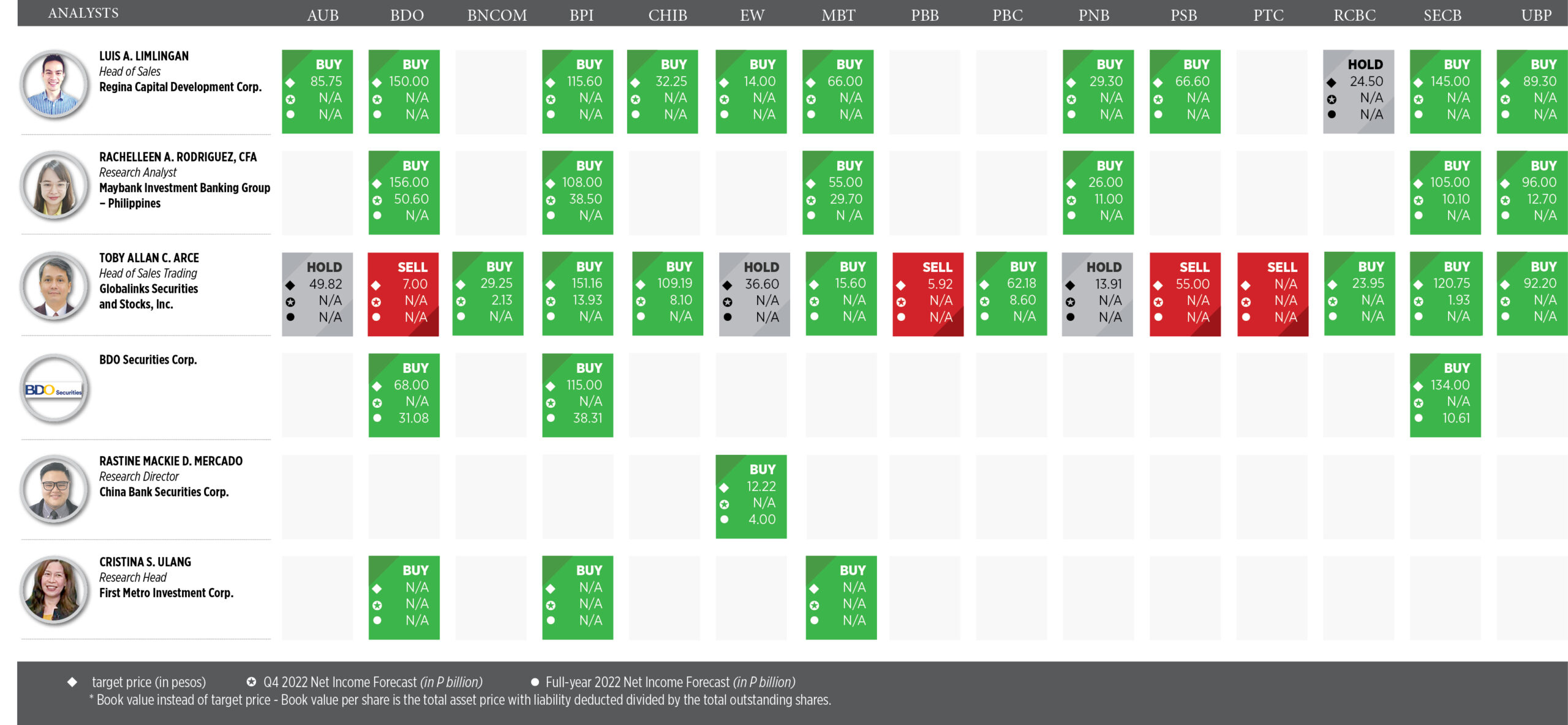
The third quarter saw six out of 16 listed banks stock prices decrease on a quarter-on-quarter basis. The Philippine Bank of Communications (PBC) led with a 27.6% decline in its share price from P17.98 in the previous quarter. This was followed by East West Banking Corp. (EW, -13.9%), Security Bank Corp. (SECB, -11.4%), China Banking Corp. (CHIB, -5.8%), Philippine National Bank (PNB, -5.5%), and Asia United Bank (AUB, -4.0%).

On the other hand, top gainers in the July to September period were Rizal Commercial Banking Corp. (RCB, 10.2%), Bank of Commerce (BNCOM, 10%), UnionBank of the Philippines (UBP, 8.2%), Philippine Business Bank (PBB, 7%), and Bank of the Philippine Islands (BPI, 5.5%).

China Bank Securities Corp. Research Director Rastine Mackie D. Mercado said overall price movement of banks were mixed in the third quarter as the market turned volatile.

“However, price performance between the end of the third quarter to end-November was generally more upbeat as market conditions improved. Furthermore, a robust third-quarter earnings season provided incremental tailwinds, with some banks now trading close to their year-to-date highs,” Mr. Mercado said in an e-mail.

Meanwhile, Rachelleen A. Rodriguez, research analyst at Maybank Investment Banking Group-Philippines, picked out BDO and BPI as outperformers in the July-to-September period.

“BDO’s September-end earnings beat our expectations due to its higher-than-expected fee income. For BPI, although its year-to-date operating income was within expectations, it delivered above-peers loan growth of 15.4% year on year,” Ms. Rodriguez said in an e-mail.

For Cristina S. Ulang, research head at First Metro Investment Corp. (FMIC), Metropolitan Bank & Trust Co. (Metrobank, MBT) was notable due to its consistent “strong capitalization with the highest capital adequacy ratio (CAR) of 18% and earnings growth year-to-date, beating market expectations.”

OUTLOOK
Analysts point out the probable effects of further policy tightening on banks as this could potentially drive net interest margin (NIM).

“Investors should pay close attention to the future actions of the US Federal Reserve and how the BSP will react on such,” Mr. Limlingan said.

“Usually, it paves the way for NIM expansions for banks but at the same time it introduces more odds of having higher bad loans. Additionally, the holiday season is expected to impact the lenders’ performance in the fourth quarter. However, the positive impact that it may have might be deterred by inflation,” Mr. Limlingan added.

The NIM of universal and commercial banks — a ratio that measures banks’ efficiency in investing their funds by dividing annualized net interest income to average earning asset —increased to 3.38% in the third quarter from the 3.29% in the April-to-June period.

Similarly, Ms. Rodriguez sees better NIM expansion in the coming quarters which would be driven by a hawkish US Fed stance and the BSP’s decisions to defend the Philippine peso.

“Nevertheless, we are closely monitoring the impact of a steep and accelerated rate hike on businesses, which may decide to defer expansion plans. This could lead to a deceleration in credit growth, which would heighten competition among banks, ultimately reducing their pricing power or ability to pass on rate hikes. Rising commodity prices is likewise a double-edged sword,” Ms. Rodriguez said.

For Mr. Mercado, U/KBs should refine foreign fund flows as this may lead to better performance.

“Especially against prospects of easing macro uncertainties. Nevertheless, a significant deterioration in offshore market sentiment is likely to still lead to negative spill over effects in the domestic market,” Mr. Mercado said.

“In terms of stock price effect, expectations of a further weakening in the peso may affect foreign funds’ appetite for local equities given that prospective currency returns form part of their total return considerations,” Mr. Mercado added.

Ms. Ulang sees a robust loan spread for banks as interest rates increase while loan demand will continue to pick up due to further economic reopening.

“Retail banking and microfinance are picking up too as banks compete with fintech and small entrepreneurs require higher working capital. Corporate capital expenditure programs continue to be upbeat in step with the strong GDP (gross domestic product) growth which means higher loan demand and need for capital market access, funding raising through IPOs (initial public offering) and bonds,” Ms. Ulang said.

“Only one weak spot is [the] property development lending due to higher mortgage rates, undermining affordability of housing loans and higher construction cost nudging up residential unit prices,” she added.

However, Mr. Arced said loan demand would be dampened by further monetary policy tightening as inflation continues to increase.

“But banks should see improved margins as loans are repriced, which will sustain healthy revenue growth for the full year. Large banks are in a good position to weather incremental asset quality weakness resulting from higher interest rates over the next 12 months, supported by their loan loss buffers. Therefore, an improving outlook on the banking sector is maintained,” Mr. Arce said.

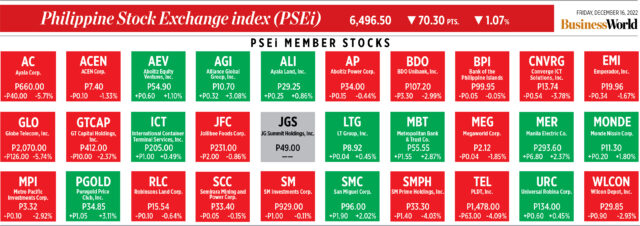
How PSEi member stocks performed — December 16, 2022

Here’s a quick glance at how PSEi stocks fared on Friday, December 16, 2022.


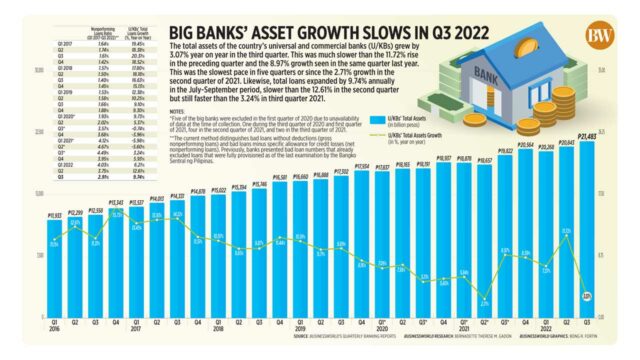
Big banks’ asset growth slows in Q3 2022

THE COUNTRY’S biggest banks reported slower annual growth in assets and loans in the third quarter of 2022. Read the full story.

Big banks’ asset growth slows in Q3 2022

Bargain hunting seen amid Fed, BSP rate bets

BW FILE PHOTO

THE MARKET may see bargain hunting this week due to dampened investor sentiment and expectations of further interest rate hikes.

On Friday, the benchmark Philippine Stock Exchange index (PSEi) fell by 70.30 points or 1.07% to end at 6,496.50 points, while the broader all shares index went down 30.76 points or 0.89% to close at 3,400.13. 

Week on week, the PSEi dropped 83.62 points or 1.27% versus its close of 6,580.12 on Dec. 9. 

For this week, analysts said investors may pick up bargains.

“We may see bargain hunting [this] week following [last] week’s decline. However, the market is still expected to go through a rough path as monetary outlooks weigh on growth prospects, which in turn may still cloud sentiment,” Philstocks Financial, Inc. Senior Research Analyst Japhet Louis O. Tantiangco said in a mobile phone message.

“The Federal Reserve’s policy outlook poses recession risks on the US which may spill over to the rest of the global economy. Meanwhile, the Bangko Sentral ng Pilipinas (BSP), which is still on a tightening path, may slow down our local economic growth,” he added.

The US Federal Reserve last week hiked its benchmark overnight interest rate by 50 basis points (bps) to the 4.25%-4.5% range and projected it could go up to 5%-5.25% next year.

The US central bank has now raised borrowing costs by 425 bps since March.

Meanwhile, the BSP raised benchmark interest rates by 50 bps at its meeting on Thursday, bringing its policy rate to 5.5%. Rates on the central bank’s overnight deposit and lending facilities were likewise raised to 5% and 6%, respectively.

The Philippine central bank has now raised rates by 350 bps since May.

Chiefs of both central banks said last week that they need to tighten further to bring down elevated inflation.

Online brokerage 2TradeAsia.com likewise said in a market note that bargain hunting is expected in the upcoming trading week. 

“Last-minute shopping for beaten down plays in the last few sessions of 2022 might prove itself rewarding, as intraday volumes tend to get thinner around the holidays and there is more opportunity to quietly snap some bargains,” it said. 

“Sentiment weakened alongside the Fed’s and the BSP’s 50-bp rate hikes, as the former hinted of a more hawkish 2023 that what was initially expected,” it added. 

Mr. Tantiangco said the PSEi’s major support is at 6,400, while major resistance is at 6,600.

“Last week, the market has fallen below its 200-day exponential moving average. If it is unable to get back above the said line in the immediate term, then we may see more bearish movements from the market moving forward,” Mr. Tantiangco said. 

2TradeAsia.com said the PSEi’s immediate support is seen at 6,350-6,400, while resistance is at 6,600. — R.M.D. Ochave

Peso likely to move sideways on rate hike bets

BW FILE PHOTO

THE PESO is expected to move sideways against the dollar this week as both the US Federal Reserve and the Bangko Sentral ng Pilipinas (BSP) are likely to continue hiking rates to bring down inflation.

The local unit closed at P55.56 per dollar on Friday, rising by 12.5 centavos from its P55.685 finish on Thursday, Bankers Association of the Philippines data showed.

However, week on week, the peso weakened by 19 centavos from its P55.37 close on Dec. 9.

The peso opened Friday’s session weaker at P55.85 per dollar. It dropped to as low as P55.88, while its intraday best was at P55.56 against the greenback, which was also its closing level.

Dollars exchanged dropped to $902.27 million on Friday from the $1.055 billion recorded on Thursday.

The peso strengthened on Friday on the back of seasonal dollar inflows as the holidays draw near and as the BSP kept the door open for further rate hikes, a trader said in a Viber message.

The Philippine central bank on Thursday raised its benchmark interest rate to its highest in 14 years and signaled more tightening to bring inflation back within its target.

The Monetary Board increased its overnight borrowing rate by 50 basis points (bps) to 5.5%. The rates on the BSP’s overnight deposit and lending facilities were also increased to 5% and 6%, respectively.

Since May, the central bank has increased borrowing costs by a cumulative 350 bps.

The move followed a 50-bp hike by the Fed at its Dec. 13-14 meeting, which brought its own policy rate to 4.25-4.5%. The Fed has raised borrowing costs by 425 bps since March.

BSP Governor Felipe M. Medalla on Friday said the Monetary Board will likely continue hiking borrowing costs next year to ensure that inflation will return to its 2-4% target range next year.

Rizal Commercial Banking Corp. Chief Economist Michael L. Ricafort said in a Viber message that the peso ended stronger on Friday amid the seasonal increase in remittances and holiday spending.

He added that the downward correction in global crude oil prices supported the peso.

Oil fell by more than $2 per barrel on Friday, with Brent crude futures settling at $79.04 per barrel, down $2.17 or 2.4%, while West Texas Intermediate futures fell by $1.82 or 2.4% to settle at $74.29 per barrel.

For this week, UnionBank of the Philippines, Inc. Chief Economist Ruben Carlo O. Asuncion said the peso could move sideways as the Fed also hinted at further tightening, which could support the dollar.

Fed Chair Jerome H. Powell on Wednesday said the US central bank will deliver more interest rate hikes next year to get a firmer grip on inflation.

Still, the BSP’s own hawkish stance will provide some support for the peso, Mr. Asuncion added.

Mr. Ricafort said the release of balance of payments data on Monday will affect peso-dollar trading.

“The seasonal surge in remittances and conversion to pesos to finance the seasonal increase in holiday spending will factor into this week’s peso movement, especially with measures to further reopen the economy, including the optional wearing of face masks,” he added.

For this week, Mr. Ricafort expects the local unit to move from P55.30 to P55.80 per dollar, while Mr. Asuncion gave a wider forecast range of P54 to P56. The trader said the peso might move from P55 to P56 this week. — A.M.C. Sy

Agriculture industry lobbies for ‘mandatory’ Maharlika allocation

THE AGRICULTURE industry said it is hoping to capture as much as 30% of the proposed sovereign wealth fund’s investable capital, saying that the wealth fund will draw away funding from the farm sector.

Danilo V. Fausto, president of the Philippine Chamber of Agriculture and Food, Inc. (PCAFI), told reporters Friday, “We demand a mandatory Maharlika Investment Fund share for agriculture productivity.”

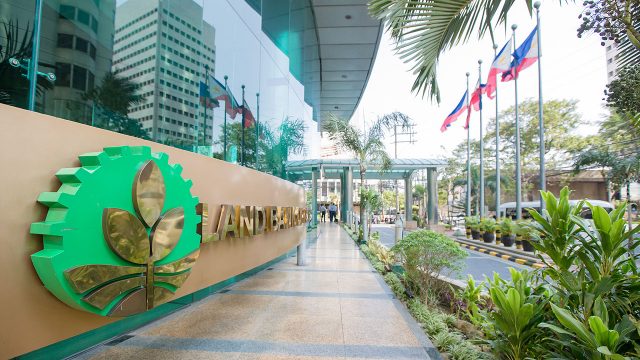
Mr. Fausto said 25 to 30% of any “activity, investment or investable funds” of the MIF should go to agriculture, because Maharlika draws its funding in part from the Land Bank of the Philippines (LANDBANK) and the Development Bank of the Philippines (DBP).  

“These are our agricultural banks. I do not see in the Maharlika Investment Fund anything on the agricultural sector. I want to make it mandatory in the law that a portion of that fund should be invested in the agricultural value chain,” Mr. Fausto said.

Last week, the House of Representatives approved on third and final reading the Maharlika bill, with 279 legislators voting in the affirmative and six against.

The Maharlika bill, or House Bill (HB) No. 6608, had been certified as urgent by President Ferdinand R. Marcos, Jr.

The bill lists as “allowable investments” foreign currency, metals, fixed-income instruments, domestic and foreign corporate bonds, equities, real estate, infrastructure projects, loans and guarantees, and joint ventures or co-investment projects.

The initial capital of the Maharlika fund will be put up by LANDBANK, the DBP, and Bangko Sentral ng Pilipinas (BSP).

Mr. Fausto noted that the government should focus on agriculture because it will “certainly generate profit.”

“If you put it in processing, milling, drying, logistics, it will make money and I suggest it should not be run by the government,” Mr. Fausto added.

The proposed MIF also generated backlash after the initial involvement of pension funds in putting up the capital and the designation of the President as chairman of the fund’s board.  

On Dec. 15, legislators agreed to remove the Government Service Insurance System (GSIS) and Social Security System (SSS) as Maharlika funders. — Ashley Erika O. Jose

ADVERTISEMENT
ADVERTISEMENT