Home Blog Page 5494

Bangsamoro celebrates Muslim heritage and tri-people diversity

SHARIFF Kabunsuan festival — BANGSAMORO.GOV.PH/BIO-H.BADRUDIN

A FLUVIAL parade on Monday featuring a reenactment of the arrival of Shariff Kabunsuan, the Arab missionary believed to have introduced Islam to southern Philippines in the 16th century, will cap off the Bangsamoro regions five-day celebration of its heritage and diversity among its tri-people.

We take inspiration from the determination of Shariff Kabunsuan in sailing towards the nourishment of peoples faith and improvement of the lives of the people of Maguindanao and in other areas in mainland Mindanao,Chief Minister Ahod Ebrahim said in his message during the opening ceremony on Dec. 15 in Cotabato City.  

Over the weekend, various activities were held such as a cooking demonstration of local dishes, including cuisines of the regions indigenous peoples, Muslims, and Christian settlers.   

These dishes are part of our identity that we want to preserve, thats why we continue to showcase them so that it will continue to be part of our narratives, our history,Tourism Bureau Director Marites K. Maguindra said in Filipino in a statement from the regions information office.

Minister of Trade, Investments, and Tourism Abuamri A. Taddik said the Culinary Show also puts a spotlight on halal practices in food preparation, an important component for the regions aim to promote the halal sector, including tourism.    

A trade fair featuring the regions agricultural commodities and processed products mainly by micro, small and medium enterprises is also ongoing at the Cotabato City Plaza.  

Mr. Taddik said the Agri-Trade Fair is intended not just to promote the regions goods but also to strengthen unity and camaraderie among the provinces, echoing the chief ministers message.   

We must always remember that development is built on the foundation of peace and cooperation and it is an effort in which everyone must participate,Mr. Ebrahim said. MSJ 

Baliuag now a city of Bulacan

The Baliuag Museum — BULACAN.GOV.PH

THE TOWN of Baliuag in Bulacan province is now a city after its residents voted on Saturday in favor of a law on the conversion, which gives the area a bigger share in national taxes, the Commission on Elections (Comelec) said. 

In a statement on Saturday evening, Comelec said a total of 17,814 agreed with Baliuag’s cityhood or 75.6% of those who cast their ballots.  

The voter turnout was only 21.7% with 23,562 out of 108,572 registered voters participating in the plebiscite.   

Baliuag, with a population of 168,470 as of the 2020 census, will now be the countrys 147th city and one of the 109 component cities, or those which remain under the administrative authority of the province.   

In a separate statement, election watchdog National CitizensMovement for Free Elections (Namfrel) said the plebiscite was conducted in a generally smooth and peaceful manner.  

“However, while the counting was transparent, there were very few observers who could further strengthen the process by being able to ascertain that what was being read was accurate,” Namfrel said.  

“The dream of the Baliwageños has become a reality thanks to the cooperation from Comelec, the Department of Education, the Philippine National Police, the Armed Forces of the Philippines, and the Department of the Interior and Local Government,” the election body said in Filipino. John Victor D. Ordoñez

Lawmaker questions looming hike in disaster insurance 

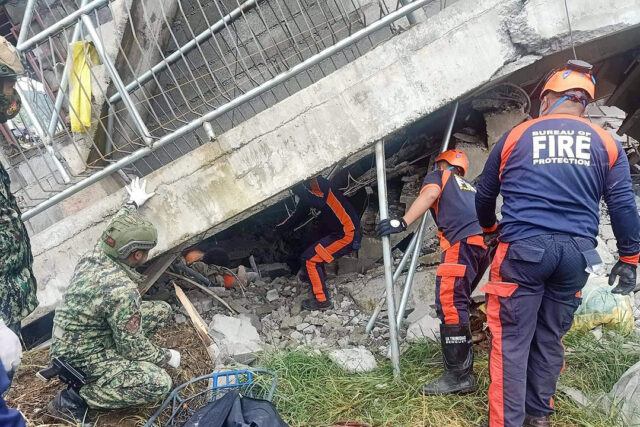
EMERGENCY responders — including firefighters, police, military, and local government teams — at a site of a collapsed building in La Trinidad, Benguet following the magnitude 7 earthquake that struck northwestern Luzon on July 27. — BUREAU OF FIRE PROTECTION

A SOLON has filed a resolution seeking to investigate an increase in insurance premium rates for catastrophes like earthquakes, floods, and typhoons that will take effect by Jan. 1, and asked the Insurance Commission (IC) to suspend its approval of the hike.   

AGRI Party List Rep. Wilbert T. Lee, who filed House Resolution 632 on Dec. 12, said the abrupt, unreasonable, and untimely increaseof catastrophe insurance rates will cascade to prices of basic commodities.  

This is going to be a domino effect. Food prices will increase because insurance premium increase affects production, storage, machinery, transportation to distribution center, until retail, he said in a statement on Sunday.   

(This is why) we regulate the insurance industry, to ensure that insurance companies are fair and not abusive. But why werent end-users consulted on the insurance premium hike?Mr. Lee said, noting that the IC has yet to respond to a letter of inquiry he sent on the issue.   

Beginning 2023, the adjusted rates will result to a sudden huge increase in insurance premiums ranging from 40% to as high as 400%, according to the lawmaker.   

Minimum catastrophe rates vary according to the type of disaster (earthquake or typhoon/flood) as well as the type of occupancy of the structure (commercial, industrial, warehouse, residential).  

Mr. Lee also said that the agriculture sector and efforts to achieve food security will be affected by the insurance rate increase.   

Even the Philippine Crop Insurance Corporation (PCIC) is affected and will also increase insurance premium. If agricultural workers will be placed at a disadvantage, then we may not achieve food security,he said. Beatriz Marie D. Cruz

Cabalida leads Batang Pinoy impressive new weightlifters

AUBREY TOM emerged the event’s first triple-gold medalist after she conquered the girls’ 400m individual medley.

ILOCOS SUR — In a sport where the country has high hopes of winning its next Olympic gold medal, Hannah Shene Cabalida of Cebu City served notice of her intention of reaching for the stars with a worthy performance in weightlifting of the Philippine Sports Commission’s Batang Pinoy at the Caoayan Gym here.

Ms. Cabalida was nothing less than impressive as she lifted a barbell heavier than her 30-kilogram frame — 34kg in snatch and 40kg in clean and jerk for a 74kg total — in claiming the gold.

And that mint could serve as a springboard to launching the nine-year-old third-grader’s quest to emulate Olympian Elreen Ando, a Cebu native herself, and Hidilyn Diaz-Naranjo, who delivered the country’s historic Olympic gold in last year’s Tokyo Games.

And Ms. Cabalida wasn’t alone as Elaine Jane Calunsag, an 11-year-old from Bayawan, Negros Oriental, likewise set in motion her own ambitious bid by topping the girls’ 26kg class with a 55kg total — 20kg in snatch and 35kg in clean and jerk.

Also coming through with worthy performances were Lucena’s Kristian Yugo Cabana and La Union’s Kyla Louise Bulaga, who joined Rizal’s Aubrey Tom as the games’ first double-gold winners at the Quirino Stadium pool center and Mauritanya Krog, who emerged as one of the first four cycling winners in the criterium races that unfurled and concluded in front of the Provincial Capitol.

Mr. Cabana clocked 1:5.40 in capturing his second mint in the boys’ 100-meter butterfly to add to his 200m individual medley he topped the day before while Ms. Bulaga topped the girls’ 100m fly in 1:12.70 that came a day after she ruled the 200m IM.

They joined Aubrey Tom of Cainta, who reigned supreme in 100m free and 200m IM the day before, in the elite cast of double-gold medalists.

Ms. Krog, who belonged to a family of cyclists that included elder siblings and former national team members Rex and Mathilda, stole some of the limelight and ruled the 13-and-under girls’ criterium in 37:43.519 ahead of Iloilo’s Maria Louise Alejado (39:12.067) and Calapan’s Jhanah Abella (39:16.426).

“My dream is to become a national team member and to compete abroad,” said Ms. Krog after her biggest race triumph to date.

Also striking gold in cycling were Emmanuel Arago of Batangas City, Jacqueline Joy de Guzman of Quezon City and Chris Andreu Ferrer of Cebu City.

In girls’ long jump also at the Quirino Stadium, Sophia Angela Mae dela Vega of San Jose City delivered the first golden feat in centerpiece athletics after she reigned supreme with a leap of 4.77 meters.

Ms. Dela Vega bested a field of 37 jumpers including Jesalyn Materdan of Masbate and Angelica Jane Balason of Quezon City, who copped the silver and bronze medal with 4.52m and 4.37m, respectively.

In the afternoon races, Rizal’s Aubrey Tom emerged the event’s first triple-gold medalist after she conquered the girls’ 400m individual medley that came on the heels of her 200m IM and 100m freestyle triumphs the day before. — Joey Villar

Domination versus redemption in Battle of Katipunan

JAMES SPENCER of UP battles for the rebound against BJ Andrade of Ateneo during the UAAP Men’s Basketball Game. — PHILIPPIINE STAR/ RUSSELL PALMA

Game Today
(Smart Araneta Coliseum)
6 p.m. — UP vs ATENEO (winner-take-all Game 3)

THE Battle of Katipunan reaches yet another apex.

For the second straight season, archrivals University of the Philippines (UP) and Ateneo collide head on in a winner-take-all Game 3 of the finals with the UAAP Season 85 men’s basketball title at stake at the Smart Araneta Coliseum today Dec. 19.

The battle lines are drawn in the fitting finals rematch and with both squads raring to go one last time at it after splitting the first two tussles in this best-of-three series, fireworks erupt at 6 p.m. to determine the realization of their respective fates.

Reigning champion UP, only seven months after ending a 36-year title drought on JD Cagulangan’s game-winner in the Season 84 finals against the same team, is out for more glory of winning a rare twin-title in 2022 compared to Ateneo’s bid to reclaim its rightful throne as the former three-time titlist.

From a theme of destiny against dynasty last season, domination versus redemption is the battlefield’s mantra this time with only one standing tall and proud to turn it into fruition after an expected all-or-nothing salvo.

Momentum is on the Blue Eagles’ nest after taking flight in Game 2, 65-55, to force a rubber match — which coach Tab Baldwin anticipates to be a harder nut to crack.

“It’s gonna get even tougher. We hope and pray that everybody can bring their best in Game 3. Basketball is winning. It’s a great thing for a sport we all love. I guess I’ll leave it there,” he said as Ateneo seeks to cap a redemption tour after missing out on a four-peat last season.

But the beleaguered UP — undermanned and all with the unfortunate ACL tear injury of versatile forward Zavier Lucero — vowed an unwavering resistance to frustrate Ateneo anew and retain their hard-earned Cup.

The Fighting Maroons took Game 1, 72-66, and was poised to become the first team in UAAP history to win two titles in just a year prior to a shellacking loss in Game 2, where they even absorbed a double whammy with Mr. Lucero’s gruesome injury in the fourth quarter.

Now more than ever, UP is out to fight. — John Bryan Ulanday

Minnesota Vikings rally to biggest comeback in NFL history, edge Indianapolis Colts in overtime

MINNESOTA VIKINGS — REUTERS

THE MINNESOTA Vikings pulled off the biggest comeback in National Football League (NFL) history on Saturday when they rallied from a 33-0 halftime deficit to beat the visiting Indianapolis Colts 39-36 in overtime.

Minnesota, who trailed 36-7 with under five minutes to play in the third quarter, put the finishing touches on the comeback when Greg Joseph nailed a 40-yard field goal with three seconds left in the extra period.

With the win, the Vikings improved to 11-3 and secured the NFC Division title — their first since 2017 — with three games left to play in the 2022 regular season.

The previous record for the biggest comeback in NFL history was set by the Buffalo Bills in 1993 when they erased a 35-3 third quarter deficit to beat the Houston Oilers 41-38 in overtime of a wild card playoff game.

Indianapolis built a 17-0 first-quarter lead after a field goal, a blocked punt that JoJo Domann returned for a score and a one-yard Matt Ryan touchdown pass to Deon Jackson.

They padded their lead in the second quarter with another three field goals and a 17-yard interception return that Julian Blackmon returned for a touchdown.

But the Vikings cut into the deficit with a pair of third quarter touchdowns, the second of which came after Chase McLaughlin put the Colts ahead 36-7 when he kicked a 52-yard field goal.

Minnesota then added another three touchdowns in the fourth quarter, tying the game with about two minutes left when they converted a two-point conversion after Dalvin Cook took a screen pass from Kirk Cousins and ran it 64 yards for the score.

The victory also handed Indianapolis quarterback Ryan the dubious distinction of having been on the losing end of both the largest comeback in Super Bowl history and NFL history. — Reuters

TNT completes a hat trick of PBA 3×3 conference crowns

AFTER yielding the floor to Cavitex-led rivals in the latter stage of the six-leg PBA 3×3 Season Conference, TNT reasserted itself and took its familiar place as conference champions.

Sniper Almond Vosotros, no surprise, fired the kill shot in overtime as the No. 2 Tropang Giga sneaked past the top-seeded Braves, 19-17, to complete a hat trick of conference titles Saturday at Robinsons Malabon.

The Tropang Giga saved the best for last and won the biggest prize after struggling in the last three legs. After winning Legs 1 and 3, TNT missed the semis in the fourth, fell to a low ninth in the fifth and bungled a winning title duel with Cavitex for sixth-leg honors.

“We just look glorious being champions from the outside but the conference was really a struggle. We had lots of adversity to go over with but we stayed together,” said TNT coach Mau Belen.

The clincher was tough work as TNT rallied from 17-14 then outsmarted the Braves in extension with a nifty setup by Ping Exciminiano to Mr. Vosotros for the winning corner deuce.

It wasn’t the usual high-scoring outing for Mr. Vosotros, who only netted three points but knocked down the biggest basket of all.

Lervin Flores took the cudgels with seven points, including a pair of layups that helped force the OT, while Samboy de Leon and Mr. Exciminiano chipped in five and four, respectively.

The Braves fell short of a breakthrough crown coming off their Leg 5 and 6 triumphs. They settled for runner-up honors and P250,000.

Meanwhile, J&T Express beats Platinum Karaoke, 20-14, for third place and P100,000. — Olmin Leyba

Croatia beats Morocco 2-1 to clinch third spot at World Cup

DOHA — Croatia beat injury-hit Morocco 2-1 in the World Cup third-place playoff on Saturday to leave Qatar on a high after again surpassing expectations following their run to the final in 2018.

Despite defeat, Morocco also leave with heads aloft after becoming the first African side to reach a World Cup semifinal.

Mislav Orsic’s late first-half strike was enough to settle the contest after two early goals inside the first nine minutes set the tone for a pulsating encounter, Achraf Dari canceling out Josko Gvardiol’s opener for Croatia.

A bronze medal may have served as nothing more than consolation after both sides endured disappointment in the semifinals, but Croatia and Morocco looked eager to make amends after losing to Argentina and France respectively.

For Croatia, it was well-deserved after dominating the early stages of the game and being clinical with opportunities while Morocco were left to rue what might have been after missing several chances.

“This is bronze with a golden glow. We won a tough game,” said Croatia coach Zlatko Dalic, who also led the nation of four million people to runners-up in Russia four years ago.

“This is a medal for the Croatian people… It’s really great that we won two medals in two tournaments, big congratulations to my players.”

NERVES
There were signs of nerves from Morocco early on with goalkeeper Yassine Bounou nearly scything a clearance into his own goal in just the third minute.

Moroccan fans have turned up in massive numbers to support their team in Qatar and Saturday was no different as they jeered the Croat players whenever they had possession, their whistles echoing inside the packed Khalifa International Stadium.

That did not deter Croatia, however, who started the game on the front foot and took the lead in the seventh minute through a cleverly worked set-piece.

A cross floated into the box found Ivan Perisic who expertly headed the ball into the mix where the masked Gvardiol bravely dived in for the header to silence the Moroccan contingent, albeit briefly.

Two minutes later, Morocco responded at the other end with a set piece of their own when a cross came off Lovro Majer’s head and looped into the box where an unmarked Dari beat the keeper with a header.

Emboldened by the equalizer, Morocco began to find chinks in the Croatian defense, with their movement and slick passing helping to create several chances.

But the African side lacked the killer instinct in front of goal, the final pass or touch always found wanting.

Croatia duly punished them in the 42nd minute when an interception in the final third found Orsic, whose curling shot arced beautifully from a tight angle past the outstretched arm of Yassine Bounou before going in off the post.

The second half did not start as fast or feisty as the first as exhaustion after a long tournament finally seemed to have caught up with both teams, playing their seventh game in Qatar.

Croatia’s Andrej Kramaric even left the pitch in tears with what looked like a thigh injury while goal scorer Dari hobbled off having opted to continue playing after the restart despite struggling at the end of the first half.

By the 67th minute, Morocco had made all five of their substitutions. With Romain Saiss and Nayef Aguerd benched, Jawad El Yamiq became their fourth centre back to bid the tournament goodbye when he came off.

“Physically it was difficult, our players got tired, it was intense,” Morocco coach Walid Regragui said.

PENALTY DENIED
Croatia also felt hard done by when Gvardiol looked to have been tripped in the box by Sofyan Amrabat — now playing in defence with their centre backs injured — but the referee refused to award a penalty.

The Qatari referee Abdulrahman Al Jassim also lost control of proceedings as both Croatia and Morocco were left frustrated by his decisions not to award fouls, with players from both sides squaring up at one point.

Mateo Kovacic could have put the game to bed for Croatia in the 87th minute when through on goal but shot wide while Youssef En-Nesyri came close when he headed over in stoppage time.

But despite Morocco’s best efforts to find an equalizer, Croatia held on for victory and the bronze, matching the feat of their heroes from 1998 who also finished third.

Morocco broke new ground for Africa by reaching the final four. As Regragui promised, they still go home to a hero’s welcome.

“We wanted to please our fans. We’re still happy, we’re among the four best teams in the world,” Regragui said.

“We provided everyone with a good show, we never gave up. Congratulations to Croatia, they deserve their third place.” — Reuters

Lakers sans Davis

For the Lakers, first the bad news: leading scorer, rebounder, and shot blocker Anthony Davis will not be in uniform when the Wizards trek to the crypto.com Arena today. He tweaked his right foot in the first half of a homestand against the dangerous Nuggets in their previous outing, and did not even stay on the bench after the break. While an initial x-ray test at the facility showed no structural damage, officials figured prudence to be the better part of valor and decided to hold him out pending the result of a magnetic resonance imaging scan.

The absence of Davis cannot but be deemed a blow, and not simply because he scored a whopping 55 points and grabbed 17 rebounds in 38 minutes to lead the Lakers to a rare road victory over the Wizards earlier this month. More than anything else, his sidelining exposes the major weaknesses of the purple and gold; these are particularly evident on defense, where he makes up for the shortcomings of those around him with his length, mobility, and uncanny timing and anticipation to cap his on-ball and help coverage.

The good news is that the Lakers can build on their statement-making triumph against the Nuggets. They were particularly engaged in the second half, during which their dynamism and preferential option to run at just about any instance served them in good stead. Only time will tell whether they will again encounter success sans Davis, and if their Plan B — which features 20-year veteran LeBron James at center — proves as productive in holding the Wizards at bay. The hope is that the moving parts once again get together well enough to be better as a collective.

In any case, oddsmakers have pegged the Lakers as favorites. They’re prepped to get smiles in the faces of fans for the most part, but all and sundry know they’ve provided ample cause for disappointment time and time again. They should be good for a W assuming they manage to rein in their Hyde side. Else, they’ll get to prove once more their capacity to underwhelm, especially in the crunch.


Anthony L. Cuaycong has been writing Courtside since BusinessWorld introduced a Sports section in 1994. He is a consultant on strategic planning, operations and human resources management, corporate communications, and business development.

A closer look at the Maharlika fund

TOWFIQU BARBHUIYA-UNSPLASH

I am pleased to share with readers a post we released to Globalsource Partners subscribers (globalsourcepartners.com) on Dec. 14 on the Maharlika Wealth Fund. I end with a postscript — a recommendation to address concerns of the critics on its governance.

Last Friday (Dec. 9 – Ed.), after over a week of intense public debate about the rationale and source of funds of a congressional initiative to set up a sovereign wealth fund, Finance Secretary Benjamin Diokno stepped up to own the proposal. In a press briefing, he read a statement signed by the core members of the economic team strongly endorsing the creation of the Maharlika Wealth Fund (MWF) as a vehicle to help achieve the medium-term economic objectives of the administration.

But beyond showing legislative-executive cooperation in this particular instance, the finance secretary failed to provide what critics of the MWF have been looking for: a clear Exposition of first principles, defining what the problem is, why current institutions are not up to the task and how the MWF will fill in the gap. Rather the statement was uncharacteristically vague, suggesting in part that the MWF would enhance. Fiscal space, increase investments in development projects while offering improved risk-reward trade-offs.

Following the economic managers’ embrace of the proposal, the draft bill was further tweaked with congressional proponents deciding to label it an investment rather than a wealth fund. The name change is noteworthy as it reflects the public’s rejection of the original concept of tapping the BSP’s (Bangko Sentral ng Pilipinas) foreign reserves and the two pension funds’ assets as sources of capital. It ought to be a recognition as well that the funds involved are not surplus monies in search of higher yields but are scarce resources that have competing uses in the short to medium-term.

SOURCES OF FUNDS
Under the latest draft bill, the major source of capital for the Maharlika Investment Fund (MIF) are the two government banks, Landbank of the Philippines (LBP) and Development Bank of the Philippines (DBP), and the Bangko Sentral ng Pilipinas (BSP). The first red flag is that all three have histories of government bailouts and recapitalizations.

In the case of the LBP and the DBP, both banks are already performing developmental lending of the kind that the MIF is envisioned to go into. This raises the basic question of what added value the MIF, a startup with no track record, can bring to the table in the short to medium-term. The second question has to do with their more immediate role in government’s pandemic recovery program. Under the proposal, both banks are asked to chip in P50 billion each. The combined P100 billion is almost double the P53.3 billion capital infusion of the previous administration in the two institutions, a large portion of which was added lately to enable them to implement pandemic recovery leading programs.

The third question has to do with the size of their contributions. For LBP, the amount represents close to 25% of its net worth which just meets the prudential cap for bank investment in a single enterprise. For DBP, which asset-wise is less than half the size of LBP, P50 billion is about two-thirds of its net worth, quite a high concentration of risk in a single investment. Thus, not only does the mandate to capitalize the MIF expose the banks to an unfamiliar risk will be difficult to manage thus weakening their financial condition, it also increases the odds of more capital calls on the national government down the road. Considering the high likelihood of the latter, directly budgeting the amounts in the annual appropriations would be more in keeping with fiscal transparency.

The case of the BSP is somewhat more complicated with the MIF intending to tap only declared dividends; but the plan similarly raises red flags. Under the BSP charter, dividends declared, representing 50% of its profits, are remitted to the Treasury. The Treasury then turns around and give the amount back to the BSP in the form of national government contribution to build up its capital over time, i.e., from P50 billion currently to the target P200 billion. The draft bill seeks to amend this provision by directing the BSP to send those dividends, in whole or in part following a set schedule, to the MIF. Thus, creating the MIF would be at the expense of fully capitalizing the BSP at the soonest possible time, a delay that may be defensible if push comes to shove but seems unwise at the present time given all the economic and financial uncertainties, global and local.

However, there is the separate issue of trying to rope in the BSP as part of the formal governance structure of the MIF. Lay persons like us are inclined to take the view that those dividends belong to the national government (since it was the national government that capitalized the BSP) and that the BSP need not have any role or responsibility in the MIF itself. However, framers of the MIF seem to prefer to consider those dividends as belonging to the BSP rather than the national government. The danger here is saddling the BSP anew with quasi-fiscal functions that could interfere with its primary monetary policy setting role and, over time, erode its credibility and independence. The resources of the old central bank were similarly deployed in expansive developmental work that contributed to its eventual bankruptcy.

USES OF FUNDS
The economic managers’ statement suggests that the MIF will drive strategically important investments in the country, funding “big ticket infrastructure projects, high-return green and blue projects, and country development, including agriculture.” This raises a whole slew of issues related to government trying to pick winners and brings to mind the failed experience of the National Development Co. (NDC). Over the course of its over 100-year history, this investment arm of the government ventured into a diverse range of pioneering commercial, industrial, mining, and agriculture enterprises, including several of the so-called 11 major national projects, whose foreign debts were guaranteed by government financial institutions that eventually had to be recapitalized and rehabilitated. This misadventure contributed majorly to the Philippines being the only Asian country that fell into the 1980s Latin American debt crisis.

The implicit assumption that the MIF, by its sheer size, will do better than the contributing institutions in terms of investment returns goes against the NDC experience. Even more worrisome, we have not seen supporting studies that spell out the MIF’s basic investment strategy or identify prospective high-yielding economically and financially superior projects nor any financial plan that maps out recoverability of the proposed high overhead costs. The excessive hype about potential high investment returns is without reference to the (at least equal) probability of potential huge losses. Thus, despite recent tweaking of the proposal, including replacing the President with the finance secretary as chairman of the board, the lack of complete staff work and the rush in congress to pass the bill makes brushing aside suspicions of political motivations and future interference impossible.

THE IMMEDIATE RISKS
Clearly, the economic managers’ endorsement of the MIF is intended to lend it credibility. Yet, the business sector, civil society, the academe, and the public in general continue to oppose it. For now, with the President openly supporting its creation, the Speaker of the House of Representatives, a cousin of the President, is still actively pushing for the quick passage of the proposed bill. Despite the high odds of the measure passing the lower house, it will likely face rougher sailing in the Senate which usually does more thorough research, analysis and deliberation.

The hope now is that having owned the proposal, the economic managers could prevail upon the proponents of the MIF to give more time for the necessary background work to be done that would also benefit from wider consultations with experts in the field. The President’s chief legal counsel, the influential 98-year-old former defense secretary of his father, has likewise cautioned the President to study the proposal carefully.

The fear is that pushing forward and insisting on the proposal in its current form, which as we said add to Philippine financial and fiscal risks, may negatively affect investors’ perception of the country’s sovereign risk and hamper fiscal consolidation efforts. At a minimum, it distracts economic managers from attending to more urgent and critical matters that affect short to medium-term economic growth. In the event, the collateral damage to the economic team’s credibility, including in their relationship with the President who is losing political capital on the issue, may lead to possible changes in the composition of the economic team, not necessarily for the better.

A POSTCRIPT:
A straightforward way to address the governance concerns of critics is for government to own under 50% of the shareholdings, with the balance to be subscribed by multilateral organizations (the Asian Development Bank or ADB, the International Finance Corp. or IFC, Asian Infrastructure Investment Bank or AIIB) and private investors. For example: 40% Republic of the Philippines, 20% ADB, 20% IFC, 20% private sector. By attracting other investors, they can multiply the size of what is now just a P100-billion fund. If co-investors are not attracted to join, then perhaps government should re-think whether this is truly as remunerative and developmental as its proponents represent?


Romeo L. Bernardo was finance undersecretary from 1990-1996. He is a trustee/director of the Foundation for Economic Freedom, the Management Association of the Philippines, and the FINEX Foundation. He also serves as a board director in leading companies in banking and financial services, telecommunication, energy, food and beverage, education, real estate, and others.

romeo.lopez.bernardo@gmail.com

Tracking the budget for children

MI PHAM-UNSPLASH

The pandemic years have been quite difficult for our people. The majority of our vulnerable people have borne the brunt of the shocks — closed schools, lost jobs, sickness, and worse, death. Our nation’s children have been among the most affected by the pandemic and related shocks.

Children’s ability to learn has deteriorated with the closure of face-to-face learning even as many barriers like weak internet connection and poor supervision have slowed down online learning. On top of this was the rising online sexual abuse and exploitation of children.

The number of calls from children to the National Center for Mental Health (NMCH) Crisis Hotline and Center for Wellness increased exponentially between 2019 and 2020. It reached thousands starting in March 2020 when community quarantine was implemented.

Moreover, the closure of schools resulted in delays in delivering nutrition-related services. UNICEF (the United Nations Children’s Fund) reported a 30% reduction of nutrition services in schools in low and middle-income countries; especially those that imposed total lockdowns like the Philippines.

Responding to the immediate needs of our children rests largely on local governments. In this regard, spending matters. It may sound like a cliché, but local governments should put their money where their mouth is. It is sad but true that the Philippines is one of the lowest spenders for children among middle income countries.

And even if there is money, child-focused budgets that are lodged in national agencies and local government units (LGUs) are either lumped in broad budget categories or are given mere attributions. A child-focused budget is the 1% IRA/NTA (Internal Revenue Allotment/National Tax Allotment) allocation for the Local Council for the Protection of Children.

Budget reporting formats differ from the ones used for budget preparation, which makes tracking of actual expenditures a challenge. Presentation of expenditures aggregated by spending class makes it difficult to determine how much is actually spent on children.

In 2009, the UN Committee on the Rights of the Child urged the Philippines to utilize a child right’s approach in the elaboration of the State budget by implementing a tracking system for the allocation and use of resources for children throughout the budget, thus providing visibility to the investment on children. The Committee also urges the State party to use this tracking system for impact assessments on how investments in any sector may serve “the best interest of the child,” ensuring that the differential impact of such investment on girls and boys is measured.

Against this backdrop, Social Watch Philippines, with the support of UNICEF and guidance from a Technical Working Group led by the Council for the Welfare of Children (CWC), embarked on developing a Budget Tagging System for Children (or BTS4C) for adoption by local governments.

For almost two years, a lot of work was done in developing the budget tagging system anchored on the core child rights — Survival, Development, Protection, and Participation. This budget tagging system follows the principles of interrelatedness, interdependence, and indivisibility of children’s rights. Thus, the PPAs or Programs/Projects/Activities, tagged under one classification of a “core right,” (for example, Survival) likewise contribute to the promotion of other children’s core rights, namely Development, Protection, and Participation.

The tool does not burden LGUs with additional reporting requirements. That is why it has capitalized on what LGUs are already familiar with: the Child-Friendly Local Governance Audit (CFLGA). It is a mandatory audit chaired by the Department of the Interior and Local Government in support of the country’s commitments to the United Nations Convention on the Rights of the Child (CRC). The audit covers all the 145 cities and 1,489 municipalities.

The gamut of activities that can be classified into different programs and projects falling under each major child right category consists of finer details. Further, an assignment of weights is devised such that various expenses, whether directly or indirectly benefiting children, are recognized. For instance, 100% weight of the amount is assigned for very child-specific budgets such as a school feeding program; 50% for pre-natal check-ups (50% goes to women); 20% if the targeted beneficiaries are the youth population of which children (those 15 to 17 years old) constitute a subset.

The tagging system also has markers attributed to the PPAs if the objective is clearly gender-sensitive, disability-inclusive, promotes the rights of ethnic groups, promotes the rights of geographically isolated and displaced areas (GIDA), provides humanitarian support, and benefits a particular age group.

The tagging will be done from the very start of the local planning, budgeting, authorization, and disbursement following the local public finance processes. It is a very simple excel-based platform with drop-down menus which when filled out can generate all sorts of reports for the LGUs’ child-focused programming and analysis.

The tool was developed through a series of focused group discussions, consultations with pilot areas for field testing in Cagayan de Oro City, Mapanas in Northern Samar, and South Upi in the Bangsamoro Autonomous Region. Validation sessions were conducted with national government agencies and civil society organizations that carry child rights mandates and advocacies. Initial capacity building sessions were likewise done in other LGUs like the cities of Valenzuela, Angeles, and Zamboanga and the provinces of Samar and Zamboanga del Norte. Also held was the training of trainers for the staff of the Council for the Welfare of Children, League of Cities, Department of Budget and Management, and the Department of Finance-Bureau of Local Government Finance.

The budget tagging system for children is the first of its kind in the ASEAN. It is designed to follow the money trail — from planning to budgeting and utilization — to facilitate tracking and analysis of LGU spending levels on children’s programs. It will enable LGUs to report and monitor allocation and expenditure for child-focused PPAs vis-à-vis local targets and national goals. It can serve as a useful reference for planning, policy development, service delivery, and in ensuring transparency and informed participation in budgeting for children.

To enhance transparency and accountability of government spending for children and to improve the use of data for policy-making, let us push for the adoption of the budget tagging system for children by all LGUs.


Jessica Reyes-Cantos is Co-Convenor of Social Watch Philippines and President of Action for Economic Reforms

Elon Musk’s big problems with Twitter

SARA KURFESS-UNSPLASH

After months of negotiations, Elon Musk finalized his acquisition of Twitter on Oct. 27. The price? A whopping $44 billion.

Of the purchase price, Musk coughed-up $25 billion which he raised from the sale of his Tesla stocks. Another $7.1 in cash was provided by a group of investors including Sequoia Capital, Andreessen Horowitz, Larry Ellison, and Saudi Prince Alwaleed bin Talal Al Saud. The balance of $13 billion was sourced from lender banks through a leverage buyout deal (LBO). This was the largest LBO deal of a technology company in history.

For those unaware, an LBO is a deal commonly used to take a public company private. In an LBO, the buyer (Musk) is not the borrower of the $13 billion but rather, the acquired company (Twitter) is. So instead of pledging Musk’s own assets to guarantee the loan, it is Twitter’s publicly listed stocks that serves as collateral.

An LBO works to Musk’s favor in three ways. First, using borrowed funds preserves Musk’s personal liquidity position. Second, he gets to acquire Twitter without surrendering his personal assets as collateral. Third, interest payments are borne by Twitter and booked as an expense. It lowers Twitter’s taxable income.

The risks to the lender banks are enormous considering Twitter has not turned a profit in eight out of 10 years. This is why interest rates for this deal were sky high, reportedly at 15%. So, to minimize their risk, lender banks subdivided their exposure and re-sold the Twitter loan in the form of bonds. Say Bank ABC has a $1 billion exposure. It sold 10 bonds at $100 million each at an attractive interest rate of 10%. Asset Management Firms would buy these bonds for its high yields.

In this manner, Bank ABC gets to raise the entire $1 billion without shelling-out its own money. It also earns a cool 5% interest in the process. For their part, Asset Management Firms are happy with their higher-than-usual bond yield. Everybody makes money — everybody is happy.

But there are problems.

The deal was inked before it was clear that the US and Europe will be facing a deep recession next year. This has not been factored into the equation.

Last year, Twitter booked a net cash flow of $630 million wherein its interest expense amounted to only $50 million. With its new $13-billion debt load resulting from the LBO, Twitter is now saddled with interest expense amounting to nearly $2 billion, way above its net cash flow last year. Twitter’s cash reserves of $6 billion prior to the buy-out are also running low. All these will lead Twitter (and Musk) to a liquidity crisis.

Musk had no choice but to downsize to cut cost. At least 3,500 of Twitter’s 7,000 workforce were laid off. The lay-off included critical executives who have relationships with advertisers. Twitter derives 90% of its revenues through advertising sales and many have started to stop advertising on the platform. Among those who pulled-out were Volkswagen, General Mills, and Pfizer. So now, Twitter revenues are in freefall.

Dwindling liquidity means that Musk must also cut spending on research & development, advertising, and innovation. This is a problem as Musk must find ways to combat fake accounts and find new ways to manage content.

To raise revenues, Musk launched Twitter Blue, a premium subscription service that elevates conversations on Twitter. A subscription fee of $8 is charged to those who opt-in to the premium service. The program was a flop with dismal subscriptions.

Twitter needs more money to stay alive and roll-out new innovations. But finding new investors is proving difficult, what with the poor economics of the company. Exacerbating matters is how tech firms have lost favor among investors. Facebook stocks, for instance, have lost 70% of value this year alone.

Given Musk’s net worth of $220 billion, many say he could easily cover Twitter’s cash requirements. He could also take-out some of Twitter’s debts to reduce its interest expense load. But there is a problem — most of Musk’s wealth is tied-up in the stocks of Tesla and its value has already plunged by 40% this year alone.

Twitter is also a mature business model that faces slow growth. And unlike a property or manufacturing concern, it is bereft of large fixed assets like land and machinery to offer as collateral to banks.

The avalanche of bad developments at Twitter has caused the market to panic. As a result, debtor banks are unable to sell the bonds at full value. They are now selling them at a 40% discount.

If banks sell the bonds at only 60% of their value, they must shell-out $400 million (for every $1 billion) of their own money to fill the loan. However, they must still pay the bond holders a 10% return on the $100 million principal. So, they must pay $10 million in interest for $60 million received. That is a 16.66% interest rate. If the banks are only earning 15% from the loan, they effectively lose 1.66% of the principal per annum. That is on the assumption that they are able to sell the bond in the first place. Twitter bonds are now classified as “junk.”

This is the state of Twitter as of the first week of December.

It’s a slippery slope for Musk as the odds are stacked against him. At this point, we cannot factor-out the possibility of Twitter going belly-up unless fresh funds are infused. One can imagine the anxiety the lender banks and private investors are experiencing considering their $13-billion exposure.

But then, we must never underestimate Musk. Recall how naysayers said he would never make money manufacturing electric cars. And how critics said he could never launch hundreds of satellites to provide cellular service through Space-X. Tesla and Space-X are among the most valuable companies today.

We hope that Musk’s genius prevails against Twitter’s enormous problems. This is a developing story that will unravel next month.


Andrew J. Masigan is an economist

andrew_rs6@yahoo.com

Facebook@AndrewJ. Masigan

Twitter @aj_masigan

ADVERTISEMENT
ADVERTISEMENT