Home Blog Page 5484

Globe dominates ASEAN Corporate Governance Scorecard anew

Leading digital solutions platform Globe dominated the ASEAN Corporate Governance Scorecard (ACGS) anew, bagging three awards at a virtual awarding ceremony held last Dec. 1.

Globe received outstanding recognition as among the Top 3 Philippine Publicly-Listed Companies and part of the ASEAN Top 20 and the ASEAN Asset Class – Philippines for being at the forefront of corporate governance standards and practices. Globe bagged the same awards in the previous awarding ceremony.

“We are honored to be recognized through the prestigious ACGS Awards and rally the Philippines to be among the top corporate governance performers in the region,” said Globe Group President and CEO Ernest Cu, stressing that corporate governance plays a significant role in the company’s purpose.

Globe was also recognized for Best Corporate Governance under the Telecom – Asia category for two consecutive years from the Ethical Boardroom Corporate Governance Awards, proving its commitment to Environment, Social, and Governance (ESG) strategies that help shape society’s sustainable future.

“At Globe, corporate governance is everybody’s business as we carry out our vision, mission, and core values in the delivery of our products and services. It is our duty that our customers and stakeholders feel this difference in how we perform and do business,” he added.

The ACGS is a joint effort of the ASEAN Capital Markets Forum (ACMF) and the Asian Development Bank (ADB) aimed at promoting integration within the region and the ASEAN as an investment asset class.

Assessment of the top ASEAN publicly-listed companies based on market capitalization was conducted using a Scorecard supported by rigorous methodology and benchmarked against international principles and best practices. The domestic ranking bodies (DRBs) of each participating ASEAN country lead the evaluation process of their respective domestic listed companies. The shortlisted companies undergo a peer review process where the DRBs are assigned to review the shortlist from another participating ASEAN country. The DRB for the Philippines is the Institute of Corporate Directors, which is also an organizer of the Awards ceremony.

Introduced in 2011, the ACGS recognizes corporate governance achievements of publicly-listed companies in the region, with the first inaugural awarding ceremony held in 2015. Globe has been consistently on the list since then.

Globe recognizes the importance of good governance in realizing its vision, carrying out its mission, and living out its values to create and sustain increased value for all stakeholders.

“The equilibrium between our business and our commitment to corporate governance principles propels us to achieve our goals in collaboration with one another. This is a journey that is worth pursuing as the principles and practices sustain a healthy business culture that gives value to our stakeholders,” said Marisalve Ciocson-Co, Globe Chief Compliance Officer, SVP for Law and Compliance, and Assistant Corporate Secretary.

Globe is committed to upholding the 10 UNGC principles and the UN Sustainable Development Goals (UNSDGs). The company has also made it to the FTSE4Good Index Series for the seventh consecutive year and received an “A” rating from MSCI ESG.

It was also recognized for Best Corporate Governance under the Telecom – Asia category for two consecutive awarding periods from the Ethical Boardroom Corporate Governance Awards, proving its dedication to Environmental, Social, and Governance (ESG) that help shape society’s sustainable future.

To learn more about Globe, visit www.globe.com.ph.


Spotlight is BusinessWorld’s sponsored section that allows advertisers to amplify their brand and connect with BusinessWorld’s audience by enabling them to publish their stories directly on the BusinessWorld Web site. For more information, send an email to online@bworldonline.com.

Join us on Viber to get more updates from BusinessWorld: https://bit.ly/3hv6bLA. 

Championing a brighter, more efficient and sustainable energy system for the Philippines

The milestone of Department of Energy’s (DoE) 50th effective year in service to the Filipino people comes with daunting challenges.

For one, as the country moves forward in its ambitious plans for growth, aiming to become recognized as a high-income economy by 2045 at the latest, energy will only become more important. The country needs to build more buildings, create more jobs, and move more people away from poverty — all of which necessitate a flawless, efficient power grid.

Yet, the looming threat of climate change grows ever more urgent, and global pressure to reduce greenhouse gas emissions — which the energy sector contributes the lion’s share of — puts the country in a dilemma. The Philippines’ energy sector must be prepared to adapt and overcome future challenges, or else be left behind as the rest of the world moves into a cleaner, more sustainable energy future.

This puts the DoE at a central role in the development of the country in the years to come. More than ever, the agency needs to fully commit to its vision of becoming “a globally-competitive agency that powers up Filipino communities through clean, efficient, robust and sustainable energy systems that will create wealth, propel industries and transform the lives of men and women and the generations to come.”

In commitment to this goal, and in celebration of the agency’s 50th anniversary, it has announced a month-long observance of the National Energy Consciousness Month (NECM) for 2022 to focus on energy sustainability.

With the theme “DoE @ 50: Spearheading a Sustainable Energy Future,” the NECM’s annual observance seeks to call for a sustainable energy future aligned with the United Nation’s (UN) Sustainable Development Goal (SDG) 7 which targets universal access to energy, increasing renewable energy’s share in the energy mix, and doubling the rate of energy efficiency improvement.

The UN’s SDGs from the 2030 Agenda for Sustainable Development, adopted by all United Nations Member States in 2015, provides a shared blueprint for peace and prosperity for people and the planet, now and into the future.

At its core, the 17 SDGs are an urgent call for action by all countries, including the Philippines, to recognize that ending poverty and other societal issues must go hand-in-hand with strategies that improve health and education, reduce inequality, and spur economic growth — all while tackling climate change and working to preserve our oceans and forests.

Particular to NECM, Goal 7 is about ensuring access to clean and affordable energy. Accessible energy is key to the development of agriculture, business, communications, education, healthcare and transportation; and the lack of which poses difficult obstacles to economic and human development.

According to the UN, the latest data suggest that the world continues to advance towards sustainable energy targets. Nevertheless, the current pace of progress is insufficient to achieve Goal 7 by 2030. Huge disparities in access to modern sustainable energy persist.

Renewables push

For its part, the administration of President Ferdinand R. Marcos, Jr. aims to light the way in accelerating and expanding the development of the country’s domestic energy sources. Foremost, the country is accelerating the development of renewable energy to increase its share in the power mix from the current 22% to 35% by 2030 and 50% by 2040. Currently, the share of renewable energy (RE) in power generation is 22%.

One of the most recent landmark moves by the agency in pursuant of this target is allowing the RE sector to full foreign ownership. Energy Secretary Raphael P.M. Lotilla last month signed a circular amending the implementing rules and regulations (IRR) of the Renewable Energy Act of 2008 to allow 100% foreign capital in RE projects. Previously, Section 19 of the IRR limited foreign ownership of RE projects to 40%.

“With the impressive amount of interest, the DoE has been receiving both from the local and foreign investors in RE development, particularly in the offshore wind potential, the State can now directly undertake the exploration, development, production and utilization of RE resources or it can enter into RE service or operating contracts with Filipino and/or foreign citizen or Filipino and/or foreign-owned corporations or associations,” Mr. Lotilla had said in a statement.

In the case of hydropower, he noted that the “appropriation of waters direct from the source shall continue to be subject to foreign ownership in the Water Code.”

“The country has a vast potential in RE development,” Mr. Lotilla said, adding that the government expects higher investments in the sector that will create much-needed jobs.

The Marcos administration also opened the topic of reintroducing nuclear energy into the country’s power grid in the name of energy security, signing Executive Order No. 164 adopting a national position for a Nuclear Energy Program (NEP).

The DoE noted that the development of the program will establish a clear national policy which would withstand administration changes, and one that will ensure strict adherence to all relevant standards, particularly those from the International Atomic Energy Agency. The agency will also hold strong public consultations and spearhead information campaigns to promote scientific findings on the benefits of nuclear energy use.

Emerging technology

Furthermore, the government plans to make full use of emerging technology to achieve its sustainable energy goals. Alternative fuel sources such as green hydrogen, ammonia, and biowaste are currently being explored to help in the energy transition.

“Sustainable energy planning involves the preparation of short-, medium- and long-term energy policies and plans encompassing the exploration, development and production of indigenous energy resources from conventional and renewable sources, promotion of alternative fuels and technologies, promotion of energy efficiency and conservation and implementation of sector reforms in the downstream oil and power industries,” the DoE said in a statement.

“As energy demand is anticipated to grow significantly over the years, it is incumbent for the energy sector to pursue all means to develop the country’s indigenous (local) energy resources. The DoE recognizes the fact that the country will remain dependent on conventional fuels for many years to come to address its growing energy requirements. As such, the conduct of energy contracting rounds is seen as an effective strategy to bring in critical investments for the exploration, development and production of conventional energy such as oil, gas and coal.”

This year’s NECM is only the first of the DoE’s series of energy-related campaigns across the country through energy literacy and awareness among Filipinos. These programs aim to highlight the collective role of the government and the Filipino people in achieving a sustainable energy future.

In 2007, Presidential Proclamation No. 1427 was issued declaring December of every year as NECM, to coincide with the DOE’s anniversary. The NECM provides venue to create public awareness through information campaign to bring the people toward judicious conservation and efficient utilization of energy.

“Maximizing the use of our indigenous energy resources is imperative for energy security and sustainability. Our country has tremendous potential for renewable energy — such as solar, wind and ocean sources. Steadily, we are enhancing our renewable energy policies that would drive us our path toward energy sustainability,” Mr. Lotilla said. — Bjorn Biel M. Beltran

Powering the country toward a clean energy future

2020-2040 Philippine Energy Plan

Plans and developments in the energy sector are valuable in powering the country with renewable energy (RE) and reducing greenhouse gas emissions (GHG) to help create a sustainable future. This means an imperative role to take on by the country’s Department of Energy (DoE).

In its Nationally Determined Contribution — the efforts for reducing GHG emission and adapting to climate change impacts — submitted to the United Nations Framework Convention on Climate Change (UNFCCC), the Philippines targets to reduce its emissions by 75% by 2030 (72.29% of which is conditional commitment, while the remaining 2.71% is unconditional).

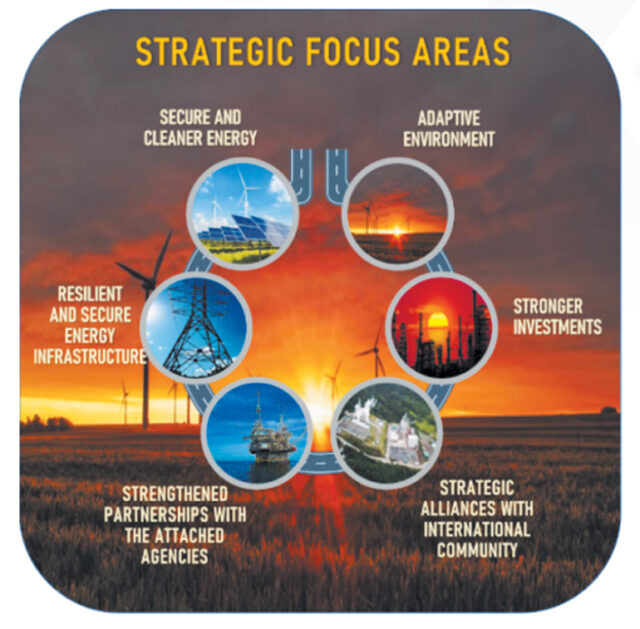
Renewables can help reduce emissions and empower a clean energy future. And in leading the country towards such a future, the DoE has laid out the blueprint and targets in the Philippine Energy Plan (PEP) 2020-2040.

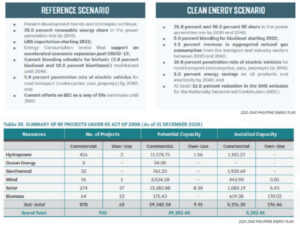
Under the Clean Energy Scenario (CES), the updated blueprint aims to increase the share of RE in the power generation mix to 35% by 2030, then 50% by 2040.

According to the PEP, renewable capacity expanded over 40% to 7,617 megawatts (MW) in 2020 from the 5,284-MW capacity in 2008, when the RE Act was passed.

Enabling policies and market support mechanisms that have been established have expedited the rapid RE deployment, as stated on the PEP.

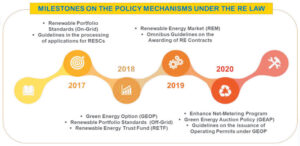
Among the issuances made was the Renewable Energy Market Rules, which indicated the conclusion of policy mechanisms provided under the RE law. Also launched was the Philippine Renewable Energy Market System (PREMS).

The Green Energy Auction Program (GEAP) was also issued, which provides additional market options through the auction of 2,000-MW renewable capacities from qualified RE suppliers. It seeks to foster a competitive setting in the country for RE supply.

Meanwhile, enabling the Green Energy Option Program (GEOP) gave end-users the option to select RE resources as their energy source.

Consumers are also empowered to be prosumers through the Net-Metering Program (NMP), which enables end-users to install up to 100 kilowatt (KW) of RE systems to lower their electricity bills and sell the surplus to the grid.

Another issuance to further encourage a more significant renewable resource utilization is the Open and Competitive Selection Process.

The DoE said they acknowledge renewables’ role in the government’s low-emission development strategy to contend with the challenges of climate change, energy security, and clean energy access. Hence, it “constantly works on setting aspirational targets, pushing stakeholders to respond to the call for cleaner, sustainable energy, and ensuring equitable access to affordable energy.”

Aligned with the PEP, the updated National Renewable Energy Program (NREP) 2020-2040 is also formulated, which works on providing a “cost-sensitive” and “demand-responsive” national program on RE.

In support of the NREP target, the RE road map brings in vital directions and deliverables for driving the renewables’ expansion in the energy system.

Included in the RE road map is accelerating RE positioning. Some of the medium-term activities are to establish Enhanced NMP in off-grid areas; execute GEAP; roll out GEOP; and study on Off-Shore Wind Development.

The road map also seeks to develop a conducive environment for businesses and reliable and efficient infrastructure, as well as promote and enhance research, design, and development agenda.

Renewable developments

2020-2040 Philippine Energy Plan

Progress in some plans set under the PEP has been made in expanding renewables in the country.

Last June, the DoE unveiled the results of the first auction round of GEAP, which saw a 98.3465% success rate. An RE capacity of 1966.93 MW has been committed to supply energy from 2023 to 2025 at a competitive price that is lower than or equal to the Green Energy Auction Reserve prices established by the Energy Regulatory Commission (ERC).

In the first round of GEAP, the DoE awarded 19 contracts. Of these contracts, 11 are in Luzon, which includes five solar contracts, four wind, and two hydropower. Two contracts, one wind and one solar, were awarded in Visayas; while four hydropower contracts and one each for solar and biomass were awarded in Mindanao.

RE developers who did not win in the first round or were not able to submit offers are encouraged by the DoE to take part in the succeeding auction rounds, since the GEA will be conducted on a yearly basis.

The department is now preparing to conduct the second GEA by June next year.

Moreover, in the shift to an increased RE share in the mix, natural gas is seen as a transition and flexible fuel that could support renewable-based generation. Having no indigenous replacement for natural gas supply from Malampaya, which concession would expire in 2024 and projected to be depleted by 2027, the DoE is focused on importing liquefied natural gas (LNG) through the development and operation of LNG receiving facilities.

So far, the DoE has approved the application of seven LNG import terminal projects. The department said in a statement that the Linseed Field Power Corp. is “on track” to complete its first integrated LNG import terminal in Batangas City, which is scheduled for commissioning in March 2023 and then the commercial operation in April. FGEN LNG Corp.’s LNG terminal is also scheduled for commissioning in March next year, while its commercial operation is set in June.

In addition, last November, the DoE announced that it is crafting an Executive Order (EO) to “strengthen and rationalize” the regulatory framework for the immediate development of offshore wind (OSW), given the interest in OSW potential among foreign and local investors.

This proposed EO would set out the regulatory framework for creating a “robust” OSW industry as well as comprises a long-term vision, infrastructure development, investments, and sound policies, according to DoE Secretary Raphael P.M. Lotilla.

As of November, 42 OSW wind service contracts have been awarded.

Last month, Alterenergy Holdings Corp. and Shell Overseas Investment have sealed their partnership for the development of the Calavite Passage OSW Project. Meanwhile, PetroGreen Energy Corp., along with Copenhagen Energy, has formed three special purpose vehicles for its OSW projects.

“I am optimistic that with the recent amendment of the Implementing Rules and Regulations (IRR) of the Renewable Energy Act of 2008, more foreign investors will come in to partner with our local companies,” Mr. Lotilla said.

The DoE is also looking into emerging technologies and marine renewable energy technologies.

Considering that diversifying the mix is an important step toward energy security, Michael O. Sinocruz, director for DoE’s Energy Policy and Planning, said at the BusinessWorld Economic Forum last month that the government is looking at harnessing alternative fuels such as green hydrogen and ammonia.

Meanwhile, Marissa P. Cerezo, director of the Renewable Energy Management Bureau, said earlier this month that the country’s clean energy strategy would count in harnessing ocean energy.

Renewable-generating facilities made up 28.9% of the total installed capacity in 2021, lower than its 32% share in 2016, according to the DoE’s Energy Accomplishment Report 2016-2022. This translated to 7,965 MW, with hydropower accounting for the highest share with 13.7% or 3,781 MW. Geothermal followed with 7% (1,928 MW), while solar significantly rose to 1,325 MW. Biomass and wind have a combined share of 3.4% with 489 MW and 443 MW, respectively.

“The RE-based capacity grew by 13.9% from 6,994 MW in 2016 to 7,965 MW in 2021, indicating the power sector’s gradual transition towards the utilization of cleaner energy fuels,” the DoE also noted. — Chelsey Keith P. Ignacio

Increasing adoption of electric vehicles in PHL

Photo from facebook.com/DOEgovph

The use of traditional fuels for transport has been observed to have caused problems for the environment, such as increased emissions of greenhouse gases to the environment. In addressing such alarming problems, electric vehicles (EVs) are being included as part of the solution.

As previously reported by the Philippine News Agency, total EV registration in the country for the past decade reached 12,965 comprising of e-trikes, e-motorcycles, e-jeepneys, and e-cars, among others. As the government ramps up its efforts for the development of the EV industry in the country, more vehicles of such type may be seen in the records and in our roads.

On the Department of Energy’s (DoE) end, part of their course of action is utilizing plug-in hybrid electric vehicles (PHEVs) as an alternative transportation system, which uses alternative fuels and energy technology. PHEVs are defined as “hybrid electric vehicles with a rechargeable energy storage system that can be charged from an external electric energy source.”

Alongside PHEVs, the DoE also launched Electric Vehicle Charging Stations (EVCS), which serve as charging stations that supply electrical energy for electric vehicles. ECVS include Battery Swapping Stations (BSS), which enables users to exchange their batteries for a fully charged battery; commercial use charging stations (CUCS), which are EVCS facilities available for the general public; and own-use charging stations (OUCS) for private use.

Recently, the DoE launched two new units of PHEVs and EVCS. According to the department, the PHEVs are expected to run a 135-kilowatt electric motor powered by an 8.3-kilowatt hour lithium iron phosphate battery and a 1.5-liter engine.

The department has also welcomed the approval of the Republic Act No. 11697, also known as the Electric Vehicle Industry Development Act (EVIDA), which has lapsed into law last April 15.

As stated in the act, EVIDA aims to “provide an enabling environment for the development of [EVs] including options for micromobility as an attractive and feasible mode of transportation to reduce dependence on fossil fuels.” Moreover, EVIDA authorizes the establishment of the Comprehensive Roadmap for the Electric Vehicle Industry (CREVI). The act also requires the government and companies to meet a 5% EV quota on their vehicle fleets.

Photo from facebook.com/DOEgovph

In a statement last April, the department said that EVIDA clearly identified the need to reduce the country’s reliance on imported fuel through the development of an enabling environment for EVs, as well as the need for intervention measures to spur the industry’s growth and potential, which includes, among others, incentives, demand generation and industry development, and roles and functions of government offices.

“We recognize that this law will allow us to transition to a clean energy scenario, and the support from all our stakeholders is needed so we may achieve a more efficient transportation system,” Former Energy Secretary Alfonso G. Cusi said in the same statement.

Following this passage, the Marcos administration recently has approved an executive order (EO) that will slash tariffs on some EVs, particularly bringing down the most favored nation tariff rates to zero percent on completely built-up units of some EVs for five years.

“The objective of this tariff reduction is to ensure that there are enough e-vehicles around and incentives after one year of implementation to assess its impacts on the development of the domestic EV industry,” Socioeconomic Planning Secretary Arsenio M. Balisacan was quoted as saying in a BusinessWorld report earlier in November.

“The EO aims to expand market sources and encourage consumers to consider acquiring EVs, improve energy security by reducing dependence on imported fuel and promote the growth of the domestic EV industry ecosystem,” he added.

The DoE has also been progressing in the implementation of the Energy Virtual One Stop Shop (EVOSS) system, albeit still seeking to include other agencies.

The EVOSS system is an online monitoring system catering to energy applications and storing energy-related information. The EVOSS system offers different services, including monitoring local energy projects, examining data requirements, establishing databases, and institutionalizing EVOSS operations.

“On the part of the Energy Regulatory Commission, they have also committed to speed up their implementation of EVOSS and to expand even beyond what is required by the law. In other words, other processes that the movements that EVOSS does not cover would also be subject to timelines and I think this is good to have this in mind, primarily since many structural reforms concern the energy sector,” current Energy Secretary Raphael P.M. Lotilla said in a message last September.

The secretary added that the DoE is expected to submit proposed Legislative and Executive Issuances in the coming months, such as the issuance of Implementing Rules and Regulations by the Energy Utilization Managements Bureau, to address the structural reforms in the energy sector.

Mr. Lotilla also emphasizes incorporating the collaboration between public and private sectors in the sector.

“We must remember that the private sector is our partner. And among the earliest forms of PPP (public private partnerships) was the service contract in the upstream sector. And with the risks our service contractors take, our risks are also very high, therefore, we see them as partners in this,” he said. — A.K.S. Brillantes

Growth may surpass target this year

PHILIPPINE STAR/EDD GUMBAN

THE PHILIPPINE ECONOMY likely saw strong growth in the fourth quarter, putting it on track to surpass the government’s full-year target, Socioeconomic Planning Secretary Arsenio M. Balisacan said on Monday.

“I think given the indications that we are seeing in the fourth quarter, it’s likely that we are going to exceed (the full-year target of 6.5-7.5%). We expect to see a robust growth in the fourth quarter,” he said at a briefing in Pasig City.

In the third quarter, gross domestic product (GDP) expanded by a better-than-expected 7.6%, bringing the nine-month average to 7.7%.

Mr. Balisacan earlier said GDP needs only to grow by 3.3-6.9% in the fourth quarter to achieve the full-year target.

Consumption, as well as more investments in construction, utilities, and mining, and increased productivity in agriculture, likely drove strong growth this year, he added.

The National Economic and Development Authority (NEDA) chief said GDP expansion would have been faster if not for rising inflation this year.

Headline inflation rose to a 14-year high of 8% in November, from 7.7% in October. For the 11-month period, inflation averaged 5.6%.

“But obviously in response to that inflation, our monetary authorities had to raise interest rates and the impact of that will be felt next year and will be felt even the year after,” Mr. Balisacan said.

The Bangko Sentral ng Pilipinas has raised its benchmark interest rate last week by 50 basis points (bps) to 5.5%. This brought the policy rate to the highest since November 2008 when it was at 6%.

Since May, the central bank has increased borrowing costs by a total of 350 bps.

For next year, Mr. Balisacan said the likely recession in major economies, persistent inflation, and the impact of BSP’s monetary tightening, may slow the Philippine economy’s growth.

The Development Budget Coordination Committee (DBCC) earlier this month revised its growth target for 2023 to 6-7%, a narrower range compared with 6.5-8%, previously.

“Despite the headwinds we face, the economic team of the Marcos administration remains confident of our prospects in the near term. A robust domestic economy, propelled by sustained consumption and investment, will be key to attaining the 6-7% growth target for 2023,” Mr. Balisacan said.

Meanwhile, NEDA said the Philippine Development Plan (PDP) 2023-2028 will address short-term issues and medium-term constraints to growth.

The NEDA Board, chaired by President Ferdinand R. Marcos, Jr., approved the PDP on Dec. 16.

Under the PDP, the government seeks to lower the unemployment rate to between 5.3% and 6.4% and bring inflation down to 2.5%-4.5%.

Mr. Balisacan said poverty incidence is also expected to drop to 16.2% in 2023 from 18.1% in 2021.

“The timely adoption of the PDP as the country’s development roadmap shall ensure the alignment of government resources, programs, projects, and activities along with the identified strategies that will enable us to achieve our desired socioeconomic objectives,” Mr. Balisacan said.

“The plan will address short-term issues such as protecting people’s purchasing power, mitigating the socioeconomic scarring in human capital, and ensuring that vulnerable population segments are provided targeted assistance,” he added.

Full of details of the PDP will be published by yearend.

MAHARLIKA
Meanwhile, Mr. Balisacan urged the Senate to act on the proposed bill creating the Maharlika Investment Fund (MIF) “the earlier the better,” saying that it could support the newly approved socioeconomic development plan of the country.

“The Maharlika Investment Fund is just another source of funds that will support our priorities, particularly investment priorities, and we see the Maharlika as another vehicle for sources of funds and investments,” he said.

He added that the MIF would be another source of financing for the government’s major infrastructure projects, such as the official development assistance, public private partnerships and national budget.

“The more vehicles you have, the better,” he said. “That will ensure that we can ramp up, not only the infrastructure, but even the other development priorities of the government.”

Last week, the House of Representatives approved on third and final reading the bill creating the MIF just over two weeks after it was filed by Speaker Ferdinand Martin G. Romualdez. — Keisha B. Ta-asan

Agri output may expand up to 2.5% next year

Fresh produce is sold at the Marikina Public Market, Oct. 7. — PHILIPPINE STAR/ WALTER BOLLOZOS

THE COUNTRY’S agricultural production is expected to expand up to 2.5% in 2023, according to the Department of Agriculture (DA).

Agriculture Undersecretary Mercidita A. Sombilla said the agriculture sector may grow faster in 2023 compared with this year.

“Hopefully we will be at 1.2% growth, so far we are expecting around 1.2% to 1.5% for this year. For 2023, our goal is 2.3% to 2.5%,” she told reporters on the sidelines of the DA’s yearender briefing on Monday.   

Preliminary data from the Philippine Statistics Authority showed the value of production in agriculture and fisheries at constant 2018 prices expanded by 1.8% in the third quarter, as growth in crops, livestock and poultry sectors offset the decline in fisheries output.

The third-quarter growth was a reversal of the 0.6% contraction in the second quarter, and the 2.6% decline in the same quarter in 2021.

For the January-to-September period, the value of agricultural production edged up 0.3%, reversing the 2.5% decline a year ago.

Despite challenges, Ms. Sombilla said the sector’s growth will likely be driven by the crops, livestock, and poultry sectors.

“I think the fourth quarter will give us a positive outlook,” she said.

However, Ms. Sombilla said the DA does not see any supply shortages of agricultural commodities next year.

“We don’t have any shortage of rice, low beginning stocks, yes. We suffered losses because of back-to-back typhoons but we don’t have shortage of supply,” she said.

Several typhoons caused significant agricultural damage, causing supply shortages this year. This has driven prices of key agricultural commodities higher in recent months.

Headline inflation accelerated to a 14-year high of 8% in November, mainly due to the spike in food prices. Prices of vegetables, fruits, and rice rose as a result of lower production brought about by  typhoon damage and higher cost of inputs.

Agriculture Senior Undersecretary Domingo F. Panganiban said onion supply will be enough next year as local supplies will enter the market in January and February.

“I think that we are in a position that by next year we shall have more supply,” he said at the same briefing.

Agriculture Assistant Secretary James A. Layug said the department is now in coordination with the Department of Justice to create a legal team against agricultural smuggling.   

Meanwhile, Mr. Panganiban defended President Ferdinand R. Marcos, Jr.’s decision to extend the reduction in tariffs on pork, corn, and rice until Dec. 31, 2023.

He said the DA is working to increase the production of agricultural products, and additional imports will ensure enough supply is available and keep prices stable.

“We need to balance the supply, in the case of typhoons during harvest season. We don’t want to see people suffering because of the rise of the prices. We need to stabilize production to lower the price,” Ms. Sombilla said. — AEOJ

Nigerian-related scams surged in 2020 — AMLC

REUTERS

NIGERIAN-RELATED cybercrimes in the Philippines surged in 2020, as syndicates took advantage of the accelerated digitalization at the height of the coronavirus pandemic, a report by the Anti-Money Laundering Council (AMLC) showed.

In a report, AMLC said it recorded 17,178 suspicious transaction reports (STRs) pertaining to Nigerian-related crimes in 2020, a 668% increase from the 2,236 reports in 2019.

The total value of the STRs jumped by 261% to P998.6 million in 2020, from P276.6 million in 2019.

“The notable rise in reported Nigerian-related crimes in the country should evidently be given attention. Aside from the significant amount, this study revealed that these unlawful transactions had been in existence in the country since 2009 and has proliferated up to the present,” the AMLC said.

The AMLC said it conducted the study amid the increasing incidence of online scams carried out by Nigerians, who operate within and outside the Philippines and use residents as mules.

“The pandemic served as precursor to signal the convenience and importance of digitizing the mode of transactions. What is glaring is that the increased use of online services during the pandemic also intensified the risks of cybercrimes,” the AMLC said.

Increased internet usage by Filipinos may have also contributed to the rise in cybercrimes, it added.

However, as lockdowns eased, the number of STRs linked to Nigerians declined by 47% to 9,036 in 2021, while the total value plunged to P569.9 million in 2021.

In its study, the AMLC noted the United States is the top source of foreign currencies linked to Nigerian-associated crimes, while most of the outward flows were sent to beneficiaries with addresses in Nigeria.

Meanwhile, the National Capital Region recorded the highest number and value of STRs, particularly Quezon City (highest in terms of value) and Las Piñas City (highest in terms of count).

AMLC noted banks are the main channels for the delivery of big-ticket proceeds likely related to Nigerian-related crimes. Electronic money issuers, money service businesses and pawnshops are used for “moderate amount transactions,” it added.

AMLC noted that there was a higher reporting volume of e-money issuers as it provides anonymity to the perpetrators.

Scams linked with Nigerians include the romance scam, advance fee scam, and inheritance/package scam. However, the study also identified some red flags for transactions, such as deposits from unverified sources, involvement in illegal drugs, and inconsistent transactional activities with a subject’s business profile.

The top five illegal activities identified in the study are unsubstantiated transactions; advance fee fraud; unauthorized transactions from mostly compromised accounts; pass-through/money mules, and package scam.

AMLC noted cryptocurrency’s vulnerability to money laundering as crypto-related transactions also generated significant STRs.

To prevent the proliferation of these crimes, the AMLC encouraged covered persons to submit STRs on Nigerian subjects and their cohorts.

The study also recommends the involvement of AMLC’s asset management group to trace the assets of scammers and other claimants. — K.B.Ta-asan

Why Marcos’ sovereign wealth fund plan is controversial

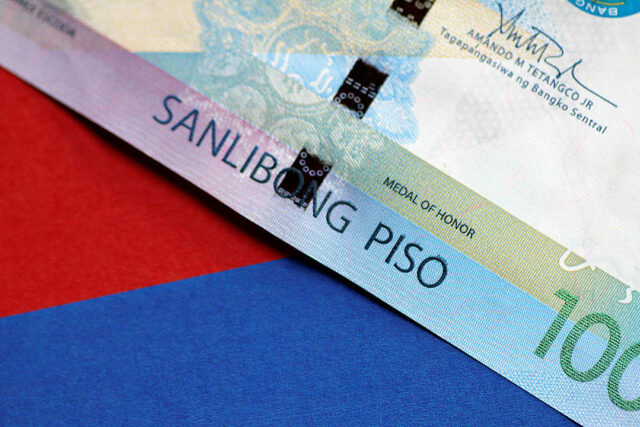
A Philippines peso note is seen in this picture illustration on June 2, 2017. — REUTERS

THE PHILIPPINES is preparing to establish a sovereign wealth fund, a move that’s being pushed by Ferdinand R. Marcos, Jr., the late dictator’s son who became president earlier this year, but is seen as controversial by some observers.

The proposal for the fund faced a backlash soon after Marcos’ allies filed it in Congress. Even the central bank chief, Felipe M. Medalla, initially expressed reservations, questioning how it would be governed and drawing a comparison to the scandal-tainted Malaysian state investment fund 1Malaysia Development Berhad (1MDB).

The bill was revised after a public outcry: the fund will no longer dip into people’s pension savings and the central bank’s reserves. A new version that says it will get money from state-owned banks has won the support of lawmakers and is likely to be passed.

Here’s what you need to know about the proposed fund and its controversies.

WHAT’S THE PLAN?
The wealth fund’s stated objective is to get the most out of government assets by investing in stocks, corporate bonds, commodities, foreign currencies and infrastructure projects, among others. The money generated will then be used for social-welfare projects, paying dividends to contributors and so forth.

The fund will secure capital from two state lenders: P50 billion ($899 million) from Land Bank of the Philippines, and P25 billion from the Development Bank of the Philippines. The central bank will also contribute all its dividends for the first two years of the fund’s operation. Other state-run companies and private sector financial institutions, including foreign ones, can also chip in. Marcos has said that he hopes a wealth fund will help boost foreign investments in the Philippines.

In subsequent years, the Bangko Sentral ng Pilipinas will put in half its dividends and use the other half to increase its own capital. The fund will also receive annual contributions from gaming revenue, natural resource royalties and proceeds from government asset sales and public borrowing.

A board of directors led by the finance minister will manage the fund, which will be subject to internal and external audits.

WHY NOW?
This isn’t the first time setting up a sovereign wealth fund has been floated in the Philippines. A similar proposal was filed during the previous administration, but it didn’t advance in the legislature.

What’s different now is that Marcos and his government are strongly backing the idea. They say it would help boost economic growth and give the government more fiscal leeway. Even Mr. Medalla, the central bank governor who initially aired concerns, is now supportive, seeing the revised proposal as a way to attract foreign investors.

WHAT ARE THE CONCERNS?
The biggest worry is the potential for corruption. In Southeast Asia, the goings-on at 1MDB are never far from people’s minds. Former Malaysian Prime Minister Najib Razak began a 12-year prison sentence this year for his involvement in the multibillion-dollar scandal linked to the troubled fund.

The Philippines has many cautionary tales of its own of giving those in power unhampered access to state resources. Marcos Jr.’s own father was ousted by a mass uprising in 1986 after some $10 billion was allegedly siphoned during his two-decade rule.

“This muddled, inconsistent and redundant bill is only setting” the planned wealth fund up for “failure and will only enable cronyism, rent-seeking and corruption,” economic think tank members, university professors and former senior government officials said in a statement.

Still, the Congress proposal mandates that international standards be followed to safeguard the wealth fund, and requires its board to create a risk-management unit.

Another concern is that wealth funds usually invest surplus funds but the Philippines has been running fiscal and trade deficits.

WHAT’S NEXT?
The bill will go to the Senate after it was quickly passed by the House of Representatives, winning approval in just 18 days while other bills take months to go through. Senators aligned with the president form a majority. Mr. Marcos has declared the bill urgent, allowing for faster approval. Once endorsed by both houses it will be signed into law by the president.

For some observers, this is far from good news.

“There is no urgency and necessity for the enactment” of this bill, said lawmaker Edcel Lagman, one of the six who rejected the proposal in the 312-member House. “We must bail out our people today from poverty, inflation and the dire prospects of recession, rather than investing in long-term ventures.” — Bloomberg

The Eraserheads come together for a reunion concert

Expect an orchestra, a hologram, and Mr. Pure Energy to join them onstage

IN September this year, the Eraserheads members posted a logo of a reversed letter “E” on their social media platforms. The post sparked a viral conversation revolving around the band’s possible reunion. Three months later, fan’s hopes are coming true with the holding of The Eraserheads: Huling El Bimbo concert on Dec. 22, 8:30 p.m. at the SMDC Festival Grounds at Parañaque City.

Band members Ely Buendia (lead vocals and rhythm guitar), Buddy Zabala (bass guitar and backing vocals), Raimund Marasigan (drummer and backing vocals), and Marcus Adoro (lead guitar and backing vocals) will perform together that night for the first time in eight years.

“I thought I would be sick of the journey by now, so far it still has been full of surprises,” lead vocalist Ely Buendia said of the reunion with the band, at a press conference at the Dolphy Theater in Quezon City on Dec. 7.

The Eraserheads were formed when the band members were students at the University of the Philippines-Diliman. The band rose to fame in the 1990s with a series of hit songs such as “Ang Huling El Bimbo,” “Magasin,” “Ligaya,” “Pare Ko,” “Alapaap,” and “With a Smile.”  The group disbanded in 2002.

In 2008, they reunited for one-night concert, but Buendia — who had been suffering from heart problems for some time — collapsed during the show and the performance was halted midway. The reunion concert pushed through in 2009. Occasional appearances by the band were held in 2012 and 2014.

“The past 30 years has been full of many detours for each of us. I think the stuff that we’ve learned the past 30 years on our own, we will bring in on Dec. 22…,” bass guitarist Buddy Zabala said during the press conference. “I think we’ve matured as musicians. I think we’ve matured as performers.”

ORCHESTRA, HOLOGRAM, AND GARY V
The concert repertoire will include their greatest hits plus never-performed before songs which were recorded for their previous albums. They will be backed by an 18-piece orchestra, and be joined onstage for certain songs by the late Francis Magalona via hologram, and “Mr. Pure Energy” Gary Valenciano.

“One thing that I was nervous about coming into the project was working with the E-heads, I wasn’t sure what that dynamic would be like,” concert director Paolo Valenciano (the son of Gary Valenciano) said.

“I’ve worked with divas in the past and a lot of them have given me headaches — I won’t name names,” said the director. “I thought [that] I would be working with a bunch of rockstars that would be giving me a hard time wanting this and that, but surprisingly it’s been very easy working with the band.”

The concert sold out in early October, and then additional tickets and a new General Admissions seated section was announced later in the same month. On Nov. 9, it was announced that the venue had been expanded to accommodate more audience members.

Para sa manonood (For those watching), get a very good night’s sleep. Get there on time. Get your phones charged. Paghandaan niyo (Prepare for it),” lead guitarist Marcus Adoro advised concert goers.

“We want it to be a good show. We fight for things that we think would make it a good show,” drummer Raimund Marasigan said.

Mr. Marasigan said that the band has requested more portable toilets, places to buy food and drinks, designated places for seniors, and a room for children.

“We asked for things like streaming services… We asked for more space in SMDC so there is more space opening, [and] more tickets so we can get more people in to catch the show,” Mr. Marasigan said.

The Eraserheads: Huling El Bimbo will be livestreamed on iWantTFC for $29.99 (https://app.iwanttfc.com/HulingElBimboConcert2022) with the link available to view within 48 hours for viewers outside the Philippines. Smart Communications, Inc. is also offering live pay-per-view access via the new Smart LiveStream App for P650 (smart.com.ph/livestream). The concert is also available on pay-per-view on Cignal TV for P650 (https://cignal.tv/article/2966/eraserheads-huling-el-bimbo-ppv).

Despite the band’s individual detours in the past years, performing live for the fans is never exhausting.

Hindi nakakapagod pero napapagod kami (It is not tiring, but we get tired too) because we are not as young as we used to be,” Mr. Marasigan said about the energy and screaming when playing live. “But we can’t help it. When you play rock and roll, it cannot just be 20% it has to be 110%.”

“We wanted to make sure that the fans are happy… and then, at the same time, there are songs they have not done ever that — I’ve seen them at rehearsals — it makes them happy,” director Mr. Valenciano said.

“It really is going to be a night to remember for music fans and E-heads fans,” he said.

Concert promoter Francis Lumen said that there plans to bring the concert on tour overseas for the Filipino audience abroad. A documentary on the making of the reunion concert is also in production. — Michelle Anne P. Soliman

PLDT shares plummet 19%; regulator starts probe

By Arjay L. Balinbin, Senior Reporter

SHARES in PLDT, Inc. fell more than 19% on Monday after reporting an estimated P48-billion budget overrun over the past four years, which caused the telecommunications giant to reorganize its management.

PLDT shares closed 19.35% lower at P1,192 apiece. The stock was down 28.54% from the highest close of P1,668 last week.

“This is a 52-week low; lowest for 2021 was during March at P1,195 per share,” Adrian Alexander N. Yu, head of institutional sales at stock brokerage house COL Financial Group, Inc., told BusinessWorld in a Twitter chat.

Mercantile Securities Corp. Analyst Jeff Radley C. See sees “tough times” for the Pangilinan-led telecommunications service provider after its announcement last week regarding a massive budget overrun.

“Investors would see more selling pressure and might dip towards its next support level at P1,083,” Mr. See said in a phone message.

Regina Capital Development Corp. Equity Analyst Anna Corenne M. Agravio said in a separate phone message: “While the news took the market by surprise, today’s price plunge overshot the actual impact on PLDT’s P&L (profit and loss) and long-term prospects.”

“So far, it looks like the company has more than enough legroom to either take on more leverage if need be, to supplement the gains from its tower sales and make up for the budget overrun,” she added.

“At this rate though, the stock is still overheating from the negative sentiment.”

Price-wise, PLDT must first find and establish support that could catch further drops, Ms. Agravio pointed out. “Expect large and relatively more volatile swings trading-wise in the next few days as investors digest the news.”

BusinessWorld is still awaiting clarification from PLDT on a news report on Saturday that the “anomalous supply deals” were initially estimated to be close to P130 billion before being reduced to P48 billion. “We have nothing to share at this point beyond the disclosure,” the company said when asked for confirmation and clarification.

The company said that it is undertaking a management reorganization process and has initiated improvements in its processes and systems to address weaknesses.

Anabelle L. Chua, PLDT’s chief financial officer, is in charge of overseeing the company’s financial activities. The company has so far announced three major appointments: Danny Y. Yu as group controller effective Nov. 17 and Emmanuel Ramon C. Lorenzana and Joseph Ian G. Gendrano as chief transformation and customer officer and chief technology officer, respectively, effective Jan. 1.

Joey Roxas, president of Eagle Equities, Inc., told BusinessWorld Live on OneNews that the budget overrun may have come in trickles.

“I think… it wasn’t noticed immediately, and that’s why we’re looking now at four years,” he said.

He also said that the budget overrun can be lower than the P48 billion stated in PLDT’s disclosure. “In the press release, it’s a maximum of P48 billion, and that figure… can go down.”

“The other thing also is they’re planning to sell more towers next year,” he added.

The P48-billion budget overrun represents 12.7% of PLDT’s P379-billion capital expenditure over the past four years.

INVESTIGATION
According to the Securities and Exchange Commission (SEC), it is closely monitoring issues that have arisen from the announcement of PLDT regarding the budget overrun as well “selloff in shares” prior to the disclosure on Friday last week.

These are “areas of concern for the commission being the regulator of the securities market and the champion of investor protection in the country,” the SEC said in a statement on Monday,

“In this light, the SEC has immediately commenced an inquiry into the matter,” the regulator said.

At the same time, the SEC said that PLDT needs to clarify its disclosures to the commission and The Philippine Stock Exchange, Inc. (PSE) in relation to statements attributed by the media to the company and its officers, especially with regard to the nature of the P48-billion expenditure.

“The SEC has likewise directed PSE and Capital Markets Integrity Corp. (CMIC) to submit initial reports on their investigation into the trading activities that have resulted in the sudden and sharp decline in the share prices of PLDT before the official disclosure of the ‘budget overruns,’ among others,” the regulator noted.

CMIC serves as the independent audit, surveillance and compliance arm of PSE.

The regulator vowed to closely monitor the investigation.

“[The SEC] will continue to conduct a parallel, independent inquiry into the matter to safeguard the interest of the investing public,” it said.

PLDT’s Ms. Chua also sits on the board of the PSE, which is also conducting an investigation. The PSE  has yet to respond to BusinessWorld’s request for comment.

Hastings Holdings, Inc., a unit of PLDT Beneficial Trust Fund subsidiary MediaQuest Holdings, Inc., has a stake in BusinessWorld through the Philippine Star Group, which it controls. — with input from Justine Irish D. Tabile

Bonifacio High Street is the most expensive shopping district in PHL

THE country’s first outdoor, larger-than-life 3D-LED screen is located in One Bonifacio High Street, Bonifacio Global City in Taguig City. — PHILIPPINE STAR/ WALTER BOLLOZOS

FIFTH AVENUE in New York City is the world’s most expensive shopping street once again, according to a new global ranking from real estate services firm Cushman & Wakefield.

The report, “Main Streets Across the World,” showed Fifth Avenue was the most expensive retail district in the United States, with an annual rent of $2,000 per square feet (sq.ft.) or €21,076 per square meter (sq.m.).

The second most expensive shopping street was Hong Kong’s Tsim Sha Tsui, where rent averaged $1,436 per sq.ft. or €15,134 per sq.m. annually.

Bonifacio High Street ranks 41<sup>st</sup> in expensive rentals in the worldThird spot went to Milan’s Via Montenapoleone at $1,380 per sq.ft. per year or €14,547 per sq.m., making it Europe’s most expensive shopping street.

Ranked fourth and fifth respectively were New Bond Street in London and Avenues des Champs Elysees in Paris.

Rounding out the top ten most expensive shopping streets were Ginza in Tokyo; Banhofstrasse in Zurich; Pitt Street Mall in Sydney; Myeongdong in Seoul; and West Nanjing Street in Shanghai.

Bonifacio High Street is the most expensive retail district in the Philippines, but was 41st in Cushman & Wakefield’s global ranking.

However, Bonifacio High Street’s annual rent remained at pre-pandemic levels of $46 (around P2,550) per sq.ft. or €480 (around P28,200) per sq.m., and significantly lower than the rents in Fifth Avenue and Tsim Sha Tsui.

Claro Cordero, director and head of research, consulting and advisory services at Cushman & Wakefield, said the retail environment in the Philippines at the height of the pandemic was similar to other markets when most businesses were put to a standstill.

The Philippines implemented strict lockdowns for most parts of the country starting mid-March 2020 to prevent the spread of the coronavirus disease 2019 (COVID-19). Restrictions have since been lifted.

“(The) high-end retail segment is seen to gain lost grounds in the medium-term, while full recovery of the mid-end retail segment will take a while due to challenges in the growth of consumer spending attributable to the escalating prices of goods and services,” Mr. Cordero said in a statement.

Demand for luxury will continue to grow as wealthy shoppers are undaunted by high inflation, he added.

“In the Philippines, the decoupling of the high-end/luxury and mid-end segment post-pandemic will be largely due to the ability of the luxury brand operators to embrace changes in consumer preference and shopping habits,” Mr. Cordero said.

He noted that new retail space completions in the mid-end segment remained “lackluster as developers reassess expansion strategies in favor of more resilient asset classes.”

“As retail space vacancies in the mid-end segment were still observed to be high compared with pre-pandemic averages, the high-end retail segment has since recovered due to improvement in mall features (such as higher ceiling, better air circulation that mimic ‘outdoor’ spaces) that enhance ‘experiential shopping’,” Mr. Cordero said.

Cushman & Wakefield’s Main Streets Across the World report monitors the top retail streets around the world, ranking the most expensive in 92 cities by prime rental value using the company’s data. The latest report is the first since 2019.

Cushman & Wakefield noted that rents in prime retail districts fell by an average of 13% during the height of the pandemic, but have now rebounded to just 6% below pre-pandemic levels.

Rental growth averaged 2% globally, but this varied by region. Asia-Pacific saw rents plunging 17% on average as border closures hurt tourist hotspots. In EMEA, rents fell by 11%, while the drop in the Americas was at 7%.

Global retail market rents have rebounded by around 50% since the height of the pandemic.

However, this rebound was mostly seen in 2021 and early 2022 before global economic headwinds impacted markets in the last six months, according to Cushman & Wakefield.

“The industry has been through one of the biggest stress tests imaginable over the past few years, but retail real estate has come out of the other side stronger, with brands understanding their customers better than ever,” Robert Travers, head of Europe, Middle East, and Africa (EMEA) Retail at Cushman & Wakefield, said in a statement.

“With further investment in high-quality in-store experiences and advances in omnichannel approaches, we are confident in the resilience of the sector, particularly at the luxury end, and in key global destinations,” he added. — Cathy Rose A. Garcia

Pricey Avatar sequel opens shy of forecasts on its box office journey

IN LINE WITH the release of James Cameron’s Avatar: The Way of Water, a 3D billboard teaser was unveiled at Bonifacio Global City, Taguig, giving a glimpse into why the film is best experienced in 3D, 4D, and IMAX formats. Located at One Bonifacio High Street, the billboard features the character Kiri, a young Na’vi, seemingly leaping from the screen while riding a Pandoran creature. For information on tickets to the film, visit https://20thcenturystudios.asia/avatar-2-the-way-of-water/ph.

LOS ANGELES — James Cameron’s long-awaited Avatar sequel fell short of ticket sales forecasts as it swept into theaters over the weekend, though box office experts said it was too soon to judge whether the movie would recoup its massive costs.

Avatar: The Way of Water racked up roughly $435 million around the globe, distributor Walt Disney Co. said, including $134 million in the United States and Canada.

Pre-weekend predictions called for at least a $140-million domestic tally for Mr. Cameron’s decade-in-the-making return to the story of the blue Na’vi people on a moon called Pandora, and as much as $500 million worldwide.

While the numbers came in lower than projections, the global total ranked as the third-highest Hollywood opening of the COVID-19 pandemic, according to Comscore.

Box office analysts said The Way of Water had the chance to draw large family audiences over the Christmas and New Year’s holidays. The film has little major competition until February.

The Way of Water is “built for the long haul, as are almost all James Cameron films,” said Jeff Bock, senior media analyst at Exhibitor Relations Co. Audiences “may not show up the opening weekend, but they will show up eventually.”

Studios split ticket sales with theaters, and Mr. Cameron has said The Way of Water will need to make $2 billion just to break even. Disney has not disclosed the budget and marketing costs.

The movie was released 13 years after the first installment wowed audiences with pioneering 3D technology. The original Avatar remains the all-time box office champion with $2.9 billion in global ticket sales.

The first Avatar and Mr. Cameron’s Titanic, which also dominated at the box office the year it was released, played in theaters for weeks longer than most movies.

Tony Chambers, head of theatrical distribution at Disney, said he expected The Way of Water to bring in strong sales over the holiday period and said its performance should be judged after the New Year.

“We know it’s resonating,” he said, noting positive reactions from ticket buyers and film critics. “We are in very good shape.”

The sequel was delayed multiple times as Mr. Cameron and co-writers crafted a story to be told over four additional movies. A third Avatar installment and part of a fourth already have been filmed.

In The Way of Water, actors Sam Worthington and Zoe Saldana return as Jake Sully and Neytiri 10 years later, now parents of five children. Their peaceful life is interrupted when the Sky People, the Na’vi name for humans, return to go after Jake.

Film critics praised the visual spectacle of The Way of Water, and 94% of ticket buyers provided a positive rating on the Rotten Tomatoes website. — Reuters

ADVERTISEMENT
ADVERTISEMENT