Home Blog Page 5481

Jeremy Clarkson’s Meghan column most complained about ever UK press regulator

LONDON — A Sun newspaper column by British television presenter Jeremy Clarkson about Prince Harry’s wife Meghan has become the press standards regulator’s most complained about article, it said on Tuesday, with more than 17,500 complaints received.

In a column published on Friday, Clarkson, who gained worldwide fame as presenter of motoring show Top Gear, wrote of Meghan: “I hate her. Not like I hate (Scottish First Minister) Nicola Sturgeon or (serial killer) Rose West. I hate her on a cellular level.

“At night, I’m unable to sleep as I lie there, grinding my teeth and dreaming of the day when she is made to parade naked through the streets of every town in Britain while the crowds chant, ‘Shame!’ and throw lumps of excrement at her.” Mr. Clarkson on Monday said he was “horrified to have caused so much hurt.” The article has now been removed from the Sun’s website.

The Independent Press Standards Organization (IPSO) said it had received more than 17,500 complaints so far, the most about any article since it was established in 2014.

More than 60 lawmakers signed a letter written by Caroline Nokes, chair of parliament’s Women and Equalities Select Committee, to the editor of the Sun warning such articles contribute to a climate of hatred and violence against women.

“Enough is enough. We cannot allow this type of behavior to go unchecked any longer,” said the letter, which was posted on Twitter by Nokes. “We now demand action is taken against Mr. Clarkson and an unreserved apology is issued to Ms. Markle immediately.”

The Duke and Duchess of Sussex, as Harry and Meghan are officially known, stepped down from royal duties in March 2020, saying they wanted to forge new lives in the United States away from media harassment.

In a Netflix documentary series which concluded last week, Meghan spoke about how her treatment by the media had left her feeling suicidal as well as concern over whether she and her children were safe. — Reuters

Court convicts former bank officer for creating fake loans

A FORMER rural bank officer was sentenced to a year of imprisonment for creating fake loan accounts in a financial statement submitted to the Bangko Sentral ng Pilipinas (BSP) for which the executive pleaded guilty.

In a statement on Wednesday, the BSP said: “The Municipal Circuit Trial Court of Carmen-Sto. Tomas-Braulio E. Dujali of Davao del Norte convicted a former officer of the now-closed Rural Bank of Sto. Tomas (Davao), Inc. for violating Section 35 of Republic Act (RA) No. 7653 (The New Central Bank Act).”

Based on charges filed by the central bank, the court convicted Rosele R. Solis for creating several dummy loan accounts in the bank’s Financial Reporting Package-Balance Sheet as of Sept. 30, 2012.

“Section 35 of RA No. 7653 punishes the willful making of a false or misleading statement on a material fact to the Monetary Board or the BSP examiners,” the BSP said.

Under the law, anyone who creates false or misleading statements that are true to the BSP may be fined P100,000 to P200,000 or imprisoned for five years at most, at the court’s discretion.

In a separate statement, the Monetary Board revoked the license to operate as a nonstock savings and loan association of Manila Teachers’ Savings and Loan Association, Inc. (MTSLAI).

The revocation was signed by the Monetary Board in Resolution No. 735 dated May 26 for violating RA 8367 or the Revised Non-Stock Savings and Loan Association Act of 1997 as well as BSP rules and regulations.

The Monetary Board, in Resolution No. 1676 on Nov. 17, denied the request for reconsideration on the revocation of MTSLAI’s license to operate as a nonstock savings and loan association.

“The BSP fosters the soundness of the financial system by promoting good corporate governance and regulatory compliance among its supervised financial institutions,” the central bank said. — Keisha B. Ta-asan

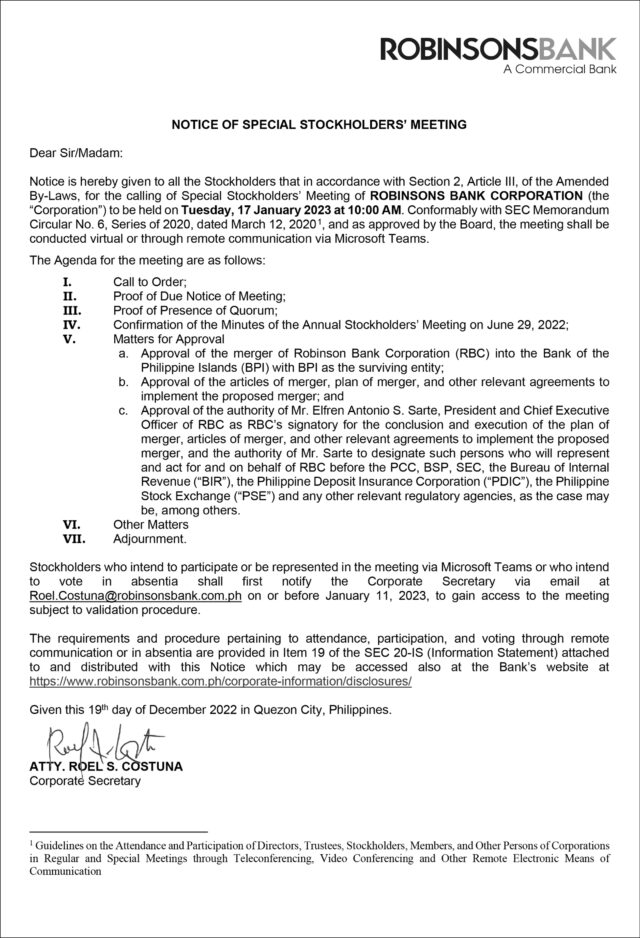
Robinsons Bank Corp. to hold special stockholders’ meeting on Jan. 17


Spotlight is BusinessWorld’s sponsored section that allows advertisers to amplify their brand and connect with BusinessWorld’s audience by enabling them to publish their stories directly on the BusinessWorld Web site. For more information, send an email to online@bworldonline.com.

Join us on Viber to get more updates from BusinessWorld: https://bit.ly/3hv6bLA.

Mastercard, UNO Digital Bank offer numberless debit card

MASTERCARD, Inc. and UNO Digital Bank have partnered to launch the country’s first numberless debit card to address security concerns on online and offline payments.

In a press release on Wednesday, the companies said that the card shows only the cardholder’s name and the logos of Mastercard and UNO Digital Bank. They added that the feature averts the risk of personal or financial data theft in case the card is lost or stolen.

They also said that the important details of the card are instead embedded in its chip for safe transactions.

“The numberless UNO Debit Mastercard combines security with convenience, bringing together the advantages of a safer and more secure debit card,” Mastercard Philippines Country Manager Simon Calasanz said.

“Through this partnership, Mastercard is enabling innovative, easy-to-use and frictionless transactions for consumers as they spend and seek priceless experiences,” he added.

A cardholder is given the option to lock a card temporarily and to reset the daily transaction limit in-app anytime to prevent misuse.

An email or an SMS alert will be sent every time there is a transaction to monitor usage. A cardholder will also be alerted of suspected fraudulent activity.

The physical card is PIN-enabled and contains a Europay Mastercard Visa (EMV) chip to lessen potential fraud or risk.

For convenience, the card also has Mastercard’s Tap & Go feature which can be used at point-of-sale terminals that have the universal contactless symbol for easier checkout.

Aside from online payments, the physical card can be used for cash withdrawals at ATMs where Mastercard is accepted, both locally and overseas.

Mastercard and UNO Digital Bank said the physical card is made from recyclable plastic and is composed of 85.5% polyvinyl chloride plastic, making it eco-friendly.

“Working with Mastercard has provided us with the opportunity to offer our customers an innovative payment experience through a numberless card. While we are on a mission to provide a single trusted interface to manage one’s entire financial life cycle journey, we continue to aim to be a trusted partner,” UNO Digital Bank Chief Executive Officer Manish Bhai said.

“Through the numberless UNO Debit Mastercard, the first in the country, we can demonstrate how innovation can elevate the banking experience,” he added. — Aaron Michael C. Sy

TikTok ban for US government phones advances, threatening its ad revenue, experts say

SOLEN FEYISSA-UNSPLASH

WASHINGTON — A proposal to bar federal employees from using Chinese app TikTok on government devices appeared set to become law, threatening to deal a blow to the company’s reputation and scare off advertisers even if it will not affect many users, experts said.

US lawmakers early on Tuesday included the proposal in a key spending bill, as first reported by Reuters, virtually ensuring its passage later this week following a Senate vote to green-light a similar measure.

The move is the latest US effort to crack down on the popular social media platform, which has been the subject of a slew of recent state bans and a long-running US national security probe over fears the app could be used by the Chinese government to censor content or spy on Americans.

While the new federal ban is not expected to put a significant dent in TikTok’s estimated 130 million US users, experts consulted by Reuters said the measure could damage the company’s reputation, which could in turn scare away valuable advertisers.

“That is what TikTok is at massive risk for: of having that brand reputational (blow) impact the overall revenue monetization that they can make,” said Eunice Shin, a partner at brand strategist Prophet.

TikTok said in a statement it was “disappointed that Congress has moved to ban TikTok on government devices — a political gesture that will do nothing to advance national security interests — rather than encouraging the administration to conclude its national security review.”

The ban was tucked into a massive omnibus measure to fund US government operations that is expected to be voted on this week and then sent to President Joseph R. Biden for his signature. The bill gives the White House Office of Management and Budget 60 days “to develop standards and guidelines for executive agencies requiring the removal” of TikTok from federal devices.

Many federal agencies, including the White House and the Defense, Homeland Security and State departments, already banned TikTok from government-owned devices.

White House National Security Council spokesperson Adrienne Watson said late Tuesday the Biden administration welcomes “Congress codifying this restriction across the federal government” and noted the Biden administration “has never allowed TikTok on White House devices.”

“The ban is minimal, extraordinarily minimal on the overall TikTok user base,” said Matthew Quint, a brand expert at Columbia Business School. “The question is more, ‘will this action get the ball rolling to create a bipartisan movement to fully ban the service because of a potential threat to national security?’”

The proposal last week won the backing of Democratic House Speaker Nancy Pelosi and House Republican Leader Kevin McCarthy.

But prior bids to ban the app have run up against free speech concerns. In 2020, Republican then-President Donald Trump attempted to block new users from downloading TikTok and to ban other transactions that would have effectively barred the app’s use in the United States but lost a series of court battles in part on free-speech grounds.

Efforts to ban the app have gained steam in recent weeks after US FBI Director Christopher Wray said last month it poses national security risks, flagging the threat that the Chinese government could harness the app to influence users or control their devices.

On Monday, state agencies in Louisiana and West Virginia became the latest to ban the use of TikTok on government devices over concern that China could use it to track Americans and censor content.

Some 19 of the 50 US states have now at least partially blocked access on government computers to TikTok. Most of the restrictions came within the past two weeks.

The US government Committee on Foreign Investment in the United States, a national security body, has for months sought to reach a national security agreement to protect the data of US TikTok users, but it appears no deal will be reached before year’s end. — Reuters

How PSEi member stocks performed — December 21, 2022

Here’s a quick glance at how PSEi stocks fared on Wednesday, December 21, 2022.


Manila ranked 26th most expensive city in Southeast Asia in terms of premium office space occupancy costs

Manila ranked 60th out of 134 real estate markets in the 2022 edition of the Premium Office Rent Tracker report published by real estate consultancy firm Jones Lang LaSalle (JLL). The index measures and compare occupancy costs which include rent, service charges, and taxes of premium office buildings. Manila’s occupancy cost amounted to $41 per square foot per year, making it 26th most expensive premium office space among 36 East and Southeast Asian cities included in the report.

Manila ranked 26<sup>th</sup> most expensive city in Southeast Asia in terms of premium office space occupancy costs

Peso maintains strength on possible future interest rate increases

BW FILE PHOTO

THE PESO further appreciated on Wednesday after the central bank’s hawkish view on future rate hikes, driving the local currency’s strength not seen since its July 4 finish of P55.08 per dollar.

It ended at P55.10 against the greenback, up by 14 centavos from Tuesday’s P55.24 close, data from the Bankers Association of the Philippines showed.

After opening at P55.10 per dollar, the peso reached its weakest showing on Wednesday’s session at P55.29. Its intraday best was at P55.04 versus the greenback. Dollars traded inched down to $833.7 million from $940.55 million on Tuesday.

A trader said in an e-mail that the peso strengthened after the Bangko Sentral ng Pilipinas (BSP) said on Tuesday that it might hike borrowing costs by 25 basis points (bps) in the next two policy meetings.

“The peso strengthened after BSP Governor [Felipe M.] Medalla hinted at more local policy rate hikes in 2023,” the trader said.

The BSP said it aims to bring inflation to nearly 3% by the third quarter.

“Our goal is to have inflation between 2-4%, preferably closer to 3% than to 4% by the third quarter of next year, and then the fourth quarter until 2024 will also be like that. That’s our goal,” Mr. Medalla told reporters on Tuesday.

National inflation accelerated to a 14-year high of 8% in November, bringing the full-year average to 5.6%.

The inflation figure is lower than the BSP’s 5.8% forecast for the whole year but well above its 2-4% target.

The BSP raised borrowing costs by 50 basis points (bps) to 5.5% on Dec. 15, bringing the policy rate to its highest since November 2008 when it was at 6%.

The Monetary Board has hiked rates by a total of 350 bps since May.

Mr. Medalla said that the central bank might consider smaller rate hikes next year, noting a higher chance of 25-bp or 50-bp rate increases at its next two policy meetings.

Meanwhile, a second trader said via Viber that the peso’s strength was more due to “decent” dollar inflows.

In a Viber message, Rizal Commercial Banking Corp. Chief Economist Michael L. Ricafort credited the peso’s further strengthening to the timing of the last two trading days before Christmas, which also caused the continued seasonal increase in foreign exchange inflows.

For Thursday’s movement, Mr. Ricafort expects the local currency to range between P55 and P55.20. The first trader gave a similar forecast of P55 to P55.25 while the second trader sees the peso moving at a range of P55 to P55.35 per dollar. — Aaron Michael C. Sy

Stocks rise on bargain hunting and stronger peso

PHILIPPINE STAR/KRIZ JOHN ROSALES

LOCAL shares climbed on Wednesday on bargain hunting as the peso strengthened versus the greenback amid higher investment pledges approved by the Philippine Economic Zone Authority (PEZA).

The benchmark Philippine Stock Exchange index (PSEi) climbed by 62.68 points or 0.97% to close at 6,520.80 on Wednesday, while the broader all-shares index rose by 35.43 points or 1.04% to 3,419.83.

“Market cheered BSP (Bangko Sentral ng Pilipinas) messaging that the period of strong dollar is over, spurring emerging market risk appetite,” First Metro Investment Corp. Head of Research Cristina S. Ulang said in a Viber message.

On Wednesday, the local currency ended at P55.10 against the greenback, up by 14 centavos from Tuesday’s P55.24 close.

The peso opened the session at P55.10 per dollar, also its closing value, and reached its weakest showing for the day at P55.29. Its intraday best was at P55.04 versus the dollar.

“The local bourse gained … amid continued bargain hunting. Also, strong investment pledges approved by the PEZA, boosted the sentiment,” Philstocks Financial, Inc. Research Analyst Claire T. Alviar said in a Viber message.

PEZA said it approved 198 projects this year, which are expected to generate P140.7 billion or more than double last year’s P69.3 billion. The rise was due to several big-ticket projects, helping the investment promotion agency surpass its 6.7% growth target for 2022.

On Wednesday, most of the sectoral indices closed higher except services, which inched down by 0.79 points or 0.05% to close at 1,589.68.

Meanwhile, mining and oil surged by 364.01 points or 3.54% to close at 10,639.61; financials added 32.54 points or 2% to 1,659.65; property increased by 35.26 points or 1.24% to 2,877.33; holding firms went up by 52.94 points or 0.83% to 6,405.13; and industrials climbed by 42.95 points or 0.46% to close at 9,270.82.

Value turnover went up to P6 billion on Wednesday with 4.36 million shares changing hands from P5.58 billion or 509 million shares traded on Tuesday.

Advancers outnumbered decliners, 103 versus 68, while 46 names closed unchanged.

Foreigners turned buyers with P158.45 million in net purchases on Wednesday from P427.62 million in net selling seen the previous trading day.

First Metro Investment’s Ms. Ulang placed the PSEi’s support at 6,300 and its resistance at 6,600, while Philstocks’ Ms. Alviar put the index’s support at 6,400 and its resistance at the 6,600 level. — Justine Irish D. Tabile

China calls reported reclamation activities in Spratlys ‘fake news’

PHILIPPINE COAST GUARD/NATIONAL TASK FORCE-WEST PHILIPPINE SEA/HANDOUT VIA REUTERS

By Alyssa Nicole O. Tan, Reporter

CHINA on Wednesday denied allegations that it is conducting reclamation activities in unoccupied features of the resource-rich Spratlys Island, parts of which are claimed by the Philippines and calls it the  Kalayaan Island Group.

“Fake news,” the Chinese Embassy in the Philippines said in response to an article published by Bloomberg News on Tuesday indicating that Beijing is building in several land features in the disputed areas of the South China Sea.

Bloomberg cited warnings from Western officials on Beijing’s latest construction activity, which they said indicated an attempt to advance a new status quo.

The report included graphics such as a map and images on changes in land features, mentioning Whitsun Reef, locally known as Julian Felipe Reef, and Sandy Cay, locally known as Pag-asa Cay, “where previously submerged features now sit permanently above the high-tide line.”

A 2002 Declaration on the Conduct of Parties in the South China Sea, where both the Philippines and China are signatories, provides that “no new structures shall be constructed in an uninhabited feature of South China Sea.”

China’s Foreign Ministry in Beijing had denied the article, saying “the relevant report is purely made out of thin air.”

Last year, the Philippines sent extra vessels to patrol areas within its exclusive economic zone after over 200 Chinese militia ships were spotted lingering in the disputed waters, while at least six Chinese Navy vessels and poachers were caught collecting giant clams known as Taklobo in the Philippines, a specie  classified as vulnerable on the International Union for Conservation of Nature’s Red List.

The Philippine Department of Foreign Affairs said it has directed relevant agencies to verify the report.

“We are seriously concerned as such activities contravene the Declaration of Conduct on the South China Sea’s undertaking on self-restraint and the 2016 Arbitral Award,” Foreign Affairs Spokesperson Maria Theresa C. Daza told reporters via WhatsApp Tuesday evening.

“We have asked relevant Philippine agencies to verify and validate the contents of this report,” she added.

The US Embassy in the Philippines did not respond to a Viber message seeking comment before the print deadline.

PHL-CHINA MEETING
Philippine President Ferdinand R. Marcos, Jr., who took office in July, is set to visit China in early January and hold a bilateral meeting with Chinese President Xi Jinping.

“I expect nothing less than a firm assertion of our sovereign and legal rights in the West Philippine Sea,” Senator Ana Theresia “Risa” N. Hontiveros-Baraquel told reporters in a Viber message on Wednesday.

“Everything that is to be discussed should be in the context of China’s incessant incursions in our territories; therefore, every prospective deal or engagement should be premised upon China’s recognition of the Philippine’s rightful ownership of the West Philippine Sea,” she added.

The South China Sea, a key global shipping route, is subject to overlapping territorial claims involving China, Brunei, Malaysia, the Philippines, Taiwan and Vietnam. Each year, trillions of dollars of trade flow through the sea, which is also rich in fish and gas.

Ms. Hontiveros noted that Mr. Marcos said in his first address to Congress that he will not give up a square inch of Philippine territory.

“I am pleased that finally, under this administration, all senators have recently unanimously supported a resolution expressing the sense of the Senate that condemns the continued intimidation, threats, and harassment of Chinese vessels toward Philippine boats and personnel,” she said.

The Senate recently adopted a still unnumbered resolution expressing “disgust” over China’s maneuvers in the South China Sea, noting risks that may lead to short and long-term implications for the Philippines’ national security.

“President Marcos would be well advised to study and understand this resolution so as to make an unyielding stand, as he should, for the sake of our country and the Filipino people,” Ms. Hontiveros said.

The opposition senator said Manila should repeatedly assert its rights while simultaneously strengthening economic and trade cooperation with Beijing.

“Government must always be reminded, however, that economic gains from our relationship with China should not supersede our duty to protect our sovereignty and uphold our national interest,” she said.

On joint oil and gas exploration in the disputed sea, Ms. Hontiveros said: “China should first recognize and respect the 2016 Arbitral Ruling. Only then could both parties start to truthfully and faithfully discuss a joint exploration.”

The Permanent Court of Arbitration based in the Hague upheld the Philippines’ rights to its exclusive economic zone within the disputed waterway.

China has repeatedly rejected the 2016 arbitral ruling, which voided its claim to more than 80% of the South China Sea based on a 1940s nine-dash line map.


CHR supports bill to decriminalize libel

THE COMMISSION on Human Rights (CHR) on Wednesday said it supports a Senate bill seeking to decriminalize libel after a community journalist was convicted of cyber-libel over a Facebook post made five years ago.

In a statement, the CHR urged lawmakers to thoroughly evaluate the measure, citing that imprisonment is too harsh a penalty for libel and the current law has been weaponized against free expression.

“The CHR reminds the Philippine government that as a consignee of the International Covenant on Civil and Political Rights, it has the obligation to protect people’s rights to freedom of opinion and expression,” the human rights body said.

It added that public officials should deal with criticism through open discussions and promote transparency instead of suing people for libel.

Senator Ana Theresia “Risa” N. Hontiveros-Baraquel, who filed the bill, said existing laws “have been weaponized to stifle very basic fundamental rights.”

The measure would amend the Revised Penal Code and the Cybercrime Prevention Act of 2012 if passed.

At the same time, the CHR acknowledged that libel remains an important legal instrument against peddlers of fake news.

“The discourse over this bill should thus encompass not only the mentioned rights; it must remain mindful of facts and truths,” it said.

Ms. Hontiveros had said the media plays an important role in delivering accurate information to the public.

“We need the press to vet information and continue to be the safe keepers of facts,” the senator said.

A Quezon City regional trial court convicted Baguio City-based journalist Franklin Cimatu over a comment he made on ex-agriculture secretary Emmanuel F. Piñol in a social media post.

The court said his statement was defamatory as it made it appear as though the former official illegally amassed money during the bird flu outbreak in 2017, gaining P21 million.

Mr. Cimatu was sentenced to up to five years, five months and 11 days in prison along with a fine of P300,000 for moral damages.

Mr. Piñol, in a public Facebook post on Dec. 14, a day after the court ruling was released, said the decision was a lesson on accountability for journalists.

“As an individual, it is my right to defend my honor because this is my legacy to my children and my grandchildren, a name untarnished by issues of corruption in public service,” he said.

Mr. Cimatu said he would appeal the case before the year ends.

The Philippines slipped two notches in the 2021 World Press Freedom Index released by the Committee to Protect Journalist last month, ranking 138th among 180 countries. — John Victor D. Ordoñez

UNICEF says development of digital learning platforms must continue

PHILIPPINE STAR/ MIGUEL DE GUZMAN

THE DEVELOPMENT of digital learning platforms to complement traditional teaching methods must continue as part of the education agenda to help young students such as those in the Philippines recover from the impact of the pandemic, according to the United Nations International Children’s Emergency Fund (UNICEF).

A UNICEF global study showed that one in three digital learning  platforms developed during the coronavirus crisis was “no longer functional, have entirely shutdown, are outdated.”

“Today, governments are at a pivotal point of either failing to educate an entire generation, or making trend-altering investments in cost-effective initiatives, including digital learning, to transform their education systems,” UNICEF Director of Education Robert Jenkins said in a statement on Tuesday.

The UN agency noted that in the Philippines, the Department of Education includes digital learning in its recovery plan with existing platforms being consolidated into one portal.

However, Leonardo Garnier, UN Special Adviser for the Summit, warned against  “simply replicating” in the digital form the bottlenecks made at in-person learning.

“When applied with sound pedagogical approaches, technology can help putting learners at the center, enabling the creation of student communities bonded by common questions and interests,” Mr. Garnier said.

UNICEF said quality and equitable digital learning opportunities — if planned and facilitated effectively — will help not just in terms of pandemic recovery but address the learning crisis that was already prevalent before the health emergency.

The agency’s Pulse Check on Digital Learning report noted that with half of the world’s population not having access to internet, 70% of learning platforms only work with internet access, 67% do not provide interactive and appealing content, and only 22% attend to children with disabilities, 85% are mobile friendly, and 84% featured all of a country’s national languages.

Under the Philippine education department’s Basic Education–Learning Continuity Plan, 75.1% or about 20.69 million kindergarten to Grade 12 pupils in all sectors use modular distance learning (MDL) the most, where students use printed or digital self-learning modules.

According to the Department of Education, MDL is the top preferred learning modality by parents and students, followed by blended learning or a mix of face-to-face and online learning.

Online distance learning, or remote online classes, was the least preferred, it said. — Beatriz Marie D. Cruz

ADVERTISEMENT
ADVERTISEMENT