Home Blog Page 5459

Entertainment News (12/27/22)


Simple Plan returns to Manila

CANADIAN rock band Simple Plan will be coming to Metro Manila and Davao in 2023 as part of its The Harder Than It Looks Tour in Southeast Asia. The band will perform on March 11 at the New Frontier Theater in Cubao, Quezon City, and on March 13 at the SMX Convention Center Davao. Simple Plan boasts of worldwide sales topping 10 million, with chart-topping hits including Perfect,” “I’m Just a Kid,” “Welcome to My Life,” “Jet Lag,” “Addicted,” “I’d Do Anything,” “Shut Up!,” and “Untitled (How Could this Happen to Me?).” Tickets to Simple Plan’s The Harder Than It Looks Tour in Manila will go on sale on Jan. 15 via TicketNet.com.ph and at TicketNet outlets nationwide. Tickets for the Davao show will go on sale on the same day via SMTickets.com and at SM Tickets outlets nationwide. For updates, visit @WilbrosLive on Facebook, Twitter, Instagram, and TikTok.


SB19 and Nobita release E-Heads song covers

TO commemorate the success of The Eraserheads’ reunion concert, original Pilipino music (OPM) acts SB19 and NOBITA have put their own unique spin on the supergroup’s famous songs.  Released today under Sony Music Entertainment, the revamped versions honor the Eheads’ music while giving the songs a more contemporary flavor that resonates with the streaming audience. P-Pop group SB19 tackled “Christmas Party,” a song off The Eraserheads’ fourth studio album, Fruitcake. Turning the original into a festive song, the five-member boyband incorporates elements of dance-pop, R&B/hip-hop, and modern funk into the mix. Meanwhile, NOBITA gave a jazz-pop treatment to “Magasin” without completely losing the song’s upbeat and heavily melodic arrangement. Slowing it down slightly with stripped-down finesse, the chart-topping five-piece act puts sunshine back in “hugot” with endearingly surprising twist. SB19’s “Christmas Party” and NOBITA’s “Magasin” are available on all digital music platforms.


GMA’s Kapuso Countdown to 2023

GMA Network parties with its contract stars, P-Pop stars, and the K-pop stars of SBS Gayo Daejeon in the New Year special, Kapuso Countdown to 2023 Gayo Daejeon, which will air on Dec. 31, 10:30 p.m., on GMA-7 and on the network’s official YouTube channel. Leading the countdown special are Alden Richards, Julie Anne San Jose, Rayver Cruz, and Christian Bautista, who will be joined by Barbie Forteza, Kyline Alcantara, Ruru Madrid, and Korean social media star Dasuri Choi. Also, part of this star-studded celebration are Sparkle actors Derrick Monasterio and Sanya Lopez. The P-Pop groups Calista, 1st.ONE, and KAIA will also be performing their hit songs. Viewers can watch out for the first mega trailer of Voltes V: Legacy which will be aired in the New Year special.

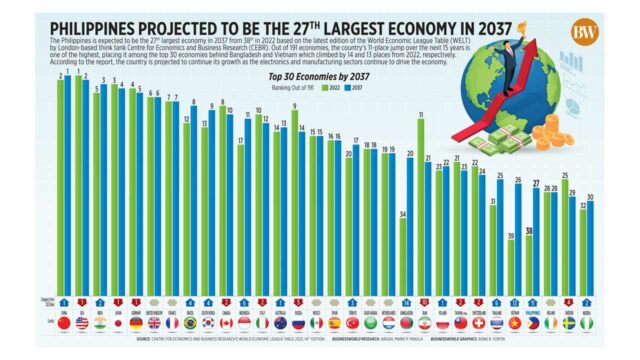
Philippines projected to be the 27th largest economy in 2037

THE PHILIPPINES is poised to become the 27th largest economy in the world by 2037, as gross domestic product (GDP) growth is expected to average 5% over the next 15 years, a report showed. Read the full story.

Philippines projected to be the 27<sup>th</sup> largest economy in 2037

Stocks to move sideways as year comes to a close

BW FILE PHOTO

PHILIPPINE STOCKS may move sideways in the last trading week of the year as investors price in economic concerns that may linger in 2023.

The bellwether Philippine Stock Exchange index (PSEi) declined by 35.91 points or 0.54% to close at 6,541.03 on Friday, while the broader all shares index lost 9.79 points or 0.28% to 3,432.47.

Week on week, the PSEi closed higher by 44.53 points or 0.69% versus its close of 6,496.50 on Dec. 16.

For this month, the PSEi has so far declined by 3.5% after it gained 10.2% in November, which was the biggest monthly gain in more than 12 months or since September 2010.

Philippine financial markets were closed on Dec. 26 due to a special non-working holiday.

Philstocks Financial, Inc. Senior Research Analyst Japhet Louis O. Tantiangco said the market may move sideways this week as investors price in their expectations for 2023.

“Investors are expected to weigh economic concerns that could still be present next year including the country’s high inflation, the monetary tightening of the Bangko Sentral ng Pilipinas (BSP) and the Federal Reserve, and the possible global economic slowdown, against hopes that next year would still be a robust one for our local economy, particularly its growth, despite the aforementioned challenges,” Mr. Tantiangco said in a Viber message.

The BSP raised benchmark interest rates by 50 basis points (bps) at its meeting on Dec. 15, bringing its policy rate to 5.5%. Rates on the central bank’s overnight deposit and lending facilities were likewise raised to 5% and 6%, respectively.

The Philippine central bank has now raised rates by 350 bps since May.

Meanwhile, the US Federal Reserve hiked its benchmark overnight interest rate by 50 bps to the 4.25%-4.5% range at its Dec. 13-14 meeting and projected it could go up to 5%-5.25% next year.

The Fed has now raised borrowing costs by 425 bps since March. 

Online brokerage 2TradeAsia.com said the benchmark index could retest the 6,600 and 6,800 levels before the year ends.

“At this level, the price is around 13x forward earnings. While this supports broad optimism, there is some wisdom to picking apart the basket and aiming for the crème de la crème — the high yield, recession-resistant plays that have their multi-year growth stories intact,” it said in a report. “As the curtains close for 2022, eyes are trained towards 2023 and the movers for the first quarter of the year.”

2TradeAsia.com said global interest rates, inflation and China’s reopening will be key considerations for the market going into 2023.

“Spending, public and private, will be a key metric for 2023, as the much higher effective cost of capital now rewards efficiency over anything,” it said.

2TradeAsia.com placed the PSEi’s immediate support between 6,350 and 6,400 and resistance at 6,600, while Philstocks Financial’s Mr. Tantiangco put the index’s immediate support at its 200-day exponential moving average and immediate resistance at the 6,600 level. — Justine Irish D. Tabile

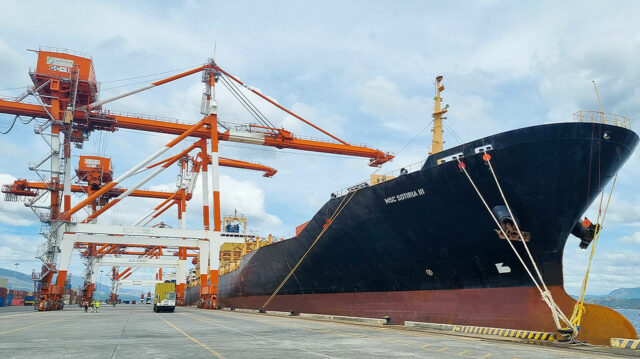
‘Keen’ European interest in shipping after foreign ownership cap removed

ICTSI.COM

By Alyssa Nicole O. Tan, Reporter

THE SHIPPING and telecommunications industry are likely to receive increased European investment following the passage of a law that removes the 40% foreign equity cap in various industries, according to the European Chamber of Commerce (ECCP).

Republic Act 11647, which amends the 85-year-old Public Service Act, now allows 100% foreign ownership in airports and airlines, subways and railways, telecommunications, domestic shipping, and tollways and expressways after these industries were excluded from the definition of public utility. 

ECCP President Lars Wittig told BusinessWorld in a video call that “when it comes to shipping, we already know that the interest is keen, actually, I will say extreme.”

Despite the “abnormally high” freight rates in the Philippines, Mr. Wittig said some of the largest international shipping companies still had access to domestic freight.

Freight charges have already gone up by an average of 25% this year, reflecting the impact of higher oil prices.

In the year to date, fuel prices have risen by a net P13.95 per liter for gasoline, P27.50 for diesel, and P20.80 for kerosene.

The presence of foreign companies here is a token of their enthusiasm, Mr. Wittig said, “because they had to go through a lot of challenges in order to get the advantages that they already had before the Public Service Act was signed.”

This was possible because of their size, as well as decades of operations which allowed them to find ways to work around obstacles. However, Mr. Wittig said that it was still better to have an open market.

“We want everybody, without any limitation, to be able to do it, not just the biggest because they have the money to find a way,” he said.

“It has to be equal, fair, even playing field for everybody — foreign and local alike, not just a few foreign and all the locals,” he added.

Mr. Wittig said foreign interest in telecommunications was apparent from the 2018 bid to become the third player in the telecommunications industry.

Dito Telecommunity Corp., formerly known as Mindanao Islamic Telephone Company, Inc. (Mislatel), won after the two other contenders were disqualified. The consortium was granted a certificate of public convenience and necessity, as well as six radio frequency bands.

“There were multiple European telco providers that came here… but none of them won the tender, also because many of them didn’t even submit their proposal. Why? Because of the 40% ownership cap,” he said.

”Forty percent into something like telco is a massive investment, but it’s not enough ownership to control your own destiny. And therefore, that was won by the Chinese,” he added, referring to Dito’s Chinese investor, China Telecom.

Now that the Public Service Act has been passed, European telecommunications companies have indicated renewed interest, he said.

“They are very eager to return now and give it another try, and they will be dead serious about it. I guarantee you,” Mr. Wittig said..

“I also believe personally they will succeed in doing this,” he added.

The law “basically eliminates the Chinese providers,” Mr. Wittig said, referring to a provision that prohibits foreign state-owned enterprises from investing in any public service classified as a public utility or critical infrastructure.

“The Public Service Act, that which is really about national security, will allow the country to be equally safe in case of war,” he added.

The Philippines, however, will have to ensure acceptable implementing rules and regulations are in place to make the most out of the newly passed law, he said.

“We need to advance the current movements in the legal system by changing the implementation of rules and regulations on foreign ownership,” he said, noting that it is the country’s constitution that “prevents foreign companies from eroding resources for their gain in the Philippines.”

Onion crisis blamed on DA forecasting failures

PIXABAY

THE ONION shortage has been blamed on the failure of the Department of Agriculture (DA) to adequately project supply and demand for the commodity, resulting in a delay in turning to imports.

Danilo V. Fausto, president of the Philippine Chamber of Agriculture and Food, Inc. (PCAFI), told reporters recently: “We failed to import, so that is why we are short of supply. Naturally, there was a transfer of leadership so maybe they did not notice that.”

Mr. Fausto said that during holidays, demand spikes for many commodities, which should have been anticipated and planned for.

“During Christmas season the demand doubles, sometimes triples because of… celebrations and parties left and right. That’s the time that you have to really prepare for, and you prepare for it for a year,” he said.

Mr. Fausto said that this year, the shortage is estimated at about 40,000 to 50,000 metric tons. He added imports should have ordered in July and August to meet current demand.

“We did not import. Naturally, the supply is low and that is why the prices go up. There is no such thing as hoarding of onions,” he said.

Mr. Fausto added that onions tend have a short shelf life. “if you keep onions in cold storage for long, you cannot sell it, simply because of the nature of the product.”

The DA has cited hoarding as a possible cause for high prices.

Mr. Fausto also warned that “farmers are now planting onions because of the price, and it will take three months to harvest.”

He expects a bumper harvest by April, which the government must prepare for with more cold storage.

“If the government will not put up (cold storage), by April we will be throwing onions away,” Mr. Fausto said. — Ashley Erika O. Jose

Services, BPOs, semiconductors to remain growth drivers in 2023

PIXABAY

THE SERVICES, business process outsourcing (BPO), semiconductor, and infrastructure industries are expected to be the growth drivers for the economy next year, analysts said.

“The crucial sector will be services. Digital technology has made it possible to realize economies of scale in services since face-to-face transactions are no longer necessary,” Ateneo de Manila University Economics Professor Leonardo A. Lanzona said in an email.

“Trade in services especially with the numerous college graduates, is feasible as long as we improve our internet infrastructure. This can include professional services such as accountancy, advertising and computer services.  Educational and health services may also be viable,” he said.

“Services with the new technology can blur distinctions between sectors since services can enhance industry and agriculture by reducing transaction costs between buyers and sellers.  We cannot ignore industry since this will absorb relatively unskilled labor,” he added.

In the third quarter, services grew 9.1%, the most of any sector. It also had the biggest contribution to gross domestic product (GDP) growth.

Terry L. Ridon, a public investment analyst and convenor of think tank InfraWatch PH, said that the semiconductor and BPO industries are also key growth areas.

“The semiconductor and BPO sectors remain our best bet in driving high-value economic growth, and the Marcos government should find ways to further raise incentives and cut costs in these sectors,” he said in an email.

“The country is at a good spot in developing the semiconductor business given the new chips ban on China. Government should be agile in convincing US chipmakers to transfer their factories here instead of our other ASEAN neighbors,” he added.

Last year, the Semiconductor and Electronics Industries in the Philippines Foundation, Inc. (SEIPI) exceeded its 10% growth target.

Electronics exports ended 2021 at $45.92 billion, up 12.9%, on the back of strong demand for new technologies, SEIPI said.

As of September, year-to-date electronics exports totaled $35.34 billion, up 4.71%, according to SEIPI.

Electronics exports remain the top export category, accounting for 60.60% of the $58.31 billion worth of overall commodity exports.

Mr. Ridon also said BPOs remain a significant growth and employment driver, enabling Filipino providers to service various international firms.

In November, the Philippine Economic Zone Authority (PEZA) endorsed 163 information technology and BPO projects for registration transfer to the Board of Investments (BoI). The 163 companies have taken in investment of P13.9 billion.

The industry is expected to generate up to 1.1 million direct jobs by 2028, according to the Finance department.

In June, the IT and Business Process Association of the Philippines (IBPAP) said that the industry is running ahead of the pace for its 2022 goals of 1.43 million full-time employees (FTEs) and $29.1 billion worth of revenue.

In 2021, the industry’s FTEs increased by 120,000, bringing total headcount to 1.44 million, up 9.1%. The industry also generated revenue of $29.49 billion.

Pantheon Chief Emerging Asia Economist Miguel Chanco said that construction and utilities are likely targets for new investment next year, as infrastructure remains one of the key areas in which the Philippines lags its regional peers.

“I’d go so far as to say that these ambitions shouldn’t be limited to just 2023. The Marcos administration would do well to encourage such capital expenditure throughout its entire term. We’re seeing an arguably faster shift out of export manufacturing in China, and into Southeast Asia. The only way the Philippines can benefit from these structural flows is to make sure that it has a more conducive environment for labor-intensive industry,” he said in an email.

Mr. Chanco added that there should also be more public investment in human capital,  particularly in public healthcare and education systems.

Infrastructure spending rose 39.3% to P99.1 billion in September. In the nine-month period, infrastructure spending was up 13.4% at P727.7 billion, but 4.11% lower than the P758.9 billion targeted for the period. — Luisa Maria Jacinta C. Jocson

PHL rated 17th in global manufacturing risk index

REUTERS

THE PHILIPPINES placed 17th out of 45 countries in Cushman and Wakefield’s manufacturing risk index (MRI), indicating further room for improvement in making manufacturing more attractive to investors.

The ranking was the outcome of the firm’s “baseline” scenario. The Philippines did much better in a scenario weighted towards cost (ninth) and much worse when risk was the main consideration (33rd).

The cost scenario scores countries higher for low operating costs, while the risk scenario favors countries presenting lower levels of economic and political risk.

“While the Philippines has continued to move up in the ranking of countries in the MRI index, there are several factors that will strengthen the attractiveness of the country as a manufacturing destination,” Cushman and Wakefield said in a statement.

A year earlier, the Philippine ranking on the baseline scenario was 28th.

Cushman and Wakefield, a real estate services consultancy, said structural reform is needed to unlock the manufacturing industry.

“While the Philippines maintains strong and growing domestic consumer markets, the country is also beset by lack of qualified labor (i.e., new skills given advancements in technology), aging infrastructure networks and facilities, low commitment on renewable energy sources and still opaque level of business transparency,” it added.

“Overall, the Philippines needs to clearly demonstrate its strength and arrest the weaknesses by dismantling the barriers that make it less competitive in any of the aforementioned factors,” the firm said.

The MRI assesses the most suitable locations for global manufacturing among 45 countries in Europe, the Middle East and Africa (EMEA), the Americas and Asia-Pacific (APAC).

China placed first in all three scenarios, with half of the top 12 countries in the cost scenario being from the Asia-Pacific.

“Asian markets have dominated an annual study ranking top manufacturing destinations according to baseline, cost and risk scenarios, holding the most top quartile rankings of any region across each of the scenarios,” Cushman and Wakefield said.

The report also noted that emerging Asia Pacific markets continue to benefit from expanding labor pools as unemployment rates continue to fall. — Aaron Michael C. Sy

Chinese companies express interest in RE collaboration

THE DEPARTMENT of Energy (DoE) said it is in official talks with China on possible areas of collaboration within the energy industry, after Chinese companies indicated their interest in investing in renewable energy (RE) projects.

“We’ve had discussions with the Ambassador of the People’s Republic of China on different aspects of cooperation in the energy sector,” Energy Secretary Raphael P.M. Lotilla said in a virtual briefing last week.

Mr. Lotilla said that in the past few months a number of companies from China have engaged with the DoE to declare their interest in investing in renewable energy (RE) projects involving offshore wind, solar and other technologies.

In November, the RE industry was opened up to full foreign ownership following a legal opinion issued by the Department of Justice, with Mr. Lotilla releasing a circular amending the implementing rules and regulations (IRR) of the Renewable Energy Act of 2008.

The law previously limited foreign ownership of RE projects to 40%, the constitutional limit for many industries.

The circular allows foreign nationals and foreign owned entities to explore, develop and use RE resources such as solar, wind, biomass, ocean or tidal energy.

Mr. Lotilla said that the Energy department is also keeping an eye on any possible breakthroughs regarding exploration activity in the West Philippine Sea.

“As far as joint exploration is concerned the Department of Foreign Affairs (DFA) of course takes the lead in the negotiations and any announcement in this regard will be coming from the President. We continue to work with all concerned regarding the prospects of developing the service contracts in the West Philippine Sea,” he said.

Mr. Lotilla said that the discussions on exploration are currently at a “delicate stage” but said the DoE remained engaged with all the other agencies involved.

Earlier this month, PXP Energy Corp. said it is time to resume discussions on the exploration in the West Philippine Sea and hopes that President Ferdinand R. Marcos, Jr., who is scheduled to visit China in January, could negotiate a suitable agreement.

PXP Energy said it wants to be guided by the government on its next steps regarding the development of the company’s service contracts in the disputed waters.

The oil and gas company’s subsidiary Forum (GSEC 101) Ltd., serves as the operator of SC 72 at Recto Bank. Within its block is the Sampaguita gas discovery, which is estimated to contain about 2.6 trillion cubic feet of contingent gas resources. PXP Energy also holds a 50% interest in SC 75 in northwest Palawan.

These areas are also claimed by China.

The DoE in April ordered the suspension of joint exploration activities in the West Philippine Sea due to the maritime dispute. This led to the suspension of all exploration work in SC 72 and 75.

In October, the DoE approved a declaration of force majeure covering the two service contracts in response to a PXP Energy request made in April. — Ashley Erika O. Jose

The concept of profit level indicator in TPD

Another year is dawning, and the countdown has begun. As we take the first step in faith towards the new year, we hope everyone can reflect and truly say that it was indeed a year of intense growth. Since I am a believer that the new year is neither an end nor a beginning, I wish to take everyone back and to the Let’s Talk Transfer Pricing (TP) articles that we published throughout the year so we may welcome 2023 with proper guidance.

To name a few, we started 2022 with our first article entitled “Are your related party transactions at arm’s length?” followed by other monthly installments such as “Transfer pricing policies are a must-have,” “How FAR are you in transfer pricing documentation?,” “Fundamentals of entity characterization in TPD,” “What’s #TRENDING? Understanding and documenting industry analysis,” and most recently “Understanding transfer pricing methodologies”.

Before 2022 ends, our last Let’s Talk TP article of the year deals with the concept of profit level indicator (PLI) in transfer pricing documentation (TPD) as discussed in Revenue Regulations (RR) No. 2-2013 and Revenue Audit Memorandum Order (RAMO) No. 1-2019.
WHAT IS PLI?
PLI is the ratio of net profit to an appropriate base (e.g., sales, costs incurred, assets employed). It measures the relationship between the net profit and the appropriate base.

Examples of PLI are return on sales (gross margin or operating margin), return on costs, and return on capital.

WHERE IS PLI USED IN TPD?
The discussion and selection of an appropriate PLI is presented in the “Application of the transfer pricing method” or “Benchmarking” section of the TPD.

In applying the transfer pricing method, consideration must be given to the choice of PLI. The use of an appropriate PLI ensures better accuracy in the determination of the arm’s length price of a related party transaction.

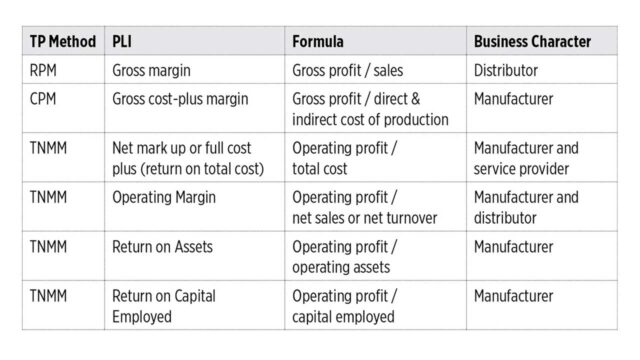
The Resale Price Method (RPM), Cost Plus Method (CPM) and Transactional Net Margin Method (TNMM) are the transfer pricing methods that use PLI to determine whether the related party transaction involved is carried out at arm’s length.

HOW DO WE SELECT AN APPROPRIATE PLI?
The selection of an appropriate PLI depends on the facts and circumstances of the related party transaction involved. Factors to consider include but are not limited to: (1) characterization of business; (2) availability of comparable data; and (3) the extent to which the PLI is likely to produce a reliable measure of arm’s length profit.

In determining the numerator and denominator of the PLI, taxpayers should bear the following principles in mind: (a) only those items that are directly or indirectly related to the related party transaction involved and are of an operating nature should be considered; and (b) items that are not similar to the independent party transaction being compared should be excluded.

Further, the determination of the denominator used in PLI is done by considering the company’s profit drivers and their independence from the denominator that is used. Other factors that need to be considered in selecting the PLI are the type of business and the availability of data.

WHAT ARE THE GENERALLY USED PLIs?
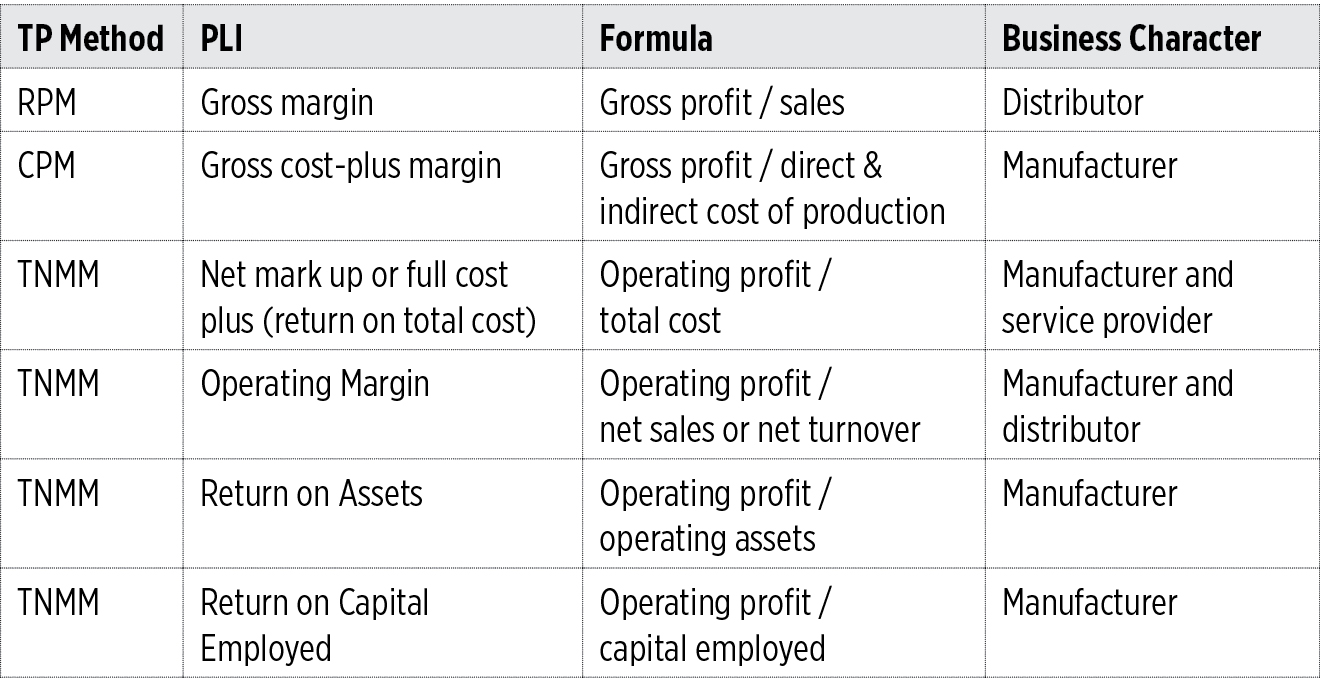
While PLI differs from case to case depending on the characterization of the business, among others, presented below are the generally used PLIs.

Business characterization is important because by determining the accurate characteristics of the entity’s business, the expected level of price or return by the entity can be known and the selection of reliable comparable can be made.

HOW IS PLI APPLIED?
A benchmarking study or comparable analysis is conducted to find comparable independent transactions or companies to verify the arm’s length nature of the related party transactions under evaluation.

a. Search for comparable

In searching for comparable independent transactions or companies, it is advisable to consult commercial databases to generate reliable comparables. The data obtained from commercial database only leads you to a set of candidate comparables. Candidate comparables must be subjected to a manual selection process (i.e., General and Financial Review) mentioned in RAMO No. 1-2019 to be able to arrive at the final comparable.

a. Use of multi-year data

Then, the chosen appropriate PLI of the final comparable is computed. Multi-year PLI data (usually three years) rather than single-year data improves the reliability of the analysis. The inclusion of numerous years makes it easier to pinpoint variables that may have influenced or should have influenced transfer prices, like long-term arrangements and business or product life cycles, which may also need to be considered when determining comparability. Further, the use of multi-year data can help neutralize the impact of extreme data points, like abnormally high profits or abnormal losses, while at the same time ensuring that the arm’s length range/ price is representative of the data points identified.

a. Use of interquartile range

In some cases, it will be possible to apply the arm’s length principle to arrive at a single figure of PLI that is the most reliable to establish whether the conditions of a transaction are at arm’s length. However, because transfer pricing is not an exact science, there will be many occasions when the application of the most appropriate method produces a range of figures all of which are equally reliable. This is often the case in practice where the comparable is extracted from a commercial database. In such cases, if the range includes many observations, statistical tools that account for a central tendency to narrow the range (e.g., the interquartile range or other percentiles) might help enhance the reliability of the analysis.

a. Benchmarking

The PLI of the tested party or related party transaction involved is compared with the interquartile range of PLIs of the comparable.

If the PLI of the tested party is within the arm’s length range, the related party transaction is carried out at arm’s length basis. Hence, no adjustments are likely to be made by the tax authority in case of audit.

However, if the PLI of the tested party falls outside the arm’s length range, the tested party must be able to present justifiable commercial reasons that the conditions of the related party transaction satisfy the arm’s length principle. If the tested party is unable to establish this fact, the related party transaction is deemed not to have been carried out at arm’s length basis. Hence, the tax authority will make adjustments and determine the point within the arm’s length range to which it will adjust the conditions of the related party transaction.

TAKEAWAY
Much like how life is about the choices we make and how the direction of our lives comes down to the choices we take, the use of an appropriate PLI grants taxpayers relief from questioning by tax authorities. Good life choices help us build healthy relationships and reliable PLI ensures better accuracy in the determination of the arm’s length price of a controlled transaction. As we welcome the new year, may we all start doing our best to make decisions that matter, both in life and in choosing the appropriate PLI.

Happy new year and we hope everyone makes the conscious choice of staying tuned in for next month’s Let’s Talk TP article as we walk you through the remaining concepts of transfer pricing. 

Let’s Talk TP is an offshoot of Let’s Talk Tax, a weekly newspaper column of P&A Grant Thornton that aims to keep the public informed of various developments in taxation. This article is not intended to be a substitute for competent professional advice.


Paul Vinces C. Leorna is a manager from the Tax Advisory & Compliance division of P&A Grant Thornton, the Philippine member firm of Grant Thornton International Ltd.

pagrantthornton@ph.gt.com

At least 6 dead, 19 missing due to floods, landslide

MISAMIS OCCIDENTAL PROVINCIAL POLICE

AT LEAST six people died and 19 others were reported missing as heavy and incessant rains triggered landslides and flooding in several parts of central and southern Philippines during the Christmas weekend, authorities reported on Monday.

More than 44,000 people across the regions of Mimaropa, Bicol, Eastern Visayas, Zamboanga Peninsula, and Northern Mindanao were evacuated on Dec. 25, and emergency response teams remained on alert Monday as continued rains were expected based on the forecast of state weather agency PAGASA.

Among the confirmed deaths were in Oroquieta City, Misamis Occidental due to a landslide, according to a report from the provincial police office.

Among those missing were three fishermen in Catanduanes, who failed to return home on Christmas eve after going out to sea, according to the Philippine Coast Guard.

The Coast Guard said search and rescue operations were still ongoing Monday with the help of local fishermen.

In an 11 a.m. bulletin Monday,  the National Disaster Risk Reduction and Management Council (NDRRMC) said over 23,000 families were affected by flooding, composed of 100,691 people.

Of the those affected, 44,707 were moved to 27 evacuation centers.

Northern Mindanao — composed of the provinces of Misamis Oriental, Misamis Occidental, Bukidnon, Lanao del Norte and Camiguin, including the independent city of Cagayan de Oro —  accounted for majority of those affected.

The Department of Social Welfare and Development’s office in Northern Mindanao said in an 8 a.m. report on Monday that 45,883 people in the region have been evacuated.

The Zamboanga City government tallied 433 families affected by flashfloods and one person missing.

SHEAR LINE
State-run Philippine Atmospheric, Geophysical, and Astronomical Services Administration (PAGASA) said in a weather advisory Monday that the regions of Eastern Visayas, Caraga, and Northern Mindanao along with the provinces of Bohol and Davao Oriental will likely experience moderate to heavy rains in the next 24 hours.

The rains are caused by a shear line, which occurs when there are  abrupt changes in wind component and easterly winds and the northern cold front interact.

PAGASA Weather Forecaster Patrick Del Mundo, in an interview with One Balita Pilipinas on Monday, said that moderate to heavy rains in the Visayas and Mindanao will continue until December 28 due to a shear line.

“The northeast monsoon and shear line continue to prevail… It could possibly dissipate by Dec. 29 but the northeast monsoon will continue to bring rains in Luzon up to Mindoro,” Mr. Del Mundo said in Filipino.

Philippine National Police Spokersperson Jean S. Fajardo, meanwhile, told a separate televised briefing that emergency response teams have been deployed to help distribute relief goods to affected residents.

“We will have a sufficient number of officers from the reserve standby force in the Eastern Visayas who can respond to our countrymen affected in the region,” she said in Filipino.

The NDRRMC also reported an initial P5.3 million worth of damage in public infrastructure and an estimated P54.78 million damage cost in agriculture. — Marifi S. Jara, John Victor D. Ordoñez and Beatriz Marie D. Cruz

More than 7,000 Filipinos repatriated this year

THE PHILIPPINE Embassy in Bahrain brought home 50 Filipinos from Manama in January, the first batch of the Department of Foreign Affairs’ repatriation program for 2022. — DFA

THE DEPARTMENT of Foreign Affairs (DFA), through its Office of the Undersecretary for Migrant Workers Affairs, repatriated over 7,000 overseas Filipinos this year, according to a statement released by the Office of the Press Secretary on Monday.

Of the 7,880 repatriated Filipinos as of end-November, more than half or 58% were from the Middle East, with 942 from Kuwait, and another 70 from Sri Lanka, based on DFA data.

President Ferdinand R. Marcos, Jr. earlier assured of stronger coordination between the DFA and the newly-formed Department of Migrant Workers (DMW) to provide better assistance to overseas Filipinos.

“We will intensify this partnership to provide fast and competent services and assistance to overseas Filipinos who need help,” the Chief Executive told a Filipino community in Cambodia in Filipino on the sidelines of the 40th and 41st Association of Southeast Asian Nations (ASEAN) Summit in November.

There were about 1.83 million overseas Filipino workers as of 2021, higher than the 1.77 million estimate in 2020, based on data from the Philippine Statistics Authority released on Dec. 2.

Those with existing work contracts comprised 96.4% or 1.76 million of the 2021 total. The rest were Filipinos working abroad under a tourist, visitor, student, medical, and other types of non-immigrant visas.

The top country destinations were Saudi Arabia at about 24.4% and United Arab Emirates at 14.4%. Other countries in Asia with large number of overseas Filipino workers were: Hongkong (6.7%), Kuwait (5.9%), Singapore (5.8%), and Qatar (4.8%).

Remittances by overseas Filipino workers reached $2.91 billion in October, higher than the $2.81 billion in the same month last year, based on data from the Bangko Sentral ng Pilipinas released on Dec. 15.

The amount of money sent home by migrant workers was the highest in three months or since the $2.92 billion in July.

Mr. Marcos had on several occasions described overseas Filipino workers as the pride of the Philippines as they “bring honor to the Filipino nation.”

“You provided a much-needed boost to the pandemic-stricken economy… allowing us to fund social programs that help the poor and the most vulnerable families in the Philippines,” he said.

Meanwhile, the DFA also said in its yearend report that it issued a total of 3,589,620 passports from January to October.

As of November, the department has also issued 55,574 visas and 551,635 apostille certificates.

Six temporary off-site passport services facilities were also opened this year.

The agency also cited bilateral agreements it signed on defense, culture, counterterrorism, trade and investment, technology and data protection, and migrant workers protection. — Alyssa Nicole O. Tan

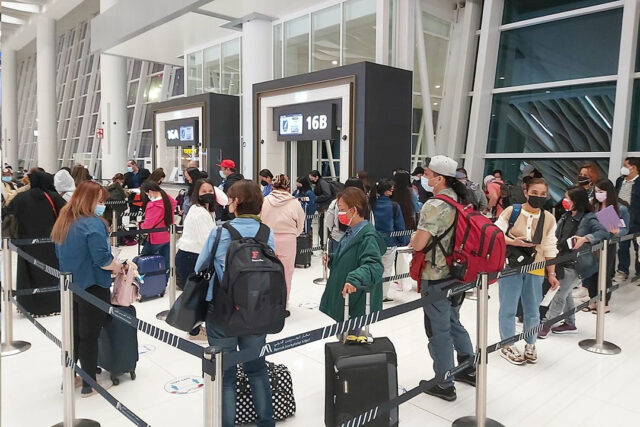
BI expects passenger traffic at airports to increase heading into 2023

PHILIPPINE STAR/ MIGUEL DE GUZMAN

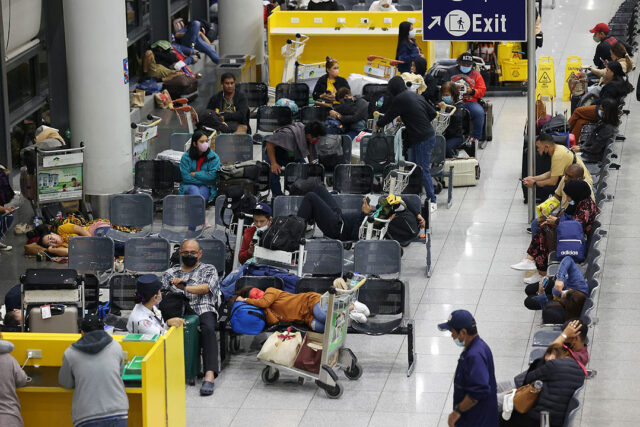
THE BUREAU of Immigration (BI) on Monday said it expects passenger traffic to continue to increase up to New Year’s Eve as more Filipinos and foreign visitors arrive and leave.  

“Usually during New Year’s, departures also increase since Filipinos who live abroad, especially our overseas Filipino Workers return to the countries they came from,” Immigration Spokesperson Dana Krizia M. Sandoval told a televised briefing.  

“We see that the tourism and international travel sector is really on the rebound.”  

Ms. Sandoval gave assurance that airports will have enough manpower to process arrivals despite the expected influx. 

A total of 31,992 visitor arrivals at the Ninoy Aquino International Airport (NAIA) were processed on Dec. 24, the BI reported on Sunday.  

The agency said NAIA Terminal 1 recorded 10,047 passenger arrivals, while Terminals 2 and 3 saw 4,646 and 12,615 arrivals, respectively.   

A total of 22,248 departures were also processed on Christmas Eve.  

No data on passenger movement was immediately available for other international airports in the country.  

The BI earlier implemented an electronic gate system at the NAIA to fast-track the passport processing process. 

The bureau also scrapped the arrival card requirement for returning Filipinos at airports to lessen processing time.  

Last month, the Department of Tourism reported over two million visitor arrivals, which surpassed its projection of 1.7 million after the Philippines eased restrictions.   

In the first nine months of 2022, tourist arrivals in the Asia-Pacific region were still 83% below pre-pandemic levels, the United Nations World Tourism Organization said in its November World Tourism Barometer report. John Victor D. Ordoñez