Home Blog Page 5458

Metro Manila Film Festival 2022: What lives in the dark

Movie Review
Deleter
Directed by Mikhail Red
MTRCB rating: R-13

PAINFUL and disturbing reality and truths viewed on screen can be even more difficult to face in real life. Mikhail Red confronts this reality in the techno-horror film Deleter.

This was the first of three movies I had lined up for the day. I was glad to see more than 20 people in the audience compared to the audience count of five I saw at the opening day of last year’s Metro Manila Film Festival.

The film’s opening scene effectively sets the story. It begins with a buffering computer screen which leads to a shot of a dark bedroom. A figure of a standing woman slowly turns, and sits in front of the camera. She then recites some words and proceeds to cut her right cheek with a blade and bleed. The shot zooms out to a woman watching the scene on her computer in cubicle — she screams, falling on the floor, and causing a commotion at the office.

The story centers on Lyra (played by Nadine Lustre), who works as a content moderator tasked with filtering violent, sexual, exploitative content from reaching social media platforms. Unlike her colleagues who often grow uncomfortable with the demands of the job, Lyra has seemingly mastered a technique to reach her quota.

Content moderators, or “deleters,” are given a set of videos to review. After watching it, it is either ignored and remains accessible online, or deleted. In the film, Lyra’s boss Simon (Jeffrey Hidalgo) admits that their job can make them crazy and mentally exhausted. (Trigger warning: Some scenes may be difficult to watch.)

The environment in the workplace is disrupted with the suicide of their colleague Aileen (Louise Delos Reyes) — the woman who freaked out in the opening scene. When investigators interrogate the employees about the incident, Lyra replies by saying they were not really close, which is believable at first considering her minimal interaction with other colleagues. Her only good acquaintance is Jace (McCoy De Leon), an employee in a different company lin the same building.

As the story progresses, the audience learns that not only did Lyra have a traumatic childhood which led to her apathetic attitude, but that she secretly was close friends with Aileen. An unfortunate incident involving Aileen and their boss which Lyra was the sole witness to has led her to be fearful of confronting and speaking the truth. The inclusion of surveillance footage offers the audience a point of view not available to the characters in the story.

The film keeps a consistent dark mood through the character’s wardrobes, the use of blue color grading, and almost pitch-black shots in interior scenes in a power outage. The only bright scenes in daytime at the building rooftop and convenience store.

The eerie music scoring effectively builds the tension leading up to a jump scare, as well as the volume dynamics as the film reached the climax.

In my five years of reviewing horror films at the MMFF, this has been the most notable film.

Deleter is a supernatural horror movie that uses technology as a bridge to relate real horrors about life such as personal fears and truths that are difficult to face.

The final sequence feels like an interrogation — not only for Lyra but also for the audience. It confronts our behavior towards speculation, lies, and the unheard truths about ourselves, other people, and scenarios around us and our society — whether online or in real life. The attempt to ignore, deny, and erase it is a nightmare that will continue to haunt us. — Michelle Anne P. Soliman


BoJ chief dismisses near-term chance of exit from easy policy

WIKIPEDIA.ORG

TOKYO — Bank of Japan (BoJ) Governor Haruhiko Kuroda on Monday brushed aside the chance of a near-term exit from ultra-loose monetary policy but voiced hope that intensifying labour shortages will prod firms to raise wages.

Mr. Kuroda said the BoJ’s decision last week to widen the allowance band around its yield target was aimed at enhancing the effect of its ultra-easy policy, rather than a first step toward withdrawing its massive stimulus program.

“This is definitely not a step toward an exit. The bank will aim to achieve the price target in a sustainable and stable manner, accompanied by wage increases, by continuing with monetary easing under yield curve control,” Mr. Kuroda said in a speech delivered to a meeting of business lobby Keidanren.

He also said Japan’s average consumer inflation will likely slow below the BoJ’s 2% target in the next fiscal year as the effects of soaring import costs dissipate.

But Mr. Kuroda said wage growth will likely increase gradually due to intensifying labour shortages and structural changes in Japan’s job market, which are leading to higher pay for temporary workers and a rise in the number of permanent workers.

“Labor market conditions in Japan are projected to tighten further, and firms’ price- and wage-setting behavior is also likely to change,” Mr. Kuroda said.

“In this sense, Japan is approaching a critical juncture in breaking out of a prolonged period of low inflation and low growth,” he said.

The strength of wage growth is seen as key to how soon the BoJ could raise its yield curve control (YCC) targets, which are set at -0.1% for short-term interest rates and around 0% for the 10-year bond yield.

The BoJ shocked markets last week with a surprise widening of the band around its 10-year yield target. Mr. Kuroda had described the move, which allows long-term rates to rise more, as aimed at easing some of the costs of prolonged stimulus rather than a prelude to a full-fledged policy normalization.

With inflation exceeding its 2% target, however, markets are rife with speculation that the BoJ will raise the yield targets when the dovish governor Mr. Kuroda’s term ends in April next year.

While more companies are starting to hike prices to pass on higher costs to households, the BoJ must examine whether such changes in corporate price-setting behavior will take hold as a new norm in Japan, Kuroda said.

The outcome of next year’s spring wage negotiations between big companies and unions will also be key to the outlook for wage growth, he said.

Speaking at the same meeting, Prime Minister Fumio Kishida called for business leaders’ help in achieving wage growth high enough to compensate households for the rising cost of living.

Japan’s core consumer inflation hit a fresh four-decade high of 3.7% in November as companies continued to pass on rising costs to households, a sign that price hikes were broadening.

But wages have barely risen for permanent workers, as companies remained cautious about increasing fixed costs amid an uncertain economic outlook. — Reuters

Aiming for a strong finish: Philippine property recovery to spill over into 2023

OJ SERRANO-UNSPLASH

(This is the first of a two-part property market outlook by Colliers Philippines.)

THE Philippine property market is likely to finish strong this 2022, backed by improvement in office deals across the country; higher supply and demand in the Metro Manila pre-selling condominium market; a rebound in mall consumer traffic; and a rise in hotel occupancies and average daily rates (ADRs).

We see this optimism persisting through 2023 as recovery prospects are boosted by strong macroeconomic fundamentals.

Office developers should take advantage of a rebound in leasing within and outside Metro Manila by constructing new office towers and offering more flexible workspaces.

Residential developers should launch new projects, integrating sustainable & green features, as the Metro Manila pre-selling condominium market recovers.

Mall operators should brace for more foreign and local retailers as consumer confidence and foot traffic pick up next year.

Industrial locators should look at available space and warehouses in northern and central Luzon, which are viable alternatives to industrial parks and facilities in southern Luzon.

OFFICE: POSITIVE NET TAKE-UP
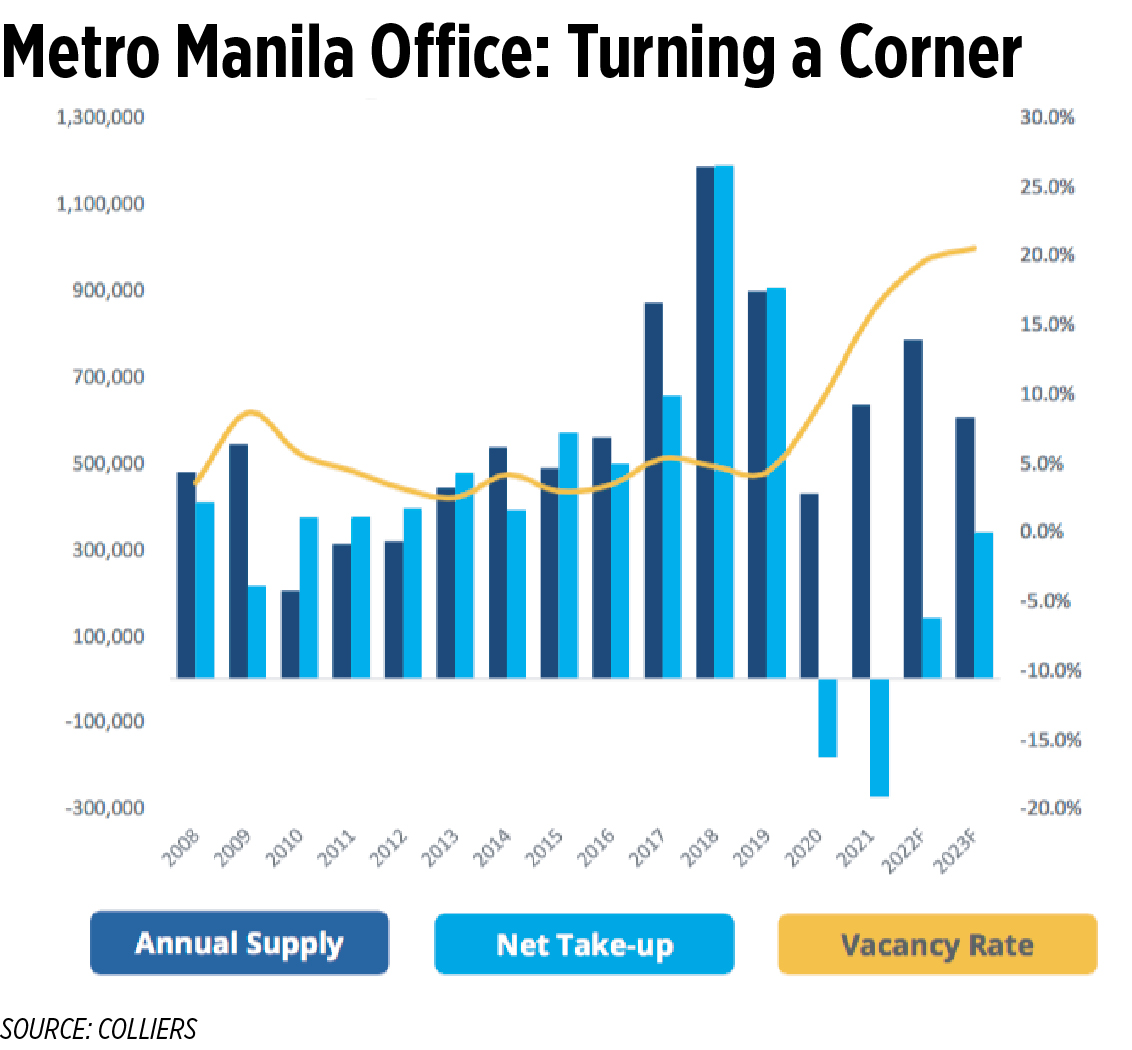
Colliers sees positive net take-up by the end of 2022. We forecast net absorption to reach 140,000 square meters (sq.m.) (1.5 million square feet), a turnaround after negative net absorption in 2020 and 2021. We adjusted our forecast to a 19.5% vacancy in 2022 from our initial estimate of 18.2% due to muted pre-leasing in upcoming buildings.

In 2023, we see net take-up improving to 338,600 sq.m. (3.6 million sq.ft.). However, we expect vacancy to rise to about 20.5% as we project the delivery of 603,900 sq.m. (6.5 million sq.ft.) of new supply. Vacancy in Metro Manila will remain supply-driven.

Average office rents in Metro Manila have dropped by 35% since 2020. In our view, rents are likely to have declined by another 10% this year, before bottoming out in 2023.

Colliers is starting to see rents stabilizing in submarkets with declining vacancies such as Fort Bonifacio and Makati central business districts (CBD).

Meanwhile, submarkets with significant amount of new supply and muted take-up are likely to see a further decline in rents in the next 12 months.

Colliers recommends that occupiers take advantage of the market conditions by implementing flight-to-quality measures as well as securing early renewals in business districts such as Ortigas CBD, Fort Bonifacio and Bay Area, where quality new supply is available.

From 2023 to 2026, we see the annual delivery of about 545,700 sq. m. (5.9 million sq.ft.) of new office space. Landlords should continue providing concessions (e.g. delayed escalations, extended fit-out) to attract new occupants and retain existing ones amid the completion of more options in the market.

Colliers is optimistic of greater office space absorption in the provinces as occupiers revisit their business continuity plans (BCP) and expand operations by tapping provincial talent.

Developers are keen on capturing this demand outside the capital region by building more office towers. Among key areas with substantial new supply up to 2024 include Cebu, Bacolod, Iloilo, and Davao.

RESIDENTIAL: MORE INTEGRATED COMMUNITIES, SUSTAINABLE FEATURES
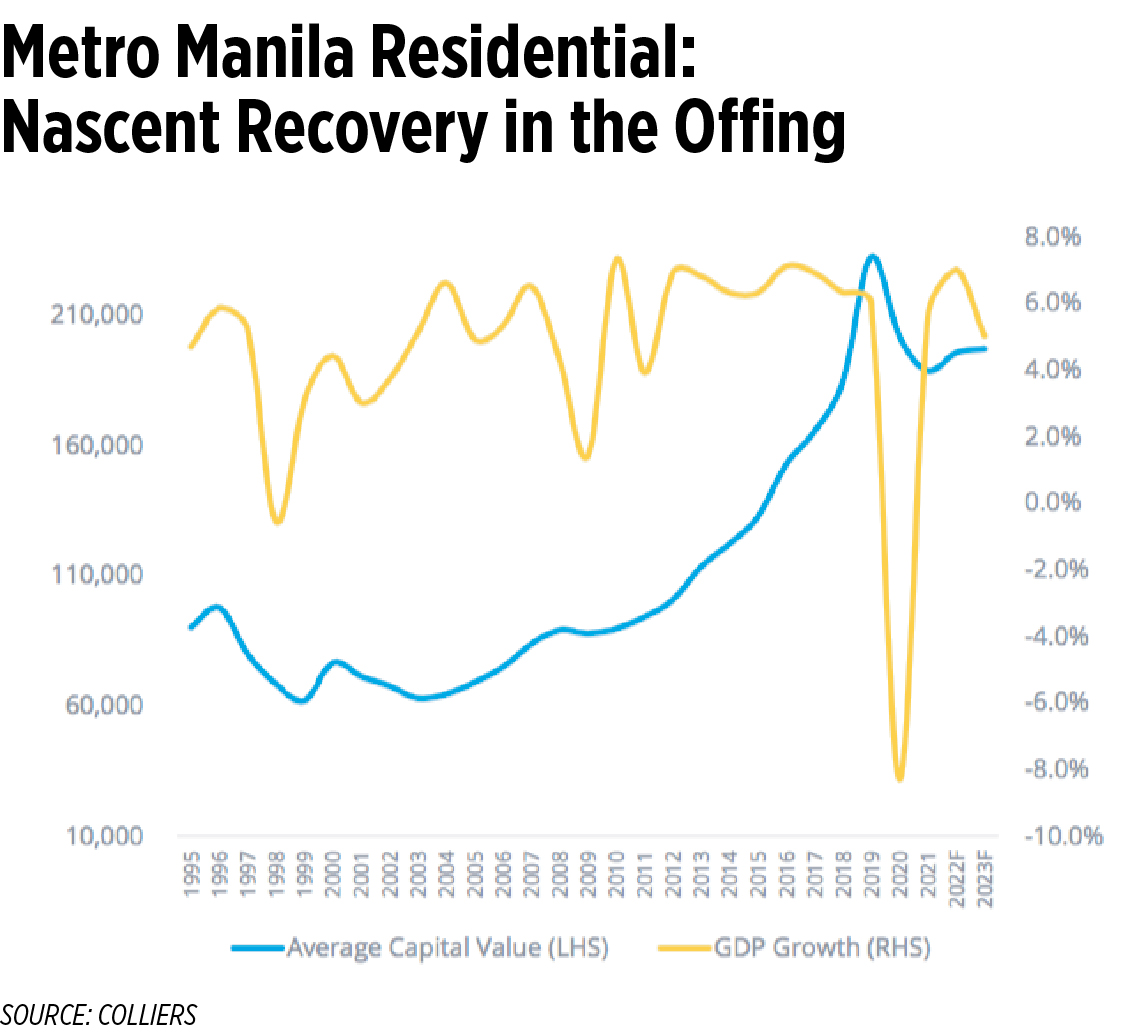
Colliers sees an annual average completion of 8,100 units from 2022 to 2024, from the 7,800 units completed yearly from 2019 to 2021. By the end of 2024, we project condominium stock in major business districts in Metro Manila to reach 166,400 units, a 17% increase from 142,200 units in 2021.

The Bay Area will likely overtake Fort Bonifacio as the biggest condominium market in the capital region in 2024, with 44,100 units or 27% of Metro Manila stock during the period.

We expect vacancy in the secondary market to drop to 17.1% in 2023 from 17.6% in 2022. Residential leasing should be supported by demand from expatriates and local employees looking for condominium units near their workplaces.

Meanwhile, Colliers saw a pick-up in demand in the pre-selling condominium market in Metro Manila. As of the first nine months of 2022, about 14,900 units were sold in the capital region, already outpacing full-year 2021 figures of 12,400 units.

While the mid-income market (P3.2 million to P6.0 million or $54,200 to $101,700) continued to dominate total take-up, we observed an increased demand for luxury projects (P8 million and above or $135,600 and above). The segment accounted for about 28% of total take-up in the first nine months of 2022, up from −1.6% in the same period in 2021, a negative share which reflects net back out.

In our view, this market will remain resilient amid the rising interest and mortgage rates. Colliers believes that demand for luxury and ultra-luxury projects will likely be sustained as investors bank on these properties’ potential for capital appreciation.

We also recommend that developers highlight amenities such as open spaces and green areas. Based on our third quarter 2022 Residential Survey, about 90% of respondents believe that having green and sustainable features are important in purchasing a residential unit.

Moving forward, Colliers sees more developers securing green building certifications for their residential towers. We believe that this will play a crucial role in future-proofing residential projects.

Colliers also encourages developers to assess the viability of launching more master-planned communities to take advantage of the government’s infrastructure projects. In the next 12 to 36 months, we see the completion of big-ticket projects including Metro Rail Transit Line 7, Light Rail Transit Line 1 Cavite Extension, North-South Commuter Railway and Cavite-Laguna Expressway (CALAX), raising the attractiveness of key provinces in Central and Southern Luzon for more township developments.

(In next week’s Property section: Outlook for retail.)

ESG professionals needed to move businesses’ sustainability agenda

EJ YAO-UNSPLASH

COMPANIES preparing sustainability reports suffer costs for not having professionals knowledgeable in environmental, social and governance (ESG) processes, said an official of a company with buildings awarded for their design excellence.

Raymond D. Rufino, chief executive officer of Neo Group, said doing sustainability reports and securing building certifications are inexpensive but companies need to allot resources for these.

“It’s not expensive but you need to have a budget, especially for people. These people put the data, they do the measures, there are people who will do the reporting,” Mr. Rufino said in an interview with BusinessWorld.

Companies can hire a third-party consultant who can check whether reports and measurements meet the required standards but they still need their own team to do the report, he said.

“If you don’t have the team to do the report, you can get consultants and this is where it becomes kind of costly,” he added.

Putting up a building can be costly for a company but it should also set aside a budget for human resources especially amid the low number of ESG professionals, according to Mr. Rufino.

Kaya sana ’yung schools magkaroon sila ng (I hope schools will start putting in) courses on ESG professionals. It should be a full course,” he said.

“In my view, it should be a degree course where you put together the different components of environmental science, a little bit of engineering, a bit of marketing. It has many aspects, so I think it is a four-year course,” Mr. Rufino added.

Neo Group is a unit under Sy-led SM Investments Corp. The company has seven buildings that have certifications from Building for Ecologically Responsive Design Excellence, Excellence in Design for Greater Efficiencies, WELL Building Standard, and Advancing Net Zero Philippines.

Its seven buildings are One/NEO, Two/NEO, Three/NEO, Four/NEO, Five/NEO, Six/NEO, and Seven/NEO, which are all at Bonifacio Global City in Taguig. — Justine Irish D. Tabile

Faithless singer Maxi Jazz, 65

FACEBOOK.COM/FAITHLESS

LONDON — Maxi Jazz, the lead vocalist of British electronic music band Faithless and known as the voice in trance hits such as “God Is a DJ” and “Insomnia,” has died aged 65, the band said on Saturday.

“He was a man who changed our lives in so many ways. He gave proper meaning and message to our music,” the other two core members of Faithless, Rollo and Sister Bliss, said in a statement on Facebook.

“He was also a lovely human being with time for everyone and a wisdom that was both profound and accessible.”

The band said on Twitter that Mr. Jazz had died peacefully in his sleep. It did not give a cause of death.

Mr. Jazz was born Maxwell Fraser in Brixton, south London, in 1957. He helped form Faithless in 1995, which then grew into one of the most popular dance bands in Britain and round the world.

“He was the kindest man with such an aura about him. His words and performances touched so many of us,” British DJ MistaJam wrote of Mr. Jazz on Twitter.

Faithless’ 1995 song “Insomnia,” which features Mr. Jazz rapping about struggling to sleep with the refrain “I can’t get no sleep,” was voted the fifth-greatest dance record of all time by readers of dance music magazine Mixmag in 2013.

The song, which topped the dance charts in many European countries, made Mr. Jazz quip in a 2020 interview: “If I had a quid for every time someone’s come up going, ‘I can’t get no sleep,’ I’d be living on the space station.”

Faithless said in their statement: “He was a brilliant lyricist, a DJ, a Buddhist, a magnificent stage presence, car lover, endless talker, beautiful person, moral compass and genius.” — Reuters

Israel regulator awards license for new digital bank

JERUSALEM — Israel’s banking regulator on Sunday approved a conditional license and control permit to a group of entrepreneurs to establish a new online bank, the second addition to the highly concentrated banking sector in three years.

The Bank of Israel said its banking supervision department had completed the inspection process for the new institution named Esh Bank Israel.

The approvals, it said, will allow the founders to move forward and complete the mechanical, operational and regulatory preparations required for the start of the bank’s activities.

These include completing the development and testing phases of new technology and hiring a management team and bank staff.

It will take about a year and a half to get the bank up and running, the central bank said.

“We have a long way to go,” said Shmuel Hauser, the chairman of Esh, adding the bank would offer attractive interest rates and banking services without commissions.

Last January, One Zero Digital Bank received final regulatory approval for a full banking license, becoming the first new Israeli bank in 43 years.

Israel’s banking system is highly concentrated and run by a handful of banks, with the two largest controlling more than half the assets in the sector.

“We see great importance in the entry of banks and additional new players into the banking system in Israel, so that they contribute to increasing competition and innovation in the financial system,” said Bank of Israel Governor Amir Yaron. — Reuters

Toyota hits record November output, but shortages loom

K S-UNSPLASH

TOYOTA Motor Corp. said its global output hit a record for November, thanks in part to solid consumer demand, though it warned of an uncertain outlook due to a persistent shortage of semiconductors and spikes in Covid cases in China.

The world’s No. 1 automaker produced 833,104 vehicles last month, an increase of 1.5% from a year earlier. Global sales rose 2.9% to 796,484 units, the company said in a statement on Monday.

The output for vehicles reflects solid demand in areas such as North America, and a rebound from a year earlier when Covid infections in Southeast Asia disrupted supply chains. The auto industry is still dogged by shortages of chips and other car parts, while it will also face challenges stemming from the rapid spread of Covid cases across China. 

In early November, Toyota cut its global production target for the fiscal year through March while sticking with a conservative profit outlook because of chip shortages.

Toyota’s domestic output for November declined 3.3% from a year earlier to 266,174 units, while overseas output was up 3.8% to 566,930 units, according to the statement.

Including vehicles assembled by subsidiaries Daihatsu Motor Co. and Hino Motors Ltd., output and sales totaled 982,552 units and 884,112 units, respectively.   

Toyota shares edged up 0.3% in Tokyo, paring the decline this year 13%.

Separately, Nissan Motor Co. said global output declined 23% from a year earlier to 248,961 units in November, while sales slid 26%. Honda Motor Co.’s global production fell 12% to 325,996 units last month, the first year-on-year decline in six months. — Bloomberg

Homeowners in Japan now facing an unfamiliar headache: higher mortgages

PEOPLE wear face masks at Shinagawa station during the rush hour in Tokyo, Japan, April 20, 2020. — REUTERS

TOKYO — When salaryman Takayuki Nakamura bought his Tokyo home last year, he got a floating-rate mortgage at a rock-bottom 0.35% and an assurance from the real estate agent that rates weren’t going anywhere. After this week, he’s not sure.

“On Tuesday, all of a sudden I’m hearing the interest rates are going up,” said the 48-year-old father of two. “It’s kind of obvious that I’m going to end up paying more.”

The Bank of Japan whipsawed global financial markets when it said on Tuesday it would allow rates to rise a little more, signaling a potential end to ultra-low rates and easy money after decades of trying to revive the world’s No.3 economy.

Like Mr. Nakamura, many Japanese fear they may eventually start paying more for mortgages. While any increase is likely to be modest, it would be a further injury to households worn down by years of flat wages.

“Even a small increase would have a big impact on consumer incomes,” said Masaaki Kanno, chief economist at Sony Financial Group and a former central bank official.

Fixed-rates are seen rising first, because the central bank allowed 10-year yields to creep up. That means new borrowers could start paying more than they might have a year or two ago.

The government-backed Japan Housing Finance Agency offers 35-year, fixed-rate mortgages as low as 1.65%. That compares with 1.33% in December last year and is more than four times as high as some variable mortgage loans.

Floating-rate mortgages aren’t expected to move anytime soon as they are tied to short-term rates that are still stuck in negative territory. Nevertheless, the central bank’s move has plenty of borrowers worried they will one day face higher payments.

Sony Financial’s Mr. Kanno reckons that as many as 80% or 90% of homeowners have opted for floating-rate mortgages, on the expectation that interest rates wouldn’t rise. Many of them are now likely looking to switch to fixed-rate loans, he said.

SERVER CRASHED
Mortgage comparison website Mogecheck.jp was flooded with traffic that sparked a server outage some 40 minutes after the Bank of Japan’s announcement. It was the first such incident since the site launched in 2015, said Takashi Shiozawa, chief operating officer of online mortgage broker MFS, Inc., which runs the site.

Customer inquiries have more than doubled, with many asking if they should now consider getting a fixed-rate rather than a floating mortgage, Mr. Shiozawa said. 

The company is telling them that floating-rate loans won’t be affected as long as the central bank keeps short-term rates negative, he said.

The issue is also political.

Prime Minister Fumio Kishida has made higher wages the centerpiece of his domestic political agenda and voters are waiting to see how much of a pay increase unions will get at their annual wage talks in spring.

But an increase in mortgage costs could eat into that wage bump in spring. The negotiations between unions and big manufacturers such as Toyota Motor Corp. typically set the tone for the rest of the Japanese economy.

“I’ve heard customers saying they want to lock in their deals soon before the rates go up,” said one employee at a Tokyo real estate agency, who declined to be identified because he was not authorized to speak to the media.

Some would-be buyers may now balk, given the risk that they may not be able to manage a potential increase, he said.

For Mr. Nakamura, the salaryman, the issue highlighted the deepening pain for single-income Japanese households such as his own.

“A person like me, the household income is dependent on the father my wife is a stay-at-home mom. Gas prices are going up, the price of everything is going up, but salaries aren’t going up,” he said. “It’s tough.” — Reuters

Entertainment News (12/27/22)


Simple Plan returns to Manila

CANADIAN rock band Simple Plan will be coming to Metro Manila and Davao in 2023 as part of its The Harder Than It Looks Tour in Southeast Asia. The band will perform on March 11 at the New Frontier Theater in Cubao, Quezon City, and on March 13 at the SMX Convention Center Davao. Simple Plan boasts of worldwide sales topping 10 million, with chart-topping hits including Perfect,” “I’m Just a Kid,” “Welcome to My Life,” “Jet Lag,” “Addicted,” “I’d Do Anything,” “Shut Up!,” and “Untitled (How Could this Happen to Me?).” Tickets to Simple Plan’s The Harder Than It Looks Tour in Manila will go on sale on Jan. 15 via TicketNet.com.ph and at TicketNet outlets nationwide. Tickets for the Davao show will go on sale on the same day via SMTickets.com and at SM Tickets outlets nationwide. For updates, visit @WilbrosLive on Facebook, Twitter, Instagram, and TikTok.


SB19 and Nobita release E-Heads song covers

TO commemorate the success of The Eraserheads’ reunion concert, original Pilipino music (OPM) acts SB19 and NOBITA have put their own unique spin on the supergroup’s famous songs.  Released today under Sony Music Entertainment, the revamped versions honor the Eheads’ music while giving the songs a more contemporary flavor that resonates with the streaming audience. P-Pop group SB19 tackled “Christmas Party,” a song off The Eraserheads’ fourth studio album, Fruitcake. Turning the original into a festive song, the five-member boyband incorporates elements of dance-pop, R&B/hip-hop, and modern funk into the mix. Meanwhile, NOBITA gave a jazz-pop treatment to “Magasin” without completely losing the song’s upbeat and heavily melodic arrangement. Slowing it down slightly with stripped-down finesse, the chart-topping five-piece act puts sunshine back in “hugot” with endearingly surprising twist. SB19’s “Christmas Party” and NOBITA’s “Magasin” are available on all digital music platforms.


GMA’s Kapuso Countdown to 2023

GMA Network parties with its contract stars, P-Pop stars, and the K-pop stars of SBS Gayo Daejeon in the New Year special, Kapuso Countdown to 2023 Gayo Daejeon, which will air on Dec. 31, 10:30 p.m., on GMA-7 and on the network’s official YouTube channel. Leading the countdown special are Alden Richards, Julie Anne San Jose, Rayver Cruz, and Christian Bautista, who will be joined by Barbie Forteza, Kyline Alcantara, Ruru Madrid, and Korean social media star Dasuri Choi. Also, part of this star-studded celebration are Sparkle actors Derrick Monasterio and Sanya Lopez. The P-Pop groups Calista, 1st.ONE, and KAIA will also be performing their hit songs. Viewers can watch out for the first mega trailer of Voltes V: Legacy which will be aired in the New Year special.

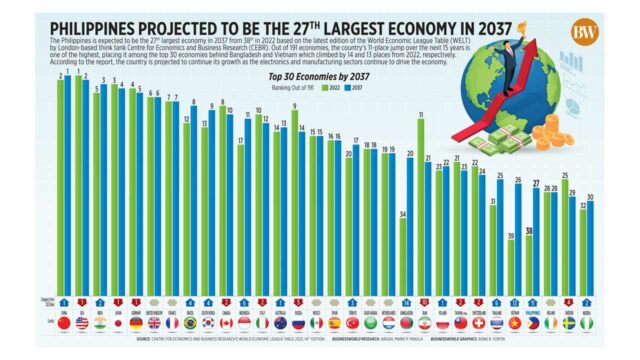
Philippines projected to be the 27th largest economy in 2037

THE PHILIPPINES is poised to become the 27th largest economy in the world by 2037, as gross domestic product (GDP) growth is expected to average 5% over the next 15 years, a report showed. Read the full story.

Philippines projected to be the 27<sup>th</sup> largest economy in 2037

Stocks to move sideways as year comes to a close

BW FILE PHOTO

PHILIPPINE STOCKS may move sideways in the last trading week of the year as investors price in economic concerns that may linger in 2023.

The bellwether Philippine Stock Exchange index (PSEi) declined by 35.91 points or 0.54% to close at 6,541.03 on Friday, while the broader all shares index lost 9.79 points or 0.28% to 3,432.47.

Week on week, the PSEi closed higher by 44.53 points or 0.69% versus its close of 6,496.50 on Dec. 16.

For this month, the PSEi has so far declined by 3.5% after it gained 10.2% in November, which was the biggest monthly gain in more than 12 months or since September 2010.

Philippine financial markets were closed on Dec. 26 due to a special non-working holiday.

Philstocks Financial, Inc. Senior Research Analyst Japhet Louis O. Tantiangco said the market may move sideways this week as investors price in their expectations for 2023.

“Investors are expected to weigh economic concerns that could still be present next year including the country’s high inflation, the monetary tightening of the Bangko Sentral ng Pilipinas (BSP) and the Federal Reserve, and the possible global economic slowdown, against hopes that next year would still be a robust one for our local economy, particularly its growth, despite the aforementioned challenges,” Mr. Tantiangco said in a Viber message.

The BSP raised benchmark interest rates by 50 basis points (bps) at its meeting on Dec. 15, bringing its policy rate to 5.5%. Rates on the central bank’s overnight deposit and lending facilities were likewise raised to 5% and 6%, respectively.

The Philippine central bank has now raised rates by 350 bps since May.

Meanwhile, the US Federal Reserve hiked its benchmark overnight interest rate by 50 bps to the 4.25%-4.5% range at its Dec. 13-14 meeting and projected it could go up to 5%-5.25% next year.

The Fed has now raised borrowing costs by 425 bps since March. 

Online brokerage 2TradeAsia.com said the benchmark index could retest the 6,600 and 6,800 levels before the year ends.

“At this level, the price is around 13x forward earnings. While this supports broad optimism, there is some wisdom to picking apart the basket and aiming for the crème de la crème — the high yield, recession-resistant plays that have their multi-year growth stories intact,” it said in a report. “As the curtains close for 2022, eyes are trained towards 2023 and the movers for the first quarter of the year.”

2TradeAsia.com said global interest rates, inflation and China’s reopening will be key considerations for the market going into 2023.

“Spending, public and private, will be a key metric for 2023, as the much higher effective cost of capital now rewards efficiency over anything,” it said.

2TradeAsia.com placed the PSEi’s immediate support between 6,350 and 6,400 and resistance at 6,600, while Philstocks Financial’s Mr. Tantiangco put the index’s immediate support at its 200-day exponential moving average and immediate resistance at the 6,600 level. — Justine Irish D. Tabile

‘Keen’ European interest in shipping after foreign ownership cap removed

ICTSI.COM

By Alyssa Nicole O. Tan, Reporter

THE SHIPPING and telecommunications industry are likely to receive increased European investment following the passage of a law that removes the 40% foreign equity cap in various industries, according to the European Chamber of Commerce (ECCP).

Republic Act 11647, which amends the 85-year-old Public Service Act, now allows 100% foreign ownership in airports and airlines, subways and railways, telecommunications, domestic shipping, and tollways and expressways after these industries were excluded from the definition of public utility. 

ECCP President Lars Wittig told BusinessWorld in a video call that “when it comes to shipping, we already know that the interest is keen, actually, I will say extreme.”

Despite the “abnormally high” freight rates in the Philippines, Mr. Wittig said some of the largest international shipping companies still had access to domestic freight.

Freight charges have already gone up by an average of 25% this year, reflecting the impact of higher oil prices.

In the year to date, fuel prices have risen by a net P13.95 per liter for gasoline, P27.50 for diesel, and P20.80 for kerosene.

The presence of foreign companies here is a token of their enthusiasm, Mr. Wittig said, “because they had to go through a lot of challenges in order to get the advantages that they already had before the Public Service Act was signed.”

This was possible because of their size, as well as decades of operations which allowed them to find ways to work around obstacles. However, Mr. Wittig said that it was still better to have an open market.

“We want everybody, without any limitation, to be able to do it, not just the biggest because they have the money to find a way,” he said.

“It has to be equal, fair, even playing field for everybody — foreign and local alike, not just a few foreign and all the locals,” he added.

Mr. Wittig said foreign interest in telecommunications was apparent from the 2018 bid to become the third player in the telecommunications industry.

Dito Telecommunity Corp., formerly known as Mindanao Islamic Telephone Company, Inc. (Mislatel), won after the two other contenders were disqualified. The consortium was granted a certificate of public convenience and necessity, as well as six radio frequency bands.

“There were multiple European telco providers that came here… but none of them won the tender, also because many of them didn’t even submit their proposal. Why? Because of the 40% ownership cap,” he said.

”Forty percent into something like telco is a massive investment, but it’s not enough ownership to control your own destiny. And therefore, that was won by the Chinese,” he added, referring to Dito’s Chinese investor, China Telecom.

Now that the Public Service Act has been passed, European telecommunications companies have indicated renewed interest, he said.

“They are very eager to return now and give it another try, and they will be dead serious about it. I guarantee you,” Mr. Wittig said..

“I also believe personally they will succeed in doing this,” he added.

The law “basically eliminates the Chinese providers,” Mr. Wittig said, referring to a provision that prohibits foreign state-owned enterprises from investing in any public service classified as a public utility or critical infrastructure.

“The Public Service Act, that which is really about national security, will allow the country to be equally safe in case of war,” he added.

The Philippines, however, will have to ensure acceptable implementing rules and regulations are in place to make the most out of the newly passed law, he said.

“We need to advance the current movements in the legal system by changing the implementation of rules and regulations on foreign ownership,” he said, noting that it is the country’s constitution that “prevents foreign companies from eroding resources for their gain in the Philippines.”