Home Blog Page 5444

Because we move in groups


The Nissan Livina features the familiar V-motion grille of the brand. — PHOTO BY KAP MACEDA AGUILA

Nissan PHL reenters MPV segment via a familiar nameplate

By Kap Maceda Aguila

NISSAN PHILIPPINES, Inc. (NPI) is entering the multipurpose vehicle (MPV) segment in the country with the launch of the all-new Nissan Livina. The three-row, seven-seater MPV, manufactured in Indonesia, is available in four variants — priced from P1.029 million.

In a launch event at the Nissan Shaw dealership in Mandaluyong City, NPI officials led by President and CEO Juan Manuel Hoyos oversaw the presentation of the model and its features.

Underneath the hood, the all-new Livina’s variants are similarly powered by a 1.5-liter DOHC engine boasting maximum output of 105ps and 141Nm. The entry-level E variant gets a five-speed manual transmission, while the EL, VE, and top-spec VL get a four-speed automatic.

In a release, Mr. Hoyos said, “The all-new Livina is a modern and practical MPV that young families and first-time car buyers will appreciate and trust. As part of Nissan’s transformation plan, we hope to reach more customers through this exciting offering to this competitive and fast-growing segment.”

It is a segment that has proven very lucrative for Mitsubishi Motors Philippines Corp. (MMPC). More than 60,000 units of the Mitsubishi Xpander have been sold here since the model debuted in 2018. This should be of interest to car browsers because this second-generation Livina is actually predicated on the nameplate. This is obviously another expression of the Renault-Nissan-Mitsubishi Alliance, a strategic tie-up of the auto brands which, taken together, control eight major marques.

Asked about the unique value propositions the Livina brings to the table amid the shared attributes with the aforementioned Xpander, Mr. Hoyos insisted to “Velocity” that the Livina is distinctly Nissan. “You can see the V-motion grille design; it’s very Nissan,” he began. “It also has innovations for our customers in terms of versatility and safety… It also comes with a five-year warranty, so in terms of total cost of ownership, it costs 30% less in maintenance and after-sales compared to its competitors because you only have to go twice a year to the dealership. So it’s a full package.”

The Livina features a front under spoiler, the LED taillamps, and daytime running lights. The VL AT trim receives silver accents, while the other variants get black. The driver’s seat in the VL and VE boasts six-way manual adjustment, and get fold-and-tumble second and third rows.

The VL additionally has keyless entry, a push-button engine start and stop, dial-type air-conditioning controls, a seven-inch touchscreen with audio and hands-free phone control, and multiple charging and connectivity ports at the center console. Its seats are wrapped in black leather — as is the steering wheel with a tilt and telescopic feature. Multiple storage compartments and cubbies are available, along with 12 cup holders.

NPI said that the Livina also comes with Nissan Intelligent Mobility and various safety features, including hill start assist, plus a reverse camera, air bags, anti-lock braking, vehicle dynamic control, traction control system, and parking sensors.

The Livina closely follows NPI’s launch of the Kicks e-Power, and Mr. Hoyos said that these are by design because the two segments promise growth. “We are entering two models that are highly proven — one an SUV, another an MPV. These are our entrants in (segments) that keep growing and we know why (they are) growing. They have elements that the Filipinos love — oriented to family, and we are providing lots of innovation through these vehicles. In the case of the Livina, we feel this is well-suited for multitaskers — particularly because of the third row.

The all-new Nissan Livina is available in five hues: Royal Ruby Red, Moonstone Grey, Diamond Pearl White, Onyx Black, Platinum Silver. Its pricing is as follows: VL AT (P1.209 million), VE AT (P1.149 million), EL AT (P1.109 million), and E MT (P1.029 million). The model also gets segment-first five-year/150,000-kilometer warranty.

Sales will commence on Sept. 15. For more information, customers may check with a Nissan dealership, download the Nissan Assist App to book a test drive, or go to https://www.nissan.ph/vehicles/new/livina.html.


PBEd says skills more important than degrees when hiring

By Revin Mikhael D. Ochave, Reporter

COMPANIES should focus on job competencies instead of college degrees during the recruitment process, advocacy group Philippine Business for Education (PBEd) said.

The Trade Chief recently recommended hiring more graduates of the Kindergarten to Grade 12 (K-12) program.

Justine B. Raagas, PBEd program director for workforce development, said that companies must look at the required job duties during the hiring process.

“[Companies] need to think of competencies. This means that they should think of the actual job and what the tasks entail so that when they hire or put out job advertisements, they don’t check for a paper qualification first but the actual competencies,” Ms. Raagas said in an interview last week.

For her part, PBEd Executive Director Lovelaine B. Basillote said that companies should review their recruitment process to meet the competencies needed for the job.

“It’s more of an overall review of the recruitment process so that you really hire a person fit for the job with the right competencies, making sure that you just hire for the job and the skills required of the job,” Ms. Basillote said.

Trade Secretary Alfredo E. Pascual recently urged companies to hire more K-12 graduates.

“When you check the job descriptions nowadays, almost all require college degrees. This should change because we already have the K-12 program,” he said.

“But it’s still not enough to say that having the program is enough. We need to prove that the K-12 program is able to produce holistically developed individuals,” he added.

“The mindset of people is that you cannot fully prepare for work when you don’t have a college degree, which is totally an erroneous mindset,” he pointed out.

Mr. Pascual also said that employers should invest in improving the skills of the country’s workforce, which according to Ms. Basillote, is the government’s responsibility.

“We think it is the responsibility of government to actually invest in human capital and continuously invest in its people,” she said.

Sacred designs in pearls and gold

A TRIP to Peru inspired a collaborative collection between jewelry brands Joanique and Arao.

The collaboration is called Alchemy, as in the ancient art of mixing elements together in the search to make gold and other precious (and even legendary) materials.

“When we started collaborating, it was more than a year ago. I just came from Peru, what I experienced there was still fresh,” said Joanique founder and creative director Malou Araneta. “I’m still so high from that journey, and I really want to express that in my designs,” said Ms. Araneta.

Joanique started in 2011 and is named after her two children, Joaquin and Monique.

About a year ago, Ms. Araneta went to Peru for a healing ritual. Interacting with the Quesha people of Peru, she sketched patterns that she saw during her trip, and interpreted them in jewels, with the pearls provided by Hong Kong-based Arao. During a luncheon on Sept. 1, Ms. Araneta walked us through some of her favorites.

She picked out a pendant woven in gold like a bird’s nest, an interpretation of the Flower of Life in the belief of sacred geometry, where sacred meanings are ascribed to repeating patterns found in nature. This piece is called T’ika (flower, $2,900 for the earrings, and $2,200 for the matching pendant; most of the pieces are in this price range). “A lot of patterns come from this,” she said about the flower.

Some designs were directly inspired by the Quesha people’s traditional motifs, or patterns found in Quesha weavers’ dreams. For example, she picked out a pair of earrings with a pearl dangling from a leaf. This set is called the Quintu (sacred leaf). “In Peru, it’s very common for them to take coca leaves. It’s like a sacred plant medicine,” she said. Apparently, on hikes, the high altitude makes it difficult to breathe. “So you take this coca leaf so you can breathe. It’s helps you acclimatize.”

A design with a spiral in the center of a sunburst (named Inti, meaning sun), meanwhile, reflects her own journey towards enlightenment.

As dreams and visions differ from person to person, she believes that this translates into her designs. She points out that even in pairs of earrings, for example, no two pearls are exactly identical.

“When you work with natural stones, no stones are completely the same,” she said. “I love working with pieces like that. Imperfection, for me, is beauty.” The fact that the collection is handmade also adds to its uniqueness. “We cannot really have it exactly the same,” she said.

What this says about visions and dreams, she says, “This is my journey. The ideas that I’ve had, the experience during the Peru trip — that for me is very unique. No one can take that away from me.”

View the collection at https://thearaolife.com/. —  JL Garcia

Mitsubishi donates two L300 units to Santa Rosa LGU

Mitsubishi Motors Philippines Corp. (MMPC) President and CEO Takeshi Hara (second from left) holds a symbolic key with Santa Rosa Vice-Mayor Arnold Arcillas at the turnover of two L300 units to the city government. With them are (from left) MMPC EVP for Corporate Division Takehisa Usami, EVP for Manufacturing Taro Soga, and CFO and EVO for Finance Michihiro Toyomizu. — PHOTO FROM MMPC

MITSUBISHI MOTORS Philippines Corp. (MMPC) recently turned over two Mitsubishi L300 units it donated to the local government of Santa Rosa, Laguna.

“Mitsubishi Motors acknowledges the efforts being done by the Santa Rosa local government to aid not only its citizens but also all the hardworking frontliners within the city,” said MMPC President and CEO Takeshi Hara in a release.

The company added that the donation represents the “strong partnership and cooperation” between itself and the Santa Rosa LGU. The L300 units are expected to support the local government’s logistical and transportation requirements.

Commenting on the donation, Santa Rosa Mayor Arlene Arcillas remarked, “From taxes paid, to employment opportunities, the corporate social responsibility programs of the automotive manufacturing industry has contributed immensely to the capacity and capability of the city government to provide continuous services for our constituents. Thank you very much, MMPC.”

Added Mr. Hara, “We at MMPC are committed to make every Filipino’s life better. Together with the Santa Rosa LGU, we aim to contribute to the lives of the Filipino people by providing reliable mobility solutions.”

The Mitsubishi L300 is regarded as an “iconic nameplate” in the utility van segment, known for its reliability, durability, and low cost of ownership. Equipped with a Euro 4 diesel engine, it delivers 40% more power and 10% better fuel efficiency compared to its predecessor.

For more information about MMPC’s activities and the Mitsubishi L300, visit https://www.mitsubishi-motors.com.ph or follow https://www.facebook.com/MitsubishiMotorsPH/.

Salt industry output seen held back by reclamation, import competition

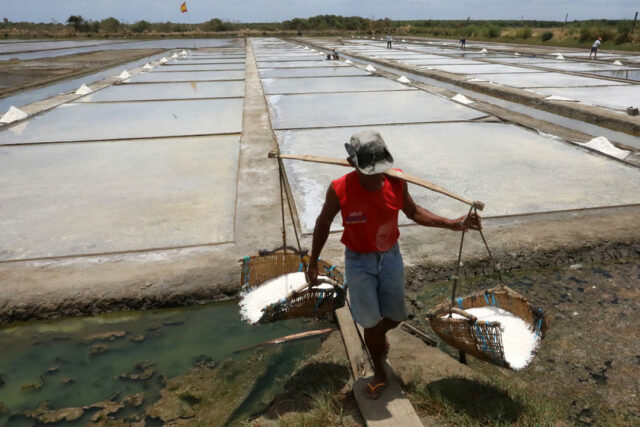
PHILIPPINE STAR/EDD GUMBAN

THE salt industry is unable to boost production due to the reclamation of shoreline and competition from imports, an organization of farmers said. 

“Due to cutthroat trade liberalization and side-by-side reclamation projects, local salt farms started closing one after the other,” the Kilusang Magbubukid ng Pilipinas (KMP) said in a statement. 

“Cheaper imported salt also flooded the markets, driving small salt producers and marginal fisherfolk into bankruptcy,” it added.

Before the Philippines signed on to the General Agreement on Tariffs and Trade, Bulacan used to be among the country’s biggest producers of salt, according to the KMP.

Apart from Bulacan, Pangasinan, Occidental Mindoro, and Las Piñas City were also key salt producers.

The Department of Agriculture has said that the self-sufficiency ratio for salt is equivalent to 7% of demand. The remaining 93% is supplied by China and Australia.

“Our over-dependence on rice and other food imports undermines our capacity to produce food staples locally,” KMP Chairman Rafael V. Mariano said in a statement.

“Back in the day, salt making was considered profitable and many families relied on it for their livelihood as Manila Bay provided clear waters for salt beds. But land reclamation became insatiable. Now, several reclamation and expansion projects along Manila Bay, spanning from Cavite, Pasay, to Bulacan, are in the pipeline,” Mr. Mariano added. — Luisa Maria Jacinta C. Jocson

Del Monte eyeing e-commerce and brand expansions

DEL MONTE Pacific Ltd. (DMPL) is looking to distribute its products via both conventional and digital channels, a company official said.

“The group will continue to improve and expand its offering of high-quality products, and make these more readily available to consumers through traditional and digital channels including e-commerce, and through more convenient formats,” the company said in a statement on Friday.

“We remain relentless in pursuing initiatives that will generate sustainable sales and profit while proactively dealing with cost inflation,” DMPL Managing Director and Chief Executive Officer Joselito D. Campos, Jr. said.

As part of the company’s brand expansion, DMPL’s subsidiary Del Monte Foods, Inc. (DMFI) recently acquired the intellectual property of the Kitchen Basics brand. 

DMFI paid $99 million to McCormick & Company, Inc. with the purchase including $17 million of inventory with market value of $25 million to $27 million.

“The acquisition is consistent with DMFI’s overall growth strategy as it focuses on innovation, renovation and customization of its iconic brand portfolio,” the company said.

DMPL said that it had started a number of cost-optimization initiatives. In the United States, it introduced distribution center consolidation and increased use of rail instead of trucks to save on fuel cost, while it introduced tin can packaging optimization in the Philippines.

On Friday, the group reported that it incurred a net loss of $30.52 million in the first quarter from an $18.32-million profit last year after booking a one-off redemption cost.

The one-off cost is from DMFI’s redemption of 11.87% senior secured notes worth $50 million “to secure a much lower interest rate.”

Without the said one-off cost, the group’s net profit climbed by 7.2% to $19.64 million in the first quarter from the previous year.

DMPL’s fiscal year starts in the month of May with the first quarter ending in July.

The group’s sales ended lower by 1.2% in the quarter to $456.6 million versus last year as the company booked lower sales in the Philippines.

Del Monte Philippines, Inc. (DMPI) recorded a 16.9% decrease in its net profit to $19.7 in peso terms after booking higher product and distribution costs due to inflation.

Meanwhile, it achieved an overall 3.6% increase in its sales to $168.5 in peso terms driven by sales of S&W processed and fresh pineapples.

Its sales in the Philippines, which accounts for about half of DMPI’s sales, was lower by 9.7% after it registered a decline in volume across its core categories amid a high inflationary environment.

“Packaged mixed fruits and beverage sales were down as consumers shifted priorities in the face of high food prices, and are spending more on necessities and products offering improved value,” DMPL said.

“Barring unforeseen circumstances, the group expects to generate a net profit in [2]023 after one-off redemption expenses,” the company said.

DMPL closed unchanged on Friday at P14.00 apiece. — Justine Irish D. Tabile

How to build your own skincare routine

By Zsarlene B. Chua

IN the past few years — and especially during the pandemic — skincare has been at the front and center of every beauty routine. People realized that having good skin is key to snatched makeup looks and feeling and looking great.

With all the options available today, it can be intimidating and confusing for those who are new to the skincare game and are looking to create their own routine.

As a person who has, for years, gone on her own skincare journey and tested products for a living, I’ve learned that every person’s routine can be different and the most important thing is that you find your routine not only effective but also something you enjoy doing every day.

So, if you’re new to the skincare game and are looking to build your own skincare stash, here are tips to get you started.

(I am not a licensed dermatologist or aesthetician, so please take my tips as suggestions and please do seek medical advice if you’re having skin issues.)

Ask yourself: how much time and money are you willing to spend on a routine?

A skincare routine is a commitment — a commitment that you’ll have to set aside time and money for to achieve your skincare goals. Remember that a skincare routine is done twice a day, so the first thing to consider before building your own skincare routine is to ask yourself how much time and money you can comfortably allocate for it.

This doesn’t mean that if you’re always in a rush that you won’t get a good routine or if you don’t have that big of a budget you won’t get that glowy, glass skin you want. No, this just means that you’ll have to create a routine that works for your skin, your wallet, and your time.

If you only have 15 minutes (or even five!) in the morning and at night to do skincare, that’s perfectly fine. You can stick to the very basic, yet effective products, to get you sorted out. You should never feel that you’ll have to go way beyond what you’re comfortable with because, again, skincare should be self-care and you should always enjoy doing it.

Don’t know where to start? Start by finding out your skin type

The most important thing about any good skincare routine is understanding what your skin needs and your goals are. Before buying any product, it’s important to know if that product is suitable for your skin type.

If you don’t know what your skin type is, try doing this. Wash your face with water, let it air dry, and wait for a few minutes. If your skin feels tight all over, chances are you have dry skin. If, after a few minutes, you already see a shine all over your face, you may have oily skin. If it feels tight in some places (like the cheeks) and shiny in other places (like the nose and forehead area), you may have combination skin. If your skin feels none of these and feel normal, you may have normal skin. In addition, if your skin is easily irritated, you may have sensitive skin (but please confirm this with a dermatologist).

Note that your skin type may vary because of the weather, your health, and other factors, so it’s important to always listen and re-adjust to your skin needs.

How to create a beginner skincare routine? Stick to the basics of the basics.

There’s a ton of products out there and our favorite influencers always have a new thing they’re recommending every day. It can be overwhelming and confusing. Remember that the most important thing in a newbie routine is to have a basic routine down pat.

That means using only the most basic and essential products and once you’re used to using those products every day, twice a day, that’s the time you can start experimenting and adding other products.

The basics are, for me, a good facial cleanser, a good moisturizer, and sunscreen. That’s it.

Start your day and end it with a clean face. This means using a good facial cleanser. Not only does it remove dirt and irritants, a clean face provides a good canvas that will allow other products to sink in and do their work.

If you’re looking for a good affordable cleanser, Celeteque Hydration Facial Wash (P89/60ml) and Human Heart Nature’s Nourishing Facial Wash (P84.75/50ml) are great places to start. Both are local brands that promise gentle cleansing while keeping the skin moisturized. This is perfect for those with normal, combination, and sensitive skin. If you do need something for acne, Human Heart Nature also has one product for acne defense.

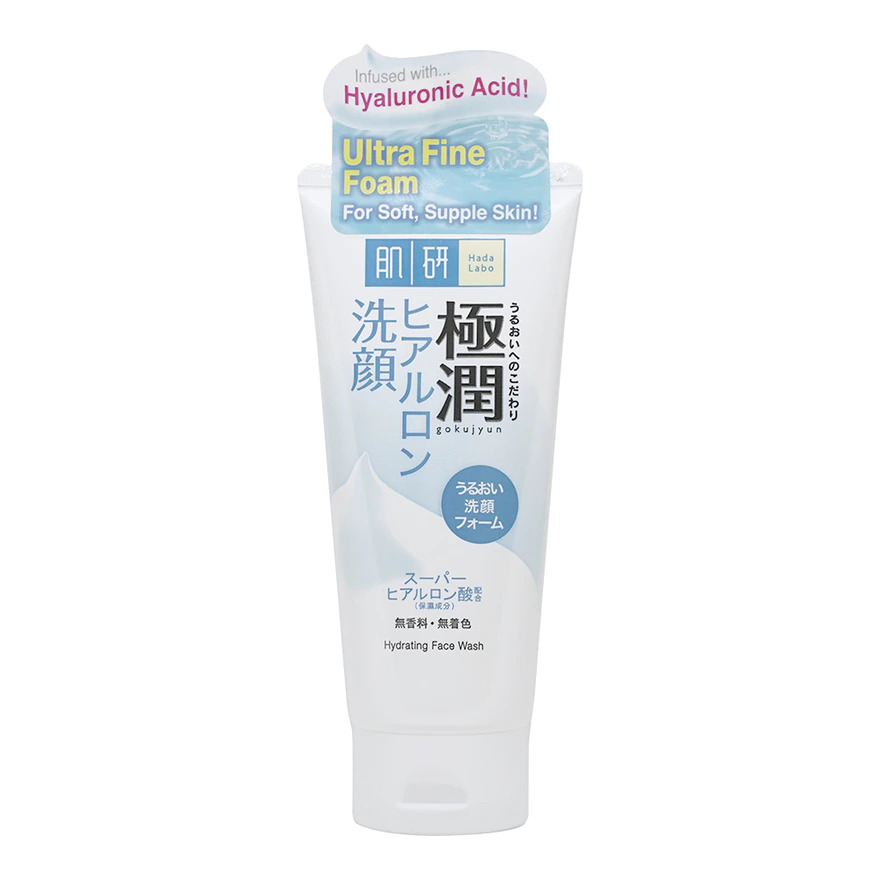
Personal favorites of mine are the Senka Perfect Whip Facial Wash (P279/125g) and the Hada Labo Hydrating Face Wash (P385/100g) if you have a bigger budget. Both Senka and Hada Labo have this whipped, smooth texture that makes washing your face fun and luxurious.

Remember to stop using your facial wash if it makes your skin feel tight, burning, or itchy.

Next is a good moisturizer. Moisturizers protect the skin’s moisture barrier — this is the barrier that keeps environmental stressors like pollutants and irritants out, as well as bacteria that can make our skin look and feel bad.

All skin types need to moisturize: drier skin types can go for heavier creams while oilier types can go for water gel or lotions.

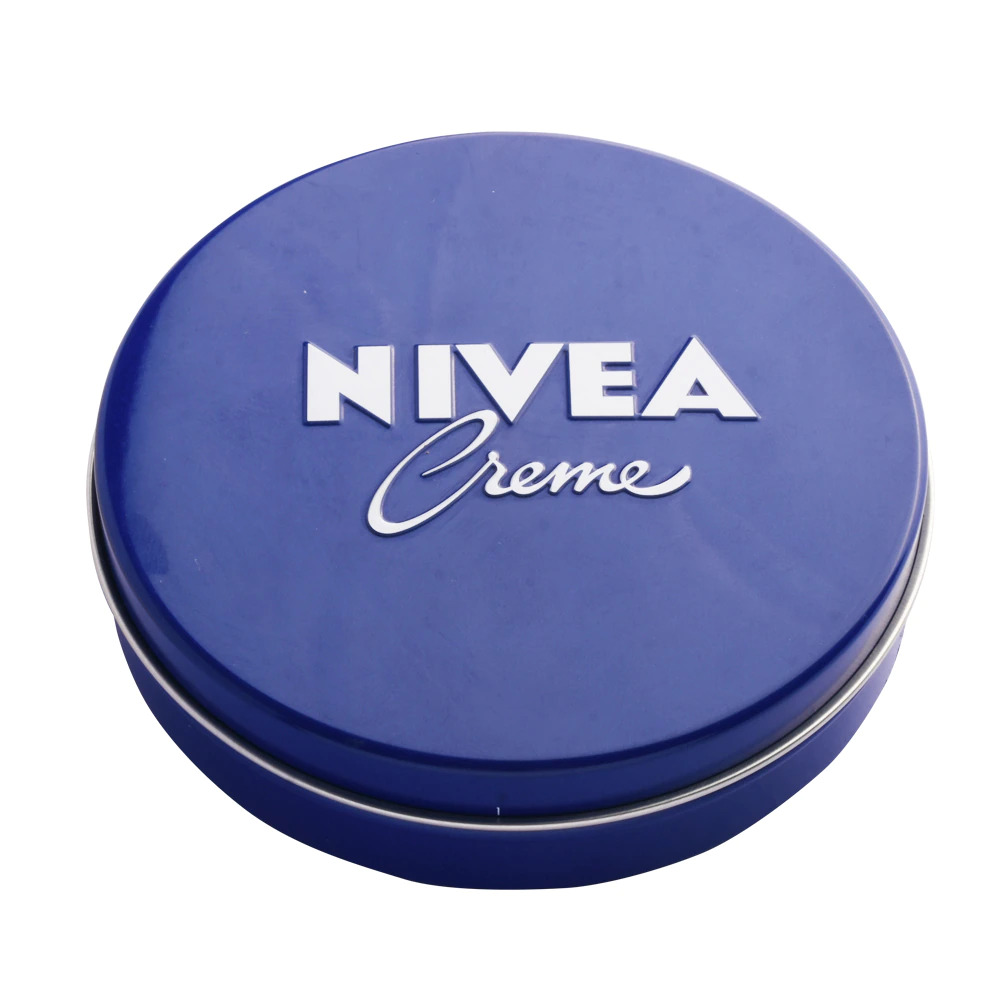
My brother, who has oily and acne-prone skin, has recently fallen in love with Fresh Skinlab’s Jeju Aloe Ice Soothing Gel Lotion (P209/300ml). This is a lightweight gel moisturizer that contains aloe leaf water that soothes the skin, and panthenol that moisturizes the skin’s barrier. Meanwhile, I am currently loving the Fresh Skinlab Tomato Glass Skin Hyaluronic Water Drop Cream (P239/80ml) because while it’s lighter, it does give me all-day moisturization. A tried-and-tested mainstay is the classic Nivea Moisturizing Creme (P345/150ml) for times when my skin needs extra moisturizing.

Like the facial wash, you’ll need to use a moisturizer day and night. What I do to save time in the morning is that I use more lightweight formulas like Fresh Skinlab to layer underneath my sunscreen and use the Nivea creme at night.

Finally, get yourself a good sunscreen to apply after your moisturizer in the mornings. This is another non-negotiable for me because the sun is the main cause of skin damage and aging. It doesn’t even matter if you’re stuck inside working or studying, you still need to put on sunscreen because you’ll still be exposed to the UV rays from your windows (even your laptop and other devices emit UV).

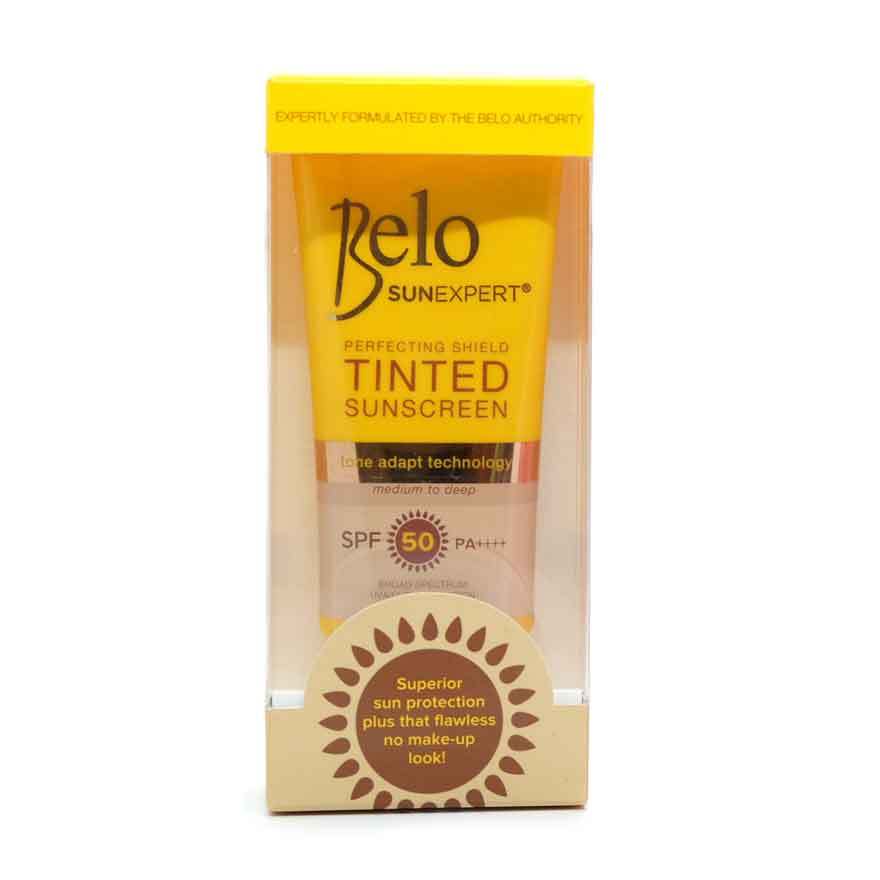
A common complaint I get from people who are not fans of sunscreen is that they don’t like it because it’s sticky. The fix to that is to find brands which are not, like the Sunglow by Fresh Tinted Sunscreen (P329/50ml) and the Belo Sunexpert Perfecting Shield Tinted Sunscreen (P462/50ml). These products are not only not sticky, they also layer well under makeup and can even substitute for foundation or BB cream due to their light-to-medium coverage.

If you don’t want the tint, you can also try the BIORE UV Watery Essence Cream (P495/50ml) which is also incredibly lightweight and has this water gel texture for those who don’t want heavy sunscreens.

Good sunscreens can be pricey but please do put it in your skincare routine. Your skin will thank you for it.

Now, you have a list and you want to go buy the products, but skincare can be a bit of hit-and-miss and it takes time and money to know which products work for you. So, what do you do?

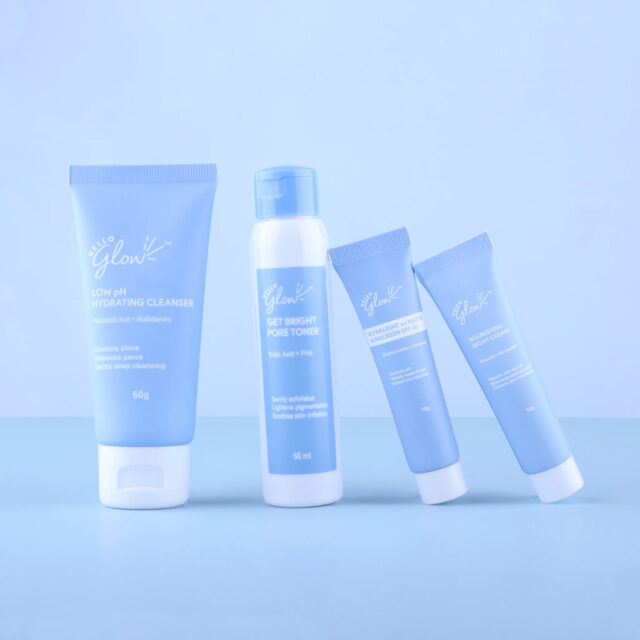
Well, one thing is to try skincare sets — especially trial or travel-sized ones — like Celeteque’s Traveler’s Basics Set (P155) that contains three hydration products: facial wash, toner, and moisturizer, or Hello Glow’s All-Natural Whitening or Rejuvenating Set (P360) that contains four mini products — a cleanser, toner, cream, and sunscreen — enough for a complete routine. The All-Natural set is said to be meant for dealing with uneven skin tone and has Apple Extract, Glutathione, Arbutin, Kojic Acid, and Vitamin C to lighten and brighten skin tone, while the Rejuvenating Set is for those who want to address skin issues like acne. It has Ceramides, Hyaluronic Acid, AHAs and BHAs, among others, to help improve skin texture.

By buying a set, you already have most of the products you need and you can see if it will work for you without burning a big hole in your pocket.

Those are the products you can use to start your skincare routine. Once you’ve gotten the hang of applying these and are satisfied with what they’re doing for your skin, then you’ll be able to add or substitute other products like serums, oils, and masks to your routine.

Remember that a good skincare routine isn’t about the number of steps, it’s about choosing the products that will work for your skin, time, and budget.


Zsarlene Chua is a former BusinessWorld reporter who is now a fledgling PR girl. She’s all about skincare, makeup, and video games. None of these products recommended are the writer’s clients. These are all independently reviewed and acquired products.

Campaign underscores Seaoil’s customer service pledge

SEAOIL, the leading independent fuel company in the Philippines, reiterated its pledge to deliver excellent customer experience through its Alagang Seaoil campaign. Aside from caring for its customers via innovative products and services, delivered even during the challenging times such as at the outset of the COVID-19 pandemic, Seaoil — through the Seaoil Foundation — continues to implement relevant programs.

“As we slowly transition into a post-COVID world, we will double our efforts in fostering the Alagang Seaoil way of doing things within and outside the organization. If there’s anything the past two years have taught us, it’s that we serve our customers best when we adapt to the present realities and innovate continuously to address their needs. They can count on us to consistently deliver products and services with genuine care,” said Seaoil CEO Glenn Yu.

At the height of the pandemic, Seaoil partnered with Locq, OPC to give customers some relief over volatile fuel prices through the PriceLocq mobile app. The company said there are now over 200,000 PriceLocq app users that are able to buy and store fuel for future use before a series of price hikes. To further add convenience for its users, the RFID top-up feature was recently added in the app to enable customers with Autosweep RFID accounts to also reload through the PriceLocq app. Easytrip compatibility will be added soon, said the company.

Seaoil also recently opened its second LubeServ branch in San Fernando, Pampanga to offer change oil and preventive maintenance services to customers based in the Central Luzon area. Apart from its fuels, Seaoil also made STP additives available in its lubricant product line when it expanded its partnership with the international oil treatment brand STP last November. Three more Lubeserv branches located in Cavite and Caloocan are expected to open by the end of 2022.

More customers will have access to quality products and value-added programs as Seaoil is set to close the year with over 700 stations nationwide. The firm also recently broke ground on its Zamboanga Bulk Terminal in May this year, scheduled to open by the end of 2023. It is Seaoil’s 12th terminal nationwide, and will serve retail and industrial customers in the Zamboanga Peninsula, and the neighboring islands of Tawi-Tawi, Jolo, and Sulu.

Award-winning actress, entrepreneur, and philanthropist Anne Curtis-Smith was recently introduced as the brand ambassador for the Alagang Seaoil campaign. “It’s such an honor to be a part of this campaign that promotes a culture of care for the Filipino community,” she commented.

Labor dearth set up Malaysia for 3rd year of palm oil losses

REUTERS

KUALA LUMPUR — Malaysian palm oil planters are letting thousands of tons of fruits rot as the third year of a worker shortage has left companies unable to increase their harvesting during the peak production season.

Palm oil output in Malaysia, the world’s second-largest producer, is forecast to decline, or at best remain unchanged, from last year’s 18.1 million tons, according to planters and analysts.

Plantations across the Southeast Asian nation are facing their worst labor crisis since the industry began in 1917, with the arrival of migrant workers that are the core of the industry’s labor force at a “snail’s pace,” the Malaysian Palm Oil Association’s (MPOA) Chief Executive Joseph Tek, told Reuters, despite the lifting of coronavirus-related hiring restrictions.

A lack of skilled harvesters means companies cannot fully capitalize on the peak harvest season that spans from August to November, forgoing a boost of growth from recent rains.

“The plantation industry is no longer at the breaking point, it has been pushed beyond the breaking point,” Mr. Tek said.

Production shortfalls in Malaysia will support prices for benchmark crude palm oil futures, the most-traded vegetable oil in the world, which have lost half their value after hitting a record in March.

Travel restrictions enacted in 2020 to fight the COVID-19 pandemic left the Malaysian palm oil industry short of 120,000 foreign workers needed to maintain trees and harvest fruit bunches. After that, oil palm yields plummeted to near 40-year lows in the 2020/21 marketing year, adding to a broader global edible oil shortage triggered by the Russia-Ukraine war.

That pushed palm oil prices to record highs in March, inflating prices of foodstuffs, detergent and other palm oil-based products.

Since then, though palm oil prices have slid lower following the resumption of exports from rival Indonesia, the world’s biggest palm oil producer, and a rebound in world oilseed production, with estimates of all-time high soybean output in the US and Brazil.

Chicago soybean oil has fallen 25% since hitting its all-time peak in April.

Malaysia’s palm industry expected their labor woes to ease after the government lifted the COVID-19 freeze on recruitment in February, with the MPOA expecting the entry of 52,000 migrant workers.

However, only several hundred workers have arrived, largely because of slow government approvals and concerns over worker protections.

The MPOA estimates only 12% of approvals for migrant workers granted to companies across all industry sectors in Malaysia have successfully translated into boots on the ground.

Migrants, mainly from Indonesia and Bangladesh, make up around 80% of the workforce in Malaysian estates. Malaysia’s Ministry of Human Resources, which is responsible for approving the intake of foreign workers, did not immediately respond to Reuters queries for a comment on the labor crunch.

Messages sent to the Minister of Human Resources Saravanan Murugan were not replied to as well.

FGV Holdings, the world’s largest crude palm oil producing firm, said it has received 647 migrant workers this year and it has only filled 62% of its required workforce. The firm is optimistic it will receive 7,000 workers by the end of the year, FGV said in a stock exchange filing on Aug. 30.

However, any incoming workers will miss the crucial high crop season. As harvesting time at some plantations extends to as much as 90 days from the usual 10 to 15, producers are losing up to a quarter of their crops, the MPOA said.

It estimates opportunity losses from unrealized crop and palm products could exceed 20 billion ringgit ($4.44 billion) by the end of the year. — Reuters

Philippines slips in Human Development Index

The Philippines ranked 116th out of 191 countries, down three places from 113th previously, in the latest Human Development Index (HDI) by the United Nations Development Program. The index ranks countries based on three dimensions of human development: a long and healthy life, knowledge, and a decent standard of living. With a score of 0.699 out of 1, the Philippines was only ahead of Laos and Timor-Leste (both 140 overall), Cambodia (146), and Myanmar (149) in select East and Southeast Asian countries included in the index. The Philippines’ HDI score was also below the East Asia and the Pacific’s average of 0.749 and the World’s average of 0.732.

Philippines slips in Human Development Index

SC affirms P8.11-million fine against production company

PHILSTAR FILE PHOTO

THE Supreme Court (SC) has upheld a fine against members of a post-production company in favor of Magsaysay Films International Corp. (Magsaysay).

In a 16-page resolution on Jan. 5 and made public on Sept. 9, the SC Second Division upheld with modification the P8.11-million fine for damages against Cinecolor Corp. (Cinecolor) with an interest of 6% for failing to correctly render its services to the local film company.

“It was incumbent upon defendants to release a  good quality film after post-production. It was their legal duty. It was what they were paid to do. The outcome of the film, however, was a total disaster,” the High Court said in the ruling.

It added that the original fine issued by the Court of Appeals was a reasonable amount.

The appellate court ruled the production company acted in bad faith when it failed to refund the P8 million agreed upon for the film’s production. The court ordered the production company to pay P8.11 million in compensatory damages.

In 2004, the two firms agreed upon a schedule for a film that Magsaysay planned on releasing in time for the Manila Film Festival on the afternoon of June 22 that year.

A day before the festival, Cinecolor had not finished the final mixing of the film which caused the film’s release to be rescheduled to the evening of June 22, the SC said.

When the film was eventually premiered, the final product had faulty sound work, color editing, and other technical issues, it also noted.

Cinecolor claimed that Magsaysay did not provide them with the raw materials needed to complete the film project.

Magsaysay pointed out that the production company showed inexperience and unpreparedness when it turned over a “substandard film.”

The high tribunal noted that the unfinished film that was shown to a viewing audience also damaged the film company’s reputation, which led to P8.11 million in total damages.

“Instead of a mere reassurance, defendants (Cinecolor Corp.) should have done what they were asked and paid to do,” said the High Court. “They should have corrected what was needed to be corrected to come out with a good quality movie.” — John Victor D. Ordoñez

Burberry, cancels runway show following the death of Queen Elizabeth II

PHOTO FROM TWITTER.COM/BURBERRY

LONDON — British luxury brand Burberry said it had canceled its spring-summer 2023 runway show on Sept. 17 following the death of Queen Elizabeth II.

Burberry’s runway shows are a highlight of London fashion Week.

Belgian designer Raf Simons has also announced that his brand’s show, scheduled for Sept. 16, will be canceled in a show of respect for the Queen.

According to GQ magazine, Burberry released a statement saying: “It is with great sadness that we have learned of the passing of Her Majesty The Queen. As a mark of respect, we have taken the decision to cancel our Spring/Summer 2023 runway show due to take place on 17 September in London.” It is not known if Burberry will reschedule the show at a later time.

“As the country enters a period of official mourning, we will pause during this time of great sadness. We will take this time to respect the legacy of Her Majesty Queen Elizabeth II and her 70 years on the throne. Our thoughts are with the Royal Family and the people of the Commonwealth,” Raf Simons’ brand said in a statement according to GQ.

Meanwhile, the British Fashion Council said that London Fashion Week will go on as scheduled from Sept. 16-20. “It is an important moment for designers to show their collections at a specific moment in the fashion calendar, [and] we recognize the work that goes into this moment,” the council said in a statement according to the Financial Times.

“Therefore, shows and presentations of collections can continue, but we are asking that designers respect the mood of the nation and period of national mourning by considering the timing of their image release,” the statement said. The council did urge the designers to postpone “non-essential” events, and urged that their shops close during the funeral.

The council also suggested that shows on the day of the funeral be rescheduled.

The date of the funeral has yet to be announced.   with a report from Reuters