Home Blog Page 542

Kia Philippines continues support for EJ Obiena, other Pinoy athletes

International pole vaulting star EJ Obiena with a Kia Sorento Turbo Hybrid — PHOTO FROM KIA PHILIPPINES

KIA PHILIPPINES, a subsidiary of ACMobility, firmed up its support for Filipino international pole-vaulting sensation and Olympian EJ Obiena, through “dedicated mobility” as he continues to represent the Philippines on the global stage. In a release, the company said that the initiative aligns with Kia’s global philosophy of “Movement That Inspires” and complements the Ayala Group’s broader advocacy for athlete development through programs such as Atletang Ayala.

Kia Philippines Managing Director Jay Lopez said that “EJ’s story mirrors Kia’s own evolution, driven by discipline, innovation, and an unwavering pursuit of excellence. He’s a living embodiment of movement that inspires, and we’re proud to help him reach even greater heights.”

Kia Philippines continues to provide Mr. Obiena with dedicated mobility support as he competes and trains around the world. During a recent visit to Manila for the Atletang Ayala World Pole Vault Challenge, where Kia served as the official mobility partner, Mr. Obiena was transported in a Kia vehicle throughout his stay. A Kia Sorento Turbo Hybrid also served as his personal vehicle for other engagements across the Philippines, underscoring Kia’s commitment to delivering comfort, reliability, and performance for Filipino excellence.

In Italy, where the athlete maintains his residence and training base, Kia has extended its support through its global network by providing him with a dedicated vehicle for his daily mobility needs. This ensures consistent comfort and reliability, allowing EJ to focus fully on his training and international competitions, including his participation in the 2025 SEA Games.

“I’ve mostly driven Kias my whole life, from my first car to the Sorento I used while I was in the Philippines,” he revealed. “It’s kind of poetic that the brand I started with is now a partner in my journey. Kia has always been purposeful, capable, and stylish, just like how I approach my sport.”

Meanwhile, through Ayala Foundation’s Atletang Ayala, Ayala provides national athletes with full-salaried employment, flexible work arrangements, and access to world-class training and medical facilities, empowering them to excel both in sport and in their professional careers.

This SEA Games 2025, Kia is committed to supporting and celebrating Atletang Ayala athletes joining the international multi-sport event by featuring their journey in a series of short-form videos to inspire greatness.

Through ACMobility, Kia Philippines, and Ayala Foundation, the Ayala Group continues to advance its shared vision of movement with meaning, supporting Filipino excellence on and off the field.

“This partnership goes beyond providing vehicles,” Mr. Lopez said. “It’s about supporting Filipino excellence in all forms, on the road, in sport, and in life. We want Kia to be a brand that moves people to achieve more and reach higher.”

For more information about the brand’s vehicle lineup, visit www.kia.com/ph or follow Kia Philippines on Facebook, Instagram, and YouTube.


Style (12/22/25)


End-of-season sale at Rustan’s

RUSTAN’S invites shoppers to its End of Season Sale, happening from Dec. 26 to Jan. 11, both in-store and online. With offers of up to 50% off, the sale arrives just in time for last-minute gifting, thoughtful home refreshes, and dressing for the final gatherings of the year. On Dec. 26 only, FSP members can receive X5 FSP Points on regular priced items with no minimum purchase required for both FSP Regular and FSP Premium members. As an added festive treat, FSP Premium members can also earn X5 FSP Points on regular priced purchases from SSI brands within Rustan’s. Up for grabs are Self Portrait’s Chiffon Ruffle Dress and the Natori Chiyo Cotton Dress. Lady Rustan and Criselda present timeless pieces with their signature polish; the Ramy Brook Blanca Dress delivers modern glamor and the Adolfo Dominguez Midi Dress highlights sophistication. Accessories provide thoughtful accents, from the sculptural charm of the Rodo Paris Wicker Bag to the Aquazzura Latour Sandal 75 Multimetal. For subtle sparkle, Swarovski adds a refined touch, while Frame offers modern versatility. The Naturalizer Jayla Slingback Pump in Cappuccino Brown rounds out the season’s options for womenswear. Menswear brings craftsmanship and polish through pieces like the Pedro del Hierro Polo Neck Sweater in Black. The minimalist Cote et Ciel Sava Sleek Black bag makes an ideal gift or a smart update for the new year. Beauty enthusiasts will enjoy offerings such as the Anastasia Beverly Hills Magic Touch Blush Trio and the Perricone Lip Oil. The L’Occitane Hair Care Line provides luxurious self-care moment, while Neal’s Yard Remedies Organic Frankincense Essential Oil offers a calming touch. For the home, Rustan’s offers the Christofle Mood Set of 24-piece Flatware in rose gold. The Lalique Zeila Panther Sculpture makes a striking centerpiece, while the Hanoia Tigris Tic Tac Toe gameboard offers sentiment and craftsmanship. Elevate hosting and New Year’s dining with the Vista Alegre x Oscar de la Renta Coralina Blue collection, featuring couture-inspired floral motifs. Children join the fun with the Yumbox Bento Three, a colorful and practical lunch companion. For imaginative play, the Melissa and Doug Deluxe Wooden Cooktop Set encourages creativity and roleplay. Visit Rustan’s in-store, online 24/7 at Rustans.com, or shop with the help of a personal shopper.


Fendi launches Emily in Paris capsule collection

FENDI has launched a special capsule collection to celebrate the 5th season of the Netflix series Emily in Paris, which premiered on Dec. 18. Available in a limited release in selected Fendi boutiques worldwide and at fendi.com, the exclusive collection puts the spotlight on Fendi’s icons, with two Baguette bags and one Peekaboo bag designed to capture the spirit of the show reinterpreted with the House’s codes. Each piece features a dedicated tag and is crafted with a tapestry-effect fabric with the Fendi Dots motif — a blend of the FF logo and Art Deco-inspired polka dots, offered in color-block combinations of brown and pink or dove and mint green. The capsule collection highlights the brand’s relationship with the show, enhanced by a presence of Fendi in Season 5 where viewers will witness Emily Cooper (Lily Collins) embark on Roman adventures with the Baguette bag at the Fendi Headquarters at Palazzo della Civiltà Italiana and Palazzo Fendi flagship store.


Last-minute gift shopping at Araneta City

LAST-MINUTE shoppers are sure to find what they are looking for at the various malls and special areas of Araneta City. Over at the Parolan — located near Farmers Garden and Farmers Market — one can search for last-minute Christmas décor and festive touches, including lanterns, garlands, ornaments, and other decorative pieces suited for home styling and gifting. The selection also includes festive items that can serve as thoughtful seasonal presents. Farmers Bazaar on Level 3 of Farmers Plaza is a stop for exchange gifts. Its assortment of stalls offers novelty items, practical accessories, and everyday essentials, providing a wide range of affordable gift options. Calle Plaza (on the Upper Ground Floor of Farmers Plaza) features locally produced items such as woven goods, handmade accessories, and artisanal décor. Ali X, located on the Upper Ground Floor of Ali Mall, caters to shoppers seeking something unconventional. With stalls offering vintage items, art pieces, vinyl records, and collectibles, it is a fitting stop for gift-giving aimed at niche interests and hobbies. For shoppers who prefer established retail brands and ready-to-gift items, Araneta City also houses a variety of lifestyle and novelty stores, from KKV and Flying Tiger at Gateway Mall 2; to Miniso and Rustan’s at Gateway Mall 1; and Papemelroti and Blue Magic at Ali Mall.

Sustainable procurement vital for competitiveness, ESGpedia says

REDGREYSTOCK ON FREEPIK

PHILIPPINE COMPANIES should make sustainable procurement a core part of environmental, social, and governance (ESG) practices to strengthen their supply chains and stay competitive, sustainability consulting firm ESGpedia said.

“Another equally important pillar to consider is sustainable procurement, where companies evaluate and engage suppliers not just on price and efficiency, but on environmental performance, ethics, and social impact,” ESGpedia Vice-President Jozsef Acabo said in an e-mailed reply to questions.

He said this approach embeds sustainability across the entire value chain — from raw materials to distribution — not just within the organization.

Companies that share data openly with suppliers and uphold ESG standards can better manage Scope 3 emissions, meet global expectations, and maintain resilient supply chains over the long term, he added.

Scope 3 emissions are indirect greenhouse gases from a company’s supply chain, excluding direct operations and purchased power, which make up the majority of a company’s carbon footprint.

“In many cases, responsible sourcing becomes a competitive advantage, especially for organizations aiming to export or partner with global brands,” Mr. Acabo noted.

He said that adopting ESG practices is not just about compliance, but also a strategic step for companies seeking to secure international contracts and partnerships.

Philippine firms need to integrate ESG into core operations, including reducing emissions, improving social impact, strengthening governance, and adopting transparent ESG reporting aligned with global standards, he said.

“My advice to Philippine companies would be to view ESG as an opportunity to future-proof their business, especially as the regulatory landscape evolves toward 2026. With mandatory sustainability reporting on the horizon, companies that prioritize sustainability now will be ahead of the curve,” Mr. Acabo said.

He added that focusing on ESG from the outset can also unlock new revenue opportunities through sustainability-linked loans and green financing, which are increasingly important to investors looking for measurable sustainability goals. — Alexandria Grace C. Magno

Chinese prized trees, tea converted into digital assets

Eric Ma, founder and CEO of Teaken, scans a tea cake with the smartphone application at Bei Teahouse in Shanghai, China, December 15, 2025. — REUTERS/GO NAKAMURA

ON THE Chinese tropical island of Hainan, Huanghuali trees — a rare kind of rosewood — are being photographed so that they can be turned into digital assets.

Huanghuali or “yellow flowering pear” produces wood with a beautiful luster and golden sheen. Favored by Chinese emperors, the wood continues to be highly prized. But a tree takes decades to mature, testing the patience of farmers.

Converting the Huanghuali into real world asset (RWA) tradeable tokens would bring capital to an industry facing cash flow problems, says Zhao Xiaobao, general manager of Dongfang Yilin, a subsidiary of Geely Technology Group.

“We are converting the dormant resource of precious wood into tradeable assets,” Mr. Zhao said, adding that the tokenization business model could revolutionize the forestry industry and “turn green mountains and clear waters into gold and silver.”

His company aims to raise $13 million in an initial tranche of tokens to be launched in Hong Kong in the next few months. Each tree will be assigned a different value, depending on its size and quality, which would then be broken up into a number of tokens.

Dongfang Yilin’s plan, Mr. Zhao believes, could mark the world’s first tokenization of tradeable RWAs that are biological in nature.

It’s also not just prized trees. All sorts of Chinese goods, from fine tea to expensive baijiu liquor, are now being turned into digital assets.

“Artifacts, collectables, data assets, commodities and real estate — we have received many enquiries about how to tokenize these assets,” Liao Renliang, a lawyer at Yingke Law Firm, told a seminar on the topic last month.

While many Chinese companies appear excited about this new avenue of funding that has opened up for them in Hong Kong since last year, blockchain-based RWA tokenization is very much in its infancy. In particular, it remains unclear whether a potential onslaught in supply will be met with sufficient demand, given limits on investment from mainland China.

“There are way more assets… than investors willing to buy them. We need to expand the investor base,” said Eric Zuo, managing director at Tadwill & Co.

Mr. Zuo is working on a project that is seeking to raise 523 million yuan for a bankrupt hydro dam in Sichuan province via digital tokens in Hong Kong.

The global RWA market has surged 115% over the past year to $35.7 billion, according to data provider RWA.xyz. RWA tokens are mainly backed by traditional financial assets like bonds, stocks and real estate, with US Treasuries accounting for the lion’s share.

Hong Kong, which operates under a separate, more free-wheeling economic system from mainland China, has embraced digital assets, keen to burnish its reputation as an Asian financial hub.

But there have also been signs that authorities in Beijing, which take a dim view of many digital assets and have banned trade in cryptocurrencies since 2021, are concerned.

The China Securities Regulatory Commission informally advised some mainland brokerages to pause their RWA tokenization businesses in Hong Kong, sources said earlier this year.

Mainland citizens can, however, trade in RWA tokens if they have an account with a Hong Kong broker.

Asked for comment, the commission referred to a Dec. 5 statement published by it and other financial authorities, which warned criminals were exploiting the rise of stablecoins, air coins and RWA tokens, and said mainland firms were prohibited from providing such services.

In contrast, the Hong Kong Securities and Futures Commission said tokenized products that amount to securities or futures contracts fall under its existing rules.

“Regulators are targeting fraudsters who use RWA to raise money illegally,” said Liu Honglin, founder of Man Kun law firm in Shanghai. He added that if an RWA project is compliant and is used to stimulate consumption, “I don’t think there’s any problem.”

In Shanghai, startup Shanghai Teaken Technologies has issued digital assets that represent cakes of highly sought-after fermented pu’er tea. Like fine wine, the tea gains in value the more it ages and can be a good long-term investment.

Blockchain technology brings digital authentication to an industry plagued by counterfeiting — with tea stored, say, for only five years, often masquerading as 10-year-old tea, Founder and Chief Executive Officer Eric Ma told Reuters.

“We really want to build a platform for tea collectors to safely own and share and maybe pass on this premium quality good tea with transparency and trust,” he said, adding that his company would provide state-of-the-art storage cellars for the tea cakes.

Juno Zhu, a 27-year-old lover of tea from Xiamen city who works in advertising, said she had bought 100 digital cakes of tea at 700 yuan ($100) apiece and was not worried about compliance concerns.

“It’s backed by something of value. It’s not a token based on nothingness,” said Ms. Zhu, who has given some to friends as gifts.

Other examples include China Qidian Guofeng Holdings which has said that some 62 metric tons of its baijiu have been used as the underlying assets in an RWA project. The project, arranged by a key shareholder, aims to raise HK$500 million. — Reuters

Protecting children’s health and future through immunization

FREEPIK

A child’s early years are full of “firsts”: first breath, first steps, first day in school. They should also include the first line of protection against dangerous infections through vaccines delivered on time. Immunization is not merely a clinic visit. Vaccination is a safeguard for childhood, a promise that preventable disease will not be allowed to steal a child’s health, learning, or life.

That promise is rooted in rights. The United Nations Convention on the Rights of the Child (UNCRC) affirms every child’s right to the highest attainable standard of health which means that children deserve prevention, not only treatment.

Vaccination is among the most effective and cost-effective ways to deliver on that right. We now have vaccines that protect against more than 30 life-threatening infectious diseases, and globally, immunization prevents millions of deaths every year.

There is also a clear economic case. UNICEF has estimated that, on average, every $1 invested in vaccination can generate about $54 in broader economic benefits. For Filipino households, that “return” is felt as fewer days of missed work for parents and caregivers, fewer out-of-pocket medical expenses, and fewer catastrophic costs that can wipe out savings or force families into debt. Vaccination also reduces unnecessary antibiotic use, helping slow antimicrobial resistance (AMR).

Vaccines protect not only the child who receives them, but also the wider community. When enough people are immunized, outbreaks struggle to spread which is indirectly protecting newborns too young to be fully vaccinated and others who are medically vulnerable. This “herd immunity” is especially important in the Philippines, where families are often multigenerational and communities are highly connected.

Because prevention depends on timing, “some shots” is not the same as being protected. Children must complete required doses on schedule, or from birth through the first year of life, and those who missed doses should be reached through catch-up vaccination and immunization campaigns.

The Philippine Pediatric Society underscores the importance of the first 1,000 days. Protection in this period commonly includes BCG; hepatitis B; DTP-containing and polio vaccines; Hib; rotavirus; pneumococcal; MMR; influenza; Japanese encephalitis; hepatitis A; and varicella.

However, the Philippines is still far from attaining the coverage needed to keep outbreaks at bay. The Department of Health (DoH) reported last February that the nationwide Fully-Immunized Child (FIC) coverage for 2024 was at 64.85%. FIC refers to children who received all the recommended routine vaccines before their first birthday. That leaves many children vulnerable, and it leaves communities exposed to outbreaks. The DoH, together with partners such as UNICEF and the World Health Organization, is working to reach 95% immunization coverage, because highly contagious diseases like measles exploit even small gaps.

The good news is that the country has strong foundations to build on. Republic Act No. 10152 or the Mandatory Infants and Children Health Immunization Act of 2011 affirms the state’s responsibility to provide free basic immunization through government facilities. Through the National Immunization Program, routine childhood vaccines are available in public health centers.

After pandemic disruptions, the DoH and Department of Education revived school-based immunization to protect children against vaccine-preventable diseases such as measles, rubella, tetanus, diphtheria, and human papillomavirus (HPV). From October to November 2024, “Bakuna Eskwela” resumed in selected public schools. With parents’ consent, students received vaccines such as measles-rubella and tetanus-diphtheria, and HPV vaccination for Grade 4 girls.

So what must change to close the gap between where we are and where we need to be?

First, make vaccination easy and dependable with clear schedules, reliable supply, shorter queues, and simple reminders so fewer children miss appointments. Parents can help by keeping immunization cards updated and bringing them to every clinic or school vaccination day. Second, normalize catch-up vaccination and that completing missed doses should be routine and stigma-free. Third, rebuild trust with respectful and science-based communication. This means listening to parents’ concerns, answering questions honestly, and equipping health workers, teachers, and local leaders with consistent messages that counter misinformation early.

Childhood immunization is a shared responsibility. Employers can support working parents with time to bring children to health centers, and communities can help normalize on-time vaccination as an act of care. The research-based pharmaceutical industry likewise has a role such as investing in vaccine innovation, meeting rigorous safety and quality standards, and partnering with government and civil society to expand access and support science-based health information.

Immunization is a choice but it is also a duty. The difference between 65% and 95% coverage is not a statistic. It is the difference between a protected generation and one vulnerable to preventable outbreaks. Every missed dose is a child left exposed, and every missed child is a risk that spreads beyond one household. We should not accept that as normal especially not when protection is available, proven, and within reach.


Teodoro B. Padilla is the executive director of Pharmaceutical and Healthcare Association of the Philippines, which represents the biopharmaceutical medicines and vaccines industry in the country. Its members are at the forefront of developing, investing and delivering innovative medicines, vaccines, and diagnostics for Filipinos to live healthier and more productive lives.

Debt yields end higher as US data back Fed bets

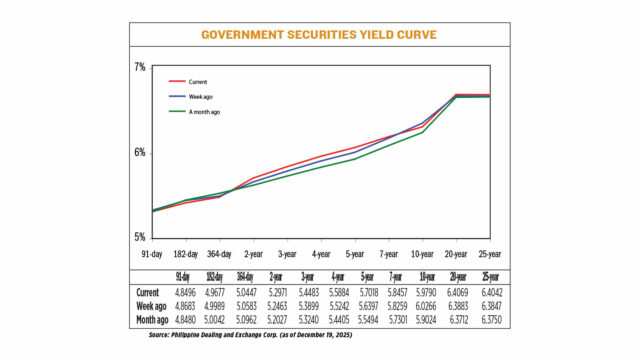
YIELDS on government securities (GS) ended mostly higher last week following the release of US economic data that fueled bets on the Federal Reserve’s next move, which could also affect the Bangko Sentral ng Pilipinas’ (BSP) policy path.

Debt yields, which move opposite to prices, rose by an average of 1.66 basis points (bps) week on week at the secondary market, based on the PHP Bloomberg Valuation Service Reference Rates as of Dec. 15 to 19 published on the Philippine Dealing System’s website.

At the short end of the curve, rates fell across the board. The 91-, 182-, and 364-day Treasury bills (T-bills) saw their yields drop by 1.87 bps (4.8496%), 3.12 bps (4.9677%), and 1.36 bps (5.0447%), respectively.

Meanwhile, at the belly, yields on the two-, three-, four-, five-, and seven-year Treasury bonds (T-bonds) rose by 5.08 bps (5.2971%), 5.84 bps (5.4483%), 6.42 bps (5.5884%), 6.21 bps (5.7018%), and 1.98 bps (5.8457%), respectively.

At the long end of the curve, the 20- and 25-year papers went up by 1.86 bps and 1.95 bps to yield 6.4069% and 6.4042%, respectively. Meanwhile, the 10-year T-bonds fell by 4.76 bps to fetch 5.9790%.

GS volume traded decreased to P44.87 billion last week from P89.79 billion previously.

The release of delayed US economic data on inflation and jobs mainly drove trading at the fixed-income market last week as the numbers supported US Federal Reserve rate cut expectations, the first trader said in an e-mail.

“This wiggle room still opens the possibility for the BSP to cut interest rates next year, pulling short-term yields lower. However, medium- to long-term yields moved up amid expectations of a potential acceleration in domestic inflation next year,” the first trader said.

“Market activity overall was weaker this week as Christmas Eve and the year-end approaches rapidly. Subsequently, this is also the reason for the sideways yield movement at the start of the week… On the global side, the lower-leaning US jobs data contributed to the fall in yields midweek on Wednesday and Thursday. The lower-than-expected US CPI (consumer price index) data incited a sell-off that caused yields to increase, which was also aided by traders looking to lessen their position,” the second trader said in a Viber message.

The number of Americans filing new applications for unemployment benefits fell a week ago, reversing the prior week’s surge and suggesting labor market conditions remained stable in December, Reuters reported.

Initial claims for state unemployment benefits dropped 13,000 to a seasonally adjusted 224,000 for the week ended Dec. 13, the Labor department said on Thursday. Economists polled by Reuters had forecast 225,000 claims for the latest week.

The claims data covered the period during which the government surveyed businesses for the nonfarm payrolls component of December’s employment report. Nonfarm payrolls increased by 64,000 jobs in November, the Bureau of Labor Statistics (BLS) said on Tuesday. December’s employment report will be released on schedule in January.

Though the unemployment rate was at 4.6% in November, the highest since September 2021, it was distorted by technical factors related to the 43-day government shutdown, which caused the BLS not to publish the jobless rate for October. The longest shutdown in history prevented the collection of data from households needed to calculate October’s unemployment rate.

Policymakers at the Federal Reserve this month cut the US central bank’s benchmark overnight interest rate by another 25 basis points to the 3.50% to 3.75% range. But they signaled a pause to further rate cuts while seeking clearer signals about the direction of the job market and inflation.

Meanwhile, US consumer prices rose less than expected in the year to November, but households still faced affordability challenges as the costs of basic goods and services like beef and electricity soared, posing a political problem for President Donald J. Trump.

The CPI increased 2.7% on a year-over-year basis in November after advancing 3.0% in the 12 months through September. Economists polled by Reuters had forecast the CPI would rise 3.1%. The CPI gained 0.2% over the two months ending in November. The BLS said it “cannot provide specific guidance to data users for navigating the missing October observations.”

Meanwhile, the BSP on Dec. 11 delivered a fifth straight 25-bp cut to bring the policy rate to an over three-year low of 4.5%. It has so far slashed benchmark rates by 200 bps since August 2024.

The central bank expects inflation to average 1.6% this year, below its 2-4% annual target. This could pick up to 3.2% next year and ease to 3% in 2027.

BSP Governor Eli M. Remolona, Jr. has left the door open to one final cut next year as manageable inflation gives them room to support the economy if needed.

For this week, GS yields could mostly move sideways, the second trader said.

“The relatively low market activity will continue. On the topic of yield movement though, I presume it will be a similar sideways movement, or back and forth day on day given that there is a similar lack of local news, while some relevant US data will be released, including annualized gross domestic product (GDP), durable goods orders, core personal consumption expenditures, and new home sales data,” the trader said.

“This week, expect sideways action in rates, while the long end could see buying if global risk appetite holds. Watch US GDP, US Fed commentary, and local inflation — any surprise there can quickly shift the curve,” Jonathan L. Ravelas, senior adviser at professional service firm Reyes Tacandong & Co., said in a Viber message.

The first bond trader said the yield curve could continue to steepen in line with US Treasuries as “a potential downward revision in the US GDP report could solidify expectations for US rate cuts next year.” — Lourdes O. Pilar with Reuters

Green GSM all-electric taxi service now available to Davao commuters

Green GSM Southeast Asia Managing Director Dao Quy Phi (leftmost) poses with local business partners at the launch of the all-electric taxi service in Davao. — PHOTO FROM GREEN GSM

GREEN GSM has launched its all-electric taxi service in Davao, marking the company’s first expansion outside Metro Manila to realize part of its long-term plan to support a clean, modern, and well-managed transportation system across key Philippine cities.

The launch ceremony was attended by Land Transportation Franchising and Regulatory Board (LTFRB) Davao Region Director Nonito Llanos, representatives from various local government departments and agencies, along with members of the local business community.

In a release, Green GSM said that “as one of Mindanao’s major urban centers, Davao plays an important role in the country’s economic and social landscape. The city is often noted for its focus on public safety, environmental conservation, and strong community values, which have helped create a transportation system centered on safety, reliability, and public confidence.”

In recent years, Davao is said to have experienced steady growth in population and commercial activity — while ongoing efforts are being made by local authorities to promote cleaner air, responsible urban development, and long-term livability.

Green GSM’s operating model in Davao is “built around its five ‘Green Promises:’ good experience, good drivers, good cars, good pricing, and good for the environment.” The fleet is exclusively comprised of VinFast battery electric vehicles that produce zero tailpipe emissions. They are driven by full-time professional drivers “trained to deliver predictable and courteous service, displaying transparent pricing in the app, and adopting an operating philosophy centered on cleaner air, quieter streets, and a better quality of life.”

Said Green GSM Southeast Asia Managing Director Dao Quy Phi: “Davao is a city that places strong emphasis on order, safety, and environmental responsibility. Our objective is to provide a reliable, zero-emission mobility option that aligns with these priorities while meeting the everyday transportation needs of local residents. This expansion is a strategic step in our national roadmap for electric mobility, and we look forward to working closely with Davao’s institutions and communities to ensure that the service contributes meaningfully to the city’s long-term goals for well-managed and sustainable urban development.”

Davao commuters can book Green GSM taxis through the Green GSM app, the hotline, designated pickup points, or by street hailing in key commercial districts. As an introductory offer, residents who download and register on the Green GSM app will automatically receive 25 Green Points, each worth one Philippine peso. These points can be used immediately for the first trip or flexibly applied toward future rides.

Since launching in the Philippines in June 2025, Green GSM has focused on providing mobility solutions that prioritize reliability, transparency, and environmental responsibility. The expansion into Davao highlights the company’s ongoing commitment to supporting cities that emphasize safe governance, community well-being, and sustainable growth, while promoting the broader shift toward cleaner, more efficient urban transportation nationwide.

Zara turns to AI to generate fashion imagery using real-life models

LONDON — Zara has become the latest fast-fashion retailer to use artificial intelligence (AI) to help create new images of real models in different outfits, speeding up the production process as part of an industry shift that could have a major impact on fashion photography.

Zara’s AI experimentation follows Swedish rival H&M, which earlier this year said it had created AI clones of models to use in marketing. European online fashion retailer Zalando is also using AI to create imagery faster.

“We are using artificial intelligence only to complement our existing processes,” a spokesperson for Zara owner Inditex said in a statement. “We work collaboratively with our valued models — agreeing any aspect on a mutual basis — and compensate in line with industry best practice.”

Zara’s move was first reported by London business-focused newspaper CityAM, which cited an unnamed model saying Zara asked for approval to edit images of them with AI to show different items, and that they were paid the same amount as if they had traveled for another photo shoot.

H&M and Zalando, like Inditex, have said AI would complement their creative teams’ processes and help them be more efficient rather than replacing them, downplaying the risk to photographers and production teams who work on fashion shoots.

Inditex chair Marta Ortega, daughter of the founder Amancio Ortega, has spoken in interviews about her passion for fashion photography.

Since 2021 her MOP (Marta Ortega Perez) Foundation gallery in A Coruna, the town in northern Spain where Zara was founded, has hosted exhibitions showcasing the work of major photographers.

It is currently showing Annie Leibovitz’s fashion photography, and previous exhibitions have spotlighted photography greats Steven Meisel — with whom Zara has worked extensively — and Helmut Newton.

Ms. Ortega has tried to move Zara upmarket, cutting store numbers to focus on fewer, bigger flagships with a more spacious, sophisticated feel.

Isabelle Doran, chief executive officer of the Association of Photographers in London, said the use of AI would reduce the number of times photographers, models, and production teams are commissioned, impacting a whole ecosystem of established professionals as well as early-career fashion photographers trying to get a foothold in the industry. — Reuters

ALI shares dip despite developments

AYALALAND.COM.PH

STOCKS of Ayala Land, Inc. (ALI) inched down weekly despite promising announcements as external factors dragged markets, analysts said.

Data from the Philippine Stock Exchange (PSE) website showed ALI ranking sixth last week among most actively traded stocks by value, as 72.16 million shares worth P1.60 billion exchanged hands up to Friday.

The stock closed the week with a value of P21.30, lower by 1.8% from the previous Friday’s P21.70. The property sector and the PSE index (PSEi) were likewise on the red week on week as the former declined by 1.3% and the latter by 1.9%.

Ayala Land saw an even sharper drop of 18.5% year to date from its P26.20 close on the last trading day of 2024, outpacing the downward movements of the property sector (6.5%) and PSEi (9.3%) during the span.

The price dip came despite a couple of welcome moves made by the company over that week.

On Tuesday, ALI announced the P13.5-billion sale of its 50% stake in Alabang Town Center to the Madrigal family.

The company said that proceeds from the sale will be used to support leasing growth plans in the future.

Aniceto K. Pangan, equity trader at Diversified Securities, Inc., said that the company “unlocked a premium value from its mature asset” through the sale to help boost its leasing portfolio and “provide better returns to its capital.”

Additionally, Ayala Land also announced the launch of its second CityFlats living development in Cebu the previous Friday.

CityFlats properties aim to cater to residential- and working-space needs of young professionals and students — cutting down affordability and travel issues for the targeted stakeholders.

“Taken together, the Alabang Town Center stake sale and the CityFlats Cebu launch are both relatively good news […] even so, ALI shares still fell, which suggests the market move was likely driven by external factors,” Luis A. Limlingan, head of sales at Regina Capital Development Corp., added in a Viber message.

On Thursday, the PSEi’s downward movement already began as it inched down 0.78% to end at 6,031.48.

Analysts said the sell-off was due to the market lacking catalysts for the week and instead setting its eyes on upcoming US inflation data which may set the tone for the Fed’s outlook.

Banks’ exposure to the property sector also slipped in the July-September period.

Data from the Bangko Sentral ng Pilipinas showed that the banking sector’s real estate investments over the span slipped by 5.75% to P354.75 billion from P376.41 billion last year.

Analysts said the exposure eased due to higher nonperforming real estate loans in the quarter due to muted developments amid weaker demand.

Moreover, Mr. Pangan noted that valuation for ALI was low with its price in the week, citing its decline to levels lower than those seen during the pandemic.

According to PSE data, ALI shares dropped by 38% from its closing price of P34.35 at year-end 2020.

Moving forward, Mr. Limlingan said that Ayala Land investors may monitor updates on project launches, capital spending plans, and changes in real estate demand.

For this week, Mr. Pangan placed immediate support at P20 and immediate resistance at P22.70.

On the other hand, Mr. Limlingan pegged support and resistance at around P21-20 and P23-24.50, respectively. — Matthew Miguel L. Castillo

USDA not likely to issue more farm aid

REUTERS

WASHINGTON — The US Department of Agriculture (USDA) is not considering issuing more farm aid beyond its recently announced $12-billion package meant to help farmers weather poor economic conditions, said Richard Fordyce, the undersecretary for farm production and conservation.

Farmers are facing low crop prices, high costs of agricultural inputs like fertilizer and the impacts of President Donald J. Trump’s trade war, which has shrunk exports of some crops. While farmers welcomed news of the $12-billion package earlier this month, they warned that it would not make them whole or rescue the sagging farm economy.

Farm losses this year could reach $44 billion, according to an estimate from North Dakota State University.

Mr. Fordyce said the USDA was aware the aid would fall short, but is not considering further assistance in part due to funding limitations.

“At this point, we feel like we’ve kind of done what we can do. I don’t know what next year will bring, but at this point, we’re where we’re going to be,” Mr. Fordyce said.

Trump administration officials have said the aid should serve as a stopgap until new farm supports from Mr. Trump’s tax and spending bill take effect, like higher reference prices for crops.

The aid program allocates $11 billion to row crops like corn, soybeans and wheat, and $1 billion to fruits, vegetables and other “specialty crops.”

Mr. Fordyce said the agency has still not finalized how that $1 billion will be issued but that it is soliciting data and input from farmers.

Agriculture Secretary Brooke Rollins has said that aid payments will be disbursed by Feb. 28. — Reuters

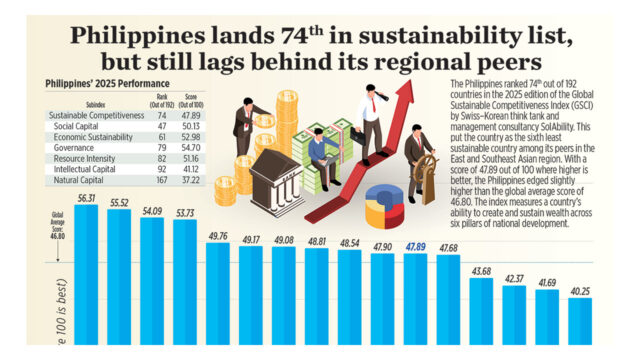
Philippines lands 74th in sustainability list, but still lags behind its regional peers

The Philippines ranked 74th out of 192 countries in the 2025 edition of the Global Sustainable Competitiveness Index (GSCI) by Swiss–Korean think tank and management consultancy SolAbility. This put the country as the sixth least sustainable country among its peers in the East and Southeast Asian region. With a score of 47.89 out of 100 where higher is better, the Philippines edged slightly higher than the global average score of 46.80. The index measures a country’s ability to create and sustain wealth across six pillars of national development.

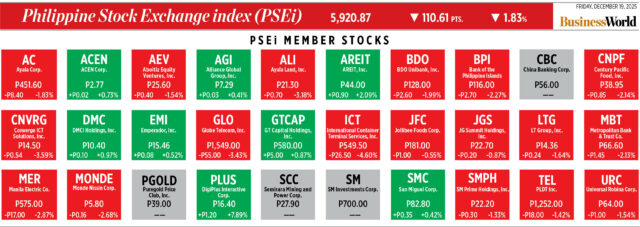
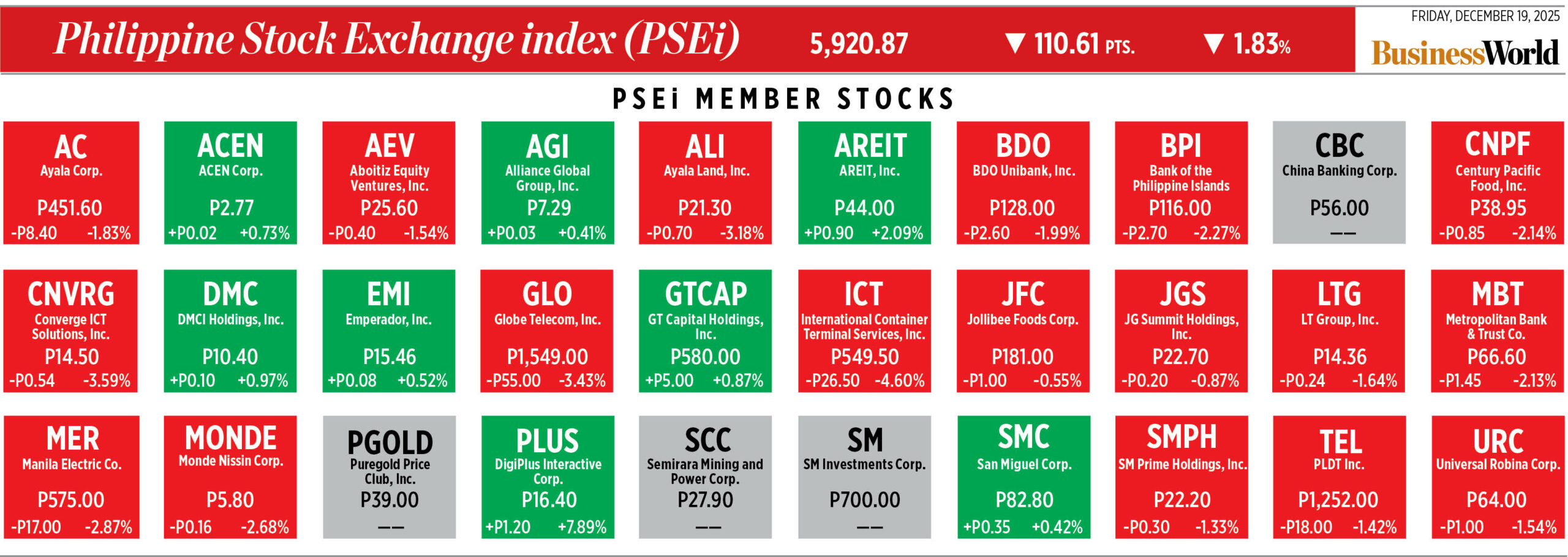
How PSEi member stocks performed — December 19, 2025

Here’s a quick glance at how PSEi stocks fared on Friday, December 19, 2025.


ADVERTISEMENT
ADVERTISEMENT