Home Blog Page 5379

PCCI warns of brand exodus if luxury tax passes

PIXABAY

THE proposed tax on luxury goods risks the departure from the Philippine market of luxury-goods brands, possibly undermining the Philippines’ appeal as a shopping destination, the Philippine Chamber of Commerce and Industry (PCCI) said.

PCCI President George T. Barcelon said on the sidelines of an event in Taguig City on Wednesday that the government should have “reasonable” rules on which luxury goods will be taxed.

“They have to put some criteria (that) are within reason,” Mr. Barcelon noted, pointing to the role of luxury shopping as a draw for visitors in places like Singapore and Hong Kong.

“When some of these luxury brands find that it is not so attractive here, they may just pull out from the country. We need them also (for) the tourist business.”

Mr. Barcelon said the proposed luxury tax should be timebound.

“Whatever is helpful in the meantime to address the challenges that we are facing (but the luxury tax) cannot be in perpetuity. There must be a timeline… These are abnormal times (because the) government deficit is a major concern,” Mr. Barcelon said.

Albay Rep. Jose Ma. Clemente S. Salceda has said that the House Committee on Ways and Means is studying a plan to impose more taxes on wristwatches, bags, beverages, paintings, cars selling for more than P5 million, and residential property worth more than P100 million.

Under the Tax Code, a 20% tax is collected on jewelry, perfume, and yachts. — Revin Mikhael D. Ochave 

PPA sees monitoring system reducing logistics costs

REUTERS

THE Philippine Ports Authority (PPA) said its upcoming Trusted Operator Program-Container Registry and Monitoring System, or TOP-CRMS, will help reduce logistics costs by eliminating the container deposits charged by shipping lines to truckers, brokers, and forwarders.

The monitoring system, which has attracted a backlash, will also cut costs incurred by truckers on the road by helping them anticipate unavailable yard slots when they return empty containers, PPA General Manager Jay Daniel R. Santiago said at a briefing on Wednesday.

TOP-CRMS, a P900-million PPA digitalization project, is expected to be implemented within the first half of the year, according to Mr. Santiago.

“There are still certain regulatory and legal compliances that we need to undertake,” he said.

In July, Transportation Secretary Jaime J. Bautista urged the PPA to work towards reducing the cost of shipping and travel.

According to Mr. Santiago, port charges account for only 2-5% of total logistics costs.

All other charges such as freight charges of shipping lines, trucking charges, container handling charges of private container yards, and warehousing costs are “not regulated,” he said.

“We can only do so much in terms of minimizing or regulating the regulated charges. But we are not immune to the need to lower logistics costs, which is why we are working to reduce the incremental costs in the logistics chain.”

Using TOP-CRMS, the PPA is proposing to “eliminate the container deposit and replace it with container deposit insurance,” Mr. Santiago noted.

He said that container deposits charged by shipping lines range from P10,000 to P30,000 for dry containers and up to P180,000 for refrigerated containers. Container deposits are required by shipping lines to ensure that their containers are returned undamaged.

With TOP-CRMS, Mr. Santiago said, such amounts will be reduced to a P980 container monitoring fee, inclusive of container deposit insurance for missing or damaged containers.

The monitoring system also hopes to address the problems encountered by truckers when returning empty containers.

Shipping lines give truckers between three and five days to return empty containers, and charge them for exceeding five days, according to Mr. Santiago.

Truckers are also charged P1,000 to schedule the return of the empty containers, he added.

Truckers are sometimes advised by shipping lines to return their containers to a specific container yard only to be informed that there is no more space, Mr. Santiago added.

“So the trucker will either wait, or risk fines for parking or staying on the road even during the truck ban,” he said.

Such costs are ultimately passed on to the consumer, according to the PPA chief.

With TOP-CRMS, the PPA will accredit or designate yards for empty containers.

“Initially, the PPA has designated one yard in Bulacan, which is a minimum of 10 hectares expandable to 18. We have also identified yards in Laguna. We are willing to accredit or designate yards within the port area… provided that they commit to a certain number of slots that they will make available for the system, and they have to be integrated into our system including their CCTVs to monitor the condition of each container for damage or dispute assessment and resolution purposes,” Mr. Santiago said.

Under the proposal, truckers returning empty containers will pay P900 per lodgement. Before the release of the containers, they will pay another P3,408 in handling fees.

“Any PPA-accredited empty container yard cannot refuse acceptance because all of the available slots will be seen on a dashboard. They will have no reason to reject acceptance,” Mr. Santiago said. — Arjay L. Balinbin

Protectionism shields bulk of PHL diet from imports — PIDS

PHILSTAR FILE PHOTO/CC0 PUBLIC DOMAIN

THE bulk of the Philippine diet enjoys protection from import competition, according to the Philippine Institute for Development Studies (PIDS), a government think tank.

“The food groups that contribute most to the Filipinos’ energy, protein, and micronutrient intake — including rice, cereals, fish, meat, and poultry — are all produced under high levels of trade protection against cheaper imports,” PIDS said in a statement, citing a study by senior research fellow Roehlano M. Briones.

The study said that the government should liberalize trade instead of offering subsidies to improve food affordability.

“Prior to the pandemic, the nutritional status of Filipino children was already a serious concern. Adding to the recent rounds of food inflation, these economic shocks are likely to have an adverse impact on food consumption and nutrient intake at the household level, leading to worsening nutritional status,” Mr. Briones said.

He said that the government should “aggressively” pursue liberalization measures to improve affordability.

“The sooner the government dismantles high tariffs and overly strict (and often arbitrary) application of sanitary and phytosanitary standards on these major consumer goods, the more affordable these items become, especially to the poor,” he added.

The study recommended improving value chain productivity in order to boost competitiveness against cheap imports and raise the incomes of food producers, processors, and distributors.

“Productivity improvements by lowering production and logistics costs tend to make food more affordable. Identifying the right investments and suitable actors along the value chain to realize these productivity improvements poses a real challenge to agro-industrial policy; however, the potential benefits are too large to ignore this approach to food policy,” Mr. Briones added. — Luisa Maria Jacinta C. Jocson

House panel estimates luxury tax will generate P12.4B a year

PHILSTAR FILE PHOTO

THE House Committee on Ways and Means said it expects its proposed luxury tax to raise at least P12.4 billion a year.

“I’m looking at a short list of additional items… Basically, the aim is to find some way to tax the rich consistent with the constitutional principle of progressivity in taxation. For now, my short list will generate P12.4 billion at least,” Albay Rep. Jose Ma. Clemente S. Salceda, the committee chairman, said on Wednesday.

His initial shortlist includes high-end watches, cars selling for more than P5 million, private jets, residential property valued at more than P100 million per unit, beverages above P20,000 per bottle, and leather goods selling for more than P50,000.

Mr. Salceda said the mechanism will be the amendment of Section 150 of the National Internal Revenue Code, which currently taxes jewelry, perfume, and yachts. He is also looking to increase the tax rate to 25% or 30% from 20%.

The main target of the amendment is “non-essential goods whose prices are beyond the reach of the bulk of consumers, and which are not significant or important inputs to other value-adding industries,” Mr. Salceda said.

Mr. Salceda added that the luxury car tax will form part of the automotive excise tax, while the tax on high-end residential property “will be on top of the value-added tax and other taxes on its sale.”

He said the committee is also considering taxing club shares, jacuzzis, fur, boats, and antiques.

Mr. Salceda said the resulting revenue could be “funneled into the country’s creative sectors, particularly our own creators of luxury items,” saying that the Philippines should be “more than just a part of the whole assembly of luxury goods.” — Beatriz Marie D. Cruz

Philippines cedes tax revenue under global minimum tax rules

To expedite the revival of the economy from the pandemic and restore its trajectory towards upper middle-income status, the government has eased restrictions on foreign investment by amending foreign ownership rules for public services and retail. While the Corporate Recovery and Tax Incentives for Enterprises (CREATE) law reduced our regular corporate income tax (CIT) rate to 25%, the Philippines still has one of the highest CIT rates in Southeast Asia. CREATE also rationalized the tax incentives granted to registered business enterprises (RBEs), allowing them to enjoy up to 17 years of income tax holidays (ITH), a 5% special corporate income tax, or enhanced deductions, among other fiscal incentives. However, these fiscal incentives may not look as enticing as before for large multinational enterprises (MNEs) considering investment in the Philippines. This article hopes to explain why.

The OECD/G20 Inclusive Framework on Base Erosion and Profit Shifting published the Global Anti-Base Erosion (GloBE) Model Rules on Dec. 20, 2021. GloBE Rules introduce a coordinated system of taxation to ensure that large MNEs pay a minimum level of tax on the income they earn in every jurisdiction in which they operate. A top-up tax will be imposed on their profits should their jurisdictional effective tax rate (ETR) fall below the minimum rate. The 70-page GloBE Rules provide for a global minimum tax rate of 15% for MNEs with a turnover of more than 750 million euros. Ultimate Parent Entities (UPEs) such as pension funds, government, international and non-profit organizations as well as investment funds and real-estate investment vehicles are excluded from the scope of the GloBE Rules. Transitional safe harbor rules and a regulatory framework for the development of a potential permanent safe harbor were also published on Dec. 20, 2022.

Simply put, GloBE Rules are two interlocking rules — the Income Inclusion Rule (IIR) and the Undertaxed Payment Rule (UTPR). IIR requires the immediate parent entity to pay the top-up tax with respect to the low-taxed income of a constituent entity (an entity of the MNE Group in a country where the ETR is below the minimum rate). Otherwise, the UTPR will deny deductions or require an equivalent adjustment on the UPE level to the extent that the low-taxed income of a constituent entity is not subject to tax under IIR. The determination of whether a top-up tax is required, either through the IIR or the UTPR, is based on a complex calculation of the ETR for a specific jurisdiction. In computing the jurisdiction ETR, the GloBE Rules provide for modified deferred tax calculations for the timing differences, the treatment of losses, and an elective substance-based carve-out that may reduce the profits subject to top-up tax. Carve-outs are based on the level of payroll and the carrying value of certain tangible assets within a jurisdiction.

Based on the above rule, however, there may be instances when a certain jurisdiction will not be able to collect the top-up tax on the income earned by a constituent entity operating in its jurisdiction if the immediate parent or the UPE of the MNE is established in a different country. Hence, the GloBE Rules also introduced a Domestic Top-up Tax. Countries can now impose a specific tax in their own jurisdiction to increase the ETR on certain profits, excluding those that are subject to substance-based carve-outs, to the 15% global minimum ETR. It will allow a jurisdiction to ensure that the tax is collected therein and will not be ceded to another jurisdiction under either the IIR or the UTPR. If the low-tax jurisdictions adopt this domestic top-up tax, it will reduce the complexity of the GloBE Rules and will achieve the primordial goal of the Pillar 2 project which is leveling the playing field for tax competition. Participating countries must have enacted the appropriate domestic legislation in 2022 since the plan is for the IIR to be effective in 2023 while the UTPR can come into effect in 2024.

To briefly illustrate, let’s consider an RBE enjoying ITH in the Philippines. Its immediate parent is a Singapore entity and the group is ultimately owned by a Japanese company. Both Japan and Singapore and other neighboring countries are currently adjusting their laws to account for the possible effect of the GloBE Rules. However, to date, the Philippines has not yet signed on to this two-pillar solution (including Pillar 2) which aims to address tax challenges arising from the digitalization of the economy (BEPS 2.0). Hence, since the Philippine RBE will be effectively paying 0% ETR to our government, the Singapore or Japanese company, through IIR or UTPR respectively, will pay a top-up tax in their respective jurisdictions to meet the 15% global minimum ETR. This will be a certain revenue loss to the Philippine government as it cedes taxing rights on the low-taxed income of this RBE. Moreover, from a group ETR perspective, MNEs will be paying this global minimum tax rate which dilutes their tax savings in the Philippines.

Though the potential uncollected taxes are as clear as daylight, our policy makers may also see this as only a time-bound setback. RBEs may only enjoy up to 17 years of tax incentives. Afterwards, they will be subject to the 25% regular CIT, which is much higher than the 15% global minimum tax. Other than the contribution of CIT to our gross domestic product, the Philippine government may have also considered other factors in not yet joining BEPS 2.0. The danger of losing the jobs created by foreign investors who may pull out their investments if they lose their tax incentives, and the requirement to abandon unilateral digital service tax (which is a pending bill in the Congress) may have restricted our government from being part of this Inclusive Framework. Nonetheless, these is all mere speculation on my part. I assume that a thorough and detailed impact assessment of this two-pillar solution must have been discussed by our economic managers and policy makers. I eagerly await how things evolve as more countries sign on to the framework.

The views or opinions expressed in this article are solely those of the author and do not necessarily represent those of Isla Lipana & Co. The content is for general information purposes only, and should not be used as a substitute for specific advice.


Mac Kerwin Visda is a manager at the Tax Services department of Isla Lipana & Co., the Philippine member firm of the PwC network.

mac.kerwin.visda@pwc.com

Philippine journalist cleared of tax evasion; press freedom hailed

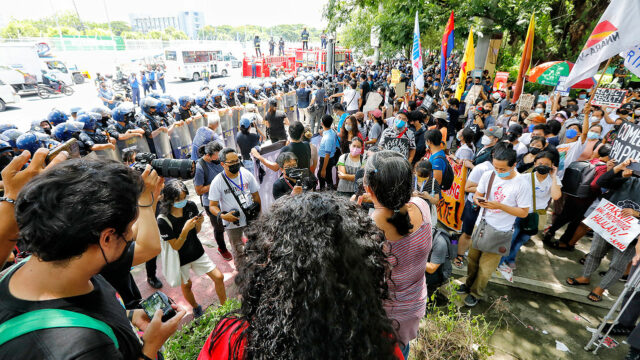
THE PHILIPPINE Court of Tax Appeals on Wednesday acquitted Rappler Holdings Corp. and its founder of tax evasion in a ruling hailed as a win for press freedom.

In an 80-page decision, the court’s First Division ruled government prosecutors had failed to prove the guilt of the news website and Filipino journalist Maria Ressa beyond reasonable doubt.

“No civil liability may be adjudged against the accused as the alleged unpaid tax obligations have not been factually and legally established and proven,” according to the ruling written by Associate Justice Jean Marie Bacorro-Villena.

The Bureau of Internal Revenue under ex-President Rodrigo R. Duterte and Department of Justice (DoJ) accused Ms. Ressa and her company of evading taxes by failing to declare Philippine depositary receipts it sold to foreign investment firms North Base Media and Omidyar Network Fund LLC in their income tax returns in 2015.

The government alleged that Rappler had earned P162.41 million in income from the receipts.

Ms. Ressa and Rappler denied the charges, saying the transactions involved legitimate financial mechanisms that did not generate taxable income.

The tax court said the holder of the depositary receipts only retained an option to buy the underlying shares of Rappler subject to certain conditions. “There is no law restricting foreign ownership in the business of the operating entity.”

A Philippine depositary receipt is a security that gives its holder the right to the sale of the underlying shares of stock, according to the Philippine Stock Exchange. It is not evidence or certificates of ownership in a company.

The court agreed, noting that Rappler had not gained taxable income from the receipts. Under the country’s Tax Code, income tax may be imposed on ventures that yield profit.

“Today facts win, truth wins, justice wins,” Ms. Ressa, a Nobel Peace laureate, told reporters after the verdict, based on a livestreamed YouTube video. “This victory is not just for Rappler. It’s for every Filipino who has ever been unjustly accused.”

“These charges were politically motivated, they were incredible to us, a brazen abuse of power and meant to stop journalists from doing their jobs,” she said. “These cases are where capital markets, rule of law and press freedom meet.”

Ms. Ressa, who founded Rappler, has been the target of legal action by the government under Mr. Duterte.

In July, the Court of Appeals convicted her and a former Rappler researcher of cyber-libel over a 2012 article that claimed a businessman had been involved in human trafficking, murder and drug smuggling.

Her lawyer has said they would bring the case to the Philippine Supreme Court.

Last year, the Securities and Exchange Commission upheld Rappler’s closure for allegedly violating restrictions on foreign ownership in mass media.

PRESS FREEDOM
Senator Ana Theresia N. Hontiveros-Baraquel said the dismissal of the tax charges is an important victory for the free press in the Philippines.

“In a democracy, truth-telling and sharing independent views is not a crime, even if it irks and annoys the powers that be,” she said in a statement.

In a statement posted on its website, Rappler said the decision saw past the harassment against media organizations in the Philippines and decided objectively.

“We thank the court for this just decision and for recognizing that the fraudulent, false and flimsy charges made by the Bureau of Internal Revenue do not have any basis in fact,” it said. “An adverse decision would have had far-reaching repercussions on both the press and the capital markets,” it added.

Bayan Muna Chairman and former Party-list Rep. Neri J. Colmenares said Ms. Ressa’s acquittal was a victory for press freedom, even if the struggle against fake news, communist-tagging and repression continues.

“Let this serve as a reminder that dictatorships will never succeed,” he said in a statement. “We must not let our guard down as fascists who are intolerant of dissent are again occupying key positions in the Marcos administration, itching to ram their kind of thinking on the populace.”

The former ruling Liberal Party also hailed the tax court’s ruling. “Truly, when truth wins, justice prevails,” it said in an e-mailed statement.

“The firing line against attacks on media freedom, civic space and democracy has always been strong, but this decision and recent others like it by courts unafraid to uphold the rule of law are well-received,” says Ibon Foundation in a statement.

“The Marcos administration is also served notice that the forces resisting autocracy and authoritarianism are many, broad and unbowed.”

Wednesday’s acquittal is not the end of Ms. Ressa and Rappler’s legal battles because they still face three active court cases.

These are Rappler’s appeal against the corporate regulator’s 2022 closure order, an appeal by Ms. Ressa and former Rappler journalist Reynaldo Santos, Jr. against convictions for cyber libel and another tax case against Rappler and its founder. 

President Ferdinand R. Marcos, Jr. in September said he would not interfere in Ms. Ressa’s cases, citing the separation of powers between the Executive and Judiciary. — John Victor D. Ordoñez and Beatriz Marie D. Cruz


DoJ junks murder raps vs cops in 2021 activist raid

PHILIPPINE STAR/WALTER BOLLOZOS

PHILIPPINE government prosecutors have cleared 17 cops in connection with the murder of a labor activist in a series of police raids where nine activists died in March 2021.

In a resolution dated Jan. 16, a panel of Department of Justice (DoJ) prosecutors found no probable cause against the police officers for the death of Emmanuel Asuncion.

“We lament the demise of Emmanuel Asuncion,” Senior Assistant State Prosecutor Rodan G. Parrocha said. “However, the complainant and the evidence she submitted failed to discharge the obligation to prove the existence of a crime and identify the perpetrators,” he added, referring to the wife of the slain labor activist.

The court said Liezel Asuncion had failed to see the faces of the cops who allegedly killed her husband.

The police raids were based on 24 search warrants issued by trial courts in Manila and Quezon City.

In 2021, an inter-agency task force of the DoJ formed 15 teams that probed extralegal killings and human rights violations in the Philippines.

Last year, the National Bureau of Investigation (NBI) filed a murder complaint against the 17 policemen allegedly involved in the raids and the killings of the other activists.

“There is no justice,” Renato M. Reyes, Jr., secretary general of Bagong Alyansang Makabayan tweeted in Filipino late Monday.

Defend Southern Tagalog in a separate statement said the acquittal reinforces the severe human rights violations by the government of ex-President Rodrigo R. Duterte.

“Asuncion’s killing serves as an example of how the people are deprived of great civic leaders and how the right to organize has been twisted and supplanted by the Philippine government,” it said.

Human rights abuses continued in the first six months of President Ferdinand R. Marcos, Jr.’s rule, Human Rights Watch said in a report last week.

The Philippines has accepted 200 recommendations from member-states of the United Nations Human Rights Council, including investigating extralegal killings and protecting journalists and activists.

Justice Secretary Jesus Crispin C. Remulla has said the government does not sanction attacks, harassment or intimidation of activists.

He said an inter-agency task force on extralegal killings had investigated at least 17,000 police officers.

The UN Human Rights Committee has said the Philippines should comply with international human rights mechanisms.

The Philippine Commission on Human Rights has said the government of Mr. Duterte had encouraged a culture of impunity by hindering independent inquiries and failing to prosecute erring cops involved in the government’s anti-illegal drug campaign. — John Victor D. Ordoñez

Philippine air transport regulator to hire contractor for traffic oversight

PHILIPPINE STAR/ MIGUEL DE GUZMAN

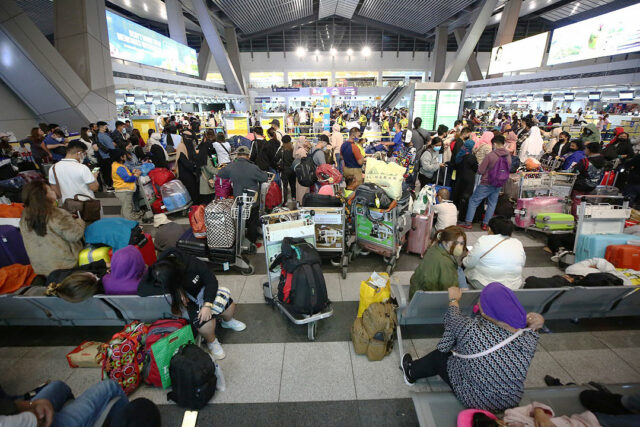
THE CIVIL Aviation Authority of the Philippines (CAAP) is looking to hire a contractor that will oversee the country’s air traffic after a New Year’s Day glitch that led to thousands of canceled flights.

“We need to provide stricter oversight,” CAAP Director-General Manuel Antonio L. Tamayo told a House of Representatives hearing on Wednesday.

He said he would meet with his Singaporean counterpart for best practices in air traffic management. “There is a company that provides oversight to them,” he said “It is external, so I was asking them if we could apply that system in our [country].”

CAAP also plans to upgrade and provide for a backup of the country’s air traffic system.

Mr. Tamayo said CAAP continues to train workers. “We have a rationalization plan in place. We are continuously training our technical personnel.”

He said the last onsite audit by the International Civil Aviation Organization for CAAP was in 2017. The next audit will take place this year after the 2020 review got canceled amid a coronavirus pandemic.

CAAP had bought two uninterruptible power supply units to prevent another malfunction, Mr. Tamayo said.

At the hearing, officials of the Cybercrime Investigation Coordinating Center told congressmen it needs P400 million to find out whether the Jan. 1 glitch involved a cyber-attack.

“We’re given sticks and stones to go to war [but] we’re doing it based on capability,” CICC Undersecretary Alexander K. Ramos said. “Give us the tools, maybe we can ride on something faster.”

Antipolo City Rep. Romeo M. Acop, who heads the House transportation committee, asked why the agency could not do its job well “because of a budget cut.”

Maria Victoria Castro, director of the Cybersecurity bureau of the Department of Information and Communications Technology (DICT), said its cyber-attack test would take six weeks. — Beatriz Marie D. Cruz

Bureau of Customs seizures down 14% in 2022 

BUREAU OF CUSTOMS

THE BUREAU of Customs (BoC) confiscated smuggled goods worth P24.28 billion in 2022, down 14.6% year on year.

Last years total amount is lower than the P28.43 billion worth of goods seized in 2021.  

In a statement on Wednesday, the agency reported that it had a total of 709 seizures last year. 

These included illegal drugs worth P11.95 billion, counterfeit goods amounting to P7.69 billion, and agricultural products worth P1.87 billion. 

It also noted that 200 Letters of Authority, which provide basis for inspections, were implemented, of which 109 yielded positive results. 

Meanwhile, 193 alert orders were also issued, of which 120 were positive for violating customs laws, rules, and regulations. 

Almost all or 88.8% of high-risk shipments that resulted in the issuance of warrant and seizure and detention (WSD) were targeted shipments of the Risk Management Office for non-intrusive and physical inspection. 

This is a result of the improved Risk Management System which the BoC has advanced to intensify its intelligence and enforcement capabilities,the bureau said. 

The BoC also noted that all importations of agricultural commodities last year were identified as high-risk commodities, except those under the Super Green Lane category. 

Customs is targeting to raise P901.3 billion this year, 24.9% higher than its P721.5-billion goal for 2022. Last year, the agency collected a total of P862.9 billion.  

This year, it is expected to collect P570.3 billion in value-added tax (VAT) from imports, P207.4 billion in excise taxes, P105.1 billion in import duties and P18.5 billion in other fees. Luisa Maria Jacinta C. Jocson

Marcos: OFW presence in Middle East could drive Gulf investments

PRESIDENT Ferdinand R. Marcos, Jr. meets with Saudi Foreign Minister Prince Faisal bin Farhan Al Saud in Malacañang in September 2022. — BONGBONG MARCOS TWITTER PAGE

THE STRONG presence of migrant Filipino workers in the Middle East could help the Philippines corner investments from Arab countries looking eastward for new ventures, President Ferdinand R. Marcos, Jr. said on Wednesday. 

The Philippines has strong ties with the Middle East and talks between them always begins with the overseas Filipino workers (OFWs),he said in an open forum at the World Economic Forum in Davos, Switzerland, based on a press release from the Office of the Presidential Communications (PCO). 

Trade has also been an important element in discussions with Arab nations, said Mr. Marcos, who cited the spending plan of the Organization of Petroleum Exporting Countries for the next few years, which the Palace described as “very expansive and aggressive.” 

Trade becomes part of the discussion with Arab nations as the Philippines speaks about its planned sovereign wealth fund, President Marcos noted,the Palace release read.

Some of the examples that were looking at are the ones in the Middle East because they have been the ones that have been most successful,Mr. Marcos was quoted as saying.

The connections are there,” he added, “any opportunities that we will be given…(we) have to take full advantage of.” 

The country had a total of 1.83 million OFWs in 2021, about 24.4% of whom worked in Saudi Arabia and 14.4% worked in the United Arab Emirates.    

Kuwait was the fourth largest destination for OFWs at 5.9%. Qatar came sixth place at 4.8%. Kyle Aristophere T. Atienza 

Filipinos trafficked as crypto scammers in Cambodia

SENATE.GOV.PH

FILIPINOS have been victimized into becoming online scammers by an alleged Chinese group operating in Cambodia, a senator reported on Wednesday.  

“Filipinos are becoming the main target of human trafficking syndicates,Senator Ana Theresia RisaN. Hontiveros-Baraquel said in a statement.

After we helped some Filipinos in Myanmar who were abused and forced to work as crypto scammers, we find out that this method also exists in Cambodia,she added. These fraud factories are part of a disturbing industry that has to be dismantled. 

Ms. Hontiveros earlier reported that Chinese syndicates have been trafficking Filipinos to Myanmar to scam foreigners into putting money into fake crypto accounts. 

Some of the victims sought help from the senators office. 

The senators office was able to speak with one of the victims from Cambodia who said that they were promised customer service or call center jobs but ended up being forced to dupe citizens from the United States and Cambodia. 

“When we are not able to get a client, we are made to work for more than 16 hours, without sleep, seven days a week… I saw and heard that an employee was even electrocuted,” the victim said in Filipino through a video shared with the media.

A group of Filipinos to which the victim belonged was rescued Monday evening by Cambodian police authorities and the Philippine Embassy in Phnom Penh. However, they are currently being held at a police station without beds and basic necessities. 

I trust that our Department of Foreign Affairs can bring our kababayans home as soon as possible,Ms. Hontiveros said. 

I also expect that we keep closely working with ASEAN (Association of Southeast Asian Nations) member-states to strategize how to effectively put a lid on these criminal activities, she added. 

The Chinese Embassy in the Philippines did not respond to a Viber message seeking comment on the alleged Chinese operators before the print deadline. Alyssa Nicole O. Tan

DoJ rejects Bantag’s motion to inhibit prosecutors from murder complaint  

BW FILE PHOTO

THE DEPARTMENT of Justice (DoJ) has rejected the motion of suspended Bureau of Corrections director Gerald Q. Bantag that sought the inhibition of the Justice secretary and DoJ prosecutors from his murder complaint over the death of a local broadcaster. 

In a resolution on Wednesday, a panel of DoJ prosecutors said it had jurisdiction over the murder case since the complaints were filed with the department.  

“It was clarified that the authority of the Ombudsman to prosecute cases involving public officers and employees before the regular courts does not conflict with the power of the regular prosecutors under the DoJ,according to the resolution, citing a prior Supreme Court decision.   

The Justice department noted that the Ombudsman was not an exclusive authority but a “shared authority” in prosecuting murder complaints involving public officials.  

The DoJ cited an agreement it signed with the Ombudsman, which allowed the latter to endorse a complaint to any of the formers prosecution offices.   

Mr. Bantag’s allegation of bias against the DoJ and Justice Secretary Jesus Crispin C. Remulla was just speculation, it added.  

Philippine police filed a murder complaint against the suspended prison chief in November for allegedly ordering the murder of radio journalist Percival C. Mabasa and a supposed middleman in the incident.  

The DoJ is currently conducting a preliminary investigation of the killing. A panel of government prosecutors and investigators is set to convene to resume the probe on Jan. 24.  

Mr. Bantag had denied his involvement in the murder, saying he had nothing to gain from it.  

The broadcasters YouTube channel, which had more than 200,000 subscribers, showed that he had been critical of former President Rodrigo R. Duterte and some sitting officials. John Victor D. Ordoñez 

ADVERTISEMENT
ADVERTISEMENT