Home Blog Page 5377

Ookla: Smart delivered fastest download speed in Q4; Globe ‘most consistent’

BW FILE PHOTO

SMART Communications, Inc., the wireless arm of PLDT Inc., delivered the fastest median download speed at 32.16 megabits per second (Mbps) in the fourth quarter (Q4) of 2022, according to global benchmarking firm Ookla.

In its fourth-quarter mobile performance report for the Philippines released on Wednesday, Ookla said that Globe Telecom, Inc. had a median download speed of 21.30 Mbps for the period, followed by DITO Telecommunity Corp.’s 17.66 Mbps.

Smart also “registered the lowest median multi-server latency in the Philippines at 47 ms (milliseconds),” it added.

Ookla said its multi-server latency is “designed to represent the latency the user should expect to encounter more generally when their network is not under heavy load.”

It is computed from the multiple pings conducted during server selection. “During server selection, the application pings several on- and off-net servers, multiple times each, to determine which servers to use during the test,” Ookla said.

DITO had the second lowest median multi-server latency during the period at 48 ms, followed by Globe at 56 ms.

In terms of consistency, Ookla said that Globe had the highest consistency in the Philippines during the quarter, with 83.1% of results showing at least a 5 Mbps minimum download speed and 1 Mbps minimum upload speed.

Consistency is the metric used by Ookla to identify fixed broadband or mobile networks that provide a consistent quality of service.

“It reflects the percentage of a provider’s data samples that meet minimum thresholds for download and upload speeds, depending on the type of network. The higher a provider’s consistency, the more likely a consumer will enjoy acceptable internet performance and quality,” Ookla said.

Smart was the second most consistent mobile network provider in terms of quality during the period, with 80.8%, followed by DITO with 72.6%, according to Ookla.

Hastings Holdings, Inc., a unit of PLDT Beneficial Trust Fund subsidiary MediaQuest Holdings, Inc., has a majority stake in BusinessWorld through the Philippine Star Group, which it controls. — Arjay L. Balinbin

This lunar year will be the Year of the Rabbit or the Year of the Cat, depending on where you live

On Jan. 22, 2023, more than a billion people globally will welcome the Year of the Rabbit — or the Year of the Cat, depending on which cultural traditions they follow — as the start of the Lunar New Year. In the New York City public school district, Lunar New Year has been observed as a school holiday since 2015.

The Lunar New Year is sometimes called the Chinese New Year, because it follows a calendar that was developed in China; but it is also celebrated in various parts of Asia, such as Korea and Vietnam. Tibetan and Mongolian cultures follow a similar calendar that will start the Year of the Rabbit about a month later, on Feb. 20.

While this calendar is sometimes just called “lunar,” it adds an extra month every few years to stay in sync with the solar cycle, so it’s technically lunar and solar, or lunisolar. This means that the date of the Lunar New Year in the Gregorian calendar changes from year to year but always falls in January or February. The Gregorian calendar is the solar calendar used today in most parts of the world, including the United States.

As a scholar of East Asian religions, I am familiar with the wide range of lunar and lunisolar calendars used in different religions and cultures, and especially with the religious significance of the East Asian lunisolar calendar.

The lunisolar calendar that developed in China combines two categories: 12 earthly branches, each of which corresponds to an animal, and 10 heavenly stems, each of which corresponds to one of the five elements — fire, water, wood, metal, and earth — and either the feminine yin or masculine yang force.

While this lunisolar calendar brings people together, different countries and cultures have their own legends and customs surrounding the New Year. Even the animal associated with the year can vary.

In most parts of East Asia, the new year that begins on Jan. 22 corresponds to the rabbit, and also to the element of water and the feminine yin force. The cycle takes 60 years to complete, so 60th birthdays across East Asia are times for special celebrations.

However, the animal associations of the zodiac can vary: In Vietnam, Jan. 22 will usher in the Year of the Cat instead. The most recent Year of the Cat, in 2011, saw a baby boom in Vietnam because of the good luck associated with that zodiac sign.

One explanation among scholars for why Vietnamese culture celebrates it as the Year of the Cat is that the earthly branch corresponding to “rabbit” is pronounced mao in Mandarin and meo in Vietnamese, which sounds similar to the Vietnamese word for “cat.”

Another explanation comes from two variations of a popular legend about how the 12 zodiac animals were chosen. According to that legend, either the Buddha or the Jade Emperor, head of the Chinese pantheon, organized a race across a river to choose the zodiac animals and their order.

In the Chinese version, the cat and rat were riding across a river on an ox when the rat, in its drive to be first, pushed the cat into the water so that the cat arrived last and was disqualified. The rabbit was crossing the river by hopping on stones sticking out of the water, but with one lucky leap it landed on a floating log that swiftly carried it to shore, so that the rabbit finished fourth. However, in the Vietnamese version — which lacks a rabbit — the cat could swim and ended up arriving fourth.

In the Chinese tradition, people born in particular zodiac years have some of their animal’s characteristics. Since the late 20th century, Chinese regions have seen birth rates spike during Years of the Dragon because dragons are powerful symbols of good fortune and success.

Some animals carry strongly gendered meanings: the Year of the Tiger is widely seen as a good year for male births, but female tigers are stereotyped as overly aggressive. In Korea, the Year of the Horse is similarly perceived as a bad time for girls to be born.

Conversely, the Year of the Rabbit is seen as a better year for girls because the rabbit’s qualities of kindness, empathy, and patience are stereotypically feminine virtues. Moreover, rabbits have been associated with male homosexuality since the 18th century, and the word “rabbit,” tuzi in Mandarin, is a slur for male sex workers. The stigma surrounding homosexuality in Chinese cultures means that, for some people, having a boy in the Year of the Rabbit would be less ideal. However, some members of Chinese LGBTQ+ communities are rejecting this stigma by reclaiming the Rabbit God as a patron deity.

The Rabbit God is not always understood as a god of male same-sex love. He can also be a symbol of longevity. Chinese lore holds that a rabbit and toad on the Moon work with the moon goddess Chang’e to refine the elixir of immortality. 

The Year of the Rabbit will feature rabbit decorations, rabbit-themed marketing, and an abundance of new pet rabbits. However, the celebration will remain the same as in other years.

Chinese Lunar New Year celebrations emphasize family togetherness as well as good luck and prosperity for the coming year. In China, the Lunar New Year marks the world’s largest annual human migration, as people who work in big cities travel home to see their families for the two-week holiday.

The new year officially ushers in the spring, so it is also called Spring Festival, or Chunjie in Mandarin. To start the New Year on the right foot, people get haircuts, clean their houses, and wear new clothes. These new clothes, like most New Year’s decorations, are red, which symbolizes good fortune.

New Year’s foods also aim to bring good fortune. Among the dishes commonly eaten at New Year’s are fish, because in Mandarin “having fish,” you yu, is a homophone for “having a surplus.” Eating a dessert of glutinous rice balls in sweet soup, known as tangyuan, represents the family being complete, because the word for round, yuan, also means “complete.”

Family is the focus of New Year celebrations, which traditionally take place in the home of the husband’s family. Adults generally give gifts of money in red envelopes to younger relatives who are still in school. On the second or third day of the new year, families often travel to the wife’s family home to see the in-laws.

The Lantern Festival, Yuanxiao jie, wraps up the festivities two weeks after the New Year begins with the first full moon of the year. As the name suggests, people celebrate with decorated lanterns, which often have riddles attached. In addition to guessing the answers to these riddles, people celebrate by eating tangyuan or similar round dumplings called yuanxiao, and watching dragon and lion dances.

The global Asian diaspora means that Lunar New Year is now celebrated around the world, including in the United States. Chinese American, Korean American, and Vietnamese American communities will mark the beginning of the Lunar New Year with a variety of celebrations, some welcoming the Year of the Rabbit and others welcoming the Year of the Cat. — The Conversation via Reuters Connect


Megan Bryson is an Associate Professor of Religious Studies at the University of Tennessee.

AREIT’s property share swap with Ayala Land gets SEC nod

THE real estate investment trust (REIT) of property developer Ayala Land, Inc. (ALI) secured the approval of the Securities and Exchange Commission (SEC) for its property-for-share swap worth P11.26 billion.

In a disclosure to the Philippine Stock Exchange, AREIT, Inc. said that the SEC approved ALI’s subscription to around 252.14 million shares in the REIT in exchange for ALI-owned Cebu commercial properties.

The transaction price is at P44.65 per share, which brought the projected yield of the assets to be infused to 6%.

“The swap will further increase AREIT’s portfolio from 549,000 square meters (sq.m.) to 673,000 sq.m. of gross leasable area [and] increase AREIT’s assets under management from P53 billion to P64 billion,” said AREIT.

“The new assets are expected to contribute to earnings of the company in the succeeding periods,” the company added.

The assets involved are: 20,842-sq.m. eBloc 1; 27,727-sq.m. eBloc 2; 15,233-sq.m. eBloc 3; 16,167-sq.m. eBloc 4; 27,517-sq.m. ACC Tower; and 16,813-sq.m. Tech Tower 1, all located in Cebu IT Park.

In line with the approval of the SEC, AREIT and ALI have amended the deed of exchange the parties signed in recognition of the income from the new assets of AREIT in the fourth quarter of 2022.

“AREIT will apply for the Bureau of Internal Revenue Certificate Authorizing Registration for the new assets and listing the shares in favor of ALI within the first quarter of 2023,” the company said.

Once realized, this will increase AREIT’s outstanding common shares to 1.76 billion from 1.51 billion, with ALI owning 66% of the total shares.

ALI is the sponsor of AREIT, which owns 60.32% direct and indirect shares of AREIT.

On Wednesday, ALI’s shares climbed by 50 centavos or 1.56% to P32.45 apiece, while shares in AREIT slipped by 10 centavos or 0.28% to P5.60 each. — Justine Irish D. Tabile

Sony relaunches Walkman as a high-resolution streaming device

SONY Philippines this week launched the brand’s two new Walkman music players in the country, which will be available for purchase by next month, it said in a statement on Tuesday.

The local unit of Sony Electronics Asia Pacific Pte. Ltd., a subsidiary of Sony Corp., said the company recently announced two new additions to the Walkman series, the NW-ZX707 and the NW-A306.

“Both players are designed for listeners to enjoy music the way the artist intended with high-quality sound with a sleek design,” Sony Philippines said.

The two new music players will be available at select Sony Authorized Dealers nationwide starting Feb. 10.

The higher end NW-ZX707, priced at P44,999, offers “astonishing” sound quality, the company said.

The new music player, built with the philosophy of the company’s Signature Walkman, has upgraded fine-tuned capacitors and an FTCAP3 (high polymer capacitor), and a large solid high polymer capacitor that offers large capacitance and low resistance.

An OFC milled block covers the digital block to strengthen digital ground and improve noise shielding. A large 8mm coil for balanced output also allows for better sound resolution across all frequencies.

“NW-ZX707 integrates a DSD Remastering Engine where PCM (pulse code modulation) audio is resampled into an 11.2 MHz DSD (direct stream digital), offering even more ways to enjoy music,” Sony Philippines said.

“With enhanced battery life, a balanced connection, a larger 5-inch display, and Wi-Fi compatibility for easy downloading and streaming functions, it is also portable and stylish for the most demanding music lover,” it added.

Meanwhile, the NW-A306, priced at P19,999, is targeted for users “looking for high-quality sound and style,” Sony Philippines said.

“This stylish and compact music player lets consumers download and stream more of the music they love. With full Wi-Fi compatibility, weighing just only 7 ounces, and with the comfort and function of both a 3.6-inch touch screen and tactile physical music controls, the NW-A306 series is dedicated to delivering exceptional music experiences right from the users’ pocket,” it said.

“The premium aluminium milled frame on the NW-A306 provides superior rigidity for low impedance and clear, stable sound and solid bass,” it added.

Both models feature the S-Master HX digital amp technology developed for Walkman, which is compatible with the native DSD format. It reduces distortion and noise across frequencies.

The music players apply a reflow solder containing gold for improved sound localization and wider sound space. Both also have a dual clock, film capacitor, and fine sound register.

The NW-ZX707 and the NW-A306 both use Edge-AI (artificial intelligence), and DSEE Ultimate (digital sound enhancement engine) to upscale compressed digital music files in real-time.

“With further progress from its predecessor models, consumers can enjoy DSEE Ultimate for upscaling their music, whether it is Wi-Fi streamed or downloaded. Now, listeners can also enjoy DSEE Ultimate with wireless headphones,” Sony Philippines added.

The two new music players also feature longer battery life. No plastic is used in their packaging material. — BVR

Medical research, business development among fastest growing jobs in PHL — LinkedIn

JOBS in medical research, business development, and technology are among the fastest-growing jobs in the Philippines, according to the professional networking platform LinkedIn.

In a statement on Wednesday, LinkedIn said the clinical research associate role topped the list of in-demand professionals, followed by business development representative.

Job seekers should be aware of the fastest-growing occupations in the country to help make informed decisions for their respective career paths, it said.

“From the rise in skills-based hiring to the demand for hybrid work, the employment landscape has been undergoing a wave of changes,” it said.

The platform said the continuing shift towards digitalization and hybrid work arrangements has led to job growth for technology specialists.

The Asian Development Bank said on July 6 that the global coronavirus pandemic has increased the need for workers to develop digital skills.

The Philippines’ unemployment rate dropped to 4.2% in November, the lowest level in over 17 years, according to the Philippine Statistics Authority.

However, job quality worsened that month as the underemployment rate, which represents Filipinos looking for more work, inched up to 14.4% from 14.2% in October.

“While the economy is likely to be uncertain throughout most of 2023, there are bright spots in the labor market with macro-trends such as the rapid acceleration towards greater digitalization and jobs focused on business growth powering some of the strongest opportunities for job seekers,” Pooja Chhabria, a career expert from LinkedIn, said in the statement. — John Victor D. Ordoñez

Yields on term deposits slip on dovish Fed bets

BW FILE PHOTO

YIELDS on the central bank’s term deposits inched down on Wednesday as market players now expect a smaller rate increase from the US Federal Reserve at its meeting at the end of this month.

The term deposit facility (TDF) of the Bangko Sentral ng Pilipinas (BSP) fetched bids amounting to P404.159 billion on Wednesday, well above the P350 billion on the auction block and the P377.197 billion in tenders seen for the P390-billion offer a week ago.

“The BSP lowered volume offering for the TDF auction to P350 billion (from P390 billion). Based on actual bids received last week, the total offer volume was also reallocated between the 7-day and 14-day tenors at P190 billion (from P220 billion) and P160 billion (from P170 billion), respectively,” BSP Deputy Governor Francisco G. Dakila, Jr. said in a statement on Wednesday.

Broken down, tenders for the seven-day papers reached P259.374 billion, beyond the P190 billion auctioned off by the central bank and the P190.262 billion in bids for the P220-billion offer seen the previous week.

Banks asked for yields ranging from 6% to 6.4%, a wider and lower band compared with the 6.27% to 6.45% seen a week earlier. This caused the average rate of the one-week deposits to decrease by 5.8 basis points (bps) to 6.2973% from 6.3553% previously.

Meanwhile, bids for the 14-day term deposits amounted to P144.785 billion, falling below the P160-billion offering and the P186.935 billion in tenders seen for the P170-billion offer on Jan. 11.

Accepted rates for the tenor were from 6.15% to 6.5088%, wider than the 6.25% to 6.459% margin seen a week ago. With this, the average rate for the two-week deposits fell by 2.47 bps to 6.3733% from 6.398% logged in the prior auction.

The central bank has not auctioned 28-day term deposits for more than two years to give way to its weekly offerings of securities with the same tenor.

The term deposits and the 28-day bills are used by the BSP to mop up excess liquidity in the financial system and to better guide market rates.

“The results of the TDF auction came as eligible counterparties reallocated their placements towards the shorter tenor as part of their efforts to manage liquidity in anticipation of some client requirements,” Mr. Dakila said.

“Moving forward, the BSP’s monetary operations will remain guided by its assessment of the latest liquidity conditions and market developments,” he added.

Term deposit yields were lower amid expectations of a dovish Fed after US consumer inflation eased to a 14-month low in December, Rizal Commercial Banking Corp. Chief Economist Michael L. Ricafort said in a Viber message.

The US consumer price index (CPI) slipped by 0.1% last month, the first decline since May 2020 and coming from a 0.1% rise in November.

On an annual basis, the CPI increased 6.5%, easing from the 7.1% print seen in November 2022.

The report bolstered bets that the Fed will deliver smaller rate hikes as early as its first meeting for the year, which will be held from Jan. 31 to Feb. 1.

The US central bank increased borrowing costs by 425 bps last year.

Mr. Ricafort said the expected 25-bp rate hike from the Fed at their first meeting could be matched by the BSP next month.

BSP Governor Felipe M. Medalla last week said the central bank is likely to raise benchmark rates by 25 or 50 bps at its meeting on Feb. 16 as it still needs to anchor inflation expectations.    

The BSP hiked rates by 350 bps in 2022 in an effort to bring down elevated inflation. — Keisha B. Ta-asan

Taboos and superstitions of the Lunar New Year

ALEXANDER GREY-UNSPLASH

THERE are a number of superstitions surrounding the Lunar New Year, to avoid bad luck in the new year and to attract good luck. Here is a list compiled by The Peninsula Manila.

House Cleaning: All house cleaning must be done prior to the New Year. On New Year’s Eve, all brooms, brushes, dusters, dust pans, and other cleaning equipment must be put away. If any cleaning utensils, especially brooms, are used during the holiday, it will bring bad luck because you will be sweeping out all the good fortune from your house.

Holiday Greetings: During this season, greet everyone with a “Kung Hei Fat Choi” which means “All the very best for a prosperous New Year.”

Bringing in the New Year and Expelling the Old: Shooting off firecrackers on New Year’s Eve is the Chinese way of sending out the old and welcoming in the New Year. Firecrackers and loud gongs are also used to scare away evil spirits who may disrupt one’s good fortune. On the stroke of midnight, every door in the house and even windows have to be open to allow the old year to go out.

Wear Red: Everyone buys new clothes to celebrate the New Year. Red clothing is preferred during this festive season since it is considered a bright, happy color and assures the wearer a sunny and bright future. Coincidentally, many retail shops have sales at this time.

Lai See for Luck: Children and unmarried friends, as well as close relative, all receive lai see or “lucky money” in red envelopes from friends and family for good fortune.

Pay Up: All debts have to be paid before the New Year. Nothing should be lent on New Year’s Day, as anyone who will do so will be lending all year.

No to Broke: The year will get off on a bad start if food is served or eaten from broken or chipped crockery, as this signifies eating into your own capital. Do not use knives or scissors on New Year’s Day as this may cut off good fortune.

Banks to face asset quality risks

BANKS in the Philippines and Southeast Asia could face pressure from growing asset quality risks due to higher interest rates, Fitch Ratings said.

Fitch said in a report dated Jan. 17 that it expects asset quality across banking systems in the Association of Southeast Asian Nations (ASEAN) region, including the Philippines, to weaken amid the policy tightening of central banks.

“The modest deterioration in ASEAN banking-sector asset quality that we expect over 2023 will largely reflect the lagged effect of rate hikes in 2022. Rates will likely rise further this year in all six key regional banking markets, aggravating the impact,” it said.

“Moreover, if asset-quality deterioration is greater than we expect, it could dampen profit growth or delay the post-pandemic rebuilding of capital buffers that we currently anticipate for some banks, for example, in the Philippines and Vietnam,” Fitch added.

The Bangko Sentral ng Pilipinas (BSP) raised rates by a total of 350 basis points (bps) last year to tame inflation and slow the peso’s decline. This brought the policy rate to a 14-year high of 5.5%.

BSP Governor Felipe M. Medalla last week also said they could hike borrowing costs by 25 or 50 bps at their first policy meeting for this year on Feb. 16.

Fitch said asset quality risks from higher interest rates will vary, as differences in the scale and pace of monetary tightening are one of the important factors in determining the likelihood of loan deterioration in these banking systems.

“We expect further, albeit mostly milder, rate hikes in all ASEAN markets in 2023. The Philippines is likely to remain a regional outlier in terms of the scale of its rate hikes, reflecting greater inflationary pressure in that economy compared with markets like Indonesia, Malaysia and Thailand. The impact of tightening could be more severe in banking systems where leverage has increased sharply in recent years,” it said.

“We expect system leverage to rise in Thailand and Vietnam in 2023. However, we expect it to fall in Malaysia, the Philippines and Singapore in 2023, which will continue the trend from 2022,” the credit rater added.

It said scenarios where adverse economic developments cause asset quality to deteriorate could also affect sovereign credit profiles, especially those with negative outlooks like the Philippines.

It added that any changes in a country’s credit ratings would affect the Issuer Default Ratings of banks, whose ratings are driven by expectations of sovereign support.

Fitch affirmed the Philippines’ “BBB” investment grade rating and kept its “negative” outlook in October 2022, amid concerns over the impact of rising interest rates, soaring inflation and slowing global demand on the economy’s recovery. — K.B. Ta-asan

Globe group’s Kickstart Ventures president enters Forbes’ ‘50 Over 50’

MINETTE NAVARRETE, co-founder and president of Kickstart Venture

ANNA Irmina “Minette” B. Navarrete, co-founder and president of Globe group’s Kickstart Ventures, Inc., is among Forbes’ “50 Over 50: Asia 2023” list.

This year’s list features 50 women over age 50 from the Asia-Pacific region who are “reaching new heights in their industries and inspiring the region’s next generation,” the magazine said.

Ms. Navarrete sees herself as “a bridge between established Philippines conglomerates and startups in the country,” it added.

She was “a particular help to Philippine startups during the pandemic, when her work placed an emphasis on sustainable tech.”

In an e-mailed statement, Ms. Navarrete said: “We’ve seen the world go through a massive change and it will take all our collective efforts to rebuild the social, environmental, economic, and moral structures that make life safe, productive, fair, and enjoyable for everyone.”

According to Globe Telecom, Inc., Ms. Navarrete leverages the resources and networks of her corporate parent company and key shareholders Ayala Corp. and Singtel to provide capital and commercial support to startups and address key issues in the Philippines, “with portfolio companies originating in eight countries and operating in more than 60 countries worldwide.”

The Forbes list was produced in partnership with Mika Brzezinski and Know Your Value. — Arjay L. Balinbin

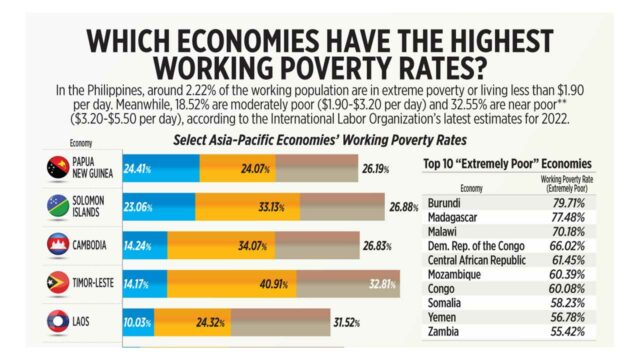
Which economies have the highest working poverty rates?

In the Philippines, around 2.22% of the working population are in extreme poverty or living less than $1.90 per day. Meanwhile, 18.52% are moderately poor ($1.90-$3.20 per day) and 32.55% are near poor** ($3.20-$5.50 per day), according to the International Labor Organization’s latest estimates for 2022.

Which economies have the highest working poverty rates?

China lets Marvel movies back in, sets dates for Black Panther, Ant-Man sequels

LOS ANGELES — Walt Disney Co.’s Marvel Studios on Tuesday announced February release dates for Black Panther and Ant-Man sequels in China, marking the first time in nearly four years that the Communist country has allowed Marvel movies into its cinemas. Black Panther: Wakanda Forever will arrive in Chinese theaters on Feb. 7 followed by Ant-Man and the Wasp: Quantumania on Feb. 17, Marvel announced on Chinese social media network Weibo.

Ant-Man and the Wasp: Quantumania, the third movie about the superhero who can shrink to the size of an insect, will premiere the same day in China as it does in the United States. Wakanda: Forever, the sequel to 2018’s blockbuster hit Black Panther, debuted in global theaters in November.

The loss of the Chinese market in recent years cost Disney tens of millions of dollars. The first Black Panther took in $105 million at Chinese theaters, while the second Ant-Man movie generated $121 million, according to Box Office Mojo.

The February releases will be the first Marvel films to play in Chinese theaters since Spider-Man: Far from Home in July 2019.

Chinese officials never explained why they did not allow other movies including Eternals and Shang-Chi and the Legend of the Ten Rings to play in the country. Disney has refused requests from some countries to edit movies such as Eternals and Doctor Strange and the Multiverse of Madness to remove references to same-sex relationships. — Reuters

Ninja Van eyes program to support live sellers

TECH-enabled express logistics company Ninja Van Philippines announced on Tuesday that it plans to launch a program aimed at supporting early-stage live sellers through seed money and skills development.

“Ninja Van Philippines plans to conduct its first-ever live-seller accelerator program, designed to equip both new and would-be live-sellers with necessary skills and seed money to bridge their business to live-selling platforms,” the company said in a statement.

Citing its own survey, the company noted that more Filipinos now view live selling as a way of bringing in new business, with 74% saying that attracting new customers is a top driver for conducting live selling.

“A secondary driver would be to increase profit, with 52% of Filipino sellers saying live selling is more profitable than just posting items on marketplaces and apps,” Ninja Van said.

The company said it surveyed 9,000 respondents across Malaysia, Singapore, Indonesia, Thailand, Vietnam, and the Philippines on the importance of reliable delivery services for online shoppers.

“When asked about their online shopping habits, 92% of Filipino shoppers said it is important to know who the shipping company is,” Ninja Van said.

They voted for “real-time tracking” and “delivery where I am located” as their top delivery preferences for a hassle-free delivery experience.

Filipinos have the second largest average basket size at $33 per single purchase among the six markets, the study showed.

Ninja Van has an automated sorting hub in Cabuyao, Laguna, a 21,000-square-meter facility that is the group’s largest in the entire region. It can process 300,000 parcels per day, according to the company.

It has also launched a sorting hub in Novaliches, Quezon City, mainly to serve growing demand in North Metro Manila and Central and Northern Luzon. — Arjay L. Balinbin

ADVERTISEMENT
ADVERTISEMENT