Home Blog Page 5374

CoA holds Nueva Ecija mayor accountable for P22-M municipal hall fire damage 

PHILIPPINE STAR/MICHAEL VARCAS

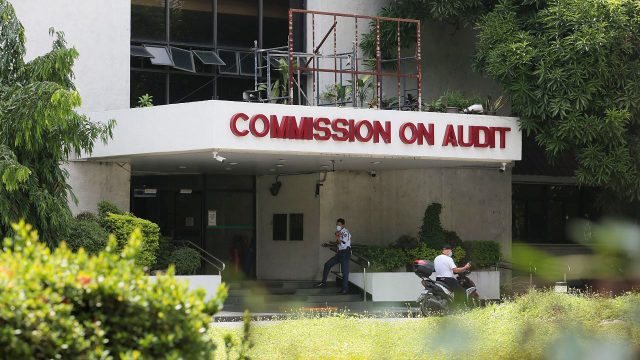
THE COMMISSION on Audit (CoA) declared the town mayor of San Antonio, Nueva Ecija accountable for a P22-million damage in the municipal hall caused by a fire in June 2013.    

In a decision dated May 30, 2022 but only posted on CoAs website recently, state auditors said Mayor Arvin C. Salongas negligence as an official who failed to insure the municipal building against unexpected occurrences became the proximate cause of the loss or damage to government property.  

Auditors also cited that the local government did not insure the municipal building with the General Insurance Fund as required under existing laws.   

His failure to do so deprived the municipality of the value and use of the municipal building, such great financial loss on the governments end,CoA said.   

State auditors denied Mr. Salongas request for relief from property accountability on July 21, 2016, three years after the incident. He said that the delay in filing for relief was because he was not mayor of San Antonio between June 2013-June 2016.  

CoA, however, said Mr. Salonga still had 23 days to notify auditors of the incident before the end of his term on June 30, 2013 based on Republic Act No. 7160 or the Local Government Code.   

The fire incident took place 22 days before the end of his term. 

Mr. Salonga is currently back as the town mayor after winning in the May 2022 elections.    

CoA auditors also noted that the fire was not accidental based on available evidence, but did not point to a culprit. Beatriz Marie D. Cruz

Labor group denounces killing of two rebel returnees in Cotabato City 

LABOR group Federation of Free Workers (FFW) has condemned an indiscriminate attack in a village in Cotabato City that led to the deaths of two former members of the Moro National Liberation Front and left five others wounded, including farm workers. 

In a statement on Thursday, the labor group urged local police to probe the incident and track the armed men who fired at the community in the Philippines’ south last week. 

“The leaders of both the national and the Bangsamoro Autonomous Region in Muslim Mindanao governments should exert extra effort to protect, as well as extend assistance to the victims and their families,” Arlene D. Gollosos, board member of the FFW, was quoted in the statement.  

FFW President Jose “Sonny” G. Matula said that ordinary farm workers and farmers were among those hurt during the attack. 

“FFW is in solidarity with our Muslim brethren who were extra-judicially killed though not necessarily involving labor dispute,” he told BusinessWorld in a Viber message. 

The incident took place less than a week before the International Labor Organization’s (ILO) High-Level Tripartite Mission to the Philippines to look into killings of trade unionists and other violations of worker’s rights. 

Labor groups are set to meet with a team of ILO officials on Jan. 23 to discuss recent cases of harassment and violence against those in the labor sector.  

ILO Bureau of Worker’s Activities Director Maria Helena André has said the Philippine government should uphold the rule of law since rights violations would deter investments and economic activity. John Victor D. Ordoñez

Teachers’ party-list rep hits anti-communist task force’s school seminars

A LAWMAKER representing a party-list for teachers condemned the anti-communist task forces reported orientation activities in a public high school in Baguio City, saying these were used to tag progressive groups as violent communists. 

In a press conference on Wednesday, House Deputy Minority Leader France L. Castro, who represents the ACT Teachers Party-list, said the ad hoc task force under the Office of the President recently conducted orientations to students of Philippine Science High School in Baguio regarding a Communist Terrorist Group.”  

She said the presentationscontained vilification, red-tagging, and terror tagging of progressive individuals and organizations targeting students, teachers, and education support personnel. 

Progressive organization Anakbayan, in a tweet on Jan. 17, cited a memo indicating that the activity was sanctioned by school authorities. 

Ms. Castro called the National Task Force to End Local Communist Armed Conflicts (NTF-ELCAC) move an attempt to condition the minds of the youth. 

The NTF-ELCAC has accused educators of brainwashing the youth many times and has tagged them as terrorists for simply doing their job to encourage curiosity, furthering human knowledge using critical thinking, and passing on learnings from history with the benefit of context, hindsight and guided analysis, she said.  

Ms. Castro was recently accused by former NTF-ELCAC spokesperson Lorraine Marie T. Badoy of extorting money from teachers.  

Schools are zones of peace and red-tagging orientations in schools must stop,Ms. Castro said.  

In a separate statement, the Kabataan Party-list which represents youth concerns, said in Filipino, Red-tagging kills not only students’ academic freedom and critical thinking, but also actual people.” Beatriz Marie D. Cruz 

That Gordian knot of challenges

It was a paradox of sort.

The World Economic Forum (WEF) at Davos, Switzerland has been suffering for years from an image problem. Forum attendees have described it as “out of touch, ineffective, and irrelevant” because the WEF has not done its homework of solving global problems for which it was established. Instead, it seems more adept at reframing serious issues than in actually working out their solutions. It subscribes to the stakeholder theory which asserts that an organization is accountable to all parts of society, but it has turned the tables on the consumers for them to solve the problems of poverty, inequality, climate change, and the environment rather than on governments and markets.

In 2019, for instance, CNBC reported that Dutch historian Rutger Bergman went viral in Davos “when he called out billionaires for tax avoidance.” His argument was irrefutable in that tax avoidance leads to inequality. Bergman felt that he was in a fire-fighters conference but no one was allowed to talk about water.

And this year’s Davos summit is no exception. The forum’s perennial celebration of globalization coincides with many economies increasingly becoming more protectionist, and multinationals going back to their home economies. Global value chains are becoming more localized.

And while this year’s Davos theme is all about the global collaboration village, the IMF’s Kristalina Georgieva pointed out that the global policymakers and business leaders are now facing that Gordian knot of challenges: global recession, climate change, inflation, high debt levels, and geo-political tensions. What make it even more complicated is the contemporary version of Cold War that could very well result in fragmentation “into rival economic blocks.” There is no sense reversing the benefits of post-Cold War economic integration.

To Georgieva, this would be a major collective policy error with nobody getting any better and more secure.

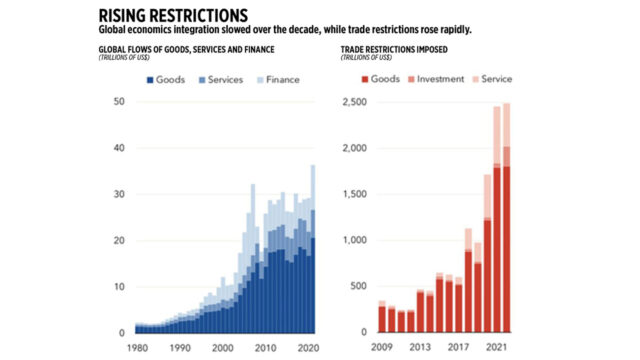
However, the Fund official herself admitted that global integration has not been a panacea to all. While globalization has seen the world’s output tripled in the last 80 years, and more than a billion escaped extreme poverty, the accompanying trade and technological gains have brought pains to some communities in terms of increased inequality and environmental decay. For these reasons, we have seen some decline in cross-border flows of both goods and capital as well as higher trade barriers.

The motivation is clearly corporate decision. Reports of higher corporate earnings are now derived more from re-shoring, on-shoring, and near-shoring of key operations. Thus, one of globalization’s offspring, outsourcing, now faces risks of contraction all because public policies have been implemented to ensure economic and national security, or synonymously, nationalism and populism.

Fragmentation could be very costly. The Fund’s computation of long-term cost varies from 0.2% of global output in a limited scenario to a high of 7% in a worst scenario, or, in the Fund’s estimate, equivalent to the combined annual output of Japan and Germany. With technological decoupling, some countries stand to lose around 12% of GDP. Even worse, the cost could rise further if the impact on migration, capital flows, and international cooperation is considered.

While the Philippines’ external link is admittedly limited relative to other countries in the Asia Pacific region, the fallout cannot be underestimated. The set of assumptions could become too ambitious.

This is the global context of the Philippines’ representation that it is poised to grow by the targeted 6.5% this year even as “there are signs” that growth could rise to as much as 7%. In his conversation with the Fund’s Georgieva, President Bongbong Marcos was reported to have underscored the country’s strong macroeconomic fundamentals, fiscal discipline, structural reforms, and liberalization of key economic sectors. It was correct for him to have linked these to the economy’s ability to roll with the negative shocks due to the pandemic and economic recession. It was doubly correct to point out that these factors were behind the country’s quick economic recovery.

But while there was really no global audience to speak of, the President should have concluded his discussion with potential business in the country in renewable energy, agro-processing, transportation, infrastructure development, and several public-private partnerships in the pipeline.

Instead, the President and some of his economic managers went on trumpeting the Maharlika Investment Fund, an idea that is still in the legislative womb, and one that is anchored on existing resources of government. In short, there is no new money. That being the case, sourcing the money from the Land Bank of the Philippines, the Development Bank of the Philippines, the Bangko Sentral ng Pilipinas (BSP), PAGCOR (the Philippine Amusement and Gaming Corp.) and other government-owned and -controlled corporations, would necessitate additional taxes or additional borrowings to cover for the foregone revenues from these sources. No way could this fund generate additional income to improve fiscal sustainability.

Pursuing infrastructure projects does not require an investment fund. All we need to do is to put to good use the 2023 budget minus all the fat, and wisely leverage on public-private partnerships whether existing or in the pipeline.

The Philippines is indeed credited with having achieved consecutive, positive economic growth from 1999 through 2019. But this success did not involve any wealth fund or investment fund even as our external payments position showed some significant gains between those years. There was no exotic tweak of public policy, whether monetary, fiscal, trade, or energy but a simple vanilla of competence and hard work focused on fundamentals, stability of prices, and the financial system, debt and fiscal sustainability, leverage on public-private partnership, and concessional loans.

Ironically, the Maharlika Investment Fund trumps all these old reliable tenets of public governance and economic management.

It should not surprise us that if this proposed vehicle of portfolio diversification gets through in the early part of this year, the downgrading of economic growth for 2023 as announced by various international financial institutions and research outfits might become self-fulfilling.

It all began with the country’s economic managers who announced in December 2022 that the Philippines was looking at lower growth of 6-7% from the original target of 6.5-8% on account of global headwinds this year. Following this, the ASEAN+3 Macroeconomic Research Office (AMRO) this January trimmed its corresponding growth outlook from 6.3% to 6.2%. Earlier, the Asian Development Bank (ADB) projected Philippine real GDP growth at 6% from an original forecast of 6.3%. The World Bank’s recent assessment indicated that the Philippine economy “is expected to lose momentum in 2023” from 5.8% to 5.7% due to lower consumer demand, high inflation, and high interest rates.

On the part of the IMF, Georgieva’s comment that what the current administration has done is “quite commendable” squares off with the country’s expected slowdown from 6.5% to 5% for 2023 as contained in the public information notice at the November conclusion of Article IV consultation. She must be attributing this to the Gordian knot of challenges that was called at the time as “unsettled conditions in major advanced economies” overshadowing the positive outlook.

Finally, one could relate these less optimistic macroeconomic prospects with what it means to the banking sector in the Philippines. Fitch Ratings expects asset quality across the banking systems in the ASEAN region, including the Philippines, to weaken due policy tightening by central banks. As a result, it is expected that profit growth could be dampened or even delay the post-pandemic rebuilding of capital buffers. With the BSP’s significant adjustments in the overnight rate, the fallout could be substantial without a corresponding decline in leverage. Fitch continues to rate the country’s outlook at negative.

The point is to recall that King Midas’ Gordian knot would be impossible to untie, and it could waste so much time figuring out how. But the Alexandrian solution of a simple sword swipe may not work in this fragmenting global village. We might need to go back to the fundamentals and even if incremental progress is made, we avoid silver bullets that solve nothing.


Diwa C. Guinigundo is the former deputy governor for the Monetary and Economics Sector, the Bangko Sentral ng Pilipinas (BSP). He served the BSP for 41 years. In 2001-2003, he was alternate executive director at the International Monetary Fund in Washington, DC. He is the senior pastor of the Fullness of Christ International Ministries in Mandaluyong.


‘Only in the Philippines’

TIM HUFNER —UNSPLASH

Neither netizens, newspaper readers, radio listeners, nor TV news viewers seemed surprised. It was as if it was just what they expected would happen, but one could almost hear their sighs of resignation. Some went on to perorate on the double standard of justice in these parts with which they are so familiar, or to just repeat what has long been the more cynical’s flippant dismissal of such events: that “only in the Philippines” do certain things happen, such as —

• Too many police and military personnel escaping accountability for the massacres, arbitrary arrests, abductions and extrajudicial killings in which they have been implicated;

• The most brazen plunderers and thieves getting off scot-free and even being appointed to high office because they’re wealthy and/or well connected;

Journalists, human rights defenders, lawyers, independent judges, and critics of government being harassed, threatened, and even murdered with impunity, and the killings even being justified supposedly due to the victims being either corrupt or members of Communist Party “front” organizations;

and more recently —

• A former senator’s remaining in prison for five years as the resolution of the case against her is delayed again and again in court — in stark contrast to the lightning speed with which the drug trafficking case against the current Secretary of Justice’s son went through the courts and how he was acquitted a bare three months after he was allegedly apprehended with a shipment of high-grade marijuana.

It was not so much the acquittal of Justice Secretary Jesus Crispin Remulla’s son, Juanito Diaz Remulla III, that called the public attention, but the speed with which his case was resolved. It suggests that, among other possibilities, the justice system could perform as well in other cases. If it cannot, however, it would reinforce the widespread belief that the system is broken and not working as it should in terms of assuring everyone of the equal protection of the law, and that the principle of justice for all regardless of economic and social status is being observed.

Department of Justice (DoJ) Chief Remulla had declared last October that he would inhibit himself from any involvement in the conduct of his son’s prosecution on drug trafficking charges. But that pledge was in denial of the fact that the responsibilities of his office demanded that he nevertheless be involved.

As this column noted then, the DoJ is the government’s principal law agency. Its many powers include the investigation and prosecution of suspected law breakers, and it is also the legal counsel of government. Justice Secretaries have authority over the National Prosecution Service (NPS) and decide on the prosecution of, or the dropping of charges against, alleged wrong-doers. They can also order the National Bureau of Investigation (NBI), over which it also has authority, to investigate them should they think it necessary.

Remulla’s intervention in his son’s case would have constituted an obvious conflict of interest. But his not doing anything about it would have been in abdication of his duty to decide whether the evidence demands the prosecution of any individual or not.

Remulla’s son was eventually brought to court, which seemed to validate his promise not to intervene. But it did not dispel suspicions that he could have influenced the outcome of the case through any number of ways, because what was at stake was not only his son’s freedom but also his and his family’s future in Philippine politics and governance. His son’s conviction on drug trafficking charges could have weakened the Remulla dynasty’s hold on Cavite politics and even prevented any of its other members’ election to a national office, given the universal disdain attached to involvement in the drug trade, specially by the kin of a high government official.

But as crucial to how the case of Remulla’s son was so obviously quickly resolved is its contributing to perceptions on how broken is the Philippine justice system, which is already driving the continuing investigation by the International Criminal Court (ICC) of former President Rodrigo Duterte and those of his officials who implemented his bloody “war on drugs.”

The ICC suspended its investigation on Duterte and company in 2021 when the Philippine government requested a “deferral.” But ICC Prosecutor Kharim Khan has since concluded that contrary to government claims that it was looking into the circumstances behind the thousands of deaths at the hands of the police during Duterte’s six-year “war on drugs,” only a small number of cases were actually being investigated and what the Duterte regime was doing was “a mere desk review.” Khan thus declared in September 2022 that the deferral request was without merit, and only last November asked the ICC to allow his office to resume its investigation.

Whether the ICC would eventually prosecute Duterte and company on charges of crimes against humanity or not depends on whether the Philippine justice system is perceived to be so fair as to prosecute alleged wrong-doers of whatever social, economic, or political status, or to be so biased in favor of the powerful, the wealthy, and the well-connected as to exempt them from any accountability. The latter conclusion would validate claims that without international legal assistance, the culture of impunity makes justice an impossible dream for most Filipinos. The ICC knows that by exempting wrong-doers from prosecution and punishment, impunity also encourages violence and other forms of lawlessness, not only against journalists, political and social activists, and human rights defenders, but also against ordinary folk.

The ICC decision to continue its investigation suggests that it is convinced that the Philippine justice system is not functioning as impartially as it should, which is just another way of saying that because that system penalizes the poor and the powerless twice— first by allowing those who persecute, harass and even murder them free rein, and then by denying them the justice that can only be realized through the prosecution of those responsible — the system is not working at all.

That conclusion is based not only on the many instances in which convicted felons end up luxuriating in their ill-gotten wealth and are even in government, while those accused of petty crimes rot in jail. There is as well the anomaly evident in the non-accountability of the killers of farmers demanding land reform, or of human rights defenders, lawyers, and activists protesting violations of the rights to free expression and due process. More currently, out of the 177 cases of journalists killed by those who resent their reporting and/or commentary, less than 20 have been resolved by the courts.

The consequences have since been evident in the common belief that there is one law for the rich and powerful and another for the poor and powerless. But the justice system over which DoJ Secretary Remulla now presides could still gain some measure of credibility. Other than merely demonstrating its alleged impartiality in the case of such high-profile cases as its current Secretary’s son, it could also look into actively helping speed up the judicial process.

Hundreds if not thousands of individuals awaiting trial jam the country’s jails. Unable to pay bail and legal help, many are from the poorest sectors of the population, and have been imprisoned for years. The speedy resolution of their cases would go a long way in convincing the world that maybe — just maybe — the Philippine justice system is working, after all. Perhaps then, when describing that system, fewer citizens would throw up their hands to declare “only in the Philippines.”


Luis V. Teodoro is on Facebook and Twitter (@luisteodoro).

www.luisteodoro.com

The coming El Niño could be a glimpse of a grim future

EDUARDO GUTIERREZ-UNSPLASH

THANKS to El Niño, the world is about to experience something like time travel to the year 2050. It won’t be pleasant. But rather than devolve into panic at the grim climate future it portends, we should use it as a warning about the need to do more to slow global warming.

Climate scientists warned recently that the likely return of the El Niño weather pattern in the Pacific later this year could cause global temperatures to temporarily surge 1.5°C above their pre-industrial average in 2024. That margin represents a warming benchmark the whole planet has set as a barely tolerable maximum for many decades in the future, not for the next few years.

The repercussions could be grim. The strong El Niño of 2015-16 produced the highest average global temperature on record, in 2016, along with a horrific drought in Ethiopia, a powerful cyclone in Fiji, rain and snowfall records in parts of the US and history’s worst coral reef die-off. For some reason, it didn’t cause flooding in California; but El Niño events typically strengthen atmospheric rivers of the sort that have been drowning that state for the past few weeks.

And the planet is warmer now than it was when that El Niño began, with average temperatures occasionally touching 1.2°C above pre-industrial levels. This despite nearly three years of the cooling La Niña weather pattern. These phenomena take months to influence the climate, but at some point after El Niño returns, a new temperature record is likely, bringing the 1.5°C threshold uncomfortably close.

Some scientists warn it’s already too late to limit global warming to 1.5°C. Topping that target even briefly long before, say, 2050, could lead to widespread acceptance that the planet is doomed to far higher temperatures in the long run.

Such hopelessness could be dangerous. It would also be mistaken. One or two years of high temperatures do not a long-term trend make, says climate scientist Michael Mann. It may be politically difficult to take the steps necessary to avoid 1.5°C becoming the long-term trend, but it is still technically possible.

We must do everything we can, for as long as we can, to avoid sustained warming of 1.5°C or more. A brief spike in 2024, as miserable as it will be, would be a mild foretaste of what the planet faces if such temperatures become normal. El Niño’s regional impacts are altogether different from those that will prevail due to long-term global warming. The devastation of decades of ice melt, sea-level rise, ecosystem collapse, and other climate-change effects will be magnitudes more harrowing.

Any El Niño warming spike should be seen as an opportunity to remind the world of the need to mitigate climate change much more quickly than we have been doing. A short-term emergency can help focus minds and dollars on curbing carbon emissions, transitioning to green energy and researching technologies to fight the long-term emergency.

And long before El Niño arrives, we must prepare for the extreme weather it will ultimately bring. Governments around the world should get busy making water supplies more resilient, protecting vulnerable people from deadly heatwaves and storms while greening and strengthening electrical grids, to name a few tasks.

We have maybe a year to get ready. Foresight hasn’t exactly been humanity’s strong suit when it comes to climate, but it’s not too late to give it a try.”

BLOOMBERG OPINION

When words have lost their meaning

SVEN BRANDSMA-UNSPLASH

“Wordplay” was a 1985 episode of the Twilight Zone, where a businessman, Bill, wakes up to find words, everyday words, have all changed meanings. Thus, “lunch” is now called “dinosaur” (e.g., “Let’s go for a dinosaur”) and “dog” is “encyclopedia,” and so on. The episode ends with Bill picking up his young son’s ABC book and starts trying to relearn language all over again.

That words are important is a ridiculous understatement. The whole of creation could have been done by a mere flick of the wrist by God but instead He chose to do so through words. Thus, “let there be light,” of which — at the end of it — God proclaims all to be “good.”

“In the beginning was the Word and the Word was with God and the Word was God.” The Logos. Jesus Christ himself being the Word made flesh.

And yet, as punishment for pride, for building the Tower of Babel, men were made to grapple with different words of different meanings, causing division, confusion, and misunderstanding.

For a while, several millennia later, people had seemingly somewhat paid for their pride: globalization, technology, the internet all helped — so the intellectuals say — to make people closer, bridging the gap caused by the differences and barriers in cultures, languages, and borders. People can wear stuff from other countries, talk to friends from the other side of the world, read books translated from various languages, and travel personally to different cities in different continents.

But — of course — the Left has to come in and ruin everything.

Many point out that the most damaging thing ever created by the Left was communism and socialism. Perhaps there is indeed a point to that. The hundreds of millions of dead bodies strewn all over Russia, China, Cambodia, North Korea — just to start — all attest to that.

And yet, far more damaging ultimately is post-modernism, which is skeptical or even cynical about everything, including reason itself, and thus doubtful about the very existence of truth. Communism could cause people to starve or be murdered, post-modernism could do all that and still go further by causing people to lose their sense of meaning, hence, even their souls.

Take the debate over the environment: those old enough would remember the big furor made over pollution. For a time, environmentalists focused on insecticides (see 1962’s Silent Spring by Rachel Carson), which some experts say caused between 60-80 million deaths from the malaria that spread from the banning of DDT. Then there were the 1950-1960s Thalidomide babies, with blame placed on pharmaceutical companies and pretty much all forgotten now in these pharma-fueled vaccine-hysteria times.

But environmentalists, it must be remembered, also loudly trotted out “global warming,” until they realized the world was actually cooling down so they had to shift to “climate change.” But climate change itself — as a term — is a redundancy: the climate, by definition, does change over certain periods of time.

Nevertheless, the Left has never been deterred by logic. Or rather the lack of it. Witness the many environmental doomsayers (from Malthus to Alexandria Ocasio-Cortes) that would make solemn predictions of the world ending in 10 (or 12 years) and then when that day has come and gone, would give the world another 10 or 12 years.

Abortion is another good example: what should simply be considered as nothing more than the selfish murder of an unborn child has become a “choice.” “My body, my choice.” Which ignores the fact that the most oppressed, voiceless segment of our society — the unborn — was practically given no choice in the matter. But as science has day-by-day shown that the fetus is truly a distinct human being, then murder (in this case, abortion) has now morphed into “reproductive health,” in that without the ability to murder a baby then a woman’s good mood could be prejudiced.

Eugenicists, which the abortion movement could be counted among, also speaks the same way in relation to the murder of the elderly and handicapped: from eugenics, to population control (at least in those days they were honest), to the present day’s “dying with compassion,” and the ever-popular default reason: “choice.”

All the foregoing culminated most brilliantly during the pandemic: justifying the lockdowns with “flatten the curve,” to avoid overwhelming hospitals, to squash the curve, to complete testing, to wait for vaccine, to save every single life.

About the last part, about “saving every single life,” the declared (repeat: declared) condition for many is that it meant saving the “vaccinated’s” life, the unvaccinated be damned. Now that data and more data are coming out that the vaccinated are filling many countries’ records, either with COVID-19, myocarditis, blood clots, stroke, or SADS, nobody is now talking about saving every single life. But medical privacy — which before was taboo as the pro-vaccination crowd wanted the right to study, work, or travel reserved only for the vaccinated — is suddenly important, and all of a sudden, the vaccination status of the sick or deceased must be kept private.

Which leads us to even having to struggle saying what a woman is.

In saner times, it a woman was simply an adult human female. Generally, with a female reproductive system and XX chromosomes.

But no.

In these insane, woke, times, one sees the New York Times unironically declaring triumphantly that the Miss Universe pageant now has its “first female owner.” Of course, that owner is a man. The same goes for Jeopardy’s first “woman” champion.

So, apparently, feminism has won because the men took over. It figures.

But the best symbol, so far, of the fact that words have lost meaning has got to be that Martin Luther King, Jr. statue recently unveiled in Boston. For the progressives, it was a work of art. For saner people it is: “What the f**k?”


Jemy Gatdula is a senior fellow of the Philippine Council for Foreign Relations and a Philippine Judicial Academy law lecturer for constitutional philosophy and jurisprudence

https://www.facebook.com/jigatdula/

Twitter @jemygatdula

Acaylar jumpstarts PHL medal bid in ASBC, defeats Rakhimov

JERICHO ACAYLAR (in red) beats taller Tajikistan’s Khusravkhon Rakhinov (blue), 4-1, to lead the country’s medal bid in ASBC boxing championship in Bankok, Thailand — ASBC ASIAN U22 BOXING CHAMPIONSHIPS SCREENGRAB

JERICHO Acaylar repulsed Tajikistan’s Khusravkhon Rakhimov, 4-1, Wednesday night to jumpstart the Philippines’ medal bid in the ASBC Asian U22 Boxing Championships in Bangkok, Thailand.

Mr. Acaylar, who saw action in the Asian Junior Championships in Fujairah, United Arab Emirates four years ago, needed a strong start and a mightier finish to make up for a lackluster second-round effort in disposing the taller, bigger Mr. Rakhimov, also a veteran internationalist.

When it was over, Mr. Acaylar gained the nod of four of the five judges, who all scored it 29-28, while the only other one went to Mr. Rakhimov, 29-28, to claim the win in his featherweight bout.

“He (Mr. Acaylar) had a strong first round then he had a hard time dealing with the Tajik’s assertiveness in the second round,” said Association of the Boxing Alliances of the Philippines secretary-general and executive director Marcus Manalo.

“Good thing he was able to regain control and landed clear, strong punches in the third round, which sealed the win for him.”

“He’s a good, young talent and we expect him to go to the medal rounds in this tournament,” he added.

Mr. Acaylar’s triumph made up for a painful defeat by countryman Mervin Lucky Alcober to Asian Youth bronze winner Enkhtur Tegshjargal of Mongolia, 4-1, in their lightweight duel.

The country’s women’s bets, minimumweight Althea Shine Pores and light flyt Mariel Talandrata, were battling Thai Thipsatcha Yodwaree and Kazakh Moldir Toikova, respectively, at press time with hopes of advancing to the next round.

Mark Lester Durens, the country’s best bet after snaring a bronze in the ASBC Asian Elite Championships in Dubai two years ago, is also entered along with Aaron Judo Bado (men’s 51kg), Flint Jara (men’s 54kg) and Mark Ashley Fajardo (men’s 63.5kg) in this event that drew a total of 149 pugs — 95 men and 54 women — across the region.  Joey Villar

Strong Group gelling well with three NBAers for Dubai tourney

CHARLES Tiu-mentored Strong Group is on track to hit full form with improved chemistry a week before the Dubai tilt. — NCAA/GMA-SYNERGY

SLOWLY but surely, Strong Group is sharpening its saw for an expected tough grind in the 32nd Dubai International Basketball Championship after being drawn into Group A featuring the United Arab Emirates national team.

Head coach Charles Tiu said the Philippine contingent is on track to hit full form with improved chemistry a week before the prestigious tilt, where they will also face Al-Wahda from Syria, Dynamo from Lebanon and Al Nasr from Libya, slated on Jan. 27 to Feb. 5

“Team chemistry is slowly picking up. Renaldo Balkman has been our clear cut leader as always. They’re slowly getting in shape so that’s a good sign,” said Mr. Tiu as Strong Group eyes to duplicate the championship run of his Mighty squad last time.

Then led by Mr. Balkman and former Gilas Pilipinas naturalized player Andray Blatche, the Caesar Wongchuking-owned Mighty squad swept the 2020 edition of Dubai tilt to become the first non-Middle Eastern champion team.

Mr. Balkman is back for another duty this time with the team owned by Jacob Lao and backed by Mighty Sports and Acrocity Guiguinto to create a formidable troika with fellow ex-NBAers in Shabazz Muhammad and Nick Young.

The presence of the three seasoned reinforcements bolster the Strong Group’s title chances, especially with coverage from a bevy of collegiate stalwarts led by Adamson’s Jerom Lastimosa.

“Jerom Lastimosa is really good. Best point guard in college for sure. He’s so much better than I thought,” added Mr. Tiu on the ace guard who anchored the Falcons’ magical Final Four run in UAAP Season 85.

Aside from Mr. Lastimosa, also in the fray for Strong Group are Gilas naturalized cager Ange Kouame from Ateneo, Fil-Am prospect Sedrick Barefield, NCAA MVP Will Gozum from St. Benilde and ex-La Salle big man Justine Baltazar.

Completing the squad are Ateneo’s BJ Andrade, Inand Fornillos and Lebron Lopez, JD Cagulangan of University of the Philippines and St. Benilde’s Miguel Oczon. — John Bryan Ulanday

Top sports officials meet for the country’s preparation for SEAG

OFFICIALS of Philippine Olympic Committee (POC) led by president Abraham Tolentino, Philippine Sports Commission headed by Richard Bachmann meet for the Phnom Penh Southeast Asian Games. — POC

THE COUNTRY’s top sports officials had a meeting Wednesday night and they all agreed on one thing — the ball must start rolling when it comes to the country’s preparation for the Phnom Penh Southeast Asian Games (SEAG) slated May 5 to 17.

“It was a fellowship and working dinner meeting that delved more on the training of the SEA Games-bound athletes,” said Philippine Olympic Committee (POC) President Abraham Tolentino on his talks with top brass of the Philippine Sports Commission chaired by Richard Bachmann at the Conrad Hotel in Pasay.

Accompanying Mr. Tolentino were most of his board including auditor and the country’s chef-de-mission to the Phnom Penh Games Chito Loyzaga, secretary-general Edwin Gastanes and treasurer Cynthia Carrion while Mr. Bachmann was with commissioners Bong Coo and Walter Torres.

All stressed the need that training must be in full swing as the biennial event is just less than four months away.

The country is out to eclipsing, if not replicating, its fourth-place finish in last year’s Hanoi Games where it had a 52-gold, 70-silver and 104-bronze medal haul although they also knew the challenges they will be facing amid host Cambodia’s controversial restrictions.

It included limiting participation by all other nations except the host in martial arts events and other disciplines.

One of the most outrageous rules the Cambodian organizers will be imposing is in gymnastics where, according to Ms. Carrion, the Gymnastics Association of the Philippines president, said world champion Carlos “Caloy” Yulo could only take home as many as two gold even if he sweeps all his seven events.

The Tagaytay City mayor and PhilCycling chief also voiced concerns on the late transmission of the games’ technical handbooks on the 49 sports that the host has calendared.

“The THBs (handbooks) were issued only days ago and most of them contain some errors, mistakes the host organizer has apologized for,” he said. — Joey Villar

Ailing Nadal bows out of Australian Open, rain causes havoc, Coco beats Raducanu

MELBOURNE — Rafa Nadal’s Australian Open title defense lay in ruins on Wednesday after an injury-plagued defeat that shook up the men’s draw, even as rain wreaked further scheduling havoc at Melbourne Park on day three.

A wincing Nadal suffered a left hip problem midway through his 6-4 6-4 7-5 loss to American Mackenzie McDonald at Rod Laver Arena and gloomily played out the match in pain.

The result not only opens up the top half of the draw, it also hands Novak Djokovic a boost as the Serb hunts a 10th title at Melbourne Park to draw level with Nadal’s 22 major triumphs in the Grand Slam race.

For all Nadal’s struggles, hard-hitting McDonald was hugely impressive and had the better of the match before his veteran opponent broke down.

Humiliated by Nadal at the same stage of the 2020 French Open, their only previous meeting, McDonald was glad to square the ledger.

Another shock appeared set to rock Melbourne Park when Felix Auger-Aliassime went two sets down against Alex Molcan at Margaret Court Arena but the Canadian sixth seed rallied to close out the match 3-6 3-6 6-3 6-2 6-2.

There was less tension in the women’s side, as Iga Swiatek, hot favorite for the women’s title, overcame Camila Osorio 6-2 6-3 under the roof on Rod Laver Arena.

A highly-anticipated first meeting between tennis prodigies went the way of Coco Gauff, who outshone Briton Emma Raducanu to win 6-3 7-6(4) in the evening session — offering fans a glimpse of the future of women’s tennis in the post-Serena Williams era.

Daniil Medvedev stayed on course to reach a third successive final at Melbourne Park with another straight-sets victory, as the Russian flexed his muscles to ease past Australian John Millman 7-5 6-2 6-2.

Stefanos Tsitsipas was equally dominant against another home hope in Rinky Hijikata as the Greek third seed won 6-3 6-0 6-2.

Men’s dark horse Jannik Sinner, who has reached the quarter-finals of all four Grand Slams but never gone any further, also swept into the third round by waltzing past Tomas Etcheverry 6-3 6-2 6-2 on the similarly protected John Cain Arena.

Rain kept the players off the outer courts throughout the day session, however, adding to fixture congestion triggered by extreme heat and storms on Tuesday when nine matches did not get started and two could not be completed. — Reuters

Jazz stay hot, win over Clippers

LAURI Markkanen returned to the lineup and lifted the Utah Jazz to a 126-103 victory over the Los Angeles Clippers with 34 points and 12 rebounds on Wednesday night in Salt Lake City.

Markkanen, back after missing two games due to hip issues, scored the first seven points of the game during a 9-0 Jazz run and proceeded to hit 11 of 20 field-goal attempts, 6 of 8 3-point shots and 6 of 6 free throws.

Utah, which shot 51.7 percent from the field and nailed 19 of 32 (59.4 percent) shots from 3-point range, evened its record at 24-24 with its fourth win in five outings. The Jazz won the season series over the Clippers 3-1. — Reuters

ADVERTISEMENT
ADVERTISEMENT