Home Blog Page 5352

Young northern Europeans flock to Spain’s Malaga to work remotely

A WOMAN in a remote meeting via videoconference works from her living room. — REUTERS

MADRID — The Spanish city of Malaga and its Costa del Sol surroundings are seeing a surge in people moving in from the rest of Europe as lifestyle and working habits change after the coronavirus disease 2019 (COVID-19) pandemic, according to two of Spain’s largest homebuilders.

Aedas Homes said its sales to foreigners in Costa del Sol doubled last year, from 124 units sold in 2021 to 248 in 2022, while Neinor Homes SA said about 40% of young people taking on long-term rents in the city since they launched a rental division in 2020 were foreign. That compares with almost no international customers elsewhere in Spain.

Property purchases by foreigners increased by 62% from a year earlier in the region of Andalusia, which includes Malaga, in the first half of 2022, according to the Centre for Statistical Information of Notaries.

Malaga’s town council said a platform launched in February 2021 to help so-called digital nomads, www.malagaworkbay.com, had received more than 160,000 visits by the end of 2022.

Millions of workers were forced to work from home during lockdowns aimed at stalling the spread of COVID-19 in 2020 and many companies have allowed the shift to become permanent — with employees discovering they can now work from anywhere. Aedas CEO David Martinez said the homebuilder had seen a spike in sales to people from Poland and the Czech Republic, countries feeling the proximity to the Ukraine war, as well as Belgians, French and Nordics.

“I don’t think it’s just the war,” Mr. Martinez told Reuters. “I think it’s that lots of people have had a rethink about their lives post-COVID.”

TECH HUB
Malaga has been working to position itself as a tech hub that can attract foreign talent rather than just a gateway to the beaches and golf courses further south. The local government last year eliminated a wealth tax that obliges residents and non-residents to pay income tax on money held abroad.

The policy is bearing fruit. Google-owner Alphabet, Inc. chose the city as the location for a European cybersecurity hub because of the number of tech startups already based there, according to the Spanish government.

Citigroup C.N announced in March 2022 plans to open a hub for junior investment bankers in the city, offering what it said was “a better equilibrium between work and private life to attract young talent.”

The pull of southern Europe for northern Europeans was amplified by the pandemic, Neinor Homes CEO Borja Garcia-Egotexeaga told Reuters, as companies struggling to hold on to their best employees are giving them the freedom to work from sunnier climes.

“Companies in Europe could consider measures such as lowering the salary or paying less to those who seek to work remotely from other countries, because the employee will be happy because they have some freedom,” he said. — Reuters
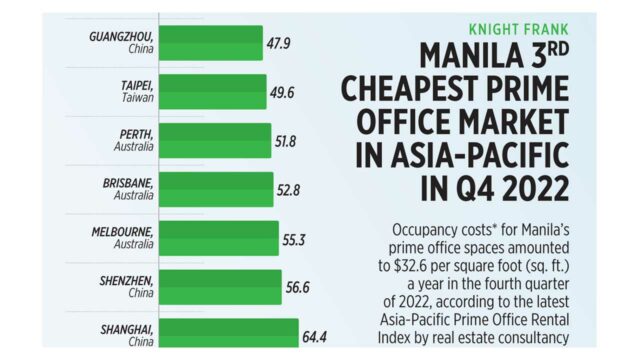
Manila 3rd cheapest prime office market in Asia-Pacific in Q4 2022

Occupancy costs* for Manila’s prime office spaces amounted to $32.6 per square foot (sq. ft.) a year in the fourth quarter of 2022, according to the latest Asia-Pacific Prime Office Rental Index by real estate consultancy firm Knight Frank. It was the third most affordable office space among 23 Asia-Pacific markets after Kuala Lumpur ($18.8/sq. ft.)

Manila 3<sup>rd</sup> cheapest prime office market in Asia-Pacific in Q4 2022

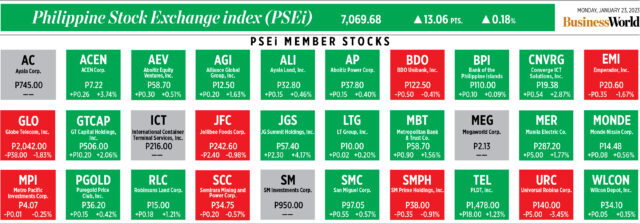
How PSEi member stocks performed — January 23, 2023

Here’s a quick glance at how PSEi stocks fared on Monday, January 23, 2023.


Marcos: Philippines to import more to deal with rising prices

OFFICE OF THE PRESS SECRETARY

President Ferdinand R. Marcos, Jr. on Monday vowed to address rising food prices this year by importing more, saying the country’s record inflation keeps him up at night.

“That’s what I lose sleep every night over — how to bring down inflation,” he told a briefing streamed live on state television. “I’m determined to make sure that inflation starts to come down.”

Mr. Marcos said rising food prices were “alarming,” hinting at a government plan to import more.

“In the short term, the increasing prices of food products are alarming,” he said. “Whatever we do, we must import. It’s an emergency situation… Our production is well below our demand, therefore we must import.”

Still, Mr. Marcos said boosting local production is the best way to improve the lives of Filipino farmers who have to deal with climate change. “Hopefully, down the road, we no longer have to worry about nontraditional supply because we’ll be able to produce enough for ourselves.”

Mr. Marcos said being Agriculture chief is advantageous because it allows him to deal with issues at the agency directly.

Philippine Inflation hit 8.1% in December, the fastest since November 2008. It averaged at 5.8% last year, above the central bank’s 2-4% target.

Aside from prices, the Southeast Asian nation also has to deal with record debt, which hit P13.644 trillion at the end of November.

Mr. Marcos said rising debt should be outpaced by economic growth, which the World Bank expects to slow to 5.4% this year from an estimated 7.2% last year. “We will pull ourselves out of debt via growth.

The president went to Davos, Switzerland last week to attend the World Economic Forum. He said he would cut his foreign trips with state officials this year, citing the need to follow up on commitments his government had secured from previous trips.

Mr. Marcos said he would attend the Asia-Pacific Economic Cooperation (APEC) summit in November in the United States.

“APEC again is one of those that…a Philippine president should have to attend because it is the relationship essentially between the Association of the Southeast Asian Nations, the Philippines, and the rest of the world.”

The Philippines also struggles with geopolitical tensions, including its sea dispute with China.

On Saturday, the Philippine Coast Guard said the Chinese Coast Guard had driven away a Filipino fishing vessel at the Second Thomas Shoal, which is within the Philippines’ exclusive economic zone.

This was after Mr. Marcos earlier this month met with Chinese President Xi Jinping in Beijing, where they talked about the sea dispute.

The Philippines would continue to file diplomatic protests against China if needed, he said.

PHL shares climb ahead of key economic reports

REUTERS

PHILIPPINE STOCKS finished higher on Monday despite being in the red for most of the session due to profit taking ahead of the release of key economic data.

The bellwether Philippine Stock Exchange index (PSEi) went up by 13.06 points or 0.18% to close at 7,069.68 on Monday, while the broader all shares index added 8.39 points or 0.22% to end at 3,691.25.

“Philippine shares still managed to eke out gains even with Asian markets on holiday, and with the big economic releases happening later,” Regina Capital Development Corp. Head of Sales Luis A. Limlingan said in a Viber message.

“There are no speeches from Fed officials this week, as the central bank will meet the following week, on Jan 31 and Feb 1. However, investors will be monitoring another batch of economic data, including the Fed’s preferred inflation measure, the personal consumption expenditure price index, due out Friday,” Mr. Limlingan said.

He added that the S&P Global manufacturing purchasing managers index will also be released on Jan. 23, while Philippine full-year 2022 gross domestic product (GDP) and December 2022 trade data will be out on Jan. 26.

GDP likely grew 6.8% in the October-to-December period in 2022, according to the median forecast of 23 economists polled by BusinessWorld, slower than the 7.6% rise in the third quarter and the 7.8% print in the same period in 2021.

For the full year, the economy may have grown 7.5%, according to median forecasts of economists, matching the high end of the Development Budget Coordination Committee’s 6.5%-7.5% target.

“Local stocks pulled back for most of the trading day due to profit taking. The market started the year strong and was ripe for a pullback. Despite the pullback, market breadth was positive as gainers outnumbered losers,” AB Capital Securities, Inc. Vice-President Jovis L. Vistan said in a Viber message.

Advancers beat decliners, 99 versus 92, while 55 names closed unchanged.

“Almost 90% of stocks are now above their medium-term average and 64% are above their long-term average,” Mr. Vistan added.

Sectoral indices ended mixed on Monday. Mining and oil lost 94.03 points or 0.79% to close at 11,724.97; industrials went down by 35.03 points or 0.35% to 9,881.16; and property declined by 10.35 points or 0.33% to end at 3,113.29.

Meanwhile, holding firms went up by 42.81 points or 0.62% to 6,885.60; financials added 4.37 points or 0.24% to end at 1,816.43; and services increased by 3.95 points or 0.22% to 1,779.

Value turnover went up to P8.35 billion on Monday with 1.24 billion shares changing hands from the P6.86 billion with 1.56 billion issues traded on Friday.

Net foreign buying dropped to P421.79 million on Monday from the P664.83 million seen the previous trading day.

AB Capital’s Mr. Vistan placed the PSEi’s support at 6,900 and resistance at 7,160, while Regina Capital’s Mr. Limlingan put support at 6,950 and resistance at 7,200. — Justine Irish D. Tabile

Peso steady amid US debt ceiling woes, PHL GDP bets

BW FILE PHOTO

THE PESO closed unchanged against the dollar on Monday as negative sentiment brought by developments in the United States was offset by expectations of strong Philippine gross domestic product (GDP) growth.

The local currency ended at P54.54 versus the greenback on Monday, steady from Friday’s finish, data from the Bankers Association of the Philippines showed.

The peso opened Monday’s trading session at P54.40 per dollar. Its weakest showing was at P54.60, while its intraday best was at P54.30 against the greenback.

Dollars traded went up to $1.24 billion on Monday from $1.05 billion on Friday.

The local currency was steady on Monday amid mixed developments, a trader said in an e-mail.

“The peso was unchanged due to mixed signals from lingering concerns over the US debt limit and prospects of a likely strong Philippine GDP report this week,” the trader said.

The US government hit its $31.4-trillion borrowing limit on Thursday, equivalent to around 120% of the country’s annual economic output.

Back home, the Philippine Statistics Authority is set to release the fourth-quarter and full-year 2022 GDP report on Thursday.

The economy likely grew by 6.8% in the October-to-December period in 2022, according to the median forecast of 23 economists polled by BusinessWorld. This is slower than the 7.6% expansion in the third quarter and the 7.8% print in the same period in 2021.

For 2022, GDP likely expanded by 7.5%, according to the median estimate of the economists, matching the high end of the government’s 6.5%-7.5% target.

Meanwhile, Rizal Commercial Banking Corp. Chief Economist Michael L. Ricafort said in a Viber message the peso closed unchanged “after latest signals acknowledging the recent strength or appreciation of the peso.”

Bangko Sentral ng Pilipinas (BSP) Governor Felipe M. Medalla said in a Bloomberg interview on Friday that the central bank is “giving the peso some room to appreciate,” but noted that the currency’s excessive strengthening could be bad for the economy.

For Tuesday, the trader said that the peso might appreciate ahead of the release of likely weaker US manufacturing data for January.

The trader sees the peso moving between P54.40 and P54.65 a dollar on Tuesday, while Mr. Ricafort gave a narrower forecast range of P54.45 to P54.60. — A.M.C. Sy

Senate minority says Maharlika must benefit public, not investors

SENATE PRIB

SENATE Minority Leader Aquilino Martin D. Pimentel III expressed doubts on Monday about private investment in the proposed sovereign wealth fund, saying that the interests of investors will take precedence over those of the public.

“We are just creating a protected corporation, a protected entity whose beneficiaries are investors,” Mr. Pimentel told TeleRadyo.

He added that sovereign wealth funds should only be established if a government has a windfall or surplus since it’s a new source of income. But there is none.

The wealth fund’s sources of financing have proved to be a key sticking point as the legislation setting up Maharlika has evolved. The original bill proposed that Maharlika be funded mainly by the two big government pension funds and the two big state-owned banks. The backlash to using pension funds led the bill’s authors to propose as a funder, alongside the two government banks, the Bangko Sentral ng Pilipinas (BSP), which was to contribute its profits.

Albay Rep. Jose Ma. Clemente S. Salceda, who chairs the House ways and means committee, has said that the bill has since been “reengineered” to designate as Maharlika’s source of initial capital the dividends generated by government-owned and -controlled corporations (GOCCs).

“Well, we already use (GOCC dividends) in the budget as well. So, what will happen is that we will reduce non-tax revenue,” Mr. Pimentel said. “If we reduce that then continue with our spending, our budget deficit will surely increase.”

He said such a set-up will inevitably increase government debt.

“Imagine the end of this, the proponents of the sovereign wealth fund (will cause) the debt of the National Government to become larger and larger,” he added.

President Ferdinand R. Marcos, Jr. has said the terms for setting up the Maharlika fund are being adjusted, including the sources of funding. Mr. Marcos recently pitched Maharlika to participants at the World Economic Forum in the Swiss mountain resort of Davos.

“The more we study it, the more it’s clear that although the sovereign wealth funds around the world have the same name, they’re all very different. They’re different in purpose, they’re different in methodology and of course, they operate in a different context of law,” he told reporters at the end of the Davos conference.

“We have to design it very specifically to Philippine conditions, and that’s what the legislators are trying to do now: to make sure that it is customized for us and it will be a good thing for us. So that’s the process that we’re undergoing now,” he added.

Mr. Pimentel objected to the corporate orientation of the fund, adding: “The sovereign wealth fund should be owned by the people, so if there is any dividend or benefit, it should go directly to the people.”

The Senate’s version of the Maharlika Investment Fund, Senate Bill 1670, filed by Sen. Mark A. Villar on Jan. 12, envisions Maharlika’s ownership structure as proportional to investors’ contributions.

The bill calls for the establishment of the Maharlika Investment Corp. (MIC) which will govern and manage the fund to ensure optimal returns while directing investment to projects that reinvigorate job creation and reduce poverty.

If passed, initial capital will be provided by the Land Bank of the Philippines (LANDBANK) (P50 billion) and Development Bank of the Philippines (DBP) (P25 billion).

The BSP, if retained as funder, was to remit all of its dividends to the fund in the first and second fiscal years after its establishment. In the succeeding years, BSP was to remit half of its dividends to the fund.

The Philippine Amusement and Gaming Corp. and other government-owned gaming operators must also contribute at least 10% of their gross gaming revenue. Other proposed sources were royalties and special assessments on natural resources, proceeds from privatization of government assets and debt incurred by Maharlika itself.

Such contributions will be subject to review by the Secretary of Finance every five years.

The Maharlika board will have 15 members, including the Secretary of Finance, the MIC chief executive officer, and the presidents of LANDBANK and the DBP.

Six regular members will represent other fund contributors and five independent directors from the private sector, academe, the business sector and the investment industry. — Alyssa Nicole O. Tan

Cold storage industry warns capacity inadequate for mitigating onion crisis

PHILSTAR FILE PHOTO

THE cold storage industry said its capacity is inadequate if the government intends to counter the onion shortage by building up inventories.

In a briefing on Monday, the Cold Chain Association of the Philippines (CCAP) estimated the required investment at P150 million for every 2,500 metric tons (MT) of onions held in storage.

It also estimated the import requirement at up to 360,000 MT, and warned that domestic supply will be close to depletion by the fourth quarter.

“Local production is estimated at 70% sufficiency, or a shortfall of about 100,000 metric tons, which can be covered either by improved agricultural productivity or imports,” CCAP said in its statement.

According to CCAP President Anthony S. Dizon, the private cold storage industry’s capacity is 600,000 pallet positions, used for commodities such as meat, dairy, and onions.

He noted the “obvious disparity between demand and capacity.”

“The government needs to develop and implement a holistic policy… to balance supply and demand and mitigate undue market volatility,” he added. — Sheldeen Joy Talavera

PPA warns dev’t mission to suffer if commercial function prioritized

PHOTO COURTESY OF ICTSI

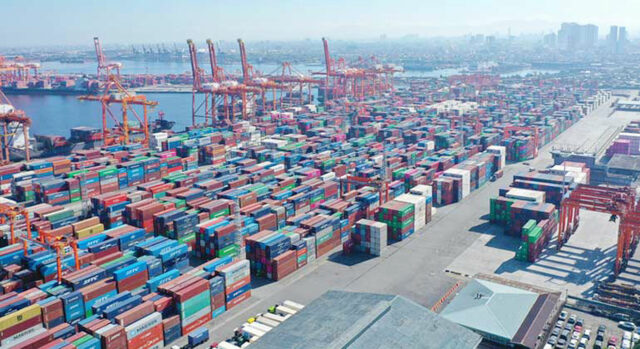
THE Philippine Ports Authority (PPA) said it hopes legislators will consider the developmental role played by the agency under its current setup of acting as a regulator and a commercial entity.

Stripping the PPA of regulatory functions will leave it with a purely commercial mission, which may cause it to neglect ports which it does not consider viable.

“When you say commercial, I have to turn a profit. Why will I put something there if it is not commercially viable? Will I not violate my mandate?” PPA General Manager Jay Daniel R. Santiago told reporters during a recent briefing, where he was asked to comment on the proposed reorganization of the agency.

A “developmental” mandate means “it does not really matter whether it’s commercially viable as long as I provide linkages. That’s the advantage of the dual (regulatory and commercial) personality,” he added.

“We leave it to the wisdom of Congress if they want to (remove functions from the PPA), but the first question I will ask is if you (transfer) the regulatory function of PPA to MARINA (Maritime Industry Authority) … will you ask the same people from PPA to be transferred to MARINA to do it?”

He said the agency has been addressing concerns from the private sector questioning the setup where it is a regulator and an operator of ports.

“Privatizing the terminals is one step towards separating the regulatory and the operational functions. We acknowledge (the concerns) also, and we try to work within the limitations of the current regulations to address the concerns.”

Last year, a legislator refiled a bill seeking to reorganize the PPA by separating its regulatory and commercial functions.

Bagong Henerasyon Party-list Representative Bernadette Herrera-Dy’s House Bill No. 1400 aims to convert the agency into the Philippine Ports Corp. (Philports) while transferring its regulatory functions to MARINA.

“Through the years, the port users, including domestic shippers, exporters, and importers, have complained of low service levels, inefficient port operations and ever-increasing port charges,” Ms. Herrera-Dy said in the bill’s explanatory note. 

“They claim that the high cost of transport serves as a barrier to increased trade (both local and foreign) and undermines the country’s competitiveness.”

The PPA was established by Presidential Decree (PD) No. 505, which was subsequently amended by PD No. 857 in 1975. It is tasked with carrying out an integrated program for the planning, development, financing, operation and maintenance of ports or port districts.

The bill seeks to “avoid the conflict of interest arising from regulatory agencies vested in both regulatory and development or commercial functions.”

“Under no circumstances should a regulatory agency benefit from its own regulation and/or use its own regulatory powers to protect itself from competition at the expense of the public interest,” according to the bill.

Under the bill, PPA will be converted into Philports to handle the development, management and operation of public ports. Philports will collect port fees and dues approved by MARINA, which will fund port development, modernization, and expansion, among others.

The Philippine Liner Shipping Association has expressed support for the measure. — Arjay L. Balinbin

Glencore interested in expanding PHL in-country mineral processing

REUTERS

SWISS multinational Glencore plc is hoping to support Philippine plans to expand in-country mineral processing, Trade Assistant Secretary Glenn G. Peñaranda said.

In a briefing on Monday, Mr. Peñaranda said: “Glencore is involved in the processing of our minerals. This is important because we are fortunate that the Philippines has a lot of minerals like nickel, copper and cobalt, which are very important since these are needed for EVs, and also power batteries that are needed for renewable energy projects,” Mr. Peñaranda said.

Trade Secretary Alfredo E. Pascual said at a conference of the Financial Executives Institute of the Philippines in Makati City on Monday that “Mineral processing is crucial given our resources of green metals… (that) can be used for downstream industries such as electric vehicle (EV) battery manufacturing, hyperscale data centers, and renewable energy projects.”

“The Philippines can be a vital partner for these critical minerals, not as an exporter of raw ores, which is what is happening now, but as a processor and producer of semi-finished and finished products. We have Indonesia as a model,” he added.

Indonesia suspended nickel exports in 2020 in a bid to do more processing in-house. The Philippines, Indonesia, and Australia are some of the biggest ore exporters because of their proximity to China, where nickel is manufactured into stainless steel, though new-energy applications are growing for the metal.   

The Mines and Geosciences Bureau estimated the value of metallic mineral output in the first nine months of 2022 at P175.61 billion, up 29.21%. — Revin Mikhael D. Ochave

USAID backs project to upgrade tech manufacturing skills

THE United States Agency for International Development (USAID) has partnered with the ICCP Group Foundation, Inc., a non-profit affiliated with an economic zone developer, to improve the skills of the Philippines’ technology manufacturing workforce. 

USAID and the UNILAB Foundation signed a memorandum of agreement with the ICCP foundation to carry out a five-year Advanced Manufacturing Workforce Development (AMDev) program. The program is ongoing and runs through September 2027.

“The project aims to strengthen the workforce through the development of an industry-led technical education system with better-defined, harmonized skills as well as qualifications descriptors and competency and training standards,” the ICCP Group said in a statement on Monday.

The foundation is the social development unit of the ICCP Group.

The AMDev program, which was among the initiatives announced by US Vice-President Kamala D. Harris in her recent visit, seeks to “create a highly skilled and adaptive workforce that meets the evolving requirements of the high-tech manufacturing sector.” 

Under the agreement, the ICCP foundation will join the Advanced Manufacturing Skills Council, which will “lead the effort to define and harmonize standards and qualifications for the workforce and identify strategic priorities. It will have three core functions: human capital development; policy, research, and advocacy; and stakeholder engagement among government, industry, and education sectors,” the ICCP Group said.  

“Specifically, (the foundation) shall lead in the skills gap and training needs analysis through the conduct of surveys with locators within industrial zones towards the development of a competency framework for the advanced manufacturing workforce,” it added.

The foundation will also help in the delivery of a training curriculum for the current and future workforce co-developed by partner firms and schools.

The ICCP Group owns and operates the Science Park of the Philippines, Inc., which operates ecozone estates in Cabuyao and Calamba, Laguna; Sto. Tomas and Malvar, Batangas; Hermosa, Bataan; and Lapu-Lapu City, Cebu. — Revin Mikhael D. Ochave

LANDBANK in agri tech, dev’t financing tieup with Israel

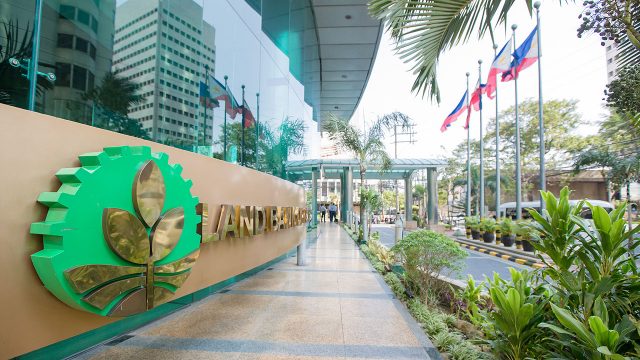
THE Land Bank of the Philippines (LANDBANK) said it is collaborating with the government of Israel to share technology and best practices in agriculture and development financing.

“LANDBANK continues to explore strategic partnerships to help advance national development. We look forward to collaborating …towards the adoption of innovative technology and approaches, especially in the agriculture sector,” LANDBANK President Cecilia C. Borromeo said in a statement on Monday.

LANDBANK said it is looking into a program to endorse qualified Filipino students to “undergo advanced learning and skills development training in agriculture technology and innovation in Israel.”

In the nine months to September, LANDBANK’s net profit grew 54% to P25.69 billion amid higher interest earnings from loans and investments.

The nine-month total was equivalent to a return on equity of 14.89%, and a return on assets of 1.15%. — Luisa Maria Jacinta C. Jocson